Chinese Folk Religion
Ancestors, local gods, and the fabric of everyday Chinese life.
Overview
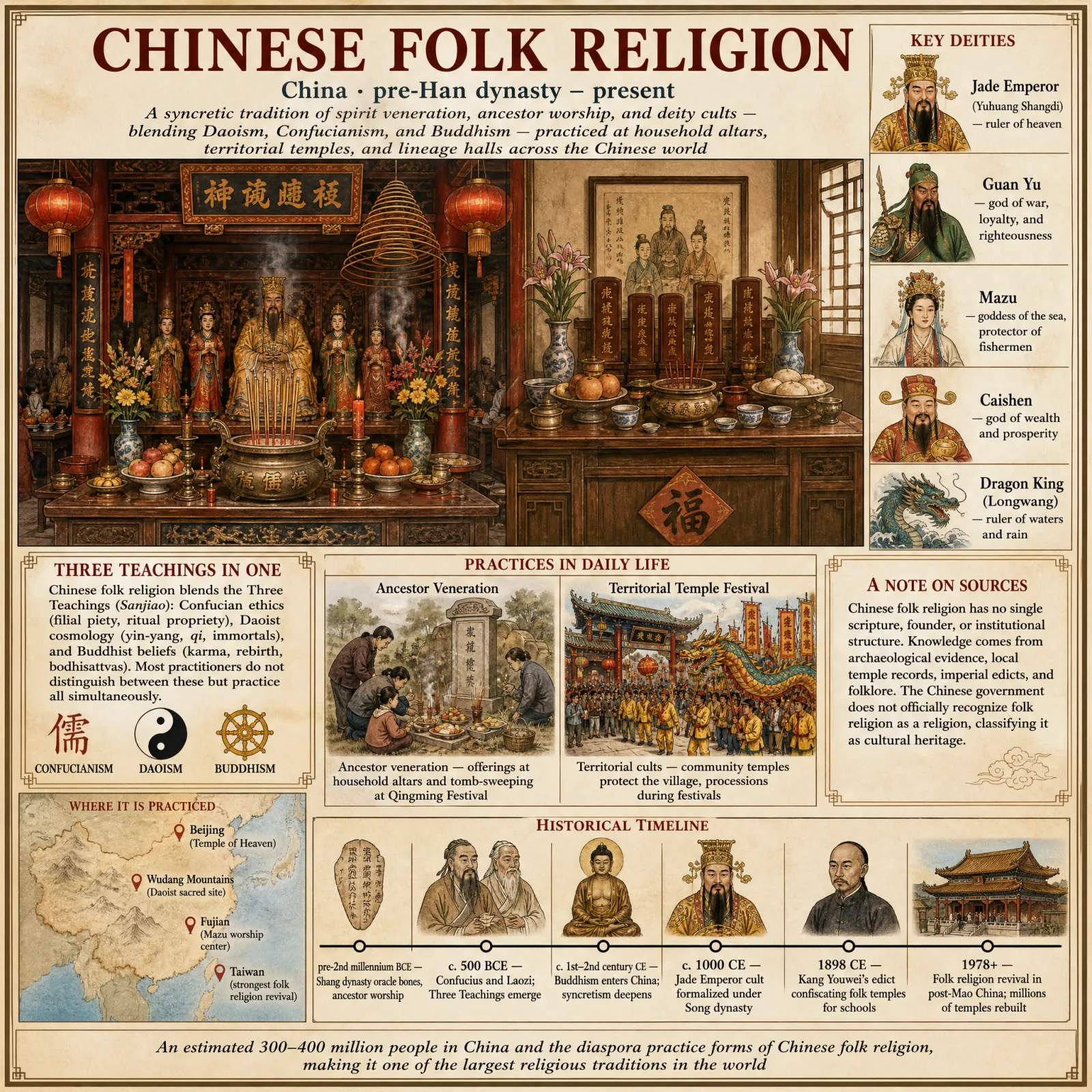
Chinese folk religion, also called Chinese popular religion, Shenism (from 神, shen, 'god' or 'spirit'), or diffused religion, is the indigenous religious tradition of the Han Chinese people, characterized by the worship of diverse deities (shen, 神), ancestors, local spirits, and cosmic forces through household rituals, temple festivals, life-cycle ceremonies, and seasonal observances deeply embedded in family and community life. Unlike institutionalized religions with fixed doctrines, clergy, and canonical scriptures, Chinese folk religion is a fluid, syncretic, and decentralized tradition that draws on Confucian ethics, Daoist cosmology, Buddhist concepts, and pre-imperial shamanic and animistic practices, adapting them to local contexts and popular needs. The tradition centers on pragmatic concerns: securing blessings, prosperity, health, fertility, and protection from misfortune through offerings, prayers, divination, exorcism, and festivals directed toward a vast pantheon of gods ranging from cosmic deities (the Jade Emperor, Heaven, Earth) and cultural heroes (Guan Yu, Mazu) to local tutelary gods (chenghuangShen, 城隍神, city gods; tudigong, 土地公, earth gods) and deified ancestors. Rituals are performed at multiple sites—household altars, lineage ancestral halls, community temples, sacred mountains, and natural features—creating a sacred landscape that maps spiritual power onto physical territory and social relationships.
The classification of Chinese folk religion as a single 'religion' is contested. Western scholars have used terms such as 'diffused religion' (C.K. Yang), emphasizing its integration into social institutions rather than existing as a separate religious sphere, and 'popular religion' or 'local religion,' highlighting its grassroots, non-elite character. Chinese terms include minjian xinyang (民間信仰, 'popular beliefs'), su xin (俗信, 'common beliefs'), and mixin (迷信, 'superstition,' a pejorative term used by modernizing elites and the Chinese Communist Party). The tradition lacks a unified organizational structure, theological orthodoxy, or exclusive membership: most practitioners do not identify Chinese folk religion as their primary religious affiliation but participate in its rituals alongside Buddhist, Daoist, Confucian, or even Christian practices without perceiving contradiction. This fluidity has made Chinese folk religion resilient yet difficult to categorize, regulate, or suppress. During the 20th century, Chinese folk religion was attacked by modernizing reformers (who stigmatized it as backward superstition), by the Nationalist government (which attempted to abolish 'superstitious' practices and confiscate temple property), and most severely by the Chinese Communist Party, which destroyed millions of temples, banned popular religious activities, and persecuted religious practitioners during the Mao era (1949-1976), especially during the Cultural Revolution (1966-1976). Despite this unprecedented assault, Chinese folk religion has revived dramatically since the 1980s reform era, with millions of temples rebuilt, festivals restored, and religious practices flourishing across rural and urban China, Taiwan, Hong Kong, and Chinese diaspora communities worldwide.
Today, hundreds of millions of Chinese people engage in folk religious practices, though precise demographic estimates are impossible because most do not exclusively identify with the tradition and because the Chinese government does not officially recognize 'Chinese folk religion' as a legitimate religious category (only Buddhism, Daoism, Islam, Catholicism, and Protestantism are state-recognized). Scholars estimate that Chinese folk religion may be the world's largest religious tradition by number of participants, encompassing perhaps 400-500 million or more people in mainland China alone, plus tens of millions in Taiwan, Hong Kong, Southeast Asia, and global diaspora communities. The tradition continues to provide spiritual resources for coping with life crises, maintaining family and community cohesion, expressing local identity, and connecting individuals to cosmic order and ancestral heritage, even as it adapts to urbanization, globalization, commodification, and state regulation. Chinese folk religion exemplifies the enduring power of indigenous, grassroots spirituality to survive persecution, absorb diverse influences, and embed itself in the everyday lives of ordinary people.
Historical Development
The origins of Chinese folk religion lie in the prehistoric and early dynastic periods (Shang, circa 1600-1046 BCE; Zhou, 1046-256 BCE), when ancestor worship, divination, shamanic practices, and the veneration of natural forces and spirits were central to Chinese religious life. Oracle bone inscriptions from the Shang dynasty document sacrifices to ancestors and high gods (Shangdi, 上帝, 'Lord on High'; Tian, 天, 'Heaven'), establishing patterns of communication with the spirit world through ritual specialists and offerings. During the Zhou dynasty, the concept of the Mandate of Heaven (tianming, 天命) linked cosmic order, moral virtue, and political legitimacy, while ancestor veneration became systematized through lineage rituals. Confucius (551-479 BCE) emphasized the moral and social functions of ritual (li, 禮) and filial piety (xiao, 孝), reinterpreting traditional sacrifices as expressions of humanistic ethics rather than as transactions with spirits, though he maintained the importance of ancestral rites. Daoism, emerging in the 4th-3rd centuries BCE, contributed cosmological concepts (yin-yang, wu xing / five phases, qi) and practices (alchemy, meditation, exorcism) that profoundly influenced popular religious imagination and ritual.
During the Han dynasty (206 BCE-220 CE), the state sponsored imperial cults to Heaven, Earth, and major deities, while local communities worshipped tutelary gods, ancestors, and regional deities. Buddhism's introduction to China (1st-2nd centuries CE) brought new concepts (karma, rebirth, merit-making, Pure Lands, bodhisattvas) and institutions (monasteries, clergy, scriptures) that were gradually sinicized and incorporated into popular religious practice. By the Tang (618-907 CE) and Song (960-1279 CE) dynasties, Chinese folk religion had assumed recognizable forms: household altars for ancestors and Kitchen God (Zaoshen, 灶神), community temples for local gods and cosmic deities, spirit mediums (wu, 巫) and Daoist priests performing exorcisms and healing rituals, and temple festivals featuring processions, operas, and offerings. The Song dynasty saw the proliferation of deity cults, including the deification of historical figures such as Guan Yu (關羽, deified general from the Three Kingdoms period) and Mazu (媽祖, deified shamaness and sea goddess from Fujian). The state attempted to regulate popular religion through a system of officially recognized deities receiving imperial titles, while condemning 'illicit cults' (yinsi, 淫祀), though enforcement was inconsistent and many popular deities gained official recognition.
During the Ming (1368-1644 CE) and Qing (1644-1912 CE) dynasties, Chinese folk religion flourished with the construction of vast temple networks, the codification of deity pantheons, and the development of elaborate ritual traditions. Lineages built ancestral halls (citang, 祠堂) to honor forebears and assert status. Cities installed chenghuang temples (城隍廟, city god temples) as spiritual bureaucracies paralleling civil administration. Villages maintained earth god shrines (tudigong miao, 土地公廟) and organized temple festivals to major deities. Regional pilgrimage centers emerged, including Mount Tai (泰山, associated with the Great Emperor of the Eastern Peak, Dongyue Dadi, 東嶽大帝), the Meizhou Mazu Ancestral Temple in Fujian, and countless local sacred mountains, springs, and caves. The Qing state maintained an ambivalent stance toward popular religion: supporting officially recognized cults that reinforced social order and Confucian morality while suppressing heterodox sects and 'superstitious' practices deemed socially disruptive. Popular religious novels such as *Journey to the West* and *Investiture of the Gods* disseminated deity myths and cosmological narratives, shaping collective religious imagination.
The late Qing and Republican period (late 19th-early 20th centuries) brought unprecedented challenges. Western imperialism, Christian missions, and the introduction of modern science and secular thought prompted Chinese intellectuals and reformers to attack traditional religion as the source of China's backwardness and weakness. The anti-superstition campaigns (po mixin yundong, 破迷信運動) of the 1920s-1930s, led by Nationalist (Guomindang) authorities and modernizing elites, destroyed temples, confiscated temple property for schools and government use, banned spirit mediums and religious festivals, and stigmatized popular religion as feudal ignorance obstructing national progress. These campaigns inflicted severe damage on Chinese folk religion's institutional infrastructure, though many practices continued clandestinely or adapted by associating with Buddhism or Daoism.
The Chinese Communist Party (CCP) intensified anti-religious policies after taking power in 1949. Viewing religion as 'opium of the masses' and popular beliefs as feudal superstition incompatible with socialist modernity, the CCP systematically dismantled Chinese folk religion: temples were confiscated, demolished, or converted to secular use; deity statues were destroyed; religious festivals were banned; spirit mediums, geomancers, and ritual specialists were persecuted; and ancestral halls and clan property were seized during land reform. The Cultural Revolution (1966-1976) represented the most extreme assault, with Red Guards destroying millions of temples, burning scriptures and religious artifacts, humiliating and killing religious practitioners, and attempting to eradicate 'the four olds' (old ideas, old culture, old customs, old habits). Chinese folk religion was driven underground or ceased entirely in many areas, particularly in urban centers. Only after Mao's death in 1976 and the initiation of economic reforms under Deng Xiaoping in 1978-1980 did Chinese folk religion begin to revive. The state's relaxation of ideological control, coupled with economic prosperity and the return of lineage power and local autonomy, enabled massive temple reconstruction, the restoration of festivals, and the resurgence of popular religious practices across China, though the state continues to regulate and restrict activities deemed politically sensitive or socially destabilizing.
Core Worldview and Doctrines
Chinese folk religion lacks a systematic theology or unified doctrinal framework, instead embodying a pragmatic, syncretic, and situationally adaptive worldview shaped by Confucian ethics, Daoist cosmology, Buddhist soteriology, and indigenous animistic beliefs. The cosmos is understood as an organic, interconnected whole in which humans, gods, ancestors, spirits, and natural forces are bound together by moral principles (li, 理, cosmic order) and vital energy (qi, 氣). Human well-being depends on maintaining harmonious relationships (hexie, 和諧) with these cosmic forces through proper ritual conduct (li, 禮), filial piety (xiao, 孝), and moral virtue (de, 德). Misfortune—illness, poverty, conflict, natural disasters—is attributed to imbalances in qi, offended spirits, ancestral displeasure, geomantic flaws (fengshui, 風水, wind-water), or karmic retribution (yinguo, 因果, cause and effect, a Buddhist concept), and is addressed through offerings, prayers, exorcisms, geomantic corrections, and moral reform.
The Chinese folk pantheon is vast, fluid, and hierarchically organized, reflecting earthly bureaucratic structures. At the apex is the Jade Emperor (Yuhuang, 玉皇 or Yuhuang Dadi, 玉皇大帝), supreme ruler of heaven, who oversees celestial bureaucracy. Major cosmic deities include Tian (Heaven), Di (Earth), and the Three Pure Ones (Sanqing, 三清, highest Daoist deities). Cultural heroes deified include Guan Yu (關羽, god of loyalty, war, and commerce), Mazu (媽祖, goddess of the sea and protector of fishermen and sailors), and Guanyin (觀音, bodhisattva of compassion, absorbed from Buddhism). Regional and local deities include chenghuang (城隍, city gods who protect urban areas and judge souls), tudigong (土地公, earth gods who manage local territory and prosperity), and countless village and neighborhood gods. Ancestors are venerated as protective spirits who continue to influence descendants' fortunes and who require offerings and respect. Ghosts (gui, 鬼), spirits of the unfilial, improperly buried, or violently dead, are dangerous and must be placated through rituals such as the Ghost Festival (Zhongyuan Jie, 中元節). Deities are pragmatically evaluated by their ling (靈, spiritual efficacy or responsiveness): gods who grant prayers attract followers and resources, while inefficacious gods may be abandoned or their temples closed.
Chinese folk religion emphasizes reciprocity (bao, 報) in relationships with deities and ancestors: offerings (incense, food, spirit money) are given in exchange for blessings, protection, and assistance. This transactional logic extends to moral behavior: virtue brings rewards, vice brings punishment, as expressed in the concept of baoying (報應, retribution or karmic response). Divination practices—qian (籤, divination sticks), bua bwei (擲筊, divination blocks), consultation with spirit mediums—allow humans to discern divine will, predict the future, and make decisions aligned with cosmic order. Ritual specialists (Daoist priests, Buddhist monks, spirit mediums, geomancers) mediate between human and spiritual realms, though most household and community rituals are performed by laypeople without clerical intermediation.
Chinese folk religion integrates seamlessly with life-cycle rituals (birth, marriage, death) and agricultural/seasonal festivals. Birth rituals invoke protection from child-protecting deities (such as Songzi Guanyin, 送子觀音, Guanyin who brings children). Weddings honor ancestors and ensure fertility and prosperity. Death rituals guide the soul to the afterlife, transform the deceased into protective ancestors, and address unfinished business. Major festivals include Spring Festival (春節, Chinese New Year, honoring ancestors and household gods), Qingming Festival (清明節, Tomb-Sweeping Day, offering sacrifices at graves), Dragon Boat Festival (端午節, warding off evil), Mid-Autumn Festival (中秋節, family reunion and moon worship), and Ghost Festival (placating wandering spirits). These festivals structure communal time, reinforce social bonds, and embed religious practice in everyday rhythms.
Sacred Texts and Canon
Chinese folk religion lacks a single canonical scripture comparable to the Bible or Quran. Instead, it draws on diverse textual traditions: Confucian classics (especially ritual texts such as the *Liji* / *Book of Rites*), Daoist scriptures (*Daode Jing*, *Zhuangzi*, liturgical texts), Buddhist sutras (especially those popularized through vernacular storytelling: *Lotus Sutra*, *Amitabha Sutra*, *Heart Sutra*), popular religious novels (*Journey to the West* / *Xiyou Ji*, *Investiture of the Gods* / *Fengshen Yanyi*), and orally transmitted myths, legends, and ritual instructions. Popular religious novels, written in vernacular Chinese and widely read, have been particularly influential in shaping collective knowledge of deities, cosmology, and moral lessons. *Journey to the West* narrates the monk Xuanzang's pilgrimage to India, featuring the Monkey King Sun Wukong, and popularizes Buddhist cosmology and morality tales. *Investiture of the Gods* recounts the Zhou conquest of Shang and the deification of heroes, providing origin stories for many popular deities worshipped in folk temples.
Deity hagiographies and local temple inscriptions record the lives, miracles, and official titles of gods, serving as oral and written narratives that authorize worship and explain ritual practices. Morality books (shanshu, 善書), popular texts promoting ethical behavior through stories of karmic retribution and divine reward, have circulated widely since the Ming dynasty, including the *Ledger of Merit and Demerit* (*Gongguoge*) and the *Treatise of the Exalted One on Response and Retribution* (*Taishang Ganying Pian*). These texts teach that gods record human deeds and dispense rewards and punishments accordingly, reinforcing moral discipline.
Divination manuals, almanacs (tongshu, 通書 or huangli, 黃曆, often called 'Chinese almanacs'), and geomancy texts provide practical guidance for selecting auspicious dates, interpreting omens, and managing qi flows in buildings and graves. Almanacs are consulted for weddings, funerals, business openings, and travel, functioning as indispensable ritual calendars. While these texts are not 'sacred' in the sense of revealed scripture, they are authoritative practical guides integrated into daily religious life. The transmission of Chinese folk religion relies heavily on oral tradition, ritual performance, and embodied practice rather than on textual study, distinguishing it from text-centered traditions such as Judaism, Christianity, or Islam.
Practices and Observances
Chinese folk religious practice centers on offerings and prayers at household altars, lineage ancestral halls, and community temples. Household altars typically honor ancestors (tablets or photographs on the family altar) and deities (such as the Kitchen God, Guanyin, or local tutelary gods). Daily or periodic offerings include incense, tea, fruit, cooked food, and joss paper (zhiqian, 紙錢, spirit money and paper goods burned to provide for ancestors and gods in the afterlife). Prayers are pragmatic petitions for health, prosperity, success in exams or business, safe travel, fertility, and protection from misfortune. Temple worship follows similar patterns: devotees light incense, bow, make offerings, pray, and often perform divination to discern divine guidance. Major temples serve as community centers where religious festivals, operas, markets, and social gatherings occur.
Ancestor veneration (jisi, 祭祀) is central to Chinese folk religion, rooted in Confucian filial piety and the belief that ancestors continue to influence descendants' fortunes and require ongoing care. Families maintain ancestral tablets inscribed with names and dates, make regular offerings of food and incense, and perform elaborate rituals at death anniversaries and festivals (especially Qingming and Zhongyuan/Ghost Festival). Lineages with resources build ancestral halls where collective worship ceremonies honor clan founders and prominent ancestors, reinforcing kinship identity and social hierarchy. Improper treatment of ancestors (neglect, failure to provide male heirs to continue sacrifices) brings misfortune, while proper veneration brings blessings and protection.
Temple festivals (miaohui, 廟會) are elaborate communal celebrations honoring temple deities, often coinciding with gods' birthdays or seasonal events. Festivals feature processions (carrying deity statues through streets to bless the community), opera and puppet performances (entertaining gods and humans), markets, feasting, and ritual offerings. Major festivals can involve hundreds of thousands of participants, lasting days or weeks, with neighboring villages or urban neighborhoods taking turns hosting or contributing. Temple festivals express local identity, reinforce social cohesion, redistribute wealth through feasting and donations, and create spectacular public spaces for religious and cultural expression. The Mazu pilgrimage in Taiwan, where millions of devotees follow deity palanquins on multi-day journeys between temples, exemplifies large-scale temple festival culture.
Divination and spirit mediumship provide communication with the spiritual realm. Divination methods include drawing qian (籤, bamboo divination sticks with fortunes), casting bua bwei (擲筊, crescent-shaped wooden blocks that give yes/no answers), consulting the *I Ching* or almanacs, and visiting spirit mediums (jitong, 乩童 or wu, 巫) who enter trance and channel deities or ancestors, delivering messages, diagnoses, and prescriptions for ritual remedies. Spirit mediums may perform self-mortification (cutting, piercing) to demonstrate possession authenticity. Divination and mediumship address uncertainty and crisis, allowing individuals to navigate illness, business decisions, marriage prospects, and family conflicts with divine guidance.
Life-cycle rituals and seasonal festivals integrate Chinese folk religion into everyday temporal rhythms. Birth rituals include manyue (滿月, full-month celebration) with offerings to child-protecting deities. Weddings honor ancestors and seek blessings for fertility and harmony. Death rituals are elaborate and costly, involving Buddhist or Daoist clergy to perform rites guiding the soul through the afterlife bureaucracy, offerings to judges of the underworld, burning of paper goods (houses, cars, servants) for the deceased's use, and geomantic selection of grave sites. Seasonal festivals structure the year: Spring Festival (welcoming the new year, honoring Kitchen God, family reunion), Qingming (tomb-sweeping and ancestor offerings), Dragon Boat Festival (dispelling evil qi), Mid-Autumn Festival (moon worship and family reunion), and Ghost Festival (feeding hungry ghosts). These festivals are observed by hundreds of millions of Chinese people, whether or not they identify as religious, embedding folk religious practices in national and ethnic cultural identity.
Internal Diversity: Regional and Social Variations
Chinese folk religion exhibits immense regional diversity, with local pantheons, ritual styles, temple architectures, and festival traditions varying across China's vast geography. Fujian and coastal southeastern China feature prominent maritime deities (Mazu, sea gods), elaborate temple processions, and extensive overseas transmission via diaspora networks. Taiwan, where Chinese folk religion flourishes with particular vitality due to political autonomy from PRC suppression, hosts massive temple festivals (Mazu pilgrimages, Daoist rituals), spirit mediumship, and syncretic movements. Northern China (especially Shaanxi, Hebei, Shandong) emphasizes city god cults, mountain deity pilgrimages, and village temple festivals, often integrating elements of sectarian religious movements. Southern China (Guangdong, Guangxi) features strong lineage organizations, ancestral hall worship, and localized deities. Southwestern China incorporates ethnic minority religious elements and maintains distinct ritual traditions blending Han Chinese and non-Han practices. Each region's deity pantheon reflects local history, economic activities (fishing communities worship sea gods, agricultural villages honor grain gods), and cultural heroes who become patron saints of their home territories.
Urban and rural Chinese folk religion differ in institutional forms and social functions. Rural communities traditionally maintained collective temple cults managed by village elders or temple committees, with festivals serving as primary communal events integrating religious, social, economic, and political life. Urbanization and migration have disrupted village-based religious structures, though many urban migrants maintain ties to home temples and return for major festivals. Urban Chinese folk religion often becomes more individualized and privatized, with household altars replacing collective temple participation, though urban temples also thrive as sites for tourism, cultural heritage, and personal devotion. Urban temples may be managed by Buddhist or Daoist clergy, government-sponsored religious associations, or commercial interests, sometimes blurring lines between religion, cultural performance, and tourism.
Class and education distinctions shape Chinese folk religious participation. Elites historically patronized official and institutionalized Buddhism and Daoism while simultaneously participating in folk rituals (ancestor veneration, geomancy, temple donations) when pragmatically useful. Intellectuals often expressed ambivalence or disdain toward popular practices (spirit mediumship, exorcism, 'superstition') while upholding Confucian ritual propriety and philosophical Daoism. Peasants and urban working classes have been the primary practitioners and defenders of Chinese folk religion, finding in it accessible spiritual resources, community solidarity, and cultural identity unmediated by elite institutions or state control. Contemporary revival has involved all social classes: wealthy entrepreneurs donate to temple reconstruction as status-building and blessing-seeking; urban middle classes consult geomancers and almanacs for business and family decisions; migrants maintain home-village temple networks as social capital and identity markers.
Communities and Demographics
Estimating the number of Chinese folk religion practitioners is exceptionally difficult because most do not identify it as their exclusive religious affiliation, because the tradition lacks formal membership or institutional boundaries, and because the Chinese government does not recognize it as an official religion category in censuses or surveys. Scholars estimate that 400-500 million or more people in mainland China engage in Chinese folk religious practices (ancestor veneration, temple worship, divination, festival participation), making it potentially the world's largest religious tradition by participant count, though most practitioners would not self-identify as 'religious' or would simultaneously identify as Buddhist, Daoist, or secular. In Taiwan, Chinese folk religion is practiced by the majority of the population (estimates range from 60-80% participation), integrated into daily life and national culture despite the growth of Christianity and secularization. Hong Kong maintains vibrant folk religious traditions, particularly temple festivals and ancestor veneration. Chinese diaspora communities in Southeast Asia (especially Singapore, Malaysia, Thailand, Indonesia, Philippines) have preserved and adapted Chinese folk religion, often syncretizing with local traditions. Diaspora communities in North America, Europe, and Australia practice Chinese folk religion through temple organizations, home altars, and life-cycle rituals, though participation tends to decline in second and third generations as cultural assimilation progresses.
Chinese folk religion is organized at multiple scales without centralized authority. The most basic unit is the household, where individual families maintain ancestral tablets and deity altars and perform domestic rituals without external mediation. Lineages (zu, 族 or jia, 家) with shared surnames and common ancestors organize collective worship at ancestral halls, manage clan property, and enforce kinship obligations. Villages and urban neighborhoods organize community temples with rotating leadership (temple committees) or hereditary management by influential families. Some temples are managed by Buddhist or Daoist clergy who perform rituals for lay patrons while maintaining separate monastic identities. Regional temple networks link affiliated temples venerating the same deity (e.g., Mazu temple networks connecting Fujian, Taiwan, and Southeast Asia), facilitating pilgrimage, incense-sharing rituals, and transmission of deity legitimacy. Since the 1980s, the PRC government has attempted to regulate Chinese folk religion through officially recognized Buddhist and Daoist associations and through local Cultural Relics Bureaus and Tourism Boards that manage temples as heritage sites, though grassroots religious organizations often operate semi-autonomously or negotiate with state authorities for legitimacy and resources.
Sacred Places and Pilgrimage Sites
Meizhou Mazu Ancestral Temple (湄洲媽祖祖廟), Meizhou Island, Putian, Fujian Province: The Meizhou Mazu Ancestral Temple is the most sacred site in the global Mazu cult and the origin point of Mazu worship, located on Meizhou Island where the goddess Lin Moniang (林默娘, circa 960-987 CE) was born, lived, and is said to have ascended to heaven. The temple was founded in 987 CE, shortly after her death, and has been repeatedly expanded, destroyed, and rebuilt over centuries. During the Cultural Revolution, the temple was almost entirely demolished, with statues destroyed and rituals banned, but it was reconstructed beginning in 1989 with donations from Mazu devotees worldwide, especially from Taiwan and Southeast Asian Chinese diaspora. The temple complex now includes the Tianhou Palace (main hall enshrining a Song-dynasty soft-bodied statue of Mazu), the Ascension Memorial, the Ancestral Temple, and numerous subsidiary shrines. Meizhou is a major pilgrimage center attracting millions of visitors annually, particularly on Mazu's birthday (23rd day of the 3rd lunar month), when elaborate festivals, processions, and offerings are held. The temple serves as the ritual center for the global Mazu network: temples worldwide trace their spiritual lineage to Meizhou through 'dividing incense' (fenxiang, 分香) rituals in which emissaries carry fire from Meizhou incense to establish or renew branch temples, creating transnational religious networks.
Tianhou Palace (天后宮), Tianjin: The Tianhou Palace in Tianjin is one of the oldest and most prominent Mazu temples in northern China, originally built in the Yuan dynasty (1326 CE) to serve the Grand Canal and maritime trade networks. Located in Tianjin's old city, the temple historically served as a major pilgrimage and commercial center for boatmen, merchants, and officials traveling between Beijing and the coast. The temple was damaged during the Boxer Rebellion (1900) and later during the Republican and Mao eras, but it was restored and reopened in the 1980s. The Tianhou Palace hosts annual Mazu birthday festivals with processions, operas, and markets, attracting tens of thousands of participants. The temple exemplifies the spread of Mazu worship from coastal Fujian to northern regions via trade and official patronage, and its survival demonstrates the resilience of folk religious institutions in adapting to political and social change.
Chenghuang Temples (城隍廟) in Major Cities (e.g., Shanghai, Beijing, Xi'an): Chenghuang (city god) temples were once ubiquitous in Chinese cities and towns, serving as spiritual bureaucratic centers paralleling civil administration. The city god, often a deified virtuous official or local hero, protected the city, judged souls after death, and maintained cosmic and social order. Major chenghuang temples include the Shanghai Chenghuang Temple (上海城隍廟), originally built in the Ming dynasty (15th century) and rebuilt multiple times, now a major tourist and religious site in Shanghai's old city featuring elaborate temple architecture, markets, and festivals. During the Mao era, chenghuang temples were largely destroyed or converted to secular use, but many have been reconstructed since the 1980s, often managed as heritage sites or commercial centers. The Xi'an Chenghuang Temple (西安城隍廟) and the Beijing Chenghuang Temple are similarly significant urban religious sites that have been restored and now serve both religious and cultural tourism functions. Chenghuang temples embody the integration of popular religion with statecraft and urban identity, and their revival reflects the resurgence of local religious traditions and the commodification of religious heritage.
Tudigong Shrines (土地公廟) throughout China and Taiwan: Tudigong (earth god or land god) shrines are ubiquitous in Chinese rural and urban landscapes, ranging from small roadside altars to substantial temple buildings. Tudigong is one of the most universally worshipped deities in Chinese folk religion, managing local territory, ensuring agricultural productivity, protecting communities, and serving as the lowest-level deity in the celestial bureaucracy who reports to higher gods. Tudigong shrines are found at village entrances, in fields, at crossroads, and in urban neighborhoods, often consisting of simple stone altars or small pavilions with incense burners and deity statues. Offerings (incense, fruit, spirit money) are made regularly, especially on the 2nd and 16th days of each lunar month and during the earth god's birthday (2nd day of the 2nd lunar month). In Taiwan, tudigong worship is particularly vital, with tens of thousands of shrines and an elaborate system of earth god festivals and processions. Tudigong shrines exemplify the grassroots, decentralized, and pragmatic character of Chinese folk religion, providing accessible spiritual resources for everyday concerns without requiring clergy or institutional mediation.
Ancestral Halls (祠堂, Citang) throughout Southern China: Ancestral halls are lineage temples where extended families and clans worship common ancestors and maintain kinship identity and solidarity. Particularly prominent in southern China (Fujian, Guangdong, Jiangxi, Hunan), ancestral halls range from modest single-room structures to grand architectural complexes with multiple courtyards, carved beams, painted murals, and inscribed tablets recording lineage genealogy and history. Major lineages maintain elaborate halls housing ancestral tablets for dozens or hundreds of generations, where collective sacrifices are performed at death anniversaries, festivals (especially Qingming and Chongyang), and important lineage events (weddings, births, funerals). During the Mao era, ancestral halls were confiscated, destroyed, or converted to schools, warehouses, and administrative offices as part of land reform and the campaign against feudalism. Since the 1980s, many lineages have rebuilt or reclaimed ancestral halls with private donations, asserting renewed lineage power and cultural continuity. Ancestral halls embody the fusion of kinship, property, ritual, and identity that characterizes Chinese folk religion's social embeddedness.
Sacred Mountains (e.g., Mount Tai 泰山, Shandong Province): China's sacred mountains have been pilgrimage centers for millennia, integrating state religion, Daoism, Buddhism, and folk cults. Mount Tai (泰山, Taishan), one of the Five Great Mountains (五嶽, Wuyue), is particularly important in Chinese folk religion as the abode of the Great Emperor of the Eastern Peak (Dongyue Dadi, 東嶽大帝), a major deity who judges souls and controls life and death. Pilgrims ascend Mount Tai to pray for longevity, prosperity, and protection, and emperors historically performed imperial sacrifices to Heaven and Earth there. The mountain features hundreds of temples, shrines, inscriptions, and sacred sites along the pilgrimage route. Mount Tai worship exemplifies the integration of cosmic, imperial, and popular religious traditions, and the mountain remains a major pilgrimage destination attracting millions of visitors annually, blending religious devotion, cultural tourism, and nationalist heritage narratives.
Contemporary Debates and Contested Issues
The fundamental debate concerns whether 'Chinese folk religion' constitutes a single religion or is merely a scholarly analytical category imposed on diverse, localized practices. Critics argue that 'Chinese folk religion' lacks the institutional coherence, doctrinal unity, and self-conscious identity that define most recognized religions, and that the term homogenizes vast regional, temporal, and social diversity under a misleading label. Participants in these practices often do not identify them as 'religious' or as belonging to a distinct tradition called 'Chinese folk religion,' instead viewing them as 'custom' (fengsu, 風俗), 'tradition' (chuantong, 傳統), or simply pragmatic responses to life's challenges. Proponents argue that despite diversity, Chinese folk religion exhibits recognizable structural patterns (ancestor veneration, polytheistic pantheon, temple cults, reciprocal offerings, pragmatic efficacy orientation) that distinguish it from institutionalized Buddhism, Daoism, and Confucianism, and that the category is analytically useful for understanding Chinese religious life. The term Shenism (from shen, god/spirit) has been proposed as an indigenous alternative to Western-imposed 'folk religion,' though it has not gained universal acceptance.
The relationship between Chinese folk religion and institutionalized traditions (Buddhism, Daoism, Confucianism) is complex and contested. Folk religion has extensively borrowed concepts, deities, and rituals from these traditions: Buddhist karma, rebirth, and bodhisattvas (especially Guanyin); Daoist cosmology, qi theory, and liturgy; Confucian ethics, ancestor veneration, and ritual propriety. Conversely, Buddhism and Daoism have adapted to folk religious contexts: Buddhist monks perform funerals and merit-making rituals for lay patrons; Daoist priests conduct exorcisms, temple consecrations, and life-extension rituals. Some scholars view Chinese folk religion as 'diffused religion' (C.K. Yang) that pervades all Chinese religious traditions rather than existing separately, while others argue for its distinctiveness. The question is further complicated by institutional competition and boundary-making: Buddhist and Daoist clergy sometimes claim superiority over 'vulgar' folk practices, while folk practitioners may view clergy as hired ritual specialists rather than spiritual authorities. Since the 1980s PRC revival, many folk temples have affiliated with Buddhist or Daoist associations to gain legal status, creating ambiguous institutional identities.
The state's regulation and legitimation of Chinese folk religion remains deeply contested. The PRC government officially recognizes only five religions (Buddhism, Daoism, Islam, Catholicism, Protestantism) and continues to stigmatize unregulated folk religious activities as 'feudal superstition' (fengjian mixin, 封建迷信), particularly when they involve spirit mediumship, sectarian movements, or practices deemed threatening to social stability or Party authority. However, the state has selectively tolerated and even promoted certain folk religious practices as 'intangible cultural heritage' or tourism resources, creating contradictory policies that allow some temples and festivals while suppressing others. Scholars debate whether the post-1980s revival represents genuine religious freedom or state co-optation of religion for economic development, social control, and nationalist legitimation. Spirit mediumship and divination remain legally ambiguous or prohibited, forcing practitioners to operate clandestinely or to disguise practices as cultural performance. The state's relationship to Chinese folk religion reflects broader tensions between authoritarian control, market liberalization, and cultural nationalism in contemporary China.
The commodification and commercialization of Chinese folk religion has generated debate about authenticity, meaning, and social function. Temple reconstruction, festivals, and pilgrimages have become major economic activities generating tourism revenue, real estate development, and employment, with local governments, businesses, and religious entrepreneurs investing heavily in religious infrastructure. Critics argue that commercialization reduces religion to spectacle and profit, undermines genuine devotion, and transforms temples into theme parks. Defenders argue that economic incentives enable religious revival in the absence of state support, that commercial activity has always been integrated with temple festivals, and that economic prosperity itself is a legitimate religious good in Chinese folk religion's pragmatic worldview. The debate reflects broader questions about modernity, capitalism, and religious change.
Key Terms
- Shen (神)
- God, deity, spirit; the fundamental category of divine beings in Chinese folk religion, encompassing cosmic gods, cultural heroes, local tutelary deities, ancestors, and efficacious spirits.
- Minjian xinyang (民間信仰)
- Popular beliefs or folk beliefs; a Chinese term for grassroots religious practices and local cults, often used to distinguish folk religion from institutionalized traditions.
- Ling (靈)
- Spiritual efficacy, responsiveness, or miraculous power; the quality that attracts worshippers to particular deities and temples based on their demonstrated ability to grant prayers and blessings.
- Bao (報)
- Reciprocity, repayment, response; the principle that offerings and moral conduct bring divine rewards, and that gods and ancestors reciprocate human devotion with blessings and protection.
- Chenghuang (城隍)
- City god; a tutelary deity who protects cities, judges souls after death, and maintains order, often a deified virtuous official. Chenghuang temples are major urban religious institutions.
- Tudigong (土地公)
- Earth god or land god; the most universally worshipped local deity, managing territory, ensuring agricultural productivity, and serving as the lowest-level celestial bureaucrat. Tudigong shrines are ubiquitous in Chinese landscapes.
- Mazu (媽祖)
- Goddess of the sea; a deified shamaness from Fujian (Lin Moniang, 960-987 CE) who protects fishermen, sailors, and coastal communities. One of the most popular deities in Chinese folk religion, worshipped globally.
- Guan Yu (關羽)
- Deified general from the Three Kingdoms period (circa 160-220 CE); god of loyalty, war, righteousness, and commerce. Widely worshipped in temples across China and diaspora.
- Jade Emperor (玉皇 / 玉皇大帝)
- Supreme ruler of heaven in the celestial bureaucracy; the highest deity in the folk pantheon, overseeing gods, ancestors, and cosmic order.
- Jisi (祭祀)
- Sacrifice, offering, worship; ritual offerings to deities and ancestors, central to Chinese folk religious practice, involving incense, food, spirit money, and prayers.
- Xiao (孝)
- Filial piety; the Confucian virtue of respect and care for parents and ancestors, foundational to ancestor veneration and family-centered religious practice.
- Fengshui (風水)
- Wind-water; geomancy, the practice of arranging buildings, graves, and spatial layouts to harmonize with qi flows, ensuring prosperity and well-being. Integral to Chinese folk religion.
- Qi (氣)
- Vital energy, life force, breath; the fundamental substance of the cosmos, flowing through bodies, landscapes, and objects. Proper cultivation and harmonization of qi is essential to health and fortune.
- Zhiqian (紙錢)
- Spirit money or joss paper; paper offerings (money, goods, houses, cars) burned to provide for ancestors and gods in the afterlife. Central to funerary and festival rituals.
- Miaohui (廟會)
- Temple festival or temple fair; communal celebrations honoring temple deities with processions, operas, markets, offerings, and feasting. Major events in Chinese folk religious calendar.
- Qian (籤)
- Divination sticks; bamboo sticks with fortunes drawn at temples to receive divine guidance on questions and decisions. A common divination method in Chinese folk religion.
- Jitong (乩童) / Wu (巫)
- Spirit medium or shaman; ritual specialist who enters trance to channel deities or ancestors, delivering messages and performing healing rituals. Important in folk religious practice.
- Gui (鬼)
- Ghost or malevolent spirit; spirits of the improperly buried, unfilial, or violently dead, who must be placated through rituals to prevent harm. Addressed during Ghost Festival.
- Citang (祠堂)
- Ancestral hall; lineage temple where extended families worship common ancestors, maintain genealogies, and perform collective sacrifices. Central to kinship-based religious organization.
- Mixin (迷信)
- Superstition; a pejorative term used by modernizers and the Chinese Communist Party to stigmatize folk religious practices as backward and irrational, justifying suppression.
Further Reading
- Adam Yuet Chau, Miraculous Response: Doing Popular Religion in Contemporary China (Stanford University Press, 2006)
- Vincent Goossaert & David A. Palmer, The Religious Question in Modern China (University of Chicago Press, 2011)
- Daniel L. Overmyer, Folk Buddhist Religion: Dissenting Sects in Late Traditional China (Harvard University Press, 1976)
- Daniel L. Overmyer, Precious Volumes: An Introduction to Chinese Sectarian Scriptures (Harvard University Asia Center, 1999)
- C.K. Yang, Religion in Chinese Society (University of California Press, 1961)
- Stephan Feuchtwang, Popular Religion in China: The Imperial Metaphor (Routledge, 2001)
- Encyclopaedia Britannica: Chinese Folk Religion
- Meizhou Mazu Ancestral Temple (UNESCO Intangible Cultural Heritage)
- Kenneth Dean, Taoist Ritual and Popular Cults of Southeast China (Princeton University Press, 1993)
- Robert Weller, Resistance, Chaos and Control in China: Taiping Rebels, Taiwanese Ghosts and Tiananmen (University of Washington Press, 1994)
Practices
- Ancestor veneration
- Temple fairs & processions
- Incense offerings
- Fengshui & divination
Core ideas
- Deity
- Layered pantheon of ancestors, local gods, and celestial bureaucracy
- Afterlife
- Ancestors sustained by descendants' offerings
Sacred texts
Chinese folk religion has no unified scripture; practice draws on the Tongshu (popular almanac) for auspicious timing, temple-specific liturgies for local deities and city gods, and orally transmitted ancestor-veneration customs. Its authority rests in community practice and lineage rather than a fixed text.