Cao Đài
Vietnam's 'Third Amnesty' — one God behind every faith.
Overview
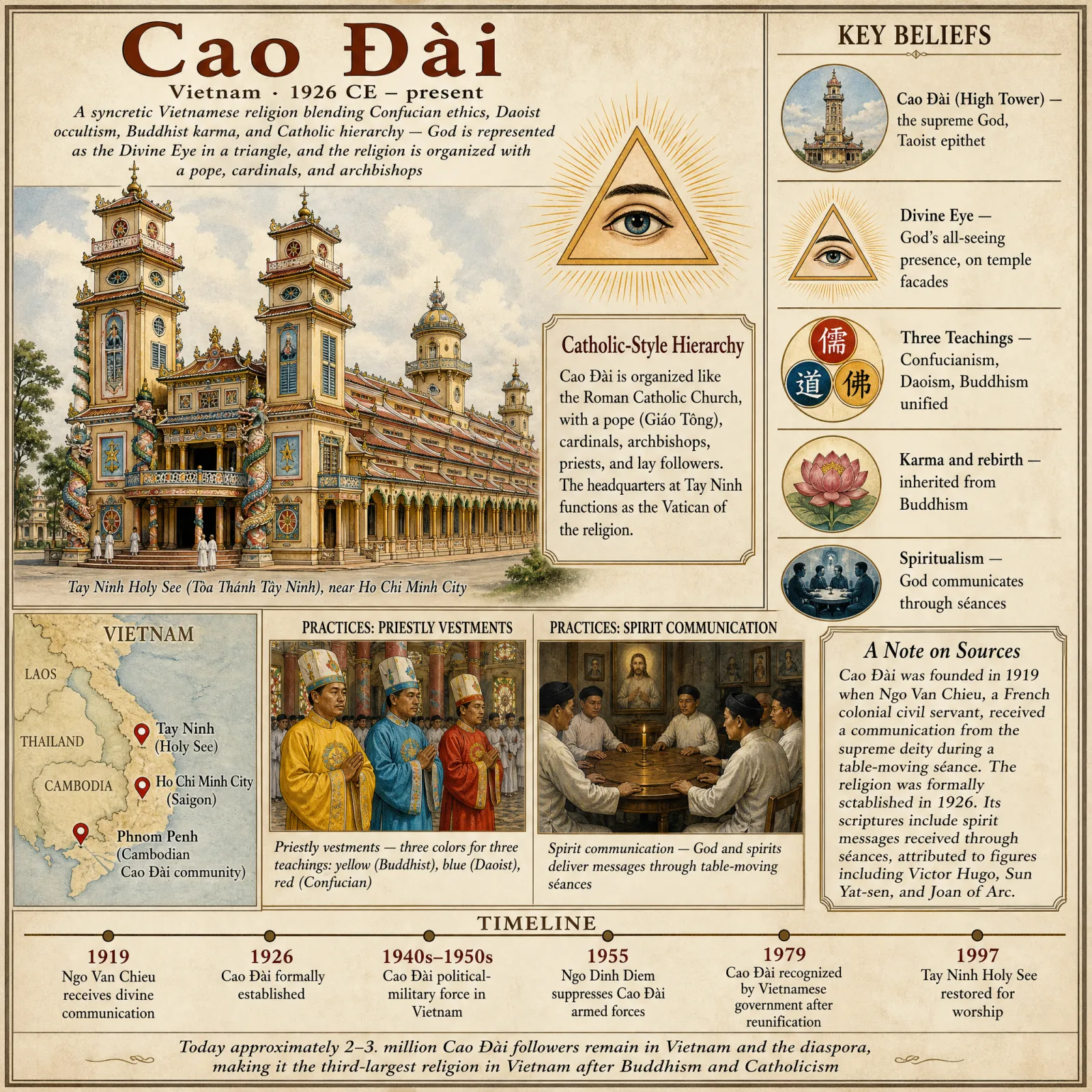
Cao Đài (Vietnamese: Đạo Cao Đài, 道高臺, 'The Way of the High Tower/Palace'; full name Đại Đạo Tam Kỳ Phổ Độ, 大道三期普度, 'The Great Way of the Third Universal Redemption') is a Vietnamese monotheistic syncretic religion officially founded on October 7, 1926, in Tây Ninh province, southern Vietnam (then French Cochinchina). The religion emerged through spiritist séances using mediumship techniques (including the Vietnamese cơ bút, or planchette writing, and French-influenced Kardecist spiritism) in which practitioners claimed to receive divine revelations from Cao Đài, identified as the Supreme Being, Jade Emperor, or ultimate God. The movement synthesizes ethical precepts from Confucianism, meditation and ritual practices from Taoism, doctrines of karma and rebirth from Buddhism, organizational hierarchy modeled after Roman Catholicism, and elements of Vietnamese folk religion and Western Spiritism (particularly Allan Kardec's teachings). Cao Đài's pantheon of saints and spiritual guides includes diverse figures from East and West: the Buddha, Laozi, Confucius, Jesus Christ, Muhammad, Moses, Jeanne d'Arc, Victor Hugo, Sun Yat-sen, Lý Thái Bạch (the Tang dynasty poet Li Bai, who serves as the 'Invisible Pope'), and the Mother Goddess of the West (Diêu Trì Kim Mẫu). The central symbol of Cao Đài is the Divine Eye (left eye of God) within a triangle, representing God's omniscience and omnipresence, prominently displayed on temple facades and altars.
The religion originated among Vietnamese civil servants and intellectuals in 1920s colonial Vietnam, led initially by Ngô Văn Chiêu (Ngô Minh Chiêu, 1878-1932), a French colonial administrator fascinated by Chinese folk religion and spiritism. Chiêu received the first revelations from Cao Đài circa 1920-1921 while serving on Phú Quốc Island, instructing him in esoteric self-cultivation and meditation. However, Chiêu preferred an esoteric, contemplative path and declined to lead a mass organization. In 1926, a group of spiritist practitioners in Saigon (including Lê Văn Trung, a wealthy businessman and French citizen; Phạm Công Tắc, a customs official; and Cao Quỳnh Cư) received messages commanding them to establish a public religious institution to save humanity in the 'Third Era of Universal Redemption' (following earlier revelations through figures like Moses, Jesus, Buddha, and Muhammad in the first and second eras). On October 7, 1926, 247 followers signed the 'Declaration of the Founding of the Cao Đài Religion', officially inaugurating the faith and submitting it to the French colonial authorities for legal recognition. Lê Văn Trung (1876-1934) became the first and only Giáo Tông (Acting Pope), heading the executive body (Cửu Trùng Đài), while Phạm Công Tắc (1890-1959) served as Hộ Pháp ('Defender of the Dharma,' head spirit medium) leading the legislative body (Hiệp Thiên Đài). After Lê Văn Trung's death in 1934, Phạm Công Tắc became the de facto leader of the Tây Ninh Holy See, though he never formally assumed the title of Pope, maintaining his role as Hộ Pháp until his exile to Cambodia in 1956 and death in 1959.
Cao Đài grew explosively in its early decades, claiming over one million followers by 1930 and becoming a significant religious, social, and eventually political force in southern Vietnam. The religion built the monumental Cao Đài Holy See (Tòa Thánh Tây Ninh) at Tây Ninh between 1933 and 1955, a vast temple complex combining architectural elements from Catholic cathedrals, Buddhist pagodas, Chinese temples, and French colonial buildings, featuring dragon-wrapped columns, a star-studded celestial ceiling, and the iconic Divine Eye above the altar. During the French colonial period, the Vietnam War, and subsequent decades, Cao Đài experienced internal sectarian divisions (with independent branches such as Chiếu Minh, Bến Tre, Minh Chơn Lý, and others breaking away from the Tây Ninh Holy See), political involvement (including maintaining armed forces during the 1940s-1950s), and repression under communist rule after 1975. Today, Cao Đài claims between 2-6 million adherents worldwide (figures vary widely), with the largest concentration in Vietnam's Mekong Delta and Tây Ninh province, and diaspora communities in the United States, France, Australia, and Cambodia. The Tây Ninh Holy See, recognized by the Vietnamese government in 1997, remains the largest and most prominent Cao Đài institution, though critics allege government interference has compromised its independence. Scholars classify Cao Đài as a new religious movement, a syncretic tradition, and a distinctly Vietnamese response to modernity, colonialism, and religious pluralism.
Historical Development
The origins of Cao Đài lie in the spiritist practices of Vietnamese civil servants and intellectuals in early 1920s French Cochinchina (southern Vietnam). Ngô Văn Chiêu (1878-1932), a district chief serving the French colonial administration on Phú Quốc Island circa 1920-1921, began practicing mediumship and reportedly received revelations from a deity identifying itself as Cao Đài (High Tower, a Taoist epithet for the Supreme Being). Chiêu, already versed in Chinese folk religion and Taoist esoteric practices, was instructed in meditation, moral cultivation, and vegetarianism. He established a small altar and shared his experiences with like-minded colonial officials fascinated by spiritism, particularly Allan Kardec's French Spiritist teachings, which were popular in early 20th-century Vietnam. By 1925, a loose network of spiritist practitioners in Saigon (including Phạm Công Tắc, a customs official; Cao Quỳnh Cư, a civil servant; and others) had formed séance groups using the cơ bút (planchette or 'beaked basket' for automatic writing) to contact spirits. They claimed to receive messages from various divine entities, including Lý Thái Bạch (Li Bai), Jeanne d'Arc, Victor Hugo, and eventually Cao Đài himself, who commanded them to establish a formal religion to unite humanity and prepare for the 'Third Era of Universal Redemption.'
In early 1926, the Saigon spiritist group, led by Phạm Công Tắc and Cao Quỳnh Cư, sought to recruit Lê Văn Trung (1876-1934), a wealthy former opium trader turned businessman and the only Vietnamese member of the French colonial Superior Council, who held French citizenship and the Legion d'Honneur. Lê Văn Trung was initially skeptical but was converted through séances at his home in January 1926, reportedly receiving a personal revelation from Cao Đài. Lê Văn Trung's social standing, wealth, and political connections proved crucial: his leadership lent legitimacy to the nascent movement and helped secure French colonial tolerance (the French initially viewed Cao Đài warily as a potential nationalist or anti-colonial threat). On October 7, 1926, in Saigon, 247 followers (including 28 prominent Vietnamese leaders) signed the 'Declaration of the Founding of the Cao Đài Religion', officially inaugurating the faith and submitting it to the French colonial authorities for legal recognition. Lê Văn Trung was designated Giáo Tông (Acting Pope), head of the Cửu Trùng Đài (Nine-Level Platform, the executive body), and Phạm Công Tắc became Hộ Pháp (Defender of the Dharma, head spirit medium), leading the Hiệp Thiên Đài (Harmony with Heaven Platform, the legislative body that received divine messages via séances). Ngô Văn Chiêu, however, refused to sign the declaration or participate in the public organization, believing it was not yet time to spread the teaching widely and preferring esoteric self-cultivation over mass proselytization.
The religion grew explosively: by 1930, Cao Đài claimed over one million adherents, concentrated in the Mekong Delta and Tây Ninh province. The movement appealed to Vietnamese peasants, workers, and petty bourgeoisie through its egalitarian teachings, promises of salvation, social welfare programs, and Vietnamese cultural identity (as opposed to French colonial Christianity or traditional Confucian-Buddhist practices perceived as elite or foreign). In 1927, construction began on the Cao Đài Holy See (Tòa Thánh Tây Ninh) at Long Hoa, Tây Ninh, a monumental temple complex designed to serve as the religion's administrative and spiritual headquarters. The Great Divine Temple was built between 1933 and 1955, employing thousands of workers and combining architectural styles: its facade resembles a European cathedral, its interior features Chinese-style dragon-wrapped columns and Buddhist symbolism, and its decoration includes the Divine Eye, stars, clouds, and elaborate carvings. The temple became (and remains) one of Vietnam's most visually spectacular religious buildings and a major pilgrimage and tourist site.
However, Cao Đài quickly fragmented into competing branches and factions. Ngô Văn Chiêu's refusal to join the Tây Ninh organization led to the founding of the Chiếu Minh (Bright Light) branch, an esoteric sect headquartered in Vĩnh Long that emphasized meditation, self-cultivation, and limited membership, rejecting mass proselytization and hierarchical bureaucracy. Other schisms followed: disputes over séance revelations, leadership succession, financial control, and theological interpretations led to the emergence of numerous independent Cao Đài branches, including Bến Tre, Minh Chơn Lý, Minh Chơn Đạo, Tiên Thiên, Cầu Kho, and others. By the 1940s, Cao Đài was deeply fragmented, with the Tây Ninh Holy See remaining the largest and most politically influential faction. During World War II and the First Indochina War (1946-1954), Cao Đài became militarized: the Tây Ninh Holy See maintained its own armed forces (estimated 25,000-30,000 troops at peak), controlling territory in Tây Ninh and parts of the Mekong Delta. Cao Đài leaders navigated complex alliances with the French, the Việt Minh, and later anti-communist factions, attempting to preserve autonomy and advance Vietnamese independence while protecting the religion's institutional interests. After Lê Văn Trung's death in 1934, Phạm Công Tắc became the de facto leader of the Tây Ninh Holy See, though he never formally assumed the title of Giáo Tông (Pope), maintaining his role as Hộ Pháp (Defender of the Dharma) and head spirit medium.
The Geneva Accords (1954) partitioned Vietnam, leaving Cao Đài's heartland in the South under the Ngô Đình Diệm regime (1955-1963), which sought to consolidate power by dismantling Cao Đài's military forces and political autonomy. Phạm Công Tắc was exiled to Cambodia in 1956, where he died in 1959. The Tây Ninh Holy See's political influence waned, though it retained significant religious and social authority. During the Vietnam War (1955-1975), Cao Đài communities were caught between communist and anti-communist forces, suffering casualties and displacement. After the communist victory in 1975, the Socialist Republic of Vietnam imposed strict controls on religious organizations, confiscating Cao Đài properties, suppressing séances and autonomous governance, and placing the Tây Ninh Holy See under state supervision. The government sought to co-opt Cao Đài leadership and suppress independent branches. In 1997, the Vietnamese government officially recognized the Cao Đài Executive Council of Tây Ninh Province, granting limited legal status and allowing the Tây Ninh Holy See to operate under state oversight. However, independent Cao Đài groups and critics (including diaspora communities) allege that government interference has undermined the Tây Ninh Holy See's independence, compromised its spiritual integrity, and marginalized non-conformist branches. Today, Cao Đài claims between 2-6 million adherents (estimates vary widely; Vietnamese government figures suggest ~2.5 million, while Cao Đài sources claim higher numbers), with the Tây Ninh Holy See remaining the largest and most prominent institution, alongside numerous smaller independent branches in Vietnam and diaspora communities in the United States, France, Australia, and Cambodia.
Core Worldview and Doctrines
Cao Đài is strictly monotheistic, affirming belief in one Supreme Being, Cao Đài (High Tower/Palace), identified with the Jade Emperor (Ngọc Hoàng) of Chinese cosmology, the ultimate God of the universe, creator of all existence. The full divine title is Cao Đài Tiên Ông Đại Bồ Tát Ma Ha Tát, combining Taoist (Tiên Ông, Immortal Elder), Buddhist (Đại Bồ Tát Ma Ha Tát, Great Bodhisattva Mahasattva), and Confucian concepts, reflecting the religion's syncretic synthesis of East Asian traditions. God is understood as transcendent, omniscient, omnipotent, and benevolent, represented symbolically as the Divine Eye (Thiên Nhãn, 天眼, left eye of God) within a triangle, symbolizing divine omniscience, omnipresence, and the illumination of truth. The Divine Eye is the central icon of Cao Đài, prominently displayed on temple facades, altars, and religious art. Unlike the unknowable God of some traditions, Cao Đài actively communicates with humanity through spirit mediumship and séances, delivering ongoing revelations, guidance, and teachings via spirit mediums (mediums channel divine entities and saints through planchette writing, automatic writing, or trance states).
Cao Đài teaches progressive revelation: God has revealed divine truth progressively through successive eras to suit humanity's evolving spiritual capacity. The First Era featured ancient sages and prophets (Moses, Abraham, and others in the West; legendary Chinese sages in the East), but their teachings were limited by geography, culture, and human misunderstanding. The Second Era saw the advent of great religious founders—Buddha, Laozi, Confucius, Jesus Christ, Muhammad—who established major world religions, each revealing partial truth suited to specific cultures and times. However, these religions became corrupted, institutionalized, and divided, leading to sectarianism, conflict, and spiritual decline. The Third Era, inaugurated with the founding of Cao Đài in 1926, represents the 'Third Universal Redemption' (Tam Kỳ Phổ Độ), God's final and complete revelation, uniting all previous religious truths into one universal faith accessible to all humanity regardless of race, nationality, or background. Cao Đài is thus presented as the culmination and synthesis of all religions, transcending and fulfilling earlier dispensations.
The Cao Đài pantheon is remarkably eclectic and inclusive, venerating a vast array of divine beings, saints, and spiritual guides from diverse traditions and historical periods. In addition to God (Cao Đài), Cao Đàists honor the Mother Goddess (Diêu Trì Kim Mẫu, Precious Mother of the瑶池, Jade Pool, a Taoist deity), revered as the feminine aspect of divinity, compassion, and nurturing. The Invisible Pope is Lý Thái Bạch (Li Bai, 李白, the Tang dynasty Chinese poet), who oversees séances and guides the religion's spiritual development. Saints and spiritual guides include the Buddha, Laozi, Confucius, Jesus Christ, Muhammad, Moses, Jeanne d'Arc (Joan of Arc, venerated for her piety and heroism), Victor Hugo (the French writer, venerated as a spiritual ambassador and symbol of justice, humanism, and mysticism—Hugo frequently transmitted messages during early Cao Đài séances, prophesying that Tây Ninh would become another Lourdes), Sun Yat-sen (Chinese revolutionary, symbol of anti-colonialism and national liberation), Descartes, Louis Pasteur, Shakespeare, Lenin, and numerous Vietnamese historical figures and former Cao Đài leaders. This inclusive pantheon reflects Cao Đài's universalist and syncretic theology, honoring wisdom and virtue wherever they appear.
Cao Đài cosmology incorporates Buddhist karma and rebirth: souls transmigrate through successive lifetimes based on their moral conduct, accumulating karma (good or bad actions) that determines future rebirths in heavens, hells, or earthly existences. The ultimate goal is spiritual liberation (escaping the cycle of rebirth) through moral cultivation, meditation, good works, and alignment with divine will. Salvation is achieved through faith in Cao Đài, adherence to the Five Precepts (no killing, no stealing, no sexual misconduct, no lying, no intoxicants), vegetarianism (strongly encouraged, especially for clergy and advanced practitioners), prayer, meditation, and service to humanity. Cao Đài emphasizes self-cultivation (tu thân, 修身), personal moral improvement, and inner transformation, drawing on Taoist meditation techniques, Confucian ethical discipline, and Buddhist mindfulness. The religion also teaches millenarianism: the Third Era represents humanity's last chance for salvation before an apocalyptic judgment or spiritual reckoning, lending urgency to conversion and moral reform.
Sacred Texts and Canon
Cao Đài scripture consists primarily of spirit messages or oracles (kinh văn, sấm giảng) received through mediumistic séances, compiled and published as authoritative revelations. Unlike religions with a single fixed canon, Cao Đài scripture is ongoing and expansive, as new messages continue to be received (though the most authoritative revelations date from the 1920s-1930s founding period). The central scriptural text is the Tân Luật (新律, 'New Canonical Codes'), a collection of divine laws and teachings revealed through séances in the 1920s-1930s, governing religious practices, ethics, rituals, and administration. The Pháp Chánh Truyền (法正傳, 'Religious Constitution of Caodaism'), revealed via séances and codified in the 1920s-1930s, serves as the religion's constitutional framework, establishing the organizational structure, hierarchy, roles of the Bát Quái Đài, Hiệp Thiên Đài, and Cửu Trùng Đài, and outlining theological principles. It resembles a religious legal code, defining powers, responsibilities, and procedures for governance.
The Thiên Đạo và Thế Đạo ('Heavenly Way and Earthly Way'), revealed through séances, elaborates on the dualism of spiritual cultivation (Thiên Đạo, the path to heaven) and secular life (Thế Đạo, ethical conduct in society), integrating Confucian social ethics with Taoist and Buddhist spiritual practices. The Đại Thừa Chơn Giáo (大乘真教, 'Grand Vehicle of the True Teaching'), compiled in 1937, contains messages received by the Chiếu Minh branch (Ngô Văn Chiêu's esoteric sect) during séances in 1936-1937, focusing on meditation, inner transformation, and self-cultivation. This text is authoritative for the Chiếu Minh tradition but less so for the Tây Ninh Holy See. Other important texts include prayers (kinh), hymns, and ritual manuals used in daily worship, many revealed through séances or composed by early Cao Đài leaders. Cao Đài also venerates texts from other religions—Buddhist sutras, Taoist classics (especially the Daodejing), Confucian Analects, Christian Bible, and Islamic Qur'an—as partial revelations of divine truth, though Cao Đài scripture supersedes them as the complete and final revelation.
The process of receiving scripture is central to Cao Đài identity: spiritist séances (cầu cơ, 求乩) using the cơ bút (planchette, a basket or instrument held by mediums that writes messages in sand, on paper, or via automatic writing) or other mediumship techniques channel messages from Cao Đài, the Mother Goddess, Lý Thái Bạch (the Invisible Pope), and various saints and divine beings. Early Cao Đài séances (1920s-1930s) were frequent and prolific, producing vast numbers of messages that were recorded, edited, compiled, and canonized by Cao Đài leadership. After the 1950s, séances became less frequent due to political repression, internal disputes, and government restrictions, though they continue in some Cao Đài branches. Critics (both external scholars and internal dissidents) have questioned the authenticity, consistency, and authority of séance messages, noting contradictions, political manipulation, and human editorial intervention. Nonetheless, for devout Cao Đàists, scripture received through séances is the direct word of God and the foundation of the faith.
Practices and Observances
Cao Đài worship centers on daily prayer services (lễ) held four times daily at Cao Đài temples: at 6:00 AM (morning prayer), 12:00 PM (noon prayer), 6:00 PM (evening prayer), and midnight (night prayer, optional for lay followers but required for clergy). The noon prayer is the most attended, drawing hundreds of adherents at the Tây Ninh Holy See and smaller numbers at local temples. Prayer services are highly ritualized and synchronized: participants (segregated by gender and rank—men enter from the right, women from the left; clergy in colored robes indicating rank process down the central aisle) kneel, bow, chant prayers, sing hymns, and perform gestures of devotion facing the altar, where the Divine Eye is enshrined above a large globe representing the universe. Services are colorful and elaborate: clergy wear distinctive robes (white for lay practitioners, yellow for Buddhist-influenced clergy, blue for Taoist-influenced clergy, red for Confucian-influenced clergy) and ornate headdresses. Incense is burned, music (drums, bells, traditional Vietnamese instruments) accompanies chants, and offerings (flowers, fruit, vegetarian food) are presented.
Vegetarianism is strongly encouraged and required for Cao Đài clergy and advanced practitioners. Lay followers are expected to observe vegetarianism on certain holy days (sáu tháng, 'six months,' referring to six lunar calendar days per month: the 1st, 15th, and four other designated days). The Five Precepts are binding on all Cao Đàists: no killing (respecting all life, promoting non-violence), no stealing, no sexual misconduct (fidelity in marriage, chastity for clergy), no lying (honesty and truthfulness), and no intoxicants (abstaining from alcohol, drugs, and other substances that cloud the mind). Cao Đài ethics emphasize compassion (từ bi, 慈悲, Buddhist concept), righteousness (nghĩa, 義, Confucian virtue), filial piety (hiếu, 孝, Confucian principle of honoring parents and ancestors), and loyalty (trung, 忠, Confucian virtue of faithfulness to duty and community).
The Cao Đài calendar follows the lunar calendar used in Vietnam and China, with holy days corresponding to lunar months and commemorating key events in Cao Đài history, the lives of saints, and cosmic cycles. Major festivals include the Founding Day (October 7, commemorating the 1926 inauguration), the Supreme Being Festival (Tết Nguyên Đán, Vietnamese New Year, when Cao Đài descends to bless the faithful), the Diêu Trì Cung Banquet Festival (honoring the Mother Goddess), and commemorations of saints such as Victor Hugo, Lý Thái Bạch, and Ngô Văn Chiêu. During festivals, the Tây Ninh Holy See hosts elaborate ceremonies, processions, and communal vegetarian feasts, attracting thousands of pilgrims.
Cao Đài governance is hierarchical and complex, modeled after Roman Catholicism but adapted to Vietnamese and spiritist contexts. The religion's organizational structure consists of three main bodies: the Bát Quái Đài (八卦臺, 'Eight-Trigram Palace,' the invisible divine council representing God's presence and spiritual guidance), the Hiệp Thiên Đài (協天臺, 'Harmony with Heaven Platform,' the legislative body led by the Hộ Pháp, responsible for receiving divine messages via séances and interpreting doctrine), and the Cửu Trùng Đài (九重臺, 'Nine-Level Platform,' the executive body led by the Giáo Tông/Pope, managing administration, clergy, and temporal affairs). The hierarchy includes ranks analogous to Catholic orders: the Giáo Tông (Pope, though this position has been vacant since Lê Văn Trung's death in 1934), Chưởng Pháp (Cardinals), Đầu Sư (Archbishops), Phối Sư (Bishops), Giáo Hữu (Priests), Lễ Sinh (Deacons), and lay followers. Clergy are celibate and vegetarian, wearing colored robes indicating their affiliation (yellow for Buddhist, blue for Taoist, red for Confucian). Despite its hierarchical structure, Cao Đài has no centralized global authority: the Tây Ninh Holy See is the largest institution, but numerous independent branches operate autonomously, and diaspora communities maintain separate governance.
Internal Diversity and Sectarian Divisions
Cao Đài is remarkably fragmented, with numerous independent branches, sects, and factions that emerged due to disputes over séance revelations, leadership succession, theological interpretation, and political alignment. The Tây Ninh Holy See (Tòa Thánh Tây Ninh), headquartered at the Cao Đài Holy See temple complex in Tây Ninh, is the largest and most prominent branch, claiming the mantle of orthodoxy and continuity from the 1926 founding. It is hierarchical, exoteric (focused on public worship and mass proselytization), and politically engaged, having maintained armed forces during the 1940s-1950s and collaborated with various political factions. The Tây Ninh Holy See received official government recognition from the Socialist Republic of Vietnam in 1997, allowing it to operate legally under state supervision, though critics allege government interference has compromised its independence and spiritual integrity.
The Chiếu Minh (Bright Light) branch, founded by Ngô Văn Chiêu (1878-1932), the first disciple of Cao Đài, represents the esoteric tradition. Chiêu broke away in 1926, refusing to join the Tây Ninh organization and rejecting mass proselytization, hierarchical bureaucracy, and political involvement. Chiếu Minh emphasizes meditation, self-cultivation, inner transformation, and limited membership, admitting only committed adepts who undergo rigorous spiritual training. Headquartered in Vĩnh Long, Chiếu Minh remains small, insular, and focused on spiritual practice rather than institutional expansion. Its scripture, the Đại Thừa Chơn Giáo (Grand Vehicle of the True Teaching, 1937), contains séance messages emphasizing esoteric Taoist and Buddhist meditation techniques. Within the Chiếu Minh tradition, there are sub-groups: the original Chiếu Minh Tam Thanh Vô Vi (founded by Ngô Văn Chiêu's disciples) and a newer group of the same name founded in 1996 by a female medium, both claiming direct connection to Ngô Văn Chiêu's teachings.
Other significant Cao Đài branches include Bến Tre, a major independent sect headquartered in Bến Tre province (Mekong Delta), which broke away from Tây Ninh in the 1930s over disputes about leadership and séance authority; Minh Chơn Lý (True Understanding), Minh Chơn Đạo (True Way), Tiên Thiên (Former Heaven), Cầu Kho, and Hội Thánh Truyền Giáo Trung Việt, each with distinct organizational structures, leadership, and emphases. These branches often dispute each other's legitimacy, séance revelations, and interpretation of doctrine, reflecting Cao Đài's decentralized and fractious nature. Some branches prioritize spiritist séances and ongoing revelation, while others emphasize fixed scripture and ethical discipline; some are politically active, while others are quietist and apolitical.
Diaspora Cao Đài communities (in the United States, France, Australia, Cambodia) are often organizationally independent from the Tây Ninh Holy See, maintaining their own temples, clergy, and governance structures. Many diaspora Cao Đàists fled Vietnam after 1975, opposing the communist government's suppression of religious autonomy, and have been critical of the Tây Ninh Holy See's collaboration with the Vietnamese state. Some diaspora communities maintain ties to pre-1975 Cao Đài leadership or independent branches, preserving practices and teachings they believe have been compromised in Vietnam. Gender roles in Cao Đài are relatively egalitarian compared to traditional Vietnamese society: women can hold high clerical ranks (including Chưởng Pháp/Cardinal and Đầu Sư/Archbishop) and serve as spirit mediums, though the highest position (Giáo Tông/Pope) has historically been occupied by men (Lê Văn Trung being the only person to hold the title, and it has remained vacant since his death in 1934).
Communities and Demographics
Estimating the global Cao Đài population is difficult due to inconsistent data, government restrictions, and the fragmented nature of the religion. The Vietnamese government reports approximately 2.5-3 million Cao Đàists in Vietnam, primarily concentrated in Tây Ninh province (the religion's heartland), the Mekong Delta (especially Bến Tre, Vĩnh Long, An Giang, and Cần Thơ provinces), and parts of southern Vietnam. Cao Đài sources and some scholars suggest higher numbers, claiming 4-6 million adherents worldwide, though these figures are contested and may include nominal or inactive members. The Tây Ninh Holy See is the largest single institution, claiming the majority of Vietnamese Cao Đàists, though numerous independent branches (Bến Tre, Chiếu Minh, Minh Chơn Lý, etc.) collectively represent a significant minority. Cao Đài adherents are predominantly ethnic Vietnamese, with smaller numbers of Khmer, Chinese, and other ethnic minorities in southern Vietnam.
Cao Đài appeals primarily to rural and working-class populations in the Mekong Delta and southern Vietnam, offering social welfare services (schools, clinics, mutual aid societies), communal identity, and moral guidance. The religion's emphasis on Vietnamese cultural identity, anti-colonialism (historically), and egalitarian ethics attracted peasants, workers, and petty bourgeoisie during the colonial and post-colonial periods. However, Cao Đài also drew support from educated elites and intellectuals in its early decades, particularly civil servants, merchants, and landowners fascinated by spiritism, modernity, and religious reform. After 1975, the communist government's suppression of Cao Đài autonomy, confiscation of properties, and restrictions on séances and independent governance led to decline and stagnation in some areas, though the religion has persisted and experienced modest revival since the 1990s.
Diaspora Cao Đài communities exist in the United States (especially California, Texas, and Washington, where Vietnamese refugees resettled after 1975), France (former colonial power with longstanding Vietnamese immigrant communities), Australia (Sydney, Melbourne), and Cambodia (where Phạm Công Tắc lived in exile 1956-1959 and where some Vietnamese Cao Đàists remain). Diaspora communities maintain temples, hold regular worship services, and preserve Cao Đài traditions, often independently from the Tây Ninh Holy See. Many diaspora Cao Đàists are refugees or descendants of refugees who fled communist Vietnam, and they are often politically opposed to the Vietnamese government and critical of the Tây Ninh Holy See's collaboration with the state. Diaspora temples serve as cultural and religious centers for Vietnamese immigrants, preserving language, customs, and spiritual practices. Some diaspora communities have built impressive new temples (e.g., the Cao Đài Temple in Sydney, Australia, opened in the 1990s), demonstrating the religion's global reach and adaptability.
Sacred Places and Pilgrimage Sites
Cao Đài Holy See (Tòa Thánh Tây Ninh), Tây Ninh, Vietnam: The Cao Đài Holy See at Tây Ninh is the spiritual and administrative headquarters of the Cao Đài religion (specifically the Tây Ninh Holy See branch, the largest Cao Đài institution) and the most important pilgrimage site for Cao Đàists worldwide. Located in Long Hoa ward, Hòa Thành town, Tây Ninh province, approximately 100 km northwest of Ho Chi Minh City (Saigon), the site covers over 100 hectares and includes the monumental Great Divine Temple (Thánh Thất), administrative buildings, clergy residences, meditation houses, gardens, and smaller shrines. The Great Divine Temple, constructed between 1933 and 1955, is one of the most architecturally striking religious buildings in Southeast Asia: its facade combines elements of European cathedral architecture (twin towers, arched entrance) with Asian motifs (dragons, phoenixes, Chinese calligraphy); its interior features rows of dragon-wrapped columns in pastel pink, blue, yellow, and green, a vaulted ceiling painted with stars and clouds representing the heavens, and the iconic Divine Eye (Thiên Nhãn, left eye of God) enshrined above a large globe at the main altar. The temple is built along a central axis representing the path from earthly existence to divine union: worshippers enter through the front gate, pass through courtyards and halls of increasing sanctity, and culminate at the Bát Quái Đài (Eight-Trigram Palace), the holiest area at the rear of the temple where only high-ranking clergy may enter. Daily prayer services (at 6 AM, noon, 6 PM, and midnight) attract hundreds of adherents dressed in white robes, creating a synchronized, colorful, and spiritually charged spectacle. The Tây Ninh Holy See is open to visitors and tourists daily (6:00-22:00, extended hours during major festivals), who are permitted to observe prayer services from balconies and walkways (visitors must dress modestly, covering shoulders and knees). The site was inscribed as a proposed UNESCO World Heritage Site candidate due to its unique architecture, cultural significance, and religious importance, though it has not yet achieved official UNESCO status. The Cao Đài Holy See symbolizes the religion's ambition, syncretism, and Vietnamese cultural identity, serving as the focal point for pilgrimage, worship, and communal identity.
Chiếu Minh Holy House, Vĩnh Long, Vietnam: The Chiếu Minh Holy House (Thánh Thất Chiếu Minh) in Vĩnh Long province (Mekong Delta) serves as the headquarters of the Chiếu Minh branch of Cao Đài, the esoteric sect founded by Ngô Văn Chiêu (1878-1932), the first disciple of Cao Đài. The Chiếu Minh Holy House was established by Ngô Văn Chiêu's disciples after his death in 1932 as a meditation house and séance center, preserving his teachings on self-cultivation, inner transformation, and esoteric practice. Unlike the monumental Tây Ninh Holy See, the Chiếu Minh Holy House is modest, simple, and closed to the public, admitting only committed adepts who undergo rigorous spiritual training. The site emphasizes meditation, quiet contemplation, and direct spiritual experience rather than elaborate rituals and mass worship. The Chiếu Minh Holy House symbolizes the esoteric, contemplative dimension of Cao Đài, contrasting with the exoteric, institutional, and publicly oriented Tây Ninh Holy See. It remains a pilgrimage site for Chiếu Minh adherents and those seeking deeper spiritual practice beyond external rituals.
Bến Tre Cao Đài Temple, Bến Tre, Vietnam: The Bến Tre Cao Đài Temple (Thánh Thất Cao Đài Bến Tre) serves as the headquarters of the Bến Tre branch, one of the largest independent Cao Đài sects. Founded in the 1930s following disputes with the Tây Ninh Holy See over leadership and séance authority, the Bến Tre branch maintains its own clergy, organizational structure, and interpretation of Cao Đài teachings. The Bến Tre temple, located in Bến Tre city (Mekong Delta), features similar architectural elements to the Tây Ninh Holy See (dragon-wrapped columns, the Divine Eye, colorful decoration) but on a smaller scale. The temple serves as a regional center for worship, pilgrimage, and communal activities for Bến Tre Cao Đàists, who number in the hundreds of thousands. It symbolizes Cao Đài's decentralized and sectarian nature, demonstrating that the religion's vitality and diversity extend beyond the Tây Ninh Holy See.
Diaspora Cao Đài Temples: Cao Đài temples in diaspora communities (United States, France, Australia, Cambodia) serve as sacred spaces, pilgrimage sites, and cultural centers for Vietnamese immigrants and refugees. Notable examples include the Cao Đài Temple in Sydney, Australia (built in the 1990s at Wiley Park, a significant undertaking by the local Vietnamese community), temples in California (especially in Orange County and San Jose, areas with large Vietnamese populations), and temples in Paris and surrounding areas (serving Vietnamese immigrants in France). These diaspora temples replicate the architectural and ritual elements of the Tây Ninh Holy See (Divine Eye, dragon-wrapped columns, colorful decoration, daily prayer services) while adapting to local contexts and legal frameworks. They are open to members and visitors, hosting prayer services, festivals, and community events, and preserving Cao Đài traditions in the global Vietnamese diaspora.
Contemporary Debates and Contested Issues
The government control and independence of the Tây Ninh Holy See is a major contested issue. In 1997, the Vietnamese government officially recognized the Cao Đài Executive Council of Tây Ninh Province, granting the Tây Ninh Holy See legal status and allowing it to operate under state supervision. However, critics—including independent Cao Đài branches, diaspora communities, and human rights advocates—allege that government recognition came at the cost of autonomy and spiritual integrity. The Vietnamese government appoints or approves senior Cao Đài clergy, monitors séances and religious activities, restricts independent branches, and uses the Tây Ninh Holy See as a tool for political control and propaganda. Critics argue that the Tây Ninh Holy See no longer faithfully upholds Cao Đài principles and traditions, having been co-opted by the state. The government denies these allegations, asserting that recognition protects religious freedom and supports Cao Đài's legitimate operations. This debate reflects broader tensions between religious autonomy and state control in communist Vietnam.
Sectarianism and fragmentation is endemic to Cao Đài, with no consensus on which branch or interpretation is orthodox. The Tây Ninh Holy See claims to be the original and legitimate Cao Đài institution, but numerous independent branches (Chiếu Minh, Bến Tre, Minh Chơn Lý, etc.) dispute this, asserting their own authority based on distinct séance revelations, lineages, and interpretations of Cao Đài teachings. Disagreements center on the validity of séance messages (which messages are authentic divine revelations vs. human fabrications?), the role of spiritism (should séances continue or are early revelations sufficient?), hierarchy and governance (centralized papal authority vs. decentralized autonomy), and theological interpretation (emphasis on exoteric ritual vs. esoteric meditation). Some Cao Đàists view sectarianism as a betrayal of Cao Đài's universalist mission to unite humanity, while others see it as inevitable diversity reflecting different spiritual paths and cultural contexts. Scholars note that Cao Đài's reliance on ongoing spirit communication and lack of fixed scriptural canon inherently invites fragmentation and disputes over authority.
The authenticity and authority of spiritist séances is contested both within and outside Cao Đài. For devout Cao Đàists, séance messages are the direct word of God and the foundation of the faith, making spiritism central to Cao Đài identity and practice. However, critics (including some Cao Đàists, scholars, and skeptics) question the authenticity of séance revelations, pointing to contradictions between messages, evidence of human editorial intervention and manipulation, political motivations (séances were sometimes used to legitimize leadership decisions or political alliances), and the subjective nature of mediumship (different mediums produce different messages). The Vietnamese government banned or restricted séances after 1975, viewing them as superstitious and politically subversive, further undermining their authority and continuity. Some modern Cao Đàists (especially in diaspora communities and educated circles) downplay spiritism, emphasizing fixed scripture, ethical teachings, and rational theology over ongoing revelations. This debate reflects broader tensions between charismatic authority (spirit mediums) and institutional authority (clergy and scripture).
The classification of Cao Đài as a syncretic religion, new religious movement, or sectarian offshoot is debated by scholars. Cao Đài self-identifies as the 'Third Universal Redemption,' the culmination and synthesis of all religions, claiming to transcend and fulfill earlier traditions. However, scholars classify Cao Đài variously as a new religious movement (a modern religion emerging in response to colonialism, modernity, and religious pluralism), a syncretic religion (combining elements from Buddhism, Taoism, Confucianism, Christianity, and Spiritism without fully belonging to any), a Vietnamese nationalist movement (asserting indigenous religious identity against French colonial Christianity), or a sectarian offshoot of Chinese folk religion and Vietnamese popular Buddhism. Each classification emphasizes different aspects of Cao Đài: its modernity and innovation, its synthesis of traditions, its political and cultural context, or its continuity with earlier religious practices. Cao Đàists generally reject the term 'sect,' viewing it as pejorative and reductive, preferring 'religion' or 'faith' to assert Cao Đài's legitimacy and independence.
Historical political involvement and militarization of Cao Đài (1940s-1950s) remains controversial. During the First Indochina War and the partition of Vietnam, the Tây Ninh Holy See maintained armed forces, controlled territory, and entered alliances with French colonial authorities, anti-communist factions, and at times the Việt Minh, attempting to preserve autonomy and advance Vietnamese independence. Critics (both communist and anti-communist) have accused Cao Đài of opportunism, collaborationism, and betrayal, while Cao Đài defenders argue the religion was navigating impossible political circumstances and protecting its community. The legacy of militarization and political involvement complicates Cao Đài's self-presentation as a purely spiritual and universalist faith, and it contributed to government suppression after 1975.
Key Terms
- Cao Đài (高臺)
- High Tower/Palace; the Supreme Being, Jade Emperor, ultimate God of the universe, creator of all existence. Also the name of the religion.
- Divine Eye (Thiên Nhãn, 天眼)
- Left eye of God within a triangle, the central symbol of Cao Đài representing divine omniscience, omnipresence, and the illumination of truth. Displayed prominently on temple facades and altars.
- Đại Đạo Tam Kỳ Phổ Độ (大道三期普度)
- The Great Way of the Third Universal Redemption; the full name of Cao Đài, signifying the Third Era of divine revelation to save humanity.
- Tòa Thánh Tây Ninh
- Cao Đài Holy See; the spiritual and administrative headquarters of the Tây Ninh branch of Cao Đài, located in Tây Ninh province, Vietnam. The most important Cao Đài pilgrimage site.
- Giáo Tông (教宗)
- Pope; the head of the Cửu Trùng Đài (executive body). Lê Văn Trung (1876-1934) was the first and only Giáo Tông. The position has remained vacant since his death.
- Hộ Pháp (護法)
- Defender of the Dharma; head spirit medium leading the Hiệp Thiên Đài (legislative body). Phạm Công Tắc (1890-1959) served as Hộ Pháp and de facto leader after Lê Văn Trung's death.
- Cơ Bút (乩笔)
- Planchette or 'beaked basket'; mediumship technique using automatic writing to receive spirit messages. Central to Cao Đài spiritism and scripture revelation.
- Ngô Văn Chiêu (吳文昭)
- First disciple of Cao Đài (1878-1932), received the earliest revelations from Cao Đài circa 1920-1921. Declined to lead the Tây Ninh organization, founding the esoteric Chiếu Minh branch.
- Lê Văn Trung (黎文忠)
- First and only Giáo Tông (Pope) of Cao Đài (1876-1934), wealthy businessman and French citizen who led the founding of Cao Đài in 1926 and headed the Tây Ninh Holy See until his death.
- Phạm Công Tắc (范公廓)
- Hộ Pháp (Defender of the Dharma, 1890-1959), head spirit medium and co-founder of Cao Đài. De facto leader of the Tây Ninh Holy See after Lê Văn Trung's death, exiled to Cambodia in 1956.
- Lý Thái Bạch (李太白)
- Li Bai, Tang dynasty Chinese poet, venerated in Cao Đài as the 'Invisible Pope' who oversees séances and guides the religion's spiritual development.
- Diêu Trì Kim Mẫu (瑶池金母)
- Mother Goddess, Precious Mother of the Jade Pool; Taoist deity venerated in Cao Đài as the feminine aspect of divinity, compassion, and nurturing.
- Chiếu Minh (照明)
- Bright Light; esoteric branch of Cao Đài founded by Ngô Văn Chiêu, emphasizing meditation, self-cultivation, and limited membership. Headquartered in Vĩnh Long.
- Bát Quái Đài (八卦臺)
- Eight-Trigram Palace; the invisible divine council representing God's presence and spiritual guidance. One of the three main bodies governing Cao Đài.
- Hiệp Thiên Đài (協天臺)
- Harmony with Heaven Platform; the legislative body led by the Hộ Pháp, responsible for receiving divine messages via séances and interpreting doctrine.
- Cửu Trùng Đài (九重臺)
- Nine-Level Platform; the executive body led by the Giáo Tông (Pope), managing administration, clergy, and temporal affairs.
- Pháp Chánh Truyền (法正傳)
- Religious Constitution of Caodaism; revealed via séances and codified in the 1920s-1930s, establishing organizational structure, hierarchy, and theological principles.
- Tân Luật (新律)
- New Canonical Codes; central scriptural text containing divine laws and teachings revealed through séances in the 1920s-1930s, governing practices, ethics, and rituals.
- Tam Kỳ Phổ Độ (三期普度)
- Third Universal Redemption; the Third Era of divine revelation inaugurated with the founding of Cao Đài in 1926, representing God's final and complete revelation to humanity.
- Victor Hugo
- French writer (1802-1885) venerated in Cao Đài as a spiritual ambassador, symbol of justice and mysticism. Frequently transmitted messages during early séances, prophesying Tây Ninh would become another Lourdes.
- Spiritism
- Belief in communication with spirits of the dead or divine entities through mediums. Central to Cao Đài theology and scripture revelation, influenced by Allan Kardec's French Spiritism.
Further Reading
- Jérémy Jammes, Les Oracles du Cao Đài: Étude d'un mouvement religieux vietnamien et de ses réseaux (Les Indes savantes, 2014)
- Victor L. Oliver, Caodai Spiritism: A Study of Religion in Vietnamese Society (Brill, 1976)
- Sergei Blagov, Caodaism: Vietnamese Traditionalism and Its Leap into Modernity (Nova Science Publishers, 2001)
- Jayne Susan Werner, Peasant Politics and Religious Sectarianism: Peasant and Priest in the Cao Dai in Viet Nam (Yale University Southeast Asia Studies, 1981)
- Encyclopaedia Britannica: Cao Dai
- Janet Hoskins, Review of Les Oracles du Cao Đài by Jérémy Jammes (Sojourn: Journal of Social Issues in Southeast Asia, 2016)
- The Sacerdotal Council of Caodaism: Official Cao Dai Website
- Chris Hartney, Open Temple, Open Eyes: Viewing Caodaism (World Religions and Spirituality Project, 2016)
- Pierre Brocheux, Review of Les Oracles du Cao Đài (Southeast Asian Studies, 2016)
- CESNUR (Center for Studies on New Religions): Caodaism Resources
Practices
- Spirit-writing séances
- Vegetarian fasting days
- Ancestor veneration
- Temple worship at Tây Ninh Holy See
Core ideas
- Deity
- Cao Đài — the one God behind all revelations
- Salvation
- Union of world religions in a final 'Third Amnesty'
Sacred texts
A collection of messages Cao Đài adherents believe were received through spirit-writing séances from God and a pantheon of saints — including Victor Hugo and Sun Yat-sen — during the religion's founding years. It forms the core scriptural basis for Cao Đài doctrine and ritual.