Overview
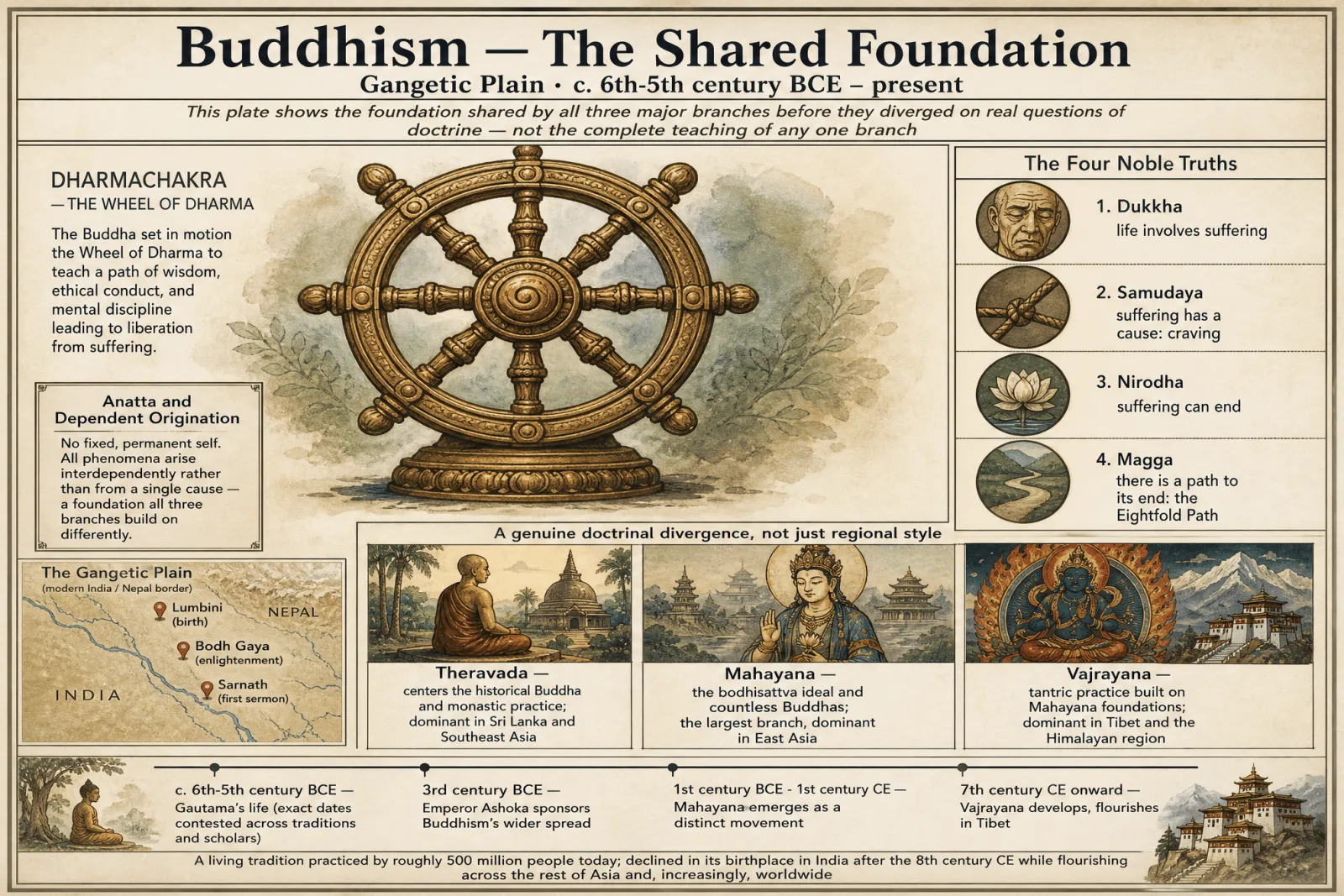
Buddhism arose in the Gangetic plain of northern India around the fifth century BCE, when Siddhartha Gautama, later known as the Buddha ("Awakened One"), taught a path to end suffering. According to early accounts preserved in the Pali canon and Chinese translations, he rejected both the extreme luxury of his palace upbringing and the harsh self-mortification practiced by contemporary ascetics, proposing instead a Middle Way grounded in ethical conduct (sila), meditative concentration (samadhi), and liberating wisdom (panna). His diagnosis of the human condition centers on dukkha—suffering or unsatisfactoriness—traced to craving (tanha) and ignorance (avijja), and his prescription is the Noble Eightfold Path leading toward nirvana, the cessation of craving and the bonds of rebirth.
After the Buddha's death around 400 BCE, monastic communities (sangha) preserved his teachings orally and eventually in written canons. Disagreements over monastic discipline and doctrinal interpretation produced distinct schools. Theravada Buddhism, prominent today in Sri Lanka, Myanmar, Thailand, Cambodia, and Laos, emphasizes monastic life and the gradual path toward arhatship—individual liberation from samsara. Mahayana traditions, which spread through Central and East Asia from the first century CE onward, celebrate the bodhisattva ideal: postponing one's own final nirvana out of compassion for all sentient beings. Vajrayana Buddhism, associated with Tibet, Bhutan, Mongolia, and parts of Nepal and India, incorporates tantric ritual, deity yoga, and esoteric meditation techniques. Despite these differences, Buddhists broadly affirm the marks of existence: impermanence (anicca), suffering (dukkha), and non-self (anatta), alongside the law of karma shaping rebirth until liberation.
From its Indian birthplace Buddhism became a major world religion across Asia and, in modern times, the West. Emperor Ashoka's third-century BCE patronage spread the dharma to Sri Lanka and beyond; missionaries carried texts and practices along the Silk Road to China, Korea, and Japan; Tibetan translators produced vast canonical libraries; colonial-era encounters introduced Buddhist philosophy to Europe and North America. Contemporary movements adapt meditation and mindfulness for secular mental-health and corporate settings, while monasteries and lay societies sustain classical liturgies, scriptural study, and pilgrimage. Whether in forest hermitages in Thailand, Zen temples in Japan, or urban dharma centers in California, Buddhists continue to debate how ancient teachings apply to modern economics, ecology, gender equity, social justice, and neuroscience.
Emerges fromHinduism ←
Historical Development
The historical Buddha, Siddhartha Gautama, was born into the Shakya clan in Lumbini (present-day Nepal). Traditional sources place his birth around 563 BCE, though modern scholars working from different textual and archaeological evidence date the Buddha's floruit to circa 450 BCE, making the chronology contested. After renouncing palace life at age twenty-nine, he studied meditation under teachers such as Alara Kalama and Uddaka Ramaputta, then practiced extreme asceticism with five companions. Finding neither indulgence nor self-torture sufficient, he sat under the Bodhi tree at Bodh Gaya (in the kingdom of Magadha, modern Bihar) and attained enlightenment. His first sermon at the Deer Park in Sarnath articulated the Four Noble Truths and the Middle Way; he spent the remaining forty-five years teaching across the Gangetic plain until his death (parinirvana) at Kushinagar.
Within months of the Buddha's death, the First Council at Rajagriha is said to have collected his discourses (suttas) and monastic regulations (vinaya). Over the next century, disputes over discipline and doctrine—such as whether an arhat could still experience doubt or whether the Buddha was fully transcendent—led to the split between the Sthavira (Elders) and Mahasanghika (Great Assembly) schools around 350 BCE. The Third Council, convened under Emperor Ashoka (circa 250 BCE) at Pataliputra, finalized the Theravada canon in Pali and sent missions abroad. Ashoka's inscriptions and donations to stupas mark Buddhism's first major geographic expansion: Mahinda and Sanghamitta brought the dharma to Sri Lanka, where the Pali Tipitaka was first written down in the first century BCE.
Mahayana Buddhism emerged from the first century BCE to the first century CE, introducing new sutras—such as the Perfection of Wisdom (Prajnaparamita), Lotus, and Pure Land texts—that emphasized the bodhisattva path and the doctrine of emptiness (shunyata). Nagarjuna (circa 150–250 CE) systematized Madhyamaka philosophy, arguing that all phenomena lack inherent existence. Asanga and Vasubandhu (fourth to fifth centuries CE) founded the Yogachara school, analyzing consciousness and the storehouse consciousness (alaya-vijnana). By the fourth century, Buddhist universities at Nalanda and Vikramashila in India attracted scholars from across Asia; Chinese pilgrims such as Faxian (fifth century) and Xuanzang (seventh century) traveled to India and returned with texts that shaped East Asian Buddhism.
Vajrayana or tantric Buddhism developed from the sixth century CE in India, blending Mahayana philosophy with esoteric ritual, mantras, mandalas, and deity yoga. It reached Tibet in the seventh and eighth centuries; the translation projects sponsored by Tibetan kings and the work of Indian masters such as Padmasambhava and Atisha established a distinct Tibetan Buddhist tradition. The Mongol Empire later adopted Tibetan Buddhism as its state religion. Meanwhile, Theravada Buddhism consolidated in Sri Lanka and mainland Southeast Asia; the Burmese, Thai, and Khmer kingdoms supported monastic ordination lineages and Pali scholarship. In East Asia, Chan (Zen) Buddhism flourished in China and Japan, emphasizing meditation and direct insight; Pure Land devotion to Amitabha Buddha attracted lay followers; and the Tiantai and Huayan schools developed comprehensive doctrinal systems.
Buddhism declined in its Indian homeland from the eighth century onward due to changing royal patronage, the rise of devotional Hinduism, and the eventual Muslim conquests of Buddhist strongholds such as Nalanda (destroyed in the twelfth century). By the thirteenth century, organized Buddhism had nearly vanished from the Indian subcontinent, though it remained vibrant in Sri Lanka, Southeast Asia, East Asia, and Tibet. Colonial-era scholarship and the Theosophical Society introduced Buddhist texts to the West; Japanese Zen teachers and Tibetan lamas began teaching in Europe and North America in the twentieth century. Dr. B. R. Ambedkar's mass conversion movement in 1956 created Navayana ("New Vehicle") Buddhism among Dalit communities in India, reinterpreting the dharma as a vehicle for social liberation. Today Buddhism counts over five hundred million adherents worldwide, with significant convert communities in the West alongside heritage communities in Asia.
Core Worldview and Doctrines
The Buddha's teaching begins with the Four Noble Truths: (1) dukkha (suffering, unsatisfactoriness) pervades conditioned existence; (2) the origin of dukkha is tanha (craving or thirst) and attachment; (3) cessation of dukkha is possible through the elimination of craving, attaining nirvana; (4) the path to cessation is the Noble Eightfold Path—right view, right intention, right speech, right action, right livelihood, right effort, right mindfulness, and right concentration. This diagnosis and prescription structure all Buddhist ethics, meditation, and philosophy.
Central to Buddhist metaphysics is the doctrine of dependent origination (pratityasamutpada): all phenomena arise in dependence on causes and conditions and lack independent, permanent essence. The doctrine of anatta (non-self) denies a fixed, unchanging soul or atman, contrasting sharply with brahmanical Hinduism and Jainism. Instead, persons are analyzed as aggregates (skandhas) of form, feeling, perception, mental formations, and consciousness, all impermanent and subject to change. The three marks of existence—impermanence (anicca), suffering (dukkha), and non-self (anatta)—are observable characteristics that, when realized, undercut clinging and lead to liberation.
Karma (Sanskrit; Pali: kamma) in Buddhism refers to volitional action: intentions and deeds shape future experiences within samsara, the cycle of rebirth. Unlike in Hinduism, there is no eternal soul that transmigrates; instead, a causal continuum of consciousness and karmic formations links one life to the next. The goal of Buddhist practice is to escape samsara by extinguishing the fires of greed, hatred, and delusion, thereby attaining nirvana—a state beyond birth and death, often described negatively (as cessation) rather than positively. In Theravada, the arhat achieves full liberation; in Mahayana, the bodhisattva vows to remain in samsara until all beings are saved, and Buddhahood itself becomes the ultimate goal.
Mahayana Buddhism introduced the concept of shunyata (emptiness): not only persons but all phenomena are empty of intrinsic existence. The Madhyamaka school, founded by Nagarjuna, uses dialectical reasoning to deconstruct all conceptual positions, revealing the emptiness of emptiness itself. The Yogachara school posits that all experience is mind-only (cittamatra) and analyzes the storehouse consciousness that carries karmic seeds. Mahayana sutras also teach Buddha-nature (tathagatagarbha): the potential for enlightenment inherent in all sentient beings. In Vajrayana, the cosmos is envisioned as a mandala, and practitioners use visualization, mantra, and ritual to realize their own Buddha-nature through tantric transformation.
Buddhist cosmology describes multiple realms of rebirth: hells, hungry ghosts, animals, humans, demigods, and gods (devas). Even gods are subject to karma and rebirth, and only from the human realm is liberation easily attained. Time is conceived as vast cycles (kalpas) of cosmic creation and destruction. However, Buddhist philosophy ultimately subordinates cosmology to soteriology: the purpose of understanding the universe is to motivate the quest for liberation, not to construct a final metaphysical system. Different schools debate the ontological status of nirvana, the existence of Buddha-lands (Pure Lands), and the nature of the Buddha's awakening, but all agree on the primacy of ethical discipline, meditation, and wisdom.
Sacred Texts and Canons
The Pali Tipitaka ("Three Baskets") is the earliest complete Buddhist canon and the scriptural foundation of Theravada Buddhism. Composed in the Pali language and preserved by Sri Lankan monasteries, it was first written down in the first century BCE after centuries of oral transmission. The Vinaya Pitaka codifies monastic discipline for bhikkhus (monks) and bhikkhunis (nuns), including the Patimokkha (227 rules for monks). The Sutta Pitaka contains the Buddha's discourses, organized into five collections (Nikayas): Digha (long discourses), Majjhima (middle-length), Samyutta (connected), Anguttara (numerical), and Khuddaka (minor texts, including the Dhammapada and Jataka birth stories). The Abhidhamma Pitaka offers systematic philosophical analysis of mind, matter, and causation. The Pali Text Society has published critical editions and translations of the entire Tipitaka, making it accessible to scholars worldwide.
Mahayana Buddhism produced a vast library of sutras composed in Sanskrit, Chinese, and Tibetan from the first century BCE onward. The Perfection of Wisdom (Prajnaparamita) sutras—including the Heart Sutra and Diamond Sutra—expound emptiness and the bodhisattva path. The Lotus Sutra (Saddharmapundarika) proclaims that all beings will attain Buddhahood and that the Buddha's life span is infinite. The Pure Land sutras (Larger and Smaller Sukhavativyuha) describe Amitabha Buddha's western paradise and the practice of reciting his name (nembutsu). The Avatamsaka Sutra (Flower Ornament) presents the interpenetration of all phenomena in Indra's Net. The Lankavatara and Sandhinirmocana Sutras are central to Yogachara philosophy. Mahayana texts often claim to be the Buddha's own words, revealed in visionary states or preserved in hidden realms until the time was ripe.
Vajrayana Buddhism's scriptural corpus includes the tantras, esoteric texts that describe ritual procedures, deity visualizations, and advanced meditative techniques. The Guhyasamaja Tantra, Chakrasamvara Tantra, and Hevajra Tantra are among the most important. The Tibetan Buddhist canon is divided into the Kangyur ("Translated Word," 108 volumes of sutras, vinaya, and tantras) and the Tengyur ("Translated Treatises," 225 volumes of Indian commentaries). Tibetan scholars such as Tsongkhapa (fourteenth to fifteenth centuries) wrote extensive commentaries synthesizing sutra and tantra, logic and meditation. The Tibetan Book of the Dead (Bardo Thodol), a guide to navigating the intermediate state between death and rebirth, became famous in the West but is only one text among thousands.
Chinese Buddhism translated Indian sutras and composed indigenous texts. Kumarajiva (fourth to fifth centuries CE) produced authoritative translations of Mahayana sutras; Xuanzang's seventh-century translations of Yogachara texts shaped East Asian philosophy. The Platform Sutra attributed to Huineng (seventh century) is a foundational Chan (Zen) text, emphasizing sudden enlightenment and the identity of meditation and wisdom. Dogen's Shobogenzo (thirteenth-century Japan) offers profound Zen meditations on being-time, Buddha-nature, and practice-realization. In Southeast Asia, Pali commentaries by Buddhaghosa (fifth century CE)—including the Visuddhimagga (Path of Purification)—standardized Theravada doctrine and meditation. Modern scholars use the SuttaCentral and Access to Insight websites to access Pali texts and translations; the Chinese Buddhist Electronic Text Association (CBETA) digitizes the Chinese Tripitaka; and the Asian Classics Input Project (ACIP) digitizes Tibetan texts.
Practices and Observances
Buddhist practice rests on the threefold training (trisiksha): ethical discipline (sila), meditative concentration (samadhi), and wisdom (prajna). Ethical discipline for laypeople is encapsulated in the Five Precepts: refrain from killing, stealing, sexual misconduct, lying, and intoxication. Monastic communities observe the Vinaya, a complex code governing conduct, possessions, and communal life. Theravada monks and nuns follow 227 and 311 rules respectively; Mahayana ordinations include additional bodhisattva vows. The sangha depends on lay support (dana) for food, robes, and shelter, while laypeople gain merit by supporting monastics and practicing generosity, morality, and meditation.
Meditation (bhavana) is the heart of Buddhist practice. Theravada traditions teach samatha (calm abiding) to develop concentration and vipassana (insight) to observe the impermanence, suffering, and non-self of all phenomena. Practitioners focus on the breath (anapanasati), body sensations, or mental states, systematically deconstructing ordinary perception. Zen (Chan) Buddhism emphasizes zazen (seated meditation) and koans—paradoxical questions designed to short-circuit discursive thought and trigger sudden awakening (satori). Pure Land Buddhists recite Amitabha's name (Namu Amida Butsu in Japanese, Namo Amituofo in Chinese) with faith that his vow will ensure rebirth in the Pure Land. Vajrayana practitioners engage in deity yoga, visualizing themselves as a Buddha-figure, reciting mantras, and using mudras and ritual implements.
Ritual and devotional practices are widespread. Stupas—dome-shaped monuments housing relics—serve as focal points for circumambulation (pradakshina) and offerings. Buddhists make offerings of flowers, incense, light, and food at shrines and altars, expressing gratitude and generating merit. Puja (worship) services often include chanting sutras, reciting the refuges ("I take refuge in the Buddha, the Dharma, and the Sangha"), and prostrations. Festivals mark key events: Vesak (Visakha Puja) celebrates the Buddha's birth, enlightenment, and death; Asalha Puja commemorates the first sermon; Kathina marks the end of the rains retreat (vassa) when laypeople offer robes to monastics. Tibetan Buddhans celebrate Losar (New Year) and perform elaborate rituals such as sand mandalas and cham dances.
Pilgrimage is an important devotional practice. The Buddha himself named four places worthy of pilgrimage: Lumbini (his birthplace), Bodh Gaya (enlightenment), Sarnath (first sermon), and Kushinagar (parinirvana). Other major sites include Sanchi and its stupas, the ruins of Nalanda University, Anuradhapura and the Bodhi tree in Sri Lanka, Shwedagon Pagoda in Myanmar, Borobudur in Indonesia, Mount Wutai and Putuo in China, and Mount Koya in Japan. In Tibet, pilgrims circumambulate Mount Kailash and the Jokhang Temple in Lhasa. Contemporary global Buddhism also sees Westerners attending meditation retreats, studying with Asian teachers, and adapting practices for secular contexts such as Mindfulness-Based Stress Reduction (MBSR).
Internal Diversity: Schools and Traditions
Theravada Buddhism, the "Doctrine of the Elders," survives today as the dominant tradition in Sri Lanka, Myanmar, Thailand, Cambodia, and Laos. It adheres to the Pali canon and emphasizes monastic discipline, gradual purification, and the ideal of the arhat—one who has eradicated all defilements and will not be reborn. Theravada monasteries are social and educational centers; monks perform rituals for laypeople, teach dhamma, and preserve Pali scholarship. The forest tradition (associated with teachers such as Ajahn Chah and Ajahn Mun) emphasizes ascetic practice and meditation in remote hermitages. Theravada modernist movements in the nineteenth and twentieth centuries, such as the Thai Dhammayut order and the Burmese vipassana movement (U Ba Khin, S.N. Goenka), adapted meditation for laypeople and presented Buddhism as a rational, empirical philosophy compatible with science.
Mahayana Buddhism encompasses a broad family of schools united by acceptance of Mahayana sutras, the bodhisattva ideal, and the doctrine of emptiness. In China, the Tiantai school (founded by Zhiyi, sixth century) systematized all Buddhist teachings into a graded hierarchy culminating in the Lotus Sutra. The Huayan school interpreted the Avatamsaka Sutra's vision of mutual interpenetration and co-arising. Pure Land Buddhism (Jingtu), focused on devotion to Amitabha Buddha, became the most popular form of Chinese and Japanese Buddhism; Honen and Shinran in medieval Japan taught that faith in Amida's vow alone is sufficient for salvation. Chan (Zen) Buddhism, transmitted from India by Bodhidharma (sixth century, traditionally), prizes direct mind-to-mind transmission, meditation, and paradoxical teaching; it split into Linji (Rinzai) and Caodong (Soto) lineages. In Japan, Dogen founded Soto Zen, emphasizing "just sitting" (shikantaza), while Eisai introduced Rinzai Zen's koan practice.
Vajrayana or Tantric Buddhism dominates the Tibetan Plateau, Mongolia, Bhutan, and parts of Nepal, northern India, and Russia (Buryatia, Kalmykia). It synthesizes Mahayana philosophy with esoteric ritual, deity yoga, mantra recitation, and guru devotion. The four major Tibetan schools—Nyingma, Kagyu, Sakya, and Gelug—share a common scriptural base but emphasize different tantric cycles and lineages. The Nyingma ("Ancient") school traces its origins to Padmasambhava and preserves the Dzogchen (Great Perfection) teachings. The Kagyu lineage, founded by Marpa and Milarepa, emphasizes Mahamudra meditation. The Sakya school developed influential scholastic systems. The Gelug school, founded by Tsongkhapa, stresses monastic discipline, logical debate, and a gradual path; the Dalai Lamas are Gelug hierarchs. Tibetan Buddhism also includes the Bon tradition, Tibet's pre-Buddhist religion, which absorbed many Buddhist elements.
Navayana ("New Vehicle") Buddhism emerged in twentieth-century India under Dr. B. R. Ambedkar, who led mass conversions of Dalit (formerly "untouchable") communities beginning in 1956. Ambedkar reinterpreted Buddhism as a religion of social equality and rationality, rejecting karma and rebirth as tools of caste oppression and emphasizing the Buddha's ethical and social teachings. Navayana Buddhism is concentrated in Maharashtra and has influenced Dalit politics and identity. Engaged Buddhism, a modern global movement, applies Buddhist principles to social justice, environmentalism, and peace work; figures such as Thich Nhat Hanh (Vietnam), the Dalai Lama (Tibet), and Sulak Sivaraksa (Thailand) have articulated socially engaged interpretations of the dharma.
Western Buddhism represents a diverse set of convert communities in Europe, North America, Australia, and elsewhere. These communities often blend elements from multiple Asian traditions, emphasize lay meditation, downplay ritual and devotion, and engage with psychology and neuroscience. Insight Meditation (vipassana) centers in the West teach Theravada-derived mindfulness practices. Zen centers, Tibetan dharma centers, and secular mindfulness programs (such as MBSR) coexist with heritage Buddhist communities—Chinese, Vietnamese, Thai, Japanese, Korean, and Tibetan immigrants who maintain traditional temple life. Scholarly debate continues over whether Western Buddhism constitutes a distinct new vehicle or simply an adaptation of existing traditions to new cultural contexts.
Communities and Demographics
According to the Pew Research Center's 2012 Global Religious Landscape study, approximately 488 million people—about seven percent of the world's population—identify as Buddhist. The overwhelming majority live in the Asia-Pacific region, where Buddhism has been a major cultural force for millennia. East Asia contains the largest Buddhist population numerically (over 240 million), primarily in China, Japan, South Korea, Taiwan, and Vietnam, though official statistics for China are unreliable due to government restrictions on religious identification and the blending of Buddhism with Taoism and folk religion. Southeast Asia is home to Theravada Buddhist majorities in Thailand (64.5 million Buddhists, over 90% of the population), Myanmar (38 million), Cambodia (13 million), Laos (over 60% Buddhist), and significant minorities in Vietnam, Singapore, and Malaysia.
South Asia, Buddhism's birthplace, has smaller but significant communities. Sri Lanka has about 14 million Theravada Buddhists (70% of the population), making it the oldest continuous Buddhist civilization outside India. In India, the 2011 census recorded 8.4 million Buddhists (0.7% of the population), concentrated in Maharashtra (Navayana Dalits) and Himalayan border regions (Tibetan and Himalayan Buddhist communities). Nepal, straddling South and East Asia, has a Buddhist population of around 9% (about 2.5 million), with Newar Buddhism in the Kathmandu Valley and Tibetan Buddhism in the northern mountains. Bhutan is constitutionally Buddhist (Drukpa Kagyu and Nyingma schools), with over 75% of its population practicing Vajrayana Buddhism. The Tibetan diaspora, following the 1959 exodus led by the Dalai Lama, has established communities in India (Dharamsala, Karnataka), Nepal, and worldwide.
In the West, Buddhism has grown significantly since the mid-twentieth century through both immigration and conversion. The United States has an estimated 3 to 4 million Buddhists, split roughly evenly between heritage communities (Chinese, Vietnamese, Thai, Japanese, Korean, Cambodian, Laotian, Tibetan immigrants) and white convert practitioners. Major American Buddhist institutions include the San Francisco Zen Center, Spirit Rock Insight Meditation Center, Shambhala International, and numerous ethnic temples. Europe has over 1 million Buddhists, with large communities in the United Kingdom, France, Germany, and the Netherlands; many are immigrants, but convert communities and secular mindfulness movements are also strong. Australia has over 500,000 Buddhists, largely of Asian heritage.
Monastic communities remain central to Buddhist identity. Theravada countries maintain large ordained sanghas; Thailand has over 300,000 monks, and Myanmar over 500,000. Temporary ordination is common: Thai men often ordain for a rainy season (three months) as a rite of passage. The bhikkhuni (nun) ordination lineage died out in Theravada countries centuries ago and has been partially restored through modern revivals, though conservative factions resist. Mahayana countries have both celibate monastics and married clergy (especially in Japanese Buddhism, where Meiji-era reforms allowed clerical marriage). Tibetan Buddhism preserves large monastic universities (reconstituted in exile in India) with thousands of monks and nuns. Lay Buddhist organizations—such as Soka Gakkai (Japan), Fo Guang Shan (Taiwan), and Tzu Chi (Taiwan)—mobilize millions for social services, education, and propagation.
Sacred Places and Pilgrimage Sites
The four most sacred sites in Buddhism are the locations of key events in the Buddha's life, all in the Gangetic plain of northern India and Nepal. Lumbini, in present-day Nepal, is the birthplace of Siddhartha Gautama. Traditional sources place his birth around 563 BCE, though modern scholars working from different textual and archaeological evidence date the Buddha to circa 450 BCE, making the chronology contested. The site includes the Maya Devi Temple marking the exact spot of his birth, the Ashoka Pillar erected by Emperor Ashoka in 249 BCE (bearing an inscription confirming the site), and monasteries built by Buddhist communities from around the world. UNESCO designated Lumbini a World Heritage Site in 1997. Pilgrims visit to circumambulate the sacred garden, meditate, and pay homage to the origins of the dharma.
Bodh Gaya, in the Indian state of Bihar, is where the Buddha attained enlightenment under the Bodhi tree (dated by scholars to circa 528 BCE in the traditional chronology, or early fifth century BCE in the shorter chronology). The Mahabodhi Temple, a UNESCO World Heritage Site, was built in the fifth to sixth centuries CE and restored in the nineteenth century. The temple complex includes the descendant of the original Bodhi tree (Ficus religiosa), a meditation platform (Vajrasana) marking the spot of enlightenment, and numerous smaller shrines and stupas. Bodh Gaya is the most important pilgrimage site in Buddhism; millions visit annually during the winter pilgrimage season. The area hosts monasteries and temples established by Tibetan, Thai, Burmese, Japanese, Bhutanese, and other Buddhist communities, reflecting global Buddhist diversity.
Sarnath, near Varanasi in Uttar Pradesh, is where the Buddha delivered his first sermon, setting in motion the Wheel of Dharma (Dharmachakra Pravartana). After his enlightenment, he walked from Bodh Gaya to Sarnath to teach his five former ascetic companions the Four Noble Truths and the Middle Way. The Dhamek Stupa, built in the fifth century CE, marks the spot of the sermon. The nearby Sarnath Archaeological Museum houses the famous Ashoka Lion Capital, now India's national emblem. Deer Park at Sarnath remains a site of meditation and teaching; Tibetan and Thai monasteries offer courses in Buddhist philosophy. Sarnath represents the beginning of the Buddhist sangha and the transmission of the dharma.
Kushinagar (ancient Kushinagara), in Uttar Pradesh, is where the Buddha passed into final nirvana (parinirvana) at age eighty. The Mahaparinirvana Temple houses a reclining Buddha statue marking his death, and the Ramabhar Stupa (also called Mukutbandhan Stupa) is believed to be the cremation site. Pilgrims visit to contemplate impermanence and the Buddha's final teaching to his disciples: "All conditioned things are subject to decay; strive with diligence." Together, these four sites—Lumbini, Bodh Gaya, Sarnath, and Kushinagar—form the core Buddhist pilgrimage circuit in northern India and Nepal, traversed by practitioners from all traditions.
Beyond these four, numerous other sites hold deep significance. Sanchi, in Madhya Pradesh, India, is home to the Great Stupa (third century BCE, expanded by Ashoka), one of the oldest stone structures in India and a UNESCO World Heritage Site. Its gateways (toranas) are masterpieces of early Buddhist art, depicting Jataka tales and the life of the Buddha. Nalanda, in Bihar, was the greatest Buddhist university (fifth to twelfth centuries CE), attracting scholars from across Asia; though destroyed in the twelfth century, its ruins are a UNESCO site and a symbol of Buddhism's intellectual tradition. Anuradhapura, in Sri Lanka, was the island's ancient capital and is home to the Jaya Sri Maha Bodhi, a cutting from the original Bodhi tree brought in the third century BCE—the oldest historically authenticated tree in the world. The Ruwanwelisaya and Jetavanaramaya stupas in Anuradhapura are pilgrimage destinations for Theravada Buddhists.
The Shwedagon Pagoda in Yangon, Myanmar, is the most sacred Buddhist site in that country, believed to enshrine relics of four past Buddhas, including hairs of Gautama Buddha. Its golden spire dominates the Yangon skyline and draws pilgrims year-round. Borobudur, in Java, Indonesia, is the world's largest Buddhist monument, a ninth-century Mahayana stupa and mandala in stone, now a UNESCO World Heritage Site. Pilgrims ascend through levels representing the stages of enlightenment, culminating in the circular terraces symbolizing formlessness. Borobudur is both an architectural masterpiece and a pilgrimage site for Buddhists from across Southeast Asia.
In East Asia, sacred mountains are centers of Buddhist practice. Mount Wutai in Shanxi, China, is sacred to Manjushri, the bodhisattva of wisdom, and has been a pilgrimage site since the first century CE; it hosts over fifty monasteries and is a UNESCO World Heritage Site. Mount Putuo, in Zhejiang, is associated with Avalokiteshvara (Guanyin) and is one of China's Four Sacred Buddhist Mountains. In Japan, Mount Hiei near Kyoto is the birthplace of Tendai Buddhism, while Mount Koya (Koyasan) in Wakayama is the center of Shingon esoteric Buddhism, founded by Kukai in 816 CE. Koyasan's cemetery, Okunoin, houses the mausoleum of Kukai and is a major pilgrimage destination. The Shaolin Monastery in Henan, China, famous for its martial arts tradition, is a Chan (Zen) Buddhist temple founded in the fifth century.
In Tibet and the Himalayas, Lhasa is the spiritual heart of Tibetan Buddhism. The Jokhang Temple, founded in the seventh century, is the most sacred temple in Tibet, housing a revered statue of the young Buddha brought from China by Princess Wencheng. Pilgrims prostrate around the Jokhang on the Barkhor circuit. The Potala Palace, former winter residence of the Dalai Lamas, dominates Lhasa and is a symbol of Tibetan Buddhism, now a UNESCO World Heritage Site. Mount Kailash, in western Tibet, is sacred to Buddhists, Hindus, Jains, and Bon practitioners; Tibetan Buddhists circumambulate the mountain (kora) as an act of devotion, believing it to be the abode of Demchok (Chakrasamvara). These sites, spanning the Indian subcontinent, Southeast Asia, East Asia, and the Himalayas, testify to Buddhism's geographic spread and its enduring power as a pilgrimage tradition.
Contemporary Debates and Issues
The question of canonical authority remains contentious. Theravada Buddhists accept only the Pali Tipitaka as the word of the Buddha (buddhavacana), while Mahayana Buddhists also accept later sutras, claiming they were taught by the Buddha in visionary states or preserved by nagas (serpent deities) until humanity was ready. Scholars debate the historical authenticity of various texts: the Pali Nikayas are generally considered the earliest strata, but even they were not written down until centuries after the Buddha's death. The problem of interpolation and regional variation complicates efforts to reconstruct "original Buddhism." Some modernist Buddhists advocate stripping away "cultural accretions" to recover a rational, ethical core; traditionalists counter that ritual, devotion, and cosmology are integral to the dharma, not optional superstitions.
The status of women in Buddhism is a major contemporary debate. The Buddha founded an order of nuns (bhikkhunis), but the lineage died out in Theravada countries (Sri Lanka, eleventh century; Burma and Thailand never had it). In 1996, Sri Lankan women received full ordination from Chinese and Korean nuns (whose lineage survived), sparking controversy. Conservative Theravada monks argue the bhikkhuni ordination cannot be restored because it requires a dual sangha (monks and nuns) to confer it; progressives argue the ordination is valid and that the Buddha intended gender equality. Mahayana and Vajrayana ordination lineages for women survived in China, Korea, Taiwan, and Tibet (though Tibetan nuns historically received only novice vows). Feminist Buddhist scholars critique patriarchal elements in traditional texts and institutions, such as rules subordinating nuns to monks and narratives depicting female rebirth as unfortunate.
The secularization of mindfulness has generated intense discussion. Mindfulness-Based Stress Reduction (MBSR), developed by Jon Kabat-Zinn in 1979, stripped vipassana meditation of its Buddhist religious context and repackaged it as a medical intervention for stress, pain, and anxiety. Mindfulness is now a billion-dollar industry, taught in schools, hospitals, corporations, and the military. Critics—both Buddhist and secular—argue that secular mindfulness ignores ethics (sila), reduces meditation to a therapeutic technique or productivity tool, and commodifies the dharma. Proponents argue it makes meditation accessible to non-Buddhists and that the benefits of mindfulness are universal. Some Buddhist teachers, such as Thich Nhat Hanh, have embraced "engaged Buddhism" and secular outreach; others insist that meditation severed from Buddhist metaphysics and ethics is incomplete at best, harmful at worst.
Buddhist nationalism and violence pose troubling questions. In Myanmar, radical monks have incited violence against the Rohingya Muslim minority, citing protection of Buddhism and the nation. In Sri Lanka, the Bodu Bala Sena (Buddhist Power Force) has promoted Sinhalese Buddhist chauvinism and attacked Muslim and Christian minorities. In Thailand, some monks have allied with authoritarian governments and supported militarism. These developments challenge the stereotype of Buddhism as inherently peaceful; scholars point to the sangha's historical entanglement with state power, the concept of righteous kings (dharmrajas) defending the dharma, and scriptural passages justifying warfare in defense of Buddhism. The Dalai Lama and other leaders condemn violence, but the phenomenon of Buddhist nationalism complicates simplistic Western narratives about Buddhism.
Archaeology and the historical Buddha remain contested. Scholars debate the dates of the Buddha's life (ranging from the sixth to the fourth century BCE), the historicity of early texts, and the archaeological evidence for early Buddhism. The Lumbini Ashoka Pillar is the earliest datable evidence for Buddhist pilgrimage. Excavations at Bodh Gaya, Sarnath, and Sanchi reveal centuries of construction and reconstruction, but no first-hand evidence of the Buddha's presence. Some scholars question whether a single historical figure named Siddhartha Gautama existed or whether "the Buddha" represents a composite of early teachers. Most accept a historical founder but acknowledge that the textual accounts are hagiographic and that disentangling myth from history is difficult. The quest for the historical Buddha parallels debates in other religious traditions about founders and sacred history.
Key Terms
- Dukkha
- Suffering, unsatisfactoriness, or stress; the first Noble Truth, identifying the pervasive problem of conditioned existence.
- Anatta (Anatman)
- Non-self; the doctrine that no permanent, unchanging self or soul exists; one of the three marks of existence.
- Nirvana (Nibbana)
- The cessation of craving and ignorance; liberation from samsara; the ultimate goal of Buddhist practice.
- Karma (Kamma)
- Volitional action; the law that intentions and deeds shape future experiences and rebirth.
- Samsara
- The cycle of birth, death, and rebirth driven by karma and craving.
- Dharma (Dhamma)
- The Buddha's teaching; truth; the nature of reality; one of the Three Jewels.
- Sangha
- The monastic community of monks and nuns; by extension, the community of all Buddhist practitioners.
- Bodhisattva
- A being who vows to attain Buddhahood for the sake of all sentient beings; the Mahayana ideal of compassionate postponement of final nirvana.
- Shunyata
- Emptiness; the Mahayana doctrine that all phenomena lack inherent, independent existence.
- Pratityasamutpada
- Dependent origination; the principle that all phenomena arise in dependence on causes and conditions.
- Vinaya
- The monastic code of discipline; one of the three baskets (Tripitaka) of the Buddhist canon.
- Arhat
- One who has attained liberation from samsara; the ideal in Theravada Buddhism.
Further Reading
- Stanford Encyclopedia of Philosophy: Buddha
- Encyclopaedia Britannica: Buddhism
- Pew Research Center: Global Religious Landscape - Buddhists (2012)
- UNESCO World Heritage: Lumbini, the Birthplace of the Lord Buddha
- UNESCO World Heritage: Mahabodhi Temple Complex at Bodh Gaya
- UNESCO World Heritage: Buddhist Monuments at Sanchi
- UNESCO World Heritage: Borobudur Temple Compounds
- Access to Insight: Readings in Theravada Buddhism (Pali Canon translations)
- SuttaCentral: Early Buddhist texts, translations, and parallels
- Oxford Handbook of Contemporary Buddhism (ed. Michael Jerryson, 2016)
- Peter Harvey, An Introduction to Buddhism: Teachings, History and Practices (2nd ed., Cambridge University Press, 2012)
- Internet Encyclopedia of Philosophy: Buddha
Practices
- Meditation (vipassana, zazen)
- Mindfulness
- Monasticism
- Pilgrimage
Core ideas
- Enlightenment
- Nirvana — extinguishing of craving
- Karma
- Intentional action conditions rebirth
- Afterlife
- Rebirth until liberation; no eternal soul
Sacred texts
The earliest complete Buddhist canon, preserved in Pali and authoritative for Theravada Buddhism. It is divided into three 'baskets': Vinaya (monastic rules), Sutta (discourses of the Buddha), and Abhidhamma (philosophical analysis). Composed and memorized orally for centuries, it was first written down in Sri Lanka around the first century BCE.
A vast library of texts revered by Mahayana Buddhists, including the Lotus Sutra, Heart Sutra, and Diamond Sutra. They emphasize the bodhisattva ideal — postponing one's own nirvana to save all beings — and introduce concepts like emptiness (shunyata) and Buddha-nature. Many were composed in Sanskrit between the first century BCE and fifth century CE.
The 'Translated Word of the Buddha,' a 108-volume collection of scriptures in Tibetan used by Vajrayana schools. It includes Hinayana, Mahayana, and tantric texts, many translated from Sanskrit during Tibet's classical period. Monasteries treat the Kangyur as physically sacred, and public readings confer great merit.