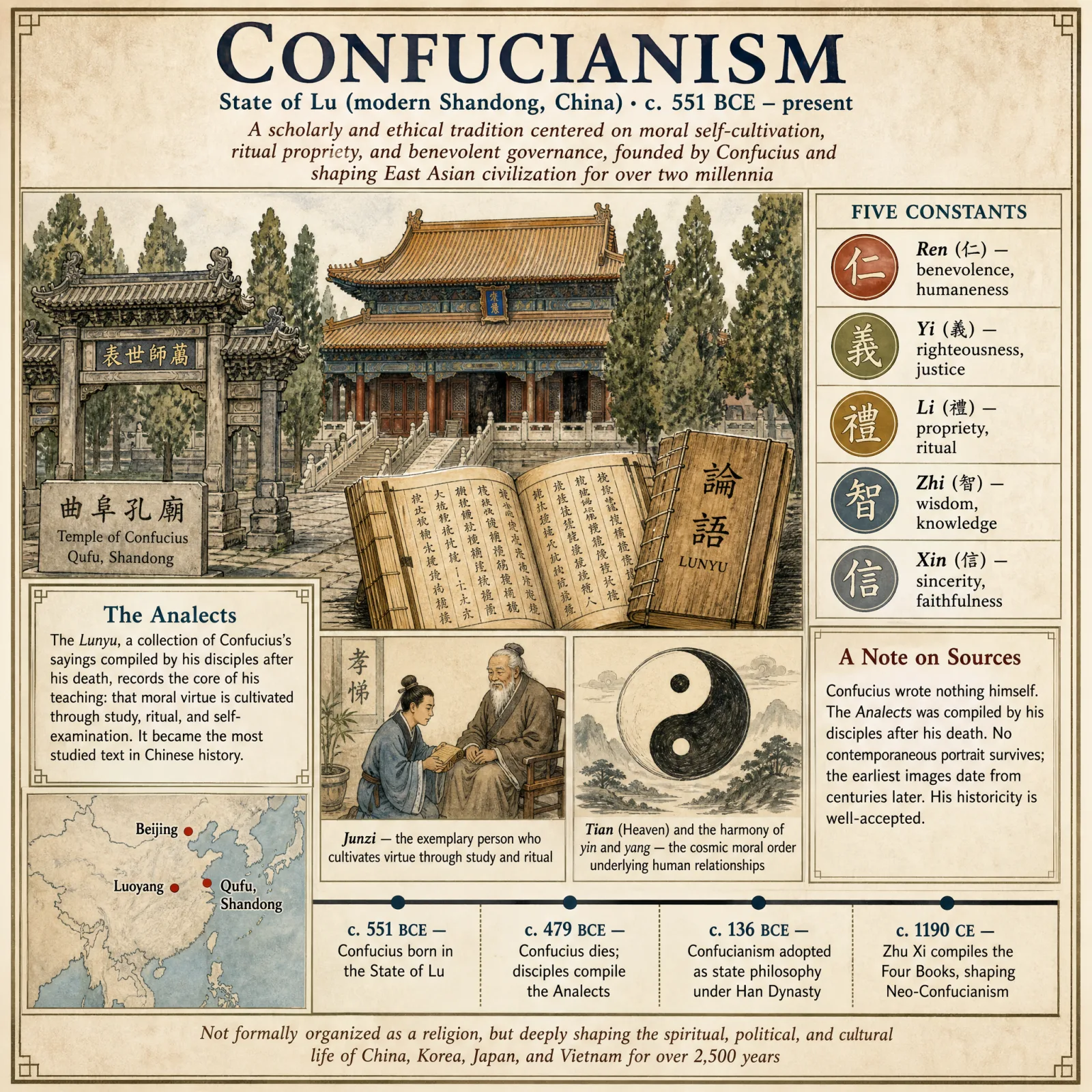
Overview
Confucianism is an ethical, philosophical, and—by some accounts—religious tradition that originated in China during the Spring and Autumn period (771-476 BCE) and has profoundly shaped East Asian civilization for over two millennia. The tradition traces its origins to Kongzi (孔子, Master Kong, latinized as Confucius, traditionally 551-479 BCE), a teacher and political advisor in the state of Lu (modern Shandong province) who sought to restore social harmony and moral order through the revival of ancient rituals, music, and ethical cultivation. Confucius compiled and transmitted the classical texts of the Zhou dynasty (1046-256 BCE), including the Shijing (詩經, Book of Songs), the Shujing (書經, Book of Documents), and he is traditionally credited with editing the Chunqiu (春秋, Spring and Autumn Annals). His teachings, recorded by disciples in the Lunyu (論語, Analects), emphasize ren (仁, humaneness, benevolence), li (禮, ritual propriety, proper conduct), yi (義, righteousness, moral duty), xiao (孝, filial piety), and the cultivation of the junzi (君子, exemplary person or gentleman) who embodies these virtues and serves as a moral exemplar for society.
Confucianism is not a monolithic tradition but rather an evolving intellectual and cultural current comprising multiple schools, interpretations, and historical adaptations. Scholars distinguish between the classical ru (儒, scholar or literati) tradition of the Warring States and early imperial periods, which included diverse thinkers such as Mengzi (Mencius, circa 372-289 BCE), who argued for the innate goodness of human nature, and Xunzi (荀子, circa 310-235 BCE), who emphasized the need for education and ritual to correct human nature's tendencies toward selfishness; the imperial Confucianism of the Han dynasty (206 BCE-220 CE) and later, which synthesized Confucian ethics, cosmology, and political theory into an official state ideology, administered through a civil service examination system based on Confucian classics; the Neo-Confucianism (理學, lixue, 'School of Principle'; or 道學, daoxue, 'School of the Way') of the Song (960-1279 CE) and Ming (1368-1644 CE) dynasties, which reinterpreted Confucianism in response to the challenges of Buddhism and Daoism, developing sophisticated metaphysics, epistemology, and theories of self-cultivation, most influentially articulated by Zhu Xi (朱熹, 1130-1200 CE) and Wang Yangming (王陽明, 1472-1529 CE); and Modern or New Confucianism of the 20th and 21st centuries, which seeks to reconcile Confucian values with Western science, democracy, and human rights. The boundaries between Confucianism as philosophy, religion, ethics, and political ideology are contested and culturally contingent; Confucianism has functioned variously as a framework for personal moral cultivation, a basis for family and social ethics, a legitimation for political authority, and a liturgical system of ancestor veneration and sacrifice to Heaven and spirits.
Today, Confucianism's influence extends across China, Korea, Japan, Vietnam, Singapore, and diaspora communities worldwide, though it is practiced and interpreted in diverse ways. In mainland China, Confucianism experienced severe persecution during the May Fourth Movement (1919) and the Cultural Revolution (1966-1976), when it was blamed for China's backwardness and feudalism, and Confucian temples were destroyed and texts burned. Since the 1980s, the Chinese government has rehabilitated Confucianism as part of China's cultural heritage, and it is promoted as a source of social harmony, moral education, and soft power, though tensions remain between Confucian ideals and Communist Party ideology. In South Korea and Taiwan, Confucianism remains central to education, family ethics, and public ceremony, with active networks of Confucian temples, academies, and ritual associations. Confucian values—filial piety, respect for education and meritocracy, emphasis on social harmony and hierarchy, cultivation of virtue—continue to shape East Asian societies, though they are also critiqued for reinforcing patriarchy, authoritarianism, and rote learning. Contemporary scholars debate whether Confucianism can serve as a resource for addressing modern challenges such as democracy, feminism, environmentalism, and human rights, or whether its hierarchical and collectivist emphases are fundamentally incompatible with liberal individualism. The historicity of Confucius and the dating and authorship of texts attributed to him and his disciples remain subjects of scholarly debate, as archaeological discoveries and textual criticism have complicated traditional narratives.
Historical Development
Confucius (Kongzi, 孔子, traditionally 551-479 BCE) was born into a minor aristocratic family in the state of Lu (in modern Shandong province) during the Spring and Autumn period, an era of political fragmentation and social upheaval following the decline of the Zhou dynasty. According to traditional accounts, compiled centuries after his death in texts such as Sima Qian's Shiji (史記, Records of the Grand Historian, circa 100 BCE), Confucius lost his father at an early age, grew up in poverty, and pursued learning with passionate dedication. He held minor government posts and traveled among various states seeking a ruler who would implement his vision of moral governance, but he was largely unsuccessful in securing political influence during his lifetime. He returned to Lu in his later years and devoted himself to teaching, attracting a circle of disciples who recorded his sayings and dialogues in the Lunyu (Analects). The historicity of Confucius and the reliability of these biographical accounts are contested among scholars. Some argue that the Confucius of the Analects is a composite figure, constructed by later disciples and editors, and that the text reflects diverse voices and concerns spanning several generations rather than a single historical teacher. Archaeological discoveries, such as the Guodian bamboo slips (circa 300 BCE) and the Shanghai Museum bamboo slips, have provided earlier versions of texts attributed to Confucius and his school, revealing significant textual fluidity and diversity.
Confucius sought to restore the li (禮, ritual propriety) and yue (樂, music) of the early Zhou dynasty, which he idealized as an era of virtuous rule under sage-kings such as the Duke of Zhou. He believed that through the proper performance of ritual, cultivation of virtue, and education, individuals could become junzi (君子, exemplary persons or gentlemen) who would transform society by moral example. Confucius emphasized ren (仁, humaneness or benevolence), the supreme virtue encompassing compassion, empathy, and love for others; yi (義, righteousness), doing what is morally right rather than what is expedient; xiao (孝, filial piety), respect and care for one's parents and ancestors, which he saw as the root of all virtue; and zhong (忠, loyalty) and shu (恕, reciprocity), treating others as one wishes to be treated. He taught that moral cultivation begins in the family, extends to service to the state, and ultimately aims at the transformation of all under Heaven (tianxia, 天下). Confucius was also a compiler and transmitter of classical texts, and he is traditionally credited with editing the Shijing (Book of Songs), Shujing (Book of Documents), and Chunqiu (Spring and Autumn Annals), though modern scholarship questions the extent of his editorial involvement.
After Confucius's death, his disciples and their successors developed and diversified his teachings. Mengzi (孟子, Mencius, circa 372-289 BCE), often considered the 'Second Sage' of Confucianism, argued that human nature is innately good (xing shan, 性善), endowed with incipient moral feelings (siduan, 四端, 'four sprouts': compassion, shame, deference, and approval/disapproval of right and wrong) that can be cultivated through education and effort to realize full virtue. Mencius advocated a benevolent government that secured the people's material welfare and moral education, and he defended the right of the people to overthrow tyrannical rulers, thereby introducing a proto-democratic strain into Confucian political thought. Xunzi (荀子, circa 310-235 BCE), by contrast, argued that human nature is inclined toward selfishness and disorder (xing e, 性惡, 'human nature is bad'), and that civilization, morality, and social order are achieved through education, ritual, and law, which restrain and redirect natural impulses. Xunzi's emphasis on ritual, music, and education as transformative practices, and his valorization of the sage-kings who created civilization, influenced later Confucian and Legalist thought. These early Confucians competed with rival schools—Mohism (which advocated universal love and utilitarian ethics), Daoism (which critiqued Confucian artifice and championed spontaneity), and Legalism (which advocated strict laws and punishments)—for influence among rulers and intellectuals.
During the Han dynasty (206 BCE-220 CE), Confucianism was established as the official state ideology under Emperor Wu (r. 141-87 BCE), who founded an imperial academy to train officials in Confucian classics and instituted a civil service examination system (though it was not fully formalized until the Sui dynasty, 581-618 CE). The scholar Dong Zhongshu (董仲舒, circa 179-104 BCE) synthesized Confucian ethics with cosmology, correlating human society with the natural order of Heaven and Earth and the cycles of yin-yang and the Five Phases (wuxing, 五行). This Han synthesis integrated Confucian morality, ritual, and statecraft with metaphysical and cosmological theories, and it portrayed the emperor as the intermediary between Heaven and humanity, responsible for maintaining cosmic and social harmony through virtuous conduct and proper ritual. Confucian values—filial piety, loyalty to the ruler, respect for education and scholarship, and adherence to ritual—became central to the state and to elite culture. The Confucian classics (initially the Five Classics: Shijing, Shujing, Yijing, Chunqiu, Liji, later expanded to include the Four Books: Lunyu, Mengzi, Daxue, Zhongyong) became the curriculum for the civil service examinations, which selected officials based on mastery of these texts and the ability to write poetry and essays. This system, with modifications, endured until 1905.
After the fall of the Han, Confucianism faced challenges from Buddhism and Daoism, which offered more developed metaphysical and soteriological systems. During the Tang (618-907 CE) and Song (960-1279 CE) dynasties, Confucian scholars responded by developing Neo-Confucianism (理學, lixue, or 道學, daoxue), a sophisticated philosophical movement that reinterpreted Confucian ethics and texts in light of Buddhist and Daoist concepts while rejecting their otherworldly orientations. The foundational figures of Neo-Confucianism include Zhou Dunyi (周敦頤, 1017-1073 CE), who introduced the concept of taiji (太極, Supreme Ultimate) and the cosmogony of the Taijitu (diagram of the Supreme Ultimate); Zhang Zai (張載, 1020-1077 CE), who articulated a materialist metaphysics based on qi (氣, vital energy or matter-energy); and the Cheng brothers, Cheng Hao (程顥, 1032-1085 CE) and Cheng Yi (程頤, 1033-1107 CE), who developed the concepts of li (理, principle or pattern) and xin (心, mind-heart) as central to understanding the cosmos and moral cultivation. Zhu Xi (朱熹, 1130-1200 CE) synthesized and systematized Neo-Confucianism, articulating a dualistic metaphysics of li (principle, the rational, intelligible, and normative pattern of things) and qi (matter-energy, the material substrate of things). Zhu Xi emphasized the investigation of things (gewu, 格物) to extend knowledge (zhizhi, 致知), the cultivation of reverence (jing, 敬) and tranquility (jing, 靜), and the reading and exegesis of the classics. His commentaries on the Four Books (Lunyu, Mengzi, Daxue, Zhongyong) became the standard for the civil service examinations during the Yuan, Ming, and Qing dynasties.
In the Ming dynasty, Wang Yangming (王陽明, also known as Wang Shouren, 1472-1529 CE) challenged Zhu Xi's orthodoxy, arguing for the unity of knowledge and action (zhixing heyi, 知行合一) and the innate knowledge of the good (liangzhi, 良知) present in every human mind-heart. Wang's teaching, known as the School of Mind (xinxue, 心學), emphasized intuitive moral insight, the extension of innate knowledge through concrete action, and the unity of inner sincerity and outer conduct. Wang's ideas inspired diverse interpretations and social activism, and they influenced later reformers and revolutionaries. Neo-Confucianism also spread to Korea, where it became deeply entrenched in the Joseon dynasty (1392-1897 CE), producing major philosophers such as Yi T'oegye (1501-1570 CE) and Yi Yulgok (1536-1584 CE); to Japan, where it influenced the Tokugawa period (1603-1868 CE), though it competed with other schools of Confucianism and with Shinto and Buddhism; and to Vietnam, where it shaped the imperial state and elite culture.
In the late 19th and early 20th centuries, Confucianism faced severe criticism as China encountered Western imperialism, military defeats, and internal rebellions. Reformers and revolutionaries blamed Confucianism for China's weakness, corruption, and resistance to modernization. The May Fourth Movement (1919) attacked Confucianism as a feudal ideology that perpetuated authoritarianism, patriarchy, and superstition, and called for 'Mr. Science and Mr. Democracy' to replace Confucian values. The Chinese Communist Party (founded 1921) initially rejected Confucianism as a reactionary ideology, though Mao Zedong's rule exhibited Confucian elements (such as emphasis on moral exemplars and mass campaigns). During the Cultural Revolution (1966-1976), Confucius was vilified in the 'Criticize Lin Biao, Criticize Confucius' campaign, Confucian temples and cemeteries were destroyed, and the Kong family (Confucius's descendants) was persecuted. Since the 1980s, under Deng Xiaoping and his successors, the Chinese government has rehabilitated Confucianism, promoting it as a source of social harmony, moral education, and Chinese cultural identity. Confucian values are now taught in schools, Confucius Institutes (language and culture centers) have been established worldwide, and Confucian scholars and intellectuals have sought to articulate a 'New Confucianism' (contemporary Confucianism) that engages with democracy, human rights, feminism, and global ethics.
Core Worldview and Doctrines
Confucianism's worldview is fundamentally anthropocentric and ethically oriented, focused on human relationships, moral cultivation, and the creation of a harmonious society. Unlike many religious traditions, Confucianism does not posit a transcendent, personal creator deity or an elaborate cosmology of heavens and hells. The concept of Tian (天, Heaven) is central but ambiguous: in early Confucian texts, Tian sometimes refers to an impersonal, normative cosmic order or pattern, sometimes to a quasi-personal moral authority that grants mandate (tianming, 天命) to virtuous rulers and withdraws it from tyrants, and sometimes simply to the natural sky or fate. Confucius himself was reticent about spirits, the afterlife, and metaphysical speculation, famously stating in the Analects: 'Respect ghosts and spirits, but keep them at a distance' (Analects 6.22), and 'Not yet understanding life, how can one understand death?' (Analects 11.12). Confucius prioritized ethical cultivation and social harmony over theological inquiry, and he regarded ritual and music as means to cultivate virtue and transform society, whether or not they invoked genuine spiritual powers.
The cornerstone of Confucian ethics is ren (仁, humaneness, benevolence, or love for others), which Confucius described as the supreme virtue encompassing all others. Ren involves empathy, compassion, and concern for the well-being of others, and it is realized through proper relationships and ritual conduct. The wulun (五倫, Five Relationships) structure the Confucian social order: ruler-subject, father-son, husband-wife, elder brother-younger brother, and friend-friend. Each relationship is characterized by specific duties and virtues: for example, the father-son relationship is governed by xiao (孝, filial piety) and paternal love; the ruler-subject relationship by zhong (忠, loyalty) and benevolence. These relationships are hierarchical but reciprocal: the superior has the duty to care for and guide the inferior, while the inferior has the duty to respect and obey the superior. Confucius emphasized that moral authority depends on virtue, not merely on status or power; a ruler who is cruel or corrupt loses the Mandate of Heaven and may be justly deposed. The cultivation of ren begins in the family through filial piety, which Confucius described as the root of virtue, and extends outward through loyalty to the ruler, service to the community, and ultimately care for all under Heaven.
Ritual propriety (li, 禮) is another central concept in Confucianism. Li encompasses formal rituals (such as ancestor worship, sacrifices to Heaven and spirits, court ceremonies, and mourning practices) as well as everyday etiquette and proper conduct in social relationships. Confucius believed that the proper performance of ritual cultivates virtue, expresses and reinforces social roles and hierarchies, and maintains cosmic and social harmony. Li is not mere external formality but must be animated by inner sincerity (cheng, 誠) and emotional appropriateness. For example, mourning rituals for deceased parents should express genuine grief and love, not merely fulfill social obligations. Music and poetry, which Confucius also emphasized, complement ritual by cultivating aesthetic and emotional refinement and by harmonizing the passions. The Confucian curriculum included mastery of the Six Arts (liuyi, 六藝): ritual, music, archery, charioteering, calligraphy, and mathematics, all aimed at producing the well-rounded, cultivated gentleman (junzi).
Neo-Confucian metaphysics, especially as articulated by Zhu Xi, posits a dualistic ontology of li (理, principle) and qi (氣, vital energy or matter-energy). Li is the rational, normative, and intelligible pattern inherent in all things; it is what makes a thing what it is (e.g., the li of humanity, the li of a pine tree). Qi is the material, psychophysical stuff of which things are composed. All things are constituted by the integration of li and qi. The taiji (太極, Supreme Ultimate) is the source and totality of all li, and it differentiates into the myriad things through the interactions of yin and yang (the polar complementary forces) and the Five Phases (wuxing, 五行: wood, fire, earth, metal, water). Human nature (xing, 性) is constituted by li and is inherently good, endowed with the moral principles of ren, yi, li, and zhi (wisdom). However, individuals are endowed with varying qualities of qi, which can obscure or distort the realization of their innate moral nature. Moral cultivation involves 'investigating things' (gewu, 格物) to apprehend their li, extending one's knowledge (zhizhi, 致知), making the will sincere (chengyi, 誠意), rectifying the mind-heart (zhengxin, 正心), cultivating the self (xiushen, 修身), regulating the family (qijia, 齊家), governing the state (zhiguo, 治國), and bringing peace to all under Heaven (ping tianxia, 平天下). This progression, articulated in the Daxue (Great Learning), one of the Four Books, outlines the Confucian vision of self-cultivation as the foundation of social and political order.
Wang Yangming's School of Mind challenged Zhu Xi's emphasis on external investigation and book learning, arguing that li is not external to the mind but is inherent in the mind-heart (xin, 心) as liangzhi (良知, innate knowledge of the good). Wang taught that knowledge and action are inseparable (zhixing heyi, 知行合一): true knowledge necessarily issues in action, and action is the realization of knowledge. Moral cultivation, therefore, is not a matter of accumulating book knowledge or analyzing external principles but of extending one's innate moral intuition through concrete action in the world, and of removing selfish desires and habits that obscure liangzhi. Wang's teaching emphasized the unity of inner sincerity and outer conduct, and it inspired social activism and efforts to educate the common people, challenging the elitism of the civil service examination system.
Sacred Texts and Canon
The Confucian canon is traditionally divided into the Five Classics (Wujing, 五經) and the Four Books (Sishu, 四書), though the boundaries and contents of the canon have evolved over time. The Shijing (詩經, Book of Songs or Classic of Poetry) is an anthology of over 300 poems dating from the early Zhou dynasty (circa 1000-600 BCE), including court hymns, aristocratic banquet songs, and folk songs. Confucius is said to have selected and edited these poems from a larger corpus, and he regarded them as essential for moral and aesthetic cultivation. The Shijing was used in the Confucian curriculum to teach moral lessons, emotional refinement, and proper conduct through the interpretation of poetic imagery and allusion. The Shujing (書經, Book of Documents or Classic of History) is a collection of historical documents, speeches, and decrees attributed to sage-kings and virtuous ministers of the Xia, Shang, and Zhou dynasties. It was revered as a record of exemplary governance and moral principles, though much of the text was lost during the Qin dynasty book-burning (213 BCE) and was reconstructed (with some forgeries) in later periods.
The Yijing (易經, Book of Changes or Classic of Changes) is a divination manual based on sixty-four hexagrams, each composed of six lines (either broken or unbroken) representing the interplay of yin and yang. Originally used for fortune-telling, the Yijing was interpreted by Confucian scholars as a cosmological and metaphysical text revealing the patterns of change and transformation in the universe. Commentaries known as the 'Ten Wings' (Shiyi, 十翼), traditionally attributed to Confucius but likely compiled later, interpret the hexagrams philosophically, emphasizing moral lessons and the cultivation of virtue in response to changing circumstances. The Chunqiu (春秋, Spring and Autumn Annals) is a terse chronicle of events in the state of Lu from 722 to 481 BCE, attributed to Confucius. Later commentaries, especially the Zuozhuan (左傳, Zuo Commentary), Gongyang Zhuan (公羊傳), and Guliang Zhuan (穀梁傳), elaborate on the Chunqiu's laconic entries and interpret them as moral judgments on the conduct of rulers and ministers. The Liji (禮記, Record of Rites or Book of Rites) is a collection of texts on ritual, etiquette, and moral philosophy compiled during the Han dynasty. It includes influential chapters such as the Daxue (大學, Great Learning) and the Zhongyong (中庸, Doctrine of the Mean), which were later extracted and elevated to canonical status as two of the Four Books.
The Four Books, canonized by Zhu Xi during the Song dynasty, became the core curriculum for the civil service examinations and the foundation of Neo-Confucian orthodoxy. The Lunyu (論語, Analects) is a collection of sayings, dialogues, and anecdotes attributed to Confucius and his disciples, compiled by later generations of students. The text is organized into twenty books and presents Confucius's teachings on ren, li, yi, xiao, the junzi, and statecraft, along with glimpses of his personality, humor, and pedagogical style. The Analects is revered as the most authentic record of Confucius's thought, though modern scholarship recognizes that the text reflects the concerns and interpretations of multiple layers of editors and compilers. The Mengzi (孟子, Mencius) is a collection of the teachings of Mencius (372-289 BCE), compiled by his disciples. The text defends the innate goodness of human nature, advocates benevolent government, and critiques rival schools of thought. Mencius's emphasis on moral intuition, the extension of compassion, and the right to rebel against tyranny has made him the most influential Confucian thinker after Confucius himself.
The Daxue (大學, Great Learning), originally a chapter of the Liji, outlines the Confucian program of moral cultivation and governance in eight steps: investigating things, extending knowledge, making the will sincere, rectifying the mind, cultivating the self, regulating the family, governing the state, and bringing peace to all under Heaven. This progression from self-cultivation to world transformation became the blueprint for Confucian ethics and political philosophy. The Zhongyong (中庸, Doctrine of the Mean), also originally a chapter of the Liji and attributed to Confucius's grandson Zisi, emphasizes the virtue of zhong (中, the mean or equilibrium) and yong (庸, constancy or ordinary), advocating a balanced, moderate approach to life and the cultivation of sincerity (cheng, 誠) as the means to realize one's nature and to harmonize with Heaven. Neo-Confucian commentaries on the Four Books, especially Zhu Xi's Sishu Zhangju Jizhu (四書章句集注, Collected Commentaries on the Four Books), shaped the interpretation and pedagogy of Confucianism for centuries. In addition to these canonical texts, the writings of later Confucian philosophers, such as Xunzi, Dong Zhongshu, Han Yu, the Cheng brothers, Zhu Xi, Wang Yangming, and modern scholars, constitute a vast and diverse Confucian literary corpus.
Practices and Observances
Confucian practice is primarily ethical and ritual rather than devotional or contemplative in the manner of some religious traditions. The core of Confucian practice is self-cultivation (xiushen, 修身), the lifelong effort to realize one's innate moral nature and to become a junzi (exemplary person). This involves the study of classical texts and history to understand moral principles and exemplars; the practice of ritual (li, 禮) to cultivate proper conduct and to express reverence, respect, and sincerity; the cultivation of virtues such as ren (benevolence), yi (righteousness), xiao (filial piety), zhong (loyalty), and xin (trustworthiness); and the application of these virtues in concrete relationships and situations. Confucian education traditionally emphasized memorization and recitation of the classics, calligraphy, poetry, and moral exegesis, aiming to internalize moral principles and to refine both intellectual and emotional capacities. Neo-Confucian practice added techniques of quiet-sitting (jingzuo, 靜坐), a form of meditation aimed at cultivating tranquility and mental clarity, and the investigation of things (gewu, 格物) to apprehend the li (principle) in phenomena. Wang Yangming's School of Mind emphasized the extension of innate moral knowledge (liangzhi) through conscientious reflection on one's thoughts and actions, and through concrete ethical engagement in the world.
Filial piety (xiao, 孝) is the foundational virtue in Confucian ethics, governing the relationship between children and parents. Xiao encompasses respect, obedience, care, and emotional devotion to one's parents during their lifetime, and the proper mourning and veneration of them after death. The Xiaojing (孝經, Classic of Filial Piety), a short text attributed to Confucius's disciple Zengzi, extols filial piety as the root of all virtue and the basis of social order. Confucian mourning rituals, prescribed in the Liji and other texts, require elaborate and prolonged mourning for deceased parents: traditionally, a son was expected to mourn for three years, living in a mourning hut, wearing coarse mourning clothes, abstaining from music and festivities, and resigning from official posts. These mourning practices were seen as expressions of genuine grief and love, and as opportunities to cultivate virtue. Confucian family rituals also include capping ceremonies (marking a young man's coming of age), weddings, and ancestral sacrifices.
Ancestor veneration is a central Confucian practice, both a domestic ritual and a state cult. Families maintain ancestral tablets (神主, shenzu), wooden plaques inscribed with the names and dates of deceased ancestors, in household shrines or ancestral halls. Regular offerings of food, incense, and wine are made to the ancestors, especially on death anniversaries and during festivals such as the Qingming (清明, Pure Brightness Festival) and Zhongyuan (中元, Ghost Festival), when families visit ancestral graves to clean and repair tombs and to make offerings. Ancestor veneration expresses filial piety beyond death, maintains continuity between past and present generations, and reinforces family identity and cohesion. In the imperial cult, the emperor performed elaborate sacrifices to Heaven (tianji, 天祭) at the Tiantan (天壇, Temple of Heaven) in Beijing, affirming his role as the Son of Heaven (tianzi, 天子) and the intermediary between Heaven and humanity. The emperor also performed sacrifices to Earth, the imperial ancestors, Confucius, and various spirits and deities. These state rituals were central to the legitimation of imperial authority and to the maintenance of cosmic and social order.
Temple rituals honoring Confucius (known as dianli, 奠禮, or jidian, 祭奠) are performed at Confucian temples (kongmiao, 孔廟 or wenmiao, 文廟, 'temples of culture') throughout East Asia, especially at the Temple of Confucius in Qufu, the ancestral seat of the Kong family. The most important ceremony is the Shidingli (釋奠禮, Ceremony of Freeing Animals), held twice a year (in spring and autumn) to honor Confucius and the sages and worthies of the Confucian tradition. The ritual involves elaborate processions, offerings of food, wine, silk, and incense, the playing of ancient music (yayue, 雅樂) with bells, drums, and flutes, and ritual dances (known as yi or wenwu) performed by rows of dancers holding feathered wands or shields and axes. Participants, including scholars, officials, and descendants of Confucius, don traditional ceremonial robes and perform prescribed prostrations and bows. The ritual is both a religious ceremony (honoring the spiritual presence of Confucius and the sages) and a cultural performance (affirming Confucian values and the continuity of the tradition). In South Korea, the Seokjeon Daeje (釋奠大祭, Grand Confucian Ceremony) at the Sungkyunkwan Confucian Academy in Seoul is recognized as an Important Intangible Cultural Property and is performed with great solemnity. In contemporary China, Taiwan, Korea, and Vietnam, Confucian rituals and festivals are promoted as part of cultural heritage, attracting tourists and serving as sites of cultural nationalism and soft power.
Internal Diversity: Schools and Movements
Confucianism is not a monolithic tradition but encompasses significant internal diversity, both historically and geographically. Scholars distinguish between the classical ru (儒, scholar or literati) tradition of the Warring States and early imperial periods, which included thinkers with diverse and sometimes conflicting views, and the more institutionalized and orthodox Confucianism of the imperial examination system and state cult. Within classical Confucianism, the two most influential schools are those of Mencius (Mengzi, 孟子, circa 372-289 BCE) and Xunzi (荀子, circa 310-235 BCE). Mencius argued for the innate goodness of human nature, endowed with incipient moral feelings (the 'four sprouts') that can be cultivated to realize full virtue. He emphasized moral intuition, the extension of compassion, and benevolent government. Xunzi, by contrast, argued that human nature is inclined toward selfishness and disorder, and that morality and social order are achieved through education, ritual, and law, which restrain and redirect natural impulses. Xunzi's emphasis on learning, ritual, and the transformative power of culture influenced later Confucian and Legalist thought. These two schools represent divergent views of human nature, moral cultivation, and the role of institutions, and they have inspired different strands of Confucian thought throughout history.
During the Song and Ming dynasties, Neo-Confucianism (理學, lixue, or 道學, daoxue) emerged as a philosophical movement that reinterpreted Confucian ethics and texts in response to the challenges of Buddhism and Daoism. Neo-Confucianism itself is diverse, encompassing multiple schools and debates. The dominant school, associated with Zhu Xi (朱熹, 1130-1200 CE), is known as the School of Principle (lixue, 理學) or Cheng-Zhu school (after the Cheng brothers and Zhu Xi). This school emphasizes the dualistic metaphysics of li (principle) and qi (vital energy), the investigation of things to extend knowledge, and the cultivation of reverence and tranquility. Zhu Xi's commentaries on the Four Books became the standard for the civil service examinations, and his synthesis dominated official Confucianism during the Yuan, Ming, and Qing dynasties. An alternative Neo-Confucian school, associated with Wang Yangming (王陽明, 1472-1529 CE), is known as the School of Mind (xinxue, 心學) or Lu-Wang school (after Lu Xiangshan and Wang Yangming). This school emphasizes the unity of knowledge and action, the innate knowledge of the good (liangzhi), and the mind-heart (xin) as the locus of moral principle. Wang's teaching was more intuitive, activist, and egalitarian than Zhu Xi's, and it inspired diverse interpretations, including radical critiques of hierarchy and orthodoxy. Neo-Confucianism also included materialist and vitalist schools, such as that of Zhang Zai (張載, 1020-1077 CE), who emphasized qi as the fundamental substance of the cosmos, and the Qing dynasty school of Dai Zhen (戴震, 1724-1777 CE), who critiqued Neo-Confucian metaphysics and emphasized empirical investigation and the balance of desires and moral principle.
Confucianism spread beyond China to Korea, Japan, and Vietnam, where it was adapted to local contexts and integrated with indigenous traditions. In Korea, Confucianism was adopted as the state ideology during the Joseon dynasty (1392-1897 CE), and it profoundly shaped Korean society, politics, education, and family structure. Korean Neo-Confucianism produced major philosophers such as Yi T'oegye (李滉, 1501-1570 CE), who synthesized and developed Zhu Xi's thought, emphasizing the priority of li over qi and the cultivation of reverence (gyeong, 敬), and Yi Yulgok (李珥, 1536-1584 CE), who emphasized the dynamic interaction of li and qi and practical statecraft. Korean Confucianism has been characterized by its rigorous adherence to ritual propriety, its emphasis on filial piety and ancestor veneration, and its intense scholastic debates over metaphysical and ethical issues. In Japan, Confucianism was introduced via Korea and China and became influential during the Tokugawa period (1603-1868 CE), when it was promoted by the shogunate as a basis for social order and loyalty. Japanese Confucianism, however, was more eclectic and pragmatic, coexisting with Buddhism, Shinto, and samurai ethics. Prominent Japanese Confucians include Hayashi Razan (林羅山, 1583-1657 CE), who served the Tokugawa shoguns and promoted Zhu Xi's teachings, and Ogyū Sorai (荻生徂徠, 1666-1728 CE), who critiqued Neo-Confucianism and advocated a return to ancient Confucian texts and institutions. In Vietnam, Confucianism was adopted by the imperial court and elite, and it shaped the civil service examination system, statecraft, and family ethics, though it coexisted with Buddhism, Daoism, and indigenous ancestor veneration.
Modern Confucianism or New Confucianism (xinruxue, 新儒學) emerged in the early 20th century as Confucian intellectuals sought to respond to the challenges of Western imperialism, science, democracy, and modernity. After the May Fourth Movement (1919) and the Communist Revolution (1949), Confucianism was vilified and suppressed in mainland China, but it was revived and reinterpreted by scholars in Hong Kong, Taiwan, and the diaspora. Influential figures include Xiong Shili (熊十力, 1885-1968 CE), who synthesized Confucianism, Buddhism, and Western philosophy; Mou Zongsan (牟宗三, 1909-1995 CE), who articulated a theory of moral metaphysics and defended the compatibility of Confucianism with democracy and science; and Tu Weiming (杜維明, b. 1940), who has promoted Confucianism as a resource for global ethics, intercultural dialogue, and the critique of Western individualism. New Confucians debate whether Confucianism can ground democracy and human rights, or whether its emphasis on hierarchy, community, and virtue is fundamentally at odds with liberal individualism. Some scholars advocate 'Confucian democracy' or 'meritocracy,' arguing that Confucian values of benevolent governance, education, and moral leadership can complement or even improve upon Western democratic institutions. Others critique Confucianism for its patriarchal, authoritarian, and conformist tendencies, and they argue that it must be radically reformed or abandoned to achieve gender equality, individual freedom, and social justice.
Communities and Demographics
Estimating the number of Confucians worldwide is extraordinarily difficult because Confucianism functions less as an exclusive religious identity than as a cultural, ethical, and philosophical tradition that coexists with other beliefs and practices. Many people in East Asia identify as Buddhist, Daoist, Christian, or non-religious while also participating in Confucian rituals (such as ancestor veneration, filial piety, and Confucian temple festivals) and adhering to Confucian values (such as respect for education, hierarchy, and family). Surveys and censuses often do not distinguish clearly between Confucianism and other traditions, and religious identity in East Asia is typically fluid and syncretic rather than exclusive. Some estimates suggest that hundreds of millions of people participate in Confucian practices or are influenced by Confucian values, though only a small fraction would identify exclusively as Confucian. The World Religion Database estimated approximately 6-7 million people who primarily identify as Confucian in 2010, but this figure almost certainly undercounts the broader influence of Confucianism.
The largest concentrations of people influenced by Confucianism are in China (including mainland China, Taiwan, Hong Kong, and Macau), South Korea, Japan, Vietnam, and Singapore, as well as among East Asian diaspora communities in North America, Europe, Southeast Asia, and Oceania. In mainland China, Confucianism experienced severe persecution during the May Fourth Movement (1919), when it was blamed for China's backwardness, and during the Cultural Revolution (1966-1976), when it was attacked as a feudal ideology, Confucian temples were destroyed, and the Kong family was persecuted. Since the 1980s, under Deng Xiaoping and his successors, the Chinese government has rehabilitated Confucianism, promoting it as a source of social harmony, moral education, and Chinese cultural identity, and as a counterweight to Western liberalism. Confucian values are taught in schools, Confucius Institutes (government-sponsored language and culture centers) have been established in over 100 countries, and Confucian scholars and intellectuals are encouraged to articulate a 'socialism with Chinese characteristics' that integrates Confucian ethics with Communist Party ideology. The Temple of Confucius in Qufu, Shandong, the ancestral home of Confucius and the seat of the Kong family, is a UNESCO World Heritage Site and a major site of pilgrimage, tourism, and state-sponsored cultural revival. Major festivals honoring Confucius's birthday (traditionally the 27th day of the 8th lunar month, or September 28 in the Gregorian calendar) are held at Confucian temples across China, with elaborate rituals, music, and dance.
In South Korea, Confucianism remains deeply influential, shaping education, family structure, business culture, and public ceremony. The Joseon dynasty (1392-1897 CE) was a Confucian state, and Confucian values—filial piety, respect for elders, education, and hierarchical social relations—are still central to Korean identity. The Sungkyunkwan Confucian Academy (成均館) in Seoul, originally the highest educational institution of the Joseon dynasty, continues to function as the headquarters of Korean Confucianism and a site of ritual observances. The Seokjeon Daeje (釋奠大祭), a grand Confucian ceremony honoring Confucius and the sages, is held twice a year at Sungkyunkwan and at the Jongmyo Shrine (宗廟), which houses the ancestral tablets of Joseon kings and queens and is also a UNESCO World Heritage Site. These rituals are performed with traditional music (jongmyo jeryeak, 宗廟祭禮樂), dance, and offerings, and they are recognized as Important Intangible Cultural Properties. Korea also has a network of local Confucian academies (seowon, 書院) and shrines (hyanggyo, 鄉校), many of which are UNESCO World Heritage Sites, where Confucian rituals and educational activities continue. Confucian values remain influential in Korean family life, education, and business, though they are also critiqued for reinforcing patriarchy, rigid hierarchy, and rote learning.
In Taiwan, Confucianism is promoted as part of Chinese cultural heritage and as a moral foundation for society. Confucian temples are active sites of worship and cultural events, and Confucian values are taught in schools. In Japan, Confucianism was influential during the Tokugawa period but declined after the Meiji Restoration (1868 CE), when Japan modernized and adopted Western institutions. Confucian values, however, continue to shape Japanese business culture, education, and social etiquette, often in combination with Shinto and Buddhist influences. In Vietnam, Confucianism shaped the imperial state and elite culture until the end of the Nguyễn dynasty (1945 CE), and it continues to influence family ethics and education, though it coexists with Buddhism, Daoism, and Catholicism. In Singapore, the government promoted Confucian values in the 1980s as part of a nation-building project to foster social cohesion, meritocracy, and moral education in a multiethnic society. Confucian ethics are taught in schools, and Confucian values are invoked to justify paternalistic governance and social discipline. Contemporary Confucianism faces challenges including the tension between Confucian hierarchy and democratic equality, the critique of Confucian patriarchy by feminists, the decline of traditional family structures and rituals in urban and modernizing societies, and the question of whether Confucianism can serve as a resource for addressing global issues such as human rights, environmentalism, and social justice.
Sacred Places and Pilgrimage Sites
Temple of Confucius, Qufu (孔廟), Shandong Province, China: The Temple of Confucius in Qufu (also known as the Kongmiao or Kong Temple) is the most important Confucian temple in the world and the ancestral temple of Confucius. Located in Qufu, Confucius's hometown in Shandong Province, the temple was first built in 478 BCE, one year after Confucius's death, to enshrine his spirit and to serve as a site of offerings and commemoration. Over the centuries, the temple was destroyed and rebuilt multiple times, and it was expanded by successive Chinese emperors who honored Confucius as a sage and teacher. The present complex, largely dating from the Ming (1368-1644 CE) and Qing (1644-1911 CE) dynasties, comprises over 100 buildings arranged along a north-south axis, modeled on imperial palace architecture. The main sanctuary, the Dacheng Dian (大成殿, Hall of Great Perfection), is a massive structure with double-eaved roofs supported by ornately carved stone pillars, and it houses a statue of Confucius. The temple complex includes courtyards, gates, pavilions, stele inscribed with imperial edicts and praise of Confucius, and ancient cypress trees. The temple is a UNESCO World Heritage Site (inscribed 1994 as part of 'Temple and Cemetery of Confucius and the Kong Family Mansion in Qufu') and a site of pilgrimage, tourism, and state-sponsored cultural revival. Grand ceremonies honoring Confucius are held twice a year (spring and autumn) with traditional music, dance, and offerings, attracting scholars, officials, and tourists from around the world. The temple symbolizes the continuity of the Confucian tradition and the enduring veneration of Confucius as China's 'First Teacher' (至聖先師, Zhisheng Xianshi).
Cemetery of Confucius (Kong Forest, 孔林), Qufu, Shandong Province, China: The Cemetery of Confucius (Konglin, 孔林, 'Kong Forest') is the burial site of Confucius, his descendants, and his disciples, and it is one of the largest and longest-used family cemeteries in the world. Located about two kilometers north of the Temple of Confucius in Qufu, the cemetery covers approximately 183 hectares and contains over 100,000 graves spanning more than 2,500 years, from Confucius's death in 479 BCE to the present day. The cemetery is a sacred landscape of ancient cypress and pine trees, stone monuments, burial mounds, and memorial structures. Confucius's tomb is marked by a simple earthen mound with a stone stele inscribed 'Tomb of the Most Holy King of Culture' (至聖文宣王墓, Zhisheng Wenxuan Wang Mu). The cemetery also contains the tombs of Kong family patriarchs, who held the hereditary title of Duke Yansheng (Yan Sheng Gong, 衍聖公, 'Duke of Perpetuating Sagehood') and served as the ritual leaders of the Confucian tradition. The cemetery is a UNESCO World Heritage Site and a site of pilgrimage and ancestor veneration. Families of the Kong clan and Confucian devotees visit the cemetery to pay respects, make offerings, and perform ancestor worship rituals. The cemetery embodies the Confucian values of filial piety, ancestor veneration, and the continuity of family and tradition across generations.
Kong Family Mansion (孔府), Qufu, Shandong Province, China: The Kong Family Mansion (Kongfu, 孔府, also known as the Mansion of the Duke of Perpetuating Sagehood) is the historical residence of the direct descendants of Confucius, the Kong family, who held the hereditary title of Duke Yansheng and served as the ritual leaders of the Confucian tradition. Located adjacent to the Temple of Confucius in Qufu, the mansion developed from a small family house into a grand aristocratic estate, expanded by successive Chinese emperors who bestowed honors, lands, and privileges on Confucius's descendants. The present complex, largely dating from the Ming and Qing dynasties, covers approximately 16 hectares with over 150 buildings, including residential quarters, reception halls, gardens, and ancestral shrines. The mansion is arranged according to traditional Chinese courtyard architecture, with official spaces (modeled on a yamen, or government office) in the front and residential quarters in the rear, reflecting Confucian principles of order and hierarchy. The mansion houses a vast collection of artifacts, including ceremonial utensils, portraits of Confucius from different periods, imperial edicts, silk and brocade garments, and over 60,000 archival documents (the Kong Family Archives, dating from the Ming and Qing dynasties), which provide invaluable records of Confucian ritual, family organization, and imperial relations. The mansion is a UNESCO World Heritage Site and a museum open to the public, offering insights into the life of the Kong family and the practice of Confucianism over the centuries. The mansion symbolizes the social and political status of Confucianism in imperial China and the intimate relationship between the Kong family, the state, and the Confucian tradition.
Beijing Confucian Temple (北京孔廟) and Guozijian (國子監), Beijing, China: The Beijing Confucian Temple (Beijing Kongmiao) and the adjacent Guozijian (Imperial College) constitute one of the most important Confucian sites in northern China. The temple was built in 1302 during the Yuan dynasty and expanded during the Ming and Qing dynasties. It served as the site of imperial sacrifices to Confucius, where the emperor and officials performed elaborate rituals to honor Confucius and the sages. The temple complex includes courtyards, gates, the Dacheng Dian (Hall of Great Perfection, the main sanctuary), and hundreds of stone steles inscribed with the names of scholars who passed the imperial civil service examinations (the 'Forest of Steles'), a testament to the Confucian ideal of meritocracy and education. The Guozijian, located directly west of the temple, was the highest educational institution in imperial China, where scholars studied the Confucian classics and prepared for the civil service examinations. The Guozijian includes the Biyong (辟雍, Circular Pool Hall), a unique structure where the emperor delivered lectures on the classics to officials and scholars, surrounded by a circular moat symbolizing the unity of Heaven and Earth. The Beijing Confucian Temple and Guozijian are now museums and cultural heritage sites, hosting exhibitions on Confucian education, ritual, and the civil service examination system. They symbolize the role of Confucianism in imperial governance and the centrality of education and meritocracy in Chinese society.
Sungkyunkwan (成均館), Seoul, South Korea: Sungkyunkwan is the most important Confucian institution in South Korea. Originally founded as the national Confucian academy during the Goryeo dynasty (918-1392 CE) and re-established as the highest educational institution during the Joseon dynasty (1392-1897 CE), Sungkyunkwan trained scholar-officials in the Confucian classics and served as the center of Confucian learning and ritual in Korea. The complex, located in central Seoul, includes the Munmyo (文廟, Confucian Shrine), which houses ancestral tablets of Confucius and the Four Sages (Mencius, Zengzi, Zisi, and Yan Hui) as well as Korean Confucian scholars, and the Myeongnyundang (明倫堂, Hall of Illustrating Human Relationships), the main lecture hall. The Seokjeon Daeje (釋奠大祭, Grand Confucian Ceremony) is performed twice a year (spring and autumn) at Sungkyunkwan to honor Confucius and the sages, with traditional music (jongmyo jeryeak), dance, and offerings. The ceremony is recognized as an Important Intangible Cultural Property of South Korea. Sungkyunkwan continues to function as the headquarters of Korean Confucianism, coordinating Confucian rituals and education across Korea, and it is also home to Sungkyunkwan University, one of Korea's leading universities, which maintains a Department of Confucian Studies. Sungkyunkwan embodies the enduring influence of Confucianism in Korean society and the continuity of Confucian ritual and education from the Joseon dynasty to the present.
Jongmyo Shrine (宗廟), Seoul, South Korea: Jongmyo is the royal ancestral shrine of the Joseon dynasty, where the spirit tablets of Joseon kings and queens are enshrined and venerated. Built in 1394, Jongmyo is the oldest and most authentic Confucian royal shrine in East Asia, and it is a UNESCO World Heritage Site (inscribed 1995). The shrine complex consists of two main buildings: the Jeongjeon (正殿, Main Hall), which houses 49 spirit tablets of kings and queens, and the Yeongnyeongjeon (永寧殿, Hall of Eternal Peace), which houses 34 additional tablets. The architecture of Jongmyo is austere and solemn, with long, low wooden halls and minimal ornamentation, reflecting Confucian values of simplicity and reverence. The Jongmyo Jerye (宗廟祭禮, Royal Ancestral Ritual) is performed annually on the first Sunday of May, with elaborate processions, offerings of food and wine, and the performance of jongmyo jeryeak (宗廟祭禮樂, Royal Ancestral Ritual Music), a unique form of ancient court music and dance that has been preserved for over 500 years and is recognized as a UNESCO Intangible Cultural Heritage. The ritual is attended by descendants of the royal family, scholars, officials, and the public, and it affirms the Confucian values of filial piety, ancestor veneration, and the continuity of the state and dynasty. Jongmyo is a powerful symbol of Korean Confucianism and the sacred relationship between the ruler, the ancestors, and the state.
Tainan Confucius Temple (臺南孔子廟), Tainan, Taiwan: The Tainan Confucius Temple is the oldest Confucian temple in Taiwan, built in 1665 during the Qing dynasty by Zheng Jing, the son of the Ming loyalist Zheng Chenggong (Koxinga). It served as the highest educational institution in Taiwan during the Qing period and as a center of Confucian learning and ritual. The temple complex includes the Dacheng Hall (Hall of Great Perfection), where Confucius is enshrined, as well as courtyards, gates, and ancillary buildings. The temple is notable for its traditional southern Fujian architectural style and its serene, scholarly atmosphere. The Tainan Confucius Temple is an important cultural heritage site and a symbol of Taiwan's Confucian tradition. Ceremonies honoring Confucius are held annually on Teachers' Day (September 28, Confucius's traditional birthday), with traditional music, dance, and offerings. The temple is also a popular tourist destination and a site for cultural education, hosting exhibitions and events on Confucian thought and Chinese culture. The Tainan Confucius Temple represents the transmission of Confucianism to Taiwan and its adaptation to local contexts, and it continues to serve as a center of Confucian learning and ritual on the island.
Contemporary Debates and Contested Issues
The historicity of Confucius and the dating and authorship of texts attributed to him and his school are contested among scholars. Traditional accounts, based on Sima Qian's Shiji (circa 100 BCE) and later hagiographies, provide a relatively coherent biography of Confucius, but modern scholarship has questioned the reliability of these sources, which were compiled centuries after Confucius's death and reflect the ideological concerns of later periods. Some scholars argue that the figure of Confucius in the Analects is a composite, constructed by generations of disciples and editors, and that the text reflects diverse and sometimes conflicting voices and concerns. Archaeological discoveries, such as the Guodian bamboo slips (circa 300 BCE) and the Shanghai Museum bamboo slips, have provided earlier versions of texts attributed to Confucius and his school, revealing significant textual fluidity and diversity. These discoveries have complicated traditional narratives of Confucian origins and have raised questions about which teachings can be reliably attributed to Confucius himself and which are later elaborations. The traditional dating of Confucius (551-479 BCE) is also debated, with some scholars arguing for alternative dates based on astronomical and calendrical calculations. The question of Confucius's historicity has implications for how we understand the origins and authority of the Confucian tradition: if Confucius is a legendary or composite figure, then Confucianism emerges not from a single foundational sage but from a broader intellectual milieu of Warring States thought.
The classification of Confucianism as religion, philosophy, or ideology is contested and culturally contingent. In Western scholarship, Confucianism has been variously categorized as a religion, a philosophy, an ethical system, a political ideology, or a form of secular humanism. This classificatory ambiguity reflects Confucianism's diversity and its integration of elements typically associated with religion (ritual, ancestor veneration, cosmology, the sacred) with elements typically associated with philosophy (ethics, metaphysics, epistemology, logic) and political thought (governance, statecraft, social order). Confucius himself was reticent about spirits, the afterlife, and metaphysical speculation, and he prioritized ethical cultivation and social harmony. Classical Confucianism lacks a personal creator deity, a doctrine of salvation, and a professional priesthood, features often associated with religion in Western definitions. However, Confucianism includes elaborate rituals (ancestor veneration, sacrifices to Heaven, Confucian temple ceremonies), a sense of the sacred (reverence for Heaven, the sages, and the classics), and a cosmology linking human society to the natural order. Some scholars argue that Confucianism is a religion if we adopt a broader, more inclusive definition of religion that emphasizes orthopraxy (correct practice) rather than orthodoxy (correct belief), and that recognizes the religious dimensions of ritual, ethics, and community. Others argue that Confucianism is better understood as a philosophy or an ethical system, and that calling it a religion imposes Western categories inappropriately. This debate has practical implications: in contemporary China, the government promotes Confucianism as cultural heritage and philosophy rather than as religion, thereby avoiding conflicts with official atheism and state regulation of religion.
The relationship between Confucianism and authoritarianism is hotly debated, especially in light of Confucianism's historical association with imperial autocracy and its contemporary promotion by authoritarian regimes. Critics argue that Confucianism reinforces hierarchical social structures, obedience to authority, and collectivism at the expense of individual freedom, dissent, and human rights. The Confucian emphasis on filial piety, loyalty to the ruler, and social harmony can be used to justify paternalistic governance, censorship, and the suppression of political opposition. The Confucian ideal of the virtuous ruler and the meritocratic civil service can mask unaccountable power and elite domination. In contemporary China, the Communist Party has rehabilitated Confucianism and promoted it as a source of social harmony and moral education, while using Confucian rhetoric to justify one-party rule and to critique Western liberalism and democracy. Defenders of Confucianism argue that the tradition is not inherently authoritarian, and that Confucian values—such as benevolent governance, accountability of rulers to Heaven and the people, and the right to rebel against tyranny (as articulated by Mencius)—can support democratic governance and the rule of law. Some scholars advocate 'Confucian democracy' or 'political meritocracy,' arguing that Confucian principles can complement or improve upon Western democratic institutions. They point to the democratic transitions in Taiwan and South Korea, which occurred in societies deeply influenced by Confucianism, as evidence that Confucianism is compatible with democracy. The debate reflects broader questions about the cultural foundations of political systems and the universality or particularity of values such as freedom, rights, and democracy.
The role of Confucianism in gender relations and patriarchy is contested and has been the subject of feminist critique. Classical Confucianism reinforced patriarchal family structures and gender hierarchies, emphasizing the subordination of women to men (wives to husbands, daughters to fathers, widows to sons) and assigning women to domestic roles. The Confucian virtue of filial piety was interpreted differently for men and women: men were expected to serve the state and continue the family line through sons, while women were expected to obey their fathers, husbands, and sons (the 'three obediences,' san cong, 三從) and to cultivate virtues such as chastity, modesty, and domesticity. Footbinding, concubinage, and restrictions on women's education and public participation were justified by Confucian norms in imperial China. Feminist scholars have critiqued Confucianism for perpetuating gender inequality and for excluding women from positions of authority, education, and moral agency. In the 20th century, reformers and revolutionaries attacked Confucianism as a feudal ideology that oppressed women, and they called for women's liberation, education, and equality. Contemporary scholars debate whether Confucianism can be reformed or reinterpreted to support gender equality and women's rights, or whether its patriarchal foundations are insurmountable. Some argue that Confucian ideals of ren, yi, and the cultivation of virtue are gender-neutral and can be applied equally to men and women, and that historical patriarchy was a distortion of Confucian principles. Others argue that Confucianism's emphasis on hierarchical relationships and differentiated roles is fundamentally at odds with egalitarian feminism, and that genuine gender equality requires a break with Confucian tradition.
Key Terms
- Ren (仁)
- Humaneness, benevolence, or love for others; the supreme virtue in Confucian ethics, encompassing compassion, empathy, and concern for the well-being of others. Ren is realized through proper relationships and ritual conduct.
- Li (禮)
- Ritual propriety, proper conduct, or etiquette; encompasses formal rituals (ancestor worship, sacrifices, ceremonies) as well as everyday manners and social norms. Li cultivates virtue and maintains social harmony.
- Yi (義)
- Righteousness, moral duty, or doing what is morally right rather than what is expedient or profitable. Yi involves judgment of what is appropriate in specific situations according to moral principles.
- Xiao (孝)
- Filial piety; respect, obedience, care, and emotional devotion to one's parents during their lifetime, and proper mourning and veneration after their death. Xiao is the root of all virtue in Confucian ethics.
- Junzi (君子)
- The exemplary person, gentleman, or superior person; the Confucian moral ideal of someone who embodies ren, li, yi, and other virtues, and who serves as a moral exemplar for society.
- Tian (天)
- Heaven; an ambiguous concept in Confucianism referring variously to an impersonal cosmic order, a quasi-personal moral authority, or simply the natural sky or fate. Tian grants the Mandate of Heaven to virtuous rulers.
- Tianming (天命)
- Mandate of Heaven; the authority to rule granted by Heaven to virtuous rulers. A ruler who is cruel or corrupt loses the Mandate and may be justly deposed, a proto-democratic concept in Confucian political thought.
- Wulun (五倫)
- The Five Relationships that structure Confucian social order: ruler-subject, father-son, husband-wife, elder brother-younger brother, and friend-friend. Each relationship has specific duties and virtues.
- Li (理)
- Principle, pattern, or rational order; a key concept in Neo-Confucian metaphysics referring to the intelligible, normative pattern inherent in all things. Li is what makes a thing what it is.
- Qi (氣)
- Vital energy, matter-energy, or psychophysical substance; the material substrate of all things in Neo-Confucian metaphysics. All things are constituted by the integration of li (principle) and qi.
- Taiji (太極)
- The Supreme Ultimate; the source and totality of all li (principle) in Neo-Confucian cosmology. The taiji differentiates into the myriad things through the interactions of yin and yang.
- Gewu (格物)
- Investigation of things; the empirical and intellectual study of phenomena to apprehend their li (principle). Gewu is the first step in Zhu Xi's program of moral and intellectual cultivation.
- Liangzhi (良知)
- Innate knowledge of the good; the intuitive moral knowledge present in every human mind-heart, according to Wang Yangming. Liangzhi must be extended through conscientious reflection and action.
- Zhixing Heyi (知行合一)
- The unity of knowledge and action; Wang Yangming's teaching that true knowledge necessarily issues in action, and that action is the realization of knowledge. Moral cultivation is not separate from practical engagement.
- Cheng (誠)
- Sincerity, authenticity, or integrity; the quality of inner genuineness and the alignment of inner thought and outer conduct. Cheng is essential for the proper performance of ritual and the realization of virtue.
- Jing (敬)
- Reverence, attentiveness, or seriousness; a mental state of focused attention and respect, cultivated through ritual and meditation, that is essential for moral cultivation in Neo-Confucianism.
- Daxue (大學)
- The Great Learning; one of the Four Books, outlining the Confucian program of moral cultivation and governance in eight steps, from investigating things to bringing peace to all under Heaven.
- Zhongyong (中庸)
- The Doctrine of the Mean; one of the Four Books, emphasizing the virtue of equilibrium (zhong) and constancy (yong), and the cultivation of sincerity (cheng) to realize one's nature and harmonize with Heaven.
- Lunyu (論語)
- The Analects; a collection of sayings, dialogues, and anecdotes attributed to Confucius and his disciples, compiled by later generations. The Analects is the most important source for Confucius's teachings.
- Ru (儒)
- Scholar, literati, or Confucian; originally referring to ritual specialists and learned men, the term came to denote adherents of the Confucian tradition.
Further Reading
- Stanford Encyclopedia of Philosophy: Confucius
- Stanford Encyclopedia of Philosophy: Song-Ming Confucianism
- Stanford Encyclopedia of Philosophy: Modern Confucianism
- Internet Encyclopedia of Philosophy: Neo-Confucian Philosophy
- Encyclopaedia Britannica: Confucianism
- UNESCO World Heritage: Temple and Cemetery of Confucius and the Kong Family Mansion in Qufu
- The Oxford Handbook of Confucianism (edited by Jennifer Oldstone-Moore, Oxford University Press, 2023)
- Bryan W. Van Norden, Virtue Ethics and Consequentialism in Early Chinese Philosophy (Cambridge University Press, 2007)
- Philip J. Ivanhoe, Confucian Moral Self Cultivation (Hackett, 2000)
- Daniel K. Gardner, The Four Books: The Basic Teachings of the Later Confucian Tradition (Hackett, 2007)
- Tu Weiming, Confucian Thought: Selfhood as Creative Transformation (SUNY Press, 1985)
Practices
- Ancestor veneration
- Ritual (li)
- Self-cultivation
- Study
Core ideas
- Virtue
- Ren — humaneness, the supreme virtue
- Sin
- Failing in duty or ritual propriety
- Deity
- Heaven (Tian) as moral order, not a person
Sacred texts
A collection of sayings and conversations of Confucius, compiled by his disciples after his death in 479 BCE. It addresses governance, personal cultivation, filial piety, and the virtue of ren (humaneness). For two millennia it was the core text of China's civil service examinations and moral education.
The teachings of Mencius (Mengzi, fourth century BCE), who argued that human nature is inherently good and that righteous governance flows from benevolent rulers. He defended the common people's right to resist tyranny and developed Confucian ideas of moral intuition. The text is one of the Four Books central to Neo-Confucianism.
A set of ancient texts — including the Book of Documents, Book of Songs, Book of Rites, Book of Changes (I Ching), and Spring and Autumn Annals — that Confucius is traditionally said to have edited. They cover history, poetry, ritual, divination, and chronicle. Confucian education treated mastery of the Classics as the foundation of wisdom and virtue.