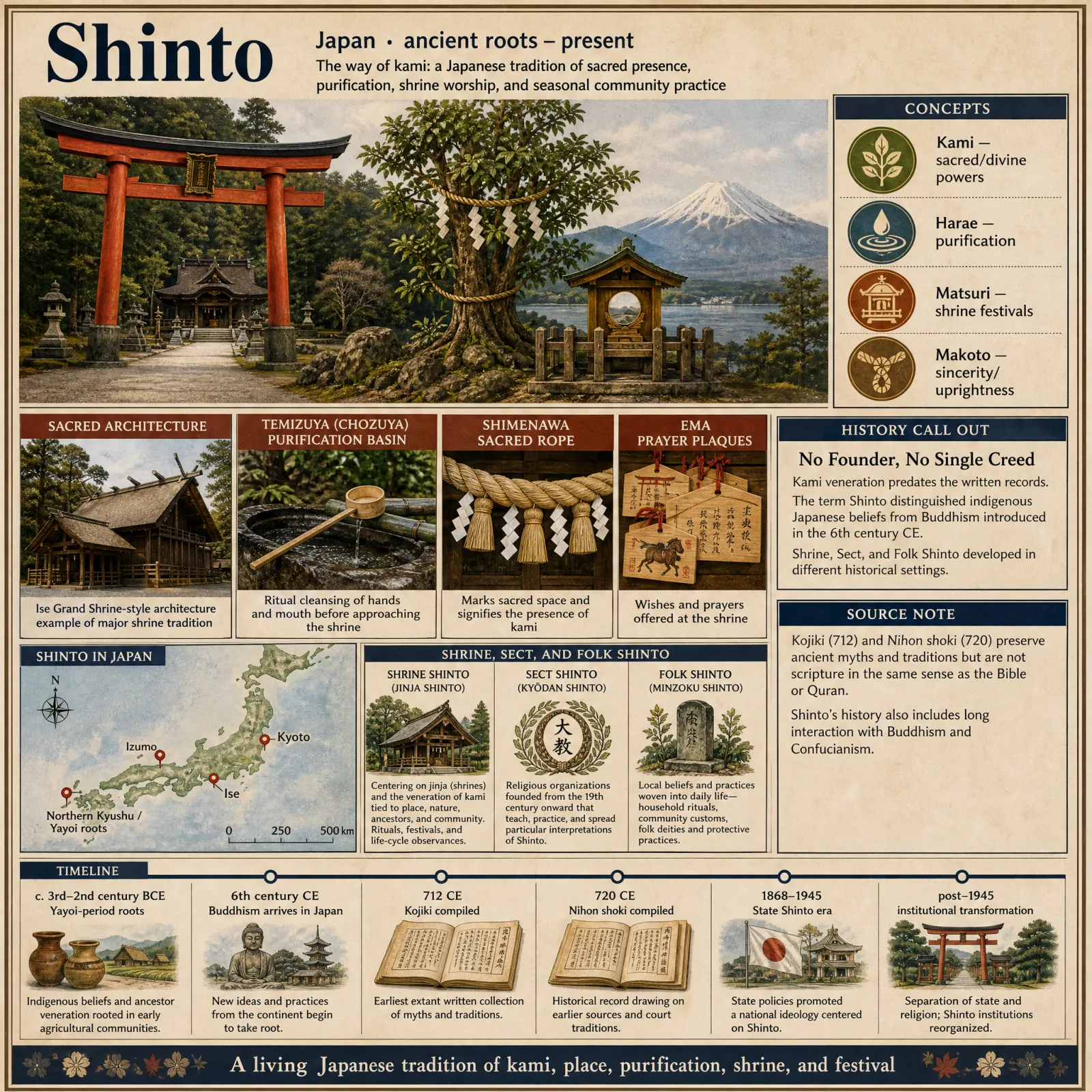
Overview
Shinto (神道, Shintō, 'the way of the kami') is the indigenous religious tradition of Japan, centered on the veneration of kami (神), spiritual beings or forces that inhabit or embody natural phenomena, places, ancestors, and abstract qualities. Kami can be mountains, rivers, trees, rocks, animals, or deified historical figures; they are not transcendent deities in the Western monotheistic sense but rather immanent presences that animate and sacralize the natural and human world. Shinto lacks a single founder, a unified scriptural canon, or a systematic theology; instead, it encompasses a diverse and fluid constellation of myths, rituals, shrines, festivals, and practices that have evolved over millennia in response to local needs, political changes, and interactions with Buddhism, Confucianism, and Daoism. The core Shinto worldview emphasizes purity (清浄, seijō), pollution (穢れ, kegare), and purification (祓い, harai); harmony with nature and community; gratitude to the kami and ancestors; and the celebration of life, fertility, and renewal through seasonal festivals (祭り, matsuri) and life-cycle rituals.
The term 'Shinto' is itself contested and historically contingent. The word first appeared in texts such as the Nihon Shoki (日本書紀, Chronicles of Japan, 720 CE) to distinguish indigenous kami worship from Buddhism (仏教, bukkyō, 'teaching of the Buddha'), which had been introduced from the Asian continent in the 6th century CE. However, for much of Japanese history, kami worship was not sharply distinguished from Buddhism, and the two traditions coexisted and interpenetrated in a complex syn cretic system known as shinbutsu shūgō (神仏習合, kami-Buddha combinatory practice), in which kami were understood as local manifestations of Buddhist deities, and Buddhist temples and Shinto shrines shared sacred sites and ritual functions. It was only during the Meiji period (1868-1912 CE) that the Japanese government forcibly separated Shinto and Buddhism (神仏分離, shinbutsu bunri), destroyed Buddhist elements from shrines, and promoted State Shinto (国家神道, Kokka Shintō), an ideology that sacralized the emperor as a living kami descended from the sun goddess Amaterasu, and that used shrine networks, Shinto rituals, and nationalist mythology to mobilize loyalty and support for imperial expansion and war. After Japan's defeat in World War II (1945), the Allied Occupation dismantled State Shinto, and Shinto was reconstituted as a voluntary, non-political religious tradition under the umbrella of the Association of Shinto Shrines (神社本庁, Jinja Honchō), which coordinates the activities of most shrines today. The categorization of Shinto as a 'religion' (宗教, shūkyō) rather than as cultural practice, national custom, or civic duty is itself a modern and Western-influenced construct that many Japanese people and scholars contest.
Today, Shinto is practiced by millions of Japanese people, though precise demographic data is elusive because most Japanese do not identify exclusively with one religion, and they participate in both Shinto and Buddhist rituals (hatsumode, or the first shrine visit of the new year, is a nearly universal practice, while funerals are typically Buddhist). Shinto shrines (神社, jinja) number over 80,000 across Japan, ranging from grand imperial shrines such as Ise Jingū and Meiji Jingū to tiny neighborhood shrines (氏神, ujigami, or tutelary kami of a community). Shinto practice encompasses shrine visits to pray for health, success, and protection; participation in seasonal festivals (matsuri) featuring processions, music, dance, and offerings; purification rituals (harai) to remove spiritual pollution; and life-cycle rites such as miyamairi (宮参り, the first shrine visit of a newborn), Shichi-Go-San (七五三, the celebration of children at ages three, five, and seven), and weddings (though most Japanese opt for Western-style or Buddhist funerals). Shinto's emphasis on harmony with nature, purity, and community ritual has also attracted global interest, and Shinto aesthetics, values, and practices have influenced Japanese arts, architecture, martial arts, and environmentalism. Contemporary debates surround the political role of Shinto, especially the relationship between shrines and the state, the veneration of war dead at Yasukuni Shrine, and the role of the emperor in Shinto rituals. Scholars also debate the historical construction of Shinto, the category of 'religion,' and whether Shinto is best understood as a religion, a cultural tradition, or a national identity marker.
Historical Development
The origins of Shinto lie in the prehistoric and protohistoric periods of Japan, before the introduction of writing and continental religious and political systems. Archaeological evidence from the Jōmon period (circa 14,000-300 BCE) and the Yayoi period (circa 300 BCE-300 CE) suggests that early Japanese communities practiced animistic worship of natural phenomena, fertility cults, and ancestor veneration, though these practices were not yet called 'Shinto' and did not constitute a unified religious system. The Kofun period (circa 300-538 CE), marked by the construction of massive keyhole-shaped burial mounds (kofun) for political elites, saw the emergence of powerful clan-based chiefdoms (uji, 氏) that claimed descent from kami and performed rituals to secure the kami's protection and blessings. Each clan venerated its own tutelary kami (ujigami, 氏神), and the ruling Yamato clan, which eventually unified much of the Japanese archipelago, claimed descent from the sun goddess Amaterasu Ōmikami (天照大御神, 'Great Divinity Illuminating Heaven'), the supreme kami in what would become the Shinto pantheon. The myth of Amaterasu and her divine mandate to the imperial line, recorded in the 8th-century texts Kojiki (古事記, Records of Ancient Matters, 712 CE) and Nihon Shoki (日本書紀, Chronicles of Japan, 720 CE), served to legitimize the Yamato rulers and to construct a cosmic and genealogical narrative linking the imperial house, the kami, and the land of Japan.
The introduction of Buddhism from the Korean peninsula in the mid-6th century CE (traditionally dated to 538 or 552 CE) profoundly transformed Japanese religious life. Initially, Buddhism was adopted by elite clans as a source of political prestige, ritual power, and continental cultural capital. Over time, Buddhism spread throughout society, and it coexisted and interpenetrated with kami worship in a complex syncretic system known as shinbutsu shūgō (神仏習合, kami-Buddha combinatory practice). From the Nara period (710-794 CE) onward, Buddhist temples and Shinto shrines were often built side by side or even within the same sacred compound; kami were understood as protectors of Buddhism and were given Buddhist names and ranks; and Buddhist monks performed rituals at shrines. Conversely, Buddhist deities were understood as manifestations (垂迹, suijaku, 'traces') of kami, or kami were seen as manifestations of Buddhas and bodhisattvas (本地垂迹説, honji suijaku setsu, 'original ground-trace theory'). This combinatory system allowed kami worship to coexist with Buddhism without being subsumed or erased, and it shaped Japanese religious practice for over a millennium. During the medieval period (12th-16th centuries), new schools of Shinto thought emerged, including Ryōbu Shinto (両部神道, 'Dual Shinto,' associated with esoteric Buddhism), Ise Shinto (伊勢神道, associated with the priests of Ise Shrine), and Yoshida Shinto (吉田神道), which sought to articulate distinctive Shinto theologies and to assert the primacy of kami over Buddhas, though these schools remained deeply influenced by Buddhist philosophy and cosmology.
The Edo period (1603-1868 CE), under the rule of the Tokugawa shogunate, saw the rise of Kokugaku (国学, 'National Learning' or 'Native Studies'), an intellectual movement that sought to recover the 'pure' indigenous thought and culture of Japan by studying classical Japanese texts (especially the Kojiki, Nihon Shoki, and the Man'yōshū, the oldest extant collection of Japanese poetry) and by rejecting foreign (especially Chinese Confucian and Buddhist) influences. Kokugaku scholars such as Motoori Norinaga (本居宣長, 1730-1801 CE) argued that Japan's ancient 'Way of the Kami' (惟神の道, kannagara no michi) was superior to Confucianism and Buddhism, that it was characterized by sincerity, purity, and spontaneity rather than by artifice and moral codes, and that the Japanese people and emperor were divinely descended from the kami. Kokugaku provided intellectual and ideological resources for the Meiji Restoration (1868), a political revolution that overthrew the shogunate, restored direct imperial rule, and embarked on a program of rapid modernization and Westernization. The Meiji government, seeking to unify and mobilize the population, promoted State Shinto (Kokka Shintō) as a civic ideology and national cult. In 1868, the government issued the shinbutsu bunri (神仏分離, 'separation of kami and Buddhas') decree, ordering the physical and institutional separation of Shinto shrines and Buddhist temples, the removal of Buddhist images and rituals from shrines, and the disestablishment of combinatory practices. This led to the haibutsu kishaku (廃仏毀釈, 'abolish Buddhism and destroy Shakyamuni') movement, in which Buddhist temples, images, and texts were destroyed or confiscated, and Buddhist clergy were forced to return to lay life. Thousands of temples were lost, though the movement's severity varied by region and eventually subsided.
Under State Shinto, shrines were organized into a national hierarchy with Ise Jingū and Yasukuni Shrine at the apex, and they were administered by the Home Ministry and the Bureau of Shrines and Temples (later the Bureau of Shrines). Shinto rituals were performed in schools, workplaces, and public spaces to cultivate loyalty to the emperor and the state. The emperor was proclaimed a 'living kami' (現人神, arahitogami) descended from Amaterasu, and imperial Shinto rituals at the palace and at Ise Jingū were central to state legitimacy. State Shinto mythology, especially the story of Japan's divine origins and the emperor's sacred lineage, was taught in schools and disseminated through mass media to create a unified national identity and to justify imperial expansion in East Asia. However, State Shinto was not a monolithic or totalizing system; it coexisted with 'Sect Shinto' (教派神道, Kyōha Shintō), thirteen officially recognized new religious movements that were classified as 'religions' and granted limited autonomy (e.g., Tenrikyō, Konkōkyō, Ōmotokyō); and it coexisted with Buddhism, Christianity, and folk religious practices, though all were subject to state surveillance and suppression if they were deemed subversive or disloyal. The ideology of State Shinto reached its apex during the militarist period (1931-1945), when shrine worship, emperor veneration, and nationalist mythology were mobilized to support total war.
After Japan's defeat in World War II (August 1945), the Allied Occupation (1945-1952) dismantled State Shinto as part of its program to democratize and demilitarize Japan. In December 1945, the Supreme Commander for the Allied Powers (SCAP) issued the Shinto Directive, which disestablished State Shinto, prohibited government support for shrines, banned the teaching of Shinto mythology and emperor worship in schools, and ordered the emperor to renounce his divinity (though Emperor Hirohito's 'Declaration of Humanity,' issued on January 1, 1946, was ambiguous and did not explicitly deny his divine descent). Shrines were reconstituted as voluntary private religious corporations under the new Religious Corporations Law (1951), and most joined the Association of Shinto Shrines (Jinja Honchō, 神社本庁), established in 1946 to coordinate shrine affairs and to represent Shinto interests to the government. Postwar Shinto has been characterized by debates over the proper relationship between shrines, the state, and the emperor; the memory of State Shinto and Japan's wartime aggression; and the tension between Shinto's claim to be the indigenous cultural tradition of Japan and its status as a 'religion' under the postwar constitution's guarantee of religious freedom and separation of religion and state. Controversies include official visits by prime ministers and cabinet members to Yasukuni Shrine, which enshrines Japan's war dead including Class A war criminals; the use of public funds for Shinto rituals; the emperor's participation in Shinto ceremonies; and nationalist Shinto groups' efforts to revise the constitution, restore patriotic education, and rehabilitate State Shinto ideology.
Core Worldview and Doctrines
Shinto's worldview is fundamentally immanent, life-affirming, and this-worldly, focused on the sacralization of nature, community, and the present moment rather than on transcendent deities, afterlife salvation, or abstract theological doctrines. The central concept is kami (神), which is notoriously difficult to define and translate. Kami are not gods in the Western monotheistic sense but rather spiritual beings, forces, or presences that possess awe-inspiring power (威, i) and that are worthy of reverence and worship. Kami can be natural phenomena (mountains, rivers, trees, rocks, waterfalls, the sun), animals (foxes, deer, snakes), ancestors (both individual and collective), deified historical figures (emperors, warriors, scholars), abstract qualities (growth, fertility, purification), and even tools or artifacts that have been imbued with spiritual presence through long use or ritual consecration. The 8th-century scholar Motoori Norinaga famously defined kami as 'anything whatsoever which was outside the ordinary, which possessed superior power, or which was awe-inspiring,' emphasizing the ineffable, numinous quality of kami rather than a fixed ontology. There is no sharp distinction between kami and humans, or between the sacred and the profane; all beings and phenomena participate in a continuum of spiritual vitality and power, and humans can become kami after death if they are venerated by descendants or if they performed extraordinary deeds.
Purity (清浄, seijō) and pollution (穢れ, kegare) are central to Shinto ethics and ritual practice. Purity is associated with life, health, fertility, growth, and harmony; pollution is associated with death, disease, blood, decay, and disorder. Pollution is not moral sin but rather a spiritual condition that disrupts one's relationship with the kami and that can spread contagiously to others. Sources of pollution include death and corpses, childbirth, menstruation, illness, and contact with decaying matter. To restore purity, one undergoes purification rituals (祓い, harai or harae), which include ritual washing (手水, temizu or chōzu, washing hands and mouth at shrines), bathing in natural water (海水, misogi, ritual purification in the sea or a river), waving purification wands (大麻, ōnusa) over people or objects, and the recitation of purification prayers (祓詞, haraekotoba). The emphasis on purity extends to Shinto architecture and aesthetics: shrines are characterized by clean, unadorned wood, gravel courtyards, and simple, elegant structures that harmonize with the natural landscape. The periodic rebuilding of major shrines, such as Ise Jingū (rebuilt every 20 years in the shikinen sengū ritual), embodies the Shinto values of purity, renewal, and the impermanence of material forms.
Shinto lacks a systematic soteriology or eschatology. There is no concept of original sin, no doctrine of salvation, and no clearly defined afterlife. Death is a source of pollution, and the dead are generally consigned to an underworld realm (黄泉の国, Yomi no Kuni, 'land of darkness,' mentioned in the Kojiki) or become ancestral spirits (祖霊, sorei) who reside near their descendants and receive offerings at household altars (神棚, kamidana) and at graves. Ancestor veneration is central to Shinto practice, though it overlaps significantly with Buddhist funerary rites, and most Japanese perform ancestor rituals through both Buddhist temples and Shinto shrines. The goal of Shinto practice is not otherworldly salvation but rather harmony, prosperity, and well-being in this life: good health, successful harvests, business success, protection from disasters, and the flourishing of family and community. This is achieved through regular shrine visits to offer prayers and gifts to the kami; participation in seasonal festivals (matsuri) that celebrate agricultural cycles, purify the community, and ensure the kami's continued blessings; and the performance of life-cycle rituals that mark transitions such as birth, coming of age, marriage, and death.
Shinto mythology, recorded in the Kojiki and Nihon Shoki, narrates the creation of the Japanese islands and the birth of the kami. According to these texts, the divine couple Izanagi no Mikoto (伊邪那岐命, 'male who invites') and Izanami no Mikoto (伊邪那美命, 'female who invites') stirred the primordial ocean with a jeweled spear, and the drops that fell from the spear formed the islands of Japan. They descended to the islands and gave birth to numerous kami, including the kami of mountains, rivers, wind, and fire. When Izanami died giving birth to the fire kami, she descended to Yomi no Kuni (the land of the dead), and Izanagi pursued her, but he was horrified by her decayed corpse and fled. Upon returning to the surface world, Izanagi performed purification rituals by bathing in a river, and from the washing of his body, three major kami were born: Amaterasu Ōmikami (天照大御神, the sun goddess) from his left eye, Tsukuyomi no Mikoto (月読命, the moon god) from his right eye, and Susanoo no Mikoto (須佐之男命, the storm god) from his nose. Amaterasu became the supreme kami and the divine ancestor of the imperial line. The myths recount conflicts and reconciliations among the kami, including Susanoo's disruptive behavior, Amaterasu's retreat into a cave (plunging the world into darkness), and her eventual emergence (restoring light). These myths have been interpreted as allegories of natural phenomena, political conflicts, and ritual patterns, and they have been central to the construction of Japanese national identity and imperial legitimacy.
Sacred Texts and Canon
Unlike many religious traditions, Shinto does not have a single canonical scripture comparable to the Bible, Quran, or Buddhist sutras. Instead, Shinto draws on a diverse corpus of texts, myths, ritual manuals, and commentaries compiled over centuries, none of which are considered divinely revealed or infallible. The two most important texts are the Kojiki (古事記, Records of Ancient Matters, 712 CE) and the Nihon Shoki (日本書紀, Chronicles of Japan, 720 CE), both commissioned by the imperial court during the Nara period to legitimize the ruling Yamato dynasty by constructing a mythological and historical narrative linking the emperor to the kami and to the divine origins of Japan. The Kojiki, compiled by Ō no Yasumaro based on oral traditions recited by Hieda no Are, is written in a mixture of classical Chinese and phonetic Japanese script, and it consists of three books: the first recounts the age of the kami (from the creation of the world to the descent of the heavenly grandson Ninigi no Mikoto, Amaterasu's grandson, to rule Japan); the second and third recount the reigns of legendary and historical emperors from Emperor Jinmu (traditionally the first emperor, circa 660 BCE, though this is mythical) to Empress Suiko (r. 593-628 CE). The Kojiki emphasizes mythological narratives and poetic language, and it has been revered by Kokugaku scholars and nationalists as the purest repository of Japan's indigenous worldview and linguistic heritage.
The Nihon Shoki, compiled by Prince Toneri and others, is written in classical Chinese and is more explicitly modeled on Chinese historical chronicles. It also consists of mythological and historical sections, covering the age of the kami and the reigns of emperors up to Empress Jitō (r. 686-697 CE). The Nihon Shoki provides multiple versions of many myths, reflecting diverse oral traditions and political agendas, and it includes more detailed genealogies, dates, and diplomatic records than the Kojiki. The Nihon Shoki was used as an official history and a tool of statecraft, and it established the narrative framework for later imperial chronicles. Both texts have been central to the construction of Japanese national mythology, imperial legitimacy, and Shinto identity, though modern scholars recognize that they are products of political and ideological projects rather than neutral records of ancient events, and that they reflect continental (Chinese and Korean) influences as much as indigenous Japanese traditions.
Other important Shinto texts include the Engishiki (延喜式, Procedures of the Engi Era, 927 CE), a compendium of laws and regulations compiled during the Heian period, which includes detailed descriptions of court Shinto rituals, lists of shrines receiving government offerings, and the texts of ritual prayers (祝詞, norito) recited at state ceremonies. The norito are formal, poetic prayers addressed to the kami, requesting blessings, protection, and purification for the emperor, the court, and the realm. The Engishiki norito have been preserved and continue to be recited at major shrines today, and they are valued as examples of classical Japanese language and religious expression. The Man'yōshū (万葉集, Collection of Ten Thousand Leaves, circa 759 CE), the oldest extant anthology of Japanese poetry, includes poems that express reverence for the kami, the emperor, and the natural world, and it has been celebrated by Kokugaku scholars as evidence of Japan's ancient aesthetic sensibility and spiritual purity. The Fudoki (風土記, Records of Wind and Earth), provincial gazetteers compiled in the 8th century, preserve local myths, place-name legends, and descriptions of shrines and sacred sites, providing valuable glimpses of regional kami worship and folk belief.
In addition to these classical texts, various Shinto schools and shrines have produced their own doctrinal and ritual texts. The Yoshida Shinto school, founded by Yoshida Kanetomo (1435-1511 CE) during the Muromachi period, claimed that Shinto was the primordial religion from which Buddhism and Confucianism derived, and it produced texts such as the Yuiitsu Shintō myōbō yōshū (唯一神道名法要集, Essential Collection of the One and Only Shinto) to articulate this claim. Ise Shinto, associated with the priests of the Ise Shrines, developed its own esoteric teachings (伊勢神道, Ise Shintō or 度会神道, Watarai Shintō) in texts such as the Shintō gobusho (神道五部書, Five Books of Shinto), which emphasized the supremacy of the outer shrine (devoted to Toyouke Ōmikami, the kami of agriculture and food) and articulated a cosmology and theology distinct from Buddhist doctrines. During the Edo period, Kokugaku scholars such as Motoori Norinaga produced massive commentaries on the Kojiki, analyzing its language, myths, and worldview to recover what they believed to be Japan's ancient 'Way of the Kami.' In the Meiji period, the government published official versions of Shinto mythology and ritual, and it promoted these texts as national scripture, though after World War II, the status of these texts as 'scripture' was contested and denationalized.
Practices and Observances
Shinto practice is primarily ritual and performative rather than doctrinal or contemplative. The core of Shinto practice is visiting shrines (神社, jinja) to venerate the kami, make offerings, and pray for blessings and protection. A typical shrine visit involves passing through a torii (鳥居, a sacred gate marking the boundary between the profane and sacred space), purifying oneself at the temizuya (手水舎, water pavilion) by washing hands and rinsing mouth, approaching the main worship hall (honden, 本殿, or haiden, 拝殿), making an offering (typically a coin tossed into an offering box), bowing, clapping (usually twice), praying silently, bowing again, and sometimes purchasing protective amulets (omamori, お守り) or fortune slips (omikuji, おみくじ). The clapping (拍手, kashiwade) is believed to attract the attention of the kami and to express respect. Shrines also sell wooden plaques (ema, 絵馬, 'picture horses') on which worshippers write prayers or wishes, and they offer ritual services such as gokitō (御祈祷, formal prayers performed by priests for health, success, protection, or purification) for a fee.
Matsuri (祭り, festivals) are central to Shinto practice and to Japanese community life. Matsuri are held throughout the year to honor the kami, celebrate agricultural cycles (planting, harvest), purify the community, ward off disasters and epidemics, and ensure prosperity and harmony. Major matsuri involve elaborate processions in which portable shrines (mikoshi, 神輿) housing the kami are carried through the streets by teams of men (and increasingly women) in traditional dress, accompanied by music (drums, flutes, bells), dance, and offerings of food and sake. Participants believe that the kami temporarily descends into the mikoshi and tours the community, blessing the people and the land. Matsuri also feature ritual performances such as kagura (神楽, sacred dance and music), theatrical reenactments of myths, sumo wrestling (originally a Shinto ritual offering), and the lighting of bonfires. Some matsuri are local and small-scale, involving a single neighborhood or village shrine; others, such as the Gion Matsuri in Kyoto (July), the Kanda Matsuri in Tokyo (May), and the Takayama Matsuri in Gifu (April and October), attract hundreds of thousands of visitors and are recognized as Important Intangible Folk Cultural Properties.
Life-cycle rituals mark important transitions and seek the kami's blessings and protection. Miyamairi (宮参り, shrine visit) is the first visit of a newborn to the local shrine (typically around the 30th day after birth) to present the child to the kami and to pray for health and protection. Shichi-Go-San (七五三, 'seven-five-three') is a festival held on November 15 when children of certain ages (girls at ages three and seven, boys at age five) visit shrines dressed in traditional clothing to give thanks for growth and to pray for continued health and happiness. Coming-of-age ceremonies (成人式, seijinshiki) are held in January for those who have reached the age of majority (20, recently lowered to 18), and many young people visit shrines to mark this transition. Weddings (神前結婚, shinzen kekkon, 'weddings before the kami') are increasingly popular Shinto rituals, though they were only formalized in the Meiji period; they involve the couple and their families offering sacred sake (三三九度, san-san-kudo, 'three-three-nine times,' a ritual exchange of sake cups), receiving blessings from a priest, and witnessing the exchange of vows before the kami. Funerals, by contrast, are almost always Buddhist, as death is a source of pollution in Shinto and is traditionally avoided by shrines and priests (though there are exceptions, and Shinto funerals do exist).
Purification rituals (祓い, harai) are performed to remove spiritual pollution (kegare) and to restore purity and harmony. Misogi (禊, ritual purification through immersion in water) involves bathing in the sea, a river, or under a waterfall to cleanse oneself of pollution and to prepare for important rituals or to seek spiritual renewal. Some Shinto groups and martial arts schools practice regular misogi as a form of asceticism and spiritual discipline. Oharae (大祓, great purification) are communal purification rituals held twice a year (June 30 and December 31) at shrines to purify the entire community of accumulated pollution from the preceding six months. Participants transfer their pollution to paper or straw dolls (人形, hitogata), which are then burned or cast into a river. The priest recites the Oharae no Kotoba (大祓詞, Great Purification Prayer), a classical norito, while waving a purification wand (大麻, ōnusa) over the participants. Shinto priests also perform purification rituals for new buildings, cars, businesses, and construction sites to remove any malevolent spirits or pollution and to ensure safety and prosperity.
Internal Diversity: Schools and Movements
Shinto is not a monolithic tradition but encompasses significant internal diversity, both historically and in contemporary practice. Scholars distinguish between several major categories of Shinto, though the boundaries among them are often fluid and contested. Shrine Shinto (神社神道, Jinja Shintō) is the most widespread and institutionalized form, comprising the network of over 80,000 shrines coordinated by the Association of Shinto Shrines (Jinja Honchō). These shrines vary greatly in size, prestige, and patronage, from major imperial shrines such as Ise Jingū and Meiji Jingū, which receive millions of visitors annually and are closely linked to the imperial house and national identity, to tiny neighborhood shrines (氏神, ujigami) serving a single community or village. Shrine Shinto emphasizes local and communal ritual, the veneration of particular kami associated with specific places and lineages, and participation in seasonal festivals (matsuri). Most Japanese people engage with Shinto primarily through shrine visits and matsuri, without belonging to any formal religious organization or professing exclusive Shinto identity.
State Shinto (国家神道, Kokka Shintō) refers to the Meiji-era (1868-1945) system in which the Japanese government promoted Shinto as a civic ideology and national cult to mobilize loyalty to the emperor and to the state. State Shinto was not a sect or denomination but rather an administrative and ideological apparatus that organized shrines into a national hierarchy, sponsored Shinto rituals in public spaces, taught Shinto mythology in schools, and sacralized the emperor as a living kami. State Shinto coexisted with 'Sect Shinto' (教派神道, Kyōha Shintō), thirteen officially recognized new religious movements that were classified as 'religions' rather than as state ideology and were granted limited autonomy (e.g., Tenrikyō, Konkōkyō, Ōmotokyō, Kurozumikyō). These movements typically centered on the revelations and charismatic leadership of a founder, and they developed distinct doctrines, scriptures, and organizational structures, though they also drew on Shinto myths, kami worship, and purification rituals. After Japan's defeat in World War II, State Shinto was dismantled by the Allied Occupation, and the Shinto Directive (1945) prohibited government support for shrines and the teaching of State Shinto ideology. However, debates continue over the legacy of State Shinto, the relationship between shrines and the state, and whether Shinto's claim to be Japan's indigenous cultural tradition can be disentangled from its history as a tool of nationalism and imperialism.
Folk Shinto (民俗神道, Minzoku Shintō) refers to the diverse and often unorganized practices of kami worship, ancestor veneration, divination, healing, and exorcism that exist outside of or alongside institutional shrine Shinto. Folk Shinto includes village festivals, household kamidana (miniature shrines for daily worship and offerings to ancestors and kami), roadside stone markers (dosojin, 道祖神, tutelary deities of roads and travelers), sacred trees and rocks tied with sacred rope (shimenawa, 注連縄) to mark them as kami-inhabited, and practices performed by itinerant ritual specialists such as yamabushi (山伏, mountain ascetics) and miko (巫女, shrine maidens and spirit mediums). Folk Shinto is characterized by syncretism with Buddhism, Daoism, Confucianism, and local customs; by pragmatic and instrumental concerns (healing, protection, divination, ensuring good harvests); and by variation across regions and communities. Many Japanese people who do not consciously identify as Shinto practitioners nonetheless observe folk Shinto customs and taboos, such as avoiding the number four (shi, 死, which sounds like 'death'), throwing salt for purification, and celebrating Shinto festivals.
Contemporary Shinto encompasses a wide spectrum of beliefs and practices, from conservative nationalist groups that seek to restore State Shinto ideology, revise the constitution, and promote emperor veneration, to liberal and progressive groups that emphasize Shinto's compatibility with environmentalism, gender equality, and interfaith dialogue. The Association of Shinto Shrines (Jinja Honchō), founded in 1946 and headquartered at Meiji Jingū in Tokyo, is the largest Shinto organization, coordinating the activities of approximately 80,000 shrines and 20,000 priests. Jinja Honchō promotes Shinto education, publishes ritual manuals and magazines, and represents Shinto interests to the government, though it is officially non-political. However, Jinja Honchō and many of its member shrines have ties to conservative political movements, including the Shinto Seiji Renmei (神道政治連盟, Shinto Association of Spiritual Leadership), which advocates for patriotic education, constitutional revision, and official recognition of Yasukuni Shrine. Not all shrines belong to Jinja Honchō; some major shrines (e.g., Fushimi Inari Taisha) and new religious movements (e.g., Tenrikyō) operate independently. There are also efforts to articulate 'modern' or 'universal' forms of Shinto that emphasize ecological harmony, reverence for nature, and pluralism, and that seek to distance Shinto from its nationalist and militarist past.
Communities and Demographics
Estimating the number of Shinto adherents is extraordinarily difficult because most Japanese people do not identify exclusively with one religion, and they participate in both Shinto and Buddhist rituals (and sometimes Christian rituals as well) without seeing contradiction. Surveys consistently show that the majority of Japanese people (70-80%) do not consider themselves religious, yet they regularly visit shrines, participate in festivals, observe life-cycle rituals, and maintain household altars for both kami (kamidana) and Buddhist ancestors (butsudan). The conventional phrase 'born Shinto, marry Christian, die Buddhist' captures this fluidity: most Japanese have Shinto rituals at birth (miyamairi), Western-style or Shinto weddings, and Buddhist funerals. The Association of Shinto Shrines (Jinja Honchō) claims over 80 million adherents, roughly 80% of Japan's population, but this figure counts anyone who has visited a shrine or participated in a Shinto ritual, and it does not reflect exclusive or conscious religious identity. Other estimates suggest that only a few million Japanese people identify primarily as Shinto, while tens of millions engage with Shinto practices and values without seeing Shinto as a 'religion' but rather as cultural tradition, national custom, or common sense.
Shinto is overwhelmingly a Japanese phenomenon, and the vast majority of shrines and Shinto practitioners are in Japan. There are over 80,000 shrines across the country, ranging from grand imperial shrines such as Ise Jingū (Mie Prefecture, dedicated to Amaterasu and the imperial ancestors) and Meiji Jingū (Tokyo, dedicated to Emperor Meiji and Empress Shōken), which receive millions of visitors annually, especially during hatsumode (初詣, the first shrine visit of the new year), to tiny roadside shrines serving a single neighborhood or family. Major Shinto festivals (matsuri) are central to community identity and social cohesion, and they attract both local participants and tourists from across Japan and around the world. Shrines are supported by offerings from worshippers, fees for ritual services (gokitō, purification rituals, weddings), the sale of amulets (omamori) and fortune slips (omikuji), and donations from patrons. Some shrines also receive income from land holdings, businesses, and investments. The Association of Shinto Shrines coordinates shrine activities, trains priests, and publishes ritual manuals, but individual shrines retain considerable autonomy in their governance and practices.
Shinto priests (神職, shinshoku or kannushi) are typically male, though there is a growing number of female priests, especially at smaller shrines. Priests are responsible for maintaining the shrine, performing rituals, offering prayers on behalf of worshippers, and serving as intermediaries between the kami and the community. Most priests are not full-time clergy; many hold secular jobs and serve part-time at local shrines. Major shrines employ multiple full-time priests and support staff, including shrine maidens (miko, 巫女), who assist with rituals, perform sacred dances (kagura), and sell amulets and omikuji. Priests are trained at Shinto universities (especially Kokugakuin University in Tokyo and Kōgakkan University in Mie Prefecture) or through apprenticeships at shrines, and they are certified by the Association of Shinto Shrines. Priestly lineages are often hereditary, with sons (and increasingly daughters) succeeding their fathers as head priests (宮司, gūji) of family-run shrines. The priestly role is primarily ritual and administrative rather than pastoral or theological; priests do not typically deliver sermons, provide spiritual counseling, or engage in theological scholarship, though there are exceptions.
Shinto has a limited but growing presence outside Japan, primarily among Japanese diaspora communities and through the establishment of branch shrines. There are Shinto shrines in Hawaii (e.g., Izumo Taishakyo Mission in Honolulu, Hilo Daijingu), California (e.g., Tsubaki Grand Shrine of America in Granite Falls, Washington), Brazil (home to the largest Japanese diaspora), and a few other countries. These shrines serve Japanese emigrants and their descendants, offering a connection to Japanese cultural identity, community, and ancestral roots. In recent decades, there has been growing global interest in Shinto, fueled by Japanese popular culture (anime, manga, video games), the global appeal of Japanese aesthetics and design, and the environmentalist and ecological dimensions of Shinto's emphasis on reverence for nature. However, Shinto remains deeply rooted in Japanese language, geography, and cultural practices, and efforts to universalize or export Shinto have been limited and contentious. Some scholars and practitioners argue that Shinto is inherently particularistic and cannot be separated from its Japanese context without losing its core meaning and identity.
Sacred Places and Pilgrimage Sites
Ise Jingū (伊勢神宮), Mie Prefecture: Ise Jingū (the Grand Shrine of Ise) is the most sacred and politically significant Shinto shrine in Japan, dedicated to Amaterasu Ōmikami (the sun goddess and supreme kami) and Toyouke Ōmikami (the kami of agriculture and food). The shrine complex consists of two main shrines: the Naikū (内宮, Inner Shrine), dedicated to Amaterasu, and the Gekū (外宮, Outer Shrine), dedicated to Toyouke, located about six kilometers apart, along with numerous auxiliary shrines. Ise Jingū is unique in its extreme simplicity and purity of architecture: the main sanctuaries are built in the ancient shinmei-zukuri style, using unpainted Japanese cypress wood, thatched roofs, and minimal ornamentation, reflecting Shinto's emphasis on naturalness and purity. Every 20 years, the entire shrine complex is rebuilt on adjacent sites in a ritual called shikinen sengū (式年遷宮, 'periodic transfer'), which has been performed for over 1,300 years (with some interruptions). This practice embodies Shinto values of renewal, impermanence, and the transmission of traditional craftsmanship. Ise Jingū is closely associated with the imperial family (the emperor serves as the shrine's chief priest, and imperial representatives perform rituals there), and it has been central to Japanese national identity and State Shinto ideology. Millions of pilgrims visit Ise annually, especially during the New Year (hatsumode) and during the shikinen sengū rebuilding ceremonies. Ise Jingū symbolizes the continuity of the imperial line, the sacredness of the Japanese land, and the spiritual heart of the nation.
Izumo Taisha (出雲大社), Shimane Prefecture: Izumo Taisha (Izumo Grand Shrine) is one of the oldest and most important Shinto shrines in Japan, dedicated to Ōkuninushi no Kami (大国主神, 'Great Lord of the Land'), the kami who, according to mythology, ruled and developed the land of Japan before ceding it to Amaterasu's descendants. Izumo Taisha is located in the Izumo region of western Japan, an area rich in ancient myths and archaeological sites. The shrine's main hall (honden) is the tallest Shinto shrine building in Japan (approximately 24 meters), built in the ancient taisha-zukuri architectural style, characterized by massive pillars and a steep thatched roof. According to tradition, during the 10th lunar month (October, known as Kannazuki, 神無月, 'month without gods,' in most of Japan), all the kami of Japan gather at Izumo Taisha for a divine assembly, and hence this month is called Kamiarizuki (神在月, 'month with gods') in Izumo. Izumo Taisha is especially popular for prayers related to marriage and relationships, as Ōkuninushi is considered a kami of matchmaking and harmony. The shrine is also significant as a counterpoint to Ise Jingū's imperial mythology, representing an alternative, older lineage of kami and a different regional power center. Izumo Taisha attracts millions of visitors annually, and its distinctive architecture, ancient myths, and regional traditions make it a vital center of Shinto worship and Japanese cultural heritage.
Fushimi Inari Taisha (伏見稲荷大社), Kyoto: Fushimi Inari Taisha is the head shrine of the Inari (稲荷) cult, dedicated to Inari Ōkami, the kami of rice, agriculture, business, and prosperity. Inari is one of the most widely worshipped kami in Japan, with tens of thousands of Inari shrines across the country (approximately one-third of all Shinto shrines are dedicated to Inari). Fushimi Inari Taisha is famous for its thousands of vermillion torii gates that form tunnels along the pathways leading up Mount Inari, donated by individuals and businesses seeking Inari's blessings for success and prosperity. The shrine's messengers are foxes (kitsune, 狐), which are believed to serve Inari and are depicted in statues throughout the shrine grounds, often holding symbolic items such as keys (to the rice granary) or jewels. Fushimi Inari Taisha has been a major pilgrimage site since the Heian period, and it attracts millions of visitors annually, including many international tourists. The shrine's association with commerce and prosperity reflects Shinto's pragmatic, this-worldly orientation and its adaptation to changing social and economic conditions. Fushimi Inari Taisha is not affiliated with the Association of Shinto Shrines (Jinja Honchō) and operates independently, reflecting the diversity and autonomy of Japanese shrines.
Itsukushima Shrine (厳島神社), Hiroshima Prefecture: Itsukushima Shrine (also known as Miyajima Shrine) is a UNESCO World Heritage Site located on the island of Itsukushima (popularly called Miyajima, 'shrine island') in the Seto Inland Sea. The shrine is dedicated to three kami: Ichikishimahime no Mikoto, Tagorihime no Mikoto, and Tagitsuhime no Mikoto, daughters of Susanoo (the storm god) and protectors of seafarers. Itsukushima Shrine is famous for its iconic floating torii gate, which appears to float on the water at high tide and stands on the tidal flats at low tide, creating one of Japan's most photographed and celebrated scenic views (one of the 'Three Views of Japan,' 日本三景, Nihon Sankei). The shrine's buildings, constructed on piers over the water, are designed to harmonize with the natural landscape, embodying Shinto's aesthetic of integrating human structures with nature. The entire island of Itsukushima has been considered sacred since ancient times, and traditionally, commoners were forbidden to set foot on the island (they had to approach the shrine by boat); even today, there are no cemeteries on the island, and births and deaths are discouraged to maintain its purity. Itsukushima Shrine has been patronized by powerful families and rulers throughout history, including the Taira clan in the 12th century and the Tokugawa shogunate. The shrine hosts numerous festivals, including the Kangensai (管弦祭, music festival, July), featuring traditional court music (gagaku) performed on boats. Itsukushima Shrine embodies Shinto's sacralization of nature, its aesthetic sensibility, and its ability to adapt to and harmonize with diverse landscapes.
Meiji Jingū (明治神宮), Tokyo: Meiji Jingū (Meiji Shrine) is dedicated to the spirits of Emperor Meiji (r. 1868-1912 CE) and Empress Shōken (1849-1914 CE), who presided over Japan's transformation from a feudal society to a modern industrial power during the Meiji Restoration. The shrine was completed in 1920 (after Emperor Meiji's death) and rebuilt in 1958 after being destroyed in World War II air raids. Meiji Jingū is located in a 70-hectare forested park in central Tokyo, created by planting over 100,000 trees donated from across Japan. The shrine is built in the nagare-zukuri architectural style, characterized by sweeping rooflines and unpainted cypress wood. Meiji Jingū is one of Japan's most popular shrines, receiving over 3 million visitors during the New Year (hatsumode) period, the highest attendance of any shrine in Japan. The shrine serves as the headquarters of the Association of Shinto Shrines (Jinja Honchō), and it is closely associated with State Shinto ideology, the emperor system, and Japanese nationalism. However, it also functions as a community shrine for Tokyo residents, hosting weddings, coming-of-age ceremonies, and festivals. Meiji Jingū symbolizes the modern construction of Shinto as a national religion, the veneration of the imperial house, and the tension between Shinto's religious and political dimensions.
Yasukuni Shrine (靖國神社), Tokyo: Yasukuni Shrine is one of the most politically controversial sites in Japan and East Asia. Founded in 1869 (initially as Tōkyō Shōkonsha, 東京招魂社) and renamed Yasukuni ('peaceful country') in 1879, the shrine was established by Emperor Meiji to enshrine and venerate the spirits of those who died in service to the emperor and the nation, beginning with soldiers who died in the Boshin War (1868-1869) that brought the Meiji government to power. Today, Yasukuni enshrines approximately 2.5 million war dead, including soldiers, sailors, and civilians who died in conflicts from the Boshin War through World War II. Controversially, Yasukuni also enshrines 14 Class A war criminals (including Prime Minister Tōjō Hideki) who were convicted by the International Military Tribunal for the Far East after World War II, and over 1,000 other convicted war criminals. The shrine's Yūshūkan (遊就館) museum presents a nationalist narrative of Japan's wars, portraying Japan as a victim of Western imperialism and justifying its military aggression in Asia as a war of liberation. Official visits to Yasukuni by Japanese prime ministers, cabinet members, and lawmakers provoke fierce domestic and international criticism, especially from China and South Korea, who view such visits as denials of Japan's wartime atrocities and as affronts to the victims of Japanese aggression. Supporters argue that Yasukuni visits honor the war dead and that criticism infringes on Japan's sovereignty and religious freedom. The Yasukuni controversy highlights unresolved tensions over the memory of World War II, the legacy of State Shinto, the relationship between shrines and the state, and the politics of reconciliation in East Asia. Yasukuni is not affiliated with the Association of Shinto Shrines, and it operates independently with support from nationalist and conservative groups.
Contemporary Debates and Contested Issues
The categorization of Shinto as 'religion' (宗教, shūkyō) is contested and has profound implications for the relationship between shrines, the state, and Japanese national identity. The concept of 'religion' as a distinct, autonomous sphere separate from politics, culture, and daily life is a Western and modern construct that was introduced to Japan during the Meiji period. Prior to the Meiji Restoration, Japanese people did not sharply distinguish 'religious' practices (kami worship, Buddhist rituals) from 'secular' activities (governance, agriculture, family life), and kami worship was thoroughly integrated into community, political, and aesthetic life. During the Meiji period, the government constructed State Shinto as a civic ideology and national cult, and it claimed that State Shinto was not a 'religion' but rather a patriotic duty and a natural expression of Japanese identity, thereby exempting it from constitutional protections of religious freedom and enabling the state to compel participation in Shinto rituals and emperor worship. After World War II, the Allied Occupation dismantled State Shinto and classified Shinto as a 'religion' under the new constitution's guarantee of religious freedom and separation of religion and state. However, many Japanese people and Shinto leaders resist this classification, arguing that Shinto is not a 'religion' in the Western sense but rather Japan's indigenous cultural tradition, national custom, or a this-worldly, non-dogmatic way of life. This debate is not merely semantic; it has practical implications for whether public officials can visit shrines, whether public funds can support shrine rituals, whether the emperor can perform Shinto ceremonies, and whether Shinto education can be included in public schools. Critics argue that claims that Shinto is 'not a religion' echo State Shinto ideology and enable the erosion of the separation of religion and state; defenders argue that Western categories of 'religion' and 'secular' cannot adequately capture the nature of Shinto and Japanese spirituality.
The historical construction of Shinto as a unified tradition is another contested issue. Modern scholars, especially those influenced by critical religious studies and postcolonial theory, argue that 'Shinto' as a coherent, continuous, and unified religious tradition is largely a modern invention, constructed during the Meiji period (and to a lesser extent during the Edo period by Kokugaku scholars) for nationalist and political purposes. They point out that before the Meiji period, kami worship was diverse, local, and syncretized with Buddhism, and that there was no single institution, doctrine, or identity called 'Shinto.' The term 'Shinto' was used sporadically and inconsistently, often to distinguish kami worship from Buddhism or Confucianism rather than to denote a unified tradition. The Meiji government's shinbutsu bunri (separation of kami and Buddhas) edict forcibly separated shrines and temples, removed Buddhist elements from shrines, and organized shrines into a national hierarchy, thereby creating the institutional and ideological boundaries of 'Shinto' as a distinct religion. This process involved the suppression of local variations, the standardization of rituals and myths, and the marginalization of practices that did not fit the new Shinto orthodoxy. Critics of this 'invention of Shinto' thesis argue that it risks erasing the genuine continuities and indigenous elements of kami worship, and that it can be used to delegitimize contemporary Shinto practice and identity. The debate reflects broader questions in religious studies about the nature of religious traditions, the role of power and politics in religious formation, and the relationship between scholarly analysis and insider perspectives.
The political role of Shinto, especially the relationship between shrines and the state, and the veneration of war dead at Yasukuni Shrine, remain deeply contentious. The postwar constitution (Article 20) guarantees freedom of religion and prohibits the state from engaging in religious activities or granting privileges to religious organizations. However, the boundaries between permissible cultural activities and impermissible religious activities are contested. Controversies include: official visits by prime ministers and cabinet members to Yasukuni Shrine, which enshrines Class A war criminals and is seen by China, South Korea, and domestic critics as a symbol of unrepentant militarism and denial of wartime atrocities; the emperor's participation in Shinto rituals at the imperial palace and at shrines (especially the Daijōsai, 大嘗祭, the emperor's accession ritual), which some argue violates the constitutional separation of religion and state; the use of public funds to support shrine festivals, rituals, or reconstructions, which is challenged by religious minorities and civil liberties groups; and the efforts by conservative politicians and Shinto organizations to revise the constitution, restore patriotic education, and rehabilitate State Shinto ideology. Supporters argue that shrines are part of Japan's cultural heritage and that honoring the war dead is a matter of national identity and gratitude, not militarism; they also argue that excessive restrictions on Shinto infringe on religious freedom and cultural expression. Critics argue that the legacy of State Shinto and Japan's wartime aggression must be confronted honestly, that shrines' ties to nationalism and conservatism threaten religious pluralism and democracy, and that the state must remain strictly neutral in religious matters. The Yasukuni controversy in particular symbolizes unresolved tensions over the memory of World War II, the nature of Japanese identity, and the proper role of religion in public life.
The role of women in Shinto, especially as priests and shrine leaders, is contested. Historically, women played important roles in Shinto as miko (巫女, shrine maidens and spirit mediums), shamans, and ritual specialists, and there are examples of female rulers and empresses who performed imperial Shinto rituals. However, during the Meiji period, the professionalization and bureaucratization of the Shinto priesthood marginalized women, and priests were almost exclusively male. After World War II, women were gradually admitted to the priesthood, and today there are several thousand female Shinto priests, though they remain a minority (approximately 5-10% of all priests). Female priests often face barriers to advancement, and most head priests (gūji) of major shrines are male. Some shrines and Shinto organizations continue to exclude women from certain roles and rituals on the grounds of menstrual pollution (though this is contested and is increasingly rare), and there are ongoing debates over whether women can serve as head priests, whether they can perform all rituals, and whether menstruation is genuinely polluting or whether these restrictions are patriarchal and anachronistic. Progressive Shinto groups and feminist scholars argue for full gender equality in the priesthood, while conservative groups defend traditional gender roles as part of Shinto's essence and cosmic order. The debate reflects broader tensions between tradition and modernity, between cultural preservation and gender justice, and between insider and outsider perspectives on Shinto.
Key Terms
- Kami (神)
- Spiritual beings, forces, or presences that inhabit or embody natural phenomena, places, ancestors, and abstract qualities. Kami are not transcendent gods but immanent powers that animate and sacralize the world.
- Shinto (神道)
- The Way of the Kami; the indigenous religious tradition of Japan, centered on the veneration of kami through rituals, festivals, and shrine worship.
- Jinja (神社)
- Shrine; a sacred structure dedicated to the veneration of kami. Japan has over 80,000 shrines, ranging from grand imperial shrines to tiny neighborhood shrines.
- Torii (鳥居)
- Sacred gate marking the entrance to a shrine and the boundary between the profane and sacred space. Torii are typically painted vermillion or left unpainted wood.
- Matsuri (祭り)
- Festival; communal celebrations held at shrines to honor the kami, celebrate agricultural cycles, purify the community, and ensure prosperity. Matsuri feature processions, music, dance, and offerings.
- Harai (祓い)
- Purification ritual to remove spiritual pollution (kegare) and restore purity (seijō). Harai includes ritual washing, bathing, and the recitation of purification prayers.
- Kegare (穢れ)
- Spiritual pollution or impurity, associated with death, disease, blood, and decay. Kegare disrupts one's relationship with the kami and can spread contagiously.
- Misogi (禊)
- Ritual purification through immersion in water (sea, river, waterfall) to cleanse oneself of pollution and to prepare for rituals or seek spiritual renewal.
- Amaterasu Ōmikami (天照大御神)
- The sun goddess and supreme kami in Shinto mythology, divine ancestor of the imperial line. Amaterasu is enshrined at Ise Jingū and is central to Japanese national identity.
- Kojiki (古事記)
- Records of Ancient Matters; a mythological and historical text compiled in 712 CE, recording the age of the kami and the origins of the imperial line.
- Nihon Shoki (日本書紀)
- Chronicles of Japan; a mythological and historical text compiled in 720 CE, providing official accounts of the kami and the imperial reigns.
- Shinbutsu Shūgō (神仏習合)
- Kami-Buddha combinatory practice; the syncretic system in which Shinto and Buddhism coexisted and interpenetrated for over a millennium (circa 6th-19th centuries).
- State Shinto (国家神道)
- Kokka Shintō; the Meiji-era (1868-1945) system in which the government promoted Shinto as a civic ideology and national cult to mobilize loyalty to the emperor and the state.
- Jinja Honchō (神社本庁)
- Association of Shinto Shrines; established in 1946 to coordinate the activities of approximately 80,000 shrines after the dismantling of State Shinto.
- Norito (祝詞)
- Formal ritual prayers addressed to the kami, recited by priests at ceremonies. Norito are valued as classical Japanese religious and literary expressions.
- Omamori (お守り)
- Protective amulets sold at shrines, believed to provide blessings, protection, and good fortune in specific areas (health, travel, exams, relationships).
- Mikoshi (神輿)
- Portable shrine carried in processions during festivals (matsuri), believed to temporarily house the kami as it tours the community.
- Kannushi (神主)
- Shinto priest; responsible for maintaining the shrine, performing rituals, and serving as an intermediary between the kami and the community.
- Kagura (神楽)
- Sacred dance and music performed at shrines to entertain and honor the kami. Kagura ranges from court dances to folk performances.
- Hatsumode (初詣)
- The first shrine visit of the new year, typically during the first three days of January. Hatsumode is one of the most widely observed Shinto practices in Japan.
Further Reading
- Stanford Encyclopedia of Philosophy: Japanese Philosophy (section on Shinto)
- Stanford Encyclopedia of Philosophy: The Kokugaku (Native Japan Studies) School
- Encyclopaedia Britannica: Shinto
- Helen Hardacre, Shinto: A History (Oxford University Press, 2017)
- Helen Hardacre, Shinto and the State, 1868-1988 (Princeton University Press, 1989)
- John Breen and Mark Teeuwen, A New History of Shinto (Wiley-Blackwell, 2010)
- Mark Teeuwen and John Breen, A Social History of the Ise Shrines: Divine Capital (Bloomsbury, 2017)
- Inoue Nobutaka, ed., Kami (Contemporary Papers on Japanese Religion 4, Kokugakuin University, 1998)
- Inoue Nobutaka, Contemporary Japanese Religion (Foreign Press Center of Japan, 2000)
- Encyclopedia of Shinto (Kokugakuin University, online resource)
Practices
- Purification (harae)
- Shrine offerings
- Matsuri festivals
- Ancestor rites
Core ideas
- Deity
- Myriad kami inhabiting nature
- Sin
- Pollution (kegare), cleansed by ritual
- Afterlife
- Ancestral spirit realm
Sacred texts
Japan's oldest chronicle, compiled in 712 CE, recording myths of the kami from creation through the age of the emperors. It tells of Izanagi and Izanami creating the islands, Amaterasu hiding in a cave, and the divine descent of Japan's imperial line. Written in a mix of Chinese characters and phonetic Japanese, it anchors Shinto ritual and national identity.
The 'Chronicles of Japan,' completed in 720 CE as a more formal, Chinese-style history parallel to the Kojiki. It includes alternate versions of creation myths and extensive genealogies of gods and emperors. Together with the Kojiki, it provides the mythological framework for shrine worship and imperial ceremony.