Overview
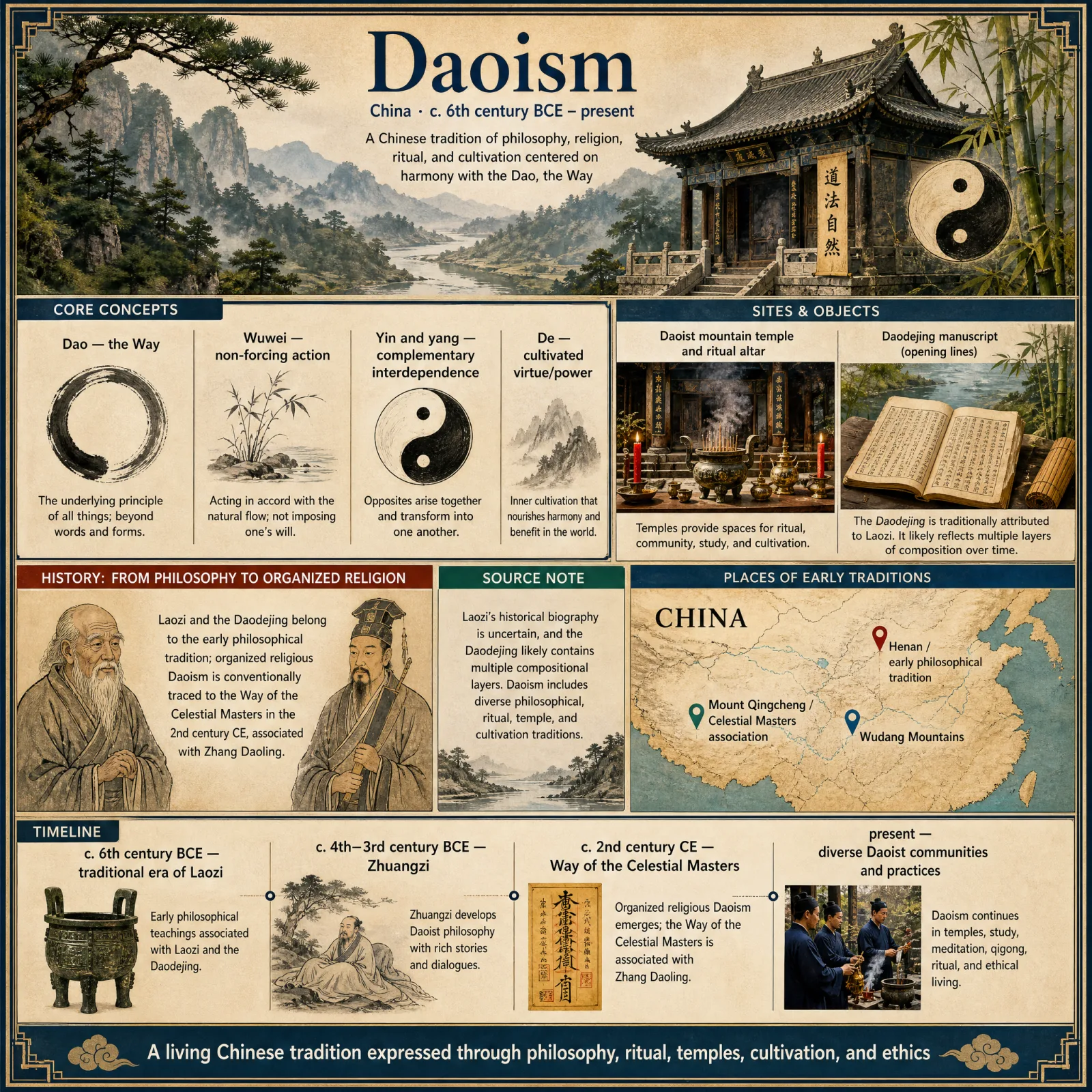
Taoism (Daoism) is a multifaceted Chinese tradition encompassing philosophy, religion, and self-cultivation practices that have shaped East Asian civilization for over two millennia. The term 'Taoism' refers to two distinct but intertwined currents: Daojia (道家, 'School of the Way'), the philosophical tradition associated with the classical texts Daodejing (attributed to Laozi) and Zhuangzi, which emphasize naturalness, spontaneity, and alignment with the Dao (道, Way); and Daojiao (道教, 'Teaching of the Way'), the organized religious tradition with ordained clergy, temples, rituals, scriptures, and a pantheon of deities. Philosophical Daoism, emerging during China's Warring States period (5th-3rd centuries BCE), critiqued Confucian and Mohist debates over social norms, advocating instead for following the natural patterns of the cosmos. Religious Daoism, crystallizing in the 2nd century CE with the Celestial Masters (Tianshi) movement founded by Zhang Daoling, integrated cosmology, meditation, alchemy, ritual, and communal ethics into a comprehensive salvational religion. Both currents share the core concept of Dao—the ineffable, spontaneous source and pattern of all existence—and the ideal of wuwei (無為, non-action or effortless action), acting in harmony with natural processes rather than forcing outcomes through artifice.
The historical development of Taoism is complex and contested. The figure of Laozi (老子, 'Old Master'), traditionally dated to the 6th century BCE and said to have been an elder contemporary of Confucius, is likely legendary; modern scholarship dates the Daodejing to the 4th-3rd centuries BCE and views it as a composite text by multiple authors. The historicity and dating of Laozi are debated, with some scholars questioning whether he ever existed as a historical person. Zhuangzi (Zhuang Zhou, circa 369-286 BCE) is better attested historically, though the text bearing his name also contains later material by his disciples. Religious Daoism emerged from diverse roots: the fangshi (方士, ritual specialists) who served rulers with techniques of longevity and divination; the Huang-Lao (黃老, Yellow Emperor and Laozi) tradition that synthesized Daoist philosophy, Legalist statecraft, and cosmology; and local cults venerating spirits and ancestors. Zhang Daoling's Celestial Masters movement (founded 142 CE in Sichuan) established a theocratic community with a moral code, rituals of confession and healing, and a priesthood that transmitted texts and ordinations. During the medieval period (3rd-6th centuries CE), new Daoist movements arose, including the Shangqing (上清, Highest Clarity) and Lingbao (靈寶, Numinous Treasure) traditions, which emphasized meditation, visualization, and elaborate liturgies. Daoism was patronized by Tang dynasty (618-907 CE) emperors, who claimed descent from Laozi, and it influenced Chinese Buddhism, which adopted Daoist terminology and practices. The Quanzhen (全真, Complete Perfection) monastic reform movement, founded by Wang Chongyang in the 12th century, synthesized Daoism, Buddhism, and Confucianism, promoting celibacy, meditation, and internal alchemy. The Zhengyi (正一, Orthodox Unity) tradition, descending from the Celestial Masters, maintained a married priesthood and focused on communal rituals.
Today, Taoism is practiced by millions across China, Taiwan, Hong Kong, Southeast Asia, and diaspora communities worldwide, though accurate demographic data is difficult to obtain due to the fluid boundaries between Daoism, Confucianism, Buddhism, and Chinese folk religion. The People's Republic of China recognizes Daoism as one of five official religions, administered by the Chinese Daoist Association (headquartered at Baiyun Guan, Beijing). Daoist practice encompasses temple worship, festivals, pilgrimages to sacred mountains, meditation, qigong (氣功, cultivation of vital energy), internal alchemy (neidan, 內丹), liturgical rituals performed by priests, and the study of classical texts. The Daozang (道藏, Daoist Canon), compiled during the Ming dynasty (1445 CE), contains over 1,400 texts spanning philosophy, ritual, meditation, medicine, astrology, and hagiography. Contemporary Taoism faces challenges including the loss of traditional knowledge during the Cultural Revolution (1966-1976), when temples were destroyed and clergy persecuted; the tension between state regulation and religious autonomy; and the task of transmitting esoteric teachings to younger generations in a rapidly modernizing society. Daoist concepts—such as yin-yang duality, wuwei, and the cultivation of vital energy—have deeply influenced Chinese medicine, martial arts (especially taijiquan, 太極拳), landscape aesthetics, poetry, and governance, and they continue to attract global interest in an era seeking sustainable, nature-centered philosophies.
Historical Development
The origins of philosophical Daoism lie in the intellectual ferment of China's Warring States period (5th-3rd centuries BCE), when competing schools debated the nature of the Dao (Way), the source of legitimate authority, and the proper ordering of society. The Daodejing, traditionally attributed to Laozi, is now dated by most scholars to the 4th or 3rd century BCE based on linguistic analysis and references in other texts. The historicity of Laozi is contested: Sima Qian's Shiji (Records of the Grand Historian, circa 100 BCE) provides conflicting accounts, including one identifying Laozi as Lao Dan, an archivist in the Zhou court who met Confucius; another as Lao Laizi, a contemporary of Confucius; and another as the Grand Historian Dan, who lived over a century later. Some modern scholars, including A. C. Graham, argue that Laozi is entirely legendary, a personification of the text itself. The Daodejing, comprising 81 short chapters in poetic, enigmatic language, critiques conventional values, political ambition, and the multiplication of laws and rituals, advocating instead for simplicity, humility, and alignment with the spontaneous processes of nature. Its opening line, 'Dao that can be dao-ed (spoken) is not the constant Dao,' introduces a meta-linguistic skepticism about the limits of language and conceptual knowledge. The ideal sage-ruler practices wuwei (non-action or effortless action), governing so subtly that the people believe they are self-governing.
Zhuangzi (Zhuang Zhou, circa 369-286 BCE) is the other foundational figure of philosophical Daoism. The text bearing his name, traditionally divided into 'Inner Chapters' (likely by Zhuangzi himself), 'Outer Chapters,' and 'Miscellaneous Chapters' (by later disciples and editors), is more playful, satirical, and philosophically sophisticated than the Daodejing. Zhuangzi employs paradoxes, parables, and fantastical dialogues to undermine dogmatic thinking and to illustrate the relativity of perspectives. Famous anecdotes include Zhuangzi dreaming he was a butterfly (raising questions about the nature of reality and identity) and his refusal to become a court minister, preferring to be 'a live turtle dragging its tail in the mud' rather than a dead, venerated tortoise shell in a temple. Zhuangzi critiques the Confucian emphasis on ritual propriety (li) and moral categories (ren, yi), arguing that such distinctions are conventional and ultimately arbitrary. He advocates for a life of spiritual freedom (xiaoyao, 逍遙), attuning oneself to the spontaneous transformations of the Dao and accepting death as a natural part of the cosmic process. Zhuangzi's thought influenced later Chinese Buddhism, especially Chan (Zen), which adopted Daoist vocabulary and paradoxical teaching methods.
Religious Daoism emerged from multiple streams: the fangshi (ritual specialists who served rulers with divination, astrology, and techniques of immortality); the Huang-Lao tradition (which synthesized Daoist philosophy, Legalist statecraft, and cosmology, and was influential in the early Han dynasty, 206 BCE-9 CE); and local cults venerating spirits, ancestors, and deified heroes. The Celestial Masters (Tianshi Dao, 天師道) movement, founded by Zhang Daoling in 142 CE in the mountains of Sichuan, is considered the first organized Daoist religious community. According to tradition, Zhang received a revelation from the deified Laozi (Taishang Laojun, 太上老君, 'Most High Lord Lao'), who appointed him Celestial Master and commanded him to establish a new covenant to replace the corrupt cults of local spirits. The Celestial Masters organized communities into parishes (zhi, 治), each led by a libationer (jijiu, 祭酒) who performed rituals of confession, healing, and exorcism. Members paid a 'tax of five pecks of rice' (hence the movement's alternative name, Wudoumi Dao, Five Pecks of Rice Daoism), and they followed a moral code (the 180 Precepts) emphasizing honesty, compassion, and communal harmony. The Celestial Masters established a theocratic state in Sichuan that lasted until 215 CE, when it was incorporated into the Cao Wei kingdom. The lineage of Celestial Masters continued, transmitting texts, rituals, and the hereditary title of Tianshi (Celestial Master) through the Zhang family, which relocated to Longhu Shan (Dragon Tiger Mountain) in Jiangxi province and became the center of the Zhengyi (Orthodox Unity) tradition.
During the 4th-6th centuries CE, new Daoist movements arose, shaped by the political fragmentation of the Six Dynasties period and by interaction with Buddhism, which had been introduced to China from India. The Shangqing (Highest Clarity) tradition, revealed through spirit-writing séances to the medium Yang Xi (330-386 CE), emphasized meditation, visualization of celestial palaces and deities, and the ingestion of talismans to purify the body and ascend to heavenly realms. Shangqing texts, written in elegant literary style, were associated with aristocratic families in the Jiangnan (south of the Yangtze River) region. The Lingbao (Numinous Treasure) tradition, emerging slightly later (late 4th-early 5th centuries CE), synthesized Daoist, Buddhist, and Confucian elements, introducing large-scale communal rituals (jiao, 醮) for cosmic renewal and the salvation of the dead, a concept of universal salvation influenced by Mahayana Buddhism, and an expanded pantheon of deities organized into a celestial bureaucracy. The Lingbao canon introduced the concept of the Sanqing (三清, Three Pure Ones)—Yuanshi Tianzun (元始天尊, Celestial Venerable of the Primordial Beginning), Lingbao Tianzun (靈寶天尊, Celestial Venerable of the Numinous Treasure), and Daode Tianzun (道德天尊, Celestial Venerable of the Dao and Its Virtue, identified with Laozi)—as the supreme triad of deities. These medieval movements produced vast scriptural corpora, monastic institutions, and a priesthood trained in complex liturgies.
Daoism flourished under the Tang dynasty (618-907 CE), when emperors, who claimed descent from Laozi, patronized Daoist temples, ordained clergy, and commissioned compilations of Daoist texts. The Tang court established a Bureau of Daoism to regulate ordinations and temples, and Daoist priests were given official ranks. The Daodejing was designated a Confucian classic, required reading for civil service examinations. However, Daoism also faced competition and conflict with Buddhism, leading to periodic persecutions of both religions (most severely in 845 CE, when thousands of Buddhist and Daoist monasteries were shut down). During the Song dynasty (960-1279 CE), Daoism was officially supported, and new compilations of the Daoist Canon were undertaken. The Quanzhen (Complete Perfection) monastic reform movement, founded by Wang Chongyang (1113-1170 CE) and his Seven Disciples, synthesized Daoism, Buddhism, and Confucianism, advocating celibacy, meditation, internal alchemy (neidan, the cultivation of an 'immortal embryo' within the body through breath control, visualization, and the circulation of qi), and ethical conduct. Quanzhen monasteries, especially those on sacred mountains such as Wudang Shan, became major centers of Daoist learning and practice. The Zhengyi (Orthodox Unity) tradition, which maintained a married priesthood and focused on communal rituals, liturgy, and exorcism, continued under the leadership of the Celestial Masters at Longhu Shan. Under the Yuan (1271-1368 CE), Ming (1368-1644 CE), and Qing (1644-1912 CE) dynasties, Daoism was officially recognized and regulated, though it also faced intermittent suppression. The Ming dynasty sponsored the compilation of the Daozang (Daoist Canon) in 1445 CE, comprising over 5,000 volumes. Under the People's Republic of China (1949-present), Daoism experienced severe persecution during the Cultural Revolution (1966-1976), when temples were destroyed, clergy forced to return to lay life, and texts burned. Since the 1980s, the Chinese government has permitted the gradual revival of Daoism under state supervision, and many temples have been rebuilt and reopened.
Core Worldview and Doctrines
The Dao (道, Way) is the central and most elusive concept in Daoism. It is the ineffable source, pattern, and process underlying all existence. The Daodejing describes the Dao as formless, nameless, and beyond conceptualization: 'The Dao that can be spoken is not the constant Dao; the name that can be named is not the constant name.' The Dao is both transcendent (preceding and surpassing the manifested world) and immanent (pervading all things). It is the spontaneous (ziran, 自然, 'self-so' or 'naturalness'), non-purposive generative force of the cosmos, producing the myriad things without intention or desire. The Dao gives rise to De (德, virtue, power, or efficacy), which is the particular manifestation of the Dao in individual beings and things. In the Daodejing, De is not moral virtue in the Confucian sense but rather the natural potency or integrity of a thing when it is aligned with the Dao. The ideal is to embody De by practicing wuwei (non-action, effortless action), which means acting in accordance with natural processes without forcing, striving, or imposing artificial constructs. Wuwei is not passivity but rather a mode of action so attuned to circumstances that it leaves no trace and achieves its ends without struggle.
Daoist cosmology envisions the Dao as giving birth to the cosmos through a process of spontaneous differentiation. The Daodejing states: 'The Dao generates One; One generates Two; Two generates Three; Three generates the myriad things.' This is often interpreted as: the Dao produces primordial unity (the One); unity differentiates into duality (the Two: yin and yang, the complementary and interdependent polar forces); duality interacts to produce triplicity (Heaven, Earth, and Humanity, or the harmonious blending of yin and yang); and from triplicity arise all phenomena. Yin (陰) and yang (陽) are not static opposites but dynamic, interpenetrating phases: yin is associated with darkness, receptivity, rest, femininity, and earth; yang with light, activity, dynamism, masculinity, and heaven. Health, harmony, and flourishing depend on the balance and smooth circulation of yin and yang. The cosmos is envisioned as an organic whole, a self-regulating process without a personal creator deity (in the philosophical tradition) or as animated by a vast pantheon of deities and spirits (in the religious tradition). Time is cyclical, and transformation is constant; Zhuangzi emphasizes the inevitability of change and the folly of clinging to fixed identities or states.
Daoist anthropology views human beings as microcosms of the cosmos, composed of the same vital substances that constitute the universe: jing (精, essence, associated with reproductive and physical vitality), qi (氣, vital breath or energy, the animating force of life), and shen (神, spirit or consciousness). Jing is finite and depletes with age and activity (especially sexual activity); qi must be cultivated and circulated to maintain health; shen must be refined and stabilized through meditation. The goal of Daoist self-cultivation is to nourish and preserve these 'Three Treasures' (sanbao, 三寶) to achieve health, longevity, and—in some traditions—physical immortality. This is pursued through yangsheng (養生, 'nourishing life') practices: breath control (tuna, 吐納, 'exhaling the old, inhaling the new'), dietary regimens, sexual hygiene, physical exercises (such as daoyin, 導引, stretching and calisthenics, precursors to modern qigong and taijiquan), meditation, and the ingestion of herbal elixirs or alchemical substances. In internal alchemy (neidan), the practitioner refines jing into qi, qi into shen, and shen into emptiness (xu, 虛) or the Dao itself, cultivating an 'immortal embryo' (xiantai, 仙胎) within the body, which can survive the death of the physical form and ascend to heaven as an immortal (xian, 仙).
Religious Daoism developed a complex soteriology and eschatology. The cosmos is divided into multiple realms: heavens (tian, 天) inhabited by deities and perfected immortals; the earthly realm where humans, animals, and spirits coexist; and underworld hells (diyu, 地獄) where the souls of the wicked are punished (a concept influenced by Buddhism). Human souls are composite: the hun (魂, ethereal soul, associated with yang and consciousness) ascends after death, while the po (魄, corporeal soul, associated with yin and the physical body) descends. Through moral conduct, ritual observance, meditation, and the grace of the deities, one can achieve salvation: the integration and elevation of the hun and po, transformation into an immortal, and residence in celestial paradises. The pantheon includes the Sanqing (Three Pure Ones) as the highest deities, the Jade Emperor (Yuhuang, 玉皇, who oversees the celestial bureaucracy), the Queen Mother of the West (Xiwangmu, 西王母, a goddess of immortality), the deified Laozi (Taishang Laojun), the Eight Immortals (Baxian, 八仙, legendary figures who attained immortality), and countless local deities, spirits, and ancestors. Daoist priests perform rituals (fajiao, 法醮) to invoke the deities, exorcise demons, heal the sick, ensure prosperity, and guide the souls of the dead. Major communal rituals, such as the jiao (醮, rites of cosmic renewal), can last for days and involve elaborate processions, offerings, music, dance, and the recitation of scriptures.
Sacred Texts and Canon
The Daodejing (道德經, Classic of the Way and Its Virtue), also known as the Laozi, is the most famous and widely translated Daoist text. Traditionally attributed to Laozi, a semi-legendary sage of the 6th century BCE, the text is now dated by most scholars to the 4th or 3rd century BCE and is understood as a composite work by multiple authors. It consists of 81 short chapters (divided into two parts: the Dao Jing, chapters 1-37, and the De Jing, chapters 38-81), written in terse, poetic, and often paradoxical language. The Daodejing critiques conventional values—fame, wealth, power, knowledge—and advocates for simplicity, humility, softness, and yielding. It describes the Dao as ineffable, formless, and spontaneous, and it extols wuwei (non-action or effortless action) as the ideal mode of conduct for both individuals and rulers. The text has been interpreted in diverse ways: as a manual of statecraft, a guide to personal spirituality, a work of mysticism, and a philosophical critique of language and knowledge. It has been translated into more languages than any book except the Bible and has influenced Chinese thought, politics, art, and religion for over two millennia. Archaeological discoveries of early manuscripts, such as the Mawangdui silk texts (circa 168 BCE) and the Guodian bamboo slips (circa 300 BCE), have provided valuable insights into the text's early versions and evolution.
The Zhuangzi (莊子), named after its author Zhuangzi (Zhuang Zhou, circa 369-286 BCE), is the other foundational text of philosophical Daoism. The received text, edited by the scholar Guo Xiang in the 3rd century CE, consists of 33 chapters, traditionally divided into the 'Inner Chapters' (chapters 1-7, likely by Zhuangzi himself), the 'Outer Chapters' (chapters 8-22), and the 'Miscellaneous Chapters' (chapters 23-33), the latter two by later disciples and editors. The Zhuangzi is a literary and philosophical masterpiece, employing parables, dialogues, satire, fantasy, and paradox to convey its vision of spiritual freedom and harmony with the Dao. Famous passages include the butterfly dream (questioning the distinction between dreaming and waking, self and other), the story of Cook Ding (whose skillful butchering exemplifies wuwei), and dialogues with Hui Shi (a logician and friend of Zhuangzi) debating the nature of knowledge and happiness. The Zhuangzi critiques Confucian moralism, Mohist utilitarianism, and the ambitions of power-seekers, advocating instead for a life of spontaneity, acceptance of change (including death as a natural transformation), and the relativity of perspectives. The text's humor, imagination, and philosophical depth have made it one of the most beloved works in Chinese literature, influencing poetry, painting, Chan Buddhism, and Neo-Daoism (xuanxue, 玄學) in the Wei-Jin period (3rd-4th centuries CE).
The Daozang (道藏, Daoist Canon) is the comprehensive collection of Daoist scriptures, compiled over centuries and reaching its definitive form in the Ming dynasty (1445 CE). The Ming Daozang contains over 5,000 volumes organized into three main sections (san dong, 三洞, 'Three Caverns'): the Dongzhen (洞真, Cavern of Perfection, associated with Shangqing texts), the Dongxuan (洞玄, Cavern of Mystery, associated with Lingbao texts), and the Dongshen (洞神, Cavern of Spirit, associated with Sanhuang and earlier texts). Supplementary sections include commentaries, biographical hagiographies, and ritual manuals. The Daozang encompasses an extraordinary diversity of materials: philosophical treatises, meditation manuals, liturgical texts, alchemical formulae, medical recipes, exorcism spells, cosmological diagrams, maps of sacred mountains, hagiographies of immortals and patriarchs, moral precepts, and historiographical works. Major texts include the Taiping Jing (太平經, Scripture of Great Peace, circa 2nd century CE, a utopian and apocalyptic text associated with the Yellow Turban Rebellion); the Shangqing and Lingbao scriptural corpora (4th-5th centuries CE); the Baopuzi (抱朴子, Master Who Embraces Simplicity, by Ge Hong, early 4th century CE, a compendium of alchemical and immortality techniques); the Huangting Jing (黃庭經, Scripture of the Yellow Court, a meditation text visualizing internal deities); and numerous ritual manuals, including the Lingbao wufu xu (靈寶五符序, Preface to the Five Talismans of Lingbao) and zhai (齋, retreat and purification rituals) and jiao (醮, offering and renewal rituals) liturgies. The Daozang is a vast repository of Chinese religious, philosophical, scientific, and literary culture, and it remains a primary source for the study of Daoism.
In addition to the classical philosophical texts and the Daozang, other important Daoist writings include the Liezi (列子, Book of Master Lie, traditionally attributed to Lie Yukou, circa 5th-4th century BCE, but likely compiled in the 4th century CE), a collection of parables and anecdotes illustrating Daoist themes; the Huainanzi (淮南子, Master of Huainan, 139 BCE), an eclectic compendium synthesizing Daoist, Confucian, Legalist, and cosmological thought, compiled under the patronage of Liu An, Prince of Huainan; and various alchemical texts, such as the Zhouyi Cantong Qi (周易參同契, Concordance of the Three According to the Book of Changes, circa 142 CE, attributed to Wei Boyang), which correlates the changes of the Yijing (Book of Changes) with alchemical processes and the cultivation of internal elixirs. Daoist texts have been transmitted through lineages of priests and masters, who have jealously guarded esoteric teachings and ritual secrets, revealing them only to initiated disciples. In the 20th century, scholars such as Kristofer Schipper, Isabelle Robinet, Livia Kohn, and Fabrizio Pregadio have worked to make the Daozang and Daoist traditions accessible to a global audience through translations, studies, and encyclopedic reference works.
Practices and Observances
Daoist practice encompasses a vast range of activities, from solitary meditation and self-cultivation to large-scale communal rituals and temple festivals. Meditation (zuowang, 坐忘, 'sitting and forgetting'; jingzuo, 靜坐, 'quiet sitting'; or cunsi, 存思, 'visualization') aims to calm the mind, refine consciousness, and align oneself with the Dao. Techniques include breath regulation (tiaox i, 調息), internal visualization (such as imagining celestial palaces, deities residing within the body, or the circulation of qi through the channels and energy centers), and the stilling of thoughts to achieve emptiness (xu, 虛) or stillness (jing, 靜). In Shangqing meditation, practitioners visualize and invoke the 'gods within the body' (shen, 神), deities believed to inhabit the organs and energy centers, to purify the body and ascend to heavenly realms. In Quanzhen internal alchemy (neidan), meditation is combined with breath control and visualization to refine jing (essence) into qi (vital energy), qi into shen (spirit), and shen into xu (emptiness) or the Dao, cultivating an 'immortal embryo' (xiantai, 仙胎) that can survive bodily death.
Yangsheng (養生, 'nourishing life') refers to a broad range of health and longevity practices aimed at maintaining and enhancing the body's vital energies. These include dietary regimens (avoiding 'five grains' in some traditions, eating medicinal herbs, minimizing food intake), breath exercises (tuna, 吐納, 'exhaling the old, inhaling the new'; bigu, 辟穀, 'abstaining from grains'), physical exercises (daoyin, 導引, stretching and calisthenics; taijiquan, 太極拳, a martial art emphasizing slow, flowing movements and the cultivation of internal energy; and qigong, 氣功, exercises for cultivating and circulating qi), and sexual techniques (房中術, fangzhongshu, 'arts of the bedchamber') aimed at conserving jing (essence) and harmonizing yin and yang. Daoist sexual practices, described in early texts such as the Sunü Jing (素女經, Classic of the Plain Girl), emphasize moderation, the importance of female pleasure, and techniques for men to retain semen while still experiencing orgasm, thereby preserving jing. These practices were intended not only for health and longevity but also for the cultivation of spiritual power and the attainment of immortality.
Ritual is central to religious Daoism. Daoist priests (daoshi, 道士), trained in lineages and ordained through elaborate initiation ceremonies, perform rituals on behalf of individuals and communities. Major rituals include jiao (醮, rites of cosmic renewal and offering), multi-day ceremonies involving processions, music, dance, the recitation of scriptures, offerings to the deities, and petitions for blessings, protection, and the salvation of the dead. Jiao rituals renew the cosmic and social order, repel malevolent forces, and ensure prosperity and harmony. Zhai (齋, purification and retreat rituals) involve fasting, repentance, and the recitation of scriptures to purify the participants and atone for sins. Priests also perform exorcisms (驅邪, quxie), healing rituals, divination, and funerary rites. Daoist liturgy is complex and highly formalized, with priests wearing elaborate vestments, wielding ritual implements (such as swords, seals, and tablets), and executing intricate choreographed movements and mudras (hand gestures) to invoke and command the deities and spirits. The talisman (fu, 符), a written or drawn symbol imbued with spiritual power, is a key ritual tool used for protection, healing, and communication with the divine. Talismans are inscribed on paper, cloth, or wood, and they may be burned (the smoke carrying the message to the gods), ingested (dissolved in water and drunk), or worn as amulets.
Daoist temples (guan, 觀 or miao, 廟) are centers of worship, ritual, and community life. Temples house statues of the deities (typically arranged in a hierarchy, with the Three Pure Ones occupying the highest altar), provide space for rituals and festivals, and serve as residences for priests and monastics. Major Daoist festivals include Chunyuan Hui (春元會, Festival of the First Principle), celebrating the birthday of the Celestial Venerable of the Primordial Beginning; Qingming (清明, Pure Brightness Festival), when families visit ancestral graves and make offerings; Duanwu (端午, Dragon Boat Festival), associated with exorcism and the warding off of evil spirits; Zhongyuan Jie (中元節, Ghost Festival), when the gates of the underworld open and rituals are performed to feed and relieve the suffering of hungry ghosts; and the birthdays of major deities, such as the Jade Emperor and the Queen Mother of the West. Pilgrimage to sacred mountains—especially the Four Famous Daoist Mountains (Longhu Shan, Qingcheng Shan, Wudang Shan, and Qiyun Shan) and the Five Great Mountains (Wuyue, 五嶽: Tai Shan, Hua Shan, Heng Shan North, Heng Shan South, and Song Shan)—is an important practice, allowing devotees to venerate the deities, receive blessings, and experience the numinous power (ling, 靈) of these sacred landscapes. The ascent of the mountain is both a physical and spiritual journey, symbolizing the ascent to higher states of consciousness and the attainment of the Dao.
Internal Diversity: Schools and Movements
Daoism is not a monolithic tradition but rather an umbrella encompassing diverse schools, lineages, and practices. The distinction between Daojia (道家, 'School of the Way,' philosophical Daoism) and Daojiao (道教, 'Teaching of the Way,' religious Daoism) is a modern scholarly categorization; historically, the boundaries were fluid, and individuals and texts often integrated both philosophical reflection and religious practice. Daojia refers primarily to the classical philosophical texts (Daodejing, Zhuangzi) and the intellectual traditions associated with them, emphasizing naturalism, skepticism toward Confucian social norms, and the ideal of wuwei (effortless action). Daojiao refers to the organized religious traditions with ordained clergy, temples, rituals, and scriptures. While these categories are useful heuristically, many Daoists—both historical and contemporary—do not sharply distinguish between them, viewing philosophy and religion as complementary aspects of a unified pursuit of the Dao.
Within religious Daoism, major historical schools and movements include the Celestial Masters (Tianshi Dao, 天師道, also called Zhengyi Dao, 正一道, Orthodox Unity), the earliest organized Daoist movement, founded by Zhang Daoling in 142 CE. The Celestial Masters tradition maintained a hereditary priesthood led by the Zhang family, who held the title of Tianshi (Celestial Master) and were based at Longhu Shan (Dragon Tiger Mountain) in Jiangxi province. Zhengyi priests are married, perform communal rituals (exorcism, healing, funerals, offerings), and transmit a canon of rituals and talismans. The Shangqing (上清, Highest Clarity) tradition, revealed in the 4th century CE, emphasized individual meditation, visualization of celestial palaces and deities, and the pursuit of transcendence and immortality through internal cultivation. Shangqing texts, written in elegant literary Chinese, appealed to the educated elite and aristocracy of southern China. The Lingbao (靈寶, Numinous Treasure) tradition, emerging in the late 4th to early 5th centuries CE, synthesized Daoist, Buddhist, and Confucian elements, introducing large-scale communal rituals (jiao, 醮) for cosmic renewal and salvation, an expanded pantheon organized into a celestial bureaucracy, and a concept of universal salvation influenced by Mahayana Buddhism.
The Quanzhen (全真, Complete Perfection) monastic tradition, founded by Wang Chongyang (1113-1170 CE) during the Jin dynasty, represents a major reform and synthesis of Daoism, Buddhism, and Confucianism. Quanzhen emphasizes celibacy, monastic discipline, internal alchemy (neidan, the cultivation of an 'immortal embryo' through meditation and breath control), and ethical conduct. Wang Chongyang and his Seven Disciples (especially Qiu Chuji, 丘處機, who traveled to Central Asia to meet Genghis Khan) spread Quanzhen teachings across northern China. Quanzhen monasteries, such as those on Wudang Shan, became major centers of Daoist learning, meditation, and martial arts (including taijiquan and other internal martial arts). The Quanzhen tradition is organized into several sub-lineages, the largest being the Longmen (龍門, Dragon Gate) lineage, which traces its transmission through Qiu Chuji. Quanzhen Daoism remains influential today, and many contemporary Daoist monastics belong to Quanzhen lineages. The Zhengyi tradition, by contrast, maintains a married priesthood and focuses on liturgical and ritual services for lay communities. While Quanzhen and Zhengyi are the two dominant contemporary Daoist traditions, numerous other lineages, local cults, and esoteric transmission lines exist, each with distinct teachings, rituals, and practices.
Contemporary Daoism also includes folk religious practices that blend Daoist, Buddhist, Confucian, and local elements. Many Chinese people who do not identify exclusively as Daoist nonetheless participate in Daoist-influenced practices, such as visiting temples to burn incense, consulting spirit mediums, practicing qigong or taijiquan, observing festivals, and following principles of fengshui (風水, geomancy) and Chinese medicine (which are rooted in Daoist cosmology and theories of qi). In Taiwan, Hong Kong, and Southeast Asia, where traditional religion was less disrupted by 20th-century political upheavals, Daoist temples and practices remain vibrant. In mainland China, the Chinese Daoist Association (中國道教協會, established 1957, headquartered at Baiyun Guan in Beijing) regulates Daoist institutions, ordinations, and clergy under state supervision. Since the 1980s, after the devastation of the Cultural Revolution, the Chinese government has permitted the gradual revival of Daoism, and many temples have been rebuilt, clergy retrained, and rituals revived. However, the transmission of esoteric teachings, which traditionally depended on close master-disciple relationships and long apprenticeships, has been disrupted, and many lineages face challenges in maintaining their traditions in a modernizing, secular society.
Communities and Demographics
Estimating the number of Daoists worldwide is extraordinarily difficult due to the fluid boundaries between Daoism, Confucianism, Buddhism, and Chinese folk religion, as well as the lack of exclusive religious affiliation in Chinese culture. Many Chinese people participate in Daoist practices (temple worship, festivals, qigong, taijiquan) without identifying exclusively as Daoist, and they may simultaneously engage with Buddhist, Confucian, and folk religious traditions. Surveys and censuses often do not distinguish clearly between these traditions, and in mainland China, religious self-identification is complicated by political sensitivities. Estimates of the global Daoist population range from a few million (counting only those who exclusively identify as Daoist or are ordained clergy) to several hundred million (including all who participate in Daoist practices or worship Daoist deities). The World Religion Database estimated approximately 8-9 million Daoists in 2010, but this figure likely undercounts participants in Daoist-influenced folk religion.
The largest concentrations of Daoists are in China (especially mainland China, Taiwan, and Hong Kong), where Daoism has been practiced for over two millennia. In mainland China, Daoism is one of five officially recognized religions (alongside Buddhism, Islam, Catholicism, and Protestantism), and it is administered by the Chinese Daoist Association (中國道教協會), headquartered at Baiyun Guan (White Cloud Temple) in Beijing. The Association oversees Daoist temples, ordinations, and clergy training, and it coordinates with government religious affairs bureaus. Major Daoist centers in mainland China include Longhu Shan (Jiangxi, seat of the Zhengyi tradition and the Celestial Masters), Wudang Shan (Hubei, a UNESCO World Heritage Site and center of Quanzhen Daoism and internal martial arts), Qingcheng Shan (Sichuan, a UNESCO World Heritage Site and birthplace of the Celestial Masters), Mao Shan (Jiangsu, historical center of the Shangqing tradition), and Baiyun Guan (Beijing, headquarters of the Quanzhen tradition). During the Cultural Revolution (1966-1976), Daoism was severely persecuted: temples were destroyed or converted to secular use, clergy were forced to return to lay life or were imprisoned, and scriptures and ritual objects were burned. Since the 1980s, the government has permitted a controlled revival of Daoism, and many temples have been rebuilt, though the transmission of esoteric teachings and lineages has been disrupted.
In Taiwan, where traditional religion was less disrupted, Daoism remains vibrant and deeply integrated into daily life and popular culture. Taiwanese Daoism is predominantly of the Zhengyi (Orthodox Unity) tradition, with a married priesthood performing rituals for lay communities. Temples dedicated to Daoist deities are ubiquitous, and festivals such as the Ghost Festival (Zhongyuan Jie) and the birthdays of the Jade Emperor and Mazu (a popular maritime goddess syncretized with Daoist and Buddhist elements) are major public events. Taiwan is also home to active Quanzhen monasteries and to new religious movements that blend Daoist, Buddhist, and Confucian teachings. In Hong Kong, Singapore, Malaysia, Thailand, and other Southeast Asian countries with significant Chinese diaspora populations, Daoist temples and practices are maintained, though they are often syncretized with local traditions and Buddhism. Diaspora Daoist communities in North America, Europe, and Australia are smaller but growing, with temples, meditation groups, and martial arts schools serving as centers for practice and community.
Daoist clergy are divided into two main categories: Quanzhen (全真) monastics, who are celibate, live in monasteries, and focus on internal cultivation and meditation; and Zhengyi (正一) priests (huoju daoshi, 火居道士, 'fire-dwelling Daoists,' i.e., married), who live in the lay community and perform rituals for clients. Ordination (shoulu, 受籙, 'receiving the registers') is a multi-stage process involving years of training, memorization of scriptures and rituals, and initiation ceremonies in which the ordinand receives ritual registers (lu, 籙), which grant authority to command celestial generals and perform specific rituals. Traditionally, Daoist teachings and rituals were transmitted orally and experientially from master to disciple within closely guarded lineages, and many texts and practices were considered esoteric, revealed only to initiated adepts. In the 20th and 21st centuries, some Daoist masters and institutions have opened their teachings to a broader audience, offering classes, workshops, and publications in Chinese and other languages. Western interest in Daoism has grown, fueled by translations of the Daodejing and Zhuangzi, the global popularity of qigong and taijiquan, and the appeal of Daoist philosophy as an alternative to materialist and anthropocentric worldviews. However, the deep transmission of Daoist ritual, internal alchemy, and esoteric meditation remains largely confined to lineages and initiated communities.
Sacred Places and Pilgrimage Sites
Longhu Shan (Dragon Tiger Mountain), Jiangxi Province: Longhu Shan, located in Yingtan, Jiangxi, is the most important pilgrimage site for the Zhengyi (Orthodox Unity) tradition and the ancestral seat of the Celestial Masters (Tianshi), the hereditary lineage founded by Zhang Daoling in 142 CE. According to tradition, Zhang Daoling achieved immortality on this mountain, and his descendants have maintained the Tianshi Dao lineage here for over 1,800 years. The Shangqing Temple (上清宮) and the Mansion of the Celestial Master (天師府) are the central religious institutions on the mountain, serving as the headquarters for Zhengyi Daoism and the site of ordination ceremonies for Zhengyi priests. Longhu Shan is also famous for its dramatic karst landscape, with cliffs overlooking the Luxi River, and for the ancient hanging coffins (suspended on cliff faces, dating to the Spring and Autumn period, circa 770-476 BCE) of the Guyue people, adding layers of historical and archaeological significance. Longhu Shan was inscribed as part of the UNESCO World Heritage Site 'China Danxia' in 2010. Pilgrims visit to pay homage to the Celestial Master, receive blessings, and participate in rituals. The mountain embodies the continuity of the Zhengyi tradition and the enduring authority of the Tianshi lineage in Chinese Daoism.
Qingcheng Shan (Mount Qingcheng), Sichuan Province: Qingcheng Shan, located about 65 kilometers from Chengdu in Sichuan, is revered as the birthplace of religious Daoism. It is here that Zhang Daoling is said to have founded the Celestial Masters movement in 142 CE after receiving a revelation from the deified Laozi (Taishang Laojun). The mountain is densely forested and dotted with temples, caves, and pavilions, creating a serene and numinous atmosphere. The most important temple is the Shangqing Gong (上清宮, Palace of Highest Clarity), located near the summit. The Tianshi Dong (天師洞, Cave of the Celestial Master) is traditionally identified as the site of Zhang Daoling's alchemical practice and enlightenment. Qingcheng Shan is one of the Four Famous Daoist Mountains and is closely associated with the Celestial Masters tradition. The mountain and the nearby Dujiangyan Irrigation System (an ancient engineering marvel dating to the 3rd century BCE) were jointly inscribed as a UNESCO World Heritage Site in 2000. Pilgrims and tourists ascend the mountain via trails and cable cars to visit the temples, offer incense, and experience the spiritual power of this foundational site of Daoism.
Wudang Shan (Wudang Mountains), Hubei Province: Wudang Shan, located in northwestern Hubei, is the most famous center of Quanzhen Daoism and the legendary birthplace of taijiquan and other internal martial arts. The mountains are sacred to Zhenwu (真武, Perfect Warrior), also called Xuantian Shangdi (玄天上帝, Supreme Emperor of the Dark Heaven), a deity associated with the north, water, and martial prowess. According to legend, Zhenwu achieved enlightenment and ascended to heaven from Wudang Shan after years of ascetic practice. The mountain complex includes over 70 temples, palaces, and shrines built during the Ming dynasty (14th-17th centuries) under the patronage of the Yongle Emperor, who claimed divine protection from Zhenwu. The most spectacular structures include the Golden Hall (金殿, Jindian) at the summit, cast entirely of bronze and gilded (prefabricated in 1416 and hauled up the mountain); the Purple Cloud Palace (紫霄宮, Zixiao Gong), a sprawling temple complex; and the Forbidden City (禁城, Jincheng), a walled enclosure surrounding the summit. Wudang Shan was inscribed as a UNESCO World Heritage Site in 1994 for its outstanding religious architecture and its association with the development of Daoism. The mountain is a major pilgrimage destination and a training center for Daoist martial arts, meditation, and internal alchemy. The steep ascent (over 1,600 meters) and the dramatic mountain scenery enhance the spiritual experience of the pilgrimage.
Mao Shan (Maoshan), Jiangsu Province: Mao Shan, located in Jiangsu Province near Nanjing, is the historical center of the Shangqing (Highest Clarity) tradition, one of the most influential medieval Daoist movements. The mountain is named after the Mao brothers (Mao Ying, Mao Gu, and Mao Zhong), who are said to have cultivated the Dao here during the Han dynasty and achieved immortality. In the 4th century CE, the medium Yang Xi received revelations from celestial beings on Mao Shan, which became the scriptural basis of the Shangqing tradition. The mountain became a center for aristocratic and literati Daoism, attracting scholars, poets, and officials who practiced meditation, studied scriptures, and sought transcendence. Major temples on Mao Shan include the Yuanfu Wanning Gong (元符萬寧宮, Palace of the Primordial Talisman and Myriad Tranquilities) and the Chongxi Wanshou Gong (崇禧萬壽宮, Palace of Venerated Auspiciousness and Myriad Longevity). During the Taiping Rebellion (1850-1864) and World War II, many temples were destroyed, and the mountain's religious community was dispersed. Since the 1980s, restoration efforts have revived Mao Shan as a Daoist center, though it no longer holds the preeminent position it once did. Mao Shan is significant not only as a pilgrimage site but also as a symbol of the rich intellectual and spiritual culture of medieval Chinese Daoism.
Baiyun Guan (White Cloud Temple), Beijing: Baiyun Guan, located in Beijing, is the headquarters of the Quanzhen tradition and the Chinese Daoist Association. Originally founded in the Tang dynasty (8th century CE) as Tianchang Guan (Temple of Heavenly Eternity), it was renamed Baiyun Guan in honor of Qiu Chuji (1148-1227 CE), one of the Seven Disciples of Wang Chongyang and a patriarch of the Quanzhen Longmen lineage. Qiu Chuji traveled to Central Asia to meet Genghis Khan and successfully persuaded the Mongol ruler to reduce taxes and protect Daoist and Buddhist clergy, earning Qiu and the Quanzhen order imperial favor. Baiyun Guan houses the tombs of Qiu Chuji and other Quanzhen patriarchs, and it serves as the ancestral court (zuting, 祖庭) of the Longmen lineage. The temple complex includes halls dedicated to the Three Pure Ones, the Jade Emperor, and various Daoist deities, as well as a library containing a complete edition of the Daoist Canon (Daozang). Baiyun Guan is the site of ordination ceremonies, religious education, and major Daoist festivals. It is also a popular tourist destination and a symbol of the revival of Daoism in mainland China after the Cultural Revolution.
Louguan Tai (Lookout Tower Monastery), Shaanxi Province: Louguan Tai, located in Zhouzhi County, Shaanxi, near Xi'an, is revered as one of the earliest Daoist monasteries and the place where Laozi is said to have transmitted the Daodejing to Yin Xi, the Guardian of the Pass, before departing westward (according to legend, riding on an ox). The site is traditionally identified as the 'Hangu Pass' or a lookout tower from which Yin Xi observed Laozi's approach. Louguan Tai was established as a monastery in the late 5th or early 6th century CE and became a major center of Daoist learning and practice. The temple complex includes the Laozi Temple (老子廟), the Yin Xi Tower (尹喜樓), and various shrines and pavilions. Louguan Tai is significant as a symbol of the origins of the Daodejing and the transmission of Daoist teachings. The site's association with Laozi's legendary journey westward has also fueled speculation (debated among scholars) about possible early contacts between Daoism and Central Asian or Indian religions. Louguan Tai is a pilgrimage site for Daoists seeking to honor Laozi and to connect with the origins of the Daoist tradition.
Contemporary Debates and Contested Issues
The historicity and dating of Laozi and the Daodejing remain central debates in Daoist studies. Traditional accounts, such as Sima Qian's Shiji (circa 100 BCE), provide conflicting information about Laozi's identity and era, leading some modern scholars (including A. C. Graham) to conclude that Laozi is entirely legendary, a personification of the text rather than a historical author. Linguistic and philosophical analysis of the Daodejing, along with archaeological discoveries of early manuscripts (such as the Mawangdui silk texts, circa 168 BCE, and the Guodian bamboo slips, circa 300 BCE), suggests that the text was compiled in the 4th or 3rd century BCE, significantly later than the traditional 6th-century BCE dating. These manuscripts also reveal textual variants and different chapter orderings, indicating that the Daodejing evolved over time and may have been authored by multiple contributors. The question of Laozi's historicity has implications for understanding the origins of Daoist thought: if Laozi is legendary, then Daoism emerges not from a single foundational sage but from a broader intellectual milieu of Warring States philosophy. Debates continue over the relationship between the Daodejing and other early Chinese texts (such as the Zhuangzi, the Confucian Analects, and Mohist writings), and over the extent to which the Daodejing represents a coherent philosophical position or a collection of sayings with diverse origins and purposes.
The relationship between philosophical Daoism (Daojia) and religious Daoism (Daojiao) is contested. This distinction, introduced by modern scholars in the early 20th century, has been criticized as anachronistic and reductive, imposing Western categories (philosophy vs. religion) onto a tradition that does not sharply distinguish between intellectual reflection and ritual practice, between texts and embodied disciplines. Some scholars argue that the Daodejing and Zhuangzi were always read in religious contexts (as scriptures, guides to self-cultivation, and sources of ritual authority) and that philosophical Daoism is a modern scholarly construct that does not reflect historical reality. Others maintain that the distinction is heuristically useful for analyzing the diversity of Daoist traditions, as long as it is recognized that the boundaries are fluid and that many historical Daoists integrated both philosophical and religious elements. The debate reflects broader questions about how to define and study religion, and about the relationship between elite textual traditions and popular practices.
The practice of internal alchemy (neidan, 內丹) and the pursuit of physical immortality (changsheng busi, 長生不死, 'long life, no death') are sometimes viewed with skepticism by modern scholars and practitioners. Critics argue that the literal pursuit of immortality is based on superstition and magical thinking, and that it has sometimes led to dangerous practices, such as the ingestion of toxic alchemical substances (external alchemy, waidan, 外丹, involving mercury, lead, and other minerals, which caused illness and death in some cases). Defenders of Daoist alchemy argue that the language of 'immortality' should be understood metaphorically or symbolically: internal alchemy aims not at the indefinite prolongation of physical life but at the transformation of consciousness, the refinement of the self, and the realization of one's unity with the Dao. The 'immortal embryo' cultivated through neidan practice is understood as a spiritualized body or a state of enlightenment that transcends ordinary dualities (life and death, self and other). This interpretive debate reflects different approaches to Daoist texts and practices: literalist vs. symbolic, materialist vs. spiritual.
The state regulation of Daoism in the People's Republic of China raises questions about religious autonomy, authenticity, and the preservation of tradition. The Chinese Daoist Association, established in 1957 and revived in 1980 after the Cultural Revolution, operates under the supervision of the State Administration of Religious Affairs and the United Front Work Department. The state controls temple registrations, ordinations, clergy appointments, and religious education, and it promotes 'patriotic' interpretations of Daoism that align with Chinese Communist Party ideology and social stability. Critics argue that state regulation constrains religious freedom, suppresses esoteric teachings and practices, and reduces Daoism to a sanitized cultural heritage for tourism rather than a living spiritual tradition. Supporters contend that state oversight has facilitated the revival of Daoism after the devastation of the Cultural Revolution, providing resources for temple reconstruction, clergy training, and the preservation of texts and rituals. The debate reflects broader tensions in China between religious revival and political control, and between tradition and modernization.
Key Terms
- Dao (道)
- The Way; the ineffable, spontaneous source and pattern of all existence. The central concept in Daoism, the Dao is both transcendent (beyond the manifested world) and immanent (pervading all things).
- De (德)
- Virtue, power, or efficacy; the particular manifestation of the Dao in individual beings and things. In the Daodejing, De is not moral virtue but natural potency and integrity.
- Wuwei (無為)
- Non-action or effortless action; acting in harmony with natural processes without forcing, striving, or imposing artificial constructs. Wuwei is the ideal mode of conduct for Daoists.
- Ziran (自然)
- Naturalness or spontaneity; the quality of being 'self-so' or 'of itself thus.' Ziran describes the Dao's spontaneous, non-purposive mode of action and the ideal for human conduct.
- Yin-Yang (陰陽)
- Complementary and interdependent polar forces: yin (darkness, receptivity, femininity, earth) and yang (light, activity, masculinity, heaven). Their dynamic balance is essential to harmony and health.
- Qi (氣)
- Vital breath or energy; the animating force of life that flows through the body and the universe. Qi must be cultivated and circulated to maintain health and spiritual vitality.
- Jing (精)
- Essence; the fundamental vital substance associated with reproductive and physical vitality. Jing is finite and must be conserved and refined in Daoist self-cultivation.
- Shen (神)
- Spirit or consciousness; the refined, luminous aspect of the self. Shen must be stabilized and cultivated through meditation to achieve spiritual realization.
- Neidan (內丹)
- Internal alchemy; the practice of refining jing into qi, qi into shen, and shen into emptiness or the Dao, cultivating an 'immortal embryo' within the body.
- Xian (仙)
- Immortal; a being who has transcended ordinary mortality through Daoist self-cultivation, meditation, and alchemy, and who possesses supernatural powers and longevity.
- Sanqing (三清)
- The Three Pure Ones; the supreme triad of Daoist deities: Yuanshi Tianzun (Celestial Venerable of the Primordial Beginning), Lingbao Tianzun, and Daode Tianzun (the deified Laozi).
- Jiao (醮)
- Rites of cosmic renewal and offering; multi-day Daoist rituals involving processions, music, scripture recitation, and petitions for blessings and salvation.
- Zhai (齋)
- Purification and retreat rituals; Daoist ceremonies involving fasting, repentance, and scripture recitation to purify participants and atone for sins.
- Fu (符)
- Talisman; a written or drawn symbol imbued with spiritual power, used for protection, healing, and communication with the divine. Talismans may be burned, ingested, or worn.
- Yangsheng (養生)
- Nourishing life; a broad range of health and longevity practices including diet, breath exercises, physical exercises, and sexual techniques.
- Taijiquan (太極拳)
- Supreme Ultimate Fist; a martial art and meditation practice emphasizing slow, flowing movements, internal energy cultivation, and the balance of yin and yang.
- Daozang (道藏)
- The Daoist Canon; the comprehensive collection of Daoist scriptures compiled over centuries, reaching its definitive form in the Ming dynasty (1445 CE), containing over 5,000 volumes.
- Tianshi (天師)
- Celestial Master; the hereditary title of the leader of the Zhengyi (Orthodox Unity) tradition, tracing its lineage to Zhang Daoling, founder of the Celestial Masters movement (142 CE).
- Quanzhen (全真)
- Complete Perfection; a monastic Daoist tradition founded by Wang Chongyang (1113-1170 CE), emphasizing celibacy, meditation, internal alchemy, and ethical conduct.
- Zhengyi (正一)
- Orthodox Unity; a Daoist tradition descended from the Celestial Masters, maintaining a married priesthood and focusing on communal rituals, liturgy, and exorcism.
Further Reading
- Stanford Encyclopedia of Philosophy: Daoism
- Stanford Encyclopedia of Philosophy: Laozi
- Encyclopaedia Britannica: Taoism
- Kristofer Schipper, The Taoist Body (University of California Press, 1993)
- Isabelle Robinet, Taoism: Growth of a Religion (Stanford University Press, 1997)
- Livia Kohn, ed., The Taoist Experience: An Anthology (SUNY Press, 1993)
- Fabrizio Pregadio, ed., The Encyclopedia of Taoism (Routledge, 2008)
- UNESCO World Heritage: Mount Qingcheng and the Dujiangyan Irrigation System
- UNESCO World Heritage: Ancient Building Complex in the Wudang Mountains
- James Miller, Daoism: A Short Introduction (Oneworld, 2003)
- Russell Kirkland, Taoism: The Enduring Tradition (Routledge, 2004)
Practices
- Qigong
- Tai chi
- Meditation
- Alchemical arts
Core ideas
- Liberation
- Wu-wei — effortless alignment with the Tao
- Deity
- The Tao, and a pantheon of immortals
- Afterlife
- Becoming a xian (immortal)
Sacred texts
A brief classic of 81 chapters traditionally attributed to Laozi, though likely compiled by multiple authors over time. It teaches the Tao — the nameless source of all things — and counsels wu-wei, acting in harmony with nature rather than forcing outcomes. Its paradoxical verses have been translated more often than almost any book except the Bible.
Named for the philosopher Zhuang Zhou (fourth century BCE), this text uses fables, humor, and paradox to celebrate spontaneity and freedom from rigid categories. Its famous butterfly dream passage questions the boundary between self and world. It complements the Tao Te Ching as the second pillar of philosophical Taoism.
The vast Taoist canon, comprising over 1,400 texts collected over centuries and formally compiled in the Ming dynasty. It includes alchemical manuals, ritual liturgies, commentaries, and biographies of immortals. Religious Taoism draws on the Daozang for temple practice, meditation, and the quest for longevity.