Overview
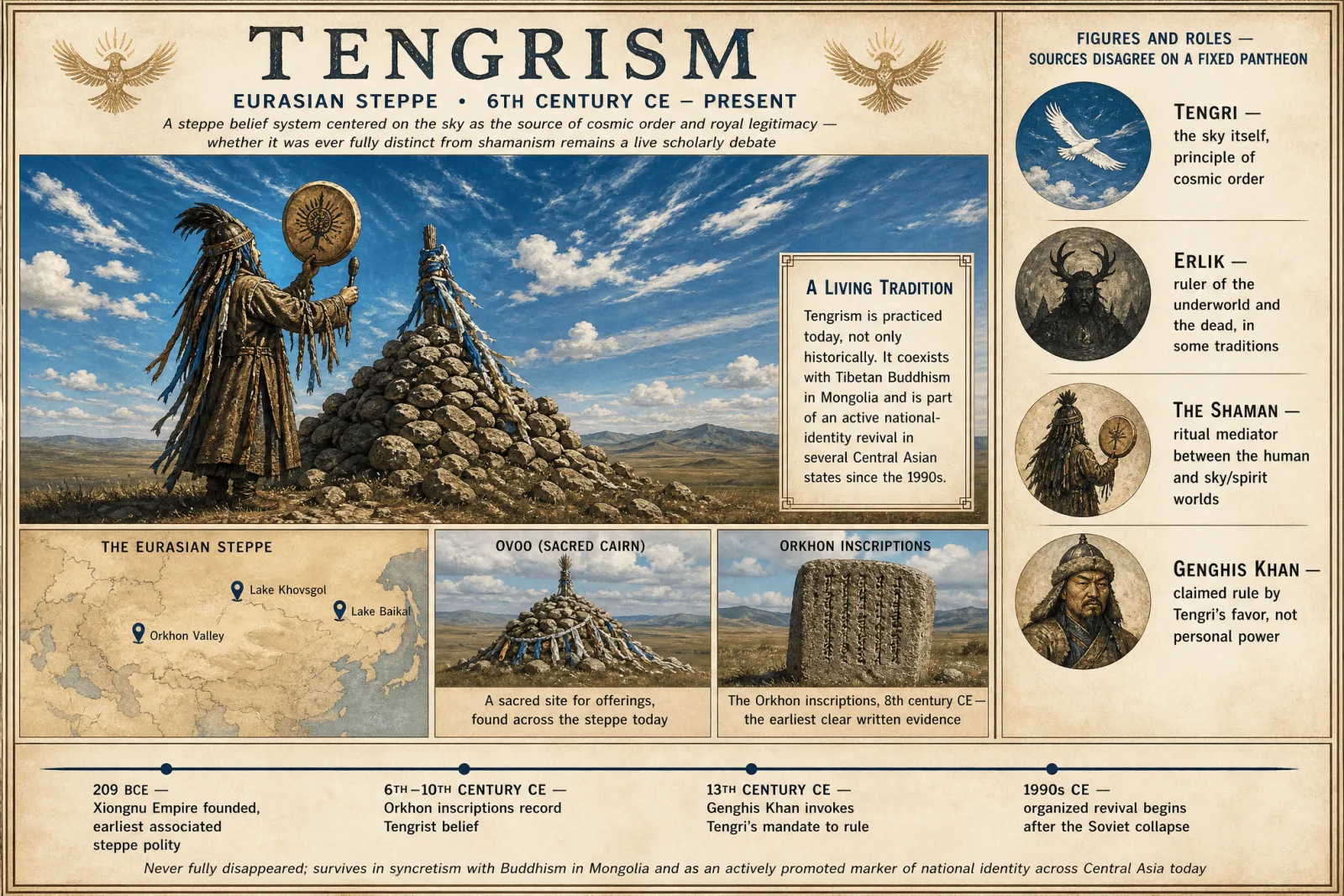
Tengrism (also Tengriism or Tengrianism) is the name given to the ancient religious worldview of the Turkic and Mongolic peoples of the Eurasian steppe, centered on the worship of Tengri (Turkic: 𐱅𐰭𐰼𐰃, Tengri; Mongolian: Тэнгэр, Tenger), the supreme sky deity. The term 'Tengrism' is a modern scholarly construct—the ancient Turks and Mongols did not use a single umbrella label for their religious system—but it usefully designates a coherent cosmological and ritual framework attested from the early first millennium CE through the medieval period, preserved primarily in Old Turkic runiform inscriptions, Chinese historical records, and later ethnographic survivals. At its core, Tengrism posits Tengri as the ultimate source of cosmic order, political legitimacy, and moral authority, governing the sky, weather, fate, and the fortunes of rulers and peoples. Tengri is not simply a personified sky but an omnipotent, eternal divine principle: the Orkhon inscriptions (8th century CE), the most direct indigenous sources, declare Tengri as the creator who 'made heaven above and earth below' and who grants qut (divine fortune, charisma, or blessing) to the khagans (rulers) who maintain harmony with the cosmic order.
Tengrism operated within a triadic cosmology: Tengri ruled the upper realm (sky), Umay (Umai, the mother goddess) protected fertility, women, children, and dynastic continuity, and Yer-Sub (Earth-Water, the sacred animate landscape) embodied the spiritual power of mountains, rivers, and springs. This triad—invoked together in the formula 'Tengri, Umay, and the sacred Yer-Sub granted victory'—legitimized the authority of the Turkic khagans and Mongol khans, who were understood as ruling by heavenly mandate. The khagan was Tengri's earthly representative, endowed with qut; failure to maintain this divine favor could result in the loss of power, defeat in war, or dynastic collapse. Religious practice included animal sacrifice (especially horses and sheep), libations, ritual feasts, veneration of ancestral spirits, and the maintenance of sacred sites and mountains (such as Ötüken in the Orkhon Valley, the spiritual and political center of the Göktürk Khaganates). Ritual specialists—shamans (qam) in some regions—mediated between the human and spirit worlds, conducted divination, healing, and sacrifices, though the extent of shamanic practice varied across Turkic and Mongolic groups, and equating Tengrism wholesale with Siberian shamanism is an oversimplification that obscures the distinct theological structure of Tengri-centered belief.
Tengrism as a coherent state-sponsored religious system flourished during the Göktürk Khaganates (6th–8th centuries CE) and the Mongol Empire (13th–14th centuries CE), but it faced gradual displacement through contact with Buddhism, Manichaeism, Nestorian Christianity, Islam, and later Russian Orthodox Christianity. By the late medieval period, most Turkic and Mongolic peoples had converted to Islam or Buddhism (Tibetan Buddhism among Mongols), though folk practices, seasonal festivals, ancestor veneration, and reverence for sacred mountains persisted in syncretistic forms. Since the collapse of the Soviet Union in 1991, Tengrism has experienced a revival, particularly in Kazakhstan, Kyrgyzstan, Mongolia, and the Altai Republic, where it serves as a symbol of pre-Islamic/pre-Buddhist cultural identity and ethnic nationalism. Contemporary 'neo-Tengrism' ranges from academic reconstruction efforts and grassroots spiritual movements to state-sponsored cultural heritage projects and, in some cases, ethnonationalist political ideologies. Scholarly debate centers on the extent to which ancient Tengrism can be reconstructed from fragmentary sources, the degree of continuity between ancient practices and modern revivals, and the role of Tengrism in contemporary identity politics.
Origins and Early Attestations (1st Millennium BCE – 6th Century CE)
The origins of Tengri worship likely extend into the Bronze and Iron Ages among the nomadic and semi-nomadic peoples of the Eurasian steppe, though direct evidence is sparse. Petroglyphs, burial mounds (kurgans), and archaeological remains suggest sky-oriented cosmologies and ritual practices emphasizing horses, animal sacrifice, and sacred mountains as early as the Scythian and Xiongnu periods (1st millennium BCE). Chinese historical sources from the Han dynasty (206 BCE–220 CE) describe the Xiongnu (Hunnic) confederacy as worshipping 'Heaven and Earth' and the spirits of ancestors, with the *chanyu* (supreme leader) performing seasonal sacrifices to Tengri. The *Book of Wei* (6th century CE) records that the Rouran Khaganate (4th–6th centuries) and early Turkic groups venerated the sky god and conducted rituals at sacred mountains. However, these external Chinese accounts provide limited theological detail and reflect the perspectives of sedentary agrarian observers; the religion's internal logic remained largely unrecorded until the rise of the Göktürks.
The earliest direct, indigenous textual evidence for Tengrism comes from the Old Turkic runiform inscriptions of the Göktürk period, particularly the Orkhon inscriptions erected in the 8th century CE in the Orkhon River valley (modern north-central Mongolia). The three major monuments—the Kül Tigin inscription (732 CE), the Bilge Khagan inscription (735 CE), and the Tonyukuk inscription (early 8th century)—were carved in Old Turkic using a runiform script derived from Sogdian or possibly earlier Central Asian scripts. These inscriptions commemorate deceased khagans and high officials, narrating their deeds, military campaigns, and the legitimacy of their rule. They open with cosmogonic statements: 'When the blue sky (kök tengri) above and the brown earth (yağız yer) below were made, between them the sons of men were made' (Kül Tigin inscription). Tengri is described as eternal, omnipotent, and the bestower of qut upon the khagans; the inscriptions repeatedly attribute victories to 'Tengri, Umay, and the sacred Yer-Sub.' These texts provide the most reliable window into the theological structure of ancient Tengrism, emphasizing Tengri's role as cosmic creator, moral arbiter, and source of political authority.
The First Göktürk Khaganate (552–630 CE) and the Second Göktürk Khaganate (682–744 CE) represent the zenith of Tengrism as a state-sponsored religious system. The Göktürks, a Turkic tribal confederacy, established a vast nomadic empire stretching from the borders of China to the Black Sea, and their khagans explicitly legitimized their rule through Tengri's mandate. The khagan was styled as Tengri qaghan ('heavenly khagan') or as 'born of Tengri,' indicating a divine appointment. Succession disputes, military defeats, and internal rebellions were interpreted as signs that Tengri had withdrawn qut from the ruler or the people, necessitating either dynastic change or ritual atonement. The inscriptions emphasize the reciprocal relationship: Tengri grants qut, the khagan rules justly and defends the people, and the people prosper; failure in any link breaks the covenant.
The spiritual and political center of the Göktürk realm was Ötüken (Old Turkic: 𐰇𐱅𐰜𐰤, Ötüken yïš, 'Ötüken forest'), a sacred mountain or forested region in the Orkhon Valley. The Bilge Khagan inscription declares: 'If you stay in the land of Ötüken and send caravans from there, you will have no trouble. If you stay in the Ötüken mountains, you will live forever dominating the tribes.' Ötüken was understood as the source of qut, the place where Tengri's power was most concentrated, and control of it was essential for legitimate rule. The khagans conducted seasonal sacrifices at Ötüken, including the ritual slaughter of horses and sheep, libations of fermented mare's milk (*kumis*), and offerings to Tengri, Umay, Yer-Sub, and ancestral spirits. Chinese sources describe the Göktürk khagans as leaving the encampment at dawn to worship the sun (a manifestation or agent of Tengri) and conducting annual spring and autumn assemblies (*qurultai*) where tribal leaders gathered for feasting, sacrifice, and the renewal of oaths.
Tengrism during this period was not a scriptural, doctrinal religion in the manner of Christianity or Islam; it was a ritual and cosmological framework maintained through oral tradition, monument inscriptions, and communal practice. There was no priestly caste analogous to Zoroastrian magi or Christian clergy, though ritual specialists—shamans (qam in Turkic)—played important roles in divination, healing, communication with spirits, and conducting sacrifices. The extent to which shamanism was central to Göktürk Tengrism remains debated; the Orkhon inscriptions do not explicitly mention shamans, and some scholars argue that shamanic elements became more prominent only after the Turkic conversion to Buddhism and Islam, when folk practices were reinterpreted through new religious lenses. The khagan himself often performed key rituals, reinforcing the fusion of political and religious authority.
The collapse of the Second Göktürk Khaganate in 744 CE marked the beginning of Tengrism's gradual displacement by missionary religions. The Uyghur Khaganate (744–840 CE), which succeeded the Göktürks in the Orkhon region, adopted Manichaeism as its state religion in 762 CE under Khagan Bögü, influenced by Sogdian merchants and missionaries. Manichaean texts from the Uyghur period, however, continued to invoke Ötüken as a source of divine power and to use Tengri-related vocabulary, suggesting syncretism rather than total abandonment. After the Uyghur Khaganate's collapse, the Uyghurs migrated westward and established the Kingdom of Qocho (856–1335 CE) in the Tarim Basin, where they adopted Buddhism and preserved a hybrid religious culture blending Manichaean, Buddhist, and residual Tengrist elements.
Among the western Turkic peoples—Oghuz Turks, Kipchaks, Volga Bulgars, and later the Seljuks and Ottomans—conversion to Islam proceeded gradually from the 10th century onward, accelerated by trade, political alliances, Sufi missionary activity, and the prestige of Islamic empires. The Karakhanid Khanate (999–1212 CE), the first Turkic dynasty to officially adopt Islam, suppressed Tengrist practices, though folk beliefs in sacred mountains, ancestor spirits, and seasonal rituals persisted in rural and nomadic communities. Islamic scholars and jurists often condemned Tengrist customs as *shirk* (polytheism) or *bid'a* (innovation), but pragmatic rulers tolerated syncretic practices, especially among recently converted or semi-nomadic populations. Elements of Tengrism survived in Turkic folk Islam, such as veneration of sacred springs and mountains, animal sacrifice at festivals, and the role of *baqshï* (shamans) as healers and diviners alongside Islamic *mullahs*.
Among the Mongols, Chinggis Khan (Genghis Khan, r. 1206–1227) and his successors practiced a form of Tengrism that emphasized Tengri's role in granting the Mongol Empire its mandate to conquer the world. Chinggis Khan styled himself as the executor of Tengri's will, and Mongol law (*Yasa*) blended Tengrist cosmological principles with pragmatic governance. The Mongols were religiously tolerant, hosting Nestorian Christians, Buddhists, Muslims, and Taoists at court, but Tengri worship remained the imperial cult. The Secret History of the Mongols (13th century), the primary Mongolian historical source, describes Chinggis Khan's birth as blessed by Tengri and recounts rituals invoking Tengri and sacred mountains, particularly Burkhan Khaldun (a mountain in northeastern Mongolia where Chinggis Khan reportedly prayed and was buried). By the late 13th and 14th centuries, the Mongol khanates began converting: the Ilkhanate (Persia) adopted Islam in 1295, the Golden Horde (Russia) converted in the 14th century, and the Yuan dynasty (China) patronized Tibetan Buddhism. The Northern Yuan and later Mongolian polities also embraced Tibetan Buddhism in the 16th–17th centuries, which became the dominant religion of Mongolia, though Tengrist elements persisted in shamanic practices among the rural population.
During the Soviet period (1922–1991), Tengrism, like other traditional religions, faced systematic suppression under state atheism. Shamanic practices were banned, sacred sites were desecrated or repurposed, and practitioners were persecuted as 'remnants of feudalism' or 'superstition.' Ethnographic studies conducted by Soviet scholars in the 1920s–1930s (e.g., by Turkologists and Mongolists such as Sergei Malov and Boris Vladimirtsov) documented surviving Tengrist and shamanic traditions among Turkic and Mongolic peoples in Siberia, Central Asia, and Mongolia before these practices were driven underground. The Mongolian People's Republic (1924–1992), a Soviet satellite state, similarly suppressed Buddhism and shamanism, though some clandestine practice continued.
The collapse of the Soviet Union in 1991 enabled a resurgence of interest in Tengrism as a symbol of pre-Islamic, pre-Buddhist, and pre-Soviet cultural identity. In Kazakhstan, Kyrgyzstan, and the Altai Republic (Russia), neo-Tengrist movements emerged, combining academic reconstruction of ancient beliefs with contemporary spiritual and nationalist agendas. Organizations such as the Tengir Ordo in Kyrgyzstan (founded 1990s) promote Tengrism as the 'original religion' of the Kyrgyz people, distinct from Islam, and conduct rituals at sacred mountains. In Kazakhstan, the government has promoted Tengrism as part of national heritage, though it remains a minority identity; the majority of the population identifies as Muslim, and some Islamic leaders view neo-Tengrism as apostasy or cultural appropriation.
In Mongolia, the post-Soviet revival of Buddhism overshadowed Tengrism, but shamanic practices have resurged, particularly in rural areas and among ethnic minorities such as the Darkhad and Tsaatan. Mongolian neo-shamanism often blends Tengrist cosmology with Buddhist terminology and environmentalist rhetoric, emphasizing harmony with nature and reverence for the 'Eternal Blue Sky.' In the Sakha Republic (Yakutia) and other Siberian regions, indigenous groups have revived shamanic traditions, though the extent to which these represent continuity with ancient Tengrism versus modern reinvention is contested. Scholarly debates focus on whether contemporary neo-Tengrism is a genuine revival of ancient religion or a constructed 'ethnic religion' shaped by nationalism, globalization, and selective reading of ethnographic sources.
Tengri: The Eternal Sky and Supreme Deity
Tengri is the central deity of Tengrism, understood as the omnipotent, eternal creator and sustainer of the cosmos. The name 'Tengri' is cognate with Old Turkic *tengri* (𐱅𐰭𐰼𐰃), Mongolian *tenger*, and possibly Proto-Turkic *teŋri*, meaning 'sky,' 'heaven,' or 'god.' Tengri is not simply the physical sky but a personified, active divine force governing weather, fate, and moral order. The Orkhon inscriptions refer to Tengri with epithets such as Kök Tengri ('Blue Sky,' emphasizing the visible sky as Tengri's manifestation) and Öd Tengri ('Time-Tengri' or 'Eternal Tengri'), stressing divine eternity: 'Eternal Tengri endures; the sons of men are all born to die' (Kül Tigin inscription). Tengri is the source of life, the judge of human actions, and the arbiter of historical events; the inscriptions repeatedly attribute military victories, dynastic stability, and the prosperity of the Turkic people to Tengri's will.
Tengri's role as the bestower of qut (divine fortune, charisma, or blessing) is central to Tengrist political theology. Qut is an impersonal, transferable spiritual power that Tengri grants to rulers, enabling them to govern effectively, win wars, and maintain cosmic and social order. A khagan who possessed qut enjoyed divine legitimacy; loss of qut—manifested in military defeat, natural disasters, or internal rebellion—signaled that Tengri had withdrawn favor, justifying the ruler's removal or the rise of a new dynasty. This concept closely parallels the Chinese Mandate of Heaven (tianming), and some scholars argue for mutual influence, though the Turkic qut predates significant Turkic-Chinese contact and likely developed independently from similar steppe political ideologies.
Tengri's moral character is complex: the god is not presented as benevolent in a Christian sense but as supremely just and sovereign. The inscriptions do not articulate a theodicy explaining why Tengri allows suffering, but they emphasize human responsibility to maintain harmony with Tengri's order. Failure to honor Tengri, Umay, and Yer-Sub through proper ritual, or failure to maintain social cohesion and military strength, invites divine retribution in the form of defeat, famine, or the collapse of the khaganate. Tengri does not demand elaborate temples or a specialized priesthood; the inscriptions suggest that proper conduct—courage in battle, loyalty to the khagan, care for the people, and regular sacrifices—constitute the essence of Tengrist piety.
Umay (Old Turkic: 𐰆𐰢𐰖, Umai; Mongolian: Үмай, Ümai) is the goddess of fertility, motherhood, and the protection of women and children in Tengrist cosmology. The Orkhon inscriptions invoke Umay alongside Tengri and Yer-Sub in the formula 'Tengri, Umay, and the sacred Yer-Sub granted us victory,' indicating her importance in the divine hierarchy. Umay's primary function is to ensure the fertility of the khagan's wives (katuns) and the continuation of the royal lineage, which was essential for dynastic stability. She is also the protector of infants and children; Turkic and Mongolic folklore depicts Umay as an invisible presence watching over cradles, and the smiling or crying of a sleeping baby was interpreted as Umay's nearness or absence. Shamanic rituals invoked Umay to heal sick children or to bless women hoping to conceive. Umay's name may derive from a Turkic root related to 'womb' or 'placenta,' reinforcing her maternal associations.
Yer-Sub (Old Turkic: Yer Suv, 'Earth-Water'; Mongolian: Газар Ус, Gazar Us) is not a single anthropomorphic deity but rather the collective sacred power of the earth and waters—mountains, rivers, springs, and the steppe itself. The term is consistently rendered as a compound, emphasizing the inseparability of terrestrial and aquatic elements in Tengrist cosmology. Yer-Sub is described with the epithet iduk ('sacred,' 'holy') in the inscriptions, placing it on par with Tengri in ritual importance. Yer-Sub represents the animate, spiritually charged landscape; specific mountains, rivers, and springs were understood as manifestations or dwelling places of Yer-Sub's power. The Göktürk khagans performed sacrifices to Yer-Sub at key geographic sites, and the inscriptions credit Yer-Sub with granting victory in battle, protecting the people, and sustaining the herds.
The triadic invocation—'Tengri, Umay, and the sacred Yer-Sub'—structures Tengrist cosmology into three interdependent realms: sky (Tengri), fertility/lineage (Umay), and earth/water (Yer-Sub). This triad legitimizes the khagan's rule by demonstrating that all cosmic forces—celestial, reproductive, and terrestrial—support his authority. The formula appears in contexts of military victory, succession, and the founding of monuments, suggesting that the triad's combined power was invoked at moments of existential importance for the khaganate. Later Turkic and Mongolic folklore elaborated on Yer-Sub, personifying rivers and mountains as individual spirits (*iyeler* in Turkic, *savdag* or *lus* in Mongolian) who required propitiation through offerings and respectful behavior.
Qut (Old Turkic: 𐰴𐰆𐰞, qut; Mongolian: хутаг, khutag, or сүлд, süld) is the divine fortune, charisma, or spiritual power that Tengri bestows upon rulers and, by extension, upon the people and the land. Qut is not earned through moral virtue alone but is a gift from Tengri, contingent on maintaining cosmic and social harmony. The khagan's possession of qut was demonstrated through military success, the prosperity of the herds, favorable weather, and the stability of the realm. Loss of qut was catastrophic: the Orkhon inscriptions describe periods when 'Tengri did not give us qut,' resulting in defeat by enemies (particularly the Chinese Tang dynasty), internal strife, and the near-collapse of the Turkic people. The concept of qut implies a reciprocal relationship between the divine and human realms: Tengri grants qut, the khagan rules justly and performs rituals, and the people thrive. Disruption of this cycle—through impiety, injustice, or military weakness—breaks the covenant, and Tengri withdraws qut.
Tengrist cosmology divides the universe into three vertical layers: the upper world (sky, Tengri's realm), the middle world (earth, the human and animal realm), and the lower world (underworld, the realm of the dead and chthonic spirits). Shamanic traditions elaborate this into a multi-layered cosmos with numerous sub-realms, though the Orkhon inscriptions themselves do not provide detailed descriptions. The sky is the source of order and light; the earth is the realm of life and struggle; the underworld is ambiguous, neither a place of reward nor punishment in the Christian sense but a shadowy continuation of existence. Ancestors and deceased heroes could influence the living, and the Göktürks practiced elaborate funerary rites, including the burial of horses, weapons, and ritual goods in kurgans (burial mounds) to accompany the dead.
The Tengrist afterlife is poorly documented in the Orkhon inscriptions, which focus on this-worldly concerns—victory, prosperity, and the continuity of the khaganate—rather than eschatology. Later ethnographic sources describe belief in the soul's journey to the sky (returning to Tengri) or to the underworld, depending on the individual's status and manner of death. Heroes and khagans were sometimes said to ascend to the sky, while ordinary people's souls remained near their graves or wandered the steppe. There is no concept of moral judgment analogous to the Christian Last Judgment or Islamic *Yawm al-Qiyamah*; instead, the emphasis is on maintaining qut and harmony during life, ensuring the community's survival and the favor of Tengri.
Primary Sources and the Problem of Reconstruction
The reconstruction of ancient Tengrism relies on a limited corpus of primary sources, chief among them the Orkhon inscriptions—the Kül Tigin inscription (732 CE), the Bilge Khagan inscription (735 CE), and the Tonyukuk inscription (early 8th century CE)—carved in Old Turkic using a runiform script. These monuments, erected in the Orkhon River valley in modern Mongolia, are funerary stelae commemorating deceased Göktürk rulers and officials. They provide the most direct, indigenous articulation of Tengrist cosmology, political theology, and ritual practice. The inscriptions open with cosmogonic statements ('When the blue sky above and the brown earth below were made...'), narrate the khagan's deeds, attribute victories to Tengri and the divine triad, and exhort the Turkic people to remain united and faithful to the khagan. Translations and philological studies by scholars such as Vilhelm Thomsen (who deciphered the script in 1893), Talat Tekin, and Marcel Erdal have made these texts accessible to modern researchers.
Other Old Turkic texts include the Irk Bitig (Book of Omens), a 9th–10th century divinatory manual discovered at Dunhuang, which preserves Tengrist cosmological concepts and references to Yer-Sub, though in a Uyghur Buddhist context. The Dīwān Lughāt al-Turk (Compendium of the Turkic Dialects) by Mahmud al-Kashgari (1072–1074 CE), an 11th-century Arabic-language dictionary and ethnography of Turkic peoples, includes references to Tengri, Umay, and traditional Turkic religious practices, though filtered through an Islamic lens. Chinese historical sources—the Book of Wei (6th century), the Book of Sui (7th century), the Old Book of Tang and New Book of Tang (10th–11th centuries)—provide external descriptions of Turkic and Mongolic religious practices, including sacrifices, shamanism, and the veneration of Tengri, but these accounts are often brief, ethnocentric, and focused on political rather than theological detail.
The Secret History of the Mongols (Mongolian: Монголын нууц товчоо, *Mongolyn Nuuts Tovchoo*, 13th century) is the primary indigenous source for Mongol-era Tengrism. Composed shortly after Chinggis Khan's death, it describes his rise to power, military campaigns, and invocations of Tengri and sacred mountains (especially Burkhan Khaldun). The text portrays Tengri as granting the Mongol Empire its mandate to conquer and unify the world, though it also reflects Buddhist and possibly Christian influences from the Mongol court's religious pluralism. Later Mongolic and Turkic epic literature—such as the Epic of Manas (Kyrgyz), the Book of Dede Korkut (Oghuz Turkic), and Mongolian oral epics—preserve Tengrist motifs, invocations of Tengri, and references to sacred mountains and ancestral spirits, though these texts were transmitted orally for centuries before being written down in Islamic or Buddhist contexts, complicating efforts to isolate 'pure' Tengrist elements.
The reconstruction of ancient Tengrism is thus a scholarly challenge: the Orkhon inscriptions provide a narrow but reliable window into 8th-century Göktürk belief, but they are brief, formulaic, and politically focused. Ethnographic studies of Siberian shamanism (conducted by 19th- and 20th-century Russian and European scholars) document Tengri worship and shamanic practices among groups such as the Altaians, Khakas, Tuvans, and Yakuts (Sakha), but these communities had been influenced by Buddhism, Russian Orthodox Christianity, and Soviet atheism, raising questions about continuity versus innovation. Scholars such as Uno Harva, Jean-Paul Roux, and Larry Moses have attempted to synthesize inscriptional, historical, ethnographic, and folkloric sources to reconstruct a coherent picture of Tengrism, but significant uncertainties remain, particularly regarding theology, eschatology, and the relationship between state-sponsored Tengri worship and local shamanic traditions.
Sacrifice, Ritual, and Sacred Sites
The primary form of Tengrist worship was animal sacrifice, particularly of horses and sheep, conducted at sacred mountains, springs, and during seasonal assemblies. The Orkhon inscriptions reference sacrifices to Tengri, Umay, and Yer-Sub, and Chinese sources describe Göktürk and Mongol rulers slaughtering horses, offering libations of fermented mare's milk (*kumis*), and burning incense or animal fat as offerings. Sacrifices were conducted at dawn, often facing east (the direction of the rising sun, associated with Tengri's life-giving power), and accompanied by prayers invoking Tengri's favor for victory in war, prosperity for the herds, and the health of the khagan and his family. The meat from sacrificial animals was consumed in communal feasts, reinforcing social bonds and the khagan's role as provider and mediator between the people and the divine.
Sacred mountains were central to Tengrist practice. Ötüken, located in the Orkhon Valley, was the supreme sacred site for the Göktürks, described as the source of qut and the spiritual heart of the khaganate. Control of Ötüken was essential for legitimate rule, and the khagans conducted annual rituals there. Burkhan Khaldun, a mountain in northeastern Mongolia, was sacred to the Mongols; Chinggis Khan reportedly prayed there for divine guidance and victory, and Mongol tradition holds that he was buried on its slopes (the exact location remains unknown). Tian Shan (Celestial Mountains), the massive mountain range spanning Central Asia, was revered by various Turkic groups as the dwelling place of spirits and a site of pilgrimage. Rivers, springs, and lakes were also venerated as manifestations of Yer-Sub; offerings of milk, butter, or small tokens were left at these sites to ensure safe passage, good harvests, and protection from illness.
The qurultai (Turkic-Mongolian assembly) was a seasonal gathering of tribal leaders, warriors, and the khagan's court, held in spring or autumn, during which sacrifices were conducted, oaths of loyalty renewed, military campaigns planned, and disputes adjudicated. The qurultai was both a political and religious institution, reinforcing the unity of the tribal confederation and the khagan's authority as Tengri's representative. Rituals included feasting, horse races, wrestling, archery contests, and the recitation of genealogies and heroic deeds, all of which served to honor Tengri, the ancestors, and the khagan. The Chinese historian Sima Qian (2nd–1st century BCE) describes similar assemblies among the Xiongnu, suggesting continuity in steppe political-religious practice over centuries.
The role of shamans (Turkic: *qam*; Mongolian: *böö* or *zaarin*) in Tengrism is debated. Shamanism—a set of practices involving trance, spirit possession, soul journeys, divination, and healing—is well-documented among Siberian Turkic and Mongolic peoples in ethnographic sources, but the Orkhon inscriptions do not explicitly mention shamans. Chinese sources describe Turkic and Mongol ritual specialists who communicated with spirits, predicted the future, and healed the sick, but it is unclear whether these were shamans in the Siberian sense, priestly officials, or simply individuals with specialized knowledge. Some scholars argue that the khagan himself performed the most important rituals (sacrifices to Tengri, Umay, and Yer-Sub), with shamans serving auxiliary roles in local, non-state contexts. Others contend that shamanism was integral to Tengrism from the beginning, and that the inscriptions' silence reflects the elite, state-centered perspective of the monuments rather than the full range of religious practice.
Siberian Turkic shamanism, as documented in the 19th and 20th centuries, includes practices such as kamlanie (shamanic séances involving drumming, singing, and trance), soul retrieval (journeying to the spirit world to recover a patient's lost soul), divination (using shoulder blades of sheep, casting stones, or interpreting omens), and offerings to spirits (*iyeler* or *savdag*) inhabiting specific locations. Shamans wore distinctive costumes adorned with metal ornaments, bird feathers, and animal imagery, and used drums, rattles, and chants to enter trance states. They mediated between the human world and the upper and lower spirit realms, negotiating with spirits on behalf of clients. While these practices likely have deep historical roots, the extent to which they represent continuity with ancient Tengrism versus later syncretism with Buddhism, Christianity, or Soviet-era reinvention is contested.
Regional Variations and Syncretism
Tengrism was never a monolithic, uniform tradition; it varied significantly across the vast Eurasian steppe, reflecting local geographies, tribal affiliations, and contact with neighboring religious systems. The Göktürk Tengrism of the Orkhon inscriptions emphasizes sky worship, qut, and the divine mandate of the khagan, with relatively little detail on cosmology or the afterlife. By contrast, Mongol Tengrism as described in the Secret History and later sources places greater emphasis on sacred mountains (Burkhan Khaldun), ancestral spirits, and the khagan's personal relationship with Tengri through prayer and visions. The Mongols' religious tolerance—allowing Nestorian Christians, Buddhists, Muslims, and others at court—suggests a more pragmatic, less dogmatic approach than the Göktürks, though Tengri worship remained central to imperial legitimacy.
Among western Turkic groups—the Oghuz, Kipchaks, and Volga Bulgars—Tengrism coexisted with and was gradually supplanted by Islam from the 10th century onward. Folk Islam in Central Asia and Anatolia retained Tengrist elements: veneration of sacred mountains and springs, animal sacrifice at festivals (such as *Qurban Bayram*), belief in *jinn* and spirits inhabiting natural features, and the role of *baqshï* (shamanic healers) alongside Islamic *mullahs*. In Siberia, Tengrist-shamanic traditions among the Altaians, Khakas, Tuvans, Yakuts (Sakha), and Buryats incorporated elements from Russian Orthodoxy (such as icons and Christian prayers) and later Buddhism (Tibetan Buddhist deities and rituals), producing highly syncretic local practices. Ethnographers such as Uno Harva and A. V. Anokhin documented these traditions in the early 20th century, but Soviet suppression and modernization have made it difficult to determine what represents ancient continuity versus recent adaptation.
Modern neo-Tengrism exhibits even greater diversity, ranging from scholarly reconstruction efforts to New Age spirituality and ethnonationalist ideology. In Kazakhstan and Kyrgyzstan, neo-Tengrist organizations promote Tengrism as a pre-Islamic 'national religion,' conducting rituals at mountains and advocating for Tengrist identity in opposition to (or alongside) Islam. In Mongolia, shamanic practitioners blend Tengrist cosmology with Buddhist terminology and environmentalist rhetoric, appealing to urban Mongolians seeking 'authentic' spiritual traditions. In the Altai Republic and Tuva (Russia), indigenous activists have revived Tengrist-shamanic practices as part of broader movements for cultural sovereignty and resistance to Russian assimilation. These contemporary movements are debated: some scholars view them as legitimate revivals of dormant traditions, while others see them as 'invented religions' constructed from fragmentary sources, nationalist agendas, and selective borrowing from global New Age movements.
Contemporary Neo-Tengrism and Identity Politics
Since the 1991 collapse of the Soviet Union, Tengrism has experienced a revival as a symbol of pre-Islamic and pre-Soviet ethnic identity among Turkic and Mongolic peoples. In Kazakhstan, the government has promoted Tengrism as part of national heritage, though the population remains predominantly Muslim. Neo-Tengrist groups organize public rituals at sacred mountains, publish books and websites reconstructing ancient beliefs, and advocate for official recognition of Tengrism as a distinct religion. However, some Islamic leaders view neo-Tengrism as apostasy or a nationalist threat to Muslim unity, and tensions between Tengrist and Islamic identities persist, particularly among younger, urban Kazakhs seeking alternatives to both Soviet-era atheism and conservative Islam.
In Kyrgyzstan, the Tengir Ordo movement (founded in the 1990s) promotes Tengrism as the 'original religion' of the Kyrgyz people, organizing pilgrimages to sacred mountains, conducting sacrifices, and publishing Tengrist liturgical materials. Tengir Ordo's founder, Dastan Sarygulov, has positioned Tengrism as a unifying national identity distinct from Islam, which he characterizes as a foreign import. This framing has sparked controversy: while some Kyrgyz embrace Tengrism as a way to reconnect with pre-Islamic heritage, others—particularly devout Muslims and Islamic political movements—reject it as heretical or as a manufactured tradition. The Kyrgyz government has taken an ambivalent stance, neither fully endorsing nor suppressing neo-Tengrism, reflecting broader anxieties about balancing secular nationalism, Islamic resurgence, and ethnic identity.
In Mongolia, the post-Soviet religious landscape has been dominated by the revival of Tibetan Buddhism, which had been the state religion before Soviet suppression. However, shamanic practices—often framed as 'Tengrism' or 'Mongolian shamanism'—have also resurged, particularly in rural areas and among ethnic minorities such as the Darkhad and Tsaatan (Dukha). Urban Mongolians, especially younger generations, have shown interest in shamanic rituals, guided meditations, and 'spiritual tourism' to sacred sites such as Burkhan Khaldun and Lake Khövsgöl. Some Mongolian intellectuals and politicians advocate for Tengrism as a 'national religion' that predates Buddhism and unites all Mongolic peoples, though this remains a minority view. In the Altai Republic (Russia), indigenous Altaians have revived Tengrist-shamanic practices as part of a cultural sovereignty movement, resisting Russian Orthodox missionization and asserting their distinct ethnic identity. The Altai revival has included the construction of new ritual sites, the training of young shamans, and the codification of oral traditions into written form.
Scholarly debates about neo-Tengrism center on authenticity, continuity, and political instrumentalization. Critics argue that contemporary Tengrism is largely a 'reconstructed' or 'invented' religion, drawing selectively on ethnographic sources, nationalist myths, and New Age spirituality rather than representing genuine continuity with ancient practice. Proponents counter that all religious traditions evolve and adapt, and that neo-Tengrism's roots in Orkhon inscriptions, oral epics, and living shamanic traditions provide sufficient grounding for revival. The political dimension is unavoidable: Tengrism serves nationalist agendas (asserting pre-Russian, pre-Chinese, pre-Islamic sovereignty), ethnic minority rights movements (resisting assimilation), and, in some cases, exclusionary ideologies (defining 'true' national identity in ethnic-religious terms). Whether neo-Tengrism will develop into a stable, institutionalized religious tradition or remain a diffuse set of cultural practices and political symbols is uncertain.
Sacred Geography: Mountains, Rivers, and Ritual Sites
Ötüken (Old Turkic: 𐰇𐱅𐰜𐰤, Ötüken yïš, 'Ötüken forest' or 'land of Ötüken') was the supreme sacred site and political center of the Göktürk Khaganates, located in the Orkhon River valley in north-central Mongolia. The Bilge Khagan inscription declares Ötüken as the source of qut and the place from which 'the tribes can be controlled,' emphasizing its role as both spiritual and administrative capital. Ötüken is described as a forested mountain or mountain range, though its exact location remains debated; most scholars identify it with the Khangai Mountains or the Orkhon Valley region. The Göktürk khagans conducted seasonal sacrifices at Ötüken, and control of the site was essential for legitimate rule. Even after the Göktürks' fall, the Uyghurs continued to invoke Ötüken as a power-granting center in Manichaean and Buddhist texts, demonstrating its enduring sacred significance. Modern scholars and neo-Tengrist groups have attempted to locate Ötüken precisely, but its sacredness may have been as much conceptual (a spiritual axis mundi) as geographic (a specific mountain).
Burkhan Khaldun (Mongolian: Бурхан Халдун, 'Holy Mountain') is a mountain in the Khentii Mountains of northeastern Mongolia, sacred to the Mongols and particularly associated with Chinggis Khan. The Secret History of the Mongols recounts that Chinggis Khan prayed at Burkhan Khaldun for divine guidance during a crisis, and the mountain granted him protection and victory. Mongol tradition holds that Chinggis Khan was buried on or near Burkhan Khaldun, though the exact location of his tomb has never been found (it was deliberately concealed). Burkhan Khaldun remains a pilgrimage site for Mongolians, and rituals invoking Tengri and ancestral spirits are conducted there. In 2015, Burkhan Khaldun and the surrounding Khentii mountain range were designated a UNESCO World Heritage Site as the 'Great Burkhan Khaldun Mountain and its surrounding sacred landscape,' recognizing its cultural and religious significance. The site is protected, and public access is restricted to preserve its sanctity and prevent looting of archaeological remains.
The Orkhon River valley, in addition to housing Ötüken, is the location of the Orkhon inscriptions—the Kül Tigin, Bilge Khagan, and Tonyukuk monuments—which are the most important textual sources for ancient Tengrism. The valley was the heartland of successive steppe empires (Göktürks, Uyghurs, Mongols) and is dotted with archaeological remains: kurgans (burial mounds), stone monuments, and the ruins of Karakorum (Kharkhorin), the 13th-century capital of the Mongol Empire founded by Ögedei Khan (Chinggis Khan's son). While Karakorum was a cosmopolitan city hosting Buddhists, Christians, Muslims, and Taoists, it was also a site of Tengrist rituals conducted by the Mongol khans. The Orkhon Valley was inscribed as a UNESCO World Heritage Site in 2004, recognizing its role as a 'cultural landscape' shaped by centuries of nomadic empires and Tengrist practice.
Tian Shan (Chinese: 天山, 'Celestial Mountains' or 'Heavenly Mountains'; Kyrgyz: Теңир-Тоо, Teŋir-Too) is a massive mountain range spanning Kazakhstan, Kyrgyzstan, Uzbekistan, and western China. The name 'Tian Shan' reflects its sacred status in both Chinese cosmology and Turkic Tengrism; the Kyrgyz name *Teŋir-Too* derives directly from *Tengri*, indicating the mountains' association with the sky god. Specific peaks and passes in the Tian Shan were venerated as dwelling places of spirits or manifestations of Yer-Sub's power. Modern neo-Tengrist groups in Kyrgyzstan conduct pilgrimages and rituals at Tian Shan sites, particularly around Lake Issyk-Kul and the Ala-Too range. The Tian Shan range (portions in Kazakhstan, Kyrgyzstan, and China) was designated a UNESCO World Heritage Site in 2013 for its natural beauty and biodiversity, though its religious significance is also recognized in local cultural heritage initiatives.
Scholarly Debates and Interpretive Challenges
Is Tengrism a 'religion' or a 'worldview'? Some scholars argue that Tengrism lacks the institutional features—scriptural canon, priesthood, theology, ecclesial organization—characteristic of 'world religions,' and is better understood as a cosmological worldview or ritual complex embedded in nomadic political structures. Others counter that Tengrism exhibits core religious features: belief in a supreme deity (Tengri), a divine mandate for rulers (qut), sacrifice and ritual, sacred geography, and a cosmology explaining the origin and structure of the universe. The debate reflects broader disciplinary disagreements about how to define 'religion,' especially when applying categories derived from Christianity, Islam, and Buddhism to non-scriptural, non-institutional traditions.
How central was shamanism to ancient Tengrism? The Orkhon inscriptions do not mention shamans, leading some scholars to argue that Göktürk Tengrism was a state-sponsored sky-god cult distinct from the shamanic practices documented among Siberian Turkic groups in later centuries. Others argue that the absence of shamans in the inscriptions reflects the elite, political focus of the monuments rather than the full spectrum of religious practice, and that shamanic rituals (trance, spirit communication, healing) were integral to Tengrism at the popular level. The relationship between Tengri worship and shamanism remains unresolved, complicated by the fact that 'shamanism' itself is a contested analytical category, often used to lump together diverse practices across Siberia, Central Asia, and beyond.
Can ancient Tengrism be reliably reconstructed? The primary sources—Orkhon inscriptions, Chinese histories, medieval epics—are fragmentary, politically oriented, and often filtered through the perspectives of outsiders (Chinese historians) or later religious contexts (Islamic, Buddhist). Ethnographic studies of Siberian shamanism provide rich detail but were conducted centuries after the Göktürk period and reflect centuries of change, syncretism, and adaptation. Scholars such as Jean-Paul Roux and Uno Harva synthesized these sources to create comprehensive reconstructions of Tengrism, but critics argue that these syntheses homogenize diverse regional traditions and project later practices back onto the ancient period. The problem is methodological: how to distinguish 'authentic' ancient elements from later innovations, and whether such a distinction is even meaningful for a non-scriptural tradition transmitted orally and through practice.
Is neo-Tengrism a genuine revival or an 'invented tradition'? Contemporary neo-Tengrist movements claim continuity with ancient beliefs, citing the Orkhon inscriptions, folk traditions, and shamanic practices as evidence of unbroken transmission. Critics argue that modern Tengrism is largely a construction of the post-Soviet era, shaped by nationalism, nostalgia for pre-Islamic/pre-Buddhist identity, and selective reading of ethnographic sources. The historian Eric Hobsbawm's concept of 'invented traditions'—rituals and identities created to serve contemporary political or cultural needs while claiming ancient pedigree—is frequently invoked in debates about neo-Tengrism. Proponents respond that all religious traditions evolve, adapt, and reinvent themselves, and that neo-Tengrism's rootedness in historical sources and living communities provides sufficient legitimacy. The debate is not merely academic but has real-world implications for religious freedom, ethnic identity, and the politics of Central Asia and Mongolia.
Key Terms
- Tengri** (𐱅𐰭𐰼𐰃)
- The supreme sky deity, creator, and source of cosmic order and political legitimacy in Tengrism.
- Qut** (𐰴𐰆𐰞)
- Divine fortune, charisma, or blessing granted by Tengri to rulers, enabling them to govern and ensuring the prosperity of the people.
- Umay** (𐰆𐰢𐰖)
- Goddess of fertility, motherhood, and the protection of women and children.
- Yer-Sub** (Yer Suv)
- 'Earth-Water,' the sacred collective power of the landscape—mountains, rivers, springs—venerated alongside Tengri and Umay.
- Kök Tengri** (𐰚𐰇𐰚 𐱅𐰭𐰼𐰃)
- 'Blue Sky,' an epithet for Tengri emphasizing the visible sky as the deity's manifestation.
- Öd Tengri
- 'Eternal Tengri' or 'Time-Tengri,' stressing the deity's timeless, eternal nature.
- Ötüken** (𐰇𐱅𐰜𐰤)
- The sacred mountain or forested region in the Orkhon Valley, spiritual and political center of the Göktürk Khaganates and source of qut.
- Khagan** (𐰴𐰍𐰣)
- The supreme ruler of a Turkic or Mongolic khaganate, understood as ruling by Tengri's mandate.
- Qurultai
- A seasonal assembly of tribal leaders and the khagan's court, during which sacrifices, oaths, and political decisions were made.
- Qam** (Turkic) / **Böö** (Mongolian)
- Shaman, a ritual specialist who mediates between the human and spirit worlds through trance, divination, and healing.
- Orkhon inscriptions
- Old Turkic runiform monuments (Kül Tigin, Bilge Khagan, Tonyukuk) from the 8th century, the primary textual sources for Göktürk Tengrism.
- Burkhan Khaldun
- 'Holy Mountain' in northeastern Mongolia, sacred to the Mongols and associated with Chinggis Khan.
- Iduk
- 'Sacred,' 'holy,' an epithet used for Yer-Sub in the Orkhon inscriptions.
- Secret History of the Mongols
- 13th-century Mongolian chronicle describing Chinggis Khan's rise and Mongol-era Tengrism.
Further Reading
- Talat Tekin, A Grammar of Orkhon Turkic (Indiana University Press, 1968)
- Jean-Paul Roux, La religion des Turcs et des Mongols (Payot, 1984)
- Marcel Erdal, A Grammar of Old Turkic (Brill, 2004)
- Larry Moses, The Political Role of Mongol Shamanism (Indiana University Press, 1977)
- Caroline Humphrey, 'Shamanic Practices and the State in Northern Asia' in Shamanism, History, and the State (University of Michigan Press, 2001)
- Haktan Kaplan, 'The Theological Transformation of Tengrism from the Ancient Turkish Belief System to the Modern Era,' Religions 17:6 (2025)
- Faiq Elekberli and Faiq Aliyev, 'The Philosophical and Socio-Political Foundations of Tengriist Thought,' Silk Road Review 9:1 (2026)
- UNESCO World Heritage: Great Burkhan Khaldun Mountain and its surrounding sacred landscape
- UNESCO World Heritage: Orkhon Valley Cultural Landscape
- Gerard Clauson, An Etymological Dictionary of Pre-Thirteenth Century Turkish (Oxford University Press, 1972)
Practices
- Shamanic trance
- Sky & mountain veneration
- Ancestor rites
Core ideas
- Afterlife
- Ancestral spirit world
- Deity
- Tengri, the Eternal Blue Sky
Sacred texts
Tengrism's core teachings were passed orally among Turkic and Mongol peoples, with no single canonical scripture. The Orkhon inscriptions of the eighth century preserve early Turkic prayers to Tengri and the ancestors of the Göktürk khagans. The Secret History of the Mongols, written in the thirteenth century, records Genghis Khan's mandate from the Eternal Blue Sky and the shamanic world of the steppe.