Overview
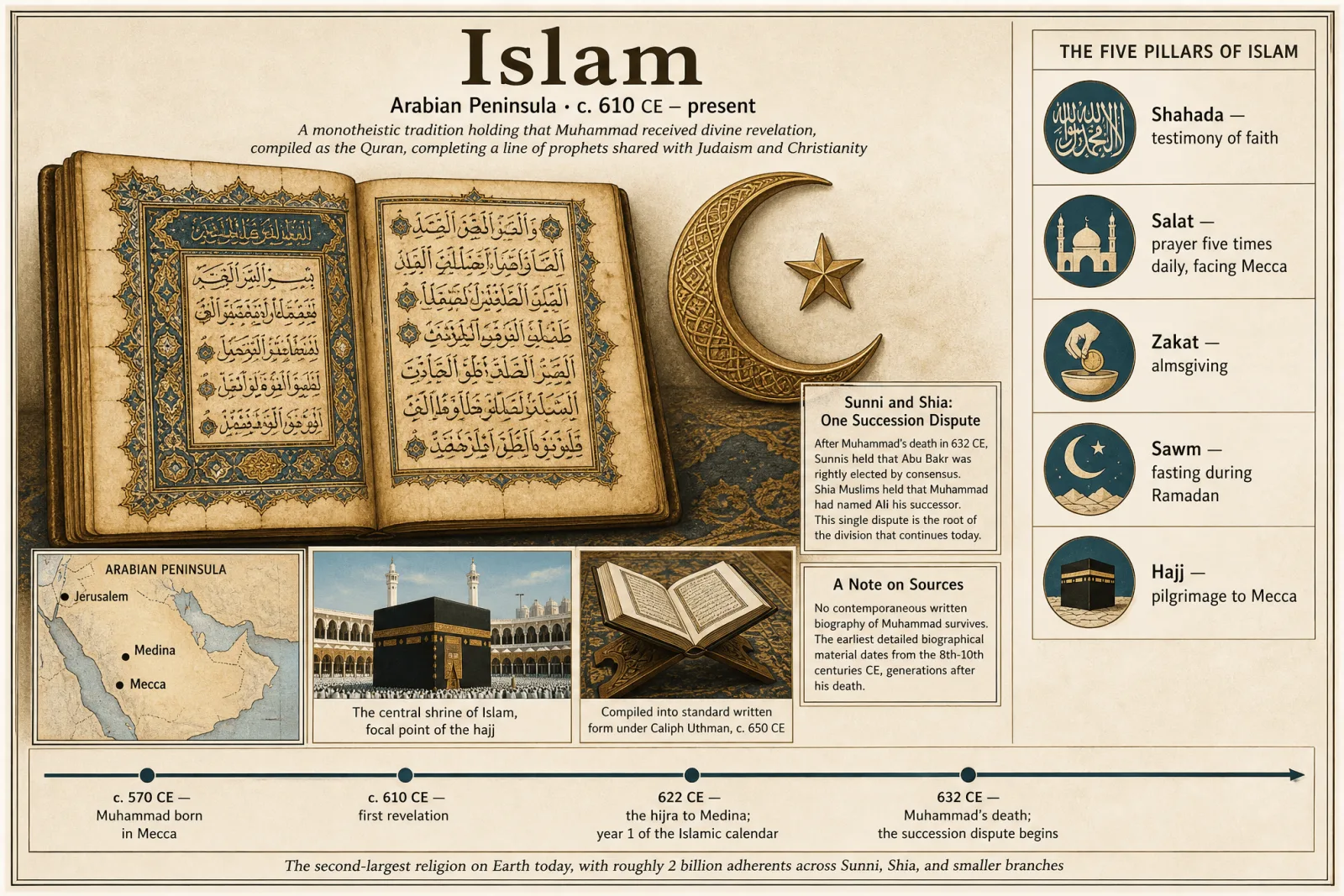
Islam is a monotheistic Abrahamic religion founded in seventh-century Arabia through the revelations received by the Prophet Muhammad (circa 570–632 CE). The Arabic word islām means 'submission' or 'surrender'—specifically, submission to the will of the one God, called Allah in Arabic. Muslims (those who submit) regard Muhammad as the final prophet in a line that includes Adam, Abraham, Moses, and Jesus, and they consider the Qur'an—the scripture revealed to Muhammad over approximately 23 years (610–632 CE)—to be the literal word of God. Alongside the Qur'an, the Sunnah (the Prophet's example, recorded in hadith collections) provides guidance for belief and practice. Islam's core theological affirmation is tawhid, the absolute oneness and unity of God, and its practical obligations are encapsulated in the Five Pillars: the profession of faith (shahada), five daily prayers (salat), almsgiving (zakat), fasting during Ramadan (sawm), and pilgrimage to Mecca (hajj). With approximately 1.6 billion adherents as of 2010 (23% of the global population), Islam is the world's second-largest religion and the fastest-growing major faith.
Islam emerged in a context of Arabian tribal society, Byzantine-Sasanian rivalry, and pre-existing monotheistic communities (Jews, Christians, Zoroastrians). Muhammad, a merchant from the Quraysh tribe of Mecca, received his first revelation in 610 CE. His proclamation of monotheism, social justice, and the Day of Judgment challenged Meccan polytheism and the socio-economic order built around the Ka'ba, a pre-Islamic sanctuary. After years of persecution, Muhammad and his followers migrated (hijra) to Medina in 622 CE, an event that marks the beginning of the Islamic calendar. In Medina, Muhammad established a religious and political community (umma), arbitrated disputes, and engaged in military campaigns that consolidated Muslim control over Arabia. By his death in 632 CE, most of the Arabian Peninsula had embraced Islam. The Qur'an, initially transmitted orally and written on various materials, was compiled into a standardized written text under the third caliph, Uthman (r. 644–656 CE), though the history of the Qur'an's textualization remains contested among scholars.
After Muhammad's death, disagreements over leadership led to the first major schism in Islam. The majority, who became known as Sunnis, accepted the caliphs elected by the community (Abu Bakr, Umar, Uthman, Ali). A minority, who became known as Shi'a (partisans of Ali), believed that leadership should remain within Muhammad's family, specifically through his cousin and son-in-law Ali and Ali's descendants, the Imams. This dispute over succession, intertwined with theological differences regarding authority and the nature of religious knowledge, produced distinct Sunni and Shi'i traditions. A smaller third group, the Ibadis (who trace their origins to the Kharijites), rejected both the Sunni and Shi'i positions and developed their own legal and theological framework. Over fourteen centuries, Islam spread from Arabia across Asia, Africa, and Europe through conquest, trade, migration, and mission, producing a rich diversity of cultures, languages, legal schools (madhahib), theological movements (such as the Mu'tazila, Ash'ari, and Maturidi schools), and mystical orders (Sufism). Today, Islam is a global religion with significant populations in the Middle East, North Africa, South Asia, Southeast Asia, sub-Saharan Africa, Europe, and the Americas. Contemporary Islam grapples with questions of tradition and modernity, secularism, political Islam, gender and authority, and the relationship between sharia (Islamic law) and pluralistic societies.
Emerges fromJudaism ←
Historical Development
Muhammad ibn Abdullah was born circa 570 CE in Mecca, a prosperous trading city in the Hejaz region of western Arabia. Orphaned early, he was raised by his grandfather and uncle and later worked as a merchant. At age 40, while meditating in a cave on Mount Hira, Muhammad received his first revelation from the angel Gabriel (Jibril). The revelations continued for 23 years, addressing theology, law, ethics, and eschatology. Early Meccan surahs (chapters) of the Qur'an emphasize monotheism, the coming Day of Judgment, and moral accountability. Muhammad's preaching attracted a small group of followers but also fierce opposition from Meccan elites who profited from polytheistic pilgrimage to the Ka'ba. The early Muslim community faced persecution, leading some followers to migrate to Abyssinia (Ethiopia) for protection. In 622 CE, Muhammad and his followers migrated to Yathrib (later called Medina, 'the City'), where he had been invited to arbitrate tribal disputes. This hijra marks the beginning of the Islamic calendar and transformed Islam from a persecuted sect into a political and religious community.
In Medina, Muhammad established the Constitution of Medina, a social contract that defined the rights and duties of Muslims, Jews, and pagan Arabs. The Medinan surahs of the Qur'an address community organization, legal rulings, jihad (struggle, often militarily in defense of the community), and relations with non-Muslims. Tensions with Mecca led to military campaigns: the Muslim victory at Badr (624 CE), the setback at Uhud (625 CE), and the successful defense during the siege of Medina (627 CE, the Battle of the Trench). In 628 CE, the Treaty of Hudaybiyyah established a truce, and in 630 CE, Muhammad and his followers entered Mecca peacefully. Muhammad cleansed the Ka'ba of idols and rededicated it to the worship of the one God, establishing Mecca as Islam's spiritual center. By Muhammad's death in 632 CE, much of Arabia had submitted to Muslim rule. The Prophet's death posed an immediate crisis: who would lead the community?
The Sunni-Shi'i split originated in this succession dispute. Abu Bakr, Muhammad's close companion and father-in-law, was chosen as the first caliph (khalifa, 'successor') by a group of senior companions. Shi'i tradition holds that Muhammad had designated his cousin and son-in-law Ali ibn Abi Talib as his successor at Ghadir Khumm, and that the election of Abu Bakr was a usurpation. Under the first four 'Rightly Guided Caliphs' (Abu Bakr, Umar, Uthman, Ali, r. 632–661 CE), Islam expanded rapidly through military conquest and diplomacy, bringing Syria, Palestine, Egypt, Iraq, Persia, and parts of North Africa under Muslim rule. Ali's caliphate (656–661 CE) was marked by civil war (fitna), and his assassination in 661 CE led to the establishment of the Umayyad dynasty (661–750 CE), which moved the capital to Damascus and further expanded the Islamic empire into Spain, Central Asia, and India. The Battle of Karbala (680 CE), in which Ali's son Husayn and his family were killed by Umayyad forces, became a defining event in Shi'i identity and is commemorated annually during Ashura.
The Abbasid revolution (750 CE) overthrew the Umayyads, moving the capital to Baghdad and ushering in a golden age of Islamic civilization (circa 750–1258 CE). Abbasid patronage supported translation of Greek, Persian, and Indian scientific and philosophical works into Arabic, and Muslim scholars made foundational contributions to mathematics (algebra, algorithms), astronomy, medicine, optics, chemistry, and philosophy. Prominent thinkers include al-Khwarizmi, Ibn Sina (Avicenna), Ibn Rushd (Averroes), al-Razi, al-Ghazali, and Ibn Khaldun. Islamic law (fiqh) was systematized through the development of four main Sunni legal schools (Hanafi, Maliki, Shafi'i, Hanbali) and Shi'i schools (Ja'fari/Twelver, Ismaili, Zaydi), which interpreted the Qur'an and hadith to address communal and individual obligations. Sufism, Islamic mysticism emphasizing direct experiential knowledge of God, emerged and spread through orders (tariqas) such as the Qadiriyya, Naqshbandiyya, and Chishtiyya. The fragmentation of the Abbasid caliphate gave rise to regional dynasties: the Fatimids (Ismaili Shi'a, North Africa and Egypt), the Seljuks (Sunni Turks, Anatolia and Persia), and later the Ottomans, Safavids, and Mughals.
The Ottoman Empire (1299–1922), centered in Istanbul, ruled much of the Middle East, North Africa, and southeastern Europe, while the Safavid Empire (1501–1736) established Twelver Shi'ism as the state religion of Persia (Iran), solidifying the Sunni-Shi'i geopolitical divide. The Mughal Empire (1526–1857) brought Islam to South Asia, creating a syncretic Persianate-Indian Islamic culture. European colonialism (18th–20th centuries) brought most Muslim-majority lands under European control, disrupting traditional Islamic institutions, legal systems, and political structures. Anti-colonial movements often drew on Islamic symbols and rhetoric, and the mid-twentieth century saw the emergence of independent Muslim-majority nation-states. The abolition of the Ottoman caliphate in 1924 spurred debates over Islamic governance and identity. Islamist movements, such as the Muslim Brotherhood (Egypt, 1928) and Jamaat-e-Islami (India, 1941), advocated for the reestablishment of Islamic law and governance, while modernist reformers sought to harmonize Islam with democracy, human rights, and science. The late twentieth and early twenty-first centuries have witnessed the Iranian Revolution (1979), which established a Shi'i theocracy; the rise of jihadist movements (al-Qaeda, ISIS); and ongoing debates over Islam's relationship with modernity, secularism, pluralism, and global politics.
Core Worldview and Doctrines
The foundational principle of Islamic theology is tawhid, the absolute oneness and uniqueness of God (Allah). God is understood as the sole creator, sustainer, and judge of the universe, omnipotent, omniscient, merciful, and just. The Qur'an emphasizes that God has no partners, no offspring, and no physical form; anthropomorphic language in scripture is understood variously as metaphorical (by rationalists like the Mu'tazila) or as literal but 'without asking how' (by traditionalists like the Ash'aris and Hanbalis). The 99 Names of God (Asma' al-Husna) enumerate divine attributes, including al-Rahman (the Compassionate), al-Rahim (the Merciful), al-Malik (the Sovereign), and al-'Alim (the All-Knowing). Shirk, associating partners with God or attributing divine qualities to created beings, is considered the gravest sin in Islam. The Qur'an polemicizes against polytheism and critiques Christian Trinitarianism as a form of shirk, though recognizing Christians and Jews as 'People of the Book' (Ahl al-Kitab) who received earlier revelations.
Islamic theology affirms prophethood (nubuwwa) as God's means of communicating guidance to humanity. Muslims believe in a long line of prophets, including Adam, Noah, Abraham, Moses, David, Jesus, and Muhammad. Each prophet was sent to a particular people and time with a message suited to their circumstances, but all prophets preached the same core message: the oneness of God and the call to righteous living. Muhammad is the 'Seal of the Prophets' (Khatam al-Nabiyyin), the final prophet whose message is universal and whose revelation, the Qur'an, supersedes previous scriptures. The Qur'an is held to be the uncreated, eternal word of God, revealed in Arabic to Muhammad through the angel Gabriel. Its inimitability (i'jaz al-Qur'an)—the belief that the Qur'an's literary and spiritual qualities are beyond human capacity to replicate—is a central Islamic doctrine. Muslims regard the Torah, Psalms, and Gospel as genuine divine revelations, but believe they have been altered or corrupted (tahrif) over time, whereas the Qur'an remains unchanged.
Islamic eschatology describes the Last Day (Yawm al-Qiyama), when the dead will be resurrected, judged by God based on their faith and deeds, and assigned to Paradise (Janna) or Hell (Jahannam). The Qur'an vividly describes the pleasures of Paradise (gardens, rivers, companionship) and the torments of Hell (fire, boiling water, chains). Belief in angels (mala'ika), created from light and obedient to God, is required; angels include Gabriel (the messenger), Michael, Israfil (who will blow the trumpet on the Last Day), and the Angel of Death. Satan (Iblis or Shaytan), a jinn (being created from fire) who refused to bow to Adam, tempts humans to disobedience. Belief in divine decree (qadar) holds that God's will governs all events, though theologians have debated the relationship between divine omnipotence and human free will. The Mu'tazila emphasized human free will and rationality, while the Ash'ari and Maturidi schools developed theologies that balanced divine sovereignty with human moral responsibility.
Islamic ethics are grounded in the Qur'an and the Sunnah, which classify actions into five categories: obligatory (wajib), recommended (mustahabb), permissible (mubah), discouraged (makruh), and forbidden (haram). Moral virtues include justice ('adl), mercy, honesty, humility, and patience. Social ethics emphasize community solidarity, care for the poor and vulnerable, and the pursuit of justice. The concept of jihad, often translated as 'holy war,' more accurately means 'struggle' and has both an inward dimension (the 'greater jihad' of personal spiritual struggle against sin) and an outward dimension (the 'lesser jihad' of defending the Muslim community or spreading Islam, subject to strict ethical constraints). Islamic law (sharia) encompasses all aspects of life—worship, family law, commerce, criminal law, and international relations—and is derived through ijtihad (independent legal reasoning) by qualified jurists. Sunni jurisprudence recognizes four sources of law: the Qur'an, the Sunnah, consensus (ijma'), and analogical reasoning (qiyas). Shi'i jurisprudence adds the rulings of the Imams and emphasizes the authority of living mujtahids (jurists capable of ijtihad).
Sacred Texts and Compilation
The Qur'an (al-Qur'an, 'the Recitation') is Islam's primary sacred text, consisting of 114 chapters (surahs) of varying lengths, totaling approximately 6,236 verses (ayat). The surahs are arranged roughly by length (longest to shortest), not chronologically, and are divided into Meccan surahs (revealed before the hijra, emphasizing theology and eschatology) and Medinan surahs (revealed after the hijra, addressing law and community). Each surah except the ninth begins with the basmala: 'In the name of God, the Compassionate, the Merciful.' The Qur'an addresses a wide range of topics: the nature of God, prophethood, creation, moral and legal guidance, stories of past prophets and peoples, and descriptions of the afterlife. Its language is considered by Muslims to be of unparalleled eloquence and beauty, a sign of its divine origin.
The Qur'an was revealed orally to Muhammad, who recited it to his companions, many of whom memorized it (hafiz, pl. huffaz). Scribes also wrote down portions on materials such as parchment, palm leaves, and bone. The process of compiling the Qur'an into a single written codex (mushaf) occurred in stages. The first caliph, Abu Bakr, ordered the collection of Qur'anic materials after many huffaz were killed in battle (Battle of Yamama, 632 CE). The third caliph, Uthman, commissioned a committee led by Zayd ibn Thabit to produce a standardized text circa 650 CE to resolve differences in regional recitations. Uthman's codex was distributed to major cities, and variant codices were reportedly destroyed. Modern scholarship debates the extent of textual variation before Uthman's standardization, the role of oral and written transmission, and the historicity of the traditional account. Some scholars propose that the Qur'an's final form emerged over a longer period, while others affirm the traditional narrative. The discovery of early Qur'anic manuscripts (such as the Sana'a manuscripts) has provided material evidence for the history of the text.
The Sunnah (the Prophet's example) is preserved in hadith collections, which record Muhammad's sayings, actions, and tacit approvals. Each hadith consists of an isnad (chain of transmission) and a matn (content). Hadith were transmitted orally for generations before being systematically collected and evaluated in the third Islamic century (ninth century CE). Sunni Islam recognizes six canonical hadith collections, the most authoritative being Sahih al-Bukhari and Sahih Muslim, compiled by scholars who applied rigorous criteria of authenticity (evaluating the reliability of transmitters and the consistency of content). Shi'i Islam has its own hadith collections, such as al-Kafi, which include the sayings of the Imams alongside those of the Prophet. Hadith provide the basis for Islamic law, theology, and practice, supplementing the Qur'an's general principles with specific details (for example, the Qur'an commands prayer, but hadith specify the form, times, and movements of salat).
Islamic exegesis (tafsir) interprets the Qur'an using linguistic analysis, historical context, hadith, and theological reasoning. Classical tafsir works include those of al-Tabari (d. 923), Ibn Kathir (d. 1373), and al-Zamakhshari (d. 1144). Tafsir bi'l-ma'thur relies on transmitted reports from the Prophet and companions, while tafsir bi'l-ra'y employs personal reasoning and interpretation. Sufi tafsir emphasizes esoteric and mystical meanings. Modern tafsir engages with contemporary issues, historical-critical methods, and interfaith dialogue. Islamic theology (kalam) developed in response to internal debates and encounters with Greek philosophy, Christianity, and Zoroastrianism. Major theological schools include the rationalist Mu'tazila (who emphasized human free will, divine justice, and the created nature of the Qur'an), the Ash'ariyya (who developed a middle position balancing reason and revelation), the Maturidiyya (similar to Ash'arism but with nuanced differences), and traditionalist Hanbalism (which rejected rationalist theology in favor of strict adherence to the Qur'an and hadith). Works by theologians such as al-Ghazali, Ibn Taymiyya, and Fakhr al-Din al-Razi continue to shape Islamic thought.
Practices and Observances
The Five Pillars of Islam structure Sunni religious practice. The shahada (profession of faith) is the declaration: 'There is no god but God, and Muhammad is the Messenger of God' (La ilaha illa Allah, Muhammadun rasul Allah). Reciting the shahada with sincere belief is sufficient for conversion to Islam. Salat (ritual prayer) is performed five times daily at prescribed times: dawn (Fajr), noon (Dhuhr), afternoon (Asr), sunset (Maghrib), and night (Isha). Prayer involves specific physical postures (standing, bowing, prostrating) and recitation of Qur'anic verses and prayers, always facing the direction of the Ka'ba in Mecca (qibla). Salat can be performed individually or communally; the Friday midday prayer (Jumu'ah) is a congregational obligation for men and includes a sermon (khutbah). Zakat (almsgiving) is an obligatory charitable contribution, typically 2.5% of one's accumulated wealth annually, distributed to the poor, needy, and other specified categories. Zakat purifies wealth and fosters social solidarity.
Sawm (fasting) during the month of Ramadan, the ninth month of the Islamic lunar calendar, is obligatory for all able-bodied adult Muslims. From dawn to sunset, Muslims abstain from food, drink, smoking, and sexual relations, focusing on prayer, Qur'anic recitation, and spiritual reflection. The fast is broken each evening with iftar, often a communal meal. Laylat al-Qadr (the Night of Power), believed to be the night the Qur'an was first revealed, occurs during the last ten days of Ramadan and is marked by intensive worship. Ramadan concludes with Eid al-Fitr, a festive holiday of communal prayer, feasting, and charity. Hajj (pilgrimage to Mecca) is required once in a lifetime for Muslims who are physically and financially able. Hajj occurs during the Islamic month of Dhu al-Hijjah and involves a series of rituals: circumambulating the Ka'ba (tawaf), walking between the hills of Safa and Marwah (sa'y), standing in prayer at the plain of Arafat (the climax of Hajj), stoning pillars representing Satan at Mina, and sacrificing an animal. Hajj commemorates the trials of the Prophet Abraham, his wife Hagar, and their son Ishmael, and symbolizes the unity and equality of all Muslims. Eid al-Adha (the Festival of Sacrifice) marks the conclusion of Hajj and is celebrated by Muslims worldwide.
Shi'i Islam emphasizes the Five Pillars but also articulates the Usul al-Din (Roots of Religion): tawhid (divine unity), 'adl (divine justice), nubuwwah (prophethood), imamah (the divinely appointed leadership of the Imams), and ma'ad (resurrection and judgment). The Imams, descendants of Ali and Fatima (the Prophet's daughter), are believed to possess divinely granted infallible knowledge ('isma) and are the rightful spiritual and political leaders of the community. Twelver Shi'ism, the largest Shi'i branch, holds that the Twelfth Imam, Muhammad al-Mahdi, went into occultation (disappearance) in 941 CE and will return as the Mahdi (the Guided One) to establish justice. In his absence, senior scholars (ayatollahs and maraji') provide religious guidance. Shi'i practice includes distinctive rituals such as the commemoration of Ashura (the martyrdom of Husayn at Karbala), mourning processions, and passion plays (ta'ziyeh). Pilgrimage to the shrines of the Imams in Najaf, Karbala, Mashhad, and Qom is highly meritorious.
Ibadi Islam, the dominant tradition in Oman and present in North and East Africa, developed from the Kharijite movement (which rejected both Ali and the Umayyads) but is theologically and legally distinct. Ibadis emphasize piety, egalitarianism, and the selection of leaders based on merit rather than lineage. Ibadi jurisprudence is conservative and emphasizes consensus and rationality. Sufism (tasawwuf), Islamic mysticism, seeks direct experiential knowledge of God (ma'rifa) through practices such as dhikr (remembrance of God, often through repetitive chanting of divine names), meditation, asceticism, and devotion to a spiritual guide (shaykh or pir). Sufi orders (tariqas) such as the Qadiriyya, Naqshbandiyya, Chishtiyya, and Mevlevi (whirling dervishes) have spread Islam and shaped popular piety across the Muslim world. Sufism has been both embraced and critiqued: reformists and puritans (such as Wahhabism) reject Sufi veneration of saints and shrine visitation as innovations (bid'a) contrary to tawhid, while others view Sufism as the spiritual heart of Islam.
Internal Diversity: Sunni, Shi'a, Ibadi, and Beyond
Sunni Islam, comprising approximately 87–90% of Muslims, derives its name from Ahl al-Sunnah wa'l-Jama'ah ('the People of the Sunnah and the Community'), emphasizing adherence to the Prophet's example and the consensus of the community. Sunni theology coalesced around the Ash'ari, Maturidi, and (to a lesser extent) Hanbali theological schools. Sunni jurisprudence is organized into four madhhabs (legal schools): Hanafi (predominant in Turkey, Central Asia, South Asia, and the Arab world), Maliki (North and West Africa), Shafi'i (East Africa, Southeast Asia, and parts of the Middle East), and Hanbali (Saudi Arabia and the Gulf). These schools differ in their methodologies and rulings but are all considered valid, and Muslims are encouraged to follow one consistently. Sunni political thought traditionally recognizes the caliph as the political leader of the Muslim community, though not infallible. After the abolition of the Ottoman caliphate in 1924, Sunni authority has been dispersed among scholars, institutions (such as al-Azhar in Cairo), and nation-states.
Shi'i Islam, comprising approximately 10–13% of Muslims, centers on the belief that leadership of the Muslim community rightfully belongs to the Ahl al-Bayt (the family of the Prophet), specifically through Ali and his descendants, the Imams. The largest Shi'i branch is Twelver (Ithna 'Ashari) Shi'ism, followed by Ismaili and Zaydi Shi'ism. Twelver Shi'ism, the state religion of Iran and the majority in Iraq, Bahrain, and Azerbaijan, holds that there are twelve divinely appointed Imams, the last of whom is in occultation and will return as the Mahdi. In the absence of the Imam, religious authority rests with qualified jurists (mujtahids and maraji'), who interpret Islamic law and provide guidance. The concept of wilayat al-faqih (guardianship of the jurist), articulated by Ayatollah Khomeini, holds that in the absence of the Imam, a qualified jurist can assume political and religious leadership, as implemented in the Islamic Republic of Iran. Twelver Shi'i law is based on the Ja'fari school, which differs from Sunni schools in areas such as inheritance, temporary marriage (mut'ah), and ritual purity.
Ismaili Shi'ism split from Twelver Shi'ism over the succession of the seventh Imam. Ismailis recognize a living Imam, currently the Aga Khan, as the spiritual leader of the community. Ismaili theology emphasizes esoteric interpretation (ta'wil) of the Qur'an and is influenced by Neoplatonism and Gnosticism. Historically, the Fatimid Caliphate (909–1171 CE) in North Africa and Egypt was an Ismaili state. Today, Ismaili communities are dispersed globally, with significant populations in South Asia, East Africa, Central Asia, and North America. Zaydi Shi'ism, followed primarily in Yemen, is theologically closer to Sunni Islam than Twelver Shi'ism. Zaydis recognize the first four Imams but diverge on succession thereafter and emphasize the right of any qualified descendant of Ali to lead the community. Zaydi jurisprudence is similar to the Hanafi school.
Ibadi Islam, distinct from both Sunni and Shi'i traditions, traces its origins to the Kharijite movement, which broke with Ali during the First Fitna. However, Ibadis reject the extremism associated with the Kharijites and have developed a moderate theology and legal school. Ibadis emphasize that leadership should be based on piety and merit, not lineage, and they hold a unique position on the status of sinners (neither believers nor unbelievers, but in a state between). Ibadism is the dominant tradition in Oman and has communities in North Africa (Libya, Tunisia, Algeria) and East Africa (Zanzibar). The Ahmadiyya movement, founded in 19th-century India, is considered by most Muslims to be outside the fold of Islam due to its founder's claims to prophethood, contradicting the belief that Muhammad is the final prophet. Sufism, though not a separate sect, represents a mystical dimension of Islam present in both Sunni and Shi'i contexts. Sufi orders have been instrumental in spreading Islam and adapting it to local cultures, though they have also faced opposition from reformist movements that view some Sufi practices as innovations or polytheistic.
Communities and Demographics
According to the Pew Research Center's 2011 report, the global Muslim population was estimated at 1.6 billion in 2010, representing approximately 23% of the world's population. The report projected that by 2030, Muslims would number 2.2 billion (26.4% of the global population), making Islam the world's fastest-growing major religion due to higher fertility rates and a younger age structure. The geographic distribution of Muslims is diverse: the Asia-Pacific region is home to the largest number of Muslims (62.1%, over 1 billion), including Indonesia (the country with the largest Muslim population, approximately 209 million), Pakistan, India, and Bangladesh. The Middle East and North Africa, though the historical heartland of Islam, contain only 19.9% of the world's Muslims (approximately 321 million). Sub-Saharan Africa has experienced rapid Muslim population growth, with approximately 242 million Muslims (15% of the global total). Smaller but significant Muslim populations exist in Europe (44 million, 2.7%) and the Americas (5.3 million, 0.3%).
Sunni Muslims constitute the majority in most Muslim-majority countries, including Turkey, Egypt, Saudi Arabia, Jordan, Pakistan, Indonesia, and Morocco. Shi'i Muslims are the majority in Iran, Iraq, Bahrain, and Azerbaijan, and form substantial minorities in Lebanon, Yemen, Afghanistan, Pakistan, and India. Ibadis are the majority in Oman and have smaller communities in North and East Africa. The Muslim diaspora in Western Europe, North America, and Australia is diverse, including immigrants and refugees from the Middle East, South Asia, Africa, and converts. In these contexts, Muslims negotiate issues of identity, integration, discrimination (Islamophobia), and the practice of Islam in pluralistic secular societies. Muslim institutions in the West include mosques, Islamic schools, charities, advocacy organizations, and academic centers. Islamic revivalism and identity politics have grown in response to colonialism, modernization, secularism, and globalization, manifesting in diverse forms: Islamist movements seeking political power (Muslim Brotherhood, Jamaat-e-Islami), Salafi-Wahhabi puritanism emphasizing a return to the Islam of the first generations, reformist and modernist movements advocating compatibility with democracy and human rights, and jihadist extremism (al-Qaeda, ISIS) that employs violence in pursuit of a militant vision of Islamic governance.
Contemporary Muslim societies exhibit wide variation in the interpretation and application of Islamic law. Some countries (Saudi Arabia, Iran) implement comprehensive sharia-based legal systems, while others (Turkey, Tunisia, Indonesia) have largely secular legal frameworks with Islamic law applying only to personal status matters (marriage, divorce, inheritance). Debates over women's rights, gender segregation, dress codes (hijab, niqab, burqa), and female religious leadership vary significantly across and within Muslim communities. Women's access to education, employment, political participation, and religious authority has increased in many contexts, though conservative interpretations continue to restrict women's roles in others. LGBTQ+ rights remain a contentious issue, with same-sex relations criminalized in many Muslim-majority countries, though some Muslim scholars and activists advocate for inclusive interpretations of Islamic ethics. Islamic finance, which prohibits interest (riba), gambling (maysir), and investments in prohibited industries (alcohol, pork, weapons), has grown into a global industry offering sharia-compliant banking, insurance, and investment products.
Islam's relationship with modernity, secularism, and pluralism generates ongoing debate. Questions of authority—who has the right to interpret Islam?—are contested among traditional scholars ('ulama), Islamist ideologues, secular intellectuals, Sufi shaykhs, feminist activists, and grassroots movements. The Arab Spring (2011) and its aftermath highlighted tensions between Islamist parties, military regimes, and secular democrats. The rise and fall of the ISIS 'caliphate' (2014–2019) provoked Muslim-majority societies to confront violent extremism and the theological and political narratives that sustain it. At the same time, Muslims worldwide engage in interfaith dialogue, peacebuilding, humanitarian work, and contributions to science, arts, and culture. The diversity of Muslim voices—conservative and progressive, traditionalist and reformist, mystical and legalistic—reflects Islam's vitality and adaptability across time and space.
Sacred Places and Pilgrimage Sites
Masjid al-Haram and the Hajj Landscape, Mecca, Saudi Arabia: The Sacred Mosque (Masjid al-Haram) in Mecca is Islam's holiest site. At its center stands the Ka'ba, a cube-shaped structure draped in black cloth (kiswah), which Muslims believe was built by the Prophet Abraham and his son Ishmael as a house of monotheistic worship. Muslims worldwide face the Ka'ba during daily prayers. The Hajj pilgrimage, one of the Five Pillars, brings millions of Muslims to Mecca annually. Hajj rituals include the tawaf (circumambulating the Ka'ba seven times), sa'y (walking between the hills of Safa and Marwah, commemorating Hagar's search for water), the standing (wuquf) at the plain of Arafat on the 9th of Dhu al-Hijjah (the spiritual climax of Hajj), the symbolic stoning of the devil at Mina, and the sacrifice of an animal. The Zamzam well, near the Ka'ba, is believed to be the spring that God provided for Hagar and Ishmael. Mecca is closed to non-Muslims, and entry is restricted to pilgrims and residents.
The Prophet's Mosque, Medina, Saudi Arabia: The Prophet's Mosque (Masjid al-Nabawi) in Medina, built by Muhammad in 622 CE, is the second holiest site in Islam. It houses the Prophet's tomb, as well as the graves of the first two caliphs, Abu Bakr and Umar. The Green Dome (al-Qubbah al-Khadra) marks the location of the Prophet's burial place. Visiting Medina, while not an obligatory part of Hajj, is highly meritorious, and pilgrims often visit before or after Hajj. The Rawdah, a section of the mosque between the Prophet's tomb and his original pulpit, is considered a 'garden of Paradise.' Medina is also restricted to Muslims only.
Al-Aqsa Mosque and Haram al-Sharif, Jerusalem: The Al-Aqsa Mosque and the Dome of the Rock, located on the Temple Mount (Haram al-Sharif, the Noble Sanctuary) in the Old City of Jerusalem, constitute Islam's third holiest site. According to Islamic tradition, the Prophet Muhammad was transported from Mecca to Jerusalem on the Night Journey (Isra' and Mi'raj), where he ascended to heaven from the rock now enshrined in the Dome of the Rock. Jerusalem was the first qibla (direction of prayer) before it was changed to Mecca. Al-Aqsa Mosque, one of the oldest mosques, was completed in 705 CE. The site is contested and politically sensitive, claimed by both Muslims and Jews (who regard it as the site of the ancient Jewish Temples). The Dome of the Rock, with its iconic golden dome and intricate mosaics, was completed in 691 CE by the Umayyad caliph Abd al-Malik. It is an architectural and spiritual symbol of Islam's connection to Jerusalem and its prophetic heritage.
Great Mosque of Kairouan, Tunisia: Founded in 670 CE and rebuilt in the 9th century under the Aghlabid dynasty, the Great Mosque of Kairouan is one of the oldest and most significant mosques in North Africa and the Maghreb. Kairouan, a UNESCO World Heritage site, was a major center of Islamic learning and jurisprudence. The mosque's hypostyle prayer hall, with its forest of columns (many repurposed from Roman and Byzantine buildings), and its massive minaret influenced mosque architecture across the western Islamic world. Kairouan is considered the fourth holiest city in Islam after Mecca, Medina, and Jerusalem, and is a pilgrimage destination, particularly for Maliki Muslims.
Imam Husayn Shrine, Karbala, and Imam Ali Shrine, Najaf, Iraq: For Shi'i Muslims, Karbala and Najaf are among the most sacred sites. The Imam Husayn Shrine in Karbala marks the burial place of Husayn ibn Ali, the Prophet's grandson, who was martyred at the Battle of Karbala in 680 CE. Husayn's martyrdom is central to Shi'i identity and theology, symbolizing resistance against tyranny and sacrifice for justice. Millions of Shi'i pilgrims visit Karbala annually, especially during Ashura (the 10th of Muharram) and Arba'een (40 days after Ashura), when massive processions converge on the shrine. The Imam Ali Shrine in Najaf contains the tomb of Ali ibn Abi Talib, the first Imam of Shi'i Islam and the fourth caliph. Najaf is a major center of Shi'i scholarship, home to hawzas (seminaries) where senior clerics train. Both shrines are architectural marvels with golden domes, intricate tilework, and vast courtyards.
Imam Reza Shrine, Mashhad, and Fatima Masumeh Shrine, Qom, Iran: The Imam Reza Shrine in Mashhad, Iran, is the burial place of the eighth Twelver Shi'i Imam, Ali al-Rida (d. 818 CE). It is the largest mosque in the world by area and attracts millions of pilgrims annually, making Mashhad one of the most visited pilgrimage cities globally. The shrine complex includes mosques, museums, libraries, and courtyards adorned with gold, mirrors, and calligraphy. The Fatima Masumeh Shrine in Qom houses the tomb of Fatima, the sister of Imam Reza and a revered figure in Twelver Shi'ism. Qom is a major center of Shi'i theological education, and senior clerics (maraji') reside and teach there. Pilgrimage to these shrines is considered highly meritorious in Shi'i tradition.
Mosque-Cathedral of Córdoba (Mezquita-Catedral de Córdoba), Spain: The Great Mosque of Córdoba, a UNESCO World Heritage site, is one of the most remarkable examples of Islamic architecture in the West. Built in 785 CE by the Umayyad emir Abd al-Rahman I and expanded by successive rulers, the mosque reached its zenith under al-Hakam II in the 10th century. Its prayer hall features hundreds of horseshoe arches in red and white striped voussoirs, creating a hypnotic visual effect, and its mihrab is adorned with intricate mosaics and inscriptions. After the Christian reconquest of Córdoba in 1236, the mosque was converted into a cathedral, and a Renaissance nave was inserted into the center in the 16th century. The building stands as a testament to the cultural and architectural achievements of al-Andalus (Islamic Spain) and the complex history of Christian-Muslim coexistence and conflict in the Iberian Peninsula.
Umayyad Mosque, Damascus, Syria: The Umayyad Mosque (Great Mosque of Damascus), a UNESCO World Heritage site as part of the Ancient City of Damascus, was completed in 715 CE by the Umayyad caliph al-Walid I. Built on the site of a Roman temple and a Byzantine church, the mosque is a masterpiece of early Islamic architecture, featuring a vast courtyard, a richly decorated prayer hall with Byzantine-influenced mosaics, and three minarets. The mosque is believed by Muslims and Christians to house the head of John the Baptist (Yahya in Islam). It is one of the oldest continuously used mosques and a symbol of Islam's expansion and adaptation of Greco-Roman and Christian architectural traditions. Damascus has been inscribed on the UNESCO List of World Heritage in Danger since 2013 due to the Syrian civil war.
Historic Mosques of Istanbul, Turkey: Istanbul, a UNESCO World Heritage site, is home to some of the most iconic examples of Ottoman Islamic architecture. The Süleymaniye Mosque, designed by the master architect Mimar Sinan and completed in 1558, is one of Istanbul's most magnificent mosques, reflecting the grandeur of Sultan Süleyman the Magnificent's reign. The Sultan Ahmed Mosque (Blue Mosque), completed in 1616, is famous for its six minarets and blue İznik tiles. The Hagia Sophia, originally a Byzantine cathedral and later an Ottoman mosque (1453–1935), was converted into a museum in 1935 and reconverted into a mosque in 2020, sparking international controversy. These mosques, along with the Topkapı Palace and other Ottoman monuments, represent the synthesis of Byzantine and Islamic architectural traditions and the Ottoman Empire's cultural and religious legacy.
Djinguereber, Sankore, and Sidi Yahia Mosques, Timbuktu, Mali: Timbuktu, a UNESCO World Heritage site, was a major center of Islamic learning and trade in the Sahel region of West Africa from the 13th to 16th centuries. Its three great mosques—Djinguereber (built 1327), Sankore (14th–15th centuries), and Sidi Yahia (circa 1400)—are constructed in the distinctive Sudano-Sahelian architectural style using mud-brick and wooden beams. Timbuktu was home to the prestigious Sankore University and held vast libraries of Islamic manuscripts on theology, law, astronomy, medicine, and history. The city's scholars and manuscripts represent the intellectual vitality and diversity of African Islam. Timbuktu's monuments and manuscripts have been threatened by desertification, conflict, and jihadist destruction, though international efforts continue to preserve this heritage.
Contemporary Debates and Contested Issues
The origins and compilation of the Qur'an remain contested among scholars. The traditional Islamic narrative holds that the Qur'an was revealed to Muhammad over 23 years, transmitted orally and in written fragments, and compiled into a standardized codex under Caliph Uthman circa 650 CE. Modern Western scholarship has raised questions about this account, with some scholars (building on the work of John Wansbrough, Patricia Crone, and Michael Cook) proposing later dates for the Qur'an's composition and suggesting significant editorial activity. The discovery of early Qur'anic manuscripts, such as those found in Sana'a, Yemen, showing textual variants and palimpsests, has fueled debates about the text's early history. Muslim scholars generally defend the traditional account, and recent material evidence (such as radiocarbon dating of early manuscripts) has tended to support earlier dates for Qur'anic texts. The debate highlights broader tensions between faith-based and historical-critical approaches to sacred texts.
Authority and interpretation in Islam are hotly contested. In the absence of a centralized religious hierarchy (except in Twelver Shi'ism), who has the authority to interpret Islamic texts and issue religious rulings (fatwas)? Traditional authority rests with trained scholars ('ulama') who have studied Islamic sciences (Qur'an, hadith, fiqh, kalam) in recognized institutions. However, Islamist movements, political leaders, grassroots activists, and online preachers increasingly claim interpretive authority. The rise of Salafism, a movement advocating a return to the practices of the first three generations of Muslims (salaf), has challenged traditional schools of law and theology, promoting a literal reading of texts and rejecting centuries of interpretive tradition. At the same time, progressive and reformist Muslims advocate for ijtihad (independent reasoning) to address contemporary issues such as democracy, human rights, gender equality, and religious pluralism, often challenging conservative orthodoxies. The question of whether and how Islam can adapt to modernity without losing its essence is a central contemporary debate.
Sharia (Islamic law) and its role in modern nation-states is a polarizing issue. For some Muslims, the full implementation of sharia is a religious obligation and the foundation of a just society. For others, sharia should be limited to personal status matters, or reinterpreted in light of modern ethics and human rights. Debates over criminal penalties (hudud punishments, such as amputation for theft, stoning for adultery), the status of apostates, blasphemy laws, and the treatment of religious minorities reflect these tensions. Women's rights are a particular flashpoint: issues such as polygamy, unilateral male divorce, inheritance shares, testimony in court, and mandatory veiling are justified by some as divinely ordained and critiqued by others as patriarchal interpretations that can be reformed. Islamic feminists argue that the Qur'an's egalitarian message has been obscured by male-dominated jurisprudence and advocate for women's full participation in religious, legal, and political life. Debates over women leading mixed-gender prayers, serving as judges and muftis, and interpreting texts challenge traditional gender norms.
Political Islam and the relationship between religion and state are ongoing sources of contention. Islamist movements seek to make Islamic law and values the basis of political systems, though they vary widely in methods (from participation in democratic elections to violent revolution) and visions (from democratic Islamism to jihadist theocracy). The Iranian Revolution (1979), the rise of the Taliban in Afghanistan, the brief rule of the Muslim Brotherhood in Egypt (2012–2013), and the emergence and defeat of ISIS (2014–2019) illustrate the diversity and contestation within political Islam. Secularists and liberals in Muslim-majority countries advocate for the separation of religion and state, arguing that this is necessary for pluralism, human rights, and development. Turkey's shift from Kemalist secularism toward a more Islamist-leaning government under Erdoğan, Tunisia's democratic transition incorporating Islamist and secular parties, and Indonesia's pluralistic democracy demonstrate different models of negotiating Islam and politics.
Relations between Sunni and Shi'i Muslims, between Islam and the West, and between Islam and other religions raise questions of coexistence, conflict, and dialogue. Sunni-Shi'i sectarianism has intensified due to geopolitical rivalries (Saudi Arabia vs. Iran), conflicts in Iraq, Syria, Yemen, and Bahrain, and the instrumentalization of religious identity by political actors. Anti-Muslim sentiment (Islamophobia) and policies targeting Muslims in Western countries, alongside Muslim grievances over Western military interventions and support for authoritarian regimes, fuel mutual suspicion and hostility. At the same time, interfaith dialogue initiatives, Muslim contributions to pluralistic societies, and Muslim advocacy for justice and peace demonstrate possibilities for constructive engagement. The question of how Muslims relate to modernity, globalization, and pluralism—and how non-Muslims relate to Islam—will shape the 21st century.
Key Terms
- Tawhid
- The absolute oneness and unity of God, the foundational principle of Islamic theology.
- Shahada
- The Islamic profession of faith: 'There is no god but God, and Muhammad is the Messenger of God.'
- Qur'an
- Islam's sacred scripture, believed to be the literal word of God revealed to the Prophet Muhammad.
- Hadith
- Reports of the sayings, actions, and approvals of the Prophet Muhammad, which supplement the Qur'an.
- Sunnah
- The example and practice of the Prophet Muhammad, normative for Muslim belief and conduct.
- Salat
- The ritual prayer performed five times daily, one of the Five Pillars of Islam.
- Zakat
- Obligatory almsgiving, typically 2.5% of accumulated wealth annually, one of the Five Pillars.
- Sawm
- Fasting during the month of Ramadan, one of the Five Pillars of Islam.
- Hajj
- The pilgrimage to Mecca required once in a lifetime for able Muslims, one of the Five Pillars.
- Sharia
- Islamic law derived from the Qur'an, Sunnah, and juristic reasoning, governing worship, ethics, and social conduct.
- Jihad
- 'Struggle' in the path of God, encompassing both spiritual self-discipline (greater jihad) and defense of the community (lesser jihad).
- Umma
- The global community of Muslims, transcending ethnic and national boundaries.
- Caliph
- The political and religious successor to the Prophet Muhammad, leader of the Muslim community (in Sunni Islam).
- Imam
- In Sunni Islam, a prayer leader; in Shi'i Islam, a divinely appointed, infallible leader descended from Ali.
- Ijtihad
- Independent legal reasoning and interpretation of Islamic sources by qualified jurists.
- Fiqh
- Islamic jurisprudence; the human understanding and application of sharia.
- Kalam
- Islamic theology; rational discourse on matters of faith and doctrine.
- Sufism
- Islamic mysticism emphasizing direct experiential knowledge of God through asceticism, meditation, and devotion.
- Shirk
- Associating partners with God or attributing divine qualities to others; the gravest sin in Islam.
- Tafsir
- Exegesis and interpretation of the Qur'an using linguistic, historical, and theological methods.
Further Reading
- Stanford Encyclopedia of Philosophy: Arabic and Islamic Philosophy of Religion
- Stanford Encyclopedia of Philosophy: al-Farabi's Philosophy of Society and Religion
- Stanford Encyclopedia of Philosophy: al-Ghazali
- Encyclopaedia Britannica: Islam
- Encyclopaedia Britannica: Islamic World - Sunnis and Shiites
- Encyclopaedia Britannica: Pillars of Islam
- The Cambridge Companion to Classical Islamic Theology
- Pew Research Center: The Future of the Global Muslim Population (2011)
- Pew Research Center: Muslims - Global Religious Landscape (2012)
- UNESCO: Kairouan
- UNESCO: Historic Centre of Cordoba
- UNESCO: Ancient City of Damascus
- UNESCO: Historic Areas of Istanbul
- UNESCO: Timbuktu
Practices
- Salat (5 daily prayers)
- Sawm (Ramadan fast)
- Zakat (charity)
- Hajj pilgrimage
Core ideas
- Monotheism
- Tawhid — absolute oneness of Allah
- Sin
- Disobedience to Allah's will
- Afterlife
- Paradise (Jannah) or Hell (Jahannam)
Sacred texts
Islam's central revelation, believed to be the literal word of God (Allah) as dictated to the Prophet Muhammad through the angel Gabriel over twenty-three years. It is organized into 114 surahs (chapters) arranged largely by length, not chronology. Muslims recite it in Arabic in daily prayer, and memorizing the entire text is a mark of great devotion.
Collections of reports about the words, deeds, and approvals of the Prophet Muhammad, compiled by scholars in the centuries after his death. Hadith provide the practical model (sunna) for living out Qur'anic principles in daily life. Sunni and Shia Muslims recognize different canonical collections, reflecting early community divisions.
The lived tradition and normative example of the Prophet Muhammad, derived from Hadith and early community practice. It covers everything from prayer posture to business ethics and family law. Together with the Qur'an, the Sunnah forms the primary source of Islamic law (sharia) and spiritual guidance.