Bön
Tibet's pre-Buddhist religion of sky, spirits, and the Nine Ways.
Overview
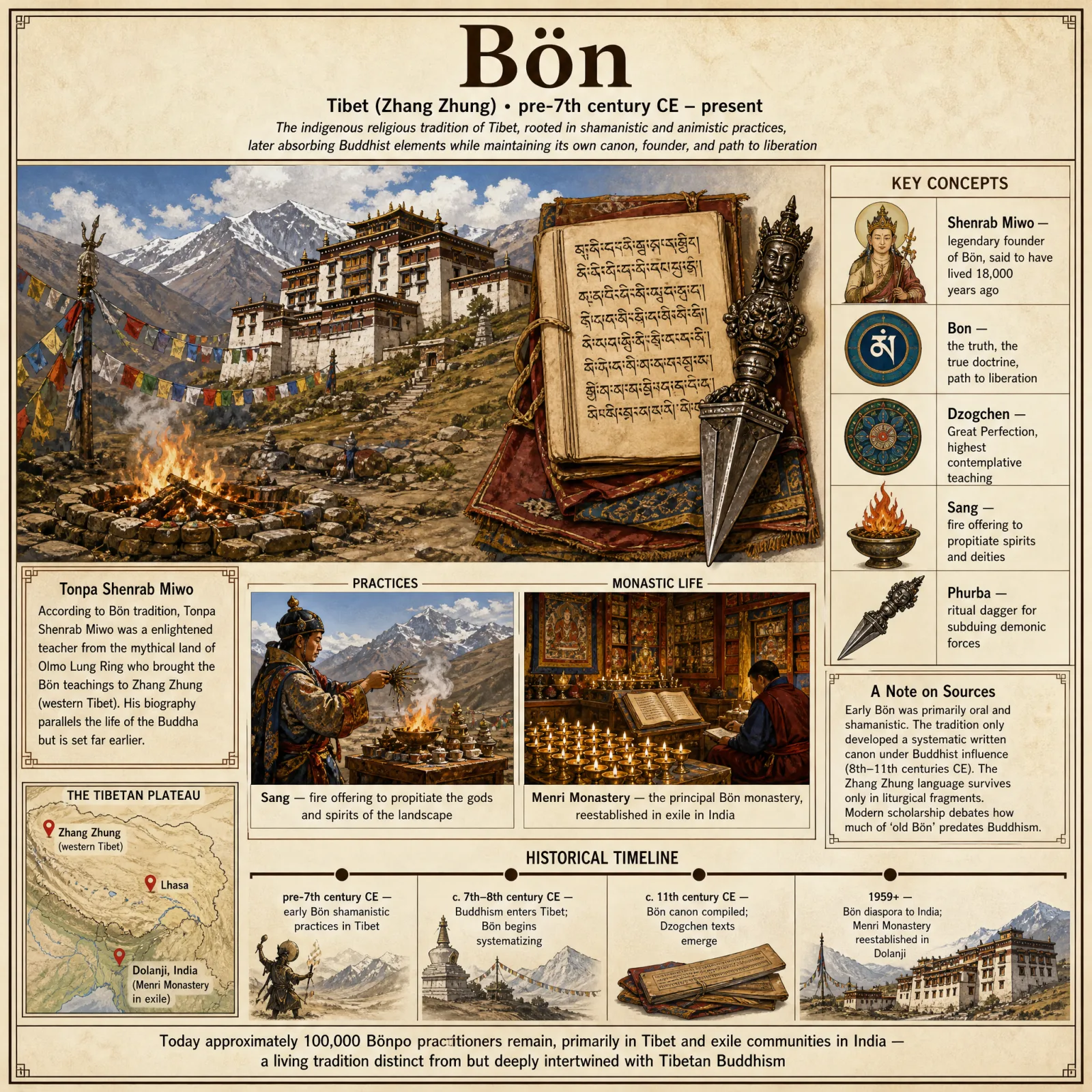
Bön (Tibetan: བོན་, Wylie: bon; also Yungdrung Bön, ག་ཡུང་དྲུང་བོན་, 'Eternal Bön') is the indigenous religious tradition of Tibet, with roots predating the arrival of Buddhism in the 7th century CE. The term 'Bön' is contested and refers to three distinct phenomena: first, the pre-Buddhist religious practices of ancient Tibet (about which very little is reliably known); second, a wide range of local and folk religious practices across the Tibetan cultural sphere, often featuring spirit mediums, divination, and ritual specialists; and third, Yungdrung Bön, the systematized monastic religion that developed in Central Tibet during the 10th-11th centuries CE (the 'renaissance period' of Tibetan Buddhism) and continues as a living tradition today. Modern scholarly consensus, following the pioneering work of David Snellgrove, Per Kværne, and Samten Karmay, recognizes that Yungdrung Bön—the organized, literate religion with its own canon, monasteries, and philosophical traditions—is not simply pre-Buddhist shamanism but rather a complex synthesis that developed in tandem with Tibetan Buddhism, sharing common roots in Indian Buddhist Tantra while insisting on distinct historical origins, lineages, and identity. The older view that dismissed Bön as a 'perversion' of Buddhism or primitive shamanism has been decisively rejected by contemporary scholars, though debates continue about the precise historical relationship between Bön and Buddhism.
Bön adherents maintain that their tradition originated with Tonpa Shenrab Miwoche (Tibetan: སྟོན་པ་གཤེན་རབ་མི་བོ་ཆེ་, Wylie: ston pa gshen rab mi bo che, 'Teacher Shenrab, Great Man'), a fully enlightened Buddha figure who lived in the land of Olmo Lungring (ཨོལ་མོ་ལུང་རིངས་, 'Long Valley of Ol'), described in Bön texts as a vast kingdom situated to the west of Tibet, featuring Mount Yungdrung Gutseg (Nine-Stacked Swastikas Mountain) at its center. Scholars debate whether Olmo Lungring corresponds to a historical geographical location (proposals include the region around Mount Kailash, Central Asia, or Persia) or is a symbolic, supra-mundane realm. Tonpa Shenrab is said to have taught the Bön doctrine in Olmo Lungring and made one journey to Tibet (the Kongpo region), where he subdued demons and introduced the teachings. Bön scriptures, organized according to several traditional models (most famously the Nine Ways of Bön, theg pa dgu, a hierarchical classification of teachings from divination and ritual magic to advanced Dzogchen meditation), claim great antiquity, asserting that Bön predates Buddhism by millennia and was the state religion of the ancient Zhang Zhung kingdom (Tibetan: ཞང་ཞུང, a kingdom centered around Mount Kailash in western Tibet, conquered by the Tibetan Empire in the 7th-8th centuries CE). However, the historical evidence is ambiguous: while Bön clearly preserves some genuinely pre-Buddhist elements (ritual practices, cosmological concepts, shamanic techniques), the Yungdrung Bön canon as we know it—with its elaborate philosophical doctrines, monastic discipline, and tantric practices—emerged during the 10th-11th centuries CE, contemporaneous with the revival of Buddhism in Tibet after the collapse of the Tibetan Empire.
The Bön scriptural canon consists of the Kangyur (Kahyur, bka' 'gyur, collected teachings attributed to Tonpa Shenrab) and Tengyur (Tanjur, bstan 'gyur, commentaries and treatises), paralleling the structure of the Tibetan Buddhist canon but containing distinct texts. Many Bön scriptures are classified as terma (གཏེར་མ, gter ma, 'treasure texts'), works said to have been hidden during periods of persecution (especially during the 8th century CE under King Trisong Detsen, who promoted Buddhism and suppressed Bön) and later rediscovered by tertöns (གཏེར་སྟོན, gter ston, 'treasure finders'). Bön practice spans the Nine Ways, ranging from the lower vehicles (divination, astrology, healing, exorcism, funerary rituals) to the higher vehicles (monastic discipline, tantric yoga, and the supreme teaching of Dzogchen, རྫོགས་ཆེན, rdzogs chen, 'Great Perfection,' the direct realization of the primordial nature of mind). The Bön and Nyingma (Old School Tibetan Buddhism) traditions of Dzogchen are remarkably similar, leading scholars to conclude they share common origins in hereditary ritual groups that integrated Buddhist Tantra with earlier Tibetan practices. Today, Bön claims approximately 400,000 adherents in Tibet (especially Amdo, Kham, and western Tibet), Bhutan, Nepal, India, Mongolia, and diaspora communities worldwide. The Menri Monastery, originally founded in Central Tibet in 1405 CE and re-established at Dolanji, Himachal Pradesh, India, in 1967, serves as the primary seat of Yungdrung Bön and the residence of the Menri Trizin (སྨན་རི་ཁྲི་འཛིན, sman ri khri 'dzin), the spiritual leader of all Bönpo. In 1979, the 14th Dalai Lama formally recognized Bön as equal in status to the four major Tibetan Buddhist schools (Nyingma, Kagyu, Sakya, Gelug), a significant ecumenical gesture acknowledging Bön's legitimacy as an independent religious tradition.
Historical Development
The early history of Bön is shrouded in myth, legend, and contested historiography, with Bön and Buddhist sources offering radically different narratives. According to Bön tradition, recorded in texts such as the Legs bshad mdzod ('Treasury of Good Sayings,' a 19th-century Bön history by Shar rdza bKra shis rgyal mtshan, translated by Samten Karmay in 1972), Bön originated in the land of Olmo Lungring, a vast kingdom to the west of Tibet, where Tonpa Shenrab Miwoche ('Teacher Shenrab, Great Man') was born, attained enlightenment, and taught the Bön doctrine. Tonpa Shenrab is described as a fully enlightened Buddha figure who lived thousands of years before Shakyamuni Buddha (the historical Buddha of Buddhism). He established the Bön teachings centered on Mount Yungdrung Gutseg ('Nine-Stacked Swastikas Mountain'), from which four rivers flow in the cardinal directions. Tonpa Shenrab made one journey to Tibet (the Kongpo region in southeastern Tibet) to subdue the demon Khyabpa Lagring, who had stolen his horses, and to introduce the Bön teachings to the Tibetan people. After his death, Bön became the state religion of the Zhang Zhung kingdom (a powerful kingdom centered around Mount Kailash in western Tibet), which maintained its independence until it was conquered and absorbed by the Tibetan Empire under King Songtsen Gampo (7th century CE). Bön sources claim that Bön was also the religion of the early Tibetan Empire until King Trisong Detsen (r. 755-797 CE) invited Buddhist masters from India and systematically suppressed Bön, burning texts and closing temples.
However, this traditional Bön narrative is historically problematic. Scholars lack independent evidence for Tonpa Shenrab's historicity, the existence of Olmo Lungring as a specific geographical location, or the antiquity of Bön texts that claim to predate Buddhism. The earliest references to 'Bön' in Tibetan historical sources (Dunhuang manuscripts, imperial inscriptions) are ambiguous, referring to ritual specialists (gshen, shen), funerary practices, and local cults, but not to a unified, systematized religion with doctrines and texts comparable to later Yungdrung Bön. What we know of pre-Buddhist Tibetan religion comes from fragmentary sources: Dunhuang manuscripts describe ritual specialists (shen, gshen) who performed divination, animal sacrifice, funerary rites (including tomb construction and offerings for deceased kings), and mediation with local spirits and deities. These practices were likely diverse, localized, and non-canonical, without a unified scriptural tradition or monastic institutions. When Buddhism was introduced to Tibet in the 7th century CE under King Songtsen Gampo and became the state religion under King Trisong Detsen (8th century CE), local religious practices were marginalized, suppressed, or absorbed into Buddhist frameworks. It is likely that some ritual specialists resisted Buddhist hegemony and maintained non-Buddhist practices, but the evidence is sparse.
The historical emergence of Yungdrung Bön as an organized, literate, monastic religion occurred during the 10th-11th centuries CE, the 'renaissance period' following the collapse of the Tibetan Empire (mid-9th century CE) and the revival of Buddhism in Tibet (late 10th century CE). This period saw the systematization of both Buddhist and Bön traditions: Buddhist schools (especially Nyingma, 'Old School,' claiming continuity with earlier imperial-period transmissions, and New Schools such as Sakya, Kagyu, and later Gelug, based on fresh translations from India) established monastic institutions, philosophical curricula, and canonical collections. Simultaneously, Yungdrung Bön crystallized as a self-conscious religious tradition with its own canon (Kangyur and Tengyur), monasteries, lineages, and philosophical doctrines, explicitly asserting its distinct, pre-Buddhist origins while paralleling Buddhist structures. Scholars, following David Snellgrove's pioneering work in the 1960s, argue that Yungdrung Bön developed as a synthesis of: (1) genuinely pre-Buddhist Tibetan ritual practices and cosmological concepts; (2) Indian Buddhist Mahayana and Tantric teachings absorbed during the imperial period and renaissance; (3) Central Asian and possibly Iranian influences (though evidence for the latter is debated); and (4) a deliberate strategy of differentiation from Buddhism, asserting Bön's antiquity and authenticity as an indigenous Tibetan tradition. Geoffrey Samuel characterizes Yungdrung Bön as 'essentially a variant of Tibetan Buddhism' that shares deep commonalities with the Nyingma school, both arising from hereditary ritual practitioners (ngakpa) who integrated Buddhist Tantra with earlier village and court practices, but Bön insisted on its non-Buddhist identity and pre-Buddhist origins.
A key feature of Yungdrung Bön historiography is the terma (treasure text) tradition: Bön texts claim that during the 8th-century persecutions under King Trisong Detsen, Bön masters hid scriptures, ritual objects, and teachings in secret locations (caves, mountains, lakes) to preserve them for future discovery. From the 10th century onward, tertöns (treasure finders) rediscovered these hidden teachings, which became the basis for Yungdrung Bön's canonical scriptures and practices. The terma tradition parallels the Nyingma Buddhist terma tradition and has been a source of ongoing doctrinal development and textual production. Critics (both Buddhist and modern scholars) have questioned the authenticity of terma texts, suggesting they were composed in the renaissance period and retrojected into the past to claim antiquity. Bönpo respond that terma texts preserve genuine ancient teachings, though their rediscovery and compilation occurred later. The debate reflects broader questions about Bön's historical origins and its relationship to Buddhism.
Despite marginalization and periodic persecution, Bön survived and flourished in certain regions of Tibet, particularly Amdo (northeastern Tibet), Kham (eastern Tibet), and western Tibet (the former Zhang Zhung territories). Major Bön monasteries were established, including Menri Monastery (founded 1405 CE in Tsang province, Central Tibet, by Nyamme Sherab Gyeltsen, becoming the leading Bön monastery and seat of the Menri Trizin, the spiritual leader of Bön) and Yungdrung Ling (founded in Kham). Bön developed a scholastic tradition modeled on Buddhist monastic education, including a geshe (dge bshes, 'spiritual friend,' doctorate in divinity) degree program involving years of study in philosophy, logic, debate, and ritual. The Chinese invasion and occupation of Tibet (1950-1959) devastated Bön institutions: monasteries were destroyed, monks killed or fled into exile, and religious practice suppressed. The original Menri Monastery in Tibet was largely destroyed during the Cultural Revolution (1966-1976), though partial reconstruction has occurred. In 1967, Menri Monastery was re-established at Dolanji, Himachal Pradesh, northern India, under the leadership of the 33rd Menri Trizin, Lungtok Tenpai Nyima, and the scholar-monk Lopön Tenzin Namdak. Dolanji became a thriving center for Tibetan Bön culture, housing the Bön Dialectic School, Bön Children's Welfare Center, Redna Menling Nunnery, and over 200 monks, preserving the geshe training program. In 1979, the 14th Dalai Lama formally recognized Bön as the fifth major Tibetan religious tradition, equal in status to Nyingma, Kagyu, Sakya, and Gelug, a landmark ecumenical gesture acknowledging Bön's legitimacy and encouraging dialogue and cooperation among Tibetan religious communities.
Core Worldview and Doctrines
Bön cosmology and soteriology closely parallel Tibetan Buddhist frameworks, reflecting shared Indian Mahayana and Tantric influences. Bön teaches that sentient beings are trapped in samsara (འཁོར་བ, 'khor ba, the cycle of birth, death, and rebirth), driven by ignorance, karma, and afflictive emotions (desire, hatred, delusion). The ultimate goal is liberation (གྲོལ་བ, grol ba) or enlightenment (བྱང་ཆུབ, byang chub, Bön equivalent of bodhi), the realization of the true nature of mind and reality, freeing oneself from samsara. Enlightenment is achieved through ethical conduct, meditation, accumulation of merit, and realization of emptiness (སྟོང་པ་ཉིད, stong pa nyid) and primordial wisdom. Bön cosmology includes the six realms of existence (རིགས་དྲུག, rigs drug): gods, demigods (asuras), humans, animals, hungry ghosts (pretas), and hell beings, through which sentient beings transmigrate based on their karma. The human realm is considered the most auspicious for achieving liberation because it balances suffering (motivating spiritual practice) and opportunity (access to teachings and teachers).
A central Bön concept is Kuntu Zangpo (ཀུན་ཏུ་བཟང་པོ, kun tu bzang po, 'Always Good,' Bön equivalent of the Buddhist Samantabhadra), the primordial Buddha, the ultimate, unchanging nature of reality and mind, pure from the beginning. Kuntu Zangpo represents the dharmakaya, the truth body of enlightenment, beyond form and conceptualization. From Kuntu Zangpo emanate the peaceful and wrathful deities of the Bön pantheon, including Sangpo Bumtri (བསང་པོ་འབུམ་ཁྲི, bsang po 'bum khri, the chief peaceful deity), Walse Ngampa (དབལ་གསས་ངམ་པ, dbal gsas ngam pa, the chief wrathful deity), and numerous protective deities, dakinis, and enlightened masters. Bön venerates Tonpa Shenrab Miwoche as the fully enlightened teacher who revealed the Bön doctrine in this world age, comparable to Shakyamuni Buddha in Buddhism. Tonpa Shenrab is depicted iconographically with specific attributes (blue-colored, seated in meditation, wearing the robes of a prince or monk, holding symbolic implements), and his life story (hagiographies) is recounted in Bön scriptures, though his historicity is unverified.
The Nine Ways of Bön (ཐེག་པ་དགུ, theg pa dgu, 'nine vehicles') is the primary organizational framework for Bön teachings, dividing practices and doctrines into a progressive hierarchy from lower to higher realizations. The Nine Ways are: (1) Way of the Shen of Prediction (ཕྱྭ་གཤེན་ཐེག་པ, phywa gshen theg pa), concerned with divination, astrology, and prognostication; (2) Way of the Shen of the Visual World (སྣང་གཤེན་ཐེག་པ, snang gshen theg pa), rituals for protection, exorcism, and subduing malevolent spirits; (3) Way of the Shen of Illusion (འཕྲུལ་གཤེན་ཐེག་པ, 'phrul gshen theg pa), magical rituals to overcome negative forces, weather control, and prosperity rites; (4) Way of the Shen of Existence (སྲིད་གཤེན་ཐེག་པ, srid gshen theg pa), funerary rituals guiding the deceased through the bardo (intermediate state) to favorable rebirth; (5) Way of the Virtuous Adherers (དགེ་སྙེན་ཐེག་པ, dge snyen theg pa), ethical precepts and vows for lay practitioners; (6) Way of the Great Ascetics (དྲང་སྲོང་ཐེག་པ, drang srong theg pa), monastic discipline and renunciation; (7) Way of Pure Sound (ཨ་དཀར་ཐེག་པ, a dkar theg pa), tantric practices including deity yoga and mantra recitation; (8) Way of the Primeval Shen (ཡེ་གཤེན་ཐེག་པ, ye gshen theg pa), higher tantric practices involving the Generation and Perfection stages (visualizing oneself as the deity, dissolving into emptiness); and (9) Supreme Way (བླ་མེད་ཐེག་པ, bla med theg pa), the teachings of Dzogchen (རྫོགས་ཆེན, rdzogs chen, 'Great Perfection'), the direct, non-gradual realization of the primordial nature of mind, considered the pinnacle of Bön spirituality. The first four vehicles are classified as 'Causal Ways' (rgyu'i theg pa), focusing on external rituals and merit accumulation; the next four are 'Ways of the Result' (''bras bu'i theg pa), internal tantric transformations; and the ninth is the supreme, beyond causality.
Dzogchen (Great Perfection) is the highest teaching in Bön, paralleling the Dzogchen tradition of the Nyingma Buddhist school. Dzogchen teaches that the true nature of mind is rigpa (རིག་པ, rig pa, 'pure awareness,' pristine cognition), luminous, empty, and primordially enlightened. Through direct introduction by a qualified master and sustained meditation practice (especially trekchö, ཁྲེགས་ཆོད, khregs chod, 'cutting through,' and tögal, ཐོད་རྒལ, thod rgal, 'direct crossing'), the practitioner recognizes rigpa and rests in the natural state, transcending conceptual elaboration, dualistic perception, and effort. Liberation is spontaneous and immediate upon recognizing rigpa. Bön Dzogchen texts, practices, and lineages are distinct from but remarkably similar to Nyingma Dzogchen, leading scholars to conclude they share common origins, possibly pre-dating the Buddhist-Bön sectarian divide or emerging from shared tantric milieux in 10th-11th century Tibet.
Sacred Texts and Canon
The Bön scriptural canon consists of two main collections: the Kangyur (བཀའ་འགྱུར, bka' 'gyur, 'Translated Word,' teachings attributed directly to Tonpa Shenrab Miwoche and other enlightened masters) and the Tengyur (བསྟན་འགྱུར, bstan 'gyur, 'Translated Treatises,' commentaries, philosophical texts, and exegetical works by later scholars). This structure parallels the Tibetan Buddhist canon but contains distinct texts, though some overlap and borrowing have occurred. The Bön Kangyur was first collected and edited in the 14th century, with subsequent editions produced in later centuries. It contains teachings organized according to the Nine Ways of Bön, including sutras, tantras, Dzogchen texts, ritual manuals, cosmological treatises, and hagiographies. The gZi brjid ('Brilliance,' a vast narrative text recounting the life and teachings of Tonpa Shenrab) is among the most important works in the Kangyur, serving as the foundational hagiography and doctrinal source. David Snellgrove's The Nine Ways of Bon (1967), a landmark English translation of excerpts from the gZi brjid, provided the first systematic Western presentation of Bön teachings and challenged earlier dismissive views of Bön as a Buddhist perversion.
Many Bön texts are classified as terma (གཏེར་མ, gter ma, 'treasure texts'), works said to have been hidden during the 8th-century persecutions under King Trisong Detsen (who promoted Buddhism and suppressed Bön) and later rediscovered by tertöns (treasure finders) beginning in the 10th-11th centuries. The terma tradition, shared with Nyingma Buddhism, has been central to Bön's textual production and religious authority. Terma texts include Dzogchen teachings, ritual cycles, prophetic revelations, and guidebooks to sacred sites. The authenticity of terma texts is contested: Bönpo assert they preserve ancient teachings genuinely hidden and rediscovered, while critics suggest they were composed in later periods and attributed to earlier masters to claim antiquity and authority. Regardless of their historical origins, terma texts have been instrumental in Bön's doctrinal development and sectarian identity.
Important Bön scriptures include the Zi ji (གཟི་བརྗིད, gzi brjid, 'Brilliance,' the extensive life story of Tonpa Shenrab), the Zermig (གཟེར་མིག, gzer mig, 'Penetrating Eye,' another major Bön tantra), and the Khandro Yangtig (མཁའ་འགྲོ་ཡང་ཏིག, mkha' 'gro yang tig, 'Heart Essence of the Dakini,' a Dzogchen cycle). Philosophical and exegetical works in the Tengyur include commentaries on emptiness, logic, epistemology, and tantric practice, often engaging with Buddhist Madhyamaka and Yogacara philosophical traditions while asserting Bön's distinct identity. The Mdzod phug ('Treasury Cave') is a comprehensive Bön encyclopedia covering cosmology, philosophy, ritual, and practice, compiled in the 14th century. Bön liturgical texts include prayers, chants, ritual manuals for monasteries and laypeople, and meditation instructions. Bön also possesses medical texts (the Bön medical tradition, sowa rigpa, སོ་བ་རིག་པ, so ba rig pa, paralleling Tibetan Buddhist medicine), astrological treatises, and divinatory manuals, reflecting the lower vehicles of the Nine Ways.
Practices and Observances
Bön religious practice encompasses the Nine Ways, ranging from ritual and magical practices (lower vehicles) to monastic discipline, tantric yoga, and Dzogchen meditation (higher vehicles). Lay Bönpo typically engage in the lower vehicles: consulting ritual specialists (gshen, shen) for divination, astrology, healing, exorcism, and funerary rites; making offerings to local deities and protective spirits; performing life-force rituals (ལ་གསོལ, la gsol, invoking life energy and prosperity); and venerating sacred sites (mountains, lakes, caves). Bönpo, like Tibetan Buddhists, perform circumambulation (kora, སྐོར་བ, skor ba) of sacred mountains and stupas, but Bönpo circumambulate counter-clockwise (left shoulder toward the sacred object), in contrast to Buddhists who circumambulate clockwise. This directional difference is a key marker of Bön identity and is observed at sites such as Mount Kailash (where Bönpo walk counter-clockwise while Buddhists walk clockwise) and Kongpo Bonri (Bonri, Bön Mountain, in southeastern Tibet, the only mountain where both Buddhists and Bönpo circumambulate counter-clockwise, reflecting Bön's claim to the site).
Bön monasticism closely parallels Tibetan Buddhist monasticism: monks and nuns take vows of celibacy, renunciation, and ethical conduct; live in monastic communities (gönpa, དགོན་པ, dgon pa, monasteries); engage in daily liturgical practices (prayers, chants, offerings); and pursue philosophical education and meditation training. The Bön monastic curriculum includes the study of Prajnaparamita (perfection of wisdom, emptiness philosophy), Madhyamaka (middle way philosophy), Vinaya (monastic discipline), Abhidharma (phenomenology and psychology), logic and epistemology, tantric practices, and Dzogchen. Advanced students pursue the geshe degree (དགེ་བཤེས, dge bshes, doctorate in divinity), involving years of memorization, debate, philosophical analysis, and examinations, culminating in public debates and thesis defense. The geshe curriculum, modeled on Gelugpa Buddhist scholasticism, demonstrates Bön's integration into Tibetan monastic intellectual culture.
Tantric practices (vehicles 7-8 of the Nine Ways) are central to advanced Bön spirituality. Practitioners receive empowerments (དབང, dbang, initiations) from qualified lamas, authorizing them to practice specific deity yogas, mantras, and visualizations. Tantric practice involves the Generation Stage (བསྐྱེད་རིམ, bskyed rim), visualizing oneself as the enlightened deity (e.g., Sangpo Bumtri, Walse Ngampa, or other yidam deities), cultivating divine pride and pure perception, and the Perfection Stage (རྫོགས་རིམ, rdzogs rim), dissolving the visualization into emptiness and resting in the natural state of mind. Tantric practice aims to purify ordinary perception, transform afflictive emotions into wisdom, and realize the inseparability of appearance and emptiness. Bön tantric rituals include elaborate offerings, mantra recitation, mudras (hand gestures), and visualization of mandalas (celestial palaces and deities).
Dzogchen meditation (vehicle 9, the Supreme Way) is the pinnacle of Bön practice. Dzogchen practitioners receive direct introduction (ངོ་སྤྲོད, ngo sprod) to the nature of mind (rigpa, pure awareness) from a qualified Dzogchen master. Through practices such as trekchö ('cutting through,' resting in the natural state without effort or elaboration) and tögal ('direct crossing,' working with visions of light and spontaneous presence), the practitioner recognizes and stabilizes rigpa, achieving liberation in this lifetime or at the moment of death. Dzogchen teachings emphasize naturalness, non-effort, and the primordial purity of mind, transcending gradual paths and conceptual frameworks. Bön Dzogchen lineages are transmitted from master to disciple through empowerments, oral instructions, and personal guidance, preserving the living tradition.
Bön observes a liturgical calendar with festivals and holy days, including the celebration of Losar (Tibetan New Year), commemorations of Tonpa Shenrab and major Bön masters, and seasonal rituals for prosperity, health, and protection. The swastika (ཡུང་དྲུང, g.yung drung, 'eternal, unchanging') is the primary symbol of Bön, representing permanence, the unchanging nature of reality, and the Nine Ways (nine stacked swastikas form Mount Yungdrung Gutseg). The Bön swastika typically rotates counter-clockwise (opposite the Buddhist clockwise swastika), though usage varies. Bönpo wear distinctive ritual attire during ceremonies, including specific hats, robes, and ornaments, and monasteries display Bön thangkas (scroll paintings), statues, and ritual implements distinct from Buddhist iconography, though overlaps exist.
Internal Diversity and Regional Variations
Bön is not monolithic but encompasses diverse regional traditions, lineages, and interpretations. The term 'Bön' itself is contested and applied to three distinct phenomena, leading to ongoing scholarly and internal debates. Yungdrung Bön ('Eternal Bön'), the organized monastic tradition centered on Menri Monastery and its lineage, claims continuity with the pre-Buddhist religion of Tibet and Zhang Zhung, asserting that its teachings derive from Tonpa Shenrab and predate Buddhism. This is the form of Bön that developed during the 10th-11th centuries CE, paralleling Tibetan Buddhist schools in structure, philosophy, and practice. Yungdrung Bön is the dominant institutional form and is recognized by the Tibetan government-in-exile and the Dalai Lama as a legitimate religious tradition. However, Yungdrung Bön's relationship to pre-Buddhist Tibetan religion remains historically ambiguous: while it preserves some genuinely ancient elements, its systematized doctrines, monastic institutions, and canonical texts clearly emerged in the medieval period, influenced by Buddhism.
In contrast, folk Bön or local Bön refers to the wide range of non-Buddhist or pre-Buddhist religious practices across the Tibetan cultural sphere: spirit mediumship, divination, shamanic healing, local deity worship, funerary rites, and protective rituals. These practices are often performed by non-monastic ritual specialists (lha pa, དྷ་པ, lha pa, spirit mediums; bon po, བོན་པོ, bon po, ritual priests) and exist independently of Yungdrung Bön's institutional structures. Folk Bön practices vary widely by region and community, and practitioners may not identify with or be recognized by Yungdrung Bön institutions. Scholars debate whether folk Bön represents survivals of pre-Buddhist religion or is a label retrospectively applied to diverse local practices. The relationship between Yungdrung Bön and folk Bön is complex: Yungdrung Bön incorporates some folk practices (especially in the lower vehicles of the Nine Ways) but distinguishes itself as a systematized, philosophical, and monastic tradition.
Regionally, Bön is strongest in Amdo (northeastern Tibet, especially Qinghai province), Kham (eastern Tibet, especially Sichuan province), and western Tibet (the former Zhang Zhung territories, including areas around Mount Kailash). In these regions, Bön monasteries, lineages, and communities have maintained continuity despite periodic persecution and marginalization. Central Tibet (Ü-Tsang), historically dominated by Tibetan Buddhist institutions, has fewer Bön monasteries and adherents, though the original Menri Monastery (founded 1405 CE) was located in Tsang. Bön also exists among Tibetan populations in Bhutan, Nepal (especially Dolpo and other northern regions), India (Ladakh, Sikkim, Arunachal Pradesh, and diaspora communities), Mongolia, and diaspora communities worldwide (especially in Europe, North America, and Australia). Diaspora Bön communities often center around prominent lamas and monasteries in exile, particularly Menri Monastery at Dolanji, India, and Triten Norbutse Monastery in Kathmandu, Nepal.
Within Yungdrung Bön, there are distinct lineages and sub-traditions, though sectarian divisions are less pronounced than in Tibetan Buddhism. The Menri lineage, originating from Menri Monastery and the Bru family (a prominent Bön lineage), is the dominant institutional form, and the Menri Trizin (abbot of Menri) is recognized as the spiritual leader of all Bönpo. Other lineages include the Yungdrung Ling tradition (originating from Yungdrung Ling Monastery in Kham) and various regional and family lineages. Bön has also produced female practitioners and masters, though monastic institutions have been male-dominated; the Redna Menling Nunnery at Dolanji represents efforts to support Bön nuns and female monasticism. Gender roles in Bön generally parallel those in Tibetan Buddhism: women can be respected practitioners, teachers, and ritual specialists, but institutional leadership has historically been male.
Communities and Demographics
Estimating the global Bön population is difficult due to inconsistent data, regional variation, and the overlap between Yungdrung Bön adherents and practitioners of folk Bön practices. Scholarly estimates suggest approximately 400,000 Bönpo in Tibet and the Tibetan cultural sphere, though figures vary widely. The largest Bön populations are in Amdo (northeastern Tibet, especially Qinghai province) and Kham (eastern Tibet, especially Sichuan province), where Bön has maintained strong communities, monasteries, and lineages. Western Tibet (the former Zhang Zhung territories around Mount Kailash) also has significant Bön presence, reflecting the tradition's historical association with Zhang Zhung. Central Tibet (Ü-Tsang) has fewer Bönpo, as the region has been historically dominated by Tibetan Buddhist institutions, though the original Menri Monastery was located in Tsang until its destruction during the Cultural Revolution.
The Chinese invasion and occupation of Tibet (1950-1959) and the subsequent Cultural Revolution (1966-1976) devastated Bön communities: monasteries were destroyed, monks and nuns killed or fled into exile, texts and ritual objects confiscated or burned, and religious practice suppressed. The original Menri Monastery in Central Tibet was largely destroyed, and most other major Bön monasteries suffered similar fates. Since the 1980s, limited religious freedom has allowed partial reconstruction of some monasteries in Tibet, and Bön communities have cautiously resumed public practice, though under Chinese government oversight and restrictions. However, many monasteries remain in ruins, and Bön adherents in Tibet face ongoing surveillance, political pressure, and restrictions on religious education and practice.
The Tibetan diaspora, following the flight of the Dalai Lama and tens of thousands of Tibetans to India and Nepal after the failed 1959 uprising, includes a significant Bön community. In 1967, Menri Monastery was re-established at Dolanji, Himachal Pradesh, northern India, under the leadership of the 33rd Menri Trizin, Lungtok Tenpai Nyima (1929-2017), and the scholar-monk Lopön Tenzin Namdak (b. 1926), one of the most prominent Bön teachers and scholars in the 20th-21st centuries. Dolanji became the primary seat of Yungdrung Bön in exile, housing the Bön Dialectic School, Bön Children's Welfare Center, Redna Menling Nunnery (for Bön nuns), and over 200 monks, preserving the geshe training program and transmitting Bön lineages to new generations. The 34th and current Menri Trizin, Geshe Dawa Dhargye, was selected through the traditional lot-drawing process and enthroned in September 2018. Another major Bön institution in exile is Triten Norbutse Monastery in Kathmandu, Nepal, founded by Lopön Tenzin Namdak in the 1980s, serving as a center for Bön studies, Dzogchen practice, and international outreach.
Bön has also spread to the West through the efforts of prominent lamas, scholars, and dharma centers. Lopön Tenzin Namdak, Tenzin Wangyal Rinpoche (founder of Ligmincha International, a Bön teaching organization with centers in the United States, Europe, and Latin America), and other lamas have established Bön centers, retreat facilities, and study programs in North America, Europe, and Australia, introducing Bön teachings (especially Dzogchen, meditation, and healing practices) to Western audiences. Western Bön communities are typically small, consisting of converts and practitioners interested in Tibetan spirituality, meditation, and tantra. Bön has also attracted scholarly attention: the pioneering work of David Snellgrove, Per Kværne, Samten Karmay, Geoffrey Samuel, and others has established Bön studies as a legitimate field within Tibetan and Buddhist studies, challenging earlier dismissive or Orientalist views of Bön as primitive shamanism or a Buddhist perversion.
Sacred Places and Pilgrimage Sites
Mount Kailash (Gang Rinpoche, གངས་རིན་པོ་ཆེ; Bön: Tise, ཏི་སེ, or Bönri, བོན་རི), Western Tibet: Mount Kailash (6,638 meters) is one of the most sacred mountains in the world, revered by Hindus, Buddhists, Jains, and Bönpo. For Bönpo, Mount Kailash (Tise, 'Ice Mountain,' or Bönri, 'Bön Mountain') is the spiritual center of the ancient Zhang Zhung kingdom and the abode of the sky goddess Sipaimen. Bön tradition associates Kailash with Olmo Lungring, the legendary land where Tonpa Shenrab taught the Bön doctrine, though scholars debate whether Olmo Lungring is a symbolic realm or a historical geographical location. Mount Kailash is described in Bön texts as Mount Yungdrung Gutseg ('Nine-Stacked Swastikas Mountain'), the cosmic axis from which four great rivers flow in the cardinal directions (the Indus, Sutlej, Brahmaputra, and Karnali/Ghaghara rivers all have sources near Kailash). Bönpo perform circumambulation (kora) of Mount Kailash counter-clockwise (right shoulder toward the mountain), in contrast to Buddhists, Hindus, and Jains who circumambulate clockwise. The kora is approximately 52 km and takes 1-3 days, depending on pace and devotion. Pilgrims believe that circumambulating Kailash purifies negative karma, brings blessings, and accelerates spiritual progress. Mount Kailash is one of the most important pilgrimage sites for Bönpo worldwide, symbolizing the origins, identity, and sacred geography of the Bön tradition.
Kongpo Bonri (Bonri, བོན་རི, 'Bön Mountain'), Nyingchi, Southeastern Tibet: Kongpo Bonri (also spelled Bönri, located in Kong po region, modern Nyingchi prefecture, southeastern Tibet) is the most sacred mountain specifically associated with Bön, and the only mountain in Tibet where both Buddhists and Bönpo circumambulate counter-clockwise (the Bön direction), reflecting Bön's historical claim to the site. According to Bön legend, Tonpa Shenrab personally visited Kongpo Bonri during his single journey to Tibet, pursuing the demon Khyabpa Lagring who had stolen his horses, and consecrated the mountain, introducing the Bön teachings to the Tibetan people. Kongpo Bonri rises to approximately 4,500 meters on the northern bank of the Yarlung Tsangpo River (Brahmaputra) and is densely forested, featuring ancient juniper groves (some trees over 1,000 years old), ecological diversity, and numerous sacred sites: caves, springs, rock formations with self-appearing images and mantras, and stones carved with the life story of Tonpa Shenrab. The full kora (circumambulation) of Kongpo Bonri is approximately 35-60 km, taking 2-7 days, passing through forests, meadows, and high passes (the Bonri-la pass at 4,500 meters). Pilgrims visit sites associated with Tonpa Shenrab, perform rituals, make offerings, and pray for purification, blessings, and long life. The mountain is home to several Bön monasteries and hermitages, though many were destroyed during the Cultural Revolution and have been partially rebuilt. Kongpo Bonri is central to Bön identity and pilgrimage, representing the historical introduction of Bön to Tibet and the tradition's deep roots in the Tibetan landscape.
Menri Monastery, Dolanji, Himachal Pradesh, India (in Exile): Menri Monastery at Dolanji, Himachal Pradesh, northern India, is the primary seat of Yungdrung Bön in exile and the residence of the Menri Trizin, the spiritual leader of all Bönpo. The original Menri Monastery was founded in 1405 CE in Namling County, Tsang province, Central Tibet, by Nyamme Sherab Gyeltsen (1356-1416), becoming the leading Bön monastery, the center of Bön scholasticism, and the seat of the Menri Trizin lineage. Menri became known for its strict adherence to monastic discipline and high standards of philosophical education, and its abbots were recognized as the spiritual leaders of the Bön community. The original Menri Monastery was largely destroyed during the Cultural Revolution (1966-1976), and though partial reconstruction has occurred in Tibet, it remains in ruins with only a small cohort of monks. In 1967, the 33rd Menri Trizin, Lungtok Tenpai Nyima (1929-2017), and the scholar-monk Lopön Tenzin Namdak (b. 1926) established a Tibetan Bön settlement at Dolanji and re-founded Menri Monastery in exile. Dolanji Menri has become a thriving center for Bön education, practice, and culture, housing over 200 monks, the Bön Dialectic School (offering the geshe degree program), the Bön Children's Welfare Center, the Redna Menling Nunnery (for Bön nuns), a Tibetan medical college, library, and guest facilities for pilgrims and visitors. The monastery preserves Bön lineages, rituals, texts, and teachings, and serves as the administrative and spiritual hub for the global Bön community. Dolanji is a pilgrimage site for Bönpo from Tibet, the Himalayas, and the diaspora, and a center for international Bön studies and outreach.
Triten Norbutse Monastery, Kathmandu, Nepal: Triten Norbutse Monastery, located in Kathmandu, Nepal, is another major Bön institution in exile, founded by Lopön Tenzin Namdak in the 1980s. Triten Norbutse serves as a center for Bön studies, Dzogchen practice, and international engagement, hosting monks, nuns, lay practitioners, and scholars. The monastery offers educational programs, including a geshe degree program (one of only two in the Bön tradition, alongside Menri Dolanji), meditation retreats, and cultural preservation initiatives. Triten Norbutse has played a significant role in introducing Bön teachings to Western audiences through publications, translations, and hosting international students and practitioners. The monastery is a pilgrimage site for Bönpo and visitors interested in Bön spirituality, architecture, and culture.
Yungdrung Ling Monastery, Kham, Eastern Tibet (historical): Yungdrung Ling Monastery (གཡུང་དྲུང་གླིང, g.yung drung gling), located in Kham (eastern Tibet), was one of the major Bön monasteries alongside Menri, serving as a center for Bön scholarship, practice, and lineages in eastern Tibet. Founded in the medieval period, Yungdrung Ling housed hundreds of monks and maintained a geshe training program and extensive library. The monastery was largely destroyed during the Cultural Revolution, and its status and reconstruction efforts are less well-documented than Menri. Yungdrung Ling represented the strength of Bön in Kham, a region where Bön has historically maintained a strong presence alongside Tibetan Buddhist schools.
Contemporary Debates and Contested Issues
The historical origins and identity of Bön remain contested among scholars, Bönpo, and Tibetan Buddhists. Bön tradition asserts that Yungdrung Bön predates Buddhism by millennia, originating with Tonpa Shenrab in Olmo Lungring and serving as the religion of the ancient Zhang Zhung kingdom and early Tibetan Empire before being suppressed by Buddhist kings in the 8th century CE. However, the historical evidence is ambiguous and controversial. Modern scholars, following David Snellgrove, Per Kværne, Samten Karmay, and Geoffrey Samuel, argue that Yungdrung Bön as an organized, literate, monastic religion with canonical texts and philosophical doctrines emerged in the 10th-11th centuries CE, contemporaneous with the revival of Buddhism in Tibet. While Yungdrung Bön clearly preserves some genuinely pre-Buddhist elements (ritual practices, cosmological concepts, shamanic techniques), its systematized teachings are heavily influenced by Indian Buddhist Mahayana and Tantra. Geoffrey Samuel characterizes Yungdrung Bön as 'essentially a variant of Tibetan Buddhism' that shares deep commonalities with the Nyingma school, both arising from hereditary ritual practitioners who integrated Buddhist Tantra with earlier Tibetan practices, but Bön insisted on its distinct, pre-Buddhist identity. This scholarly consensus is rejected by many Bönpo, who assert the authenticity and antiquity of their tradition based on Bön historiography, terma texts, and lived religious experience. The debate reflects broader questions about religious origins, identity, and the construction of tradition.
The classification of 'Bön' itself is contested. The term 'Bön' is applied to three distinct phenomena: (1) the pre-Buddhist religion(s) of ancient Tibet (about which very little is reliably known); (2) diverse folk religious practices across the Tibetan cultural sphere (spirit mediumship, divination, local deity worship); and (3) Yungdrung Bön, the organized monastic tradition. Scholars debate whether these three phenomena are continuous or distinct, and whether it is appropriate to label all as 'Bön.' The older scholarly view, prevalent until the mid-20th century, dismissed Bön as primitive shamanism, a perversion of Buddhism, or a political and sectarian construct. This view has been decisively rejected by contemporary scholars, who recognize Yungdrung Bön as a legitimate, sophisticated religious tradition with its own canonical texts, philosophical doctrines, and spiritual practices. However, the relationship between Yungdrung Bön and pre-Buddhist Tibetan religion remains unclear: Yungdrung Bön claims continuity, but the historical evidence suggests significant discontinuity and medieval innovation. The debate is complicated by the polemical nature of Tibetan Buddhist and Bön historiography, which often misrepresent or denigrate each other's traditions.
The authenticity of Bön terma texts is contested. Bön scriptures, especially those classified as terma ('treasure texts'), claim to have been hidden during 8th-century persecutions and later rediscovered by tertöns (treasure finders) beginning in the 10th-11th centuries. Critics (both Buddhist and scholarly) question the authenticity of terma texts, suggesting they were composed in the renaissance period and retrojected into the past to claim antiquity and authority. Bönpo respond that terma texts preserve genuine ancient teachings, though their rediscovery and compilation occurred later, and that the terma tradition is a legitimate mode of revelation and transmission. The debate parallels disputes over Nyingma Buddhist terma texts and reflects broader tensions between textual criticism, religious authority, and lived tradition. The terma tradition has been central to Bön's identity and doctrinal development, and questioning its authenticity touches on core issues of legitimacy and continuity.
The relationship between Bön and Tibetan Buddhism, particularly Nyingma, is debated. Scholars note the remarkable similarities between Bön and Nyingma Dzogchen, tantric practices, monastic structures, and philosophical doctrines, leading some to conclude they are essentially variants of the same tradition differentiated primarily by sectarian identity and historical claims. Geoffrey Samuel argues both Bön and Nyingma arose from shared origins in hereditary ritual groups that integrated Buddhist Tantra with earlier Tibetan practices, with Bön emphasizing its pre-Buddhist elements and Nyingma its Buddhist identity. However, Bönpo and Nyingma practitioners generally assert their traditions are distinct, with different founders, lineages, and soteriological paths. The debate reflects broader questions about religious syncretism, sectarian boundaries, and the construction of difference and identity in Tibetan religious history.
The status and recognition of Bön within Tibetan society and the Tibetan government-in-exile is an ongoing issue. Historically, Bön was marginalized, persecuted, and stigmatized as non-Buddhist or heretical by dominant Tibetan Buddhist institutions and rulers. In 1979, the 14th Dalai Lama formally recognized Bön as the fifth major Tibetan religious tradition, equal in status to Nyingma, Kagyu, Sakya, and Gelug, a landmark ecumenical gesture acknowledging Bön's legitimacy and encouraging dialogue and cooperation. This recognition has improved Bön's status, but tensions and stigma persist: some Tibetan Buddhists continue to view Bön as inferior or heterodox, and Bön adherents face social and institutional discrimination in some contexts. Bön's inclusion in Tibetan cultural and religious identity (e.g., in diaspora institutions, educational programs, and interfaith dialogues) remains incomplete and contested.
Key Terms
- Bön (བོན་)
- The indigenous religious tradition of Tibet. The term refers to three phenomena: pre-Buddhist Tibetan religion, folk religious practices, and Yungdrung Bön (the organized monastic tradition).
- Yungdrung Bön (གཡུང་དྲུང་བོན་)
- Eternal Bön; the organized, literate monastic form of Bön that developed in the 10th-11th centuries CE, claiming continuity with pre-Buddhist traditions.
- Tonpa Shenrab Miwoche (སྟོན་པ་གཤེན་རབ་མི་བོ་ཆེ)
- Teacher Shenrab, Great Man; the founder of Bön, a fully enlightened Buddha figure said to have taught in Olmo Lungring and visited Tibet. His historicity is unverified.
- Olmo Lungring (ཨོལ་མོ་ལུང་རིངས་)
- Long Valley of Ol; the legendary land west of Tibet where Tonpa Shenrab taught the Bön doctrine. Scholars debate whether it is a historical location or a symbolic realm.
- Zhang Zhung (ཞང་ཞུང)
- Ancient kingdom centered around Mount Kailash in western Tibet, conquered by the Tibetan Empire in the 7th-8th centuries CE. Bön tradition claims it was the center of early Bön.
- Menri Trizin (སྨན་རི་ཁྲི་འཛིན)
- The abbot of Menri Monastery and the spiritual leader of all Bönpo. Currently the 34th Menri Trizin, Geshe Dawa Dhargye (enthroned 2018).
- Nine Ways of Bön (ཐེག་པ་དགུ)
- The hierarchical classification of Bön teachings into nine vehicles, ranging from divination and ritual (lower) to Dzogchen meditation (highest).
- Dzogchen (རྫོགས་ཆེན)
- Great Perfection; the highest teaching in Bön, the direct realization of the primordial nature of mind (rigpa). Remarkably similar to Nyingma Buddhist Dzogchen.
- Kuntu Zangpo (ཀུན་ཏུ་བཟང་པོ)
- Always Good; the primordial Buddha in Bön, the ultimate nature of reality and mind. Equivalent to Samantabhadra in Buddhism.
- Terma (གཏེར་མ)
- Treasure texts; Bön scriptures said to have been hidden during 8th-century persecutions and later rediscovered by tertöns (treasure finders).
- Geshe (དགེ་བཤེས)
- Spiritual friend; doctorate in divinity in Bön and Tibetan Buddhist monastic education, awarded after years of study, debate, and examinations.
- Kora (སྐོར་བ)
- Circumambulation; walking around a sacred site (mountain, stupa, temple). Bönpo circumambulate counter-clockwise, distinct from Buddhist clockwise circumambulation.
- Mount Kailash / Tise (ཏི་སེ)
- Sacred mountain in western Tibet (6,638 m), revered by Hindus, Buddhists, Jains, and Bönpo. For Bönpo, it is Bönri (Bön Mountain), the spiritual center of Zhang Zhung.
- Kongpo Bonri (བོན་རི)
- Bön Mountain in southeastern Tibet, the only mountain personally consecrated by Tonpa Shenrab. The most sacred Bön pilgrimage site, circumambulated counter-clockwise.
- Swastika / Yungdrung (གཡུང་དྲུང)
- Eternal, unchanging; the primary symbol of Bön, representing permanence and the Nine Ways. Typically rotates counter-clockwise (opposite Buddhist swastika).
- Rigpa (རིག་པ)
- Pure awareness, pristine cognition; the true nature of mind in Dzogchen, luminous, empty, and primordially enlightened.
- Sangpo Bumtri (བསང་པོ་འབུམ་ཁྲི)
- The chief peaceful deity in the Bön pantheon, a manifestation of enlightened wisdom and compassion.
- Walse Ngampa (དབལ་གསས་ངམ་པ)
- The chief wrathful deity in the Bön pantheon, a protector and subduer of obstacles.
- Shen / Gshen (གཤེན)
- Ritual specialist or priest in pre-Buddhist and Bön traditions, performing divination, healing, exorcism, and funerary rites.
- Lopön Tenzin Namdak (བློ་དཔོན་བསྟན་འཛིན་རྣམ་དག)
- Prominent Bön scholar-monk (b. 1926), co-founder of Menri Monastery at Dolanji and Triten Norbutse Monastery, instrumental in preserving and transmitting Bön teachings in exile.
Further Reading
- Per Kværne, Tibet Bon Religion: A Death Ritual of the Tibetan Bonpos (E.J. Brill, 1985)
- Per Kværne, The Bon Religion of Tibet: The Iconography of a Living Tradition (Serindia Publications, 1995)
- Samten G. Karmay (ed. and tr.), The Treasury of Good Sayings: A Tibetan History of Bon (Oxford University Press, 1972)
- David L. Snellgrove, The Nine Ways of Bon (London Oriental Series, Oxford University Press, 1967)
- Geoffrey Samuel, Civilized Shamans: Buddhism in Tibetan Societies (Smithsonian Institution Press, 1993)
- Geoffrey Samuel, Introducing Tibetan Buddhism (Routledge, 2012)
- Per Kværne, The Bon Religion of Tibet: A Survey of Research (Buddhist Forum, 1995)
- Encyclopaedia Britannica: Bon
- Yungdrung Bon: The Importance of Mt. Kailash in the Bön Religion
- The Treasury of Lives: Menri (Dolanji)
Practices
- Monastic study
- Sky burial & death rites
- Divination & astrology
- Circumambulation (counter-clockwise)
Core ideas
- Founder
- Tonpa Shenrab, legendary founding teacher
- Path
- Nine Ways (theg pa dgu) from shamanic ritual to monastic philosophy
Sacred texts
Bön's canonical scripture collection, paralleling the structure of the Tibetan Buddhist Kangyur, containing teachings attributed to Tonpa Shenrab across the tradition's 'Nine Ways' (vehicles) of practice. It covers cosmology, ritual, monastic discipline, and esoteric meditation.