Slavic & Baltic Paganism
Perun's thunder and the last pagan holdout of Europe.
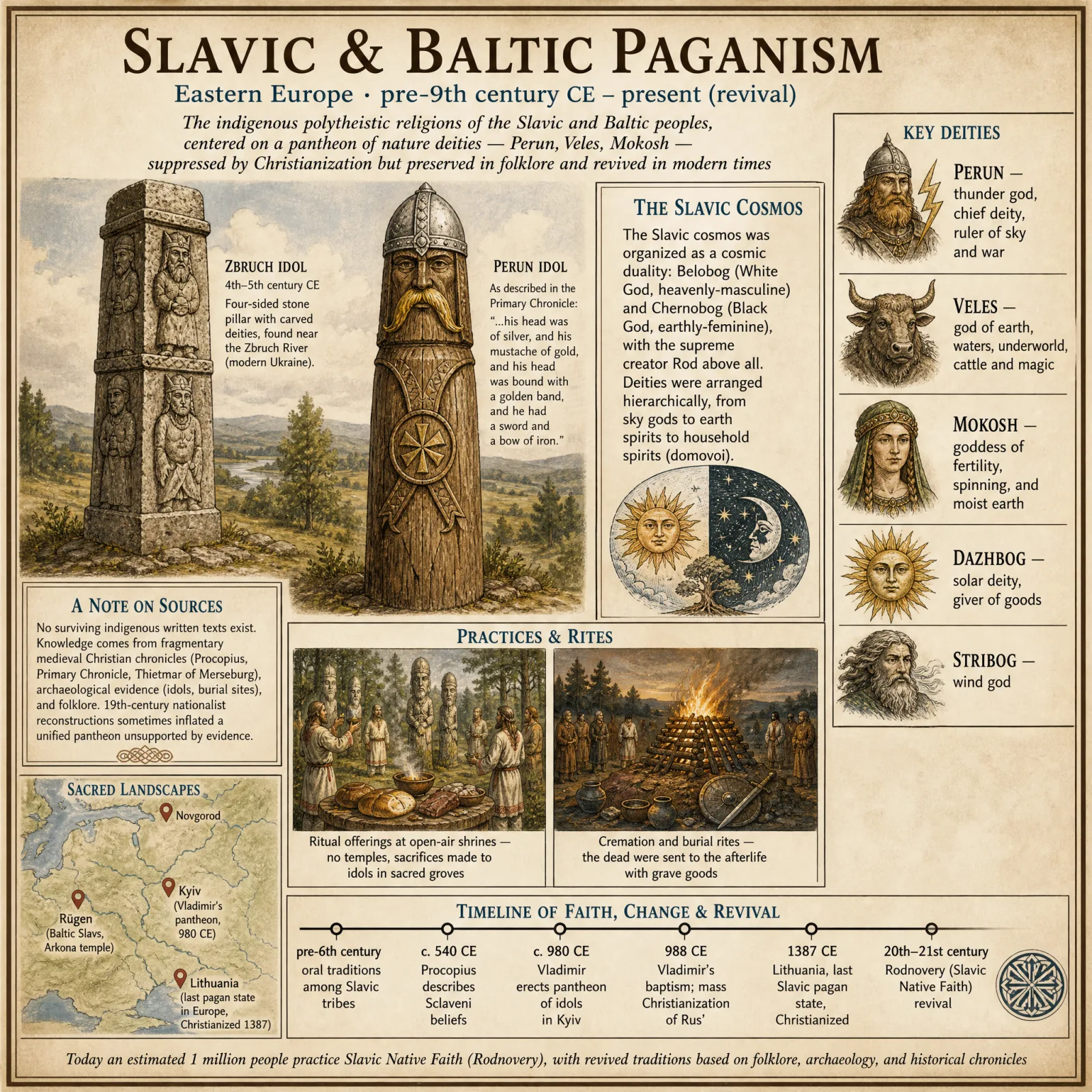
Overview
Slavic & Baltic Paganism, as this site names it, is an umbrella for the pre-Christian religions of the Slavic- and Baltic-speaking peoples of eastern and northeastern Europe—not a single church, and not Norse religion. Slavs and Balts share Indo-European vocabulary for a thunder god (Slavic Perun, Lithuanian Perkunas, Latvian Perkons) and a landscape of groves, springs, and household spirits, but they spoke different language families' neighbors, formed different polities, and were converted on different timetables. Lithuania's official baptism in 1387 is conventionally the end of the last state-level pagan religion in Europe; folk practice continued under Christianity for centuries.
There is no native pre-Christian Slavic or Baltic scripture. What can be said comes from archaeology, place-names, folklore collected much later, and written notices by Christian or Muslim outsiders: the Russian Primary Chronicle's account of Perun's idols on the Kiev hills, Thietmar of Merseburg and Helmold of Bosau on Polabian temples, Saxo Grammaticus and the Knytlinga saga on the Sventovit temple at Arkona, and Peter of Dusburg on the Prussian sanctuary of Romowe. These are late, hostile, and often second-hand. Reconstruction that treats them as a Baltic-Slavic Edda is methodologically the same error as reading Snorri as fieldwork.
The umbrella therefore has a hard limit. East Slavic, West Slavic (especially the Lutici and Rani), South Slavic, Prussian, Lithuanian, and Latvian traditions are related, not identical. They are distinct from the Aesir-Vanir world of Scandinavia, even where thunder-gods and sacred trees look comparable. Modern Rodnovery (Slavic Native Faith) and Lithuanian Romuva are twentieth-century reconstructionist movements; they take names from the old sources but are not unbroken survivals of Arkona or of the Kiev pantheon of 980.
Historical Development
Proto-Slavic and Baltic speakers inherited an Indo-European storm-god and a sacral landscape of oaks, groves, and ancestors. Archaeology of early medieval Eastern Europe shows cremation, weapon deposits, and open-air cult more often than stone temples. The first detailed written snapshots appear only as these societies met literate Christian neighbors. In Kievan Rus', the Primary Chronicle reports that Prince Vladimir in 980 set up wooden idols on the hill outside the citadel—Perun with a silver head and golden moustache, and Khors, Dazhbog, Stribog, Simargl, and Mokosh—then in 988 had Perun flogged, dragged to the Dnieper, and thrown in, as the city was baptized. Treaties of 907, 945, and 971 already show Rus' oaths by Perun and Veles/Volos, so the chronicle's "pantheon reform" is a political centralization, not the invention of the gods.
Among West Slavs, temple-strongholds are better described by German and Danish clerics because conversion came by crusade and conquest. Thietmar of Merseburg (early eleventh century) described the Lutici sanctuary of Riedegost/Rethra, with a many-headed god and a sacred horse used for divination. Helmold of Bosau's Chronica Slavorum (twelfth century) and Saxo Grammaticus describe the island of Rugen, where the Rani kept the four-headed Sventovit (Svetovid) at Arkona. In 1168 King Valdemar I of Denmark and Bishop Absalon took Arkona; the idol was dragged out and burned. That siege is one of the few pagan cult sites in northern Europe whose destruction is both narrated and, in outline, archaeologically pursued on Cape Arkona.
Baltic-speaking Prussians, Lithuanians, and Latvians remained pagan longer. The Teutonic Order's chronicles, especially Peter of Dusburg's Chronicon terrae Prussiae (1326), describe a high sanctuary at Romowe (Romuva) in Nadruvia, with a priest criwe and an ever-burning fire, analogized to a pagan "pope." The location has never been securely excavated; the report is a Christian outsider's template as much as a map. Lithuania under Grand Dukes such as Gediminas and Kestutis kept public pagan cult into the fourteenth century, using it as a marker of political independence. Jogaila's baptism and the Christianization of Lithuania in 1387, and of Samogitia in 1413–1417, closed the last European pagan monarchy. Sacred groves were cut; churches rose on hills. Folklore, dainos (Lithuanian songs), and seasonal rites preserved names and gestures under Catholic and Orthodox calendars.
From the Renaissance antiquarians through nineteenth-century romantic nationalism, scholars and poets rebuilt "Slavic mythology" from fragments, sometimes inventing deities to fill gaps. Twentieth-century archaeology and source criticism—now synthesized in Juan Antonio Alvarez-Pedrosa's Sources of Slavic Pre-Christian Religion (Brill, 2020) and related ritual studies—insist on the poverty of the dossier. Modern pagan revivals after 1990 in Russia, Ukraine, Poland, and the Baltics are new religious movements with political and cultural agendas, not the medieval cult restored.
Core Worldview and Doctrines
The most securely attested high god among East Slavs is Perun, thunder, oaths, and princely war, cognate with Lithuanian Perkunas. Veles (Volos), mentioned in the Rus' treaties as a god of cattle and wealth, is often reconstructed as Perun's chthonic counterpart, but the dualist "Perun vs. Veles" drama popular in modern Rodnovery goes beyond what the chronicles state. Mokosh, the only clearly female name in Vladimir's 980 list, is associated with women's work and moisture. West Slavic temple gods—Sventovit at Arkona, Triglav at Szczecin, Svarozic at Rethra—may be local hypostases or distinct deities; Helmold also mentions a "black god" (Zcerneboch) whose dualism should not be inflated into a full theology.
Baltic religion, as described in later folklore and in medieval notices, centers Perkunas the thunderer, a solar and fate complex (Saule, Laima), earth and forest beings, and a strong cult of the dead. Prussian Romowe, if Peter's report is more than analogy, suggests a priestly center with fire and a sacred precinct rather than a statue-filled temple on the Arkona model. Household and ancestor rites (East Slavic dziady, Baltic feeding of the dead) were likely more important to most people than any princely idol. Sacred groves (als in Baltic, gaj in Slavic) were the ordinary temples.
Afterlife is poorly documented. Ancestral spirits requiring seasonal hospitality are better attested than a moral heaven and hell. Divination by sacred horse (Arkona, Rethra) and lots appears in the Latin sources. None of this is the Norse nine worlds, Yggdrasil, or Valhalla. Comparative Indo-European work can note that Perun/Perkunas and Thor are thunderers with oak and weapon, but the myths, temples, and conversion histories are not interchangeable, and this dataset already has a separate Norse article.
Sources Rather Than Scriptures
Slavic and Baltic paganism left no native canon. The Primary Chronicle (Povest' vremennykh let), compiled in Kiev in the early twelfth century from earlier annals, is the main East Slavic narrative: Vladimir's idols, the baptism of 988, and the earlier treaty oaths. It is a Christian monastic history of a dynasty, not a pagan book. Novgorod chronicles add local notices, including the overthrow of Perun at Peryn.
Latin and German authors supply the West Slavic temples. Thietmar, Adam of Bremen (briefly), Helmold, Saxo, and the Knytlinga saga describe Rethra, Szczecin, and Arkona with the biases of missionaries and crusaders: idols, wealth, sacred horses, and the satisfaction of seeing them destroyed. Arabic geographers (Ibn Fadlan on the Rus' is often cited) describe funeral and idol practices of groups on the Volga that may be Scandinavian, Slavic, or mixed; they must not be dumped uncritically into a "Slavic" file.
For the Balts, Peter of Dusburg, the Livonian Rhymed Chronicle, and later Jesuit and Lutheran reports on Lithuanian and Latvian "superstition" are the medieval backbone. Folklore collections of the nineteenth century—dainos, byliny, seasonal songs—are invaluable and late; they show Christianized peasant religion, not a frozen Bronze Age. Alvarez-Pedrosa's Brill anthology gathers the medieval texts in original languages with English translation, which is the responsible starting point rather than reconstructed "Books of Veles" (a modern forgery sometimes circulated in Rodnovery).
Practices and Observances
Open-air worship at groves, springs, and hills was the default. Temples with statues, where they existed, cluster in the West Slavic zone that met German and Danish observers. Offerings of food, drink, animals, and—according to Christian writers—sometimes humans are reported; archaeology can confirm animal deposits more readily than the sensational claims. Communal feasts and seasonal markers (solstice fires, harvest, the ancestral dziady/veles rites of autumn) structured the year. Oaths by Perun in princely treaties show that the thunder god sanctioned political speech.
Divination is one of the best-attested public rites: the sacred horse walking over spears at Arkona and Rethra, lots, and priestly interpretation. Household practice—corner gods, oven and threshold spirits, first-fruits—survived conversion as "double faith" (dvoeverie), a term Orthodox preachers used for parishioners who still fed the dead and feared the leshii. Baltic midsummer (later merged with St. John's) and the feeding of veles/veļi likewise show calendar continuity under new names.
Conversion practices were as ritual as the cult they replaced: dragging Perun to the river, cutting groves, building churches on the same hills. That reuse is why some sites are both pagan and Christian memory. Reconstructing "how to perform a rite" from Helmold or Peter of Dusburg, however, is not possible at the level of liturgy; the sources give outsiders' snapshots, not manuals.
Slavic and Baltic, Not One Folk
East Slavs (Rus', later Ukrainian, Belarusian, Russian lands) are documented mainly through Kiev and Novgorod and through later folklore. West Slavs of the Polabian and Pomeranian coasts had the temples that Latin writers could visit or besiege. South Slavs enter the dossier more thinly, often through Byzantine notices and later folk custom. Baltic speakers—Old Prussians (extinct as a language), Lithuanians, Latvians—kept public paganism longest and left a different mix of chronicle and song.
Norse religion is a separate historical complex: different languages, different poetic corpus (Eddas, skaldic verse), different archaeology (ship burials, Thor's hammers), different conversion (royal Scandinavian baptisms, Iceland's Althing). Thunder-god comparison is legitimate Indo-European linguistics; collapsing Arkona into Uppsala or Perun into Thor as if they were the same cult is not. This article therefore does not recycle the Norse places or the Poetic Edda.
Modern Romuva in Lithuania, founded in the twentieth century and reconstituted after Soviet rule, takes its name from the medieval Prussian sanctuary. It is a legally recognized pagan community in independent Lithuania, a reconstructionist religion, not the criwe's fire restored. Rodnovery in Slavic countries is similarly modern, internally diverse, and sometimes entangled with nationalism. Both belong in the "communities today" story, not in the tenth-century one.
Conversion, Folklore, and Modern Revival
After baptism, Slavic and Baltic peasants remained the main carriers of older practice. Orthodox and Catholic clergy complained for centuries about groves, household offerings, and untimely feasts. Ethnographers of the nineteenth and early twentieth centuries recorded that residue. Urban and national elites, meanwhile, used reconstructed paganism as heritage: Polish, Russian, and Lithuanian romanticisms each built a different "ancient faith."
Today Rodnovery, Romuva, Dievturi (Latvian), and related groups are small new religious movements with registered congregations in some states. They publish liturgies, celebrate solstices, and argue over racial versus universal membership—debates familiar from Asatru. Scholarly study treats them as contemporary paganism, not as medieval survivals. The historical religions of Perun and Perkunas remain evidence-limited, which is why this dataset marks the tradition as extinct at the level of state cult while noting revival.
Sites That Can Be Sourced
Cape Arkona on the island of Rugen (Germany), the Jaromarsburg, is the best-known West Slavic temple site. Medieval accounts describe a square temple of Sventovit with a four-headed idol, a horn for divination, and a sacred horse; in 1168 the Danish king and Bishop Absalon destroyed it. Earthworks on the cape have been excavated; they match a fortified cult center even when every detail of Saxo's statue cannot be confirmed. Arkona is a real named place in the chronicles and on the ground, not a folkloric nowhere.
The Kiev hills (the citadel heights above the Dnieper, including the area later called Volodymyr's Hill) are where the Primary Chronicle places Vladimir's 980 idols and the 988 humiliation of Perun. No wooden statue survives; the source is the chronicle, corroborated in outline by the treaty oaths and by the logic of baptizing a capital. Peryn, a hill and archaeological precinct south of Novgorod near Lake Ilmen, is associated with a Perun cult and a later church; excavations have found a circular feature interpreted as a shrine, though interpretation is debated. These are East Slavic princely sites, not Baltic groves.
Rethra (Riedegost), the Lutici sanctuary described by Thietmar, has never been located with certainty—candidates in Mecklenburg remain disputed. It is mentioned here as a sourced name whose geography is unsolved, not as a tourist pin. Romowe / Romuva, the Prussian sanctuary in Nadruvia described by Peter of Dusburg, is likewise unlocated. It should not be equated casually with modern Lithuanian Romuva's ritual grounds. What can be said is that a Christian chronicler believed the Prussians had a chief sacred precinct with fire and a high priest; archaeology has not produced the temple.
Kernave in Lithuania, a UNESCO World Heritage cultural reserve (list 1137), is a complex of hillforts in the Neris valley that was a medieval Lithuanian political center in the last pagan generations and after baptism. It is not a named temple of Perkunas in a chronicle, but it is a real landscape of the conversion era. Vilnius, including the valley of Sventaragis and the later cathedral area, is where grand-ducal pagan and then Christian cult concentrated; reports of a Perkunas temple on the cathedral site are later and must be labeled as such. Sacred geography for this tradition is therefore a short list of chronicle places and a long list of unnamed groves.
The Source Problem and Scholarly Debates
The source problem is the whole field. Every connected narrative of Slavic or Baltic paganism is an inference from hostile, late, or folkloric witnesses. Alvarez-Pedrosa and colleagues insist on printing the medieval texts first, in their languages, before reconstruction. Nineteenth-century "pantheons" that multiplied gods from folk etymology are no longer acceptable. The Book of Veles is a modern forgery. Place-name and linguistic comparison (Perun/Perkunas) is stronger than invented myths.
How organized was the cult? One school sees Vladimir's 980 idols and the West Slavic temples as state attempts to centralize religion, perhaps even imitating Christianity's public cult; another sees them as the visible tip of a largely aniconic grove religion. The Scandinavian-influence thesis for the Kiev pantheon (Varangian elite importing gods) is largely rejected for Perun himself, who is linguistically Slavic-Baltic, though some other names in the 980 list (Khors, Simargl) look Iranian and remain disputed.
Romuva requires extra care. Using Peter's Romowe to validate a 1920s–1990s Lithuanian movement as "the same religion" repeats the Druid/Stonehenge error. Conversely, denying any continuity of folk practice underestimates dainos and grove memory. The balanced position is the one this article takes: medieval Baltic paganism is real and poorly documented; modern Romuva is a sourced reconstructionist religion that chose a medieval name. Distinctness from Norse religion is not a debate but a boundary of this dataset.
Key Terms
- Perun
- East Slavic thunder and oath god; the principal named deity of the Kievan princely cult.
- Perkunas
- Lithuanian thunder god, cognate with Perun and Latvian Perkons; not identical to Norse Thor.
- Sventovit (Svetovid)
- Four-headed god of the Rani at Arkona, destroyed in 1168; known from Saxo and related Latin-Danish sources.
- Veles (Volos)
- God named with Perun in Rus' treaties, associated with cattle and wealth; later folklore expands his role.
- Mokosh
- The only clearly female deity in Vladimir's 980 Kiev list, associated with women's work and moisture.
- Primary Chronicle
- Early twelfth-century Kievan annalistic compilation; main narrative source for the 980 idols and 988 baptism.
- Arkona
- Rani temple-stronghold on Cape Arkona, Rugen; the best-sourced West Slavic cult site.
- Romowe / Romuva
- Medieval Prussian sanctuary named by Peter of Dusburg; also the name of a modern Lithuanian pagan movement—do not collapse the two.
- Dziady
- East Slavic ancestral rites of feeding the dead, continued in folk practice after baptism.
- Grove (gaj, als)
- The ordinary sacred precinct in Slavic and Baltic religion, more typical than a built temple.
- Rodnovery
- Modern Slavic Native Faith; a reconstructionist new religious movement, not a medieval survival.
- Source problem
- Dependence on late Christian chronicles and later folklore, with no native pre-Christian scripture.
Further Reading
- Encyclopaedia Britannica: Slavic religion
- Encyclopaedia Britannica: Baltic religion
- Juan Antonio Alvarez-Pedrosa, ed., Sources of Slavic Pre-Christian Religion (Brill, 2020)
- Sources of Slavic Pre-Christian Religion (DOI)
- Alvarez-Pedrosa and Santos Marinas, Rituals in Slavic Pre-Christian Religion (Arc Humanities Press, 2021)
- Open Access edition: Rituals in Slavic Pre-Christian Religion (OAPEN)
- UNESCO World Heritage: Kernave Archaeological Site (Cultural Reserve of Kernave)
- World History Encyclopedia: Slavic Paganism and Mythology
- Encyclopaedia Britannica: Perun
- Encyclopaedia Britannica: Perkunas
- Harvard Ukrainian Research Institute: Povest' vremennykh let / Primary Chronicle resources
Practices
- Sacred grove worship
- Ancestor & household spirits
- Seasonal fire festivals
- Divination
Core ideas
- Deity
- Perun/Perkūnas (thunder) and a wider pantheon
- Afterlife
- Ancestral spirits (dziady) honored at seasonal rites
Sacred texts
Slavic and Baltic paganism left no native scripture; what is known comes from outside accounts — the Russian Primary Chronicle's description of Perun's idols in Kyiv, and German missionary reports on Baltic grove-worship and priesthoods. Folk songs, festivals, and place names preserved fragments long after formal conversion.