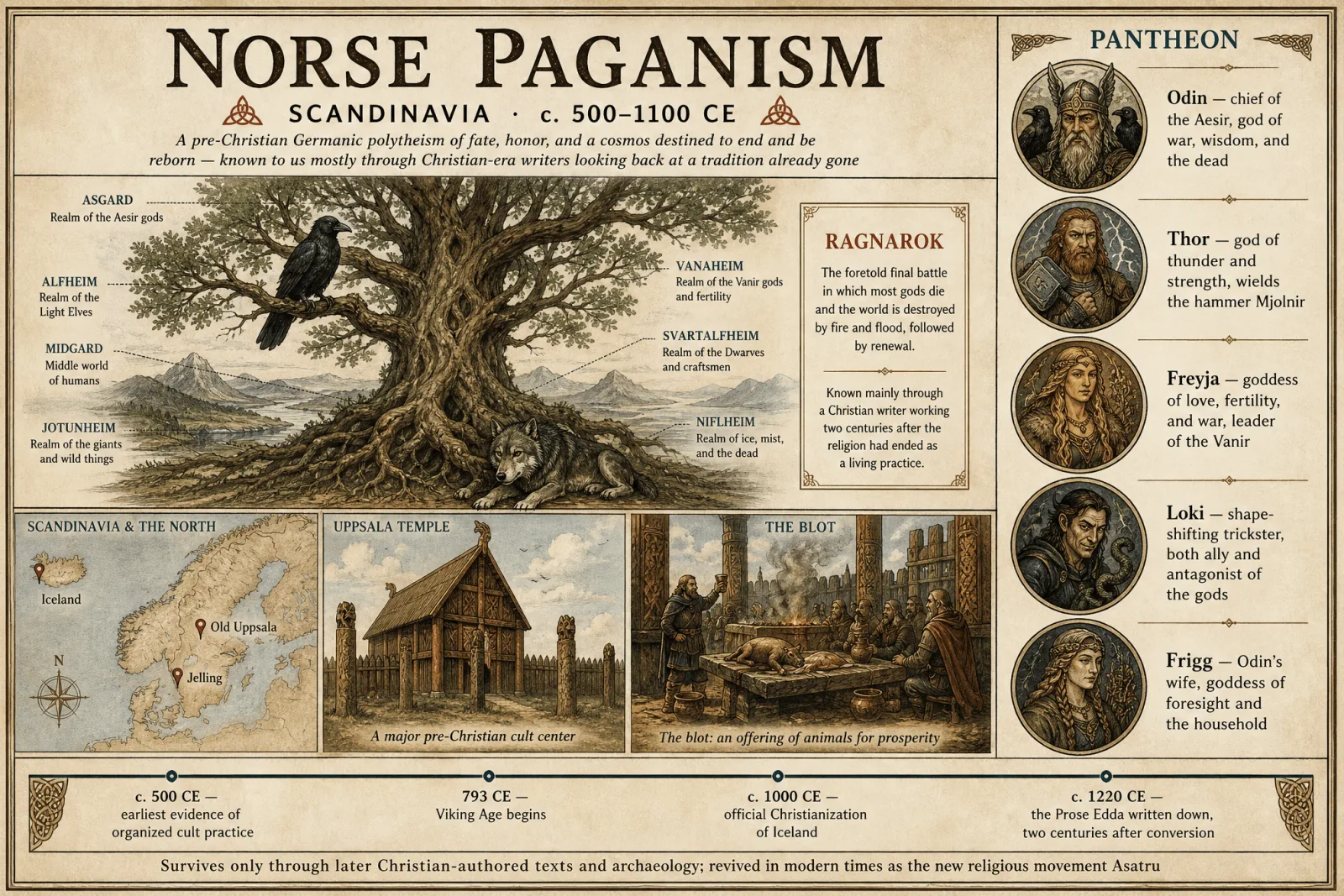
Overview
Norse Paganism designates the pre-Christian polytheistic religious traditions of Scandinavia, practiced by Germanic-speaking peoples in what is now Denmark, Norway, Sweden, and Iceland, as well as Norse settlements in the British Isles, Iceland, Greenland, and briefly North America, from approximately the late Iron Age (circa 500 CE) through the Christianization of Scandinavia (completed by circa 1100 CE in most regions, later in some areas). This religious complex is known primarily through archaeological evidence, runic inscriptions, place-names, and—most extensively but problematically—literary sources composed in Christian Iceland during the thirteenth and fourteenth centuries, two to three centuries after the official conversion.
The Norse cosmos was understood as structured around Yggdrasil, the World Tree, an immense ash connecting nine worlds inhabited by gods, humans, giants, elves, dwarfs, and the dead. The gods were divided into two primary groups: the Æsir (including Odin, Thor, Frigg, Tyr) and the Vanir (Njord, Freyr, Freyja), whose mythological war and subsequent exchange of hostages was narrated in Old Norse poetry and Snorri Sturluson's *Prose Edda*. However, modern scholarship has questioned whether this Æsir-Vanir distinction was as fundamental in pre-Christian practice as medieval texts suggest, with Rudolf Simek and others arguing that it may be a later systematization.
Norse religious practice centered on blót (sacrificial feasts involving offerings of animals, food, and drink to the gods, followed by communal consumption), seiðr (a form of magic and prophetic practice associated particularly with the god Odin and the goddess Freyja, but considered shameful [*ergi*] for men), and the maintenance of relationships with divine and ancestral powers. Major ritual sites included open-air sanctuaries, groves, and cult buildings (though the archaeological evidence for 'temples' remains debated), with the most famous being Gamla Uppsala in Sweden, described by the eleventh-century Christian chronicler Adam of Bremen as the site of a grand sacrificial festival held every nine years.
Iron Age Roots and Viking Age Religion (circa 500–1000 CE)
The religious practices attested in the Viking Age (circa 750–1050 CE) had deep roots in earlier Scandinavian Iron Age traditions. Archaeological evidence from the Migration Period (circa 400–550 CE) and Vendel Period (circa 550–750 CE) reveals continuities in burial practices, votive offerings in bogs and lakes, and the veneration of specific sites. Boat burials at Valsgärde and Gamla Uppsala, containing weapons, jewelry, and sacrificed animals, demonstrate elite funerary practices that continued into the Viking Age. Recent excavations at Valsgärde, studied by Neil Price and colleagues, show continuity from the fifth to the twelfth centuries, allowing scholars to trace the transition from the Vendel Age into the Viking Age.
The Viking Age proper began around 750 CE with intensified maritime expansion, raiding, trading, and settlement across Europe, the North Atlantic, and into the Mediterranean and Caspian regions. This expansion brought Norse peoples into contact with Christian, Islamic, and other religious traditions, but also created networks through which Norse religious practices and identities were reinforced and adapted. The mass grave at Salme in Estonia (circa 750 CE), containing warriors from Uppland, Sweden, provides insight into the earliest Viking Age practices, including possible human sacrifice accompanying elite burials.
Gamla Uppsala in Sweden functioned as a major cultic center. Adam of Bremen, writing around 1075 CE from second-hand reports, described a temple there with images of Thor, Odin, and Freyr, and a sacrificial festival held every nine years involving the sacrifice of nine males of every species—humans, horses, dogs—whose bodies were hung in a sacred grove. While Adam's account is colored by Christian polemics and stereotypes of pagan sacrifice, archaeological investigations have confirmed large-scale feasting, animal sacrifices, and the presence of significant elite burials and monumental structures (large mounds, postholes suggesting processional roads) at the site. Recent finds of amulet rings and Thor's hammers confirm the site's religious significance into the Viking Age, though the specific 'temple' described by Adam has not been archaeologically verified.
The Christianization of Scandinavia was a gradual, uneven process extending over more than two centuries, driven by royal initiative, missionary activity, economic and political incentives, and sometimes coercion. Denmark was the first Scandinavian kingdom to officially convert, with King Harald Bluetooth (reigned circa 958–987) erecting the Jelling runestone (circa 965 CE) proclaiming his Christianization of the Danes. The stone, a monumental declaration of Christian kingship, depicts Christ and declares Harald's power, blending Christian iconography with royal propaganda.
Norway's conversion was initiated by kings like Olaf Tryggvason (reigned 995–1000) and Olaf Haraldsson (later St. Olaf, reigned 1015–1028), who used military force, destruction of pagan sites, and legal enforcement to impose Christianity. Icelandic sagas recount the destruction of idols, forced baptisms, and the execution of resisters, though these accounts are written generations later and may exaggerate the violence. Iceland adopted Christianity peacefully at the Althing (national assembly) at Þingvellir in 999 or 1000 CE through a negotiated settlement that allowed private pagan worship to continue temporarily, demonstrating the pragmatic, political nature of conversion.
Sweden resisted Christianization longest. Gamla Uppsala remained a center of pagan worship into the late eleventh century, and Adam of Bremen's account suggests active non-Christian cult as late as the 1070s. Swedish kings who promoted Christianity faced opposition; King Inge the Elder was reportedly driven out for refusing to participate in pagan sacrifices. By the early twelfth century, however, Christianity was firmly established across Scandinavia, and public Norse pagan practice had ceased, though folk practices, place-name traditions, and memories persisted.
The primary literary sources for Norse mythology and religion—the *Poetic Edda*, the *Prose Edda*, *Heimskringla*, *Ynglinga saga*, and Saxo Grammaticus's *Gesta Danorum*—were all composed by Christians, mostly in Iceland, between the late twelfth and fourteenth centuries, long after the conversion. The *Poetic Edda*, a collection of anonymous mythological and heroic poems preserved in the *Codex Regius* manuscript (circa 1270), contains material that linguistic analysis suggests may originate in the pagan period, but the poems were selected, edited, and written down by Christians.
The *Prose Edda*, attributed to the Icelandic scholar, poet, and politician Snorri Sturluson (1179–1241), is the most systematic account of Norse cosmology, mythology, and poetics. Snorri's work, composed circa 1220, was explicitly a handbook for poets, teaching them how to understand and use the mythological references (*kenningar*) in traditional skaldic poetry. However, Snorri was a Christian writing for a Christian audience, and his *Prose Edda* includes a Prologue that euhemerizies the gods—reinterpreting them as human Trojan warriors who migrated north and were later deified—following medieval Christian historiographic conventions derived from Virgil's *Aeneid* and Christian universal history.
Scholars debate the extent to which Snorri's account reflects authentic pre-Christian tradition versus his own invention or Christian reinterpretation. Research by scholars including Kevin Wanner demonstrates that Snorri incorporated Christian moral frameworks, biblical imagery (particularly from Ecclesiastes), and eschatological concepts into his presentation of Norse myth, most notably in his treatment of Loki's binding and Ragnarök (the prophesied destruction and renewal of the cosmos). While Snorri frequently cites older pagan poems as sources, his narrative framing and theological systematization are his own. Thus, reconstructing pre-Christian Norse religion requires critical source analysis, cross-referencing literary sources with archaeology, place-names, and runic inscriptions, and acknowledging the limits of our knowledge.
In the twentieth and twenty-first centuries, Norse Paganism has been revived under various names, most prominently Ásatrú (Old Norse: 'faith in the Æsir'). The modern Ásatrú movement began in Iceland in 1972 with the founding of the Ásatrúarfélagið (Ásatrú Fellowship), legally recognized by the Icelandic government as a religious organization. Similar movements emerged in Scandinavia, North America, and elsewhere, reconstructing Norse religious practices based on medieval literary sources, archaeological findings, folklore, and personal spiritual experience.
Scholarly research on modern Ásatrú, including work by Michael Strmiska, Baldur Sigurvinnson, and Jefferson Calico, emphasizes that contemporary Norse Paganism is a modern, reconstructionist religion, not an unbroken continuation of pre-Christian practice. Ásatrú groups are diverse, ranging from cultural heritage movements emphasizing Icelandic or Scandinavian identity to universalist groups open to practitioners of any ethnic background. The movement has faced internal and external controversies over issues of race, nationalism, and the appropriation of Norse symbols by extremist groups, leading many Ásatrú organizations to explicitly reject racism and white supremacism.
Modern practice includes blót (reinterpreted as communal feasts with offerings to the gods), sumbel (ritual toasting and boasting), seasonal festivals (especially solstices and equinoxes), and personal devotion to specific deities. Practitioners draw on the Eddas, sagas, and archaeological evidence, but acknowledge that much of pre-Christian practice is irrecoverable, requiring creative reconstruction and adaptation to contemporary contexts. Academic study of Ásatrú has shifted from early focus on extremist fringes to examining the movement as a heterogeneous, evolving phenomenon engaging with questions of identity, memory, and the relationship between past and present.
Cosmology: The Nine Worlds and Yggdrasil
Norse cosmology, as described in the *Prose Edda* and poems like *Völuspá* and *Grímnismál*, envisioned the universe structured around Yggdrasil, the World Tree, a colossal ash whose roots and branches connected nine worlds. These worlds included Asgard (home of the Æsir gods), Vanaheim (home of the Vanir gods, though its location and significance remain obscure), Midgard (the world of humans, encircled by the ocean where the World Serpent Jörmungandr dwelt), Jotunheim (realm of the giants, enemies and sometimes allies of the gods), Alfheim (home of the light elves), Svartalfheim or Nidavellir (realm of dwarfs, master craftsmen who forged the gods' weapons), Niflheim (a primordial realm of ice and mist), Muspelheim (realm of fire, home of the fire giants), and Helheim (the underworld ruled by the goddess Hel, where most of the dead went).
The cosmos was created from the body of the primordial giant Ymir, slain by Odin and his brothers Vili and Vé. From Ymir's flesh came the earth, from his blood the seas, from his bones the mountains, from his skull the sky. This creation myth, narrated in *Völuspá* and the *Prose Edda*, emphasizes violence and transformation: the ordered cosmos emerges from primordial chaos through divine action. The gods maintain cosmic order against the forces of chaos—giants, monsters, and eventually the apocalyptic destruction of Ragnarök, when the gods and giants will fight their final battle, the world will burn, and a new world will emerge from the waters, inhabited by surviving gods and two human survivors, Líf and Lífþrasir.
Fate (wyrd or örlog) was woven by the Norns—Urd, Verdandi, and Skuld—supernatural women dwelling at the base of Yggdrasil, who determined the destinies of gods and mortals alike. Even the gods were subject to fate; Odin's foreknowledge of Ragnarök, gained through his sacrifice on Yggdrasil (hanging for nine nights, pierced by a spear, to gain knowledge of the runes), did not grant him the power to prevent it. This tragic inevitability distinguished Norse cosmology from many other Indo-European mythologies.
The Norse gods were divided into two groups, the Æsir and the Vanir, who fought a war that ended in a truce and exchange of hostages. The Æsir included Odin (Óðinn), the Allfather, god of wisdom, war, death, poetry, and magic, who sacrificed an eye for wisdom and hung on Yggdrasil to learn the runes; Thor (Þórr), god of thunder, protector of Midgard, wielder of the hammer Mjölnir, immensely popular among common people and evidenced by numerous place-names and amulets; Frigg, Odin's wife, goddess of marriage and motherhood; Tyr (Týr), god of law and heroic glory, who sacrificed his hand to bind the monstrous wolf Fenrir; Baldr, the beautiful, beloved god whose death was a prelude to Ragnarök; and Loki, the trickster figure, neither god nor giant but ambiguously positioned, whose actions ranged from helpful to catastrophic.
The Vanir included Njord (Njörðr), god of the sea, wind, and wealth; Freyr, god of fertility, prosperity, and kingship, associated with the sacred boar and the phallic symbolism attested in the *Ynglinga saga*; and Freyja, goddess of love, sexuality, fertility, war, and magic (*seiðr*), who received half of the battle-slain in her hall Fólkvangr (the other half went to Odin's Valhalla). Freyja was one of the most prominent goddesses, and archaeological finds—such as pendants and amulets—suggest widespread devotion.
Modern scholarship, particularly Rudolf Simek's 'Vanir debate,' questions whether the Æsir-Vanir distinction was as significant in actual pre-Christian worship as the medieval texts imply. Simek argues that 'Vanir' may originally have been a rare collective term for 'gods' rather than a separate race, and that the elaborate mythological war and reconciliation could be Snorri's own systematization or a late development. Other scholars, drawing on Indo-European comparative mythology (particularly Georges Dumézil's tripartite ideology), see the Æsir-Vanir war as reflecting ancient social structures: the Æsir as warrior-kings, the Vanir as fertility and prosperity gods, their synthesis representing societal integration. The debate remains unresolved, highlighting the difficulty of reconstructing pre-Christian belief from Christian-era sources.
Norse conceptions of the afterlife were varied and sometimes contradictory, reflecting the composite nature of our sources. The most famous afterlife destination was Valhalla (Valhǫll, 'Hall of the Slain'), Odin's hall in Asgard, where warriors who died in battle were brought by the Valkyries ('choosers of the slain'), supernatural women who served Odin. In Valhalla, the einherjar (single combatants) feasted, fought, and prepared for Ragnarök, when they would join Odin in the final battle. This image, prominent in skaldic poetry and the Eddas, reflects an aristocratic warrior ethos.
However, most of the dead—those who died of illness, old age, or other non-heroic causes—went to Helheim, the underworld ruled by the goddess Hel, daughter of Loki. Helheim was neither a place of punishment nor reward but a shadowy existence. Other afterlife destinations included Freyja's hall Fólkvangr, where she received her half of the slain; the realm of the sea-goddess Rán, who drowned sailors; and possibly continued existence in burial mounds or ancestral veneration, suggested by archaeological evidence and saga accounts of 'howe-dwellers' (barrow-dwellers) who remained powerful after death.
Burial practices varied: ship burials (such as the famous Oseberg and Gokstad ships in Norway, or the boat graves at Valsgärde), cremation, and inhumation, often with grave goods (weapons, jewelry, tools, animals, and sometimes enslaved individuals sacrificed to accompany the dead). The diversity of practices suggests regional, temporal, and social variation rather than a single orthodox belief system.
Seiðr was a form of magic and prophetic practice central to Norse religion but deeply ambiguous in its social valuation. Described in sagas and the *Prose Edda*, seiðr involved trance, spirit-journeys, prophecy, and manipulation of fate, performed by specialists called völva (seeresses, plural völur) or seiðmenn (male practitioners). Seiðr was strongly associated with the goddess Freyja, who taught it to Odin, and with Odin himself, who practiced it despite its association with ergi (unmanliness, sexual passivity), a severe insult in Norse society.
Archaeological evidence supports the existence of seiðr practitioners: Neil Price has identified approximately forty graves across Scandinavia containing iron staffs, exotic goods, and in some cases seeds of hallucinogenic plants (such as henbane), matching literary descriptions of völur. These burials, often of women but occasionally of men or individuals of ambiguous gender presentation, confirm that seiðr was a real practice, not merely literary invention, and that its practitioners held specialized, perhaps marginal, social roles.
Other magical practices included galdr (incantation, often using runes), útiseta (sitting out, a divinatory practice involving spending the night outdoors at significant sites), and the use of runes for protective, curative, or aggressive purposes. Runic inscriptions on weapons, amulets, and stones attest to the belief in runes' magical efficacy. The association of magic with women and with gods like Odin and Freyja suggests a complex gendering of religious power, distinct from the public, communal cult centered on blót and kingship.
Literary Sources and the Eddas
The Poetic Edda (also called the Elder Edda) is a collection of Old Norse mythological and heroic poems preserved primarily in the *Codex Regius* manuscript, dated to circa 1270 but containing poems composed at various earlier dates. Key mythological poems include *Völuspá* ('Prophecy of the Seeress'), which narrates the creation of the world, the deeds of the gods, and Ragnarök; *Hávamál* ('Sayings of the High One'), a collection of wisdom attributed to Odin; *Grímnismál* ('The Lay of Grimnir'), detailing cosmological knowledge; and *Lokasenna* ('Loki's Quarrel'), in which Loki insults the gods at a feast. These poems were composed in alliterative verse and preserve archaic vocabulary and mythological motifs that likely predate Christianity, though their written form reflects Christian-era transmission and editing.
The Prose Edda by Snorri Sturluson (circa 1220) consists of four sections: the *Prologue* (a Euhemerized Christian account of the gods as human Trojan migrants), *Gylfaginning* ('The Tricking of Gylfi,' a systematic narrative of Norse cosmogony, mythology, and eschatology framed as a dialogue between a Swedish king and the gods in disguise), *Skáldskaparmál* ('The Language of Poetry,' a guide to poetic diction and mythological kennings), and *Háttatal* ('List of Verse-Forms,' a catalog of skaldic meters). Snorri's work is invaluable for its comprehensiveness but is shaped by his Christian worldview, his literary and political goals, and his role as a systematizer and interpreter rather than a neutral recorder.
Other important sources include Saxo Grammaticus's *Gesta Danorum* (circa 1200, a Latin history of Denmark incorporating euhemerized myths), Heimskringla (Snorri's history of Norwegian kings, beginning with the mythological *Ynglinga saga*, which traces the Swedish royal dynasty to the god Freyr), and the Icelandic sagas (especially *Eyrbyggja saga*, *Landnámabók*, and *Íslendingabók*), which contain incidental references to pagan practices and conversion. Adam of Bremen's Gesta Hammaburgensis ecclesiae pontificum (circa 1075) provides an outsider Christian perspective on Scandinavian paganism, particularly the cult at Gamla Uppsala. Each source requires critical evaluation: Christian bias, temporal distance from the pagan period, literary conventions, and the authors' agendas all shape the evidence.
Blót: Sacrifice and Communal Feasting
Blót (plural blót) was the central ritual act of Norse religion, involving the sacrifice of animals (primarily horses, cattle, pigs, and goats), the offering of their blood and meat to the gods, and communal feasting on the sacrificed animals. The term *blót* derives from a Proto-Germanic root meaning 'to worship' or 'to strengthen,' and the ritual reinforced social bonds, honored the gods and local spirits (*landvættir*), and marked seasonal transitions (especially harvest and midwinter).
Literary sources describe blót performed by kings, chieftains, and community leaders at central sites. Participants sprinkled blood (*hlaut*) on altars, idols, and themselves using a ritual twig or brush. Adam of Bremen's account of the Gamla Uppsala festival describes large-scale public sacrifice, while saga accounts mention private blót held by households or at farms. Archaeological evidence of animal bones deposited in patterns consistent with ritual feasting at sites like Gamla Uppsala and Borg in Lofoten supports the literary accounts, though it cannot confirm specific details like blood-sprinkling or the accompanying prayers and invocations, which were oral and unrecorded.
The communal feast following the sacrifice was as important as the offering itself: sharing the consecrated meat created social cohesion, affirmed hierarchies (leaders presided and received choice portions), and symbolically incorporated the gods' blessing into the community. The timing of blót coincided with agricultural cycles—spring planting, harvest, midwinter—linking religious practice to subsistence needs and seasonal rhythms.
Norse religious practice took place at a variety of sacred sites. Natural features—groves, springs, waterfalls, unusual rock formations, mountains—were understood as inhabited by spirits or associated with gods. Þingvellir in Iceland, the site of the Althing (national assembly), was a sacred landscape where law, politics, and religion intersected; its dramatic rift valley was understood as a liminal space. Place-names preserving theophoric elements (god-names: Thorshof, Odense, Freyshof, Ullevi) indicate widespread local cult sites dedicated to specific deities.
Whether the Norse built 'temples' comparable to Classical or Christian structures is debated. Old Norse *hof* and *hörgr* are often translated as 'temple' and 'altar,' but their precise meanings and archaeological correlates are unclear. Some structures identified as cult buildings—such as the hall at Borg in Lofoten (Norway) and possible structures at Gamla Uppsala—show evidence of ritual feasting and offerings, but they may have been multifunctional halls rather than dedicated temples. The lack of clear archaeological temple remains contrasts with Adam of Bremen's description of a grand temple at Uppsala, leading scholars to hypothesize that 'temples' may have been wooden structures that left minimal traces, or that Adam's account reflects literary topoi rather than physical buildings.
Open-air sites were also significant. Votive deposits in bogs and lakes—weapons, jewelry, tools, and human remains—are found throughout Scandinavia and the broader Germanic world. These offerings, including the famous Iron Age 'bog bodies' (such as Tollund Man in Denmark), attest to ritual practices involving water as a sacred medium, possibly related to gods like Njord or to chthonic powers.
Runes—the angular letters of the Old Norse alphabet—were understood not merely as a writing system but as possessing inherent magical power. Runic inscriptions on weapons (such as the spearhead from Kowel, inscribed *tilarids*, possibly 'goal-rider' or 'attack-causer'), amulets, stones, and bones invoked protection, cursed enemies, or declared ownership. The *Hávamál* attributes the discovery of runes to Odin, who gained them through self-sacrifice, hanging on Yggdrasil for nine nights, pierced by a spear, neither given food nor drink, until the runes revealed themselves to him.
Thor's hammer amulets (Mjölnir pendants), made of silver, bronze, or iron, are found in thousands across Scandinavia, worn as protective symbols and markers of identity, especially during the conversion period when they may have signaled resistance to Christianity. These amulets, along with armbands, rings, and other jewelry bearing religious motifs, indicate personal devotion and the use of religious symbols in daily life, not only in formal communal ritual.
Personal devotion to specific gods is also suggested by skaldic poetry, where poets invoke deities and claim relationships with them, and by saga accounts of individuals swearing oaths by particular gods. The diversity of theophoric place-names and personal names (e.g., Thorstein, Thorbjorn, Asbjorn, Frey-dis) suggests widespread veneration of multiple deities, with regional and personal preferences rather than a single 'orthodox' pantheon.
Regional, Temporal, and Social Variation
Norse Paganism was never a unified, centralized religion. Practices, emphases, and mythological details varied by region, period, and social class. Danish, Norwegian, Swedish, and Icelandic traditions differed due to geographic separation, local kingships, and interactions with neighboring cultures (Christian Anglo-Saxons, Franks, Slavs, Sámi, and Baltic peoples). Iceland's settlement (circa 870 CE onward) and its lack of kingship created a distinct religious context, where chieftains (*goðar*) held religious and political authority without centralized enforcement of orthodoxy.
Temporal change was significant: the religion of the early Viking Age (750 CE) was not identical to that of the late Viking Age (1050 CE), and both differed from earlier Iron Age traditions. Archaeological evidence shows shifts in burial practices, the rise and decline of specific cult sites, and the introduction of new influences (such as Christian iconography appearing on runestones before official conversion). The conversion period itself saw syncretic practices, 'prime-signing' (receiving a preliminary Christian blessing without full baptism to enable trade with Christians), and the reinterpretation of pagan symbols.
Social stratification shaped religious practice. Kings and jarls (earls) sponsored large-scale blót, controlled major cult sites, and claimed descent from gods (especially Freyr, as in the Swedish Yngling dynasty). Common farmers participated in local, household, or community blót, venerated local spirits and ancestors, and used protective magic. Enslaved individuals (thralls) had limited agency in public cult. Gender roles were complex: men typically presided over public blót, but women could be völur (seeresses) wielding significant spiritual authority, and goddesses like Freyja held prominent places in the pantheon. This diversity means that any single account of 'Norse Paganism' necessarily simplifies a complex, dynamic religious landscape.
Contemporary Norse Paganism and Ásatrú
Modern Norse Paganism, primarily organized under the name Ásatrú or Heathenry, emerged in the mid-twentieth century as part of broader neopagan movements. The Ásatrúarfélagið in Iceland, founded in 1972 and legally recognized as a religious organization, is the oldest and largest Ásatrú group, with over 5,000 members as of the 2020s. Icelandic Ásatrú emphasizes cultural continuity, environmental ethics, and seasonal rituals, and has constructed a temple in Reykjavík, marking institutional recognition.
In Scandinavia, North America, and Europe, diverse Ásatrú and Heathen groups exist, ranging from universalist organizations (open to all, rejecting ethnic exclusivity) to folkish groups (emphasizing ancestral or ethnic connections to Norse heritage, sometimes controversially). Disputes over race, gender roles (especially regarding LGBTQ+ inclusion), and the interpretation of historical sources have created significant internal diversity and conflict. Major organizations like The Troth (North America, universalist) and the Asatru Folk Assembly (folkish) represent different approaches.
Academic study of contemporary Ásatrú, including work by Michael Strmiska, Jefferson Calico, and Stefanie von Schnurbein, treats it as a modern reconstructionist religion engaging with questions of identity, memory, and the relationship between past and present. Practitioners draw on medieval literature, archaeology, and folklore, but acknowledge that much of pre-Christian practice is irrecoverable, requiring creative adaptation. Modern blót, sumbel (ritual toasting), and seasonal festivals are reinterpretations, not survivals. The movement's growth, institutionalization, and engagement with scholarly research represent an ongoing process of negotiating between historical sources, contemporary values, and personal spiritual experience.
Sacred Sites and Geography
Gamla Uppsala (Old Uppsala), located north of modern Uppsala, Sweden, was the most significant cultic center in pre-Christian Scandinavia. The site features three massive royal burial mounds (from the sixth century CE), attributed in legend to kings Aun, Egil, and Adils, and was described by Adam of Bremen as the location of a great temple and a nine-year sacrificial festival. Archaeological excavations have confirmed large-scale feasting, animal sacrifices, elite burials, and the presence of religious artifacts (amulet rings, Thor's hammers), though the specific 'temple' described by Adam remains archaeologically elusive. A Christian church was built on the site in the twelfth century, symbolizing the replacement of pagan cult with Christian authority.
Valsgärde, also in Uppland, Sweden, contains a burial ground used continuously from the fifth to the twelfth century, spanning the transition from the Vendel Age to the Viking Age. The boat burials and rich grave goods (weapons, jewelry, gaming pieces) provide evidence of elite mortuary practices and suggest continuity in religious beliefs about death and the afterlife across this transformative period. Recent research by Neil Price and colleagues uses Valsgärde to study the emergence of Viking Age culture from earlier Iron Age roots.
Jelling, Denmark, is the site of two massive burial mounds, two runestones, and a church, marking the transition from paganism to Christianity under King Harald Bluetooth. The larger Jelling runestone (circa 965 CE) depicts Christ and declares Harald's Christianization of the Danes, making it a monumental statement of royal Christian identity. The smaller stone, erected by Harald's father Gorm, is pagan in character. The site thus encapsulates the religious transformation of Scandinavia in stone and landscape.
Þingvellir (Thingvellir) in Iceland was the site of the Althing, the national assembly established in 930 CE, where law, politics, and religion intersected. The decision to adopt Christianity in 999 or 1000 CE was made here, a pragmatic political compromise that allowed Iceland to avoid civil war while maintaining some continuity (private pagan worship was permitted temporarily). The dramatic rift valley landscape, formed by tectonic activity, was understood as a liminal, powerful space, and remains a site of Icelandic national and religious significance.
Borg in Lofoten, Norway, contains the largest Viking Age chieftain's hall yet discovered (83 meters long), with archaeological evidence of ritual feasting and offerings. The hall's scale and the presence of cultic objects suggest it functioned as a combined political and religious center, where the chieftain hosted blót and reinforced his authority through hospitality and ritual. This multifunctionality—political hall, feasting space, and religious site—characterizes many Norse cultic locations, blurring distinctions between secular and sacred.
Borgund Stave Church in Norway (built circa 1180 CE) is included here with caution: it is a Christian structure, not a pagan site, but its architecture incorporates motifs (dragon-head finials, carved portals) that evoke earlier Scandinavian artistic traditions, including those with pagan associations. Stave churches generally represent Christian architecture, but they are built on landscapes saturated with pre-Christian memory and sometimes incorporate or adapt earlier sacred sites. Claims that specific stave churches were built directly atop pagan temples require careful source evaluation; continuity of sacredness at a location does not mean continuity of structure or belief.
Scholarly Debates and Interpretive Challenges
The Æsir-Vanir distinction and its historical reality is contested. Traditional scholarship, influenced by Georges Dumézil's Indo-European tripartite ideology (priest-king, warrior, producer), saw the Æsir-Vanir war as reflecting ancient social structures. Rudolf Simek's 'Vanir debate' (beginning 2005) challenged this, arguing that 'Vanir' was a rare collective term for 'gods,' not a separate race, and that the elaborate mythological taxonomy may be Snorri's systematization rather than authentic pre-Christian belief. Responses by Jens Peter Schjødt, John Lindow, and others defend the distinction's antiquity, citing skaldic poetry and place-name evidence. The debate highlights broader methodological tensions: how much can we trust medieval Christian sources to reflect pagan belief?
The nature and extent of human sacrifice is debated. Adam of Bremen's account of sacrifices at Gamla Uppsala, including humans, has been dismissed by some scholars as Christian anti-pagan propaganda. However, archaeological evidence—including anomalous human remains in ritual contexts, bog bodies with signs of ritual killing, and saga accounts (though written later)—suggests that human sacrifice, while likely rare and exceptional, did occur in specific circumstances (e.g., foundation sacrifices, crisis offerings, elite funerals). The challenge is distinguishing between executed criminals whose bodies were ritually disposed of, sacrificial victims in the strict sense, and literary exaggeration.
The relationship between historical practice and modern Ásatrú is contentious within both academic and practitioner communities. Scholars like Stefanie von Schnurbein emphasize that Ásatrú is a modern invention, shaped by romanticism, nationalism, and contemporary spiritual needs, not a survival or accurate reconstruction. Some practitioners embrace this, viewing Ásatrú as a 'living religion' adapting to present contexts, while others claim closer continuity with ancient practice. The debate intersects with identity politics: who has the authority to interpret and practice Norse religion? Scholars, descendants, anyone? These questions remain unresolved and politically charged.
The problem of Christian-era sources pervades all debates. Can we reconstruct pre-Christian belief from texts written by Christians generations after conversion? Scholars employ various strategies: privileging skaldic poetry (composed in the pagan period, even if written down later), cross-referencing literary sources with archaeology and place-names, applying comparative mythology cautiously, and acknowledging the limits of knowledge. Some, like Kevin Wanner, emphasize close reading of Snorri's literary and theological agendas, showing how Christian ideas permeate the *Prose Edda*. Others, like John Lindow, argue that despite Christian framing, the Eddas preserve substantial authentic mythological content. The balance between skepticism and trust in the sources is a perennial methodological challenge in Norse religious studies.
Key Terms
- Æsir
- One of the two primary groups of Norse gods, including Odin, Thor, Frigg, and Tyr.
- Vanir
- The other primary group of gods, including Njord, Freyr, and Freyja, associated with fertility and prosperity.
- Blót
- Sacrificial ritual involving offerings (especially animals) to gods, followed by communal feasting.
- Seiðr
- Magical and prophetic practice involving trance, spirit-journeys, and fate-manipulation, associated with Freyja and Odin.
- Völva
- Seeress or female practitioner of seiðr; plural völur.
- Yggdrasil
- The World Tree, a cosmic ash connecting the nine worlds of Norse cosmology.
- Valhalla (Valhǫll)
- Odin's hall in Asgard, where warriors who died in battle feast and prepare for Ragnarök.
- Ragnarök
- The prophesied apocalyptic destruction of the cosmos, when gods and giants will battle, the world will burn, and a new world will emerge.
- Norns
- Supernatural women who weave fate (wyrd, örlog), dwelling at the base of Yggdrasil.
- Mjölnir
- Thor's hammer, a symbol of protection and divine power, widely represented in amulets.
- Ergi
- Unmanliness or sexual passivity, a severe insult in Norse society, associated with male practitioners of seiðr.
- Goði (plural goðar)
- Chieftain-priest in Icelandic society, holding both political and religious authority.
- Ásatrú
- Modern reconstructionist Norse Paganism, meaning 'faith in the Æsir.'
- Kenning
- A metaphorical poetic phrase used in skaldic poetry, often referencing mythology (e.g., 'Odin's mead' for poetry).
Further Reading
- Neil Price, The Viking Way: Magic and Mind in Late Iron Age Scandinavia (2nd ed., Oxbow Books, 2019)
- Jens Peter Schjødt, John Lindow, Anders Andrén (eds.), The Pre-Christian Religions of the North: History and Structures (4 vols., Brepols, 2020)
- Anders Hultgård, 'The Sacrificial Festival at Uppsala: A Comparative Perspective,' Religionsvidenskabeligt Tidsskrift 74 (2022)
- E.O.G. Turville-Petre, Myth and Religion of the North: The Religion of Ancient Scandinavia (Holt, Rinehart and Winston, 1964)
- Rudolf Simek, 'The Vanir: An Obituary,' Retrospective Methods Network Newsletter 1 (2010)
- Kevin J. Wanner, 'Nets and Snares: The Loki of Snorri's Edda and the Christian Tradition,' History of Religions 56.2 (2016)
- Michael Strmiska & Baldur A. Sigurvinnson, 'Ásatrú in Iceland: The Rebirth of Nordic Paganism?' Nova Religio 4.1 (2000)
- Jefferson F. Calico, 'Investigations into Asatru: A Critical Historiography,' Aura: Journal for the Study of New Religions (2021)
- John Lindow, Norse Mythology: A Guide to the Gods, Heroes, Rituals, and Beliefs (Oxford University Press, 2001)
- Terry Gunnell, 'The Background and Nature of the Annual and Occasional Rituals of the Ásatrúarfélag in Iceland,' in The Ritual Year 10 (2015)
Practices
- Blót sacrifice
- Runes
- Seiðr magic
- Feasting
Core ideas
- Afterlife
- Valhalla, Hel, or the halls of other gods
- Fate
- Norns weave inescapable destiny
Sacred texts
A collection of Old Norse poems preserved in the Codex Regius, including the Völuspá (prophecy of the seeress) and tales of Odin, Thor, and Loki. It recounts the creation of the world, the gods' deeds, and the foretold destruction of Ragnarök. These verses were the primary source for later Scandinavian understanding of the mythic past.
Written around 1220 by the Icelandic scholar Snorri Sturluson to preserve and explain skaldic poetry for future generations. It retells myths in accessible prose and includes a dialogue between Gylfi and the Aesir gods. Snorri's work is the most systematic surviving account of Norse cosmology and divine genealogy.