Overview
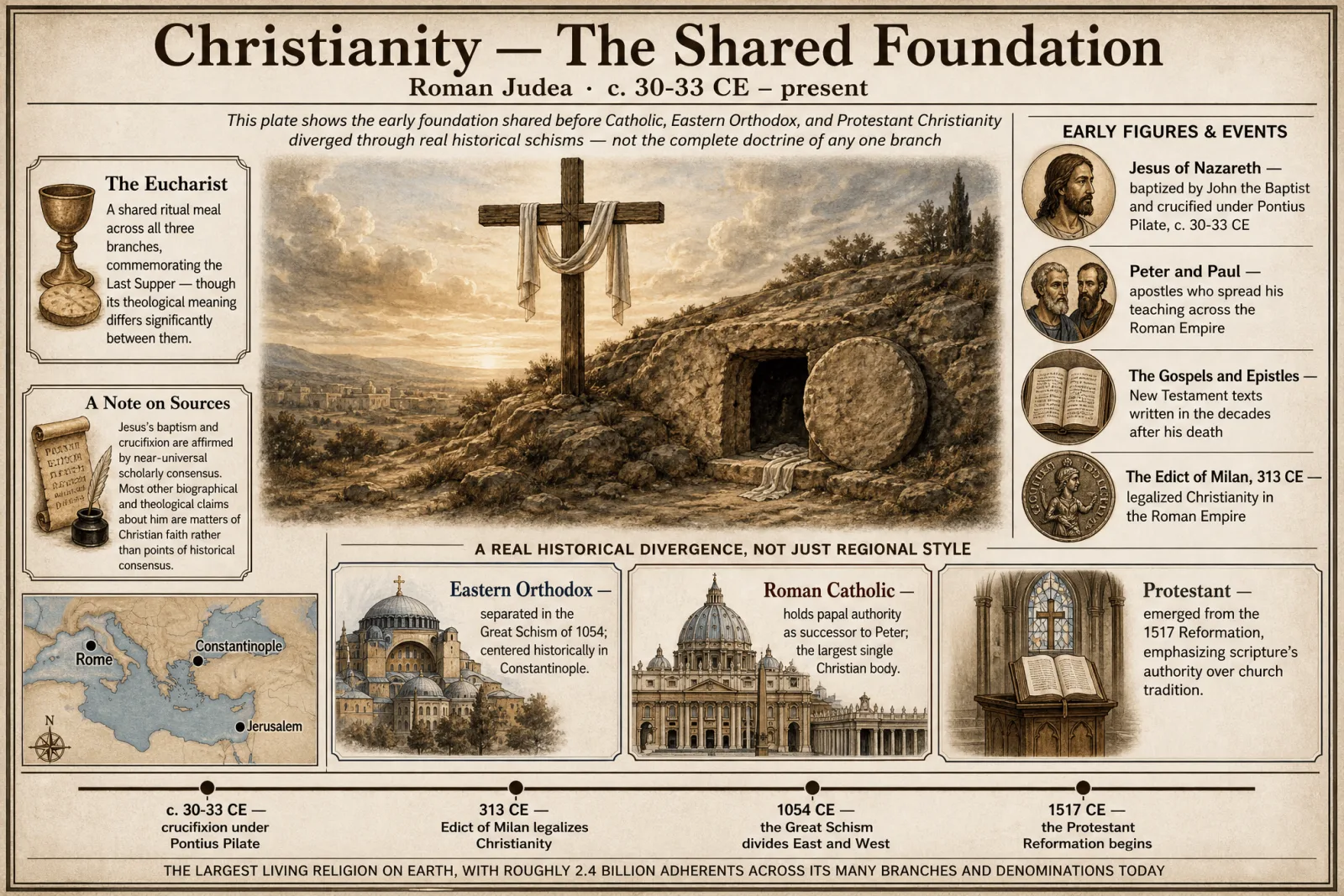
Christianity is a monotheistic Abrahamic faith tradition centered on the life, teachings, death, and resurrection of Jesus of Nazareth, whom Christians confess as the Christ (Messiah) and Son of God. Originating in first-century Roman Judea, Christianity emerged from the Jewish matrix and spread throughout the Mediterranean world and beyond, eventually becoming the world's largest religion with approximately 2.2 billion adherents as of 2010. The central Christian proclamation is that Jesus, through his crucifixion and resurrection, offers salvation from sin and reconciliation with God. This kerygma (proclamation) is attested in the New Testament writings, which alongside the Hebrew Bible (Old Testament) constitute Christian scripture. Christianity is not a monolithic tradition but encompasses significant internal diversity: the three major branches—Roman Catholicism (about 50% of Christians globally), Protestantism (37%), and Eastern Orthodoxy (12%)—differ on questions of ecclesial authority, sacramental theology, biblical interpretation, and liturgical practice, yet all affirm core Trinitarian and Christological doctrines established in the early ecumenical councils.
The historical origins of Christianity are contested among scholars. The Gospels present Jesus as an itinerant Jewish teacher in Galilee and Judea who proclaimed the kingdom of God, performed healings and exorcisms, gathered disciples, and was executed by crucifixion under Pontius Pilate around 30–33 CE. His followers proclaimed that he rose from the dead and ascended to heaven, and they identified him as the fulfillment of Israel's messianic hopes. The apostle Paul, a former persecutor of the Jesus movement who experienced a transformative encounter with the risen Christ, played a decisive role in articulating a theology of grace, faith, and inclusion of Gentiles (non-Jews) without requiring full observance of the Mosaic Law. Early Christian communities were ethnically and theologically diverse, and tensions over Jewish law, Christology, and community boundaries marked the first centuries. The conversion of Emperor Constantine in the early fourth century initiated Christianity's transformation from a persecuted minority to the official religion of the Roman Empire, leading to institutional consolidation, creedal formulation, and the merger of ecclesial and imperial power.
Over two millennia, Christianity has profoundly shaped Western civilization and spread globally through mission, colonization, and cultural exchange. Medieval Christendom saw the rise of monasticism, scholastic theology, Gothic cathedrals, and the political power of the papacy. The Great Schism of 1054 formalized the division between Eastern Orthodoxy and Roman Catholicism, reflecting theological disagreements (such as the filioque clause and papal primacy) and cultural-political tensions between Greek East and Latin West. The Protestant Reformation of the sixteenth century, initiated by Martin Luther's critique of indulgences and papal authority, fractured Western Christendom into Catholic and Protestant camps and gave rise to diverse Protestant denominations emphasizing sola scriptura (scripture alone), sola fide (faith alone), and the priesthood of all believers. Today, Christianity is no longer predominantly European: sub-Saharan Africa and Latin America together house more Christians than Europe and North America combined, and the global South is reshaping Christian theology, worship, and social engagement. Contemporary Christianity faces debates over biblical authority, gender and sexuality, interreligious dialogue, secularization in the West, and the relationship between faith and politics.
Emerges fromJudaism ←
Historical Development
The historical Jesus remains a subject of scholarly debate. According to the Gospels, Jesus was born in Bethlehem during the reign of Herod the Great (d. 4 BCE) and raised in Nazareth. Modern scholars generally date Jesus's public ministry to circa 27–30 CE and his crucifixion to around 30–33 CE under Pontius Pilate, the Roman prefect of Judea. The earliest New Testament writings, Paul's letters (circa 50–60 CE), predate the Gospels (Mark circa 70 CE, Matthew and Luke circa 80–90 CE, John circa 90–110 CE), and scholars debate the historical reliability of the Gospel narratives, which blend historical memory with theological interpretation. The Gospel accounts present Jesus as a Jewish teacher who proclaimed the imminent kingdom of God, called for repentance, taught in parables, challenged religious authorities, and performed miracles. His crucifixion, a Roman form of execution for sedition and insurrection, suggests that he was perceived as a political threat. The resurrection claim—that Jesus rose bodily from the dead and appeared to his disciples—became the foundation of Christian faith and distinguishes Christianity from other Jesus movements of the period.
The earliest Christian communities were predominantly Jewish and centered in Jerusalem, led by Jesus's brother James and the apostles Peter and John. Acts of the Apostles (written circa 80–90 CE) portrays the expansion of the Jesus movement from Jerusalem to Antioch, Asia Minor, Greece, and Rome, driven by missionary activity and the work of Paul. Tensions emerged between Jewish Christians who maintained observance of Torah and Gentile Christians who did not. The Council of Jerusalem (circa 49 CE, Acts 15) negotiated a compromise allowing Gentile inclusion without full law observance, but debates persisted. The destruction of the Jerusalem Temple by Rome in 70 CE accelerated Christianity's separation from Judaism, as the Jesus movement increasingly defined itself against rabbinic Judaism and attracted Gentile converts. By the second century, Christianity had spread throughout the Roman Empire and diversified theologically: Gnostic Christians emphasized secret knowledge and the spiritual over the material, Marcionites rejected the Hebrew Bible and the God of Israel, and proto-orthodox communities developed episcopal structures and creeds to define normative belief.
Persecution of Christians occurred sporadically under Roman emperors (notably Nero, Decius, Diocletian), but Christianity also attracted converts across social classes and grew despite—and sometimes because of—martyrdom. The conversion of Emperor Constantine (circa 312 CE) marked a turning point: the Edict of Milan (313 CE) legalized Christianity, and by 380 CE (Edict of Thessalonica), Christianity became the official religion of the Roman Empire under Theodosius I. This imperial patronage enabled the construction of monumental churches (such as the Church of the Holy Sepulchre in Jerusalem and Old St. Peter's Basilica in Rome), the convening of ecumenical councils to settle doctrinal disputes, and the integration of Christian and Roman power structures. The Council of Nicaea (325 CE) condemned Arianism and affirmed the Son's consubstantiality with the Father; the Council of Chalcedon (451 CE) defined Christ as one person in two natures, divine and human. These councils shaped orthodox Trinitarian and Christological theology, though dissenting groups (Arians, Nestorians, Miaphysites) persisted and established churches beyond the empire's borders.
The fall of the Western Roman Empire (476 CE) inaugurated the medieval period in Europe, during which the Bishop of Rome (the Pope) and monasticism became central institutions. Monasteries preserved classical learning, evangelized northern Europe, and developed liturgical and theological traditions. The medieval papacy claimed universal jurisdiction and temporal power, culminating in conflicts with secular rulers (e.g., the Investiture Controversy) and the launching of the Crusades (1095–1291) to reclaim Jerusalem from Muslim rule. The Great Schism of 1054 formalized the split between the Eastern (Greek) Orthodox Church, centered in Constantinople, and the Western (Latin) Catholic Church, centered in Rome, over theological issues (the filioque clause, papal primacy) and political-cultural divergences. The Renaissance and humanism revived classical learning and spurred calls for church reform, while the Protestant Reformation (beginning 1517) fractured Western Christianity. Martin Luther's 95 Theses challenged indulgences and papal authority, emphasizing justification by faith alone and scripture as sole authority. The Reformation produced Lutheran, Reformed (Calvinist), Anglican, and Anabaptist movements, and the Catholic Counter-Reformation (Council of Trent, 1545–1563) reaffirmed Catholic doctrine, reformed abuses, and spurred global mission through Jesuit and Franciscan orders.
The colonial period (1500–1900) saw Christianity spread globally through European conquest, trade, and mission. Spanish and Portuguese colonizers brought Catholicism to Latin America, the Philippines, and parts of Africa and Asia, often forcibly converting indigenous populations and suppressing native religions. Protestant missions, especially in the nineteenth century (the 'Great Century of Missions'), established churches, schools, and hospitals in Africa, Asia, and the Pacific. Indigenous Christians played crucial roles in translation, evangelization, and adaptation of Christianity to local cultures. The twentieth century witnessed the decline of European Christendom through secularization, two world wars, and the Holocaust, which prompted Christian theological reckoning with anti-Semitism. Simultaneously, Christianity grew explosively in the global South: African, Asian, and Latin American Christians now constitute the majority of global Christianity. Pentecostalism, emphasizing the Holy Spirit, healing, and experiential worship, became the fastest-growing Christian movement. The ecumenical movement sought to heal divisions among Christians, leading to the World Council of Churches (1948) and the Second Vatican Council (1962–1965), which reformed Catholic liturgy and opened dialogue with other Christians and religions.
Core Worldview and Doctrines
Christian theology centers on the belief in one God who exists as a Trinity: Father, Son (Jesus Christ), and Holy Spirit—three persons (hypostases) sharing one divine essence (ousia). The doctrine of the Trinity, articulated in the Nicene-Constantinopolitan Creed (381 CE), is considered a mystery beyond full human comprehension yet foundational to Christian identity. God is understood as creator of the universe, sustainer of all life, and redeemer of humanity. The Hebrew Bible narrates God's covenant with Israel and provides the prophetic and scriptural context for understanding Jesus. Christians read the Old Testament typologically, seeing Jesus as the fulfillment of Israel's hopes: the promised Messiah, the new Moses, the suffering servant of Isaiah 53, and the embodiment of divine Wisdom.
Christology—the study of the person and work of Christ—is central to Christian belief. The Council of Chalcedon (451 CE) defined Jesus Christ as one person with two natures, fully divine and fully human, united without confusion or separation. This paradox has generated extensive theological reflection and debate. Christians affirm that Jesus's incarnation (God becoming human) reveals God's love and solidarity with humanity. His death by crucifixion is interpreted as an atoning sacrifice: Jesus bore the penalty for human sin, reconciling humanity to God. Theories of atonement vary: ransom theory (Christ paid a ransom to Satan), satisfaction theory (Anselm: Christ satisfied God's honor), penal substitution (Christ bore God's wrath), moral influence (Abelard: Christ's love transforms us), and Christus Victor (Christ defeated sin, death, and evil powers). The resurrection is the vindication of Jesus's identity and mission, the defeat of death, and the firstfruits of the general resurrection Christians await.
Christian anthropology views humans as created in the image of God (imago Dei) yet fallen into sin. Original sin—the doctrine that humanity inherits a sinful nature from Adam and Eve's disobedience—shapes Christian understandings of human brokenness and the need for redemption. Salvation (soteriology) is understood as deliverance from sin's power and consequences, reconciliation with God, and the gift of eternal life. Different Christian traditions emphasize different aspects: Catholics and Orthodox stress sacramental grace and synergy (cooperation between divine grace and human response), while Protestants emphasize faith alone (sola fide) and grace alone (sola gratia). The role of good works, the nature of justification, and the possibility of losing salvation remain contested among Christians.
Christian eschatology concerns the 'last things': death, judgment, heaven, hell, the second coming of Christ, the resurrection of the dead, and the new creation. Christians believe that after death, souls face judgment, leading to eternal communion with God (heaven, paradise, the beatific vision) or eternal separation from God (hell, damnation). Interpretations of hell range from eternal conscious torment to annihilationism (the wicked cease to exist) to universal reconciliation (all are ultimately saved). Christians anticipate Christ's return (the Parousia) to judge the living and the dead, defeat evil, and inaugurate God's kingdom fully. Millennial views differ: premillennialists expect Christ to return before a thousand-year reign, postmillennialists believe Christ returns after a period of Christian flourishing, and amillennialists interpret the millennium symbolically as the current church age. These eschatological visions shape Christian ethics, mission, and engagement with history and politics.
Sacred Texts and Canon
The Christian Bible consists of the Old Testament (the Hebrew Bible, though Christian Bibles often include the Deuterocanonical books, or Apocrypha, accepted by Catholics and Orthodox but not by most Protestants) and the New Testament. The New Testament comprises 27 books: the four Gospels (Matthew, Mark, Luke, John), Acts of the Apostles, 21 epistles (letters attributed to Paul, Peter, James, John, and Jude), and Revelation. The formation of the New Testament canon was a gradual process; early Christians circulated and read diverse texts, including Gospels not in the current canon (such as the Gospel of Thomas). By the late fourth century, the 27-book New Testament canon achieved broad consensus, affirmed by church councils and influential figures like Athanasius. The criteria for canonicity included apostolic origin, orthodoxy of teaching, and liturgical use in churches.
The four canonical Gospels present Jesus's life, teaching, death, and resurrection from distinct theological perspectives. Mark, the earliest, portrays Jesus as the suffering Son of Man. Matthew emphasizes Jesus as the Jewish Messiah fulfilling prophecy. Luke presents Jesus as the Savior of all, especially the marginalized. John's Gospel, highly theological, presents Jesus as the pre-existent Word (Logos) who became flesh. The Pauline epistles (Romans, 1–2 Corinthians, Galatians, Ephesians, Philippians, Colossians, 1–2 Thessalonians, 1–2 Timothy, Titus, Philemon, and possibly Hebrews) articulate key doctrines of justification by faith, the role of the law, the church as the body of Christ, and Christian ethics. Revelation, apocalyptic literature, envisions the final victory of God over evil and the new heaven and earth.
Biblical interpretation (hermeneutics) has varied across Christian history. Early church fathers employed typological and allegorical methods, reading the Old Testament as prefiguring Christ. Medieval exegesis recognized four senses of scripture: literal, allegorical, moral, and anagogical. The Protestant Reformation emphasized the literal-historical sense and the principle of sola scriptura (scripture alone as ultimate authority). Modern biblical criticism, employing historical, literary, and archaeological methods, investigates the texts' origins, authorship, and historical contexts, sometimes challenging traditional views. Conservative Christians prioritize biblical inerrancy (scripture is without error in its original manuscripts), while liberal Christians emphasize scripture's human authorship and cultural context. Catholics and Orthodox hold that scripture must be interpreted within the tradition and magisterium (teaching authority) of the church.
In addition to scripture, Christians value creeds (Apostles' Creed, Nicene Creed), liturgies, hymnody, theological treatises, and the writings of saints and theologians. The church fathers (e.g., Augustine, Athanasius, John Chrysostom, Gregory of Nyssa) are authoritative for Catholics and Orthodox. Catholics also recognize ecumenical councils and papal teachings (especially ex cathedra pronouncements) as authoritative. The patristic, medieval, and Reformation periods produced vast theological literatures: Augustine's Confessions and City of God, Aquinas's Summa Theologiae, Luther's writings, Calvin's Institutes of the Christian Religion. Devotional classics like The Imitation of Christ (Thomas à Kempis) and The Interior Castle (Teresa of Avila) have shaped Christian spirituality. Modern theology engages philosophy, science, psychology, and social critique, with figures like Karl Barth, Paul Tillich, Karl Rahner, and liberation theologians contributing to ongoing Christian thought.
Practices and Observances
Christian worship centers on communal liturgy, prayer, and the reading of scripture. Catholics and Orthodox celebrate the Eucharist (also called the Mass, Divine Liturgy, or Holy Communion) as the central sacrament, believing that bread and wine become the body and blood of Christ (transubstantiation in Catholic theology, mystical transformation in Orthodox theology). Protestants vary: Lutherans and Anglicans maintain a real presence of Christ in the elements, while Reformed and Baptist traditions view the Lord's Supper primarily as a memorial. Worship services typically include hymns, prayers, scripture readings, a sermon, and (in sacramental traditions) the Eucharist. Orthodox liturgy is elaborate, incorporating icons, incense, and chant; Catholic Mass follows a structured rite; Protestant worship ranges from high-church liturgical (Anglican, Lutheran) to low-church informal (Baptist, Pentecostal).
The sacraments are rituals believed to convey divine grace. Catholics and Orthodox recognize seven sacraments: baptism, confirmation (chrismation), Eucharist, penance (confession), anointing of the sick, holy orders (ordination), and matrimony. Protestants typically recognize only two sacraments explicitly instituted by Christ: baptism and the Lord's Supper. Baptism, performed with water in the name of the Father, Son, and Holy Spirit, signifies initiation into the Christian community, cleansing from sin, and new life in Christ. Catholics, Orthodox, and many Protestants practice infant baptism, believing baptism removes original sin and incorporates the child into the church; Baptists and other Protestants practice believer's baptism (adult or adolescent baptism following profession of faith). Confirmation (or chrismation) in Catholic and Orthodox traditions completes Christian initiation, conferring the Holy Spirit.
Prayer is central to Christian life, encompassing adoration, confession, thanksgiving, and supplication. The Lord's Prayer (Matthew 6:9–13, Luke 11:2–4), taught by Jesus, is the paradigmatic Christian prayer. Liturgical prayer includes the Divine Office (Liturgy of the Hours), a cycle of psalms and prayers prayed at set times, maintained especially by monks and clergy. Charismatic and Pentecostal Christians emphasize spontaneous prayer, glossolalia (speaking in tongues), and healing prayer. Catholics and Orthodox venerate saints and Mary, the mother of Jesus, asking for their intercession; Protestants generally reject this practice, emphasizing direct access to God through Christ alone. Pilgrimage to holy sites, fasting (especially Lent, the 40 days before Easter), and almsgiving are traditional Christian disciplines.
The Christian liturgical year organizes time around the life of Christ. Advent (four weeks before Christmas) prepares for Christ's coming. Christmas (December 25 in Western churches, January 7 in Eastern churches using the Julian calendar) celebrates Jesus's birth. Epiphany (January 6) commemorates the visit of the Magi (West) or Jesus's baptism (East). Lent, a 40-day period of fasting and penitence, prepares for Easter, the celebration of Jesus's resurrection, the most important Christian feast. Pentecost (50 days after Easter) commemorates the descent of the Holy Spirit on the apostles. Ordinary Time fills the rest of the year, focusing on Jesus's teachings and ministry. Saints' days, Marian feasts, and other observances punctuate the calendar. Christians traditionally observe Sunday (the Lord's Day, the day of resurrection) as the primary day of worship, though Seventh-day Adventists and some others observe Saturday (the Sabbath).
Internal Diversity: Denominations and Movements
Roman Catholicism, the largest Christian denomination (approximately 1.3 billion members), recognizes the Bishop of Rome (the Pope) as the successor of Peter and the visible head of the church. Catholic theology emphasizes apostolic succession, the seven sacraments, the authority of tradition alongside scripture, the veneration of Mary and saints, and the magisterium (teaching authority of bishops in communion with the Pope). The Second Vatican Council (1962–1965) reformed liturgy (permitting vernacular languages), emphasized the laity's role, and opened dialogue with other Christians and religions. Catholicism encompasses diverse rites: the Latin (Roman) rite is most common, but Eastern Catholic churches (e.g., Maronite, Melkite, Ukrainian Greek Catholic) retain Eastern liturgies while in communion with Rome.
Eastern Orthodoxy (approximately 260 million members) comprises autocephalous (self-governing) churches, including the Greek, Russian, Serbian, Bulgarian, and Romanian Orthodox Churches, among others. Orthodox theology emphasizes theosis (divinization, union with God), the mystical and apophatic (negative theology) tradition, the authority of the seven ecumenical councils, and the consensus of the church fathers. The Divine Liturgy, celebrated with elaborate ritual, iconography, and chant, is the center of Orthodox worship. Icons are venerated as windows to the divine. Orthodox churches do not recognize papal supremacy and maintain that the church is conciliar, governed by councils and synods. The Oriental Orthodox churches (Coptic, Ethiopian, Eritrean, Armenian, Syriac, Malankara) split from the main body after the Council of Chalcedon (451 CE) over Christological formulations and maintain distinct theological and liturgical traditions.
Protestantism encompasses a vast array of denominations and movements united by the Reformation principles of sola scriptura, sola fide, sola gratia, the priesthood of all believers, and rejection of papal authority. Major Protestant families include Lutheranism (strong in Germany and Scandinavia), Reformed/Presbyterian churches (Calvinist, emphasizing God's sovereignty and predestination), Anglicanism (the Church of England and its global communion, blending Catholic and Protestant elements), and Baptist/Anabaptist churches (emphasizing believer's baptism, congregational autonomy, and separation of church and state). Methodism, arising from John Wesley's eighteenth-century revival movement, emphasizes personal holiness, social justice, and evangelism. Pentecostalism, beginning in the early twentieth century (Azusa Street Revival, 1906), stresses the baptism of the Holy Spirit, speaking in tongues, healing, and experiential worship, and has grown explosively, especially in Latin America, Africa, and Asia.
Christianity also includes groups considered marginal or heterodox by mainstream Christians. The Church of Jesus Christ of Latter-day Saints (Mormons), Jehovah's Witnesses, and Christian Scientists claim Christian identity but diverge significantly from orthodox Christology, Trinitarianism, or biblical canon. African Instituted Churches (AICs), numbering in the thousands, blend Christian faith with African cultural and spiritual practices, emphasizing healing, prophecy, and communal ritual. Latin American base ecclesial communities and liberation theology prioritize solidarity with the poor and critique of social injustice, grounded in the Gospel. The charismatic renewal within Catholicism and mainline Protestantism brought Pentecostal-style worship into traditional churches. Contemporary evangelical Christianity, a transdenominational movement, emphasizes biblical authority, personal conversion, evangelism, and often conservative social ethics, though progressive evangelicals challenge this association.
Communities and Demographics
According to the Pew Research Center's 2011 report on global Christianity, approximately 2.18 billion people—nearly one-third of the world's population—identify as Christian. Christianity is the most geographically widespread religion, present in every country. However, the demographic center of Christianity has shifted dramatically over the past century: in 1910, about two-thirds of Christians lived in Europe; by 2010, only about a quarter did. The Americas (North and Latin America) are home to 37% of the world's Christians, sub-Saharan Africa 24%, Europe 26%, and the Asia-Pacific region 13%. The Middle East and North Africa, Christianity's birthplace, contain less than 1% of Christians. The three countries with the largest Christian populations are the United States (243 million), Brazil (175 million), and Mexico (108 million).
Sub-Saharan Africa has experienced the most dramatic Christian growth, from fewer than 9 million Christians in 1910 to over 516 million in 2010—a 60-fold increase. Nigeria, the Democratic Republic of the Congo, and Ethiopia rank among the world's top ten Christian-majority countries. Christianity in Africa is diverse, encompassing Catholic, Protestant, Orthodox (in Ethiopia and Eritrea), and thousands of African Instituted Churches. Pentecostal and charismatic Christianity are particularly vibrant. Asian Christianity, though a smaller percentage of the population, is numerically significant: the Philippines (86 million Christians) and China (est. 67 million, though official figures are unreliable) have large Christian communities. Christianity in Asia includes ancient churches (such as the St. Thomas Christians in India, who trace their origins to the apostle Thomas) and growing Protestant and Catholic communities.
In Europe and North America, Christianity faces secularization: declining church attendance, disaffiliation (especially among the young), and cultural shifts toward pluralism and secularism. Yet vibrant Christian communities persist, especially among immigrants, evangelicals, and Pentecostals. The Catholic Church, though shaken by clerical sexual abuse scandals, remains a major global institution, and Pope Francis (elected 2013) has emphasized mercy, social justice, and environmental stewardship. Orthodox Christianity is strong in Russia, Greece, and Eastern Europe, where it is often intertwined with national identity. In the United States, Christianity is diverse and politically polarized, with white evangelicals often supporting conservative politics and Black Protestants and Catholics showing more varied political alignments.
Christian institutions include churches, denominations, ecumenical bodies (World Council of Churches, national councils of churches), mission organizations, relief and development agencies (Catholic Relief Services, World Vision), universities, hospitals, and schools. Christianity has profoundly shaped art, music, literature, philosophy, law, and ethics in societies where it has taken root. Christian social teaching addresses issues of justice, peace, human dignity, and the common good, though Christians disagree on specific political and ethical applications. The global South increasingly shapes Christianity's future: African, Asian, and Latin American Christians bring distinct cultural perspectives, theological priorities, and worship styles, challenging Western dominance and enriching global Christian diversity.
Sacred Places and Pilgrimage Sites
Church of the Holy Sepulchre, Jerusalem: The most sacred site in Christianity, the Church of the Holy Sepulchre is traditionally identified as the location of Jesus's crucifixion (Golgotha/Calvary), burial, and resurrection. The original church was built by Emperor Constantine and his mother Helena in the 330s CE over the site of a rock-cut tomb venerated as Jesus's burial place. Destroyed and rebuilt multiple times, the current structure dates primarily from the Crusader period (12th century) and is shared by six Christian denominations: Greek Orthodox, Roman Catholic (Franciscan), Armenian Apostolic, Coptic Orthodox, Syriac Orthodox, and Ethiopian Orthodox. Pilgrims visit to walk the Via Dolorosa (Way of Sorrows, Jesus's path to crucifixion), venerate the Stone of Anointing, and enter the Edicule (the shrine enclosing the tomb). The church's complex history reflects Christianity's diversity and the contested nature of holy sites.
Bethlehem, Church of the Nativity, West Bank: Built over the grotto traditionally identified as Jesus's birthplace, the Church of the Nativity was constructed by Constantine and Helena in the 320s–330s CE and rebuilt by Justinian in the sixth century. It is one of the oldest continuously operating churches in the world. Pilgrims descend into the Grotto of the Nativity to venerate a silver star marking the spot where Jesus was born. The church is shared by Greek Orthodox, Armenian Apostolic, and Roman Catholic (Franciscan) communities. Bethlehem and the Church of the Nativity were inscribed on the UNESCO World Heritage List in 2012 as a site of outstanding universal value, though also on the List of World Heritage in Danger due to political instability.
Nazareth, Basilica of the Annunciation, Israel: Nazareth, Jesus's childhood home, is the site of the Basilica of the Annunciation, built in 1969 over earlier Byzantine and Crusader churches and the cave traditionally identified as the home of Mary where the angel Gabriel announced Jesus's conception. It is the largest church in the Middle East and a major pilgrimage destination for Christians visiting the Holy Land. Nearby, the Church of St. Joseph is built over a site identified as Joseph's carpentry workshop. Nazareth's Arab Christian population maintains a living Christian presence in Jesus's hometown.
Vatican City, St. Peter's Basilica, Rome: The Vatican, the smallest independent state in the world, is the spiritual and administrative center of the Roman Catholic Church and the residence of the Pope. St. Peter's Basilica, one of the largest churches in the world, was built in the sixteenth and seventeenth centuries over the tomb of the apostle Peter, whom Catholics regard as the first Pope. The basilica's dome, designed by Michelangelo, dominates the Roman skyline. Pilgrims visit St. Peter's, attend papal audiences and masses in St. Peter's Square, and tour the Vatican Museums, which house masterpieces of Christian art, including Michelangelo's Sistine Chapel ceiling. Rome also contains numerous other major churches, catacombs, and sites associated with martyrs and saints.
Hagia Sophia, Istanbul, Turkey: Originally built as the cathedral of Constantinople by Emperor Justinian I in 537 CE, Hagia Sophia (Holy Wisdom) was the largest church in the world for nearly a thousand years and the patriarchal cathedral of the Eastern Orthodox Church. Its massive dome and innovative architecture influenced Christian and Islamic sacred architecture. After the Ottoman conquest of Constantinople in 1453, Hagia Sophia was converted into a mosque and later (1935) into a museum. In 2020, it was reconverted into a mosque, a move that saddened many Christians who view it as a symbol of Christianity's Byzantine heritage. The building remains a UNESCO World Heritage Site and a monument to the complex history of Christianity and Islam in the region.
Santiago de Compostela, Spain: The Cathedral of Santiago de Compostela, in Galicia, Spain, is the reputed burial site of the apostle James the Greater. According to tradition, James preached in Iberia and was martyred in Jerusalem; his remains were miraculously transported to Galicia. The discovery of his tomb in the ninth century made Santiago one of the three major Christian pilgrimage destinations alongside Jerusalem and Rome. The Camino de Santiago (Way of St. James), a network of pilgrimage routes across Europe converging on Santiago, became one of the most important Christian pilgrimages in the Middle Ages and remains popular today, attracting hundreds of thousands of pilgrims annually. The cathedral, a masterpiece of Romanesque architecture, was inscribed on the UNESCO World Heritage List in 1985.
Rock-Hewn Churches of Lalibela, Ethiopia: In the twelfth and thirteenth centuries, King Lalibela of Ethiopia commissioned the construction of eleven monolithic churches carved directly out of the rock in a mountainous region of northern Ethiopia. Intended as a 'New Jerusalem' when Muslim conquests made pilgrimage to the Holy Land difficult, Lalibela replicates holy sites: one church is named Bete Golgotha (House of Golgotha) and contains replicas of Christ's tomb and Adam's tomb. The churches remain active centers of worship for Ethiopian Orthodox Christians and are pilgrimage destinations, especially during major feasts. UNESCO inscribed Lalibela on the World Heritage List in 1978, recognizing its unique architectural achievement and its significance in Ethiopian Christianity.
Cathedral and Churches of Echmiadzin, Armenia: Echmiadzin, the spiritual center of the Armenian Apostolic Church, is the seat of the Catholicos, the head of the Armenian Church. The Cathedral of Echmiadzin, originally built in the early fourth century (traditionally dated to 301–303 CE, shortly after Armenia's adoption of Christianity as the state religion), is one of the oldest Christian cathedrals in the world. The complex includes several churches, a theological seminary, and the museum of the Mother See. Echmiadzin and the nearby archaeological site of Zvartnots were inscribed on the UNESCO World Heritage List in 2000. Armenia's claim to be the first Christian nation (adopting Christianity officially around 301 CE under King Tiridates III and St. Gregory the Illuminator) makes Echmiadzin a site of profound historical and symbolic importance.
Luther Memorials, Wittenberg and Eisleben, Germany: The UNESCO World Heritage sites in Wittenberg and Eisleben commemorate Martin Luther and the Protestant Reformation. Wittenberg's Castle Church is where Luther posted his 95 Theses on October 31, 1517, challenging indulgences and sparking the Reformation. Luther's house (now a museum) and the house of his colleague Philipp Melanchthon are also included. In Eisleben, Luther's birthplace and the house where he died are preserved. These sites are pilgrimage destinations for Lutherans and symbolize the Reformation's impact on Western Christianity, theology, and politics.
Basilica of Our Lady of Guadalupe, Mexico City, Mexico: The most visited Catholic pilgrimage site in the world, the Basilica of Our Lady of Guadalupe commemorates the 1531 apparitions of the Virgin Mary to the indigenous peasant Juan Diego on the Hill of Tepeyac. According to tradition, Mary left her image miraculously imprinted on Juan Diego's cloak (tilma), which is enshrined in the basilica. The site attracts approximately 20 million pilgrims annually, especially on December 12, the feast of Our Lady of Guadalupe. The devotion represents the synthesis of indigenous and Spanish Catholic traditions and is central to Mexican Catholic identity and Latin American Christianity more broadly.
Contemporary Debates and Issues
Biblical authority and interpretation remain contentious. Debates over biblical inerrancy, the historical-critical method, and the relationship between scripture and tradition divide Christians. Conservatives emphasize the Bible's divine inspiration and trustworthiness, resisting interpretations that contradict traditional doctrines. Liberals stress the Bible's historical and cultural contexts, viewing it as a human witness to divine revelation rather than a dictated text. These disagreements shape positions on science (evolution, cosmology), history (the historicity of Genesis, the historical Jesus), and ethics. The question of what it means for scripture to be authoritative—and who has authority to interpret it—underlies many Christian conflicts.
Gender and sexuality are flashpoints in contemporary Christianity. The ordination of women, accepted by many Protestant denominations but rejected by Catholics, Orthodox, and some evangelicals, raises questions about gender roles, biblical interpretation, and ecclesial authority. The status of LGBTQ+ persons is even more divisive: churches debate whether same-sex relationships are sinful, whether LGBTQ+ persons can be ordained, and whether churches should bless or perform same-sex marriages. Mainline Protestant denominations (Episcopalians, Presbyterians, Methodists) have split or nearly split over these issues. Theologically progressive Christians emphasize inclusion, justice, and re-reading 'clobber texts' in context, while conservatives insist on traditional sexual ethics grounded in biblical texts and natural law. These debates reflect broader cultural conflicts over sexuality, identity, and authority.
Christianity's relationship with other religions is contested. The traditional doctrine extra ecclesiam nulla salus (outside the church, no salvation) has been softened by many Christians, especially after Vatican II, which acknowledged elements of truth in other religions and opened interreligious dialogue. Pluralists argue that multiple religions offer valid paths to the divine; exclusivists maintain that Jesus is the only way to salvation; inclusivists hold that Christ saves all, even those who do not explicitly know him. Interfaith dialogue raises questions about mission and evangelism: is proclaiming the Gospel to non-Christians a faithful witness or cultural imperialism? How should Christians engage with Judaism, Islam, Hinduism, and Buddhism respectfully while maintaining Christian distinctiveness?
The relationship between Christianity and politics generates ongoing controversy. Christian nationalism, liberation theology, social gospel, Christian democracy, and political quietism represent different models. In the United States, white evangelicals often align with conservative politics (opposing abortion and same-sex marriage, supporting religious freedom and market economics), while Black Protestants and Catholics show more political diversity. In Latin America, liberation theology's 'preferential option for the poor' influenced movements for social justice, though the hierarchy often opposed radical politics. In Africa and Asia, Christians navigate postcolonial identities, religious pluralism, and political instability. The question of how faith should inform public life—and whether Christianity should seek political power or prophetic critique—remains unresolved.
Secularization in the West challenges Christianity's cultural dominance. Church attendance has declined sharply in Europe and is declining in North America, especially among younger generations. The 'nones' (religiously unaffiliated) are rising. Christians debate whether to accommodate modernity (liberal Christianity) or resist it (fundamentalism, traditionalism). The sexual abuse crisis in the Catholic Church has damaged credibility and trust. Yet Christianity is not disappearing: it is globalizing, diversifying, and adapting. Pentecostalism, immigrant churches, and online Christianity represent new forms of Christian vitality. The future of Christianity may lie less in the West and more in the global South, where Christianity is growing rapidly and reshaping theology, worship, and mission.
Key Terms
- Trinity
- The Christian doctrine that one God exists eternally as three persons: Father, Son (Jesus Christ), and Holy Spirit.
- Incarnation
- The belief that God the Son became human in Jesus Christ, uniting divine and human natures in one person.
- Atonement
- The reconciliation of humanity with God through the death and resurrection of Jesus Christ.
- Resurrection
- The belief that Jesus rose bodily from the dead on the third day after his crucifixion, central to Christian faith.
- Salvation
- Deliverance from sin and its consequences; eternal life with God, offered through Jesus Christ.
- Justification
- Being declared righteous before God; in Protestant theology, by grace through faith, not by works.
- Sacrament
- A sacred ritual believed to convey divine grace; Catholics and Orthodox recognize seven, Protestants typically two (baptism and Eucharist).
- Eucharist
- The sacrament of Holy Communion, commemorating Jesus's Last Supper, involving bread and wine.
- Baptism
- The sacrament of initiation into the Christian church, performed with water, signifying cleansing from sin and new life.
- Gospel
- The 'good news' of Jesus Christ; also refers to the four New Testament books narrating Jesus's life: Matthew, Mark, Luke, John.
- Ecclesia
- The Church; the community of Christian believers, understood as the Body of Christ.
- Apostolic Succession
- The doctrine that bishops are successors to the apostles, preserving authentic teaching and authority (held by Catholics and Orthodox).
- Sola Scriptura
- The Protestant principle that scripture alone is the ultimate authority for Christian faith and practice.
- Sola Fide
- The Protestant doctrine of justification by faith alone, not by works.
- Eschatology
- The study of 'last things': death, judgment, the second coming of Christ, resurrection, heaven, and hell.
- Christology
- The theological study of the person, nature, and work of Jesus Christ.
- Soteriology
- The theological study of salvation and how humans are saved.
- Pneumatology
- The theological study of the Holy Spirit and its role in the life of believers and the church.
- Heresy
- A belief or teaching that contradicts orthodox Christian doctrine, as defined by ecumenical councils and church authority.
- Ecumenism
- The movement promoting unity and cooperation among different Christian denominations and traditions.
Further Reading
- Stanford Encyclopedia of Philosophy: Philosophy and Christian Theology
- Stanford Encyclopedia of Philosophy: Trinity
- Stanford Encyclopedia of Philosophy: Miracles
- Encyclopaedia Britannica: Christianity
- Encyclopaedia Britannica: History of Early Christianity
- The Cambridge History of Christianity: Origins to Constantine
- The Cambridge History of Ancient Christianity
- The Cambridge Companion to Early Christian Theology
- Pew Research Center: Global Christianity (2011)
- Pew Research Center: Christians - Global Religious Landscape (2012)
- UNESCO: Rock-Hewn Churches, Lalibela
- UNESCO: Cathedral and Churches of Echmiadzin
- UNESCO: Luther Memorials in Wittenberg and Eisleben
Practices
- Baptism
- Eucharist
- Prayer
- Lent fasting
- Pilgrimage
Core ideas
- Salvation
- Grace through faith in Christ
- Sin
- Original and personal sin, redeemed by Christ
- Afterlife
- Heaven, hell, (purgatory in Catholicism)
Sacred texts
Christianity's single sacred library, comprising the Hebrew Scriptures (Old Testament) and writings about Jesus and the early Church (New Testament). The Gospels narrate the life, death, and resurrection of Jesus; the Epistles and Acts spread his teachings across the Mediterranean world. Catholic, Orthodox, and Protestant canons differ slightly, but all center on Christ as God's definitive revelation.