Celtic Druidism
Druids, sacred groves, and the wheel of the year.
Overview
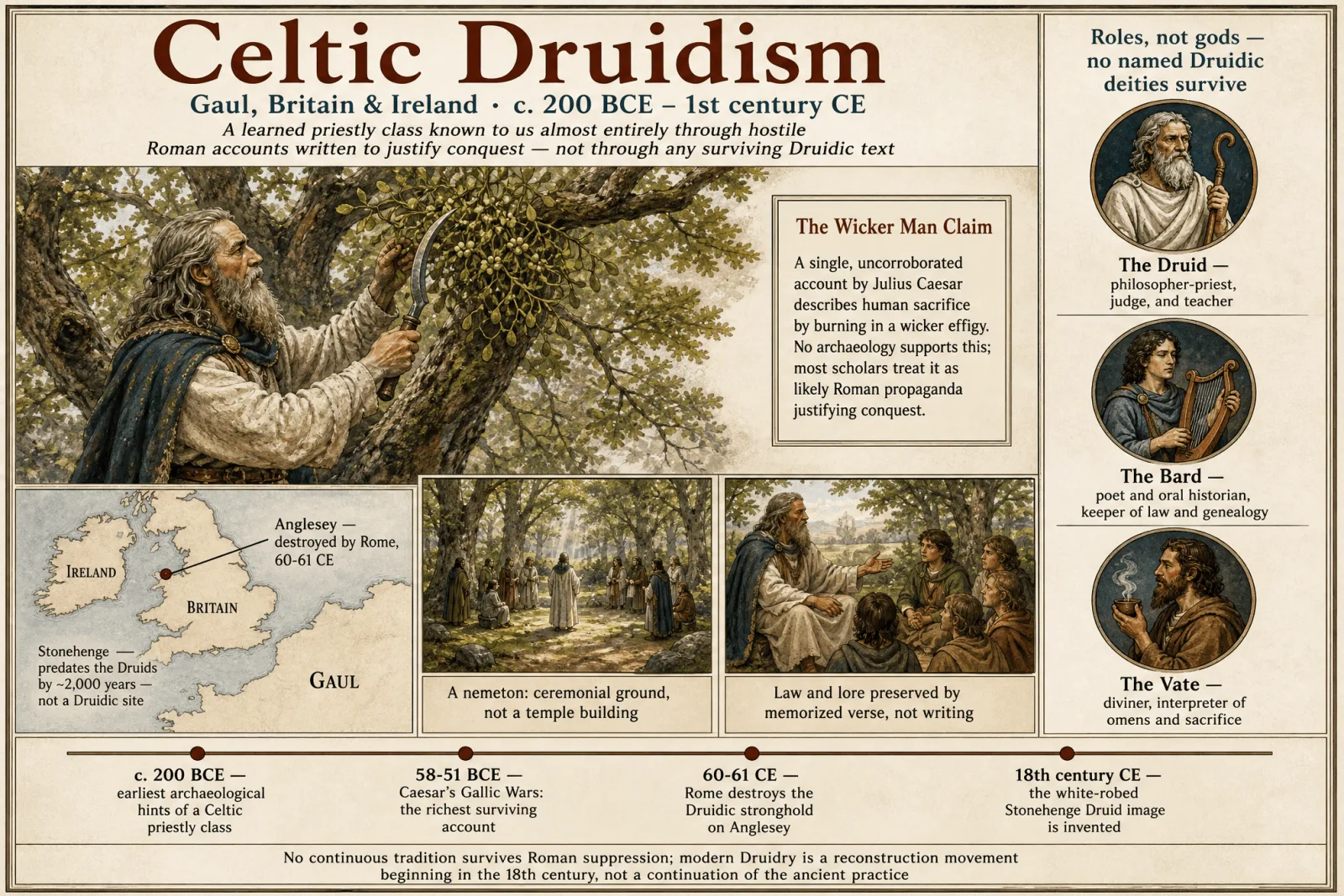
Celtic Druidism designates the religious traditions of the Iron Age Celtic peoples of Gaul (modern France, Belgium, southern Germany), Britain, and Ireland, practiced from approximately the fourth century BCE through the Roman conquest (first century BCE–CE) and continuing in modified forms in post-Roman Britain and Ireland until the spread of Christianity (circa sixth century CE). The Druids—a specialized priestly class central to Celtic religion—are known primarily through the ethnographic accounts of Greco-Roman writers (especially Julius Caesar, Strabo, Pliny the Elder, and Tacitus), Irish and Welsh medieval literature composed centuries after Christianization, and archaeological evidence of ritual sites, votive deposits, and iconography.
The scholarly understanding of Celtic Druidism is profoundly shaped by source problems. Classical accounts, written by outsiders with political and cultural biases, often served Roman propaganda purposes: Caesar's description of Druids in his *Gallic War* was tailored to his narrative objectives, alternately downplaying their influence to make Gallic society seem less sophisticated or emphasizing their 'barbarism' (including alleged human sacrifice and sacred groves soaked in blood) to justify conquest. Irish and Welsh medieval texts—the *Táin Bó Cúailnge*, the *Mabinogion*, and bardic traditions—preserve mythological narratives and references to druids (*druí* in Old Irish), but these were composed by Christian monks centuries after the conversion, blending pre-Christian memory with Christian reinterpretation and medieval political concerns.
Archaeological evidence provides a corrective but remains ambiguous. Celtic religion centered on animistic veneration of natural features (rivers, springs, groves, mountains) and deities associated with specific places and functions, evidenced by votive deposits (weapons, jewelry, cauldrons thrown into lakes and bogs), inscribed dedications to local gods, and sanctuaries. However, archaeology cannot directly confirm the Druids' existence as a distinct priestly class, their specific functions, or their doctrines. Scholars like Miranda Aldhouse-Green, Barry Cunliffe, and Ronald Hutton have worked to disentangle historical Celtic religion from Romantic-era inventions, particularly the spurious association of Druids with Stonehenge (a Neolithic monument predating the Iron Age Celts by millennia) and the fabricated 'traditions' promoted by 18th- and 19th-century revivalists like William Stukeley and Iolo Morganwg.
Iron Age Celtic Religion and the Emergence of the Druids (circa 400 BCE–50 CE)
Celtic societies of the La Tène period (circa 450–50 BCE) were decentralized, organized around tribal groups (*civitates* in Roman terminology) ruled by chieftains, warrior elites, and assemblies. Religion was not separate from social and political life; sacred sites, seasonal festivals, and votive practices structured the year and affirmed tribal identity. The Druids, as described by Caesar and other Roman sources, constituted a privileged class exempt from military service and taxation, responsible for conducting sacrifices, mediating disputes, teaching the young, and preserving oral traditions (they reportedly refused to commit their knowledge to writing, relying on memorization).
Caesar's *Gallic War* (circa 50 BCE) provides the most detailed classical description of the Druids, though recent scholarship emphasizes its constructed nature. Caesar claimed that the Druidic 'doctrine' originated in Britain and that Gauls seeking advanced training traveled there, suggesting Britain as the heartland of Druidism. However, Cambridge classicists analyzing Caesar's ethnographic passages argue that he deliberately minimized the Druids' role in most of the *Gallic War* to downplay Gallic sophistication, mentioning them primarily in a single ethnographic digression (Book VI). This selective presentation served his narrative: portraying the Gauls as less formidable justified his military achievements, while occasional references to 'barbaric' practices like human sacrifice legitimated Roman conquest as a civilizing mission.
Other classical sources add scattered details. Strabo (circa 64 BCE–24 CE) described Druids as philosophers and natural scientists, comparing them to Persian magi and Indian Brahmins. Pliny the Elder (23–79 CE) provided the iconic image of Druids cutting mistletoe from oak trees with golden sickles while dressed in white robes—a description that shaped later Romantic depictions but whose historical accuracy remains unverifiable. Tacitus (circa 56–120 CE) described the Roman assault on Anglesey (Môn) in 60 CE, where the Roman general Suetonius Paulinus confronted Druids and 'women in Fury-like robes' on the shore, destroyed sacred groves, and ended rituals involving human sacrifice. While Tacitus's account is vivid, it closely mirrors earlier literary topoi about 'barbaric' sacred groves (e.g., Lucan's description of Caesar encountering a grove near Marseilles), raising questions about whether he was recording eyewitness testimony or deploying Roman cultural stereotypes.
The Roman conquest of Gaul (58–50 BCE) and the gradual subjugation of Britain (beginning 43 CE) disrupted Celtic religious institutions. The Romans tolerated most indigenous cults, often syncretizing Celtic and Roman deities (e.g., Sulis Minerva at Bath, Apollo Grannus), but they suppressed practices considered threats to Roman order—particularly Druids, whom they associated with rebellion and resistance. The Emperor Tiberius (reigned 14–37 CE) reportedly banned Druidism in Gaul, and Claudius (reigned 41–54 CE) continued this policy. Whether these bans were effectively enforced or primarily symbolic remains debated; inscriptions and later references suggest some continuation of Druidic practices into the late Roman period.
The destruction of the Druidic center on Anglesey (Môn) in 60 CE, as recounted by Tacitus, is often interpreted as Rome's decisive blow against organized Druidism in Britain. Anglesey's significance is corroborated by archaeology: Llyn Cerrig Bach, a lake on Anglesey, was a major Iron Age ritual site where votive offerings—weapons, chariot fittings, slave chains, and other prestige objects—were deposited from circa 300 BCE to 60 CE. The cessation of deposits around the time of the Roman invasion suggests the site's ritual function ended with Roman conquest, though whether this reflects the 'Druids' last stand' (a popular interpretation) or simply the disruption of regional cult practices is uncertain.
In Ireland, which was never conquered by Rome, Druids (*druí*, plural *druid*) continued as part of pre-Christian Gaelic society. However, our knowledge of Irish Druids comes entirely from medieval Christian texts—particularly the *Ulster Cycle* (including the *Táin Bó Cúailnge*) and historical-legendary texts like the *Annals of the Four Masters*—written centuries after Christianization. These texts portray druids as advisors to kings, prophets, magicians, and sometimes antagonists to Christian saints (especially St. Patrick, who legendarily defeated the druids at the court of the High King). The extent to which these literary druids reflect historical Iron Age religious specialists versus medieval Christian literary constructions is a matter of ongoing scholarly debate.
In post-Roman Britain and Ireland, the transition from Celtic paganism to Christianity was gradual, uneven, and mediated by local elites. In Ireland, Christianity arrived by the fifth century, traditionally associated with St. Patrick (though the historical details are contested). Irish monasticism absorbed elements of earlier learned traditions: the *filid* (poets) and *brehons* (lawyers) preserved legal codes, genealogies, and mythological narratives, some of which may derive from earlier druidic learning. However, distinguishing pre-Christian druidic knowledge from Christian monastic scholarship is nearly impossible, as all surviving texts were written down by Christian scribes who selected, edited, and reinterpreted the material according to their own religious and political concerns.
Welsh tradition similarly preserves references to Druids and bards, particularly in the *Mabinogion* and the poetry attributed to figures like Taliesin. The conflation of druids, bards, and poets in medieval Welsh literature reflects both continuity of learned classes and Christian reinterpretation. The survival of Celtic languages, place-names, and folk practices into the medieval and modern periods attests to cultural continuity, but the specific religious practices and beliefs of Iron Age Druids did not survive as a coherent system. By the sixth and seventh centuries, Christianity had become the dominant religion across the former Celtic territories, and 'Druidism' existed only in literary memory and Christianized legend.
The modern popular image of Druids—white-robed sages performing rituals at Stonehenge amid standing stones—is a product of the Romantic era, not ancient history. The revival began in the 17th and 18th centuries when antiquarians like John Aubrey and William Stukeley mistakenly attributed Neolithic and Bronze Age megalithic monuments (Stonehenge, Avebury) to the Druids. Stukeley, a founding figure of British archaeology, combined fieldwork with mystical speculation, portraying Druids as proto-Christians who worshipped a single God and prefigured the Church of England. His work, though archaeologically groundbreaking, created enduring myths that conflated prehistoric monument-builders with Iron Age Celts.
The Welsh polymath Iolo Morganwg (Edward Williams, 1747–1826) was the most influential fabricator of 'Druidic tradition.' Iolo claimed that the ancient Druids' teachings had been preserved by Welsh bards and that he himself was the last true inheritor of this wisdom. To substantiate his claims, he forged medieval Welsh manuscripts, invented rituals (including the Gorsedd ceremony still performed at the Welsh National Eisteddfod), and popularized the mythos of Druids as nature-venerating bards. Ronald Hutton, the leading historian of modern Druidry, has documented how Iolo's fabrications shaped not only Welsh cultural nationalism but also the international revival of Druidry, despite being exposed as fraudulent by 19th-century scholars.
Modern Druidry emerged as a distinct spiritual movement in the 20th century, blending Romantic-era mythology, Theosophy, environmentalism, and neopagan revival. The Order of Bards, Ovates & Druids (OBOD), the British Druid Order, and other organizations practice seasonal rituals, nature veneration, and personal spiritual development, explicitly acknowledging that they are reconstructing or reimagining Druidism rather than continuing an unbroken tradition. Modern Druids have conducted ceremonies at Stonehenge since the early 20th century, despite archaeological evidence conclusively demonstrating that Stonehenge was built circa 3000–1500 BCE, millennia before the Iron Age Celts. As Hutton wryly noted, 'modern Druids arrived at Stonehenge just as archaeologists were evicting the ancient Druids from it.' Nonetheless, modern Druidry is a significant religious and cultural phenomenon with thousands of practitioners worldwide, distinct from but historically connected to ancient Celtic religion.
Animism, Local Deities, and Sacred Landscapes
Celtic religion, as reconstructed from archaeological and epigraphic evidence, was fundamentally animistic and localized. Miranda Aldhouse-Green argues that the Celts believed every part of the natural world—rivers, springs, mountains, forests, even individual trees—contained spirits or divine presence. This is evidenced by the vast number of locally-specific deities known from Gallo-Roman inscriptions: over 400 distinct deity-names are recorded, most appearing only once or twice, suggesting intense localization of cult. Rivers were particularly sacred: the Seine was personified as the goddess Sequana, the Marne as Matrona, the Severn as Sabrina, and countless springs had associated deities honored through votive offerings and healing cults.
Rather than a universal pantheon worshipped identically across all Celtic territories, Celtic religion consisted of overlapping networks of local and tribal cults. Some deities—such as Lugh (associated with kingship, oaths, and multi-skilled mastery), Brigit/Brigantia (healing, poetry, smithcraft), and Cernunnos (the horned god associated with animals, fertility, and the wild)—appear across multiple regions, but their cults varied locally. The interpretatio romana (Roman identification of Celtic gods with their own equivalents) further complicates reconstruction: when a Romano-Celtic inscription dedicates an altar to 'Apollo Grannus' or 'Mercury Lugh,' it is unclear whether this represents genuine syncretism, Roman imposition, or indigenous adaptation for a bilingual audience.
Sacred sites included natural groves, springs, mountaintops, and constructed enclosures. Classical sources emphasize the Druids' association with groves (*nemeton* in Gaulish, a word preserved in place-names like Nemetobriga and Augustonemetum/Clermont-Ferrand). Lucan's and Tacitus's descriptions of blood-soaked groves where human entrails were consulted are likely rhetorical exaggerations serving Roman propaganda, but the sacredness of groves is corroborated by archaeological evidence of offerings deposited in wooded areas and by place-name evidence. Water sites—lakes, rivers, bogs—received votive deposits (weapons, jewelry, cauldrons) across the Celtic world, from the Thames and Seine to Irish bogs, indicating widespread practices of offering prestige goods to aquatic deities or spirits.
The Druids, as portrayed in classical sources, were a specialized learned class responsible for religious, legal, and educational functions. Caesar described three roles: conducting religious rites and sacrifices, adjudicating disputes (with the power to excommunicate individuals from sacrifices, effectively ostracizing them from society), and educating the youth of the elite. He claimed that Druids memorized vast amounts of poetry and lore, refusing to write it down, and that training could take up to twenty years. This oral tradition, if accurate, means that Druidic knowledge was lost with the suppression and Christianization of Celtic societies, leaving only secondhand Roman descriptions and later medieval echoes.
The religious functions attributed to Druids included performing sacrifices (allegedly including human sacrifice, discussed below), interpreting omens, mediating between the human and divine realms, and conducting seasonal rituals. Strabo and Caesar mention that the Celts believed in the immortality of the soul and its transmigration—concepts sometimes compared to Pythagorean philosophy, leading to speculation about cultural exchange or shared Indo-European roots. However, the specifics of Celtic afterlife beliefs remain unclear; the medieval Irish *Otherworld* (Tír na nÓg, Mag Mell) described in later texts may or may not reflect Iron Age beliefs.
Archaeological evidence for Druids as a distinct class is limited but suggestive. A few burials contain objects interpreted as markers of religious or ritual authority: iron staffs, medical instruments, divination tools, and unusual grave goods. The Stanway burial near Colchester, England, contained a board game, medical instruments, and a set of rods, leading archaeologists to identify the occupant as a possible 'doctor-priest'—a specialist in healing, divination, or ritual, potentially a Druid. Similarly, excavations at Chartres and other Gaulish sanctuaries reveal evidence of specialists managing temple complexes, though whether these were 'Druids' in the sense described by Caesar is unprovable. The gap between literary descriptions and material evidence remains a central challenge in reconstructing Druidism.
Classical sources unanimously describe the Celts as practicing human sacrifice, with Druids presiding over such rites. Caesar claimed that the Gauls constructed giant wicker effigies (the infamous 'wicker man'), filled them with living humans (often criminals but also innocents if criminals were unavailable), and burned them as offerings to the gods. Strabo described criminals being stabbed in the back, their death throes observed for divination. Pliny and Tacitus added details of groves soaked in human blood and altars piled with entrails. These accounts shaped Roman and later European perceptions of Celtic 'barbarism' and justified Roman conquest as a civilizing mission.
Modern scholars, however, approach these claims with skepticism. Roman ethnographic writing followed literary conventions that emphasized the 'otherness' of barbarians, often through accusations of human sacrifice, cannibalism, and sexual deviance—topoi applied to various non-Roman peoples. The consistency of Roman descriptions may reflect shared literary models rather than empirical observation. Moreover, Romans themselves practiced forms of ritual killing (gladiatorial combat, animal and occasionally human sacrifice in times of crisis), making their moral condemnation of Celtic practices somewhat hypocritical.
Archaeological evidence for human sacrifice is ambiguous. Bog bodies from Iron Age northwestern Europe (Denmark, Germany, Britain, Ireland)—such as Lindow Man in Cheshire—show signs of violent death (strangulation, throat-cutting, blunt force trauma) and have been interpreted by some archaeologists as sacrificial victims, possibly killed by Druids. However, alternative interpretations include execution of criminals, victims of interpersonal violence, or accidental deaths. The Llyn Cerrig Bach votive deposit on Anglesey included a slave chain, leading to speculation about human offerings, but direct evidence is lacking. The debate continues: human sacrifice may have occurred in specific ritual contexts (foundation sacrifices, crisis offerings, elite funerals), but the scale and routine nature described by Roman sources likely reflect exaggeration or misunderstanding.
Literary Sources and Their Problems
There are no surviving texts composed by ancient Druids themselves. The Druids' alleged refusal to write down their teachings (if historically accurate) means that their doctrines, rituals, and cosmology were entirely oral and died with them. All textual evidence is secondhand, written by outsiders or composed centuries after Christianization. Julius Caesar's *Commentarii de Bello Gallico* (*The Gallic War*, circa 50 BCE) remains the primary classical source, devoting Book VI, chapters 13–18 to Gaulish society, including the most detailed description of Druids. However, as recent Cambridge scholarship emphasizes, Caesar was writing military propaganda and political self-justification, not objective ethnography. His portrayal of the Druids served his narrative purposes and must be read critically.
Other classical sources include Strabo's *Geography* (early first century CE), Pliny the Elder's *Natural History* (77 CE, especially Book XVI on plants and Book XXX on magic), Tacitus's *Annals* (early second century CE, describing the Anglesey campaign), and scattered references in Diodorus Siculus, Pomponius Mela, and Lucan's *Pharsalia*. These authors drew on earlier Greek ethnographic traditions (particularly Posidonius, whose work is lost but influenced later writers) and on each other, creating an intertextual web where distinguishing original observation from literary borrowing is difficult.
Irish and Welsh medieval texts preserve mythological narratives and references to druids but are even more problematic as sources for pre-Christian religion. The *Ulster Cycle* (especially *Táin Bó Cúailnge*, 'The Cattle Raid of Cooley'), the *Mythological Cycle*, and the *Mabinogion* were composed by Christian monks in the 11th–14th centuries, drawing on earlier oral traditions but filtering them through Christian theology, medieval politics, and literary conventions. Druids appear in these texts as magicians, prophets, and advisors, but their portrayal reflects medieval Christian views of pagan 'wizards' as much as or more than historical Iron Age religious specialists. Disentangling the layers of transmission—Iron Age oral tradition, early medieval adaptation, and later medieval manuscript production—is a central challenge in Celtic Studies.
Votive Offerings and Sacred Water Sites
The deposition of valuable objects—weapons, jewelry, cauldrons, tools, and occasionally human remains—in rivers, lakes, springs, and bogs is one of the most consistent features of Celtic ritual practice across Europe. These offerings, spanning from the Bronze Age through the Iron Age, indicate long-term traditions of giving prestige goods to aquatic deities or spirits. The Thames and Seine rivers have yielded thousands of objects; the Gundestrup Cauldron (found in a Danish bog but of Celtic manufacture) is one of the most famous examples, its elaborate silver panels depicting deities, warriors, and ritual scenes.
Llyn Cerrig Bach on Anglesey (Môn) is the most significant British example. Discovered during World War II airfield construction, the site yielded over 150 Iron Age objects deposited between circa 300 BCE and 60 CE: eleven swords, eight spearheads, parts of a parade shield, chariot fittings (representing at least 22 chariots), slave chains, and currency bars. The site was a natural lake overlooked by a cliff, creating a dramatic setting for ritual deposition. The cessation of offerings around 60 CE coincides with the Roman invasion of Anglesey and Tacitus's account of the destruction of Druidic sacred sites, leading some archaeologists to interpret the hoard as an 'emergency offering' by Druids facing Roman assault. However, the chronological spread of objects suggests long-term ritual use rather than a single crisis event.
Healing springs and thermal waters were also sacred. The temple complex at Bath (Aquae Sulis) in southwest England, where the Romano-British goddess Sulis Minerva was worshipped, featured a sacred spring where pilgrims threw offerings (coins, curses inscribed on lead tablets, and personal items) into the water. While the temple's monumental architecture is Roman, the veneration of the spring likely predates the conquest, representing continuity of a pre-Roman Celtic water cult overlaid with Roman forms.
Classical sources provide little direct information about Celtic festival cycles, but Irish and Welsh medieval texts, supplemented by folklore and comparative analysis, allow tentative reconstruction. The medieval Irish calendar recognized four major festivals: Samhain (beginning of winter, November 1, when the boundary between the living and the dead was permeable), Imbolc (February 1, associated with the goddess Brigit and the beginning of spring), Beltane (May 1, marking the start of summer, involving bonfires and cattle-driving rituals), and Lughnasadh (August 1, a harvest festival associated with the god Lugh). These festivals structured the agricultural year and were occasions for assemblies, legal proceedings, feasting, and ritual.
Whether these medieval Irish festivals directly reflect pre-Christian Iron Age practice is debated. The names (especially Samhain and Beltane) appear in Old Irish texts and may have ancient roots, but the detailed descriptions of rituals and their meanings were written down by Christian scribes who may have reshaped or invented traditions to fit medieval Christian cosmology. The widespread European folk customs surrounding May Day, midsummer, and November (later Christianized as All Saints' Day) suggest ancient seasonal celebrations, but specific pre-Christian forms are irrecoverable.
Archaeological evidence of ritual activity is often datable only by associated artifacts, making it difficult to link material remains to specific seasonal festivals. However, the construction and use of major sanctuaries (such as the Gournay-sur-Aronde temple in Gaul, where animal sacrifices and weapon deposits occurred over centuries) demonstrate that Iron Age Celts practiced regular, repeated rituals at fixed locations, implying some form of ritual calendar, even if its details remain unknown.
Classical sources describe Druids as skilled in divination and prophecy. Strabo claimed that Druids observed the death throes of sacrificial victims (human or animal) to predict the future. Tacitus mentioned Druidesses prophesying doom for the Romans on Anglesey. Diodorus Siculus described augury using bird flight and animal entrails. While these accounts are secondhand and shaped by Greco-Roman assumptions about 'barbarian' magicians, they suggest that ritual specialists among the Celts practiced divination, a near-universal feature of ancient religions.
Irish medieval texts portray druids as seers who prophesied the outcomes of battles, the fates of kings, and the coming of Christianity. The most famous example is the druid Cathbad in the *Ulster Cycle*, who prophesied that Cú Chulainn would have a short life but eternal glory. While these literary druids are medieval constructions, their prophetic role may reflect earlier traditions of learned specialists interpreting signs, omens, and dreams. The continuity of such practices into the Christian period—where Irish saints were often portrayed as prophecy-wielding wonder-workers—suggests cultural persistence even as the religious framework changed.
Regional Variation and the Problem of Pan-Celtic Generalization
The term 'Celtic' itself is modern, coined by scholars to group together linguistically related peoples who spoke languages of the Celtic family (Gaulish, Brythonic, Goidelic) but did not constitute a single unified culture, polity, or religion. Gaulish tribes in what is now France, British tribes on the island of Britain, and Gaelic tribes in Ireland had distinct political organizations, material cultures, and—almost certainly—religious practices, even as they shared linguistic roots, certain artistic styles (La Tène art), and some common mythological themes.
Regional differences are evident in archaeological remains. Gaulish sanctuaries like Gournay-sur-Aronde and Ribemont-sur-Ancre feature enclosures filled with weapons and animal bones, suggesting warrior-cult practices. British sites like South Cadbury and Danebury show similar hillfort-sanctuary complexes, but with local variations. Irish archaeology, lacking the influence of Roman conquest, reveals different patterns: ring-forts (*raths*), royal sites like Tara, and sacred wells, but less evidence of the monumental temple complexes found in Gaul and Roman Britain.
The Druids, too, may have varied regionally. Caesar claimed that the Druidic 'doctrine' originated in Britain, suggesting British primacy, but whether Gaulish, British, and Irish Druids shared identical training, doctrines, and social roles is unknowable. The absence of Druids from most of Caesar's military narrative, despite their supposed importance, raises questions about their uniformity and power. Were they a pan-Celtic institution with centralized authority, or were they local priestly elites whose influence varied by tribe and period? Modern scholars increasingly favor the latter interpretation, warning against projecting later Romantic-era fantasies of a unified 'Druidic church' onto the fragmented, decentralized realities of Iron Age Celtic societies.
Modern Druidry and Celtic Neopaganism
Modern Druidry is a diverse, decentralized spiritual movement with thousands of practitioners worldwide, centered primarily in Britain, Ireland, France, and North America. The largest organizations include the Order of Bards, Ovates & Druids (OBOD), founded in 1964 and claiming over 30,000 members worldwide; the British Druid Order, emphasizing ritual and seasonal celebrations; and the Druid Network, which became the first Druidic organization recognized as a charity in England and Wales in 2010, granting Druidry formal recognition as a religion.
Modern Druids practice seasonal rituals (marking the solstices, equinoxes, and the four 'cross-quarter' days associated with Irish festivals), nature veneration, meditation, poetry, and personal spiritual development. Rituals often take place outdoors at sites considered sacred—stone circles, groves, springs—and many Druids explicitly identify as Pagans, participating in the broader neopagan movement. However, Druidry is also practiced as a cultural and philosophical path without supernatural belief, a 'life philosophy' emphasizing ecological awareness, creativity, and connection to the land.
Academic scholars like Ronald Hutton and modern Druids themselves acknowledge that contemporary Druidry is a reconstruction, not a continuation of ancient practice. The movement draws on Romantic-era mythology (much of it fabricated), Celtic folklore, neopagan theology, environmentalism, and imaginative engagement with the past rather than unbroken tradition. The debate over authenticity—whether modern Druidry 'truly' represents ancient Celtic religion—is largely settled among scholars (it does not), but the movement's significance as a contemporary religious and cultural phenomenon is undeniable. As Hutton concludes, while we know almost nothing about ancient Druids, we know a great deal about modern Druids, making the latter a worthy subject of study in their own right.
Sacred Sites and Geography
Anglesey (Môn), an island off the northwest coast of Wales, was identified by Tacitus as a center of Druidism and the site of Rome's decisive assault on British Druids in 60 CE. Tacitus described the island's sacred groves, altars, and the dramatic confrontation between Roman legionaries and Druids flanked by 'Fury-like' women brandishing torches. While no archaeological traces of these specific groves have been found, Llyn Cerrig Bach, a lake on Anglesey's western edge, was a major Iron Age ritual site where votive offerings (weapons, chariots, slave chains) were deposited from circa 300 BCE to 60 CE. The site's dramatic coastal setting—a natural lake overlooked by cliffs amid a wetland landscape—would have been suitable for public ritual. The cessation of offerings around the time of the Roman invasion lends circumstantial support to Tacitus's account, though the precise connection between the votive site and the 'Druids' remains speculative.
Tara (Teamhair) in County Meath, Ireland, was the legendary seat of the High Kings of Ireland and a site of ritual and political assembly from prehistory through the early medieval period. The Hill of Tara contains Neolithic passage tombs, Bronze Age standing stones, and Iron Age earthworks, demonstrating millennia of sacred use. Medieval Irish texts describe Druids performing rituals at Tara, and the site remained symbolically central to Irish kingship and identity even after Christianization. While the specific religious practices conducted at Tara in the Iron Age are unknown, its status as a royal and sacred site is unquestioned, and it exemplifies the continuity of sacred landscape across religious transitions.
Gournay-sur-Aronde in northern France is one of the best-excavated Iron Age Gaulish sanctuaries, functioning from the third century BCE until the Roman conquest. The site features a ditched enclosure containing a central timber building (possibly a temple or shrine), a deposit pit filled with weapons (swords, spears, shields) intentionally broken and offered, and animal bones indicating large-scale sacrifices (primarily cattle, sheep, and horses). The sanctuary's long use, monumental construction, and evidence of repeated ritual activity demonstrate the institutionalization of Celtic religion in pre-Roman Gaul, though whether Druids specifically officiated there is unprovable.
Bath (Aquae Sulis), southwest England, was the site of a healing spring venerated in the pre-Roman Iron Age and later monumentalized as a grand Roman temple complex dedicated to the syncretized goddess Sulis Minerva. The spring, which produces naturally hot water, was surrounded by a sacred precinct where pilgrims threw votive offerings (coins, jewelry, curse tablets) into the water. While the visible temple architecture is Roman, the cult likely had pre-Roman Celtic roots, demonstrating continuity of sacred-spring veneration across the Roman conquest.
Stonehenge in Wiltshire, England, is the most famous megalithic monument in Britain, but it has no historical connection to Iron Age Druids. Built in phases from circa 3000 to 1500 BCE (Neolithic and Bronze Age), Stonehenge predates the Celtic arrival in Britain by over a millennium. The spurious association of Stonehenge with Druids originated with 17th- and 18th-century antiquarians like John Aubrey and William Stukeley, who mistakenly attributed all prehistoric monuments to the Druids. Despite being archaeologically disproven, the myth persists in popular culture and modern Druidry, where Stonehenge has become a symbolic center for seasonal rituals, particularly the summer solstice. As Ronald Hutton famously observed, 'modern Druids arrived at Stonehenge just as archaeologists were evicting the ancient Druids from it,' yet the site remains central to contemporary Druidic practice and identity, demonstrating how invented traditions can become culturally powerful regardless of historical accuracy.
Scholarly Debates and Interpretive Challenges
Did the Druids really exist? While this question may seem absurd given the unanimity of classical sources, some scholars have raised it due to the paucity of archaeological evidence and the Romans' tendency to impose Greek ethnographic models onto foreign peoples. The consensus view, articulated by Miranda Aldhouse-Green and Barry Cunliffe, is that Druids did exist as a specialized priestly class in Celtic societies, but that Roman accounts exaggerated, distorted, or misunderstood their roles and influence. The challenge is separating plausible core details (Druids as ritual specialists, judges, and teachers) from Roman rhetorical exaggeration (especially regarding human sacrifice and 'barbarism').
Human sacrifice: reality or Roman propaganda? The debate over whether Celts practiced human sacrifice remains contentious. Classical sources unanimously describe it, but Romans had political motives to portray Celts as 'savage.' Archaeological evidence (bog bodies, unusual burials, weapon deposits including slave chains) is ambiguous, admitting multiple interpretations. Some scholars, like Aldhouse-Green, argue that human sacrifice occurred in specific crisis contexts or elite funeals, citing comparative evidence from other ancient societies. Others, emphasizing Roman bias and the lack of unambiguous proof, remain skeptical. The debate reflects broader tensions between taking ancient sources at face value and critically interrogating their agendas.
Stonehenge and the Druids: why does the myth persist? Despite being archaeologically disproven for over a century, the association of Druids with Stonehenge remains entrenched in popular imagination and modern Druidic practice. Ronald Hutton traces this to the Romantic era's need for a 'native' British prehistory uncorrupted by Roman or Christian influence, combined with the visual power of the monument and its suitability for ritual. Modern Druids defend their use of Stonehenge not on historical grounds but through claims of spiritual connection, arguing that while ancient Druids didn't build or use Stonehenge, the site's sacredness transcends particular historical periods. This case exemplifies how 'invented traditions' (in historian Eric Hobsbawm's sense) can become culturally real and meaningful despite lacking historical basis.
Continuity or discontinuity? To what extent do medieval Irish and Welsh texts preserve genuine pre-Christian traditions versus reflecting medieval Christian invention? This is the central methodological debate in Celtic Studies. Scholars like Proinsias Mac Cana and Kim McCone have argued for substantial continuity, identifying archaic linguistic features, pre-Christian mythological patterns, and comparative Indo-European parallels in medieval texts. Others, emphasizing the texts' late composition and Christian framing, counsel extreme skepticism. The debate affects every aspect of reconstructing Celtic religion: can we trust medieval descriptions of Samhain, the Otherworld, or druidic magic as reflecting Iron Age beliefs, or are they medieval fantasies projected onto a half-remembered pagan past? No consensus exists, and scholars navigate case-by-case, weighing linguistic, comparative, and archaeological evidence.
Key Terms
- Druids (Latin *druides*, Irish *druí*)
- Specialized priestly class in Celtic societies, responsible for ritual, legal, and educational functions according to classical sources.
- Nemeton
- Gaulish word for 'sacred grove' or 'sanctuary,' preserved in place-names across Celtic Europe.
- Votive deposit
- Ritual offering of valuable objects (weapons, jewelry, tools) deposited in water or earth as gifts to deities or spirits.
- Interpretatio romana
- Roman practice of identifying foreign gods with their own equivalents (e.g., Sulis = Minerva).
- La Tène culture
- Archaeological term for the Iron Age Celtic material culture (circa 450–50 BCE), named after a Swiss site.
- Samhain
- Irish festival marking the beginning of winter (November 1), when boundaries between worlds were permeable; Christianized as All Saints' Day.
- Beltane
- Irish festival marking the beginning of summer (May 1), associated with bonfires and fertility.
- Filid (singular *file*)
- Irish learned poets, possibly successors to druidic oral traditions in Christian Ireland.
- Imbas forosnai
- Old Irish divinatory practice involving sensory deprivation to induce prophetic visions, attributed to druids and poets.
- Gorsedd
- A modern 'Druidic' ceremonial assembly invented by Iolo Morganwg in the 18th century, still performed at Welsh cultural festivals.
- OBOD
- Order of Bards, Ovates & Druids, the largest contemporary Druid organization.
- Sulis Minerva
- Romano-British goddess syncretizing the Celtic Sulis and Roman Minerva, worshipped at Bath.
Further Reading
- Miranda Aldhouse-Green, Caesar's Druids: An Ancient Priesthood (Yale University Press, 2010)
- Miranda Aldhouse-Green, Rethinking the Ancient Druids: An Archaeological Perspective (University of Wales Press, 2021)
- Barry Cunliffe, The Ancient Celts (2nd ed., Oxford University Press, 2018)
- Ronald Hutton, Blood and Mistletoe: The History of the Druids in Britain (Yale University Press, 2009)
- Ronald Hutton, 'The Druids' (Gresham College Lecture, 2025)
- Andrew Fitzpatrick, 'Druids: Towards an Archaeology' in Celtic from the West (Oxbow, 2010)
- Miranda Aldhouse-Green, 'What can archaeology tell us about the Druids' dark arts?' (Aeon Essays, 2020)
- Nathaniel P. Desrochers, 'The Suppression of the Druids in Caesar's Gallic War,' Classical Quarterly (2023)
- Patrick Sänger, 'Ethnography in Caesar's Gallic War,' Classical Quarterly (2019)
- Jane Webster, 'At the End of the World: Druidic and Other Revitalization Movements,' Britannia 30 (1999)
Practices
- Seasonal fire festivals
- Oak & mistletoe rites
- Oral bardic training
Core ideas
- Reincarnation
- Soul passes to new body
- Deity
- Many regional gods and goddesses
Sacred texts
Celtic druids transmitted theology, law, and ritual through memorized verse over generations, forbidding written records of their deepest teachings. Roman writers like Julius Caesar and later Irish Christian monks preserved fragments of this oral corpus in Latin and Gaelic manuscripts. What survives describes a cosmos of many gods, sacred groves, and the soul's passage between lives.