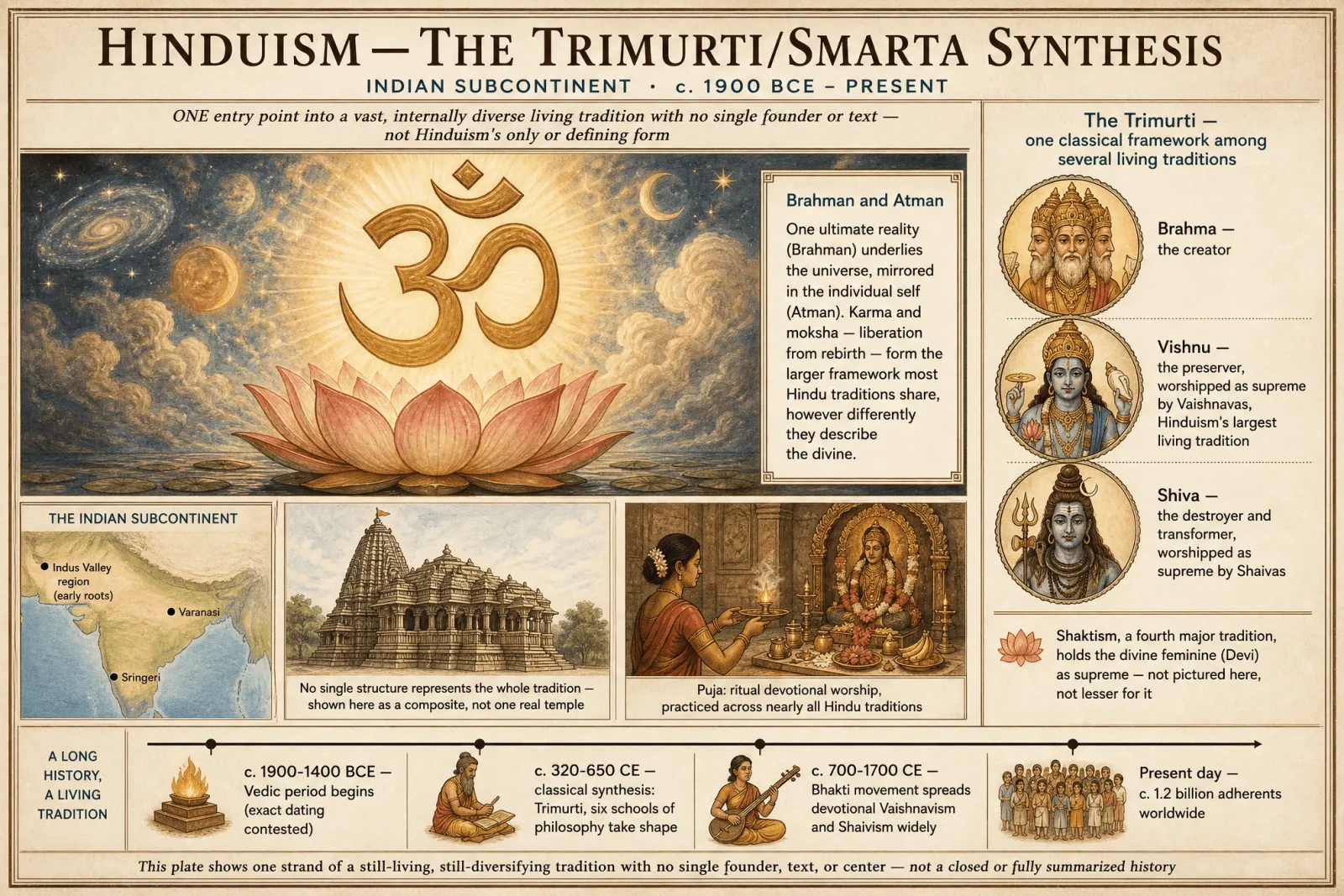
Overview
Hinduism is the world's oldest continuously practiced major religion, with roots reaching back to the Vedic civilization of the second millennium BCE in the Indus and Gangetic river valleys. It encompasses an enormous diversity of beliefs, practices, texts, and philosophical schools, unified less by a single creed than by shared reverence for the Vedas, acceptance of concepts such as dharma (cosmic and moral order), karma (action and its consequences), samsara (the cycle of rebirth), and moksha (liberation from that cycle). Unlike traditions with a single founder, prophet, or central authority, Hinduism evolved through the contributions of countless sages, poets, philosophers, and regional traditions, resulting in a family of interrelated paths rather than a monolithic system.
The term 'Hinduism' itself is relatively recent—a British colonial coinage derived from the Persian word for the Indus River—and many practitioners prefer Sanatana Dharma ('eternal order' or 'eternal way'). The tradition is grounded in a vast textual corpus: the Vedas (hymns and ritual manuals), the Upanishads (philosophical dialogues on the nature of ultimate reality and the self), the epics Mahabharata and Ramayana (narrative literature embodying dharma in action), the Puranas (mythological genealogies of gods and cosmos), and countless regional texts in Sanskrit, Tamil, Hindi, Bengali, and other languages. Philosophically, Hinduism produced six classical darshanas (schools of thought)—Samkhya, Yoga, Nyaya, Vaisheshika, Mimamsa, and Vedanta—each offering systematic interpretations of Vedic revelation and employing rigorous logic, debate, and introspection.
Today Hinduism counts approximately one billion adherents, the vast majority in India, Nepal, and diaspora communities worldwide. It manifests in diverse forms: the devotional (bhakti) movements centered on Vishnu, Shiva, Devi (the Goddess), or local deities; ascetic renunciant traditions (sannyasa) pursuing liberation through meditation and austerity; temple Hinduism with elaborate ritual, pilgrimage, and festivals; domestic worship (puja) at household shrines; and reform movements such as Arya Samaj and Brahmo Samaj that reinterpreted tradition in light of modernity. Contemporary Hinduism navigates questions of caste and social equality, nationalism and secularism, gender and women's rights, and the relationship between ancient wisdom and modern science. It remains a living, evolving tradition that defies easy categorization.
Historical Development
The earliest textual evidence of Hinduism is found in the Rigveda, a collection of hymns composed in Vedic Sanskrit around 1500–1200 BCE, though some elements may be older. The Vedic religion centered on ritual sacrifice (yajna) to deities such as Indra (storm and war), Agni (fire), and Varuna (cosmic order), performed by Brahmin priests using elaborate mantras and offerings. The Vedic period (circa 1500–500 BCE) established the priestly authority, the Sanskrit language as sacred, and the notion of rita (cosmic order) that later evolved into dharma. Archaeological evidence from the Indus Valley Civilization (circa 2600–1900 BCE) suggests proto-Hindu elements—ritual baths, possible yogic postures, and symbols resembling later Shiva iconography—but the script remains undeciphered, leaving continuity uncertain.
The Upanishads (circa 800–200 BCE), composed at the end of the Vedic period, marked a philosophical turn inward, away from external ritual toward introspection and knowledge (jnana). Sages such as Yajnavalkya articulated the concepts of Brahman (ultimate reality) and atman (the individual self), arguing that knowledge of their identity leads to liberation (moksha). This shift gave rise to the renunciant (shramana) movements, including early Buddhism and Jainism, which challenged Brahmanical authority. Hinduism absorbed and responded to these critiques, developing its own renunciant orders and integrating ascetic ideals alongside householder (grihastha) dharma. The Bhagavad Gita (circa 200 BCE–200 CE), embedded in the Mahabharata, synthesized action (karma), devotion (bhakti), and knowledge (jnana) as complementary paths to liberation.
The classical period (circa 200 BCE–500 CE) saw the systematization of Hindu philosophy in the six darshanas and the composition of the dharmashastra legal texts (most famously the Manusmriti), which codified varna (class) and ashrama (life stages) systems. The epics Mahabharata and Ramayana, though rooted in oral tradition, were compiled during this period and became central to Hindu ethics and mythology. The Puranas (circa 300–1500 CE) narrated the deeds of Vishnu, Shiva, and the Goddess, establishing sectarian devotionalism. Regional temple traditions flourished: the Gupta Empire (320–550 CE) sponsored Sanskrit literature and Hindu art; the Chola, Pallava, and Chalukya dynasties of South India (sixth to thirteenth centuries) built monumental temples and patronized bhakti poet-saints who composed vernacular hymns.
Bhakti (devotional) movements from the sixth century onward democratized Hinduism, emphasizing personal devotion over ritual purity and caste hierarchy. The Alvars and Nayanars of Tamil Nadu sang ecstatic poetry to Vishnu and Shiva; Kabir, Mirabai, Tulsidas, and the Sants of North India (fifteenth to seventeenth centuries) challenged orthodoxy and caste discrimination. Tantric traditions, developing from the fifth century onward, introduced esoteric rituals, goddess worship, and the use of mantras, yantras, and yogic techniques to harness divine power. The Advaita Vedanta philosopher Adi Shankaracharya (eighth century) systematized non-dualist philosophy and established four monasteries (mathas) at the cardinal directions of India. Ramanuja (eleventh century) and Madhva (thirteenth century) articulated qualified non-dualism and dualism, respectively, grounding Vaishnava theology.
The arrival of Islam in the Indian subcontinent from the eighth century onward profoundly shaped Hinduism. Muslim rule (the Delhi Sultanate, Mughal Empire) brought iconoclastic campaigns that destroyed temples, but also fostered Hindu-Muslim syncretism in Sufi and bhakti poetry. British colonial rule (eighteenth to twentieth centuries) imposed new categories ('Hinduism' as a single religion), introduced Western education and law, and sparked reform movements. Ram Mohan Roy founded the Brahmo Samaj (1828) to promote monotheism and oppose sati (widow immolation) and caste. Dayananda Saraswati's Arya Samaj (1875) rejected Puranic polytheism in favor of Vedic monotheism. Swami Vivekananda (1863–1902) presented Vedanta to the West and argued for a rational, universal Hinduism compatible with science. Mahatma Gandhi integrated Hindu ethics into anti-colonial nationalism, while B.R. Ambedkar (1891–1956) critiqued caste oppression and ultimately rejected Hinduism for Buddhism. Post-independence India (1947–present) has seen Hindu nationalism (Hindutva) emerge as a political force, debates over secularism, and global diaspora communities negotiating tradition and modernity.
Core Worldview and Doctrines
Hindu metaphysics revolves around Brahman, the ultimate reality described in the Upanishads as infinite, eternal, and beyond attributes (nirguna), yet also manifest in the world with attributes (saguna). The Chandogya Upanishad declares 'Tat tvam asi' ('You are That'), identifying the individual self (atman) with Brahman. This insight is central to Advaita Vedanta, which holds that plurality is illusory (maya) and only non-dual Brahman truly exists. In contrast, qualified non-dualist (Vishishtadvaita) and dualist (Dvaita) schools maintain real distinctions between God, souls, and the world, emphasizing devotion (bhakti) to a personal deity—Vishnu or Shiva—as the path to liberation. Samkhya philosophy posits two irreducible principles: purusha (pure consciousness) and prakriti (material nature), with liberation arising from discriminating between them.
Dharma is perhaps the most central concept: cosmic order, moral duty, righteousness, and the law that sustains the universe. Dharma varies by one's varna (class: Brahmin, Kshatriya, Vaishya, Shudra), ashrama (life stage: student, householder, forest-dweller, renunciant), gender, and context. The Bhagavad Gita's teaching of svadharma (one's own duty) insists that performing one's role without attachment to results leads to spiritual progress. Karma (action) generates consequences that shape one's current and future lives; good karma leads to favorable rebirth, bad karma to suffering. Samsara, the cycle of birth, death, and rebirth, is driven by karma and desire. The ultimate goal is moksha (liberation from samsara), achieved through knowledge (jnana), devotion (bhakti), disciplined action (karma yoga), or meditation (dhyana).
Hindu theology encompasses monism, monotheism, polytheism, and henotheism (worship of one god while acknowledging others). The Rigveda declares 'Ekam sat vipra bahudha vadanti' ('Truth is one, the wise call it by many names'), allowing multiple deities to be understood as faces of a single divine reality. The Trimurti (Brahma the creator, Vishnu the preserver, Shiva the destroyer) represents cosmic functions; in practice, most Hindus are Vaishnavas (devotees of Vishnu and his avatars Krishna and Rama), Shaivas (devotees of Shiva), or Shaktas (devotees of Devi, the Goddess in forms such as Durga, Kali, Lakshmi, Saraswati). Regional and village deities (gramadevatas) remain vital to lived religion, often integrated into Puranic pantheons. Avatara doctrine holds that Vishnu incarnates in ages of decline to restore dharma; ten avatars (Dashavatara) include Rama, Krishna, and (for some) the Buddha.
Hindu cosmology envisions vast cycles of time: yugas (ages) decline from a golden age (Satya Yuga) to the current age of strife (Kali Yuga), culminating in cosmic destruction and recreation over billions of years (kalpas). The universe is structured vertically—with heavens (svarga), earth (bhuloka), and underworlds (patala)—and horizontally into concentric continents surrounding Mount Meru. Rebirth can occur as gods, humans, animals, or hell-beings depending on karma. This cosmology is not primarily empirical but soteriological, mapping the soul's journey and the relative value of human birth as the gateway to liberation.
The doctrine of varna and jati (caste) has historically structured Hindu society, though it is contested and evolving. Classical texts describe four varnas based on ritual purity and occupation, with untouchables (Dalits) outside the system. Jati (birth groups) number in the thousands, governed by rules of marriage, commensality, and occupation. Reformers from the Buddha to Kabir to Ambedkar challenged caste hierarchy as incompatible with human dignity. Modern India legally abolished untouchability (1950), yet caste discrimination persists. Many Hindus today argue caste is a social distortion, not essential to dharma; others defend it as divinely ordained. This tension reflects Hinduism's capacity for internal critique and reform.
Sacred Texts and Canons
The Vedas are the oldest and most authoritative Hindu scriptures, considered shruti (revealed, heard by ancient rishis). The four Vedas—Rigveda (hymns), Samaveda (melodies), Yajurveda (sacrificial formulas), and Atharvaveda (spells and charms)—were composed in Vedic Sanskrit between 1500 and 500 BCE and transmitted orally with extraordinary precision. Each Veda has four sections: Samhitas (hymns), Brahmanas (ritual instructions), Aranyakas (forest texts), and Upanishads (philosophical teachings). The Rigveda's 1,028 hymns address deities like Agni, Indra, and Varuna; the Nasadiya Sukta (Hymn of Creation) poses cosmological questions that remain philosophically provocative. Orthodox schools (astika) accept Vedic authority; heterodox schools (nastika, including Buddhism and Jainism) do not.
The Upanishads (circa 800–200 BCE), numbering over 200 (with 13 considered principal), mark the transition from ritual to philosophy. The Brihadaranyaka and Chandogya Upanishads explore Brahman, atman, and the means of knowledge. The Katha Upanishad uses the dialogue between the god Yama and the boy Nachiketas to teach immortality of the soul; the Isha Upanishad reconciles renunciation and action. The Upanishads are the foundation of Vedanta philosophy and were translated into Persian (17th century) and Latin (early 19th century), influencing European philosophy from Schopenhauer to Emerson. Their aphoristic style ('Neti neti'—'Not this, not this') uses negation to point toward the inexpressible Brahman.
The Mahabharata and Ramayana are the two great Sanskrit epics, classified as itihasa (history) and smriti (remembered tradition). The Mahabharata, attributed to the sage Vyasa and composed between 400 BCE and 400 CE, is the longest poem in world literature (100,000 verses). It narrates the Kurukshetra war between the Pandavas and Kauravas, embedding moral dilemmas about dharma. The Bhagavad Gita (18 chapters within the Mahabharata) is Hinduism's most widely read text: Krishna counsels the warrior Arjuna on duty, devotion, and the paths to liberation. The Ramayana, attributed to Valmiki (circa 500–100 BCE), tells the story of Prince Rama, his wife Sita, and his battle with the demon king Ravana. Rama is venerated as the ideal king (maryada purushottama); Tulsidas's Hindi retelling, the Ramcharitmanas (16th century), is recited in North India as scripture.
The Puranas (circa 300–1500 CE) are encyclopedic texts that narrate the creation, destruction, and recreation of the universe, genealogies of gods and sages, and the glories of specific deities and pilgrimage sites. The 18 major Puranas are divided into those glorifying Vishnu (such as the Bhagavata Purana, celebrated for its Krishna lila), Shiva (Shiva Purana, Linga Purana), and Brahma. The Bhagavata Purana (circa 9th century) is especially beloved for its devotional poetry and theology of Krishna as supreme Godhead. Regional Puranas (sthala puranas) sacralize local geography. The Tantras, a parallel corpus (circa 500–1500 CE), outline esoteric rituals, mantra practice, kundalini yoga, and goddess worship; they are authoritative for Shakta and Tantric traditions but controversial in orthodox circles for transgressing caste and purity norms.
Vernacular traditions produced rich literatures: the Tamil Shaiva Nayanars and Vaishnava Alvars (sixth to ninth centuries) composed hymns (collected as the Tirumurai and Divya Prabandham) that rival the Vedas in devotional authority. In the medieval North, Sant poets like Kabir (15th century) and Guru Nanak (founder of Sikhism, 15th–16th centuries) sang in vernacular languages, critiquing ritual and caste. The Bengali Chaitanya Mahaprabhu (16th century) inspired ecstatic Krishna bhakti; his tradition produced the Chaitanya Charitamrita. Modern Hindu thought is reflected in works like Vivekananda's Complete Works, Aurobindo's The Life Divine, and Gandhi's Hind Swaraj. Academic translations and critical editions—such as those by the Clay Sanskrit Library, Murty Classical Library of India, and Oxford University Press—make these texts accessible globally.
Practices and Observances
Hindu practice integrates daily domestic worship (puja), temple rituals, life-cycle rites (samskaras), festivals, pilgrimage, and ascetic disciplines. Puja, the offering of light (aarti), incense, flowers, and food (prasada) to a deity's image (murti), is performed at home shrines and temples. The murti is understood not as an idol but as a consecrated vessel for divine presence, inviting darshan (seeing and being seen by the deity). Temple worship follows elaborate protocols codified in Agamic texts: priests (pujaris) bathe, dress, and feed the deity, mediating between devotees and the divine. Major temples like Tirumala Venkateswara, Jagannath Puri, and the Meenakshi Temple are pilgrimage centers drawing millions annually.
Samskaras (life-cycle rites) mark transitions from conception to death. Key samskaras include namakarana (naming ceremony), upanayana (sacred thread investiture for upper-caste males, initiating Vedic study), vivaha (marriage), and antyeshti (funeral rites). Marriage is understood as a sacrament (not a contract), uniting families and ensuring dharmic continuity. Funeral rites include cremation (agnidagdha), scattering ashes in sacred rivers, and shraddha ceremonies to honor ancestors (pitrs) and ensure their well-being in the afterlife. Widows historically faced severe restrictions; sati (self-immolation on the husband's pyre), though rare and condemned by reformers, remains a traumatic historical symbol.
Hindu festivals structure the ritual year, varying by region and sect. Diwali (Festival of Lights) celebrates Rama's return to Ayodhya and Lakshmi's blessings; Holi (Festival of Colors) marks spring and Krishna's playful legends; Navaratri (Nine Nights) honors the Goddess Durga's victory over the buffalo demon; Maha Shivaratri venerates Shiva with night-long vigils. Kumbh Mela, held every 12 years at four riverine sites (Prayagraj, Haridwar, Nashik, Ujjain), is the largest religious gathering on earth, with over 100 million pilgrims bathing at auspicious moments to wash away sins. Regional festivals—such as Onam in Kerala, Pongal in Tamil Nadu, and Ganesh Chaturthi in Maharashtra—reflect local agricultural cycles and myths.
Yoga and meditation, rooted in the Yoga Sutras of Patanjali (circa 200 BCE–200 CE), offer systematic paths to mental discipline and liberation. Classical yoga's eight limbs (ashtanga) include ethical restraints (yama), observances (niyama), postures (asana), breath control (pranayama), sense withdrawal (pratyahara), concentration (dharana), meditation (dhyana), and absorption (samadhi). Hatha yoga, a later Tantric development, uses asanas and pranayama to awaken kundalini energy. Modern global yoga often emphasizes physical health, detached from Hindu metaphysics, sparking debates over cultural appropriation and secularization. Devotional practices include chanting divine names (nama-japa), singing bhajans and kirtans, and reciting texts like the Hanuman Chalisa or Vishnu Sahasranama (Thousand Names of Vishnu). Ascetic renouncers (sadhus, sannyasis) renounce worldly ties, wander as mendicants, and pursue moksha through austerity, meditation, and study.
Internal Diversity: Schools and Traditions
Hinduism's diversity is immense, encompassing Vaishnavism, Shaivism, Shaktism, Smartism, and countless regional and sectarian variations. Vaishnavism, centered on Vishnu and his avatars (especially Krishna and Rama), is the largest tradition. The Bhagavata Purana theology, Ramanuja's Vishishtadvaita, and the Bengali Gaudiya Vaishnavism of Chaitanya emphasize loving devotion (bhakti) as the supreme path. The ISKCON movement (International Society for Krishna Consciousness, founded 1966 by A.C. Bhaktivedanta Swami Prabhupada) globalizes Krishna bhakti with temple worship, chanting 'Hare Krishna,' and vegetarianism. South Indian Srivaishnava communities maintain Tamil Alvars' hymns alongside Sanskrit Vedanta; North Indian traditions venerate Rama, with Ramlila dramatizations of the Ramayana performed annually.
Shaivism venerates Shiva as supreme, manifesting in forms from the ascetic meditator (Adiyogi) to the cosmic dancer (Nataraja) to the linga (aniconic symbol of creative power). Kashmir Shaivism (ninth to eleventh centuries), a non-dualist Tantric tradition, teaches that consciousness (Shiva) and energy (Shakti) are one, and liberation comes from recognizing oneself as Shiva. Shaiva Siddhanta, prominent in Tamil Nadu, systematizes ritual and theology in Tamil and Sanskrit texts. Lingayats (Virashaivas) of Karnataka reject caste, temple worship, and Brahmin authority, wearing a linga pendant and emphasizing personal devotion and social reform. Nath and Kapalika ascetic orders practice extreme austerities and transgressive Tantric rituals.
Shaktism worships the Goddess (Devi, Mahadevi, Shakti) as ultimate reality, both benign (Lakshmi, Parvati, Saraswati) and fierce (Durga, Kali). The Devi Mahatmya (circa 5th–6th centuries CE), embedded in the Markandeya Purana, narrates the Goddess's victories over demons, establishing her as savior of the cosmos. Tantric Shakta texts (such as the Devi Bhagavata Purana and the Tantrasara) outline mantra, yantra, and ritual practices. The Navaratri festival celebrates Durga's nine forms; animal sacrifice (bali) persists in some Shakta temples, though many communities have replaced it with symbolic offerings. Regional goddesses—such as Kamakhya in Assam, Vaishno Devi in Jammu, and Meenakshi in Madurai—draw millions of pilgrims annually.
Smartism, associated with Adi Shankaracharya's Advaita Vedanta, venerates five deities (Panchayatana puja: Vishnu, Shiva, Devi, Surya, Ganesha) as equal manifestations of non-dual Brahman. Smartas follow orthodox Brahmanical rituals, emphasize Vedic study, and value philosophical knowledge. Philosophical schools (darshanas) structure intellectual diversity: Vedanta (in Advaita, Vishishtadvaita, and Dvaita forms) dominates theologically; Samkhya and Yoga provide dualist metaphysics and meditative practice; Nyaya and Vaisheshika develop logic and atomist ontology; Mimamsa defends Vedic ritual authority. Each school wrote sutras (aphorisms), bhashyas (commentaries), and engaged in vigorous debate.
Regional and caste-based traditions add further complexity. Jat, Rajput, and other communities have martial and clan-specific deities. The Bauls of Bengal blend Hindu and Sufi elements, singing ecstatic songs and rejecting orthodox ritual. Dalits and tribal (Adivasi) communities practice forms of Hinduism with distinct deities, rituals, and social structures, often marginalized by caste Hinduism. Reform movements—Brahmo Samaj, Arya Samaj, Ramakrishna Mission, Chinmaya Mission—modernize and universalize Hindu teachings, rejecting idol worship, caste, and ritualism in favor of rationalism and ethical monotheism. Diaspora Hinduism in North America, Europe, and the Caribbean adapts tradition to pluralist contexts, often emphasizing yoga, meditation, and interfaith dialogue over sectarian distinctions.
Communities and Demographics
According to the Pew Research Center's 2012 Global Religious Landscape study, approximately one billion people identify as Hindu, representing 15 percent of the world's population. Hinduism is the most geographically concentrated major religion: over 99 percent of Hindus live in the Asia-Pacific region, and 94 percent reside in India alone. Nepal (81 percent Hindu), India (80 percent), and Mauritius (56 percent) are the only Hindu-majority countries, together accounting for 97 percent of all Hindus. Bangladesh hosts about 13.5 million Hindus (9 percent of the population), Pakistan around 2.8 million (1.6 percent), and Sri Lanka over 2.5 million (12.6 percent), communities shaped by Partition and post-colonial migrations.
Within India, Hinduism is the majority religion in all states except Punjab (Sikh majority), Jammu and Kashmir, Ladakh (Muslim majorities), and the northeastern states of Nagaland, Mizoram, and Meghalaya (Christian majorities). Regional diversity is vast: Tamil Nadu is predominantly Shaiva and speaks Tamil; Bengal venerates Kali and celebrates Durga Puja; Gujarat is Vaishnava and home to major Krishna temples; Varanasi in Uttar Pradesh is the spiritual heart of Shaivism and cremation on the Ganges banks. Caste remains a powerful social force despite legal abolition of untouchability, with Brahmins, Kshatriyas, Vaishyas, Shudras, and Dalits navigating education, marriage, politics, and temple access. The rise of Hindutva nationalism, associated with the Rashtriya Swayamsevak Sangh (RSS) and the Bharatiya Janata Party (BJP), has intensified debates over Hindu identity, secularism, and minority rights.
The Hindu diaspora numbers approximately 10 to 11 million, concentrated in countries with histories of indentured labor or skilled migration. The Caribbean (Trinidad and Tobago, Guyana, Suriname) received Indian indentured laborers in the nineteenth century; their descendants maintain Hindu practices, Ramleela dramas, and Phagwa (Holi) festivals, often blending with local cultures. Mauritius is the only African nation with a Hindu majority (56 percent), reflecting similar labor migration. In Southeast Asia, Bali (Indonesia) practices a syncretic Hinduism blended with Buddhism and indigenous traditions; Hindu-Buddhist kingdoms historically flourished in Cambodia (Angkor Wat), Thailand, and Java before Islamization.
In the West, Hindu migration accelerated after immigration reforms in the 1960s. The United States hosts over 2.2 million Hindus, concentrated in metropolitan areas like New York, New Jersey, California, and Texas. Hindu temples (mandirs) serve as cultural and religious centers; organizations like the Vishva Hindu Parishad (VHP America) and Hindu American Foundation advocate for Hindu interests. The United Kingdom has over 800,000 Hindus, largely of Gujarati and Punjabi origin; the Swaminarayan Akshardham temple in London (opened 1995, expanded 2006) is the largest Hindu temple outside India. Canada, Australia, and New Zealand also host significant Hindu communities. Diaspora Hinduism often emphasizes pan-Hindu identity over sectarian or caste divisions, adapts to pluralist societies, and engages in interfaith dialogue. Yoga studios, Ayurveda clinics, and Bollywood films transmit Hindu cultural elements globally, though detached from religious context.
Sacred Places and Pilgrimage Sites
Varanasi (Kashi) on the Ganges River in Uttar Pradesh is Hinduism's holiest city, sacred to Shiva and believed to be the axis mundi where the earthly and divine realms intersect. The city's 88 ghats (steps leading to the river) facilitate daily ritual bathing, cremation at Manikarnika Ghat (securing moksha for the deceased), and evening Ganga Aarti ceremonies. The Kashi Vishwanath Temple, dedicated to Shiva, is one of the twelve Jyotirlingas (self-manifested lingas of light). Pilgrims believe dying in Varanasi grants liberation; the city has been continuously inhabited for over 3,000 years and remains a center of Sanskrit learning, temple music, and silk weaving. Mark Twain wrote, 'Benares is older than history, older than tradition, older even than legend.'
The Char Dham ('Four Abodes'), a pan-Indian pilgrimage circuit attributed to the eighth-century philosopher Adi Shankaracharya, unifies Hinduism's sacred geography at the cardinal points of the subcontinent. Badrinath, in the Himalayas of Uttarakhand (dedicated to Vishnu), marks the north; Dwarka, on the Arabian Sea coast of Gujarat (sacred to Krishna), the west; Puri, on the Bay of Bengal in Odisha (home to Lord Jagannath, a form of Vishnu/Krishna), the east; and Rameswaram, on an island in the Gulf of Mannar in Tamil Nadu (sacred to Shiva), the south. Completing the Char Dham Yatra is believed to confer moksha. The circuit spans over 6,000 kilometers and traditionally takes weeks or months; modern pilgrims often fly between sites. Rameswaram's Ramanathaswamy Temple is where Rama worshiped Shiva to atone for killing Ravana; Puri's Jagannath Temple hosts the annual Rath Yatra (chariot festival) drawing millions.
The seven sacred cities (Sapta Puri) that grant moksha are Ayodhya, Mathura, Haridwar, Varanasi, Kanchipuram, Ujjain, and Dwarka. Ayodhya (Uttar Pradesh), Rama's birthplace, is central to the Ramayana and has been the site of intense religious and political conflict, particularly over the Babri Masjid demolition (1992) and the subsequent construction of the Ram Mandir (inaugurated 2024). Mathura and Vrindavan (Uttar Pradesh) are Krishna's birthplace and childhood home, dotted with temples and sites of lila (divine play). Haridwar (Uttarakhand), where the Ganges enters the plains, is one of four Kumbh Mela sites; pilgrims bathe at Har Ki Pauri ghat. Kanchipuram (Tamil Nadu), the 'City of Thousand Temples,' is sacred to both Vishnu and Shiva. Ujjain (Madhya Pradesh) hosts the Mahakaleshwar Jyotirlinga and Kumbh Mela.
Tirupati, in Andhra Pradesh, is home to the Tirumala Venkateswara Temple, the world's most-visited and wealthiest Hindu temple, receiving over 50,000 pilgrims daily and annual donations exceeding one billion dollars. Devotees tonsure their hair as an offering; the temple trust manages vast charitable, educational, and healthcare programs. The Meenakshi Amman Temple in Madurai (Tamil Nadu), dedicated to the goddess Meenakshi (Parvati) and Shiva, is a masterpiece of Dravidian architecture with towering gopurams (gateway towers) covered in thousands of painted sculptures. The temple complex was rebuilt in the sixteenth and seventeenth centuries under Nayak rule and is central to Tamil Shaiva-Shakta devotion.
The twelve Jyotirlingas—manifestations of Shiva as infinite columns of light—are pilgrimage destinations across India: Somnath (Gujarat), Mallikarjuna (Andhra Pradesh), Mahakaleshwar (Ujjain), Omkareshwar (Madhya Pradesh), Kedarnath (Uttarakhand), Bhimashankar (Maharashtra), Vishwanath (Varanasi), Trimbakeshwar (Maharashtra), Vaidyanath (Jharkhand), Nageshwar (Gujarat), Rameshwaram (Tamil Nadu), and Grishneshwar (Maharashtra). Kedarnath, at 3,583 meters in the Himalayas, is accessible only on foot or by helicopter and is part of the Chota Char Dham pilgrimage circuit in Uttarakhand (Yamunotri, Gangotri, Kedarnath, Badrinath). The devastating 2013 Uttarakhand floods killed thousands of pilgrims but spared Kedarnath temple, which locals attribute to divine protection.
The Kumbh Mela, held every three years rotating among four cities (Prayagraj, Haridwar, Nashik, Ujjain) and every 12 years at each site, is the largest religious gathering in history. The Maha Kumbh at Prayagraj (formerly Allahabad) in 2013 drew an estimated 100 million pilgrims over 55 days. Pilgrims bathe at the confluence (sangam) of the Ganges, Yamuna, and mythical Saraswati rivers at astrologically auspicious moments. Naga sadhus (naked ascetics) lead ritual processions; the event is a spectacle of devotion, renunciation, and mass organization. UNESCO inscribed Kumbh Mela on the Representative List of the Intangible Cultural Heritage of Humanity in 2017.
South India's temple cities—such as Thanjavur (the Brihadeshwara Temple, a UNESCO World Heritage Site), Chidambaram (Nataraja's cosmic dance), and Srirangam (the largest functioning Hindu temple)—preserve Chola and Pandya architectural heritage. Mount Kailash in Tibet, believed to be Shiva's abode and the cosmic axis (Mount Meru), draws Hindu, Buddhist, Jain, and Bon pilgrims who circumambulate the mountain (kora/parikrama). Though geographically outside India, Kailash remains central to Hindu sacred geography. Pashupatinath Temple in Kathmandu, Nepal, is a UNESCO World Heritage Site and one of the most sacred Shiva temples; cremations along the Bagmati River mirror Varanasi's Manikarnika Ghat. In Southeast Asia, Angkor Wat (Cambodia) and Prambanan (Java, Indonesia) testify to the spread of Hindu cosmology and temple architecture, though both regions later converted to Buddhism and Islam, respectively.
Contemporary Debates and Issues
Caste remains Hinduism's most contentious issue. Despite legal abolition of untouchability (1950) and affirmative action policies reserving government jobs and university seats for Scheduled Castes and Tribes, caste discrimination persists in marriage, housing, employment, and violence. Dalit activists argue caste is intrinsic to Hindu scripture (Manusmriti's varna hierarchy) and practice (temple entry bans, endogamy). Upper-caste Hindus and reformers counter that caste is a social distortion, not theological necessity, citing bhakti saints and Vedantic non-dualism as egalitarian. B.R. Ambedkar's conversion to Buddhism (1956) and the Dalit Buddhist movement challenge Hinduism to reckon with its complicity in oppression. The Mandal Commission (1990) and caste-based politics intensified these debates, which intersect with class, region, and nationalism.
Hindu nationalism (Hindutva) advocates a vision of India as a Hindu nation (Hindu Rashtra), marginalizing Muslims and Christians as foreign. The Rashtriya Swayamsevak Sangh (RSS), founded 1925, and its affiliates (Bharatiya Janata Party, Vishva Hindu Parishad) mobilize around cow protection, temple construction (notably Ayodhya Ram Mandir), and opposition to religious conversion. Critics, including secular Hindus, argue Hindutva distorts Hinduism's pluralism, instrumentalizes religion for political power, and foments communal violence (Gujarat riots 2002, Delhi riots 2020). Defenders claim Hindutva corrects centuries of appeasement and reclaims Hindu pride. The 2019 revocation of Jammu and Kashmir's autonomy, the Citizenship Amendment Act (favoring non-Muslim refugees), and mob lynchings over beef consumption exemplify Hindutva's political ascendance.
Gender and women's rights pose theological and social challenges. Classical texts like Manusmriti subordinate women to male guardianship; widows faced (and in some communities still face) severe restrictions. Reformers from Ram Mohan Roy to Ishwar Chandra Vidyasagar campaigned against sati, child marriage, and widow remarriage bans. Feminist scholars critique Hinduism's patriarchal structures while reclaiming goddesses and female saints (Mirabai, Andal) as empowering figures. The debate over women's temple entry—resolved in favor of entry at Sabarimala (2018) by India's Supreme Court, though violently resisted—illustrates tensions between tradition and constitutional rights. LGBTQ+ inclusion is debated: texts like the Kamasutra and Puranic myths (Ardhanarishvara, Mohini) suggest fluidity, yet many orthodox leaders condemn homosexuality; India's 2018 decriminalization of homosexuality opened space for queer Hindu theologies.
Appropriation and secularization of Hindu practices—especially yoga—spark debates. Global yoga markets commodify asanas and meditation, often stripped of Hindu philosophy, Sanskrit terminology, and devotion to Ishvara (God). Hindu groups argue this is cultural appropriation; others celebrate yoga's universalization as fulfilling its purpose of human welfare. Ayurveda, too, is marketed globally, sometimes distorting classical texts. The line between religious and cultural practices blurs: is Diwali a Hindu festival or a cultural celebration? Can non-Hindus practice yoga, chant Om, or wear bindi without misappropriation? These questions animate diaspora communities negotiating identity in pluralist societies.
Hinduism and science is another contested domain. Some Hindus claim Vedic texts anticipate modern science (quantum physics in Upanishads, cosmology in Puranas, aviation in Ramayana's Pushpaka Vimana). Critics, including Hindu rationalists, reject this as pseudoscience and Hindu apologetics. The debate reflects anxieties about modernity: can ancient wisdom retain authority in a scientific age? Must one choose between tradition and reason, or can they coexist? Vivekananda and Aurobindo argued Hinduism is inherently rational and empirical; orthodox voices prioritize shruti's revealed authority. Environmental movements increasingly invoke Hindu concepts like ahimsa (non-violence) and Ganga's sanctity to mobilize against pollution and ecological degradation, reframing dharma as ecological responsibility.
Key Terms
- Dharma
- Cosmic order, moral duty, righteousness, and the law sustaining the universe; varies by class, life stage, and context.
- Karma
- Action and its consequences; the law that intentions and deeds shape present and future experiences, driving samsara.
- Samsara
- The cycle of birth, death, and rebirth driven by karma and desire.
- Moksha
- Liberation from samsara; the ultimate goal achieved through knowledge, devotion, or disciplined action.
- Brahman
- The ultimate reality; infinite, eternal, and beyond attributes, yet manifest in the world.
- Atman
- The individual self or soul; in Advaita Vedanta, identical with Brahman.
- Bhakti
- Devotion; loving, personal worship of a deity as a path to liberation.
- Yoga
- Union; a discipline of physical, mental, and spiritual practices aiming for liberation or union with the divine.
- Varna
- Class or social order; the four-fold division of Brahmin (priest), Kshatriya (warrior), Vaishya (merchant), Shudra (laborer).
- Avatar
- Incarnation; Vishnu's descent into the world (e.g., Rama, Krishna) to restore dharma in ages of decline.
- Puja
- Worship; ritual offering of light, incense, flowers, and food to a deity's image.
- Darshan
- Seeing and being seen by a deity; an auspicious exchange of gaze in temple worship or in the presence of a holy person.
Further Reading
- Stanford Encyclopedia of Philosophy: Epistemology in Classical Indian Philosophy
- Encyclopaedia Britannica: Hinduism
- Gavin Flood, An Introduction to Hinduism (Cambridge University Press, 1996)
- Gavin Flood (ed.), The Blackwell Companion to Hinduism (Blackwell, 2003)
- Pew Research Center: Global Religious Landscape - Hindus (2012)
- UNESCO World Heritage: Khajuraho Group of Monuments
- Julius Lipner, Hindus: Their Religious Beliefs and Practices (2nd ed., Routledge, 2010)
- Wendy Doniger, The Hindus: An Alternative History (Penguin, 2009)
- Patrick Olivelle (trans.), Upanishads (Oxford World's Classics, 1996)
- Diana L. Eck, India: A Sacred Geography (Harmony, 2012)
- Anantanand Rambachan, The Advaita Worldview: God, World, and Humanity (SUNY Press, 2006)
- Internet Encyclopedia of Philosophy: Naturalism in Classical Indian Philosophy
Practices
- Puja
- Yoga & meditation
- Pilgrimage (tirtha)
- Festivals (Diwali, Holi)
Core ideas
- Liberation
- Moksha — release from samsara
- Karma
- Actions shape future rebirths
- Deity
- Brahman beneath many forms (Brahma, Vishnu, Shiva)
Sacred texts
The oldest and most authoritative Hindu scriptures, composed in Sanskrit between roughly 1500 and 500 BCE. The four collections — Rig, Sama, Yajur, and Atharva — contain hymns, rituals, and cosmological speculations recited by Brahmin priests. They are regarded as shruti, 'that which is heard,' revealed directly to ancient sages.
Philosophical texts appended to the Vedas, exploring the nature of Brahman (ultimate reality) and Atman (the self). They move from ritual sacrifice toward inner contemplation and the quest for moksha. The Chandogya and Brihadaranyaka Upanishads are among the most influential, shaping Hindu, Buddhist, and Western philosophy.
A 700-verse dialogue between the warrior Arjuna and the god Krishna, embedded in the Mahabharata epic. Krishna teaches the paths of devotion (bhakti), selfless action (karma yoga), and knowledge (jnana) as routes to liberation. It is one of the most widely read and commented-upon texts in Hindu tradition.
The world's longest epic poem, telling of the great war between the Pandava and Kaurava clans and the fall of the dharma age. It weaves together history, mythology, law, and philosophy across roughly 100,000 verses. The Bhagavad Gita forms its spiritual climax, and the epic's moral dilemmas remain central to Hindu thought.
The epic of Prince Rama, an avatar of Vishnu, who rescues his wife Sita from the demon king Ravana with the help of Hanuman. It celebrates dharma, devotion, and ideal kingship, and is recited and performed across South and Southeast Asia. Valmiki's Sanskrit version is the best known, though regional retellings abound.