Mandaeism
Baptism in living water and the last Gnostics of the marshes.
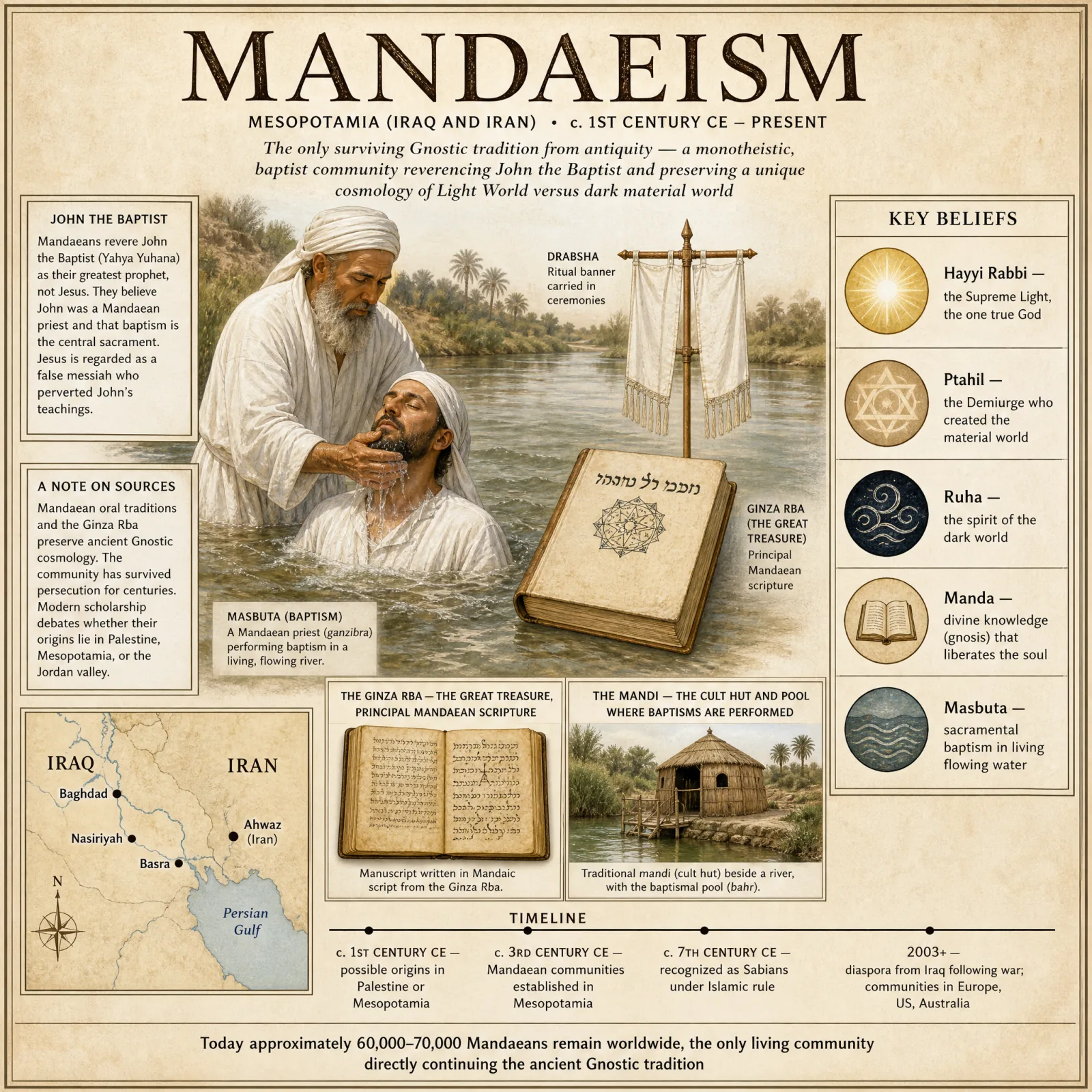
Overview
Mandaeism, also called Mandaeanism or Nasoraeanism, is the last surviving Gnostic religion from Late Antiquity. Its name derives from Mandaic manda ("knowledge" or "gnosis"), and its adherents are called Mandaeans (Mandaiia) or, more esoterically, Nasoraeans (Naṣoraiia, "guardians" or "possessors" of secret rites and knowledge). The religion emerged in the early centuries CE in Mesopotamia, with a strong identification with John the Baptist as its primary prophet. While its literary corpus shares affinities with Gnostic movements across the Near East and Mediterranean world, Mandaeism is distinct in its practice: it is a community-centered, priestly-led tradition that emphasizes repeated ritual baptism (masbuta) in flowing water, maintains a hereditary priesthood, and preserves a closed ethnic identity. Unlike the fragmentary Gnostic texts of Nag Hammadi and elsewhere, Mandaeism offers an unbroken living tradition of textual transmission, ritual practice, and communal life extending from antiquity into the present.
The religion's central focus is the cult of baptism, which Mandaeans have historically performed in rivers—especially the Tigris, Euphrates, and Karun—throughout southern Iraq and southwestern Iran (Khuzestan). Flowing water (yardna, literally "Jordan") is essential: it represents the earthly reflection of the heavenly World of Light, and immersion in it purifies the soul, secures contact with the Light World, and ensures the soul's eventual ascent after death. The religion is highly ritualistic, with baptisms conducted at dawn on Sundays by ordained priests (tarmidé) wearing white ritual garments. The priesthood is hereditary, passing through patrilineal lineages that trace back to priestly scribes in Late Antiquity. Mandaean religious life takes place at the mandi (cult-hut or temple), traditionally a simple structure near flowing water, though modern mandis—such as those in Ahvaz, Baghdad, and diaspora cities like Sydney and Stockholm—are often permanent buildings serving as community centers.
Mandaeism is a closed ethnoreligious tradition. Membership is by birth only; conversion is not permitted, and endogamy is strongly preferred. This insularity has helped the tradition survive across centuries of persecution and displacement under Zoroastrian, Christian, Muslim, and, most recently, post-2003 political turmoil in Iraq. The community numbered roughly 60,000–75,000 in Iraq and Iran in the mid-20th century, concentrated in the marshlands of southern Iraq (Amarah, Nasiriyah, Qurna) and in Khuzestan province, Iran, especially Ahvaz. Since the 1980s and especially after 2003, large-scale emigration has dispersed the community. Significant Mandaean populations now reside in Western countries—particularly Australia, Sweden, the United States, Canada, and Germany—while traditional homelands have seen dramatic population declines due to sectarian violence, economic collapse, and targeted persecution. Despite these challenges, Mandaean communities continue to perform baptisms, copy manuscripts by hand, and maintain priestly lineages, though concerns about linguistic and ritual erosion persist in the diaspora.
Historical Origins and Development
The origins of Mandaeism remain a subject of scholarly debate. The Mandaean tradition claims that the religion began in ancient Palestine or the Jordan Valley, where it was founded by or intimately associated with John the Baptist, whom the Mandaeans revere as their greatest prophet (Yahya Yuhana). According to this narrative, Mandaeans were forced to flee persecution—possibly from Jewish authorities in the early first century CE or from Christians in the late first century—and migrated eastward into Parthian-controlled Mesopotamia, eventually settling in the marshlands of southern Iraq. Scholars such as Jorunn Buckley, Charles Häberl, James McGrath, and Kurt Rudolph have argued for an Israelite or Judeo-Palestinian origin, noting that Mandaic (the liturgical language) contains linguistic traces of Hebrew, Greek, and Western Aramaic, and that key Mandaean figures and terms reflect Jewish and early Christian milieux. The connection with John the Baptist, while contested, is taken seriously by a growing number of researchers, particularly those who argue that Mandaeism preserves traditions from John's inner circle.
An alternative hypothesis, championed by scholars including Lady Ethel Stefana Drower, suggests that Mandaeism represents a much older indigenous Mesopotamian religious stratum that later incorporated John the Baptist and other Near Eastern prophetic figures into its mythology. This view emphasizes the deeply embedded Mesopotamian elements in Mandaean ritual and cosmology—water-centered cults traceable to Sumerian and Babylonian precedent, dualist cosmologies echoing Zoroastrian influence, and a priesthood resembling Babylonian scribal castes. The historical reality likely lies in a synthesis: Mandaeism appears to have roots in a Jewish or Judeo-Samaritan baptizing sect (possibly related to movements described in the Dead Sea Scrolls and to John the Baptist's disciples) that migrated to Mesopotamia, where it absorbed local mythological and ritual traditions, eventually producing a hybrid Gnostic religion with both Jewish-Christian and Mesopotamian features.
By Late Antiquity (3rd–7th centuries CE), Mandaeism had established itself in southern Mesopotamia under Parthian and then Sasanian rule. The community was largely left alone by Zoroastrian authorities, though occasional tensions arose. The rise of Islam in the 7th century marked a critical juncture: Mandaeans were recognized as Sabians (Ṣābiʾūn), a category in the Quran referring to a non-Muslim but monotheistic "People of the Book." This designation—whether historically accurate or strategically adopted—afforded Mandaeans a degree of legal protection under Islamic law, though they were subject to dhimmi status and periodic restrictions. Throughout the medieval period, Mandaeans maintained their identity through their closed community structure, hereditary priesthood, and Aramaic liturgical language, even as Arabic became the vernacular. Their geographic isolation in the marshlands also contributed to their survival. The religion experienced a slow demographic decline over the centuries, compounded by urbanization, assimilation pressures, and state-led modernization campaigns in 20th-century Iraq and Iran.
Cosmology, Theology, and Soteriology
Mandaean theology is fundamentally dualistic, rooted in a cosmic opposition between the World of Light (Alma d-Nhura) and the World of Darkness (Alma d-Hšuka). The supreme deity is the Great Life (Hiia Rbia) or the Great Mana (Mana Rbia), an infinite, unknowable, and transcendent being dwelling in the highest realm of Light. Beneath this supreme being is a complex celestial hierarchy of uthras (heavenly beings or emanations), each associated with aspects of light, wisdom, and creative power. Key figures include Abatur (the divine weigher of souls), Ptahil (the flawed demiurge who shaped the material world), and Manda d-Hiia ("Knowledge of Life"), a messenger-savior figure. Mandaean cosmology sharply distinguishes the heavenly realm—eternal, pure, and luminous—from the material world, which is tainted, transient, and associated with the forces of darkness and the planetary rulers (the seven planets and twelve signs of the zodiac, often portrayed as malevolent archons).
The material world, including the body, is the product of Ptahil, a lower demiurgic entity who acted imperfectly and under the influence of darkness. Human beings possess a divine spark—a soul (nišimta) of light—trapped in the corporeal body. The purpose of life is to liberate this soul through ritual purity, ethical conduct, and esoteric knowledge. Salvation (purqana) is achieved through baptism in living water, which washes away sins and the taint of the material world, and through participation in the ritual life of the community. After death, the soul undertakes an ascent through a series of heavenly watchhouses (mataratia), where it must recite secret passwords and undergo judgment by Abatur and other uthras. If the soul is deemed pure and possesses the correct knowledge, it ascends to the World of Light. If it is impure or ignorant, it faces purgation or even a return to earthly existence. This ascent mythology is richly detailed in texts such as the Ginza Rba and shares structural parallels with Jewish Merkabah mysticism, Manichaean cosmology, and other Gnostic traditions.
Mandaean ethics center on purity, honesty, and pacifism. Adherents are instructed to avoid violence, practice charity and truth-telling, and maintain strict ritual purity through frequent ablutions. Marriage is mandatory, and celibacy is condemned. Procreation is considered a religious duty, as it ensures the continuation of priestly lineages and the community itself. The religion forbids contact with corpses and menstruating women, both considered sources of ritual impurity. Dietary restrictions, including avoidance of certain animals, are also prescribed. Priestly conduct is held to even stricter standards: priests must avoid meat, alcohol, and sexual relations during ritual periods and are responsible for copying and preserving sacred manuscripts. A notable ethical feature is Mandaeism's rejection of crucifixion, suffering, and martyrdom as salvific acts—in stark contrast to Christianity. This is explicitly polemicized in Mandaean texts, which dismiss Jesus (identified as a false messiah) and critique Christian doctrines.
Sacred Literature
The Mandaean scriptural corpus is extensive and largely preserved in manuscripts copied by hand in classical Mandaic, an Eastern Aramaic language written in a distinctive cursive script. The most important text is the Ginza Rba (Great Treasure), also called the Sidra Rba (Great Book) or, in early European scholarship, the Codex Nasaraeus. The Ginza consists of two parts: the Right Ginza (Ginza Iamina), containing cosmological myths, hymns, and theological teachings, and the Left Ginza (Ginza Smala), which focuses on the soul's journey after death and includes descriptions of the ascent through the heavenly realms. The Ginza is a composite work, compiled over several centuries (likely finalized by the 7th century CE), and represents the core of Mandaean theology and mythology. Mark Lidzbarski's 1925 German translation, based on Julius Heinrich Petermann's earlier printed edition, served as the primary scholarly gateway for much of the 20th century. Recent digital critical editions produced by scholars at the Berlin-Brandenburg Academy of Sciences and newer English translations by Carlos Gelbert and the Al-Saadi brothers reflect ongoing efforts to make the text accessible.
The Qulasta (Canonical Prayerbook) is a liturgical collection containing the prayers, hymns, and ritual instructions used in Mandaean ceremonies, especially baptisms and the masiqta (death mass). The Qulasta is indispensable for priestly practice and includes both fixed liturgical formulae and hymns (darashia) that articulate Mandaean cosmology and soteriology. The Book of John (Drasha d-Yahya, also called the Mandaean Book of John) is a compendium of teachings, stories, and polemical material attributed to or concerning John the Baptist. Charles Häberl and James McGrath produced a critical edition and English translation in 2019 (published by De Gruyter), the first rigorous scholarly edition of this text. The Book of John portrays Yahya (John) as a prophet sent from the World of Light to oppose false prophets—including Jesus, explicitly named and condemned—and to teach the path of purity and baptism.
Other important texts include the Haran Gawaita (Inner Haran), a quasi-historical narrative describing the Mandaean migration from Palestine to Mesopotamia; the Diwan Abatur (Book of the Scales), which details the soul's judgment after death and Abatur's role as divine weigher; and the Scroll of Exalted Kingship (Diwan Malkuta Laita), a priest-initiation text translated and studied by Jorunn Buckley. Mandaean literature also includes a large corpus of incantation bowls and amulets, often inscribed with protective spells and invocations of uthras, which attest to the community's engagement with apotropaic magic and healing practices. Manuscript copying remains an active tradition among Mandaean priests; scribes append colophons (postscripts) that record the scribe's name, lineage, date, and place of copying, providing invaluable historical data. Buckley's analysis of these colophons has reconstructed centuries of Mandaean priestly genealogies and geographic dispersion.
Rituals and Observances
Baptism (masbuta) is the central ritual act of Mandaeism and is repeated throughout a Mandaean's life. Unlike Christian baptism, which is typically a one-time event marking initiation, Mandaean baptism is an ongoing process of purification. The ritual is performed in flowing water (yardna)—traditionally a river such as the Tigris, Euphrates, or Karun, though modern diaspora communities sometimes adapt by using artificial streams or, where legally and climatically necessary, indoor pools connected to running water. Baptisms are conducted at dawn on Sundays, the sacred day of the week, and are officiated by priests wearing white robes (rasta) and turbans. The ritual involves a threefold immersion, during which the initiate faces north (the direction of the World of Light) and recites prayers. The priest performs accompanying rites: signing with water (kushta), anointing with sesame oil, crowning with a myrtle wreath (klila), and offering bread (pihta) and water (mambuha) as a sacred communion. Baptism is required for infants, at marriage, during annual festivals, and for dying individuals to ensure a pure soul's ascent.
The masiqta (death mass) is an elaborate ritual conducted for the deceased, ideally within 45 days of death. The ceremony is performed by priests at the mandi and at the riverbank, and it symbolically guides the soul through the stages of its ascent to the World of Light. The masiqta includes prayers, offerings of food and drink, the ritual slaughter of a dove (representing the soul), and the recitation of hymns from the Qulasta and Left Ginza. The ritual culminates in a symbolic re-enactment of the soul's passage through the watchhouses. Mandaeans believe that a properly performed masiqta ensures the deceased's safe journey and reunification with the divine. The masiqta is also performed proactively for living individuals in certain circumstances, such as before major life transitions. The ritual's complexity requires trained priests and demonstrates the central role of the clergy in mediating between the community and the heavenly realm.
The Panja (Five Days) is the most important annual festival, occurring during the five intercalary days at the end of the Mandaean calendar year. During Panja, communal baptisms are held, and the priestly initiation ceremony—the most sacred and secretive of all Mandaean rituals—is performed. Priestly ordination takes 60 days and involves extended seclusion, fasting, ritual purifications, and the transmission of esoteric knowledge and liturgical texts. Only sons of priests can become priests, ensuring the preservation of priestly lineages (šganda). Other observances include weekly prayers, seasonal feasts, and life-cycle rituals such as weddings (conducted in a bamboo hut called andaruna) and the naming of infants. Mandaeans also observe strict dietary and purity laws, avoid work on Sundays, and maintain prescribed distances from sources of impurity, including corpses, blood, and non-Mandaeans (especially during menstruation).
Internal Traditions and Regional Variations
Mandaeism exhibits relatively little sectarian diversity compared to other religions, largely due to its closed, ethnoreligious structure and small population. However, regional variations in practice and dialect have emerged over centuries of geographic dispersion. Historically, the community was divided between the Iraqi and Iranian Mandaeans, with each group maintaining distinct priestly lineages and ritual practices. The Iraqi Mandaeans, centered in the marshlands of Amarah, Nasiriyah, and Qurna, represented the majority and preserved a more rural, traditional form of practice. The Iranian Mandaeans, concentrated in Khuzestan (especially Ahvaz and Khorramshahr), developed a Neo-Mandaic vernacular distinct from the classical liturgical language and engaged more extensively with urban Iranian culture. Charles Häberl's 2009 monograph, *The Neo-Mandaic Dialect of Khorramshahr* (Harrassowitz), documented the unique linguistic features of this Iranian community before political upheaval and emigration dispersed it.
Within Mandaean society, there is a clear hierarchy: priests (tarmidé), learned laymen (ialufia), and ordinary laity (Mandaiia). The ialufia class serves as a bridge between the priesthood and the laity, often assisting in rituals, preserving manuscripts, and transmitting religious knowledge. Lineage and descent are paramount; priestly families maintain genealogies (šganda) that stretch back for centuries, and these records are inscribed in manuscript colophons. While there are no formal theological "schools" or denominations, differences in interpretation and emphasis exist among priestly families. Some priests emphasize strict adherence to ancient ritual forms, while others advocate limited adaptations to accommodate diaspora realities (such as indoor baptismal pools in Sweden). These debates intensified after the mass emigrations of the late 20th and early 21st centuries, when the community faced unprecedented challenges in maintaining ritual purity and continuity.
Historically, Mandaeans were sometimes mistakenly conflated with other groups. Early Islamic writers referred to them as Sabians (Ṣābiʾūn), a designation also applied to the Harranians (pagan star-worshippers in northern Mesopotamia) and possibly other groups. This caused confusion in medieval Islamic legal and historical texts. European travelers in the 16th–19th centuries sometimes confused Mandaeans with "St. John Christians" or other heterodox sects. Lady Ethel Stefana Drower's pioneering fieldwork in Iraq in the 1920s–1940s was the first comprehensive ethnographic study of the Mandaeans and remains foundational. Drower's *The Mandaeans of Iraq and Iran* (Clarendon Press, 1937; reprinted by Gorgias Press, 2002) is the sole anthropological monograph based on direct fieldwork with the community in their traditional environment.
Contemporary Demographics and Diaspora
Mandaean population figures have always been uncertain, but scholars estimate that in the mid-20th century, there were approximately 60,000–75,000 Mandaeans worldwide, with the vast majority living in Iraq (especially in the southern provinces) and Iran (primarily in Khuzestan). The Iran-Iraq War (1980–1988), economic sanctions on Iraq in the 1990s, and especially the sectarian violence following the 2003 U.S. invasion of Iraq devastated the Mandaean homeland. Mandaeans, as a non-Muslim, non-Arab minority, were particularly vulnerable to kidnapping, forced conversion, and murder. By the late 2000s, the Iraqi Mandaean population had plummeted to fewer than 5,000 individuals, with the remainder fleeing to Jordan, Syria, and eventually to Western countries.
Today, the global Mandaean population is estimated at 60,000–100,000, with the majority now residing outside the Middle East. Australia hosts the largest Mandaean diaspora community, concentrated in Sydney, with smaller populations in Melbourne and other cities. Sweden has the second-largest community, primarily in Stockholm, Södertälje, and other southern cities. Significant populations also exist in the United States (especially Michigan, Texas, and California), Canada (Ontario), Germany, and the United Kingdom. These diaspora communities have established mandis and cultural centers to preserve Mandaean identity and practice. The Mandaean Association Union serves as a transnational coordinating body, and the Mandaean Council of Ahvaz remains active in Iran, despite ongoing political and economic challenges.
In the diaspora, Mandaeans face acute challenges. The religion's reliance on flowing natural water for baptism is difficult to maintain in urban Western environments, and communities have built artificial streams or adapted indoor pools. The priesthood, traditionally trained through lengthy apprenticeships in Iraq and Iran, has suffered attrition; many priests were killed or emigrated without successors. The transmission of Mandaic language and liturgical knowledge to younger generations, who are increasingly monolingual in English, Swedish, or other host-country languages, is a pressing concern. Intermarriage with non-Mandaeans, while traditionally forbidden, has become more common, raising questions about religious identity. Despite these pressures, Mandaean communities continue to hold Sunday baptisms, celebrate Panja, and commission manuscript copying. Jorunn Buckley and other scholars have worked closely with diaspora Mandaeans on asylum cases and cultural preservation efforts, documenting the community's resilience and ongoing vitality.
Sacred Geography
Mandaeism's sacred geography is intimately tied to rivers—specifically, the flowing waters of the lower Tigris-Euphrates basin and Khuzestan. These waters are not merely sites of ritual practice but are theologically charged: they are earthly manifestations of the heavenly yardna, the celestial river that flows from the World of Light. Historically, Mandaeans lived in close proximity to these rivers, and their religious life was organized around access to them.
The Tigris (Diglat) and Euphrates (Praš) Rivers: These twin rivers of Mesopotamia form the geographic and ritual heart of Mandaean tradition. The Euphrates is especially significant; it is called Praš Ziwa in the Ginza Rba and is described as the earthly reflection of the heavenly river. Mandaean settlements historically clustered along the middle and lower courses of these rivers, particularly in the marshlands where the Tigris and Euphrates converge near Qurna. Towns such as Amarah (on the Tigris), Nasiriyah (on the Euphrates), and Suq al-Shuyukh (also on the Euphrates) were major Mandaean centers. Each of these locations housed mandis and served as hubs for priestly activity and manuscript production. The Mesopotamian marshlands, with their dense reed beds and channels, provided both physical refuge and a ritually appropriate environment for a water-centered religion.
The Karun River (ʿUlat): In Iran, the Karun River in Khuzestan province is the primary site of Mandaean baptism and ritual. The city of Ahvaz, located on the Karun, has been the center of Iranian Mandaean life for centuries. The Mandaean Council of Ahvaz administers the main mandi of the Iranian community, a substantial building serving both ritual and administrative functions. Traditionally, a more isolated rural mandi north of Ahvaz was used for the priestly ordination ceremony during Panja and for other highly secretive rituals. The Karun's flowing waters, descending from the Zagros Mountains, fulfill the religious requirement for yardna. Khorramshahr, another Khuzestan city near the Karun's confluence with the Shatt al-Arab, also hosted a significant Mandaean population; the Neo-Mandaic dialect documented by Charles Häberl is named after this city. Political instability and emigration since the 1980s have severely reduced the Khuzestan Mandaean population, though ritual activity continues in Ahvaz.
Mandi Structures: A mandi (also called mashkhanna or beth manda, "house of knowledge") is the Mandaean place of worship and communal gathering. Traditionally, mandis were simple huts made of mud, bamboo, and reeds, built on riverbanks and oriented to face north. The mandi includes an enclosed prayer space and access to the yardna for baptisms. In the 20th century, permanent brick-and-mortar mandis replaced many traditional structures. The Sabian Mandi of Baghdad, located on the Tigris River in the Al-Qadisiyah neighborhood, is one of the most prominent, serving the once-large Baghdad Mandaean community. Other mandis exist or existed in Iraqi cities such as Kirkuk, Erbil, and Diwaniyah. Since the mass emigrations, many of these Iraqi mandis have been abandoned or repurposed.
Diaspora Mandis: Mandaean communities in the diaspora have constructed new mandis to maintain religious practice. In Sydney, Australia, there are three mandis: the Ganzibra Dakhil Mandi, the Yahya Yuhana Mandi, and the Wallacia Mandi. The latter, located in suburban Sydney, incorporates modern architectural features while attempting to preserve the ritual orientation and water access required for baptism. In Dalby, Sweden, the Beth Manda Yardna was consecrated in 2018 and includes an indoor baptismal pool, a necessity given Sweden's climate. Similar facilities exist in the United States (San Antonio, Texas; Warren, Michigan; Leicester, Massachusetts) and Canada. These diaspora mandis represent adaptations to new geographic and climatic realities while striving to maintain ritual continuity.
The Jordan Valley (Claimed Origin): Mandaean tradition asserts that the religion originated in the Jordan Valley or ancient Palestine, where John the Baptist conducted his baptisms. While no physical Mandaean sites remain in this region, the Jordan River holds symbolic significance as the archetype of the yardna. Scholars continue to debate whether Mandaeans actually originated in the Levant or whether this tradition reflects a later retrojection aimed at legitimizing Mandaean claims to John the Baptist's heritage. If a historical migration did occur, it would have taken place in the first or second century CE, and no archaeological evidence has been identified. Nevertheless, the Jordan Valley's role as the mythic homeland and the site of Yahya's ministry remains central to Mandaean historical consciousness.
Scholarly and Theological Controversies
One of the most enduring controversies in Mandaean studies concerns the religion's origins and historical relationship to John the Baptist and early Christianity. Mandaean texts themselves claim that Yahya (John the Baptist) was a Mandaean prophet and that Jesus was a false messiah who distorted John's teachings. This claim has been treated with skepticism by many scholars, who argue that Mandaean polemics against Jesus reflect later, post-Christian developments rather than authentic first-century eyewitness traditions. However, a growing body of scholarship—including the work of James McGrath (*John of History, Baptist of Faith*, Eerdmans, 2024), Jorunn Buckley, and Charles Häberl—has reopened the question. These scholars argue that the Mandaean Book of John preserves authentic traditions from John's inner circle and that Mandaeism may represent a direct lineal descent from a baptizing sect associated with John, which survived in Mesopotamia while Christian and Jewish variants did not. This hypothesis remains contested and requires further historical and textual analysis.
A related debate concerns the relationship between Mandaeism and Gnosticism more broadly. Kurt Rudolph's influential work (*Gnosis: The Nature and History of Gnosticism*, T&T Clark, 2001) placed Mandaeism squarely within the Gnostic tradition, and the religion is frequently cited as the only surviving example of ancient Gnosticism. However, some scholars caution against over-reliance on the category "Gnosticism," which has been criticized as anachronistic and overly broad. Critics note that Mandaeism differs significantly from Nag Hammadi Gnosticism: it is a communal, ritual-centered tradition with a hereditary priesthood and closed ethnic boundaries, whereas many Nag Hammadi texts reflect more individualistic, mystical, and philosophically speculative forms of gnosis. Nathaniel Deutsch's *The Gnostic Imagination* (Brill, 1995) explores these complexities, arguing that Mandaeism, Merkabah mysticism, and Western Gnosticism share certain structural features but also diverge in important ways. The question remains: is Mandaeism "Gnostic" in a meaningful sense, or is it better understood as a unique Near Eastern tradition with some Gnostic affinities?
A third area of debate involves the nature of Mandaic language and Mandaean ethnicity. Charles Häberl's research on Hebraisms and Westernisms in Mandaic has demonstrated that the language, while fundamentally Eastern Aramaic, contains lexical and syntactic borrowings from Hebrew, Greek, and possibly Samaritan Aramaic. This supports the hypothesis of a western (Palestinian or Transjordanian) origin and migration. However, other scholars emphasize the deep Mesopotamian roots of Mandaean culture, arguing that the religion's cosmology, priesthood, and ritual structure reflect indigenous Babylonian and Parthian influences. The ethnic identity of the Mandaeans is also contested: are they descendants of ancient Mesopotamians, of Judean exiles, or of a hybrid population? Rudolf Macuch's *Handbook of Classical and Modern Mandaic* (De Gruyter, 1965) remains the foundational linguistic study, and his analysis of the vernacular Neo-Mandaic dialects—especially the Khorramshahr dialect documented by Häberl—has illuminated the historical phonetics and morphology of the language.
Finally, the survival and future of Mandaeism is an urgent contemporary concern. Scholars such as Jorunn Buckley have worked as expert witnesses in asylum cases and have documented the community's crisis. The destruction of the Iraqi homeland, the dispersion of the priesthood, the erosion of Mandaic language competence among diaspora youth, and the challenges of maintaining ritual purity in non-traditional environments all threaten the religion's continuity. At the same time, Mandaean communities have demonstrated remarkable resilience: they have built mandis in Western cities, trained new priests in diaspora contexts, and digitized manuscripts for preservation. Whether Mandaeism can survive as a living tradition in the 21st century remains an open question, but the community's determination to maintain its identity offers grounds for cautious optimism.
Key Terms
- Manda
- Knowledge, gnosis; the divine wisdom that brings salvation. From this term derives Mandaiia (Mandaeans, "Gnostics") and mandi (house of knowledge).
- Naṣoraiia
- "Guardians" or "possessors"; the esoteric self-designation of Mandaeans, emphasizing their role as preservers of secret rites and knowledge.
- Yardna
- Flowing water, literally "Jordan"; the earthly river used for baptism, understood as a manifestation of the celestial river of the World of Light.
- Masbuta
- Baptism, the central Mandaean ritual of purification, performed through threefold immersion in flowing water. Unlike Christian baptism, masbuta is repeated throughout life.
- Masiqta
- The death mass, an elaborate ritual conducted for the deceased to guide the soul's ascent through the heavenly realms to the World of Light.
- Hiia Rbia
- The Great Life, the supreme transcendent deity in Mandaean theology.
- Manda d-Hiia
- "Knowledge of Life," a savior-messenger figure who brings gnosis and guides souls to the Light.
- Ptahil
- The demiurge, a lower divine being who created the material world imperfectly, often under the influence of darkness. Comparable to the Gnostic demiurge figure.
- Abatur
- The divine weigher of souls, who judges the deceased at the boundary between the earthly and celestial realms.
- Uthra
- A heavenly being or emanation in the World of Light; the uthras form a complex celestial hierarchy.
- Tarmidé
- Priests, the ordained clergy who conduct rituals, copy manuscripts, and preserve liturgical knowledge. The term means "disciples."
- Ialufia
- Learned laymen, an intermediary class between priests and ordinary laity, who assist in rituals and preserve religious knowledge.
- Mandi (Mashkhanna, Beth Manda)
- The Mandaean place of worship, traditionally a simple hut near a river, now often a permanent building serving as a community center.
- Ginza Rba
- "Great Treasure," the most important Mandaean scripture, divided into Right Ginza (cosmology and theology) and Left Ginza (soul's ascent and eschatology).
- Qulasta
- The canonical prayerbook, containing liturgical prayers, hymns, and ritual instructions used in baptisms and other ceremonies.
- Yahya Yuhana
- John the Baptist, revered as the foremost Mandaean prophet and the exemplar of ritual purity and baptism.
- Panja
- The five intercalary days at the end of the Mandaean calendar year, the most important annual festival, during which communal baptisms and priestly ordinations occur.
- Kushta
- "Truth" or "righteousness"; also the ritual handclasp exchanged between priests and initiates during baptism, symbolizing the bond between the earthly and heavenly realms.
- Rasta
- The white ritual garment worn by priests and initiates during baptism, symbolizing purity and the soul's return to the World of Light.
Further Reading
- Buckley, Jorunn Jacobsen. *The Mandaeans: Ancient Texts and Modern People*. Oxford University Press, 2002.
- Buckley, Jorunn Jacobsen. *The Great Stem of Souls: Reconstructing Mandaean History*. Gorgias Press, 2005.
- Drower, E. S. *The Mandaeans of Iraq and Iran: Their Cults, Customs, Magic, Legends, and Folklore*. Clarendon Press, 1937; reprinted Gorgias Press, 2002.
- Macuch, Rudolf. *Handbook of Classical and Modern Mandaic*. Walter de Gruyter, 1965.
- Häberl, Charles G., and James F. McGrath. *The Mandaean Book of John: Critical Edition, Translation, and Commentary*. De Gruyter, 2019.
- Häberl, Charles G. *The Neo-Mandaic Dialect of Khorramshahr*. Harrassowitz, 2009.
- Rudolph, Kurt. *Gnosis: The Nature and History of Gnosticism*. Translated by R. McL. Wilson. T&T Clark, 2001.
- Deutsch, Nathaniel. *The Gnostic Imagination: Gnosticism, Mandaeism, and Merkabah Mysticism*. Brill, 1995.
- McGrath, James F. *John of History, Baptist of Faith: The Quest for the Historical Baptizer*. Wm. B. Eerdmans Publishing, 2024.
- Rudolph, Kurt. "Mandaeans ii. The Mandaean Religion." *Encyclopaedia Iranica*.
Practices
- Ritual immersion (masbuta)
- Living-water baptism
- Priestly ordination
- Avoidance of intermarriage
Core ideas
- Cosmos
- World of Light vs. flawed material creation
- Salvation
- Purification through repeated baptism in flowing water
Sacred texts
The 'Great Treasure,' Mandaeism's principal scripture, combining cosmological teaching, hymns, and moral instruction in the Mandaic Aramaic language. It describes the World of Light, the flawed material creation, and the soul's ascent after death. Priests guard and copy the text by hand as a sacred duty.
A scripture centered on John the Baptist, whom Mandaeans revere as the true prophet of their faith while rejecting Jesus and Muhammad. It recounts his birth, teaching, and baptismal ministry in the Jordan. It is recited during major Mandaean rituals and festivals.