Overview
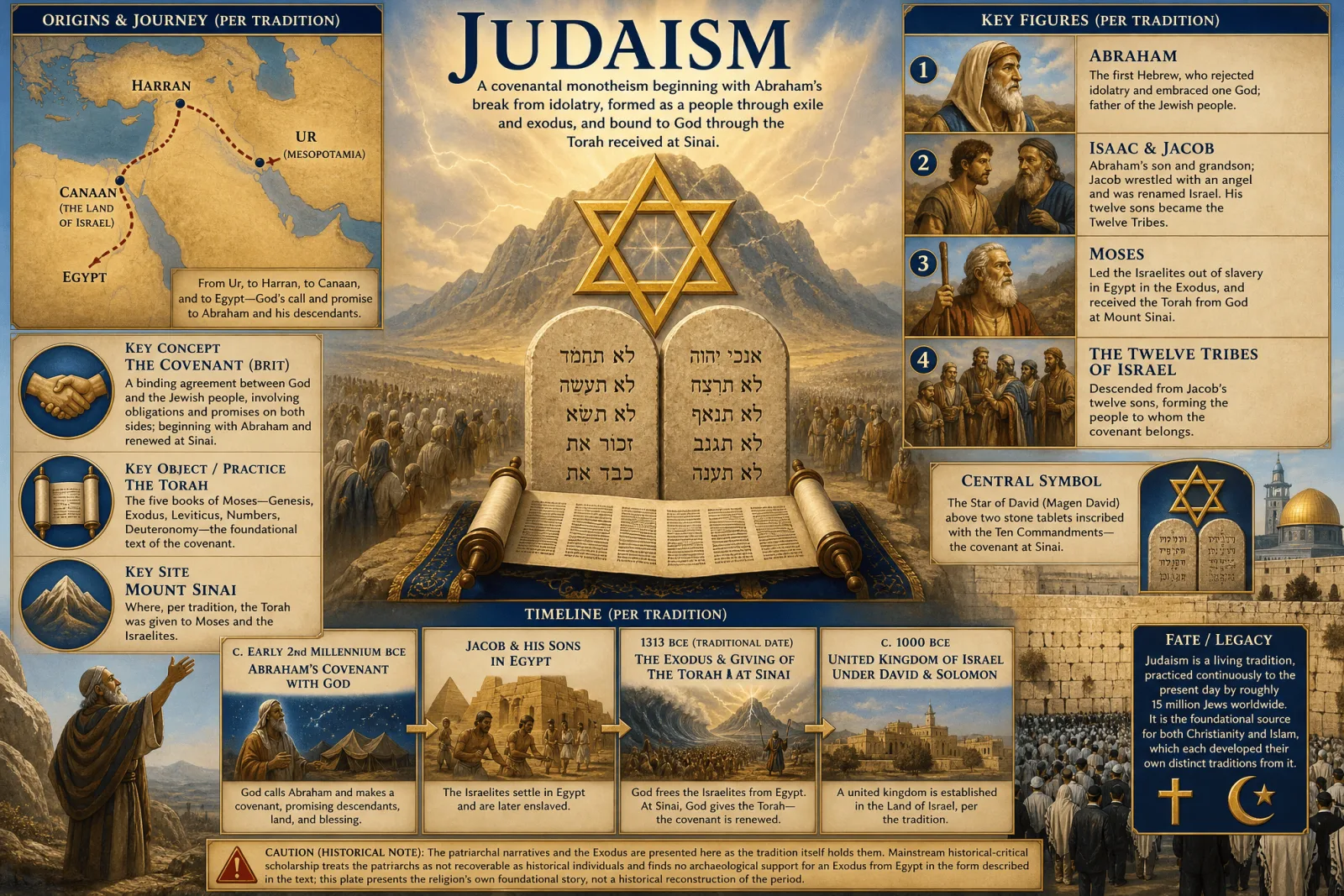
Judaism is the monotheistic religion of the Jewish people, characterized by belief in one transcendent God (YHWH, often pronounced Adonai, 'the Lord') who revealed himself to the patriarchs Abraham, Isaac, and Jacob, and to Moses on Mount Sinai. Judaism is both a religion and an ethnoreligious identity: Jews are bound not only by shared belief and practice but also by descent, covenant, and collective historical memory. The Torah (the first five books of the Hebrew Bible) is understood as the foundational revelation, supplemented by the Oral Torah, which was transmitted through generations and eventually compiled in the Mishnah (circa 200 CE) and elaborated in the Talmud (completed circa 500 CE in the Babylonian version, circa 400 CE in the Jerusalem version). Judaism emphasizes the observance of mitzvot (commandments)—traditionally numbered at 613—that govern all aspects of life: worship, ethics, family law, dietary restrictions (kashrut), Sabbath observance, and ritual purity. The covenant between God and Israel is understood as both privilege and responsibility: the Jewish people are called to be 'a kingdom of priests and a holy nation' (Exodus 19:6), to serve as a witness to the nations, and to pursue justice, mercy, and faithfulness. With approximately 14 million adherents worldwide as of 2010, Judaism is a small but historically influential religion that has profoundly shaped Western civilization and given rise to Christianity and Islam.
The historical origins of Judaism are debated among scholars. Traditional Jewish belief holds that the patriarchs Abraham (circa 2000–1800 BCE), Isaac, and Jacob (Israel) were the ancestors of the Israelites, that Moses led the Israelites out of Egyptian slavery (the Exodus, traditionally dated to the 13th century BCE), and that at Mount Sinai, God revealed the Torah, establishing the covenant with Israel. However, modern historical-critical scholarship questions the historicity of the patriarchal narratives and the Exodus, noting the lack of extrabiblical evidence for a large-scale migration from Egypt and the conquest of Canaan as described in the Bible. Archaeological evidence suggests that ancient Israel emerged gradually within Canaan during the Late Bronze Age and early Iron Age (circa 1200–1000 BCE), and that Israelite religion evolved from polytheistic Canaanite traditions toward monotheism over centuries. The united monarchy under Kings Saul, David, and Solomon (traditionally dated circa 1020–930 BCE) is also contested, with some scholars doubting the extent or existence of a centralized kingdom during this period. The destruction of the First Temple in Jerusalem by the Babylonians in 586 BCE and the subsequent Babylonian Exile were pivotal events that spurred theological reflection and the canonization of sacred texts. The return from exile (beginning 538 BCE under Persian rule) and the rebuilding of the Temple (completed 515 BCE) marked the Second Temple period, during which diverse Jewish sects (Pharisees, Sadducees, Essenes, Zealots) emerged. The destruction of the Second Temple by Rome in 70 CE was catastrophic, ending the sacrificial cult and scattering Jews throughout the Roman Empire (the Diaspora).
Rabbinic Judaism, which crystallized in the centuries following the Temple's destruction, became the dominant form of Judaism. The rabbis (sages and legal scholars) reinterpreted Judaism for a post-Temple world, centering religious life on Torah study, prayer, and observance of mitzvot rather than sacrifice. The Mishnah, compiled by Rabbi Judah the Prince circa 200 CE, codified the Oral Torah, and the Gemara (rabbinic commentary on the Mishnah) produced the Babylonian and Jerusalem Talmuds. Medieval Judaism flourished intellectually and culturally in both the Islamic world (Sephardic Jews in Spain, North Africa, and the Middle East) and Christian Europe (Ashkenazi Jews in Germany, France, and Eastern Europe), though Jews also faced persecution, expulsions, forced conversions, and massacres (such as during the Crusades and the Spanish Inquisition). Jewish philosophy (exemplified by Saadia Gaon, Maimonides, and Judah Halevi) engaged with Greek, Islamic, and Christian thought, while Kabbalah (Jewish mysticism) developed esoteric interpretations of scripture and the divine. Karaite Judaism, a movement that rejected the Oral Torah and rabbinic authority in favor of scripture alone, emerged in the eighth century and persists in small communities today. The modern period, beginning with the Enlightenment and Jewish emancipation in Europe, produced profound transformations: Reform Judaism (emphasizing ethical monotheism and adaptation to modernity), Orthodox Judaism (maintaining traditional belief and practice), Conservative Judaism (seeking a middle path), and Reconstructionist Judaism (viewing Judaism as an evolving civilization). Zionism, the movement for Jewish national self-determination, led to the establishment of the State of Israel in 1948, reshaping Jewish identity and demography. The Holocaust (Shoah), in which six million Jews were murdered by Nazi Germany and its collaborators (1933–1945), remains a defining trauma. Contemporary Judaism grapples with questions of religious authority, pluralism, Israel-Diaspora relations, gender and sexuality, intermarriage, and Jewish continuity in a secular age.
Emerges fromCanaanite Religion ←
Historical Development
The biblical narrative traces Jewish origins to the patriarch Abraham (Avraham), whom God called to leave his homeland (Ur of the Chaldeans, in Mesopotamia) and travel to Canaan (the Land of Israel), promising to make him 'a great nation' (Genesis 12:1–3). God established a covenant with Abraham, sealed by circumcision, and renewed it with his son Isaac and grandson Jacob (renamed Israel after wrestling with a divine being). Jacob's twelve sons became the ancestors of the twelve tribes of Israel. According to the Book of Exodus, the Israelites migrated to Egypt during a famine, were enslaved for centuries, and were liberated by Moses, who led them through the desert to Mount Sinai. There, God revealed the Torah, including the Ten Commandments, and established the covenant with the entire people of Israel. After forty years of wandering, the Israelites, under Joshua, conquered Canaan and settled the land, dividing it among the tribes. This traditional narrative is foundational to Jewish identity, liturgy, and theology, though its historicity is debated. Modern archaeological and textual scholarship suggests that ancient Israel emerged within Canaan, and that early Israelite religion was henotheistic (worshiping YHWH as the patron deity while acknowledging other gods) rather than strictly monotheistic. The gradual centralization of worship in Jerusalem and the development of exclusive monotheism occurred over centuries, influenced by prophetic critique and the trauma of exile.
The United Monarchy, traditionally dated to circa 1020–930 BCE, is described in the Hebrew Bible as uniting the tribes under Kings Saul, David, and Solomon. David established Jerusalem as the political and religious capital and brought the Ark of the Covenant there; Solomon built the First Temple, which became the central sanctuary for Israelite worship. After Solomon's death, the kingdom split into the northern Kingdom of Israel and the southern Kingdom of Judah. The northern kingdom fell to the Assyrian Empire in 722 BCE, and its population was dispersed (the 'lost ten tribes'). The southern kingdom, Judah, survived until 586 BCE, when the Babylonian Empire conquered Jerusalem, destroyed the Temple, and exiled the Judean elite to Babylon. The Babylonian Exile (586–538 BCE) was a watershed: deprived of land, Temple, and kingship, the exiles reflected on their identity and relationship with God, producing much of the Hebrew Bible's prophetic and historical literature. The Persian conquest of Babylon (539 BCE) allowed Jews to return to Judah, and the Second Temple was completed in 515 BCE. The Second Temple period (515 BCE–70 CE) witnessed Persian, Hellenistic, and Roman rule. Alexander the Great's conquest (332 BCE) introduced Greek culture, sparking debates over Hellenization. The Maccabean Revolt (167–160 BCE) against Seleucid repression led to a brief period of Jewish independence under the Hasmonean dynasty (140–37 BCE). Roman rule (beginning 63 BCE) brought political instability, messianic fervor, and diverse sectarian movements.
The Pharisees, Sadducees, Essenes, and Zealots represented distinct approaches to Jewish law, purity, Temple worship, and resistance to Rome. The Pharisees emphasized oral tradition and the study of Torah, laying the groundwork for rabbinic Judaism. The Sadducees, associated with the priestly aristocracy, accepted only the written Torah and controlled the Temple cult. The Essenes, possibly associated with the Dead Sea Scrolls community at Qumran, practiced asceticism and apocalyptic piety. The Zealots advocated armed resistance against Rome. The First Jewish-Roman War (66–73 CE) culminated in the destruction of the Second Temple in 70 CE, an event that fundamentally altered Judaism. Without the Temple, sacrifice ceased, and the priesthood lost its central role. Rabbinic Judaism, led by the Pharisaic tradition, reconstituted Jewish life around Torah study, prayer (as a substitute for sacrifice), and the home as a micro-sanctuary. The Mishnah, compiled circa 200 CE by Rabbi Judah the Prince in Galilee, codified the Oral Torah, systematizing legal rulings on agriculture, festivals, family law, purity, Temple ritual (preserved in memory), and civil law. The Gemara, rabbinic discussions of the Mishnah, produced two Talmuds: the Jerusalem (Palestinian) Talmud (completed circa 400 CE) and the more authoritative Babylonian Talmud (completed circa 500 CE).
Medieval Judaism developed under both Islamic and Christian rule. Sephardic Jews in Muslim Spain (al-Andalus) and the Islamic world experienced a 'Golden Age' of cultural and intellectual flourishing (circa 900–1200 CE), producing philosophers (Saadia Gaon, Maimonides), poets (Judah Halevi, Solomon ibn Gabirol), and biblical commentators (Ibn Ezra). Maimonides' Mishneh Torah (a comprehensive code of Jewish law) and Guide of the Perplexed (a philosophical synthesis of Judaism and Aristotelian thought) remain profoundly influential. Ashkenazi Jews in Christian Europe faced harsher conditions: Church anti-Judaism portrayed Jews as Christ-killers and enemies of Christendom, leading to restrictions, forced conversions, expulsions (from England in 1290, France in 1394, Spain in 1492), and massacres (during the Crusades, the Black Death, and pogroms). Despite persecution, Ashkenazi communities produced the Tosafists (medieval Talmudic commentators), Rashi (Rabbi Solomon ben Isaac, whose commentary on the Bible and Talmud became standard), and Hasidei Ashkenaz (German Jewish pietists). Kabbalah (Jewish mysticism) emerged in Provence and Spain (12th–13th centuries), culminating in the Zohar, a mystical commentary on the Torah attributed to the 13th-century Kabbalist Moses de León. Kabbalistic ideas emphasized the sefirot (ten divine emanations), the cosmic significance of mitzvot, and the possibility of human action influencing the divine realm.
The early modern period brought both catastrophe and renewal. The expulsion from Spain (1492) scattered Sephardic Jews across the Mediterranean, the Ottoman Empire, and the New World. The Khmelnytsky pogroms (1648–1657) devastated Jewish communities in Ukraine and Poland, killing tens of thousands. Mystical messianism, exemplified by the false messiah Sabbatai Zevi (1626–1676), arose in response to trauma but ended in disillusionment. Hasidism, a mystical revival movement founded by Israel ben Eliezer (the Baal Shem Tov, circa 1700–1760) in Eastern Europe, emphasized joyful worship, prayer, and devotion to God through everyday life, led by charismatic leaders (tzaddikim or rebbes). Hasidism faced opposition from the Mitnagdim (opponents), led by the Vilna Gaon, who prioritized rigorous Talmud study. The Enlightenment and Jewish emancipation in Western Europe (18th–19th centuries) challenged traditional Jewish life. Moses Mendelssohn (1729–1786) advocated for Jewish integration into European society while maintaining religious practice. Reform Judaism, emerging in 19th-century Germany, adapted Jewish worship and practice to modernity, rejecting traditional halakhah (Jewish law) as binding, embracing vernacular prayer, and emphasizing ethical monotheism. Orthodox Judaism responded by reaffirming traditional belief and practice, while Conservative Judaism sought a middle path, preserving halakhah while allowing for historical development. In Eastern Europe, traditional Orthodoxy and Hasidism remained dominant until the 20th century. Zionism, founded by Theodor Herzl (1896), advocated for Jewish sovereignty in the Land of Israel. The Holocaust (1933–1945) murdered six million Jews, destroying European Jewish civilization. The establishment of the State of Israel (1948) provided a homeland and refuge but also sparked conflict with Palestinians and neighboring Arab states. Today, the largest Jewish populations are in Israel (approximately 6 million) and the United States (approximately 5.7 million).
Core Worldview and Doctrines
Judaism's central theological affirmation is monotheism: the belief in one, unique, invisible, transcendent, and immanent God. The Shema, recited twice daily, declares: 'Hear, O Israel: the LORD our God, the LORD is one' (Deuteronomy 6:4). God is understood as creator of the universe, revealer of the Torah, and judge of humanity. God is omnipotent, omniscient, eternal, and morally perfect, yet also personal and in relationship with Israel. Jewish theology speaks of God's attributes: mercy (rachamim), justice (din), love (chesed), and holiness (kedushah). God is ineffable and beyond human comprehension, yet known through revelation, creation, and history. The proper name of God, the Tetragrammaton YHWH, is considered too sacred to pronounce; Jews substitute Adonai ('my Lord') or HaShem ('the Name'). Anthropomorphic language in scripture (God's hand, face, voice) is generally understood metaphorically, though interpretations vary. Maimonides articulated negative theology: we cannot know what God is, only what God is not (not material, not composite, not temporal).
The covenant (brit) between God and Israel is the defining relationship in Judaism. God chose Israel—not because of Israel's size or merit, but out of love and faithfulness to the patriarchs—and gave the Torah at Sinai, establishing mutual obligations. Israel is to observe God's commandments, and in return, God promises blessing, protection, and ultimately redemption. The covenant is both collective and individual: it binds the Jewish people as a nation and each Jew personally. The mitzvot (commandments) structure Jewish life. Traditional Judaism counts 613 mitzvot in the Torah: 248 positive commands (corresponding to the limbs of the body) and 365 prohibitions (corresponding to the days of the year). Mitzvot encompass ritual (circumcision, Sabbath, festivals, dietary laws), ethical (honesty, charity, justice), and civil (property, damages, family law) obligations. Observance of mitzvot is understood as both obedience to divine will and a means of sanctifying life, drawing near to God, and repairing the world (tikkun olam). Different Jewish movements interpret mitzvot variously: Orthodox Judaism holds that the mitzvot are binding divine commands; Reform Judaism views them as human responses to the divine, to be selectively observed based on personal meaning and ethical value; Conservative and Reconstructionist Judaism fall between these poles.
Jewish anthropology views humans as created in the image of God (tzelem Elohim, Genesis 1:27), endowed with dignity, free will, and moral responsibility. Judaism rejects the doctrine of original sin: humans are born morally neutral, with both a good inclination (yetzer hatov) and an evil inclination (yetzer hara). Sin is disobedience to God's commandments, but repentance (teshuvah) is always possible. God is merciful and desires repentance rather than punishment. Yom Kippur, the Day of Atonement, is dedicated to repentance, fasting, and prayer for forgiveness. Judaism emphasizes the importance of action (mitzvot, good deeds) over belief; righteousness is measured by ethical conduct and fulfillment of commandments rather than adherence to dogma. The concept of the 'righteous Gentile' (Noahide) acknowledges that non-Jews can attain righteousness by observing the seven Noahide Laws (prohibitions against idolatry, blasphemy, murder, theft, sexual immorality, eating flesh from a living animal, and the requirement to establish courts of justice).
Jewish eschatology is diverse and has evolved over time. Traditional beliefs include the coming of the Messiah (Mashiach), a divinely anointed king descended from David who will gather the exiles, rebuild the Temple, usher in an era of peace and justice, and bring about universal recognition of God. The resurrection of the dead (techiyat ha-metim) and the world to come (Olam Ha-Ba) are affirmed in classical rabbinic Judaism, though interpretations vary. Some envision bodily resurrection and judgment; others view Olam Ha-Ba as a spiritual existence for righteous souls. Reform Judaism historically rejected personal Messiah and bodily resurrection, instead emphasizing a messianic age of universal peace brought about by human ethical progress, though contemporary Reform Jews hold diverse views. Orthodox Judaism maintains traditional messianic and eschatological beliefs. The afterlife (including concepts of Gehinnom, a place or state of purification, and Gan Eden, paradise) is less emphasized in Judaism than in Christianity or Islam; the focus is on this-worldly life and the sanctification of the present. The Holocaust prompted theological reckoning: some Jews questioned God's justice and presence in history, while others reaffirmed faith in the covenant or reinterpreted theology in light of suffering.
Sacred Texts and Canon
The Hebrew Bible, called Tanakh (an acronym for Torah, Nevi'im, Ketuvim—Law, Prophets, Writings), is Judaism's primary sacred scripture. The Torah, the first five books (Genesis, Exodus, Leviticus, Numbers, Deuteronomy), also called the Five Books of Moses or the Pentateuch, is the most authoritative text, believed to have been revealed by God to Moses at Sinai. It narrates the creation of the world, the early history of humanity, the patriarchs, the Exodus from Egypt, the revelation at Sinai, and the Israelites' journey to the Promised Land. The Torah includes narrative, legal codes (the 613 mitzvot), poetry, and theology. Nevi'im (Prophets) comprises the Former Prophets (Joshua, Judges, Samuel, Kings, which narrate the history of Israel from the conquest of Canaan to the Babylonian Exile) and the Latter Prophets (Isaiah, Jeremiah, Ezekiel, and the Twelve Minor Prophets, which contain oracles, visions, and calls to repentance and justice). Ketuvim (Writings) includes diverse genres: wisdom literature (Proverbs, Job, Ecclesiastes), poetry (Psalms, Song of Songs, Lamentations), historical narratives (Ruth, Esther, Chronicles, Ezra-Nehemiah), and apocalyptic visions (Daniel). The Tanakh was canonized gradually; the Torah was fixed by the fifth century BCE, the Prophets by the second century BCE, and the Writings by the end of the first century CE. Jewish and Christian canons differ: the Jewish Tanakh and the Christian Old Testament contain the same books, but in different orders and with some textual variations; additionally, Catholics and Orthodox Christians include the Deuterocanonical books (Apocrypha), which Jews do not regard as canonical.
The Oral Torah, according to rabbinic tradition, was revealed to Moses at Sinai alongside the Written Torah and transmitted orally through generations of sages until it was compiled in writing. The Mishnah, edited by Rabbi Judah the Prince circa 200 CE in Galilee, is the foundational text of the Oral Torah. It is organized into six orders (sedarim), each divided into tractates (masekhtot), covering agricultural laws, festivals, women and family law, civil and criminal law, sacrifices and Temple service, and ritual purity. The Mishnah's terse legal rulings are elaborated in the Gemara, rabbinic discussions and commentaries. The Babylonian Talmud (Talmud Bavli), completed circa 500 CE in the Jewish academies of Babylonia, is the more authoritative and widely studied of the two Talmuds. It comprises the Mishnah and the Babylonian Gemara, totaling thousands of pages of legal analysis, theological reflection, folklore, ethics, and stories. The Jerusalem Talmud (Talmud Yerushalmi), completed circa 400 CE in the Land of Israel, is shorter and less influential but still studied. Talmudic study is the central intellectual and spiritual discipline of rabbinic Judaism, especially in Orthodox and Conservative communities. The Talmud's dialectical method (analyzing legal arguments, resolving contradictions, deriving principles) trains the mind and deepens engagement with tradition.
Medieval commentators produced classical works that shape Jewish textual study. Rashi (Rabbi Solomon ben Isaac, 1040–1105) wrote concise, lucid commentaries on the Tanakh and Talmud, which remain indispensable. The Tosafists (Rashi's descendants and students) wrote additional Talmudic commentaries (Tosafot) that are printed alongside the Gemara in standard editions. Maimonides (Rabbi Moses ben Maimon, 1138–1204) wrote the Mishneh Torah, a comprehensive code of Jewish law organized thematically, and the Guide of the Perplexed, a philosophical work reconciling faith and reason. The Shulchan Arukh (Set Table, 1563), compiled by Rabbi Joseph Karo with glosses by Rabbi Moses Isserles, became the authoritative code of Jewish law for Orthodox communities, covering daily life, Sabbath and festivals, dietary laws, family purity, and civil matters. Responsa literature (she'elot u-teshuvot), rabbinic answers to legal questions, continues to adapt Jewish law to new circumstances.
Jewish mystical literature includes the Sefer Yetzirah (Book of Creation, ancient, pre-medieval), the Bahir (12th century), and the Zohar (Book of Splendor, 13th century), the central text of Kabbalah, a mystical commentary on the Torah exploring the nature of God, the sefirot (divine emanations), and the soul. Hasidic teachings, recorded in the works of the Baal Shem Tov's disciples and later rebbes, emphasize devotion, joy, and the presence of God in all things. Modern Jewish thought includes works by Moses Mendelssohn, Hermann Cohen, Martin Buber (I and Thou), Franz Rosenzweig (The Star of Redemption), Abraham Joshua Heschel (The Sabbath, Man Is Not Alone), and Emmanuel Levinas (Totality and Infinity). Jewish liturgy, compiled in the Siddur (daily and Sabbath prayer book) and Machzor (festival prayer book), includes biblical psalms, rabbinic blessings, medieval poetry (piyyutim), and communal prayers such as the Amidah (Standing Prayer) and Kaddish (sanctification of God's name, recited by mourners).
Practices and Observances
The Sabbath (Shabbat), observed from Friday evening to Saturday evening, is the cornerstone of Jewish practice. It commemorates both God's rest after creation (Genesis 2:2–3) and the Exodus from Egypt (Deuteronomy 5:15). Observance includes refraining from work (39 categories of forbidden activities in traditional halakhah, such as kindling fire, writing, traveling, and handling money), lighting candles, reciting blessings over wine (Kiddush) and bread (challah), festive meals, Torah study, prayer services, and Havdalah (the separation ceremony concluding Shabbat). Shabbat is described as a 'taste of the world to come,' a day of rest, spiritual renewal, and family togetherness. Prayer (tefillah) is central to Jewish worship. Traditional Jews pray three times daily: Shacharit (morning), Mincha (afternoon), and Ma'ariv (evening), corresponding to the Temple sacrifices. The Amidah (Standing Prayer), consisting of 18 (actually 19) blessings, is the core of each service. Communal prayer requires a minyan (quorum of ten adult men in Orthodox practice; ten adult Jews of any gender in egalitarian communities). The synagogue (beit knesset, 'house of assembly') is the center of communal worship, study, and gathering. The rabbi (teacher) is a scholar and spiritual leader, not a priest or intermediary. Jewish worship emphasizes community, participatory prayer, and connection to tradition.
Jewish festivals (chagim) mark the agricultural cycle, commemorate historical events, and express theological themes. Rosh Hashanah (Jewish New Year, Tishrei 1–2) begins the Ten Days of Repentance, a period of introspection and judgment. The shofar (ram's horn) is sounded as a call to repentance. Yom Kippur (Day of Atonement, Tishrei 10), the holiest day of the year, is observed with a 25-hour fast, intensive prayer, and confession of sins. Sukkot (Feast of Tabernacles, Tishrei 15–21) celebrates the fall harvest and commemorates the Israelites' dwelling in booths (sukkot) during the desert wandering. Jews build and eat in temporary huts, shake the lulav (palm branch) and etrog (citron), and rejoice. Simchat Torah (Rejoicing in the Torah, Tishrei 22 or 23) celebrates the completion and restart of the annual Torah reading cycle. Hanukkah (Festival of Lights, Kislev 25–Tevet 2) commemorates the Maccabean victory and the rededication of the Temple (164 BCE). A nine-branched menorah (hanukkiah) is lit for eight nights. Purim (Adar 14) celebrates the deliverance of Persian Jews from Haman's plot, as recounted in the Book of Esther. The Megillah (Esther scroll) is read, costumes are worn, and gifts of food are exchanged. Pesach (Passover, Nisan 15–22) commemorates the Exodus from Egypt. The Seder (ritual meal) retells the Exodus story, and matzah (unleavened bread) is eaten. Shavuot (Feast of Weeks, Sivan 6) celebrates the giving of the Torah at Sinai and the first fruits of the harvest. Tisha B'Av (9th of Av) is a day of mourning for the destruction of both Temples and other Jewish tragedies, observed with fasting and lamentations.
Kashrut (Jewish dietary laws) governs what Jews may eat and how food is prepared. Based on biblical commandments (Leviticus 11, Deuteronomy 14), kashrut prohibits certain animals (pigs, shellfish, most insects), requires that land animals have split hooves and chew the cud, and that fish have fins and scales. Mammals and birds must be slaughtered by a trained shochet according to ritual law (shechitah), which aims to minimize pain. Meat and dairy may not be mixed or eaten together, and separate utensils are maintained for each. Observance varies: Orthodox Jews maintain strict kashrut; Conservative Jews may observe kashrut with some flexibility; many Reform and secular Jews do not observe kashrut or follow it selectively for ethical or cultural reasons. Lifecycle rituals mark key transitions. Brit milah (circumcision) is performed on the eighth day of a boy's life, initiating him into the covenant. A naming ceremony (simchat bat or brit bat) welcomes baby girls. Bar mitzvah (for boys at age 13) and bat mitzvah (for girls at age 12 or 13) mark religious adulthood and responsibility for mitzvot. The young person often leads parts of the service and reads from the Torah. Jewish weddings include the signing of the ketubah (marriage contract), a ceremony under a chuppah (wedding canopy), the exchange of rings, blessings, and the breaking of a glass (recalling the destruction of the Temple). Jewish funerals are simple, emphasizing the equality of all before God. The body is buried (cremation is traditionally forbidden, though accepted by some liberal Jews), and mourners observe shiva (a seven-day period of mourning at home), shloshim (30 days of mourning), and recite Kaddish (a prayer sanctifying God's name) for eleven months (for parents). Yahrzeit (the anniversary of death) is observed annually with a memorial candle and Kaddish.
Torah study (Talmud Torah) is a central mitzvah and a lifelong obligation. Traditional Jews devote time daily to studying Torah, Talmud, and rabbinic texts, often in pairs (chavruta) or study groups (shiurim). The yearly cycle divides the Torah into weekly portions (parshiyot), read publicly in the synagogue on Shabbat mornings, Monday and Thursday mornings, and festivals. Jewish education emphasizes literacy in Hebrew, engagement with sacred texts, and transmission of tradition. Yeshivot (academies for intensive Talmud study) and day schools provide immersive Jewish education. Tzedakah (charity or, more accurately, 'righteousness') is a fundamental obligation. Jews are commanded to give at least 10% of income to the poor and communal institutions. Tzedakah is understood not as optional charity but as a requirement of justice. Tikkun olam ('repairing the world') has become a contemporary rallying cry for social justice, environmental stewardship, and activism, though its classical meaning in rabbinic literature referred to legal measures for the public good. Jewish ethics emphasize compassion (rachamim), justice (tzedek), loving-kindness (chesed), humility (anavah), and the pursuit of peace (shalom). The Talmudic maxim 'The world stands on three things: Torah, worship, and acts of loving-kindness' (Pirkei Avot 1:2) expresses Judaism's balance of study, ritual, and ethics.
Internal Diversity: Rabbinic, Karaite, and Modern Movements
Rabbinic Judaism, which developed after the destruction of the Second Temple in 70 CE, is the mainstream form of Judaism and the foundation of all major contemporary Jewish denominations. It is defined by acceptance of the Oral Torah (codified in the Mishnah and Talmud) alongside the Written Torah and by rabbinic authority to interpret Jewish law. Rabbinic Judaism emphasizes study, prayer, and observance of mitzvot, and holds that the Torah is divine revelation binding on all Jews. Within rabbinic Judaism, Ashkenazi Jews (from Central and Eastern Europe) and Sephardic Jews (from the Iberian Peninsula, North Africa, and the Middle East) developed distinct liturgical rites, legal customs (minhagim), pronunciations of Hebrew, and cultural practices, though they share the same fundamental theology and law. Mizrahi Jews (from the Middle East and North Africa, often grouped with Sephardim) also have distinct traditions. These ethnoreligious divisions persist in contemporary Judaism, especially in Israel, though intermarriage and cultural exchange have blurred boundaries.
Karaite Judaism, founded in the eighth century CE by Anan ben David and others, rejects the authority of the Oral Torah and rabbinic interpretation, relying solely on the Written Torah (the Tanakh) as the source of Jewish law. Karaites interpret scripture literally and independently, leading to differences in calendar calculation, Sabbath observance, dietary laws, and prayer. For example, Karaites do not light fire on the Sabbath (interpreted literally, so they sit in darkness), whereas rabbinic Jews kindle lights before Sabbath begins. Karaite Judaism was once widespread, with communities in the Byzantine Empire, the Middle East, and Egypt, but today only small communities remain, primarily in Israel (about 30,000–50,000) and a few diaspora locations. Karaites are recognized by the State of Israel as Jews but maintain a separate religious identity and do not intermarry with rabbinic Jews without conversion. Rabbinic Judaism has historically viewed Karaism as a heretical sect, though modern relations are more respectful.
Modern Judaism encompasses several movements that emerged in response to the Enlightenment, emancipation, and modernity. Orthodox Judaism maintains that the Torah (both Written and Oral) is the revealed word of God, binding and immutable, and that halakhah (Jewish law) governs all aspects of life. Orthodox Jews observe mitzvot strictly, including Sabbath, kashrut, prayer, and family purity laws. Modern Orthodox Jews engage with secular culture and higher education while maintaining halakhic observance, whereas Haredi (ultra-Orthodox) Jews seek to insulate themselves from secular influences, often living in tight-knit communities, dressing distinctively (black hats, long coats for men; modest dress for women), and prioritizing Torah study. Hasidic Jews, a subset of Haredi Judaism, follow the teachings of the Baal Shem Tov and are organized into dynastic groups led by rebbes (spiritual leaders). Hasidic communities emphasize joy, devotion, prayer, and the role of the tzaddik (righteous leader) as intermediary between God and the community. Examples include Chabad-Lubavitch, Satmar, Breslov, and Belz.
Reform Judaism, founded in 19th-century Germany, emphasizes ethical monotheism, prophetic justice, and personal autonomy in religious practice. Reform Jews view the Torah as divinely inspired but written by humans, and halakhah as non-binding, allowing individual conscience to guide observance. Reform Judaism introduced vernacular prayer, gender egalitarianism (women's ordination as rabbis began in 1972), and LGBTQ+ inclusion. It is the largest Jewish movement in the United States. Conservative Judaism, developed in the late 19th and early 20th centuries as a middle path between Orthodox and Reform, affirms the divine origin of the Torah and the authority of halakhah but allows for historical development and adaptation. Conservative Jews observe Sabbath and kashrut but permit driving to synagogue on Shabbat, egalitarianism in prayer, and women's ordination (since 1985). Reconstructionist Judaism, founded by Mordecai Kaplan in the 1920s–1930s, views Judaism as an evolving religious civilization rather than a divinely revealed system. Reconstructionists emphasize peoplehood, culture, and ethical values over supernatural theology. Humanistic Judaism, a smaller movement, celebrates Jewish culture and ethics while rejecting belief in God. These movements differ in theology, halakhic observance, and attitudes toward tradition, but all share a common Jewish heritage and seek to transmit Judaism to future generations.
Communities and Demographics
According to the Pew Research Center's 2012 Global Religious Landscape study, there were approximately 14 million Jews worldwide as of 2010, representing 0.2% of the global population. However, defining who is Jewish is complex and contested. Traditional halakhah defines a Jew as someone born to a Jewish mother or who has undergone halakhic conversion. Reform and Reconstructionist Judaism accept patrilineal descent (if the father is Jewish and the child is raised Jewish). The State of Israel's Law of Return grants citizenship to anyone with at least one Jewish grandparent, as well as spouses and children, a broader definition than halakhic. Demographic studies typically use a 'core Jewish population' definition (those who identify as Jewish by religion or ethnicity), yielding figures of approximately 13.8–14 million. A broader definition including individuals with partial Jewish ancestry or affinity (but who do not identify primarily as Jewish) would yield significantly higher numbers. The Jewish population has not recovered from the Holocaust, which murdered six million Jews (about one-third of the global Jewish population at the time). Natural increase is slow, due to low fertility rates (especially in the Diaspora), aging populations, intermarriage, and assimilation.
The two largest Jewish populations are in Israel and the United States. As of 2010, Israel had approximately 5.7 million Jews, and the United States had approximately 5.7 million (some estimates are lower, around 5.3 million). Together, they account for about 81% of world Jewry. Other significant Jewish communities are in France (approximately 480,000), Canada (375,000), the United Kingdom (290,000), Russia (205,000), Argentina (180,000), Germany (120,000), Australia (110,000), and Brazil (95,000). European Jewish communities, devastated by the Holocaust, have not been fully reconstituted, and many European Jews have emigrated to Israel or North America. The former Soviet Union still has substantial Jewish populations (Russia, Ukraine, Belarus), though many have emigrated since the collapse of the Soviet Union. Latin American Jewish communities, primarily in Argentina, Brazil, and Mexico, are descendants of late 19th and early 20th century immigrants. Jewish communities exist on every inhabited continent, though in small numbers in Africa (outside of South Africa and North Africa) and Asia (outside of Israel).
Israeli Jewish society is diverse: about 45% identify as secular (hiloni), 25% as traditional (masorti), 15% as religious (dati), and 10% as Haredi (ultra-Orthodox). Tensions exist between secular and religious, Ashkenazi and Mizrahi, and between Israeli Jews and Arabs (including Arab citizens of Israel and Palestinians in the occupied territories). The Israeli-Palestinian conflict shapes Israeli identity, politics, and security concerns. Diaspora Jewish communities, especially in the United States, are characterized by high levels of education, economic achievement, and integration into secular society. American Jews are predominantly Reform, Conservative, or unaffiliated ('Just Jewish'), with a smaller Orthodox minority. Intermarriage rates are high (about 50–70% among non-Orthodox Jews), raising concerns about Jewish continuity. However, many Jews maintain strong ethnic and cultural Jewish identity even without regular religious practice. Jewish institutions include synagogues, community centers (JCCs), day schools, universities (Yeshiva University, Brandeis, Hebrew University), museums (Yad Vashem, the U.S. Holocaust Memorial Museum), and advocacy organizations (American Jewish Committee, Anti-Defamation League, Jewish federations).
Contemporary Jewish identity is multifaceted, encompassing religion, ethnicity, culture, and peoplehood. Many secular Jews maintain Jewish identity through cultural practices, social networks, support for Israel, Holocaust remembrance, and commitment to Jewish values (education, justice, family). The Holocaust (Shoah) remains a defining collective memory, shaping Jewish consciousness, identity, and Zionism. Holocaust education, memorialization, and combating Holocaust denial are central concerns. Anti-Semitism persists globally, manifesting as neo-Nazism, Islamist anti-Semitism, anti-Zionism (which sometimes crosses into anti-Semitism), conspiracy theories, and hate crimes. The relationship between Judaism and Israel is complex: many diaspora Jews feel a strong connection to Israel as a Jewish homeland and source of Jewish cultural and spiritual renewal, while others critique Israeli government policies toward Palestinians. Debates over Israeli settlement policy, occupation, and the two-state solution divide Jewish communities. Internally, Jewish communities grapple with issues of gender equality, LGBTQ+ inclusion, religious pluralism, conversion standards, 'Who is a Jew?' questions, and tensions between Orthodoxy and liberal movements.
Sacred Places and Pilgrimage Sites
Temple Mount (Har HaBayit) and the Western Wall, Jerusalem: The Temple Mount in the Old City of Jerusalem is Judaism's holiest site, believed to be the location of the Foundation Stone (Even HaShetiyah), the place where God gathered dust to create Adam, where Abraham prepared to sacrifice Isaac, and where the First and Second Temples stood. The First Temple, built by King Solomon circa 950 BCE, was destroyed by the Babylonians in 586 BCE. The Second Temple, rebuilt in 515 BCE and expanded by Herod the Great, was destroyed by the Romans in 70 CE. After the destruction, Jews were barred from Jerusalem for centuries. The Western Wall (Kotel), a retaining wall of the Second Temple's platform, is the closest accessible site to the Temple Mount's former inner sanctum and has become the focal point of Jewish prayer and pilgrimage. Millions of Jews and others visit the Kotel annually, placing prayer notes in its crevices. The Temple Mount is now the site of the Dome of the Rock and Al-Aqsa Mosque, making it sacred to Muslims as Haram al-Sharif. This contested site is a flashpoint in the Israeli-Palestinian conflict. Jewish access to the Temple Mount is restricted, and many Orthodox authorities forbid Jews from entering the Mount due to concerns about ritual purity and the location of the Holy of Holies. The Old City of Jerusalem, including the Western Wall, was inscribed on the UNESCO World Heritage List in 1981 (site proposed by Jordan) and has been on the List of World Heritage in Danger since 1982.
Cave of the Patriarchs (Ma'arat HaMachpelah), Hebron: Located in the city of Hebron (Al-Khalil) in the West Bank, the Cave of Machpelah is traditionally believed to be the burial place of the patriarchs and matriarchs: Abraham and Sarah, Isaac and Rebecca, Jacob and Leah. According to Genesis 23, Abraham purchased the cave and field from Ephron the Hittite as a burial site for Sarah. The site is sacred to Judaism, Christianity, and Islam (which reveres Ibrahim/Abraham as a prophet). King Herod constructed a massive stone enclosure around the cave in the first century BCE, and Byzantine, Crusader, Mamluk, and Ottoman structures were added over centuries. The site is now divided between a synagogue and a mosque, with separate prayer times and restricted access due to Israeli-Palestinian tensions. Hebron itself is a divided city, with a small Jewish settler population in the old city surrounded by a much larger Palestinian population. The Hebron/Al-Khalil Old Town, including the Ibrahimi Mosque/Tomb of the Patriarchs, was inscribed on the UNESCO World Heritage List in 2017 as a Palestinian site, and immediately placed on the List of World Heritage in Danger.
Safed (Tzfat), Israel: Safed, one of Judaism's four holy cities (along with Jerusalem, Hebron, and Tiberias), is located in the mountains of the Upper Galilee. It became a center of Kabbalistic (Jewish mystical) study in the 16th century, after the expulsion from Spain brought Sephardic Jewish scholars to the Ottoman Empire. Rabbi Isaac Luria (the Ari, 1534–1572) and Rabbi Joseph Karo (author of the Shulchan Arukh) taught in Safed, and the mystical teachings developed there profoundly influenced Jewish spirituality. Safed is home to ancient synagogues, Kabbalistic study centers, and the graves of renowned sages. The city's narrow stone alleyways, artists' quarter, and views of the Galilee attract pilgrims, tourists, and spiritual seekers. Lag BaOmer, a minor holiday, is celebrated with bonfires and pilgrimages to the tomb of Rabbi Shimon bar Yochai (author of the Zohar, according to tradition) in nearby Meron.
Tiberias and the Sea of Galilee, Israel: Tiberias, on the western shore of the Sea of Galilee (Kinneret), is one of Judaism's four holy cities. It became a center of Jewish scholarship after the Bar Kokhba Revolt (132–135 CE), when Jews were expelled from Jerusalem. The Sanhedrin (Jewish high court) relocated to Tiberias, and the Jerusalem Talmud was compiled in the Galilee. Tiberias is the burial place of prominent rabbis, including Maimonides (Rabbi Moses ben Maimon) and Rabbi Akiva. The tombs are pilgrimage sites. The region's natural hot springs and ancient ruins also attract visitors. The Sea of Galilee, fed by the Jordan River, is central to the geography of the Land of Israel and appears throughout biblical narratives.
Mount Sinai (Har Sinai), Sinai Peninsula, Egypt: Mount Sinai, identified with Jebel Musa in the southern Sinai Peninsula, is traditionally believed to be the mountain where God revealed the Torah to Moses and the Israelites. Though its exact location is debated, Jebel Musa has been venerated since early Christian times. The site is also sacred to Christians and Muslims. Saint Catherine's Monastery, a Greek Orthodox monastery at the foot of the mountain, houses ancient manuscripts and icons. Jewish tradition commemorates the revelation at Sinai annually on the festival of Shavuot. Though not a frequent pilgrimage site for Jews today (due to its location in Egypt and the association of pilgrimage with the Land of Israel), Sinai holds profound theological significance as the site of the covenant and the giving of the Law.
Dura-Europos Synagogue (historical site, Syria): Dura-Europos, an ancient city on the Euphrates River in modern-day Syria, was home to a Jewish community in the third century CE. The synagogue, discovered in the 1930s, is renowned for its elaborate frescoes depicting biblical scenes (the binding of Isaac, the Exodus, Ezekiel's vision of the dry bones, the Temple, and more), which are among the earliest examples of Jewish figurative art. The frescoes demonstrate that early Jewish communities, despite later prohibitions on graven images, produced representational art for religious purposes. The synagogue's remains and frescoes are housed in the National Museum of Damascus and the Yale University Art Gallery. Dura-Europos was abandoned in the third century and is an archaeological site of immense historical importance, though not a pilgrimage destination.
ShUM Sites of Speyer, Worms, and Mainz, Germany: The cities of Speyer, Worms, and Mainz on the Rhine River were major centers of Ashkenazi Jewish life and learning in the Middle Ages. Known collectively as the ShUM communities (an acronym of their Hebrew names: Shpira, Vermayza, Magentza), they were the intellectual and spiritual heartland of Ashkenazi Jewry from the 10th to 14th centuries. The rabbis of ShUM, including Rashi and the Tosafists, produced foundational Talmudic commentaries and legal rulings. The Worms Synagogue, originally built in 1034, is one of the oldest synagogues in Europe (though destroyed by the Nazis in 1938 and rebuilt after World War II). The Jewish cemeteries in Worms ('Heiliger Sand,' Holy Sands) and Mainz contain graves dating back a thousand years, including those of renowned medieval sages. The ShUM Sites, including synagogues, ritual baths (mikva'ot), and cemeteries, were inscribed on the UNESCO World Heritage List in 2021 as the first Jewish World Heritage Site in Germany, recognizing their significance to Jewish heritage and European history.
Old-New Synagogue (Altneuschul), Prague, Czech Republic: The Old-New Synagogue in Prague's Jewish Quarter (Josefov) is one of the oldest active synagogues in Europe, built in the Gothic style circa 1270. It served the Prague Jewish community through centuries of persecution, pogroms, and ghettoization, and famously survived Nazi occupation (Hitler planned to preserve the Prague Jewish Quarter as a 'museum of an extinct race'). The synagogue is associated with the legend of the Golem of Prague, a creature created by Rabbi Judah Loew (the Maharal) in the 16th century to protect the Jewish community. The Jewish Quarter of Prague, including the Old-New Synagogue, the Jewish Cemetery, and several other historic synagogues and museums, is a major site of Jewish heritage. The Historic Centre of Prague was inscribed on the UNESCO World Heritage List in 1992.
Beta Israel Sites, Ethiopia: The Beta Israel (also called Ethiopian Jews or, pejoratively, Falasha) are an ancient Jewish community in Ethiopia, whose origins are debated. Some trace their ancestry to the tribe of Dan or to Jews who migrated to Ethiopia in antiquity; others suggest they are descendants of local converts. The Beta Israel practiced a form of Judaism based on the Torah and some apocryphal texts, but without the Talmud, having been isolated from mainstream rabbinic Judaism for centuries. They observed Sabbath, kashrut, festivals, and maintained synagogues (called masgid) and priests (called kohen or qes). In the late 20th century, Israel recognized the Beta Israel as Jews and airlifted most of the community to Israel in Operations Moses (1984) and Solomon (1991). Ethiopian Jewish religious sites in Ethiopia, including synagogues and villages, have historical significance but are not major pilgrimage destinations today, as most Beta Israel now live in Israel.
Contemporary Debates and Contested Issues
The historical reliability of the biblical narratives remains contested. Traditional Jewish belief holds that the Torah is divinely revealed and that the patriarchs, the Exodus, and the conquest of Canaan are historical events. However, archaeological and textual scholarship has challenged these accounts. There is no extrabiblical evidence for the Exodus, the forty years of wandering in the desert, or the large-scale conquest described in Joshua, leading many scholars to conclude that the Exodus and conquest are theological narratives rather than history. The united monarchy of David and Solomon is also debated: while most scholars accept that David and Solomon existed, the extent and grandeur of their kingdom as described in the Bible (a major imperial power) is questioned. Some scholars, minimalists, argue that David and Solomon were minor local chieftains, while maximalists defend the biblical account as broadly historical. These debates have theological implications: if the foundational narratives are not historical, what does this mean for Jewish identity and the covenant? Many Jews, including liberal and academic Jews, accept that the biblical narratives contain myth, legend, and theological interpretation alongside historical memory, and find religious meaning in the texts regardless of historical accuracy. Others, especially Orthodox Jews, affirm the historicity of the Torah and reject critical scholarship as undermining faith.
The question of religious authority—who has the right to interpret Jewish law and tradition—is contested among Jewish movements. Orthodox Judaism holds that halakhah (Jewish law) is binding, derived from the Torah (Written and Oral), and interpreted by qualified rabbinic authorities (poskim) trained in Talmudic and legal methods. Only Orthodox conversions and divorces are recognized as valid by Israeli Chief Rabbinate and most Orthodox authorities, causing conflicts over personal status (marriage, divorce, conversion) in Israel and the diaspora. Reform and Reconstructionist Judaism reject halakhic authority, emphasizing individual autonomy, ethical principles, and personal meaning. Conservative Judaism maintains halakhah as authoritative but allows for evolution and reinterpretation through the Committee on Jewish Law and Standards. These differences generate conflicts: Are patrilineal Jews recognized as Jewish? Are non-Orthodox conversions valid? Can women serve as rabbis, cantors, and prayer leaders? Can LGBTQ+ Jews marry and have their unions blessed? Different movements answer these questions differently, leading to pluralism and fragmentation but also to diversity and vitality.
Gender and sexuality are flashpoints in contemporary Judaism. Orthodox Judaism maintains traditional gender roles: men and women have distinct religious obligations, women are exempt from time-bound positive commandments (such as thrice-daily prayer), and only men can serve as rabbis, cantors, and witnesses, or constitute a minyan. Orthodox synagogues maintain mechitzah (physical separation between men and women during prayer). Orthodox feminists seek to expand women's roles within halakhic boundaries, promoting women's Torah study, partnership minyanim (where women lead parts of the service), and female halakhic advisors (yo'atzot halakhah). Reform, Reconstructionist, and Conservative Judaism (since 1985) ordain women as rabbis and cantors and practice full gender egalitarianism. LGBTQ+ inclusion is even more contested: Orthodox Judaism condemns same-sex sexual acts as violations of Torah law (Leviticus 18:22, 20:13) but debates how to pastorally care for LGBTQ+ individuals. Some Orthodox rabbis advocate for compassion and inclusion while maintaining halakhic prohibitions; others allow celibate LGBTQ+ Jews full participation. Reform, Reconstructionist, and Conservative Judaism affirm LGBTQ+ Jews fully, blessing same-sex unions and ordaining openly LGBTQ+ rabbis.
Zionism and the State of Israel generate ongoing debate. Zionism, the movement for Jewish national self-determination in the Land of Israel, emerged in the late 19th century in response to anti-Semitism and pogroms. Theodor Herzl's vision of a Jewish state was realized with Israel's establishment in 1948. Most Jews worldwide support Israel's existence, though with varying degrees of criticism of specific policies. Religious Zionists view the state as the 'beginning of redemption' (atchalta de-geulah) and settlement of the Land as a mitzvah. Haredi (ultra-Orthodox) anti-Zionists, such as Satmar Hasidim and Neturei Karta, reject Zionism as a secular movement that usurps God's role in redemption and oppose the State of Israel on theological grounds. Most Haredi Jews pragmatically accept Israel's existence but do not celebrate it religiously. Left-wing and progressive Jews, including Jewish Voice for Peace and J Street, criticize Israeli occupation of Palestinian territories, settlement expansion, and treatment of Palestinians, advocating for a two-state solution or equal rights. Debates over BDS (Boycott, Divestment, Sanctions against Israel), the Israeli-Palestinian conflict, the status of Jerusalem, and the right of return for Palestinian refugees divide Jewish communities and intersect with broader debates over anti-Semitism and anti-Zionism.
Jewish continuity and identity in a secular age are existential concerns. High rates of intermarriage (about 50–70% among non-Orthodox American Jews), low fertility, assimilation, and disaffiliation threaten the demographic vitality of diaspora Jewish communities. How can Judaism remain relevant to younger generations who are less religiously observant, more socially progressive, and more diverse in background? How can Jewish communities welcome interfaith families, patrilineal Jews, and Jews by choice while maintaining Jewish distinctiveness? How can Judaism address contemporary issues (environmentalism, social justice, technology, science) in ways that resonate with modern sensibilities? These questions spur innovation: experiential and immersive Jewish education (Birthright Israel trips, Jewish summer camps, study abroad), revitalized liturgy and music, social justice activism rooted in Jewish values, and pluralistic communities that welcome diverse expressions of Jewish identity. At the same time, traditionalists worry that flexibility and inclusivity dilute Jewish identity and practice. The tension between continuity and change, tradition and adaptation, defines contemporary Judaism.
Key Terms
- Torah
- The first five books of the Hebrew Bible (Pentateuch), believed to have been revealed by God to Moses at Sinai; also refers broadly to Jewish teaching and law.
- Tanakh
- The Hebrew Bible, comprising Torah (Law), Nevi'im (Prophets), and Ketuvim (Writings).
- Talmud
- A vast compilation of rabbinic discussions, legal rulings, and commentary on the Mishnah, completed circa 500 CE (Babylonian Talmud) and circa 400 CE (Jerusalem Talmud).
- Mishnah
- The first written compilation of the Oral Torah, edited by Rabbi Judah the Prince circa 200 CE, organizing Jewish law into six orders.
- Halakhah
- Jewish law derived from the Torah, Talmud, and rabbinic interpretation, governing religious practice, ethics, and civil matters.
- Mitzvah (pl. Mitzvot)
- A commandment or obligation; traditionally 613 mitzvot are found in the Torah, encompassing ritual, ethical, and civil laws.
- Shabbat
- The Sabbath, observed from Friday evening to Saturday evening, a day of rest and sanctification commemorating creation and the Exodus.
- Kashrut
- Jewish dietary laws governing which foods may be eaten and how they must be prepared, based on biblical commandments.
- Brit Milah
- The covenant of circumcision, performed on the eighth day of a boy's life, initiating him into the covenant of Abraham.
- Bar/Bat Mitzvah
- The coming-of-age ceremony (at age 13 for boys, 12 or 13 for girls) marking religious adulthood and responsibility for mitzvot.
- Teshuvah
- Repentance; the process of acknowledging sin, seeking forgiveness, and returning to God, especially emphasized during the High Holy Days.
- Yom Kippur
- The Day of Atonement, the holiest day of the Jewish year, observed with fasting, prayer, and repentance.
- Messiah (Mashiach)
- The anointed one, a future king descended from David who will restore Jewish sovereignty, rebuild the Temple, and bring peace and divine recognition.
- Tikkun Olam
- Repairing the world; in contemporary usage, social justice and ethical action to improve society, originally a Kabbalistic and legal concept.
- Shema
- The central declaration of Jewish faith: 'Hear, O Israel: the LORD our God, the LORD is one' (Deuteronomy 6:4), recited twice daily.
- Synagogue
- A Jewish house of worship, study, and assembly (beit knesset in Hebrew).
- Rabbi
- A Jewish scholar and teacher, trained in Torah and Talmud, who serves as a spiritual leader and legal authority.
- Kabbalah
- Jewish mysticism, exploring the nature of God, the sefirot (divine emanations), and the soul, especially developed in medieval and early modern periods.
- Diaspora
- The dispersion of Jews outside the Land of Israel, especially after the destruction of the Second Temple in 70 CE.
- Zionism
- The movement for Jewish national self-determination and the establishment of a Jewish state in the Land of Israel, realized with Israel's founding in 1948.
Further Reading
- Stanford Encyclopedia of Philosophy: Maimonides
- Stanford Encyclopedia of Philosophy: Gersonides
- Encyclopaedia Britannica: Judaism
- Encyclopaedia Britannica: Orthodox Judaism
- Pew Research Center: Global Religious Landscape - Jews (2012)
- Pew Research Center: Projected Changes in the Global Jewish Population (2015)
- The Cambridge Companion to Jewish Theology
- Sergio DellaPergola: World Jewish Population (2013), American Jewish Year Book
- UNESCO: Old City of Jerusalem and its Walls
- UNESCO: Hebron/Al-Khalil Old Town
- UNESCO: ShUM Sites of Speyer, Worms and Mainz
Practices
- Shabbat
- Kosher diet
- Prayer (3x daily)
- Pilgrimage festivals
Core ideas
- Monotheism
- YHWH, one God of the covenant
- Sin
- Violation of the covenant (mitzvot)
- Afterlife
- Varied — Olam Ha-Ba; resurrection debated
Sacred texts
The first five books of the Hebrew Bible — Genesis, Exodus, Leviticus, Numbers, and Deuteronomy — traditionally attributed to Moses. It records creation, the covenant at Sinai, and the laws governing Israelite life. Torah scrolls are handwritten on parchment and read in full over the course of each synagogue year.
The complete Hebrew Bible, comprising Torah (Law), Nevi'im (Prophets), and Ketuvim (Writings). It spans from creation through exile and return, forming the scriptural foundation of Judaism. The Prophets call Israel to justice; the Writings include Psalms, Proverbs, Job, and Esther.
A vast compendium of rabbinic debate, law, and lore compiled between the third and sixth centuries CE in two versions: the Babylonian and Jerusalem Talmuds. It interprets the Torah and applies its principles to every aspect of life. Studying Talmud is the central intellectual and spiritual discipline of rabbinic Judaism.