Gnosticism
Secret knowledge (gnosis) and a flawed material world.
Overview
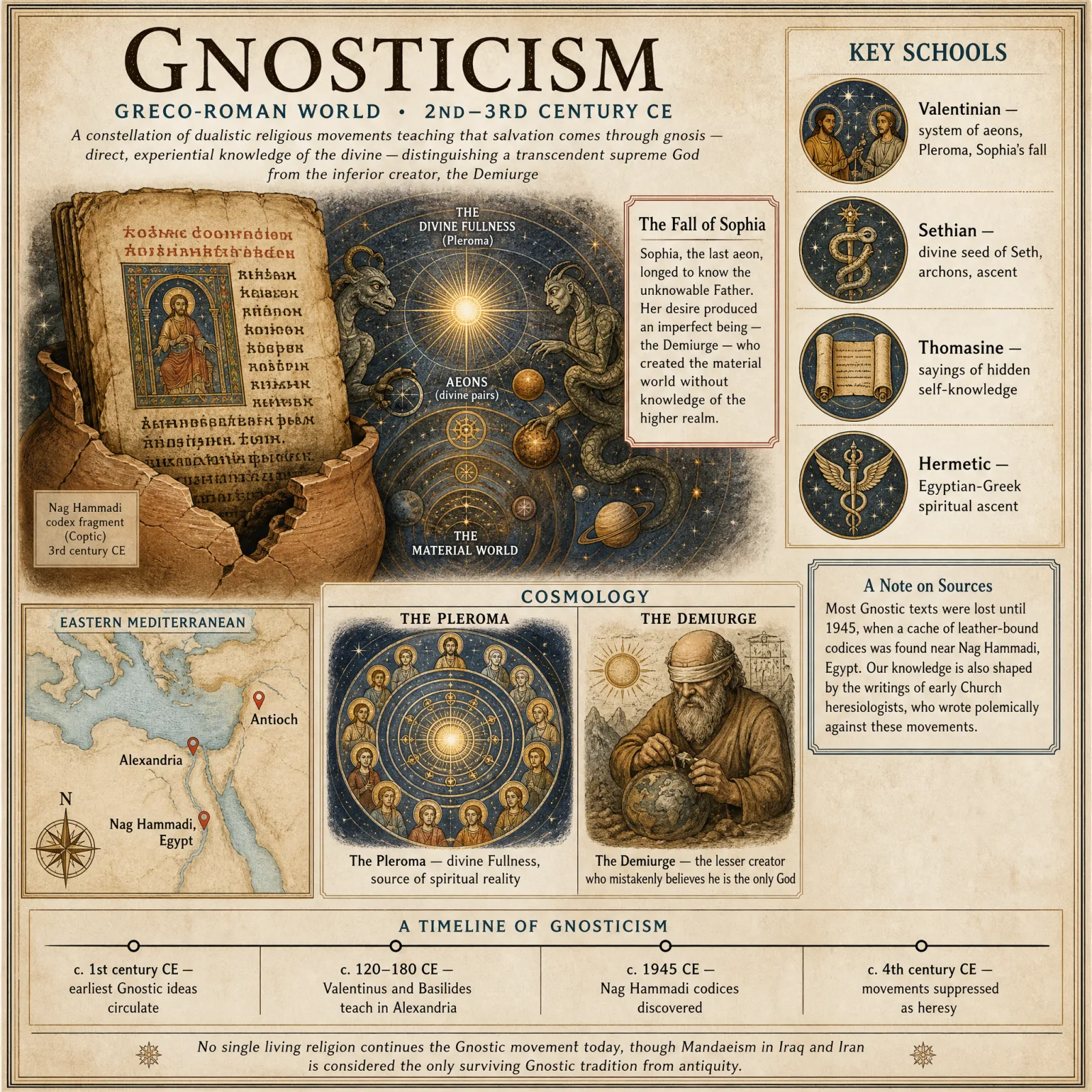
Gnosticism names a family of ancient religious movements, most of them Christian or Christian-adjacent, that flourished across the eastern Mediterranean and Near East from roughly the first through fourth centuries CE. The label is modern and contested: ancient teachers did not typically call themselves "Gnostics" as a single church, and scholars disagree over whether the word should cover a bounded tradition or a cluster of related cosmologies. What the groups share, in the texts that survive, is a claim that salvation comes through gnosis—direct knowledge of a remote, unknowable God—and that the visible cosmos is not the good creation of that God but the flawed work of a lesser craftsman, the demiurge. Human beings carry a fragment of divine light trapped in matter; a revealer, often identified with Jesus, awakens that spark so it can return to the pleroma, the realm of fullness.
The best-attested schools are Valentinian, Sethian, and the loosely related Thomas literature. Valentinus taught in second-century Rome and Alexandria, constructing an elaborate myth of divine emanations (aeons) whose disruption produced the material world. Sethian texts, including the Apocryphon of John, name the ignorant creator Yaldabaoth and treat Seth as the ancestor of a spiritual race. The Gospel of Thomas, a sayings collection rather than a narrative gospel, emphasizes self-knowledge without a full demiurgical myth. These movements must be distinguished from Manichaeism, a later dualist church founded by Mani in third-century Mesopotamia, which has its own canon, Elect/Hearer structure, and article on this site (id manichaean). Mandaeism, a still-living baptismal religion of Iraq and Iran, shares the vocabulary of gnosis but is a separate ethnoreligious tradition.
Until 1945, Gnosticism was known almost entirely through hostile heresiologists—Irenaeus of Lyons, Hippolytus, Tertullian, Epiphanius—who quoted opponents in order to refute them. The discovery of the Nag Hammadi codices near the Nile in Upper Egypt, a cache of Coptic translations of Greek originals, transformed the field by giving scholars Gnostic voices in their own words: the Gospel of Thomas, the Gospel of Truth, the Apocryphon of John, and dozens of other tractates. Even so, the source problem remains: the library is a fourth-century monastic or near-monastic collection, not a complete archive of second-century schools, and heresiological framing still shapes which texts count as "Gnostic." Organized Gnostic communities largely vanished as imperial Christianity consolidated, though the texts continue to generate scholarly debate and modern spiritual rereadings.
Historical Development
Gnostic movements took shape in the religious marketplace of the first two centuries CE, when Jewish, Christian, Platonic, and Egyptian traditions overlapped in cities such as Alexandria, Antioch, and Rome. Teachers offered rival accounts of creation, the identity of the God of Israel, and the meaning of Jesus. Basilides taught in Alexandria in the reign of Hadrian; Valentinus, said by later writers to have nearly become bishop of Rome, developed a system that attracted educated urban Christians. Marcion of Sinope, often grouped with Gnostics though his theology is distinct, rejected the Old Testament creator as a lesser just god and built a church around a stripped Pauline canon. These were not a single sect but competing schools, some inside Christian congregations, some forming their own circles.
The heresiological tradition begins in earnest with Irenaeus of Lyons, whose Against Heresies (c. 180 CE) attacked Valentinians and others as corrupters of apostolic teaching. Irenaeus argued for a public rule of faith, a fourfold gospel, and episcopal succession against secret gnosis. Hippolytus, Tertullian, and later Epiphanius of Salamis expanded the catalog, often recycling earlier lists and attributing elaborate genealogies of error to Simon Magus. Modern scholars treat these works as indispensable and biased: they preserve names, myths, and quotations otherwise lost, but they flatten diversity, invent lineages, and write from the standpoint of an emerging orthodoxy that had not yet fully won.
Sethian literature, reconstructed from Nag Hammadi tractates rather than from a named ancient church, presents a myth in which the invisible Spirit emanates Barbelo and a series of aeons; the arrogant demiurge Yaldabaoth (also called Saklas or Samael) fashions the material world and traps divine light in Adam. The spiritual race of Seth is the remnant capable of awakening. Whether "Sethian" names a historical community or a modern scholarly grouping remains debated; David Brakke and others have argued that some ancient people did call themselves Gnostics in a narrower Sethian sense, while Karen King has urged dropping "Gnosticism" as a reified category that heresiologists invented.
The Nag Hammadi discovery of 1945, near the town of Nag Hammadi (ancient Chenoboskion) in Upper Egypt, yielded thirteen papyrus codices containing more than fifty tractates, buried in a jar at the foot of the Jabal al-Tarif cliffs. Most texts are Coptic translations of Greek compositions from the second and third centuries. James M. Robinson and the Coptic Gnostic Library project published critical editions; the Claremont Colleges Digital Library now hosts the Nag Hammadi Archive of photographs and documentation. Greek fragments of the Gospel of Thomas from Oxyrhynchus (P.Oxy. 1, 654, 655) show that Thomas circulated in Greek by around 200 CE, well before the Coptic copy.
Imperial Christianity's consolidation in the fourth century, combined with monastic book culture and the condemnation of "heretical" writings, ended most public Gnostic schools. Some texts may have been hidden by monks who still read them; others simply stopped being copied. Plotinus attacked Gnostic cosmologies in Enneads II.9 ("Against the Gnostics"), showing that Platonists as well as bishops rejected the idea that the cosmos was the product of a fallen or ignorant craftsman. Manichaeism, which borrowed Gnostic dualist language but organized a transcontinental church with its own scriptures, is a separate history. By late antiquity, Gnosticism survived as a heresiological memory, a handful of manuscripts, and, in a different form, in living Mandaean communities that should not be collapsed into the Nag Hammadi schools.
Core Worldview and Doctrines
Gnostic cosmologies typically distinguish an utterly transcendent first principle—the Monad, Father, or Invisible Spirit—from the craftsman of the visible world. The demiurge is often identified with the God of Genesis, recast as ignorant, arrogant, or jealous rather than as the supreme deity. In the Apocryphon of John he declares "I am God and there is no other," a parody of biblical monotheism that exposes his blindness to the higher realm. Matter is not simply neutral stuff; it is a mixture or a prison in which sparks of pleromatic light are bound. Salvation is not primarily forensic forgiveness or civic piety but awakening: knowing one's origin and destiny.
Emanation, not creation from nothing, structures many systems. From the first principle proceed aeons in male-female pairs (syzygies). A disruption—often associated with Sophia (Wisdom) acting without her consort—produces a deficient being or a fallen thought that becomes the demiurge and his archons, rulers of the planetary spheres. The human being is composite: a material body, a psychic (soul) component formed by the demiurge, and a spiritual spark from the pleroma. Only the spiritual element can be saved; debates over whether psychics (ordinary church Christians) could also be saved divided Valentinians from more exclusive readings.
Christology in Gnostic texts varies widely. Some treat Jesus as a revealer who descends to awaken the spark, appearing in a body that only seemed physical (docetism). Valentinian systems often distinguish the earthly Jesus from a higher Christ who unites with him. The Gospel of Thomas presents Jesus as a teacher of hidden sayings: "Whoever finds the interpretation of these sayings will not taste death." Thomas lacks a passion narrative and a demiurge myth, which is why many scholars place it on the edge of, rather than at the center of, "Gnosticism." The Gospel of Truth, associated with Valentinian circles, speaks of Error and forgetfulness healed by knowledge of the Father.
Ethics followed from cosmology. Some groups practiced ascetic withdrawal from a tainted world; heresiologists accused others of libertinism on the grounds that the spiritual were not bound by the demiurge's law. Direct evidence for libertine practice is thin and comes mainly from opponents. What the texts themselves emphasize is knowledge, baptismal or bridal-chamber imagery, and the reading of scripture against the grain—Genesis as a story of archontic entrapment rather than of a good creation. This inversion of the creator-God is the sharpest break from both emerging orthodox Christianity and from Manichaean dualism, which posits two co-eternal principles rather than a hierarchy of emanations gone wrong.
Sacred Texts and Canons
There was no single Gnostic Bible. Schools circulated gospels, apocalypses, letters, and revelations, often in the name of apostles or of Seth. The Nag Hammadi library is the largest surviving collection: Codex II alone includes the Apocryphon of John, the Gospel of Thomas, the Gospel of Philip, the Hypostasis of the Archons, and On the Origin of the World. The Apocryphon of John exists in four Coptic versions (three at Nag Hammadi, one in the Berlin Codex) and offers the fullest Sethian origin myth. Bentley Layton and David Brakke's The Gnostic Scriptures organizes translations by school rather than by codex, helping readers see Valentinian, Sethian, and Thomas clusters as distinct corpora.
The Gospel of Thomas is a collection of 114 sayings attributed to Jesus, preserved complete in Coptic in Nag Hammadi Codex II and in Greek fragments from Oxyrhynchus. It has no infancy, ministry itinerary, or crucifixion story. Some sayings parallel the Synoptic Gospels; others are unique ("Be passersby"; the living Jesus speaking of a light within). Dating is contested, with proposals ranging from the mid-first to the mid-second century. It is not a Sethian demiurgical text, and treating it as the essence of Gnosticism distorts both Thomas and the Sethian corpus.
Valentinian literature includes the Gospel of Truth, the Treatise on the Resurrection, the Tripartite Tractate, and excerpts quoted by heresiologists (Ptolemy's Letter to Flora, Theodotus as excerpted by Clement of Alexandria). These works interpret the New Testament rather than simply replacing it, which is why Valentinians could remain inside Christian congregations longer than more separatist groups. The Gospel of Judas, from a Codex Tchacos not found at Nag Hammadi, presents Judas as the disciple who understands Jesus' origin; its publication in 2006 intensified debate over how far Gnostic texts rewrite apostolic memory.
Heresiological books remain sources, not merely obstacles. Irenaeus preserves Valentinian myth in Book I of Against Heresies. Hippolytus's Refutation of All Heresies quotes otherwise lost systems. These must be read against the Nag Hammadi tractates: where they overlap, the Coptic texts often show more nuance than the refutations allow; where they do not overlap, silence is not proof of invention. No Gnostic canon was closed by a council; authority rested in teachers, initiatory instruction, and the claim to hidden apostolic tradition.
Practices and Observances
Reconstructing Gnostic practice is harder than reconstructing myth, because the surviving texts are theological and the heresiologists are hostile. Initiation and instruction in secret teaching are widely attested as public-level facts: Valentinians distinguished grades of believer, and Sethian texts speak of baptismal seals and multiple immersions in the names of heavenly beings. The precise words and gestures of those rites are not fully recoverable and should not be filled in from later occult manuals. What can be said is that gnosis was not only private insight; it was transmitted in circles that read, interpreted, and likely performed baptisms and meals.
The Gospel of Philip, a Valentinian collection, mentions a "bridal chamber" among other sacraments (baptism, chrism, eucharist, redemption). Scholars debate whether this was a ritual of union, a metaphor for salvation, or both. Heresiologists accused some groups of sexual rites; the texts themselves more often use nuptial imagery for the soul's reunion with its angelic counterpart. Ascetic practices—fasting, sexual abstinence, withdrawal from civic cult—fit the view of the body as a temporary garment. Other groups may have lived as ordinary householders while keeping an inner teaching.
Study and contemplation were central. Sayings gospels reward rereading; mythological tractates map the soul's descent and ascent through archontic spheres. Names of archons, passwords, and seals in some texts resemble later ascent literature (including some Jewish merkavah and Coptic magical texts), but Gnostic groups were not a single mystery cult with a uniform grade system like Mithraism. Practice varied by school and city. By the fourth century, whatever communal rituals existed had little institutional protection once bishops and imperial law defined orthodoxy.
Internal Diversity: Schools and Traditions
Valentinian Christianity was the most theologically elaborate and the most entangled with the wider church. Valentinus (mid-second century) and students such as Ptolemy and Heracleon produced systems in which the pleroma's thirty aeons, Sophia's fall, and the demiurge's creation explained both cosmology and the different capacities of human beings (spiritual, psychic, material). Heracleon wrote the earliest known commentary on the Gospel of John. Valentinians could attend ordinary congregations while keeping additional instruction, which is why Irenaeus saw them as especially dangerous: they looked like Christians.
Sethian or "classic Gnostic" texts share a mythic grammar: Barbelo, the four luminaries, Yaldabaoth, the three races, and Seth as heavenly prototype. Tractates include the Apocryphon of John, the Hypostasis of the Archons, the Gospel of the Egyptians, Zostrianos, and Allogenes. Some of these engage Platonism so closely that Plotinus's circle knew related writings. Whether Sethians were a baptismal sect with a continuous membership or a literary tradition reused by different groups is an open question.
The Thomas tradition (Gospel of Thomas, Book of Thomas the Contender, perhaps the Acts of Thomas in a different register) emphasizes twinship, hidden sayings, and encratite (abstinent) ethics more than a full demiurge myth. Other named teachers—Basilides, Carpocrates, the Ophites or Naassenes of heresiological lists—are harder to match to surviving texts. Modern categories ("Gnostic," "Gnosticism") should not erase these differences or fold Manichaeans and Mandaeans into one ancient church. The point of the diversity section is the opposite: a constellation, not a denomination.
Communities Then and Afterlife of the Texts
Ancient Gnostic communities were urban, relatively small, and teacher-centered. They left few inscriptions and no empire-wide hierarchy. Alexandria and Rome were hubs; Syria and Egypt provided the linguistic settings in which Greek works were translated into Coptic. After the fourth century there were no large Gnostic churches comparable to the Catholic or Miaphysite establishments. Survival was textual: buried books, heresiological quotations, and, separately, living Mandaean and (until the Middle Ages) Manichaean communities that must be studied on their own terms.
Modern groups that call themselves Gnostic—nineteenth- and twentieth-century esoteric churches, some Theosophical readings, and contemporary "Gnostic" congregations—are revivals or new religious movements, not institutional continuations of Valentinus's school. They matter for the reception history of Nag Hammadi but should not be back-projected onto the second century. Academic study since 1945 has been international: Claremont, Yale, Laval, Berlin, and Oslo have been major centers for editing and interpreting the Coptic corpus. The public afterlife of Gnosticism is now as much a scholarly and literary phenomenon as a liturgical one.
Sacred Places and Findspots
Nag Hammadi (near ancient Chenoboskion) in Upper Egypt is the findspot of the thirteen Coptic codices unearthed in 1945 at the foot of the Jabal al-Tarif cliffs. The jar burial is usually explained as concealment during a period when "heretical" books were being discarded or destroyed, perhaps by monks associated with the Pachomian monasteries of the region. The site is a landscape of discovery rather than a pilgrimage shrine of the ancient schools; its importance is documentary. Photographs, conservation records, and scholarly inventories are held in the Nag Hammadi Archive at the Claremont Colleges Digital Library.
Alexandria was the intellectual capital of early Gnostic teaching. Basilides taught there; Valentinian and other Christian teachers competed in a city where Platonic philosophy, Jewish scriptural interpretation, and Egyptian temple culture were all available. The city's libraries and schools made it possible to rewrite Genesis in the language of emanation and to comment on John with a pleromatic grammar. Little architecture can be tied to Gnostic cult, because these groups used houses and existing Christian assemblies.
Rome is where Valentinus taught in the mid-second century and where, according to later reports, he nearly obtained episcopal office. The city was a magnet for Christian teachers from the East. Lyons (Lugdunum), where Irenaeus served as bishop after the persecutions of 177, is the counter-site: the place from which the most influential anti-Gnostic treatise was written for the churches of Gaul and beyond. Reading Gnosticism only from Nag Hammadi without Lyons misses the conflict that defined the category.
Oxyrhynchus in Middle Egypt yielded Greek fragments of the Gospel of Thomas (P.Oxy. 1, 654, 655), proving that Thomas circulated in Greek around 200 CE. The Coptic Museum in Cairo has housed Nag Hammadi manuscripts in modern times, making Cairo a center for conservation and access. These are scholarly and curatorial places, not ancient Gnostic temples. Unlike Teotihuacan or Arkona, Gnostic sacred geography is a map of classrooms, house-churches, monastic libraries, and modern museums—an archaeology of texts more than of pyramids.
Scholarly Debates and the Source Problem
The central debate is whether "Gnosticism" is a coherent ancient religion or a heresiological construct. Michael Williams (Rethinking "Gnosticism") and Karen King (What Is Gnosticism?) argued that the category bundles unlike groups, smuggles in Protestant and anti-Jewish tropes, and should be replaced by more precise names (Sethian, Valentinian, Thomas). David Brakke (The Gnostics) counters that some ancient people did use gnostikos of themselves and that a narrower Sethian Gnostic school can be historically recovered. The article on this site keeps the conventional label because that is the tradition id in the dataset, while insisting on internal diversity.
The heresiological source problem cannot be wished away. Irenaeus and Epiphanius wrote to destroy, not to archive. They selected the most shocking myths, attributed secret promiscuity, and drew family trees of error. Nag Hammadi confirmed some of their reports (a jealous demiurge, Sophia, multiple heavens) and contradicted the cartoon of a single libertine conspiracy. Responsible history uses both corpora and names the bias. It also refuses to treat every Nag Hammadi tractate as "Gnostic": the library includes Plato's Republic in Coptic, Hermetic works, and sentences of Sextus.
Relations to Judaism, Platonism, and emerging orthodoxy remain contested. Was the demiurge a radicalization of Jewish speculation about a second power in heaven, a Platonic craftsman gone wrong, or a Christian solution to the problem of evil and the Old Testament? Different texts answer differently. Chronology is equally unsettled: some see Gnostic myths as second-century Christian products, others as older Jewish or baptismal speculations later Christianized. Manichaeism must be kept distinct: it is a founded dualist world religion with a prophet, a canon, and a two-class church, not a Nag Hammadi school. Modern popular Gnosticism—often a self-help reading of Thomas—should not set the terms of ancient history.
Key Terms
- Gnosis
- Saving knowledge of one's divine origin and of the true God, contrasted with mere faith or law.
- Demiurge
- The lesser craftsman of the material cosmos, often identified with the biblical creator and portrayed as ignorant or arrogant.
- Pleroma
- The "fullness," the transcendent realm of the true God and the aeons, contrasted with the deficient material world.
- Aeon
- A divine emanation or eternal being within the pleroma, often appearing in male-female pairs (syzygies).
- Sophia
- Wisdom, an aeon whose independent act or error is often said to set in motion the fall that produces the demiurge and matter.
- Yaldabaoth
- Name of the Sethian demiurge, also called Saklas or Samael; a lion-serpent craftsman who claims to be the only God.
- Archon
- A ruler of the material or planetary spheres who obstructs the soul's ascent; associated with the demiurge's regime.
- Valentinians
- Followers of the second-century teacher Valentinus; a Christian Gnostic school with a complex aeonic myth and graded instruction.
- Sethians
- Modern name for a cluster of texts and possibly communities that honor Seth as heavenly ancestor and tell the Yaldabaoth myth.
- Nag Hammadi library
- Thirteen Coptic codices found in Upper Egypt in 1945, the most important direct source for ancient Gnostic and related writings.
- Heresiology
- Orthodox writing against "heresy"; for Gnosticism, the main source until Nag Hammadi, and still a biased but essential witness.
- Docetism
- The view that Christ only seemed to have a physical body; one option in Gnostic christology, not a universal Gnostic doctrine.
Further Reading
- Internet Encyclopedia of Philosophy: Gnosticism
- Encyclopaedia Britannica: Gnosticism
- Karen L. King, What Is Gnosticism? (Harvard University Press, 2003)
- David Brakke, The Gnostics: Myth, Ritual, and Diversity in Early Christianity (Harvard University Press, 2010)
- Bentley Layton and David Brakke, eds., The Gnostic Scriptures (2nd ed., Yale University Press, 2021)
- Claremont Colleges Digital Library: Nag Hammadi Archive
- Early Christian Writings: Gospel of Thomas (introduction and bibliography)
- Irenaeus of Lyons, Against Heresies (New Advent, Ante-Nicene Fathers)
- Stanford Encyclopedia of Philosophy: Neoplatonism (Plotinus against the Gnostics)
- World History Encyclopedia: Gnosticism
- Claremont Coptic Encyclopedia (Claremont Colleges Digital Library)
- Encyclopaedia Britannica: Nag Hammadi
Practices
- Study & contemplation
- Secret initiation
- Ascetic withdrawal
Core ideas
- Cosmos
- Material world as flawed creation of a lesser demiurge
- Salvation
- Gnosis — direct spiritual knowledge, not faith alone
Sacred texts
A cache of over 50 Coptic texts discovered near Nag Hammadi, Egypt in 1945, including the Gospel of Thomas and Gospel of Truth. Likely buried by monks around the fourth century to escape destruction after Gnosticism was condemned as heresy, its rediscovery transformed modern understanding of early Christian diversity.
A collection of 114 sayings attributed to Jesus, lacking narrative or a crucifixion account, emphasizing self-knowledge as the path to the divine kingdom. Found among the Nag Hammadi texts, it preserves a strand of early Jesus tradition outside the canonical gospels.