Canaanite Religion
El, Baal, Asherah — the gods of the Levant.
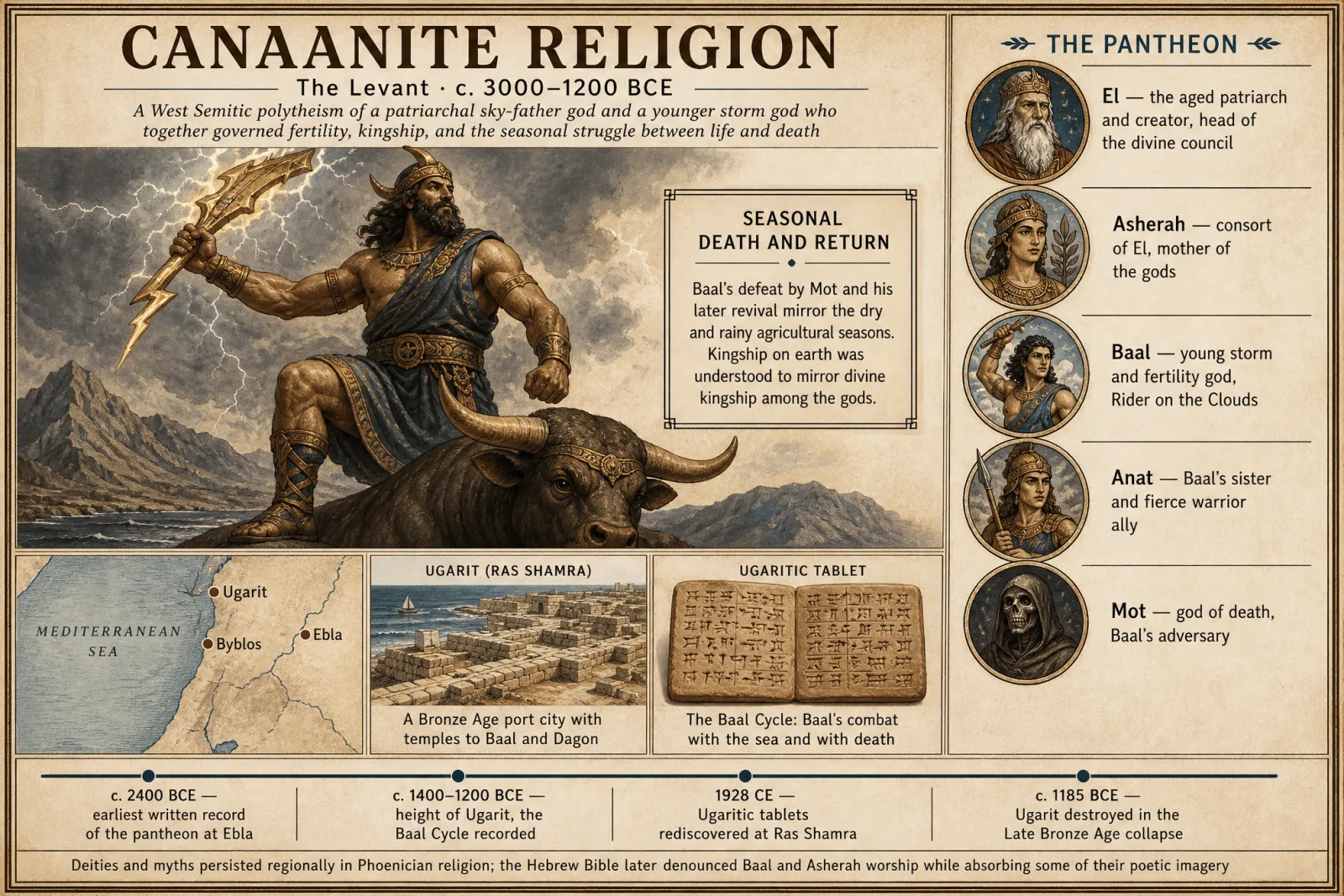
Overview
Canaanite Religion designates the polytheistic religious traditions of the Bronze and Iron Age Levant, practiced by the West Semitic-speaking peoples of the coastal and inland regions of modern-day Syria, Lebanon, Israel, Palestine, and Jordan from approximately the second millennium BCE through the early first millennium BCE. The term 'Canaanite' is both ancient (appearing in texts from Ugarit, Egypt, and Mesopotamia) and modern (adopted by scholars to designate a linguistic and cultural sphere), encompassing diverse city-states—Ugarit, Byblos, Tyre, Sidon, and others—that shared common pantheons, ritual practices, and mythological traditions while maintaining distinct local emphases.
Canaanite religion is known primarily through the extraordinary corpus of cuneiform alphabetic texts discovered at Ras Shamra (ancient Ugarit) in northern Syria beginning in 1929, supplemented by archaeological remains, iconography, inscriptions from Phoenician colonies, and references in Egyptian, Hittite, Mesopotamian, and biblical sources. The Ugaritic texts, dating to the Late Bronze Age (circa 1400–1200 BCE), preserve mythological epics (particularly the Baal Cycle), ritual texts, prayers, and administrative documents that provide unparalleled insight into Northwest Semitic religion before the emergence of biblical monotheism.
At the center of the Canaanite pantheon stood El, the aged, wise father of the gods and presiding deity of the divine council, and Baal (Haddu, Hadad), the young storm god associated with fertility, kingship, and agricultural abundance. The goddess Asherah (Athirat) was El's consort and mother of the gods, while Anat, Baal's sister and sometimes lover, was a fierce warrior goddess. Mot personified death and the dry season, and Yamm (Sea) represented chaotic waters. These deities were not abstract concepts but active participants in cosmic dramas narrated in myth and invoked in temple ritual, their actions mirroring and legitimating the political and agricultural concerns of Canaanite city-states.
The Bronze Age: Ugarit and the Levantine City-States
The Late Bronze Age (circa 1550–1200 BCE) represents the period of Canaanite religion's fullest textual documentation, particularly from Ugarit on the Syrian coast. Ugarit was a cosmopolitan port city, a nexus of trade connecting the Hittite Empire, Egypt, Mesopotamia, Cyprus, and the Aegean. Its scribal culture produced texts in multiple languages and scripts: Akkadian cuneiform (the diplomatic lingua franca), Hurrian, Hittite, Sumerian, and the unique alphabetic cuneiform developed for writing Ugaritic, a Northwest Semitic language closely related to Hebrew, Phoenician, and Aramaic.
The Ugaritic religious texts were discovered in archives associated with the royal palace and two major temple complexes: the Temple of Baal on the acropolis and the Temple of Dagan near the palace. These texts include the Baal Cycle (KTU 1.1–1.6), the epics of Aqhat and Kirta, hymns, prayers, ritual prescriptions (detailing sacrifices, offerings, and festival calendars), and god lists. The ritual texts, meticulously edited by Dennis Pardee, provide detailed instructions for temple cult: which deities receive which offerings, on what occasions, and in what order. These texts reveal a religion centered on maintaining the favor of the gods through sacrifice, prayer, and royal patronage.
Other Levantine city-states—Byblos (Gubla), Tyre (Sur), Sidon (Sidunu)—are known from archaeological excavations, Egyptian texts, and later Phoenician inscriptions, though none produced a corpus comparable to Ugarit's. Egyptian sources describe Canaanite deities worshipped by Asiatic populations in Egypt, and Canaanite gods appear in Hittite treaties and rituals. The Amarna letters (diplomatic correspondence between Canaanite kings and the Egyptian pharaoh) reference temples, divine oaths, and cultic practices, though they are primarily political rather than religious documents.
The Bronze Age collapse (circa 1200 BCE), marked by the destruction of Ugarit and other major centers, did not erase Canaanite religious traditions. Phoenician city-states—Tyre, Sidon, Byblos, Arwad—continued Canaanite cult and spread it across the Mediterranean through colonization (Carthage, Cyprus, Sardinia, Iberia). Phoenician inscriptions from the first millennium BCE attest to the worship of Baal, El (as 'Elyon, the Most High), Asherah (as 'Ashtart, Astarte), and other deities, often syncretized with Greek and Roman gods in diaspora contexts.
The relationship between Canaanite religion and early Israelite religion is a central scholarly debate. The Hebrew Bible polemicizes against 'Canaanite' practices—worship of Baal, Asherah, child sacrifice (the molk offering), cult at 'high places'—presenting them as foreign corruptions threatening Yahwistic purity. However, archaeological and textual evidence suggests that early Israelite religion emerged within, not in opposition to, the Canaanite cultural matrix. Sites like Hazor and Megiddo in the central highlands show continuity in material culture, temple architecture, and iconography between Late Bronze Canaanite and Iron Age Israelite contexts.
Mark S. Smith's influential work, *The Early History of God*, argues that Israelite Yahwism developed through two processes: convergence, in which the attributes of El, Baal, and Asherah were assimilated into Yahweh (early biblical texts depict Yahweh with storm-god imagery borrowed from Baal and identify El's epithets with Yahweh), and differentiation, in which previously acceptable practices were later rejected as 'Canaanite' and foreign. The Ugaritic texts thus serve as a crucial comparative corpus for understanding biblical religion, not as a wholly alien 'other' but as a shared cultural heritage from which Israelite religion emerged and against which it defined itself.
Canaanite religion as a living tradition persisted in Phoenician contexts into the Hellenistic and Roman periods, increasingly syncretized with Greek and Roman deities. The temple of Baal at Baalbek (ancient Heliopolis in Lebanon) was monumentalized under Roman rule as the Temple of Jupiter Heliopolitanus, preserving continuities with earlier Canaanite cult while adopting Greco-Roman architectural forms. Phoenician religion in Carthage continued until the city's destruction by Rome in 146 BCE, and Phoenician cultural influence persisted in North Africa through Punic and Neo-Punic inscriptions.
The rise of Christianity and Islam displaced the last remnants of Phoenician-Canaanite paganism, though mythological motifs, divine epithets, and cultic terminology survived in demonized or reinterpreted forms. Canaanite deities became demons in Jewish and Christian demonology (Baal-zebub, Ashtoreth), and polemical biblical memory of Canaanite religion—child sacrifice, sacred prostitution, idolatry—shaped Western perceptions for millennia, often distorting the actual religious practices documented in Ugaritic and Phoenician sources.
The rediscovery of Ugarit and the decipherment of its texts by Charles Virolleaud and others in the 1930s revolutionized understanding of ancient Levantine religion, providing a West Semitic mythological corpus comparable to Mesopotamian and Egyptian traditions and illuminating the cultural world from which biblical literature emerged. Ongoing archaeological work at Ugarit and other Levantine sites continues to refine scholarly understanding of Canaanite religion's diversity, development, and legacy.
El: The Father of the Gods and the Divine Council
El (Ilu in Ugaritic, cognate with Hebrew Elohim) was the senior deity of the Canaanite pantheon, described in the Ugaritic texts as 'Father of Gods' (abu ilm), 'Father of Humanity' (abu adm), 'Creator of Creatures' (bny bnwt), and 'Bull El' (tr il), a title emphasizing his virility and patriarchal authority. El presided over the divine council (pḥr ilm or mpḫrt bn ilm, 'assembly of the sons of El'), where the gods met to decide cosmic and earthly matters, a structure paralleling the earthly assemblies of Bronze Age city-states.
El's dwelling was described as located 'at the source of the two rivers, in the midst of the springs of the two deeps,' a mythic cosmic location symbolizing the origins of fertility and life. He was depicted as an aged, wise king, often portrayed enthroned, receiving petitions from other gods and rendering judgments. His epithet 'El the Kind, El the Compassionate' (ltpn il dpid) emphasizes his benevolent, stable character, contrasting with the more impetuous and violent storm god Baal.
The relationship between El and Baal in the Baal Cycle is complex. El grants Baal permission to build a palace (a symbol of kingship and legitimacy), but only after Baal has defeated Yamm and after the goddess Athirat (Asherah) intercedes on Baal's behalf. Scholars debate whether this reflects a theological transition in which Baal was displacing El as the active, reigning deity, or whether it represents complementary roles: El as the ultimate cosmic sovereign and Baal as the executive deity maintaining order through storm, rain, and agricultural fertility.
Baal (Baclu, 'Lord' or 'Master,' also called Haddu/Hadad, the storm god's proper name) was the most active and dynamic deity in the Ugaritic pantheon, associated with thunderstorms, rain, agricultural fertility, and royal power. The Baal Cycle, the longest and most complex Ugaritic mythological text, narrates Baal's conflicts with Yamm (Sea) and Mot (Death), his construction of a palace, and his temporary descent into the underworld and resurrection, paralleling the seasonal cycles of drought and rain in the Levant.
Baal's iconography depicts him as a warrior god wielding a club and thunderbolt, often standing on mountains or bulls. His titles include 'Rider of the Clouds' (rkb ʿrpt), 'Prince, Lord of Earth' (zbl bʿl arṣ), and 'Mightiest of Heroes' (aliyn bʿl). He is closely associated with Mount Ṣapānu (Mount Zaphon, modern Jebel Aqra on the Syrian-Turkish border), his sacred mountain and the site of his palace. This mountain became a divine archetype: biblical texts transfer Zaphon imagery to Mount Zion, and Greek sources identify Zaphon with Mount Kasios.
The Baal Cycle is not a cosmogony—it does not describe creation—but a political theology, depicting the process by which Baal achieves and maintains kingship. Recent scholarship, particularly Aaron Tugendhaft's work, interprets the cycle as reflecting Late Bronze Age politics: Baal's struggle for legitimacy mirrors the diplomatic maneuvering of earthly kings, and his eventual recognition by El as deserving a palace parallels the international practice of 'brotherhood' among peer kings. Baal's death and resurrection, at the hands of Mot, represent the Levantine agricultural cycle: the dry summer when Baal is absent and the autumn rains when Baal 'lives' again, ensuring fertility and abundance.
Anat (ʿAnatu), Baal's sister and often his companion, is depicted in the Ugaritic texts as a fierce warrior goddess, reveling in battle and slaughter. One text describes her wading through the blood of slain warriors, adorning herself with severed heads and hands. She fiercely defends Baal, threatening even El with violence if he does not grant Baal a palace, and mourns extravagantly when Baal dies. Anat's violence is both protective (defending Baal and cosmic order) and ambiguous, raising questions about the proper role of force in maintaining sovereignty.
Asherah (Athiratu in Ugaritic, 'Lady Asherah of the Sea,' rbt aṯrt ym) is El's consort and the mother of the seventy gods, the divine sons of El. In the Baal Cycle, Asherah successfully intercedes with El on Baal's behalf, using persuasion and gifts rather than violence. Her association with the sea and her title 'Creatress of the Gods' (qnyt ilm) emphasize her role as a cosmic mother and mediator. Archaeological evidence from Iron Age Israel and Judah—inscriptions reading 'Yahweh and his Asherah' and pillar figurines—suggests that Asherah was worshipped alongside Yahweh in popular Israelite religion, a practice later condemned by biblical texts as syncretism.
Other goddesses include Shapash (the sun), who serves as a messenger and guide; Pidray (daughter of mist), Tallay (daughter of dew), and Arsay (daughter of wide world), Baal's daughters or companions, associated with rain and moisture; and Ashtart (Astarte), a goddess of war and fertility who plays a minor role in the Ugaritic myths but becomes prominent in Phoenician contexts and is often syncretized with Mesopotamian Ishtar and Greek Aphrodite.
Mot (Motu, 'Death') is the deity of death, sterility, and the underworld, depicted as having an insatiable appetite and a cavernous maw that swallows the living. In the Baal Cycle, Mot challenges Baal's kingship, and Baal, unable to defeat Mot directly, descends into the underworld, dying or being imprisoned. Anat eventually defeats Mot by cutting, winnowing, burning, grinding, and scattering him like grain, a ritual destruction paralleling agricultural processing and allowing Baal's resurrection. However, Mot returns, and the cycle seems to repeat, suggesting an eternal oscillation between life and death, fertility and drought.
Yamm (Yam, 'Sea,' also called Nahar, 'River,' and sometimes given the epithet 'Judge River,' tpt nhr) represents the chaotic, primordial waters. In the Baal Cycle, Yamm demands kingship from El, and El acquiesces, but Baal challenges Yamm, defeats him with magical weapons crafted by the artisan god Kothar-wa-Khasis, and establishes his own claim to sovereignty. Yamm is not annihilated but subjugated, his chaotic potential restrained but not eliminated. Some scholars interpret Yamm as representing not chaos but the 'customary order' that Baal must overcome to establish a new political reality, with the myth functioning as propaganda for Baal's regime.
These conflicts—Baal vs. Yamm, Baal vs. Mot—are not simple good-vs.-evil narratives but complex explorations of sovereignty, legitimacy, and the balance of cosmic forces. Baal does not achieve permanent, unchallenged kingship; his rule is contested, seasonal, and dependent on ongoing struggle and divine support. This theological complexity reflects the precarious political realities of Late Bronze Age Levantine city-states, constantly negotiating between regional powers and facing environmental uncertainties.
The Ugaritic Textual Corpus
The Ugaritic texts, designated by the siglum KTU (Keilschrifttexte aus Ugarit, 'Cuneiform Alphabetic Texts from Ugarit,' edited by Dietrich, Loretz, and Sanmartín), are written in a cuneiform alphabetic script of thirty letters, invented specifically for writing the Ugaritic language. The corpus includes mythological narratives, ritual prescriptions, hymns, prayers, letters, administrative documents, and lexical lists. The texts were inscribed on clay tablets and stored in temple and palace archives, providing a snapshot of Ugarit's religious and scribal culture in the thirteenth century BCE, just before the city's destruction.
The Baal Cycle (KTU 1.1–1.6), the most extensive mythological composition, narrates Baal's rise to kingship through conflict with Yamm and Mot, his construction of a palace, and his temporary death and resurrection. The narrative is fragmentary, with missing sections, disputed readings, and ongoing scholarly debate about the sequence and interpretation of episodes. Mark S. Smith's critical edition and translation (published by Brill) remains the standard scholarly resource, providing philological commentary, literary analysis, and engagement with comparative ancient Near Eastern material.
The ritual texts (KTU 1.40–1.179), comprehensively edited by Dennis Pardee in his two-volume work *Les textes rituels* (Ras Shamra-Ougarit series), detail sacrificial offerings (burnt offerings, peace offerings, sin offerings), festival calendars, purification rites, and royal rituals. These texts list deities in order of sacrifice, specify the type and quantity of animals and goods offered, and occasionally include rubrics describing ritual actions. They reveal a religion intensely focused on maintaining divine favor through material offerings and royal mediation.
Other important texts include the Aqhat Epic (KTU 1.17–1.19), which narrates the life and death of a heroic youth and the consequences of violating divine order; the Kirta Epic (KTU 1.14–1.16), concerning a king's quest for an heir and his subsequent illness; and the Rephaim texts (KTU 1.20–1.22), which describe rituals invoking the Rephaim, the royal ancestors or chthonic deities. These texts blend mythic, legendary, and ritual elements, providing insight into royal ideology, ancestor cult, and the intersection of divine and human kingship.
Temple Cult and Sacrifice
Canaanite religion was centered on temple cult, with major temples located in urban centers like Ugarit, Byblos, Hazor, and Megiddo. The temples of Baal and Dagan at Ugarit, excavated and identified through inscriptions and votive offerings, served as the focal points of public worship. The king acted as the chief patron and officiant of temple ritual, responsible for ensuring the gods' favor through offerings, prayers, and the performance of prescribed rites. Priests and temple personnel administered daily cult, but the king's ritual role was essential, particularly during major festivals.
Sacrifice was the primary mode of interaction with the gods. The Ugaritic ritual texts prescribe offerings of sheep, cattle, birds, and grain, presented as burnt offerings (completely consumed by fire), peace offerings (shared between deity and worshippers), and libations of wine, oil, and water. The language of sacrifice emphasizes reciprocity: offerings 'satisfy' or 'soothe' the deity, and in return, the god grants fertility, victory, protection, and prosperity. The ritual vocabulary overlaps significantly with biblical Hebrew sacrificial terminology, indicating shared cultic practices.
Festivals marked the agricultural calendar and cosmic cycles. Texts refer to a New Year festival, possibly involving the ritual reenactment of Baal's kingship, and to seasonal rites ensuring rain and fertility. The festival calendar from Ugarit (KTU 1.112) lists monthly offerings to various deities, suggesting an elaborate cycle of worship throughout the year. Royal rituals, such as those invoking the Rephaim (royal ancestors), reinforced the king's connection to the divine and to past rulers, legitimating dynastic continuity.
Divinatory practices, attested in both texts and material culture, sought to discern divine will and predict future events. Liver omens, in which the markings and anomalies of sacrificed animals' livers were interpreted as divine messages, are documented in Ugaritic texts following Mesopotamian models. Letters reference prophets (nbʾ, cognate with Hebrew nabi) who delivered oracles from the gods, though no extensive prophetic texts survive from Ugarit comparable to biblical prophetic literature.
Magic and incantations were employed for protection, healing, and cursing. A few Ugaritic texts preserve incantations against snakebite, demons, and illness, invoking deities and reciting mythological precedents to compel supernatural forces. Amulets, seals, and scarabs bearing divine names and protective symbols were worn as apotropaic devices. The boundary between 'magic' and 'religion' was fluid; invoking the gods' names and recounting their deeds in myth were understood as effective means of manipulating spiritual realities.
Funerary practices included offerings to the dead (marzēaḥ feasts, possibly commemorative banquets), libations, and the invocation of Rephaim. The dead were not worshipped as gods but were understood to maintain some form of existence requiring sustenance from the living. Tomb offerings, funerary stelae, and references to the 'house of the dead' suggest belief in a shadowy underworld where the dead resided, though Canaanite eschatology is far less developed in surviving texts than Mesopotamian or Egyptian conceptions.
The scholarly debate over the relationship between Canaanite and Israelite religion is central to biblical studies and the history of ancient Near Eastern religions. The Hebrew Bible presents 'Canaanite religion' as a foil to Yahwistic faith: idolatrous, polytheistic, morally corrupt, and requiring complete eradication (Deuteronomy's ḥerem, 'ban,' commands total destruction of Canaanite cities and populations). However, this is polemical theology, not neutral historical description.
Archaeological evidence reveals no sharp cultural break between Late Bronze Age Canaanite settlements and early Iron Age Israelite villages in the central highlands. Material culture—pottery, architecture, burial customs—shows continuity, suggesting that 'Israel' emerged from within, not outside, the Canaanite cultural matrix. Early biblical texts preserve Canaanite mythological motifs: Yahweh is depicted with Baal-like storm imagery (Psalm 29, Habakkuk 3), El's titles and council are transferred to Yahweh (Psalm 82), and Asherah is referenced alongside Yahweh in inscriptions from Kuntillet Ajrud and Khirbet el-Qom.
Mark S. Smith's synthesis proposes that early Israelite religion was a subset of Canaanite religion, worshipping Yahweh as one deity among many (monolatry) within a shared cultural and theological framework. Over time, through the processes of convergence (assimilating other gods' attributes into Yahweh) and differentiation (rejecting previously acceptable practices as 'Canaanite'), Israelite religion developed its distinctive monotheistic identity. The biblical polemic against Canaanite religion thus reflects internal Israelite theological debates and identity formation, not a clash between wholly separate cultures. Ugaritic texts, as the fullest expression of Northwest Semitic religion before Israelite differentiation, provide indispensable comparative data for reconstructing this process.
Regional Variation and Phoenician Continuity
While Ugarit provides the richest textual evidence, Canaanite religion was not uniform. Different city-states emphasized different deities: Baal Shamem (Baal of the Heavens) was prominent in Phoenician Tyre and Sidon, Baal Hammon in Carthage, Melqart ('King of the City') in Tyre, and Eshmun in Sidon. Local manifestations of deities carried distinct epithets and cults, reflecting the political independence and cultural diversity of Levantine city-states.
Phoenician religion, the Iron Age continuation of Canaanite traditions, is documented through inscriptions (funerary, dedicatory, and royal), classical authors (Philo of Byblos, Lucian), and archaeological remains from Phoenician colonies. Phoenician deities were readily syncretized with Greek and Roman gods: Baal with Zeus/Jupiter, Astarte with Aphrodite/Venus, Melqart with Heracles/Hercules. This syncretism facilitated the spread and adaptation of Phoenician cult across the Mediterranean.
The biblical polemic's focus on 'Canaanite' abominations—child sacrifice (molk offerings), sacred prostitution (qedeshim/qedeshot), idol worship—has been scrutinized by modern scholars. Archaeological evidence for child sacrifice at Phoenician sites (tophet precincts) is debated: some scholars interpret the remains as evidence of infant sacrifice, others as natural infant mortality burial sites reinterpreted through biblical polemic. The existence of institutionalized 'sacred prostitution' in Canaanite temples, long accepted based on biblical and classical sources, has been challenged as lacking clear evidence in Ugaritic or Phoenician texts and as potentially reflecting Greco-Roman misunderstandings or projections.
Canaanite Religion as a Historical Tradition
Canaanite religion is a historical tradition, no longer practiced in its original form, with no continuous community of practitioners. The last Phoenician-speaking communities were absorbed into the Roman Empire, and by late antiquity, Phoenician language and cult had been displaced by Christianity and, later, Islam. Modern academic engagement with Canaanite religion is philological, archaeological, and comparative, centered on universities, museums, and research institutes.
Key scholarly resources include the Mission archéologique française de Ras Shamra-Ougarit, which continues excavations and publishes texts in the Ras Shamra-Ougarit series; the Society of Biblical Literature, which publishes critical editions and translations; and academic programs in Northwest Semitic languages and ancient Near Eastern studies at institutions such as Princeton, University of Chicago, New York University, and universities in Europe and Israel.
There is no neopagan reconstruction movement for Canaanite religion comparable to those for Egyptian, Norse, or Greco-Roman traditions, though elements of Canaanite mythology occasionally appear in esoteric or New Age contexts, typically detached from scholarly rigor. The biblical legacy of anti-Canaanite polemic has complicated popular reception; 'Canaanite' remains, in popular usage, a term associated with moral corruption and idolatry. Scholars work to disentangle historical Canaanite religion from biblical caricature, recognizing it as a sophisticated, socially embedded religious tradition comparable to other ancient Near Eastern systems.
Sacred Geography of the Levant
Ugarit (Ras Shamra): Located on the Syrian coast near modern Latakia, Ugarit was a major Bronze Age port and the source of the richest corpus of Canaanite religious texts. The city's temples to Baal and Dagan, palace archives, and scribal schools preserved mythological epics, ritual prescriptions, and administrative documents. Excavations beginning in 1929 uncovered the alphabetic cuneiform tablets that revolutionized understanding of Northwest Semitic religion. Ugarit was destroyed circa 1200 BCE and never reoccupied, leaving its archives intact for modern discovery.
Byblos (Gubla): One of the oldest continuously inhabited cities in the world, Byblos (modern Jbeil, Lebanon) was a major Phoenician religious center, famous for its temple to Baalat Gebal ('Lady of Byblos'), often identified with Asherah or Astarte. Byblos was renowned for its export of Lebanese cedar and its early adoption of the Phoenician alphabet. Egyptian sources document close ties between Byblos and Egypt, with Egyptian gods (Hathor, Re) worshipped alongside Canaanite deities in a syncretistic cult.
Tyre (Sur): The preeminent Phoenician city in the first millennium BCE, Tyre was the cult center of Melqart, the city's patron deity and divine king. The temple of Melqart was a major pilgrimage site, and Tyrian colonies across the Mediterranean spread his worship. Hiram I of Tyre, contemporary of Solomon, is mentioned in biblical texts as providing materials and craftsmen for the Jerusalem temple, suggesting shared architectural and cultic traditions. The biblical polemic against Jezebel, daughter of the king of Tyre, centers on her promotion of Baal worship in Israel.
Sidon (Sidunu): Another major Phoenician city, Sidon was the cult center of Eshmun, a healing god, and Astarte. The sanctuary of Eshmun at Bostan esh-Sheikh, excavated in the twentieth century, reveals Phoenician temple architecture and votive practices extending into the Hellenistic period. Sidonian kings bore theophoric names incorporating Eshmun and Baal, and Phoenician inscriptions from Sidon attest to the continuity of Canaanite religious traditions.
Hazor: The largest Bronze Age city in Canaan, Hazor (Tel Hazor, northern Israel) controlled strategic trade routes and maintained major temple complexes. Excavations uncovered temples with cultic installations, altars, and votive offerings, including a stela depicting hands raised in prayer to a moon crescent. Hazor's destruction and later reoccupation in the Iron Age provide evidence for continuity and change in Canaanite and early Israelite religious practices.
Megiddo: A major Bronze and Iron Age city controlling the Jezreel Valley, Megiddo (Tel Megiddo, Israel) preserved a sequence of temples spanning millennia. The Late Bronze Age temple complex yielded altars, offering stands, and evidence of animal sacrifice. Megiddo's strategic and religious importance is reflected in biblical and Egyptian texts, and its name became synonymous with apocalyptic conflict (Armageddon, from Har Megiddo, 'Mount of Megiddo').
Baalbek (Heliopolis): Located in the Beqaa Valley of Lebanon, Baalbek became a major religious center in the Roman period, but its name ('Baal of the Beqaa') and archaeological evidence suggest continuity with earlier Canaanite cult. The massive Roman temple complex, dedicated to Jupiter Heliopolitanus (identified with Baal), Bacchus, and Venus, represents the monumentalization and Romanization of local Levantine religious traditions. The site's identification with solar cult (Heliopolis, 'City of the Sun') may reflect syncretism between Canaanite Baal and solar deities.
Contemporary Scholarly Debates
The interpretation of the Baal Cycle as cosmogony or political theology is contested. Traditional scholarship, following Frank Moore Cross, read the cycle as a creation myth, parallel to Mesopotamian Enuma Elish. Recent work by Wayne Pitard, Aaron Tugendhaft, and others argues that the Baal Cycle is not a cosmogony—it does not describe the creation of the world—but a political narrative about the legitimation of kingship, reflecting Late Bronze Age diplomatic realities and the precarious nature of sovereignty. This shift reframes the myths as sophisticated reflections on power, legitimacy, and statecraft rather than timeless cosmological narratives.
The extent to which Israelite religion emerged from or against Canaanite religion remains debated. Minimalist scholars emphasize discontinuity, arguing that 'Israel' was a distinct ethnic and religious identity from its inception. Maximalist and convergence models, championed by Mark S. Smith, William Dever, and others, emphasize continuity, viewing early Israel as a subset of Canaanite culture that gradually differentiated itself. The debate has implications for biblical historicity, the dating of monotheism, and the interpretation of archaeological evidence.
The nature and extent of child sacrifice (molk) in Canaanite and Phoenician religion is intensely debated. Classical sources and biblical texts describe child sacrifice as central to Canaanite cult, particularly offerings to Baal Hammon and Tanit at Carthage. Archaeological excavations of tophet sites (burial grounds containing infant remains and inscriptions) have been interpreted as evidence for systematic child sacrifice. However, revisionist scholarship argues that the remains represent natural infant mortality, that biblical and classical sources exaggerate or fabricate, and that 'molk' may refer to a type of votive offering, not human sacrifice. The debate intersects with postcolonial critique of ancient sources and the ethics of interpreting ancient violence.
The identity and function of Asherah in Israelite religion and her relationship to Canaanite Athirat is contested. Inscriptions reading 'Yahweh and his Asherah' (Kuntillet Ajrud, Khirbet el-Qom) have been interpreted as evidence that Asherah was worshipped as Yahweh's consort in popular Israelite religion, paralleling El and Athirat in Ugaritic texts. Others argue that 'asherah' refers to a cult symbol (a wooden pole or tree) rather than the goddess herself, or that the inscriptions represent heterodox, syncretistic practices condemned by biblical orthodoxy. The debate reflects broader questions about the diversity of ancient Israelite religion and the relationship between official and popular cult.
Key Terms
- El
- Father of the gods, presiding deity of the divine council, associated with wisdom and cosmic sovereignty.
- Baal (Haddu)
- Storm god, associated with rain, fertility, and kingship; Rider of the Clouds.
- Asherah (Athirat)
- El's consort, mother of the gods, associated with fertility and the sea.
- Anat
- Warrior goddess, Baal's sister and defender, associated with violence and protection.
- Mot
- God of death, sterility, and the underworld, Baal's antagonist.
- Yamm (Nahar)
- God of the sea and rivers, representing chaotic waters, defeated by Baal.
- Astarte (Ashtart)
- Goddess of war and fertility, syncretized with Ishtar and Aphrodite.
- Melqart
- Tyrian god, 'King of the City,' patron of Tyre, identified with Heracles.
- Rephaim
- Royal ancestors or chthonic deities, invoked in ritual.
- KTU
- Keilschrifttexte aus Ugarit, the siglum for the critical edition of Ugaritic texts.
- Baal Cycle
- The major Ugaritic mythological epic, narrating Baal's rise to kingship.
- Molk
- A type of offering, possibly child sacrifice, attested in Phoenician and biblical texts.
- Zaphon (Ṣapānu)
- Baal's sacred mountain, Mount Kasios/Jebel Aqra.
- Divine Council (pḥr ilm)
- The assembly of gods presided over by El.
Further Reading
- Mark S. Smith, The Early History of God: Yahweh and the Other Deities in Ancient Israel (2nd ed., Eerdmans, 2002)
- Mark S. Smith, The Ugaritic Baal Cycle, Volume I (Brill, 1994)
- Dennis Pardee, Les textes rituels (Ras Shamra-Ougarit 12, Éditions Recherche sur les Civilisations, 2000)
- Dennis Pardee, Ritual and Cult at Ugarit (Society of Biblical Literature, 2002)
- Aaron Tugendhaft, Baal and the Politics of Poetry (Routledge, 2018)
- Aaron Tugendhaft, 'Unsettling Sovereignty: Politics and Poetics in the Baal Cycle,' Journal of the American Oriental Society 132.3 (2012)
- Aaron Tugendhaft, 'How to Become a Brother in the Bronze Age,' Fragments (University of Michigan, 2013)
- Nicolas Wyatt, Religious Texts from Ugarit (2nd ed., Sheffield Academic Press, 2002)
- Mark S. Smith, The Origins of Biblical Monotheism (Oxford University Press, 2001)
- Wayne Pitard, 'The Combat Myth as a Succession Story at Ugarit' in Ugarit at Seventy-Five (Eisenbrauns, 2007)
Practices
- High-place altars
- Animal sacrifice
- Libations
Core ideas
- Deity
- Council of gods (Elohim)
- Afterlife
- Shadowy realm of Mot
Sacred texts
Clay tablets from Ugarit (modern Ras Shamra) recording myths of the storm-god Baal's battle with Yam (Sea) and Mot (Death). They depict El as father of the gods and Asherah as consort of El, offering a window into Levantine religion before Israelite monotheism. The Baal Cycle was recited at seasonal festivals and shaped Near Eastern storm-god mythology for centuries.