Overview
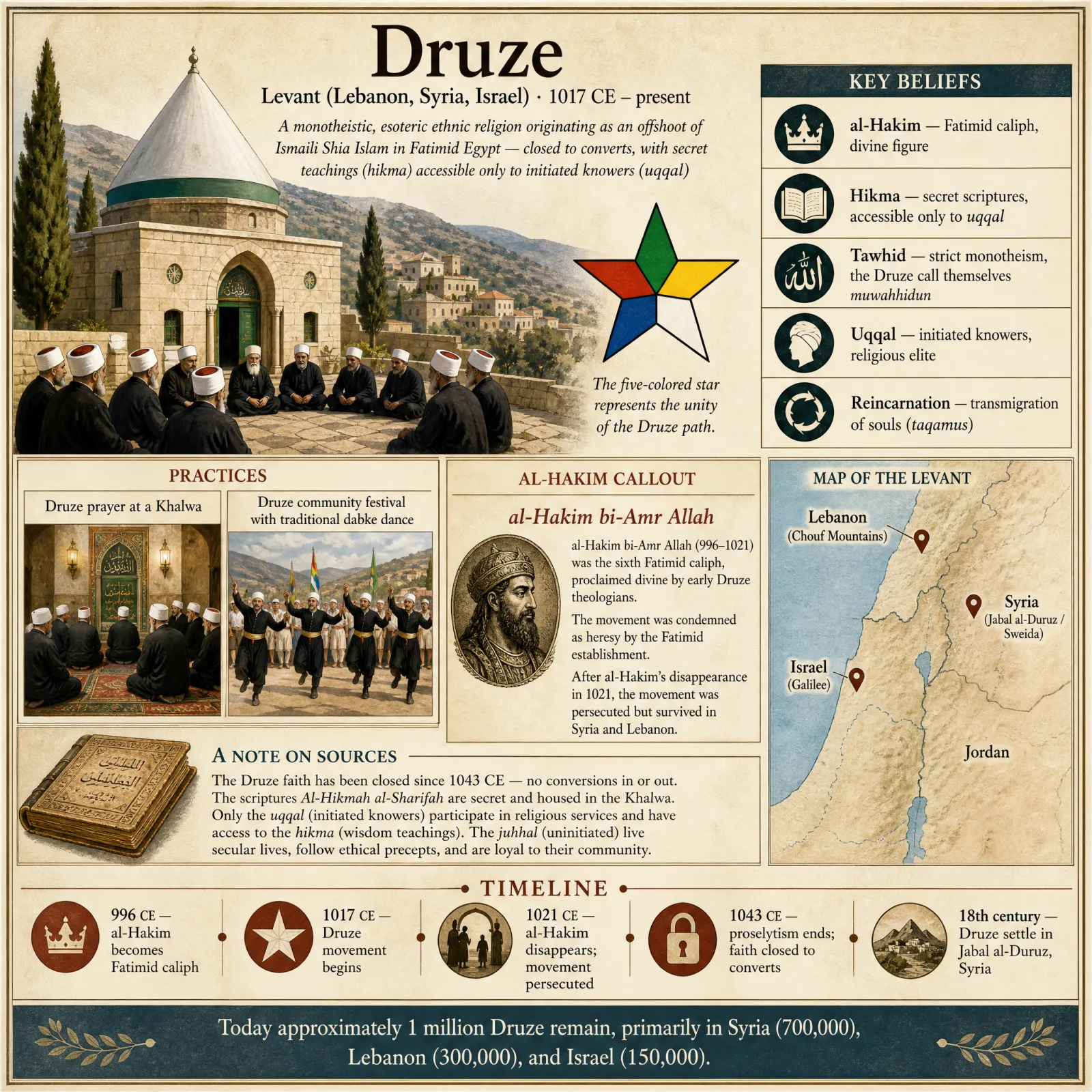
The Druze (Arabic: الدروز, ad-Durūz; self-designation: Muwaḥḥidūn, موحدون, 'Monotheists' or 'Unitarians') are an Arabic-speaking ethno-religious community practicing a monotheistic faith that emerged in the early 11th century CE (1017-1043 CE) from the Ismaili Shia branch of Islam during the reign of the Fatimid Caliph al-Hakim bi-Amr Allah (r. 996-1021 CE) in Cairo, Egypt. The Druze religion, formally known as Tawhid (توحيد, 'Oneness' or 'Divine Unity'), represents a distinct theological and philosophical system that incorporates elements from Ismaili Shi'ism, Neoplatonism, Gnosticism, and earlier monotheistic traditions, emphasizing the absolute oneness and transcendence of God, esoteric knowledge, and ethical conduct over ritual observance. The Druze faith is closed and non-proselytizing: conversion into or out of the religion is forbidden, and one must be born to Druze parents to be considered Druze. The community is estimated at 1–2 million globally, concentrated primarily in Syria (approximately 700,000–900,000, especially in the Jabal al-Druze region), Lebanon (approximately 250,000–400,000, especially in Mount Lebanon and the Chouf district), Israel (approximately 143,000, in the Galilee and Golan Heights), and diaspora communities in the Americas, Europe, and Australia.
The Druze faith emerged during a turbulent period of Fatimid history, formulated by the Ismaili missionary Hamza ibn Ali (also known as Hamza ibn Ali ibn Ahmad), who proclaimed a new religious message (the da'wa, or 'call') asserting the divinity or divine manifestation of Caliph al-Hakim. The Druze da'wa (call) lasted from 1017 to 1043 CE, during which missionaries preached the new doctrine throughout the Levant. The movement faced persecution after al-Hakim's mysterious disappearance in 1021 CE and the succession of his son, Caliph al-Zahir, who banned the movement. Druze adherents fled Cairo and established communities in the mountains of Lebanon, Syria, and later northern Israel/Palestine, where geographic isolation and communal cohesion preserved their distinct identity. The Druze faith officially closed in 1043 CE: no new members have been accepted since, and the religion is passed hereditarily. The foundational Druze scriptures, the Epistles of Wisdom (Rasāʾil al-Ḥikma, رسائل الحكمة), consist of 111 epistles (letters) attributed to Hamza ibn Ali and other early leaders, containing theological doctrines, ethical teachings, cosmology, and instructions for the faithful. These texts are secret and known only to the ʿuqqāl (عقّال, 'the initiated' or 'the wise'), a religious elite comprising approximately 10-20% of the Druze community who have undergone rigorous initiation and study. The majority of Druze, known as juhhāl (جهّال, 'the uninitiated,' though the term is considered pejorative and is often replaced with more respectful terms), do not have access to the scriptures or full theological knowledge but participate in communal life and uphold ethical principles.
Druze theology emphasizes tawhid (absolute monotheism and divine unity), rejecting anthropomorphic descriptions of God and all attributes, affirming that God is utterly transcendent, unknowable, and beyond human comprehension. The Druze believe in the transmigration of souls (reincarnation, tanāsukh, تناسخ): after death, the soul is immediately reborn into a new Druze body, and this cycle continues until spiritual perfection is achieved. There is no heaven, hell, or final judgment in the conventional sense; reward and punishment occur through successive reincarnations. Druze practice prioritizes ethical living, honesty, mutual support within the community, protection of fellow Druze, and the pursuit of spiritual knowledge over ritual obligations. Traditional Islamic practices—such as the five daily prayers, fasting during Ramadan, pilgrimage to Mecca, and adherence to Sharia law—are not observed by the Druze, who interpret religious duties esoterically and spiritually rather than literally. The Druze gather for communal meetings on Thursday evenings (rather than Friday, the Islamic day of congregational prayer) at khalwats (خلوة, prayer houses or houses of seclusion), where the ʿuqqāl engage in prayer, scripture study, and meditation, while the juhhāl attend only the initial social and communal affairs portion of the gathering. Druze identity is maintained through strict endogamy (marriage only within the Druze community), communal solidarity, and the preservation of secrecy regarding religious doctrines. Historically, the Druze have been skilled at political survival, forming strategic alliances and maintaining autonomy in the face of larger empires (Ottoman, French Mandate, contemporary nation-states). Druze communities in Lebanon, Syria, and Israel have distinct political experiences and relationships with their respective states, though all maintain a strong sense of shared Druze identity, ethical values, and religious tradition.
Emerges fromIslam ←
Historical Origins and Development
The Druze religion emerged in Cairo, Egypt, during the reign of the sixth Fatimid Caliph, al-Hakim bi-Amr Allah (الحاكم بأمر الله, r. 996-1021 CE), a controversial and enigmatic ruler whose policies and persona remain debated by historians. Al-Hakim inherited the Fatimid Caliphate at age 15, ruling over a vast empire stretching from North Africa to the Levant, including Damascus, Mecca, and Yemen. His 25-year reign was marked by internal political and religious turmoil, external threats from the Abbasid Caliphate (Baghdad), the Umayyads (Andalusia), and the Byzantines, and erratic, sometimes contradictory policies (e.g., persecuting Christians and Jews, then reversing persecutions; promoting Ismaili missionary activity, then restricting it). Despite these upheavals, al-Hakim was a patron of learning, establishing the Dar al-Hikma (House of Wisdom) in 1005 CE, an institution of higher learning where philosophy, science, Islamic theology, languages, and literatures were taught. It was in this intellectually vibrant but politically unstable environment that the Druze movement was born.
In 1017 CE (408 AH), an Ismaili missionary named Hamza ibn Ali ibn Ahmad (also known as Hamza al-Labbad or Hamza ibn Ali al-Zawzani) proclaimed a new religious doctrine, the Tawhid (Monotheist or Unitarian) call, asserting that Caliph al-Hakim was a divine manifestation or incarnation of the Universal Intellect (al-ʿAql al-Kulli, العقل الكلّي), the first and highest emanation from God in Druze cosmology. Hamza and his followers preached that al-Hakim's appearance marked a new era of divine revelation, superseding previous prophets (including Muhammad) and offering a path to true monotheism and spiritual enlightenment. This doctrine was revolutionary and controversial: it elevated al-Hakim above the status of a temporal ruler or even a divinely guided imam (as in Ismaili theology) to a divine or quasi-divine figure, and it rejected many Islamic ritual practices and legal obligations in favor of esoteric, spiritual interpretation. The movement attracted followers in Cairo and the Levant, particularly among marginalized or heterodox groups, but also provoked fierce opposition from mainstream Ismaili scholars, Sunni Muslims, and political rivals.
The Druze da'wa (call or mission) proceeded in two main phases: the First Call (1017-1018 CE) and the Second Call (1019-1043 CE). During the First Call, Hamza and his chief disciple, Muhammad ibn Ismail al-Darazi (from whom the term 'Druze' is popularly but incorrectly derived; Druze themselves reject this etymology and prefer 'Muwaḥḥidūn'), preached in Cairo, Damascus, and surrounding regions. However, al-Darazi's teachings diverged from Hamza's, and he was accused of heresy and extremism (ghuluww) by Hamza and other leaders. Al-Darazi was expelled from the movement and later killed. Despite this split, the name 'Druze' (derived from al-Darazi) stuck as an external label, though Druze adherents consider it inaccurate and prefer their self-designation, Muwaḥḥidūn. The First Call ended in 1018 CE due to internal disputes and external persecution. The Second Call began in 1019 CE and continued until 1043 CE, long after al-Hakim's mysterious disappearance. In 1021 CE, al-Hakim vanished during a nighttime walk outside Cairo; his body was never found, and the circumstances of his disappearance remain a historical mystery (theories include assassination, voluntary retreat, or ascension). Druze tradition holds that al-Hakim entered a state of occultation (ghayba, غيبة) and will return at the end of time to establish justice and peace, paralleling Shia beliefs about the Hidden Imam.
After al-Hakim's disappearance, his son and successor, Caliph al-Zahir, banned the Druze movement, persecuted its followers, and sought to restore orthodox Ismaili doctrine. Hamza ibn Ali and other Druze leaders fled Cairo, and the movement's center shifted to the mountains of Lebanon and Syria, where rural clan leaders had converted during the da'wa. Geographic isolation, rugged terrain, and clan-based social structures enabled the Druze to preserve their religion and identity despite persecution and marginalization. In 1043 CE, Hamza ibn Ali officially closed the Druze da'wa, declaring that no new members would be accepted and that the religion would henceforth be hereditary and closed. This closure was both theological (the revelation was complete) and practical (further proselytization was dangerous and unnecessary). From the 11th century onward, Druze communities developed distinct social, political, and religious structures, centered on clan leadership (mashāyikh al-ʿuqqāl, religious leaders, and mashāyikh al-juhhāl, temporal leaders) and communal solidarity. The Druze produced a substantial body of religious literature, the Epistles of Wisdom (Rasāʾil al-Ḥikma), attributed to Hamza ibn Ali and other early leaders, which constitute the canonical scriptures of the Druze faith. These epistles, numbering 111, contain theological doctrines, cosmology, ethics, and instructions for believers, and are considered sacred and secret, accessible only to the ʿuqqāl.
Throughout the medieval and early modern periods (12th-19th centuries), Druze communities in Lebanon, Syria, and Palestine maintained relative autonomy, resisting or accommodating successive empires (Crusaders, Ayyubids, Mamluks, Ottomans). The Lebanese Druze, centered in the Chouf Mountains and Mount Lebanon, became a powerful political and military force, producing influential dynasties such as the Maʿn (16th-17th centuries) and Shihab (17th-19th centuries) families, who at times governed Mount Lebanon as semi-autonomous emirates under Ottoman suzerainty. The most famous Druze ruler was Fakhr al-Din II (r. 1590-1613, 1618-1633), who expanded Druze territory, allied with European powers (Tuscany), and promoted economic development, though he was eventually captured and executed by the Ottomans. Druze-Maronite Christian relations in Lebanon alternated between cooperation and conflict, culminating in violent sectarian clashes in the mid-19th century (the 1860 Mount Lebanon civil war), which prompted French intervention and the establishment of an autonomous Mount Lebanon governorate. The Syrian Druze, concentrated in the Jabal al-Druze (Druze Mountain, also called Jabal al-Arab, 'Arab Mountain') in southern Syria, maintained a reputation for independence and resistance to central authority, rebelling against Ottoman and later French Mandate rule (the Great Syrian Revolt of 1925-1927, led by the Druze leader Sultan al-Atrash). The Druze in Palestine/Israel were historically a smaller community, concentrated in the Galilee region and later the Golan Heights (occupied by Israel from Syria in 1967). Following the establishment of Israel in 1948, the Israeli Druze population developed a distinct political identity, characterized by military service in the Israeli Defense Forces (a unique arrangement among Arab citizens of Israel, though controversial and contested within the Druze community) and complex relationships with Palestinian Arabs and the Israeli state.
Core Beliefs and Theology
Druze theology is centered on the concept of tawhid (توحيد, 'oneness' or 'divine unity'), the absolute and uncompromising monotheism that rejects all anthropomorphic attributes, descriptions, or limitations of God. God (al-Bari, البارئ, 'the Creator'; al-Mubtadiʾ, المبتدئ, 'the Originator') is utterly transcendent, beyond human comprehension, language, or conceptualization. God has no attributes (wise, just, merciful, etc.), no form, no location, and no relation to creation in the conventional sense. To ascribe any attribute to God is to limit God and compromise divine unity. This radical apophatic theology (negative theology) distinguishes Druze tawhid from conventional Islamic monotheism, which affirms God's attributes (the 99 Names of Allah). For the Druze, God is pure being, absolute oneness, and the ultimate reality, but cannot be known directly or described positively. Spiritual progress involves negating all false concepts of God and realizing the utter transcendence and unknowability of the divine essence.
Druze cosmology describes the emanation (not creation in the conventional sense) of the universe from God through a hierarchical series of five cosmic principles or hypostases, often called the five ministers or five luminaries: (1) al-ʿAql al-Kulli (العقل الكلّي, 'the Universal Intellect'), the first and highest emanation, associated with Caliph al-Hakim in Druze belief; (2) al-Nafs al-Kulliyya (النفس الكلّية, 'the Universal Soul'), the second emanation; (3) al-Kalima (الكلمة, 'the Word'); (4) al-Sabiq (السابق, 'the Preceder'); (5) al-Tali (التالي, 'the Follower'). These five principles are not gods or independent deities but metaphysical emanations through which the transcendent God relates to and sustains the universe. Each principle has a spiritual role in guiding souls toward enlightenment and maintaining cosmic order. The Universal Intellect (al-ʿAql) is particularly important: it is the active, sustaining force of creation, the medium through which God's unity is manifested, and the object of spiritual aspiration. In Druze theology, al-Hakim is understood as a manifestation or incarnation of the Universal Intellect, making him a divine figure (though this is contested and debated among scholars and even within Druze tradition, as the exact nature of al-Hakim's divinity is esoteric and complex).
The Druze believe in the transmigration of souls (tanāsukh, تناسخ, reincarnation): after death, the human soul is immediately reborn into a new Druze body, without an intermediate state or delay. Reincarnation is exclusive to Druze souls; non-Druze do not possess the same type of soul and do not reincarnate into Druze bodies. This belief reinforces the closed, hereditary nature of the Druze community: Druze souls are believed to have taken vows during the original da'wa (1017-1043 CE) and are continuously reincarnating in successive generations of Druze until the return of al-Hakim and the establishment of a golden age of justice. The quality of one's current life (good or bad fortune, health, social status) is determined by one's actions in previous incarnations. There is no heaven or hell in the conventional sense, no final judgment, and no eternal reward or punishment. Instead, spiritual progress occurs through successive lifetimes, with each incarnation offering opportunities to purify the soul, acquire wisdom, and draw closer to divine unity. The ultimate goal is to achieve spiritual perfection and union with the Universal Intellect, transcending the cycle of reincarnation.
Druze ethics prioritize honesty (صدق النطق, truthfulness in speech), integrity, mutual support within the Druze community, protection of fellow Druze, and the pursuit of spiritual knowledge. The Seven Druze Precepts (often cited in Druze ethical teaching, though their exact formulation varies) include: (1) truthfulness in speech under all circumstances; (2) mutual support and protection of fellow Druze (solidarity); (3) renunciation of other religions and avoidance of syncretism; (4) avoidance of false gods and recognition of God's absolute oneness; (5) submission to God's will and acceptance of divine decrees; (6) contentment with God's actions; (7) ethical conduct in all aspects of life, including avoidance of theft, murder, adultery, and other sins. Druze religious life emphasizes inward piety, ethical living, and esoteric knowledge over external ritual. Traditional Islamic practices—five daily prayers, fasting during Ramadan, pilgrimage to Mecca, adherence to Sharia law—are not observed by the Druze. These rituals are considered external forms (zahir, ظاهر) that have been superseded by the esoteric truth (batin, باطن) revealed in the Druze da'wa. However, the Druze respect prophets and religious figures from earlier traditions (including Adam, Noah, Abraham, Moses, Jesus, and Muhammad), viewing them as messengers who prepared humanity for the final revelation of tawhid through al-Hakim and Hamza ibn Ali.
Sacred Texts and Secrecy
The canonical scripture of the Druze faith is the Epistles of Wisdom (رسائل الحكمة, Rasāʾil al-Ḥikma), also known simply as al-Ḥikma ('The Wisdom'). This collection consists of 111 epistles (letters or treatises) attributed primarily to Hamza ibn Ali and other early Druze leaders, including Baha al-Din al-Muqtana, Ismail ibn Muhammad al-Tamimi, and al-Muqtana Abu Ibrahim. The epistles were composed during the Druze da'wa (1017-1043 CE) and address a wide range of theological, cosmological, ethical, and practical matters: the nature of God and tawhid, the five cosmic principles, the role of al-Hakim, the transmigration of souls, ethical conduct, instructions for the faithful, polemics against detractors, and historical accounts of the da'wa. The Epistles of Wisdom are considered divinely inspired, though not in the same sense as the Quran (which Muslims believe is the literal word of God); rather, they are the authoritative teachings of divinely guided leaders who transmitted the esoteric truth of tawhid.
The Epistles of Wisdom are secret and esoteric, accessible only to the ʿuqqāl (عقّال, the initiated), the religious elite who have undergone rigorous initiation, demonstrated piety and moral integrity, and committed to a life of study, ethical conduct, and spiritual discipline. The ʿuqqāl comprise approximately 10-20% of the Druze community (estimates vary). The vast majority of Druze, known as juhhāl (جهّال, literally 'the ignorant' or 'the uninitiated,' though the term is considered pejorative and many Druze prefer alternative terms such as rūḥāniyy, 'spiritual,' and jismāniyy, 'physical/worldly'), do not have access to the Epistles of Wisdom or detailed theological knowledge. The juhhāl are expected to uphold Druze ethical principles, maintain communal solidarity, and support the ʿuqqāl, but are not required to know the esoteric doctrines. This division between ʿuqqāl and juhhāl is central to Druze religious structure: it preserves the secrecy of doctrines (protecting the community from external persecution and internal misunderstanding), maintains a spiritual elite responsible for religious leadership and education, and accommodates the reality that most community members are occupied with daily life and cannot devote themselves to intensive religious study.
Initiation into the ʿuqqāl is voluntary and open to both men and women (Druze religion emphasizes gender equality in spiritual matters, and women have been included in the ʿuqqāl since the religion's inception). Candidates for initiation undergo a lengthy process of evaluation and testing, demonstrating piety, honesty, ethical conduct, and commitment to Druze values. Once initiated, ʿuqqāl adopt distinctive dress (modest, dark clothing; white head coverings or turbans for men and women), abstain from alcohol and tobacco, avoid profanity and vulgar speech, and adhere to strict ethical standards. The ʿuqqāl attend Thursday-evening gatherings at the khalwat (خلوة, prayer house or house of seclusion), where they engage in prayer, scripture study, and meditation. The juhhāl attend the initial portion of these gatherings, where community affairs and social matters are discussed, then leave so the ʿuqqāl can conduct esoteric religious activities. The most advanced and influential ʿuqqāl may attain the status of ajāwīd (أجاويد, 'the righteous' or 'the virtuous'), recognized spiritual leaders from whom the community's religious authorities are drawn.
The secrecy surrounding Druze scriptures and doctrines has been a defining feature of the religion since its inception. This secrecy served multiple purposes: (1) protection from persecution: revealing esoteric doctrines (especially the divinization of al-Hakim and the rejection of Islamic rituals) to outsiders would invite violent repression from Muslim authorities; (2) preservation of purity: restricting knowledge to the initiated prevents distortion, misunderstanding, and syncretism; (3) communal cohesion: shared secrecy reinforces Druze identity and boundaries; (4) spiritual discipline: esoteric knowledge is earned through moral and spiritual development, not casually disseminated. However, secrecy has also created challenges: it has fueled external suspicion, misunderstanding, and negative stereotypes (accusations of heresy, devil worship, secret rituals, etc.), and it has complicated scholarly study of Druze religion. In the modern era, some Druze intellectuals and scholars have published portions of the Epistles of Wisdom and written about Druze theology in accessible terms, balancing the need for secrecy with the desire to correct misunderstandings and educate outsiders. Nevertheless, the core scriptures remain largely unpublished and inaccessible to non-initiated Druze and non-Druze.
Religious Practices and Community Life
Druze religious practice emphasizes ethical living, communal solidarity, and esoteric knowledge over ritual observance. Unlike Muslims, Druze do not perform the five daily prayers (salat), do not fast during Ramadan, do not undertake pilgrimage to Mecca (hajj), and do not adhere to Sharia law. These Islamic ritual obligations are considered external forms that have been superseded by the esoteric, spiritual truth revealed in the Druze da'wa. Instead, Druze practice focuses on: (1) Honesty and truthfulness: Druze are enjoined to speak truthfully under all circumstances, avoid deception, and maintain integrity in personal and communal dealings. Honesty is considered the foundation of Druze ethics and a prerequisite for spiritual progress. (2) Communal solidarity and mutual support: Druze are expected to protect, support, and care for fellow Druze, especially in times of crisis or threat. This principle, sometimes called ḥimāyat al-ikhwān ('protection of the brethren'), reinforces communal cohesion and has been crucial to Druze survival as a minority. (3) Contentment and submission to God's will: Druze are taught to accept God's decrees, whether favorable or adverse, without complaint or rebellion. This stoic acceptance (رضا, riḍā) reflects belief in divine justice operating through reincarnation. (4) Pursuit of spiritual knowledge: For the ʿuqqāl, religious study, meditation, and contemplation are central practices, leading to deeper understanding of tawhid and purification of the soul.
The primary communal religious activity is the Thursday-evening gathering at the khalwat (خلوة, prayer house or house of seclusion). Khalwats are simple, unadorned buildings, typically located outside villages or on hillsides, designed for prayer and seclusion. The gathering begins with a social and communal portion, attended by both ʿuqqāl and juhhāl, where community affairs, disputes, and social matters are discussed and resolved. After this, the juhhāl depart, and the ʿuqqāl continue with prayer, scripture reading, and meditation. The ʿuqqāl recite passages from the Epistles of Wisdom, discuss theological and ethical topics, and engage in silent contemplation. Women and men participate equally in ʿuqqāl activities, sitting together and contributing to discussions and prayers. The choice of Thursday evening (rather than Friday, the Islamic day of congregational prayer) symbolizes the Druze break from Islamic ritual practice and the establishment of a distinct religious identity.
Druze religious life does not include elaborate rituals, sacraments, or ceremonies. Life-cycle events (birth, marriage, death) are marked by communal gatherings and ethical observances rather than sacramental rites. Marriage is expected to be monogamous and within the Druze community; endogamy (marriage exclusively with other Druze) is strictly enforced, and marriage to non-Druze is forbidden and results in expulsion from the community. Druze marriage is a civil contract emphasizing mutual respect, fidelity, and ethical partnership. Divorce is permitted but discouraged, and both men and women have the right to initiate divorce. Gender equality is a distinctive feature of Druze religious and social life: women can be initiated into the ʿuqqāl, participate fully in religious activities, own property, and engage in public life. Many Druze communities have higher rates of female education and professional employment compared to neighboring Muslim or Christian communities. Death and burial: Druze funerals are simple, with the deceased buried in a shroud without coffin or elaborate tombstone. Funeral prayers emphasize the transmigration of the soul and the continuation of spiritual existence in a new incarnation. Mourning is restrained, reflecting belief that the soul has immediately moved to a new life.
Druze dietary practices do not include specific prohibitions comparable to Islamic or Jewish dietary laws. However, ʿuqqāl abstain from alcohol and tobacco, and some observe additional dietary restrictions as personal spiritual discipline. Pilgrimage is practiced by visiting sacred Druze sites, particularly the shrines of revered figures (maqāms, مقامات, 'stations' or 'sanctuaries'), where Druze pray, seek blessings, and make vows. These pilgrimages are communal events, reinforcing Druze identity and solidarity. While Druze do not have a centralized religious hierarchy comparable to clergy in Christianity or the ulama in Islam, they do have religious authorities elected or recognized within each country: the Sheikh al-ʿAql (شيخ العقل, 'Sheikh of the Wise') is the official head of the Druze religious council in Lebanon, Syria, and Israel, elected by the local Druze community and serving as the chief religious and judicial authority. The Sheikh al-ʿAql's authority is limited to the country in which he is elected, and there is no single global Druze religious leader. Spiritual authority resides with the ajāwīd (the most advanced ʿuqqāl) and is based on personal piety, learning, and community respect rather than institutional office.
Geographic and Political Diversity
While Druze worldwide share a common religious identity, theology, and ethical system, Druze communities in different countries have distinct political experiences, relationships with their respective states, and cultural particularities shaped by local history and circumstances. The largest Druze populations are in Syria (approximately 700,000–900,000), Lebanon (approximately 250,000–400,000), and Israel (approximately 143,000), with smaller diaspora communities in Jordan, the Americas (especially the United States, Canada, Venezuela, Brazil), Europe (especially France, Germany, UK), and Australia. These geographic divisions have produced political and social diversity within the broader Druze community.
Syrian Druze, concentrated in the Jabal al-Druze (also called Jabal al-Arab) region in southern Syria (Suwayda governorate), have historically maintained a strong sense of independence and resistance to central authority. The Jabal al-Druze served as a refuge for Druze fleeing persecution in earlier centuries and became a center of Druze political and military power. Under Ottoman rule, Syrian Druze resisted taxation and conscription, preserving a degree of autonomy. During the French Mandate (1920-1946), Syrian Druze led the Great Syrian Revolt of 1925-1927, a major anti-colonial uprising led by the Druze leader Sultan al-Atrash, which spread beyond the Druze region and inspired broader Syrian nationalism. After Syrian independence, Druze participated in Syrian political life, and some Druze families (notably the al-Atrash family) remained influential. During the Syrian Civil War (2011-present), Syrian Druze have sought to maintain neutrality and protect their communities, forming local defense militias and avoiding alignment with either the Assad government or opposition forces, though this neutrality has been precarious and contested.
Lebanese Druze, centered in the Chouf district and Mount Lebanon, have played a pivotal role in Lebanese history and politics. The Druze were one of the dominant communities in Mount Lebanon during the Ottoman period and the French Mandate, and they were key actors in the formation of modern Lebanon (established 1920, independent 1943). The Lebanese Civil War (1975-1990) deeply affected the Druze: under the leadership of Walid Jumblatt (heir to the prominent Jumblatt family, one of the leading Druze clans), the Druze formed a powerful militia, the Progressive Socialist Party (PSP), and fought against Christian militias, the Palestinian Liberation Organization, and Syrian forces at various stages of the conflict. The Mountain War (1983-1984), a series of battles between Druze and Christian forces in the Chouf, resulted in significant casualties and the displacement of Christian communities from Druze-majority areas. Post-civil war, the Druze remain a significant political force in Lebanon, and Walid Jumblatt has been a key figure in Lebanese politics, navigating complex alliances and shifting between pro-Syrian, pro-Western, and independent stances. Lebanese Druze identity is shaped by Lebanon's confessional political system, which allocates political representation by religious community, and by ongoing sectarian tensions and regional instability.
Israeli Druze have a distinct and controversial political identity. After the establishment of Israel in 1948, the Israeli Druze community (concentrated in the Galilee region) was granted Israeli citizenship, unlike most Palestinian Arabs, who became either refugees, citizens of the West Bank and Gaza (under Jordanian and Egyptian rule until 1967), or internal refugees. In 1956, the Israeli government and Druze religious leaders negotiated a unique arrangement: Druze men would serve in the Israel Defense Forces (IDF), making Druze the only Arab community in Israel subject to military conscription. This policy has been deeply controversial, both within the Druze community and among Palestinian Arabs, who view it as collaboration with Israeli occupation. Proponents argue that military service provides Druze with greater integration, economic opportunities, and political influence in Israel, and reflects Druze loyalty to the state in which they live (a traditional Druze principle). Opponents argue that it alienates Druze from their Arab identity, implicates them in Israeli military actions against Palestinians, and perpetuates inequality (despite military service, Israeli Druze face discrimination in land rights, budget allocation, and political representation). In recent decades, a small but growing movement of Druze conscientious objectors has emerged, challenging the mandatory service policy. Israeli Druze maintain close cultural and religious ties with Druze in Syria and Lebanon, despite geopolitical borders and conflicts, and many Israeli Druze identify as both Druze and Arab, navigating complex and sometimes contradictory political and national identities.
Demographics and Contemporary Issues
The global Druze population is estimated at 1–2 million, though precise figures are difficult to determine due to the closed nature of the community, lack of reliable census data in some countries (especially Syria), and the challenge of counting diaspora populations. The largest populations are in Syria (approximately 700,000–900,000, concentrated in Suwayda governorate and Damascus), Lebanon (approximately 250,000–400,000, in the Chouf, Aley, and Mount Lebanon districts), Israel (approximately 143,000, in the Galilee and Golan Heights), and smaller communities in Jordan (approximately 20,000–30,000). Diaspora communities exist in the Americas (United States, Canada, Venezuela, Brazil, Argentina), Europe (France, Germany, UK, Netherlands), and Australia, though diaspora Druze populations are difficult to estimate and range from tens of thousands to over 100,000.
Contemporary Druze communities face multiple challenges: (1) Maintaining religious identity and secrecy in modern, globalized contexts: Diaspora Druze, especially younger generations, often have limited access to ʿuqqāl, khalwats, and traditional religious education. Assimilation, intermarriage (though forbidden, it occurs in diaspora), and secularization threaten the transmission of Druze identity and knowledge. Some diaspora communities have established cultural and religious centers to preserve Druze heritage, but the balance between secrecy and education remains contentious. (2) Political instability and conflict: Druze in Syria and Lebanon live in regions affected by civil war, sectarian violence, and geopolitical instability. The Syrian Civil War has displaced many Syrian Druze and threatened the security of Druze communities in the Jabal al-Druze. Lebanese Druze navigate the precarious confessional politics of Lebanon and regional tensions involving Israel, Syria, and Hezbollah. Israeli Druze face the challenges of living in a state defined by Jewish identity and ongoing conflict with Palestinians. (3) Endogamy and population sustainability: Strict endogamy (marriage only within the Druze community) has preserved Druze identity but also creates demographic challenges, especially for small diaspora communities where finding Druze marriage partners is difficult. Some Druze communities are debating whether to relax endogamy rules or allow limited conversion, though this is deeply controversial and opposed by religious authorities. (4) Gender roles and modernity: While Druze religion emphasizes gender equality in spiritual matters, traditional Druze society has been patriarchal in practice. Modern Druze women, especially in Israel and diaspora, have increasingly challenged traditional gender roles, pursuing higher education, professional careers, and political activism. These changes create tensions between tradition and modernity, though many Druze communities are adapting.
Sacred Sites and Pilgrimage
Khalwat al-Bayada (خلوات البياضة, 'White Khalwat'), near Hasbaya, Lebanon: Khalwat al-Bayada is the central sanctuary and theological school of the Druze faith, located in the southern Lebanese town of Hasbaya, near the Syrian and Israeli borders. Founded in the 19th century by Sheikh Hamad el-Qais, the site is traditionally associated with the early Druze missionary al-Darazi, who is said to have taught there during the first Druze call (though Druze reject al-Darazi's teachings and consider him a heretic). The khalwat features a large, circular stone bench next to an ancient oak tree known as the Areopagus of the Elders, secluded among nature and trees. The site provides approximately forty hermitages for the ʿuqqāl who come for spiritual retreat and study at various times of the year. Khalwat al-Bayada is the supreme religious authority for Druze worldwide, and it houses copies of the Epistles of Wisdom (though in 1838, invading Egyptian forces confiscated some manuscripts). The khalwat is a place of prayer, meditation, and communal gathering for the ʿuqqāl, and visitors (both Druze and non-Druze) are respectfully requested to seek permission from the resident sheikh before entering, and female visitors are asked to cover their heads as a courtesy.
Maqam al-Nabi Shuʿayb (مقام النبي شعيب, Station of the Prophet Shuʿayb), near Tiberias, Israel: The Shrine of Nabi Shuʿayb (also known as Jethro's tomb) is the most important pilgrimage site in the Druze faith, located west of Tiberias in the Lower Galilee region of Israel. The shrine contains the purported tomb of Shuʿayb, a prophet venerated by Druze (and identified with the biblical Jethro, Moses' father-in-law, and the Quranic prophet Shuʿayb). Druze tradition holds that toward the end of his life, Shuʿayb took refuge in a cave outside the village of Hittin (near Tiberias), where he died in old age, and his followers buried him at the site. Another tradition associates the site with Sultan Saladin, who reportedly had a dream before the Battle of Hittin (1187 CE) in which an angel promised him victory on the condition that he would honor Shuʿayb's burial site; after Saladin's victory, the Druze built a shrine there. The shrine has been a site of Druze pilgrimage for centuries, with historical mentions dating back to the 12th-13th centuries. After the 1948 Arab-Israeli War and the depopulation of the predominantly Muslim village of Hittin, Israel granted the Druze exclusive custodianship over the shrine and surrounding land (approximately 100 dunams). Under the leadership of Sheikh Amin Tarif (1898-1993, a prominent Druze spiritual leader in Israel), the shrine was renovated, and additional rooms and facilities were added. The Israeli government paved access roads and provided infrastructure. An annual Ziyarat al-Nabi Shuʿayb pilgrimage takes place every April, recognized as an official Druze holiday in Israel, attracting thousands of Druze pilgrims from Israel and abroad. The pilgrimage involves prayers, communal gatherings, feasting, and social activities, reinforcing Druze communal identity.
Other maqāms and sacred sites: Druze communities venerate numerous local maqāms (مقامات, shrines or stations) dedicated to revered figures, prophets, and saints. These sites are scattered across Lebanon, Syria, Israel, and Jordan, often located on hilltops, near springs, or in caves. Pilgrims visit maqāms to pray, make vows (نذر, nadhr), seek blessings, and request intercession for healing, prosperity, or protection. Maqāms are maintained by local Druze communities and serve as focal points for communal religious life. Some notable maqāms include: Maqam al-Amir al-Sayyid Abdullah al-Tanukhi (in Lebanon, dedicated to a revered Druze saint); Maqam Sitt Shaʿwana (in Syria, dedicated to a female saint, reflecting gender equality in Druze veneration); and various maqāms in the Golan Heights and Galilee (Israel). These sites are important for local Druze identity but are less universally significant than Khalwat al-Bayada or Nabi Shuʿayb.
Contemporary Debates and Contested Issues
Several theological, social, and political issues remain contested within Druze communities and among scholars: (1) The divinity of al-Hakim: The exact nature of Caliph al-Hakim's divinity or divine status is debated. Traditional Druze theology, as expressed in the Epistles of Wisdom, presents al-Hakim as a manifestation or incarnation of the Universal Intellect (al-ʿAql al-Kulli), making him a divine or quasi-divine figure. However, this doctrine is esoteric, complex, and not uniformly understood or accepted by all Druze. Some modern Druze scholars and intellectuals interpret al-Hakim symbolically or metaphorically, emphasizing the philosophical and spiritual dimensions of Druze theology rather than literal divinity. Others affirm the traditional view. The secrecy surrounding Druze doctrines makes it difficult to determine the full range of beliefs within the community. (2) Secrecy vs. transparency: The traditional secrecy of Druze scriptures and doctrines has protected the community but also created misunderstandings and hindered scholarship. Some contemporary Druze intellectuals advocate greater openness, publishing translations and commentaries on the Epistles of Wisdom and explaining Druze theology to outsiders. Others insist that secrecy is integral to Druze identity and religious integrity and should be maintained. This debate is particularly acute in diaspora communities, where Druze youth often lack access to traditional religious education and may question the relevance or necessity of secrecy.
(3) Endogamy and conversion: The strict prohibition on marrying non-Druze and the impossibility of conversion into the Druze faith have preserved communal boundaries but create challenges, especially for diaspora Druze and young people who fall in love with non-Druze partners. Some Druze communities are debating whether to allow limited conversion or recognize children of mixed marriages (especially if the Druze parent is the mother, as Druze identity is traditionally patrilineal but increasingly contested). However, religious authorities overwhelmingly oppose any relaxation of endogamy or opening of conversion, arguing it would undermine Druze identity and violate the closure of the da'wa in 1043 CE. (4) Military service in Israel: The mandatory conscription of Druze men into the Israeli Defense Forces remains deeply controversial within the Israeli Druze community and among Druze worldwide. Supporters argue it provides integration, opportunities, and aligns with Druze principles of loyalty to the state in which one resides. Opponents argue it alienates Druze from Arab identity, implicates them in Israeli occupation and violence against Palestinians, and perpetuates inequality (Druze citizens still face discrimination despite military service). A small but growing movement of Druze conscientious objectors challenges the policy, and debates about Druze identity, Arab identity, and political loyalty continue. (5) Gender equality: While Druze theology emphasizes gender equality in spiritual matters (women can be ʿuqqāl, participate in religious activities), traditional Druze society has been patriarchal. Modern Druze women, especially in Israel and diaspora, are increasingly challenging traditional gender roles and demanding equal rights in family law, inheritance, and political representation. These debates reflect broader tensions between tradition and modernity.
Key Terms
- Druze / Muwaḥḥidūn (موحدون)
- An Arabic-speaking ethno-religious community practicing Tawhid ('Oneness'); self-designation 'Muwaḥḥidūn' ('Monotheists' or 'Unitarians').
- Tawhid (توحيد)
- Oneness or Divine Unity; the central doctrine of Druze theology emphasizing God's absolute transcendence and the negation of all attributes.
- Al-Hakim bi-Amr Allah (الحاكم بأمر الله)
- Sixth Fatimid Caliph (r. 996-1021 CE), venerated in Druze theology as a manifestation of the Universal Intellect.
- Hamza ibn Ali (حمزة بن علي)
- Ismaili missionary who formulated Druze theology and proclaimed the Tawhid call (1017-1043 CE); author of the Epistles of Wisdom.
- Daʿwa (دعوة)
- Call or mission; refers to the period (1017-1043 CE) when the Druze faith was preached and new members accepted.
- Epistles of Wisdom / Rasāʾil al-Ḥikma (رسائل الحكمة)
- Canonical scriptures of the Druze faith, consisting of 111 epistles attributed to Hamza ibn Ali and other early leaders.
- ʿUqqāl (عقّال)
- The initiated or 'the wise'; religious elite (10-20% of Druze) who have access to scriptures and esoteric knowledge.
- Juhhāl (جهّال)
- The uninitiated; the majority of Druze who do not have access to full theological knowledge (term considered pejorative).
- Tanāsukh (تناسخ)
- Transmigration of souls or reincarnation; Druze belief that souls are immediately reborn into new Druze bodies after death.
- Khalwat (خلوة)
- Prayer house or house of seclusion; Druze place of worship where ʿuqqāl gather for prayer, study, and meditation.
- Al-ʿAql al-Kulli (العقل الكلّي)
- Universal Intellect; the first and highest cosmic emanation from God in Druze cosmology, associated with al-Hakim.
- Sheikh al-ʿAql (شيخ العقل)
- Sheikh of the Wise; official head of the Druze religious council in Lebanon, Syria, and Israel.
- Ajāwīd (أجاويد)
- The righteous or virtuous; the most advanced ʿuqqāl, recognized spiritual leaders.
- Maqām (مقام)
- Station or shrine; sacred site dedicated to a revered figure, prophet, or saint, visited by Druze pilgrims.
- Khalwat al-Bayada (خلوات البياضة)
- White Khalwat; central sanctuary and theological school of the Druze, located near Hasbaya, Lebanon.
- Nabi Shuʿayb (النبي شعيب)
- Prophet Shuʿayb (identified with Jethro); shrine near Tiberias, Israel, the most important Druze pilgrimage site.
- Ziyarat al-Nabi Shuʿayb (زيارة النبي شعيب)
- Annual pilgrimage to the shrine of Nabi Shuʿayb in April, an official Druze holiday in Israel.
- Jabal al-Druze (جبل الدروز)
- Druze Mountain; mountainous region in southern Syria (Suwayda governorate) with a large Druze population.
- Endogamy
- Marriage exclusively within the Druze community; marriage to non-Druze is forbidden.
Further Reading
- Kais M. Firro, A History of the Druzes (E.J. Brill, 1992)
- Kais M. Firro, The Druzes in the Jewish State: A Brief History (Brill, 1999)
- Robert Brenton Betts, The Druze (Yale University Press, 1988)
- Samy Swayd, The Druzes: An Annotated Bibliography (Institute of Ismaili Studies, 1998)
- The Institute of Ismaili Studies: The Druzes, from Ismaili Esotericism to the Formation of a Doctrinal School of Law
- Encyclopedia.com: Druze
- Encyclopaedia Britannica: Druze
- Encyclopaedia Britannica: ʿuqqāl
- UNESCO World Heritage (Tentative): Khalwat al-Bayada
- Wikipedia: Nabi Shu'ayb (sourced from academic references)
Practices
- Thursday meetings
- Initiation
- Modest dress
Core ideas
- Monotheism
- One transcendent God
- Reincarnation
- Successive rebirths of the soul
- Judgement
- Final accounting at the end of cycles
Sacred texts
A collection of 111 epistles composed by Hamza ibn Ali and other missionaries during the Fatimid period, forming the sole canonical scripture of the Druze faith. They expound a Neoplatonic cosmology, the unity of God, and the cyclical appearance of divine messengers. Only the initiated 'uqqal' may study them; the text remains closed to outsiders and converts.