Overview
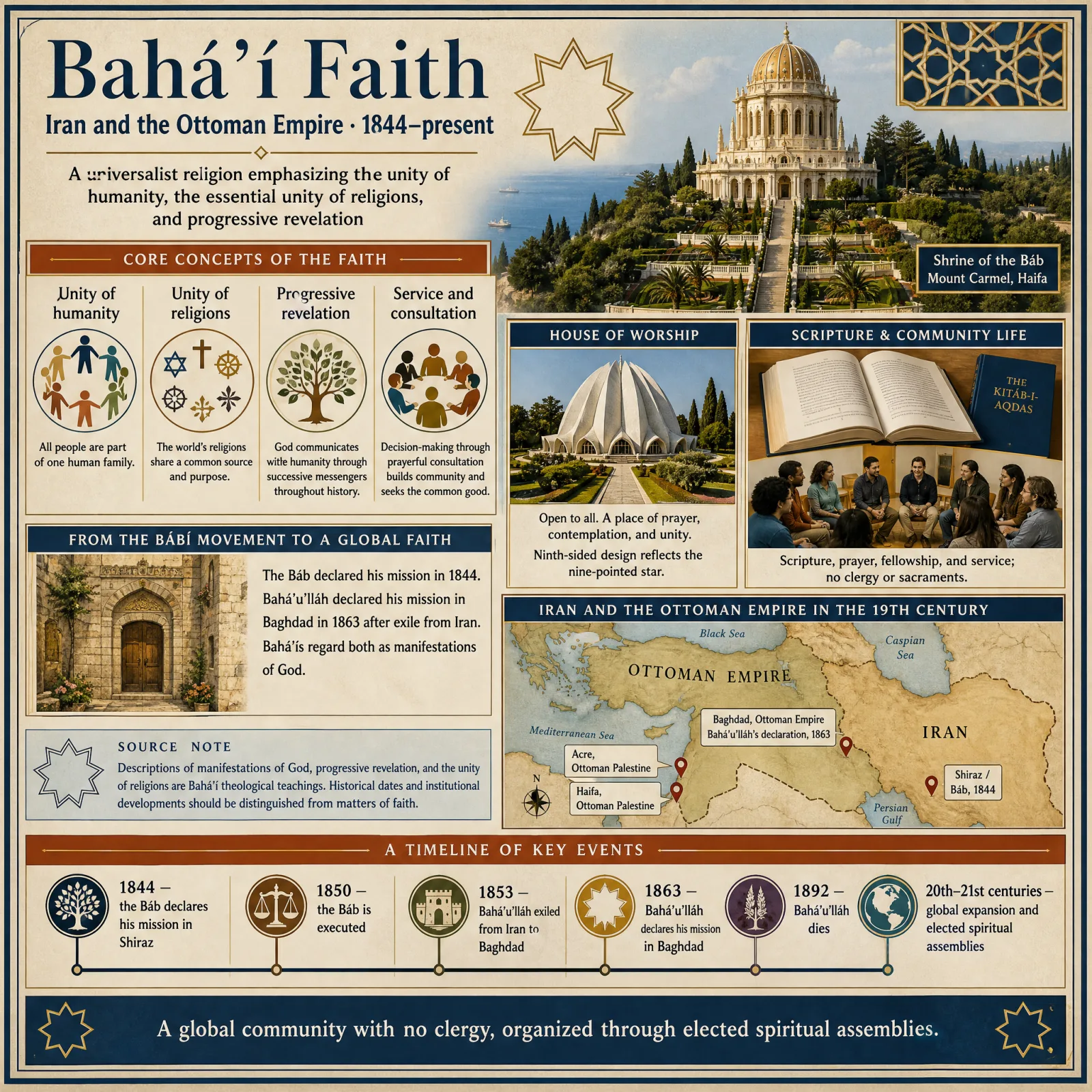
The Bahá'í Faith is a monotheistic religion founded in 19th-century Persia (Iran) by Bahá'u'lláh (بهاءالله, 'Glory of God,' 1817-1892), who proclaimed himself the promised messenger prophesied by the Báb (الباب, 'the Gate,' Siyyid Ali Muhammad, 1819-1850), the founder of Bábism, a messianic movement within Twelver Shi'i Islam. Bahá'u'lláh taught that God is unknowable in essence but reveals divine will progressively through manifestations or messengers—including Abraham, Krishna, Moses, Zoroaster, Buddha, Jesus, Muhammad, the Báb, and Bahá'u'lláh himself—who establish successive religious dispensations suited to humanity's evolving spiritual and social needs. The Bahá'í Faith emphasizes the oneness of God, the oneness of religion (all major faiths share a common divine source and progressive revelation), and the oneness of humanity, transcending divisions of race, nation, class, and gender. Core teachings include the harmony of science and religion, the independent investigation of truth, universal compulsory education, the elimination of prejudice, equality of women and men, the abolition of extremes of wealth and poverty, and the establishment of a world federal system ensuring collective security and peace. Bahá'u'lláh's writings, including the Kitáb-i-Aqdas (كتاب الأقدس, 'Most Holy Book,' the religion's central legal and doctrinal text) and the Kitáb-i-Íqán (كتاب الإيقان, 'Book of Certitude,' a major theological exposition), constitute the authoritative scriptures of the faith.
The Bahá'í Faith emerged amid profound religious and political turmoil in 19th-century Iran. The Báb declared his mission in 1844 in Shiraz, proclaiming the imminent advent of a greater prophet and calling for moral and social reform, which attracted tens of thousands of followers but provoked violent persecution from the Qajar state and Shi'i clerical establishment. The Báb was executed by firing squad in Tabriz in 1850, and thousands of Bábís were killed in massacres and persecutions. In 1863, while exiled in Baghdad, Bahá'u'lláh—a prominent Bábí leader who had endured imprisonment and exile—declared himself to be the promised one foretold by the Báb. Bahá'u'lláh spent the remainder of his life as a prisoner and exile of the Ottoman Empire, moved successively to Constantinople (Istanbul), Adrianople (Edirne), and finally to Acre (Akko) in Ottoman Palestine (now Israel), where he remained from 1868 until his death in 1892. From these places of confinement, Bahá'u'lláh addressed epistles to world leaders (including Queen Victoria, Napoleon III, Tsar Alexander II, Pope Pius IX, and Sultan Abdülaziz), proclaiming his message, warning of coming upheavals, and calling for international cooperation and disarmament. After Bahá'u'lláh's death, his son 'Abdu'l-Bahá (عبدالبهاء, 'Servant of Bahá,' 1844-1921) led the community as the authorized interpreter of Bahá'u'lláh's teachings, traveled extensively to Europe and North America (1911-1913), and established the foundations for the religion's global expansion. 'Abdu'l-Bahá's grandson Shoghi Effendi (1897-1957) served as Guardian of the Faith, systematizing Bahá'í administration and translating and interpreting authoritative texts. Since 1963, the Universal House of Justice, an elected nine-member body based in Haifa, Israel, has governed the global Bahá'í community.
Today, the Bahá'í Faith claims approximately 5-8 million adherents worldwide, with significant communities in India, Iran, Africa, Latin America, and North America, though precise numbers are contested. The religion has spread to virtually every country, establishing elected Local and National Spiritual Assemblies as its administrative structures, with no clergy or individual priesthood. Bahá'ís face severe persecution in Iran, where the Islamic Republic does not recognize the faith as a legitimate religion and systematically oppresses the Bahá'í community through arrests, property confiscation, denial of education and employment, and killings. The Bahá'í World Centre in Haifa and Acre, including the Shrine of the Báb on Mount Carmel and the Shrine of Bahá'u'lláh at Bahjí, serves as the spiritual and administrative heart of the faith and is a UNESCO World Heritage Site. Scholars classify the Bahá'í Faith as an independent world religion that emerged from Islamic milieu but developed distinct doctrines, institutions, and global identity, addressing modernity's challenges through progressive social teachings and administrative innovations.
Emerges fromIslam ←
Historical Development
The Bahá'í Faith's origins lie in the Bábí movement, a millenarian sect within 19th-century Iranian Twelver Shi'i Islam. In 1844, in Shiraz, Iran, Siyyid Ali Muhammad (1819-1850) declared himself the Báb ('the Gate'), claiming to be the Mahdi (the hidden Twelfth Imam expected to return) or a gate to the hidden Imam, and announcing the imminent advent of 'He Whom God Shall Make Manifest' (من يظهره الله, Man Yuzhiruhu'llah), a greater messenger who would fulfill Islamic prophecies and establish a new religious dispensation. The Báb's teachings combined Shi'i messianic expectations with calls for radical social and religious reform: equality of women, education, moral regeneration, and the abolition of rigid Islamic law. The Bábí movement spread rapidly, attracting tens of thousands of followers, particularly among merchants, clerics, and intellectuals. However, it provoked fierce opposition from the Qajar government and Shi'i clerical establishment, who viewed Bábism as heretical and politically subversive. Between 1848 and 1853, Bábís engaged in armed defensive conflicts at Shaykh Tabarsi, Nayriz, and Zanjan, suffering thousands of casualties. The Báb himself was imprisoned and executed by firing squad in Tabriz on July 9, 1850, becoming a martyr and cementing Bábism's revolutionary legacy.
Among the Bábí leaders was Mírzá Husayn-'Alí Núrí (1817-1892), a Persian nobleman from a prominent family in Núr, Mazandaran, who adopted the title Bahá'u'lláh ('Glory of God'). Bahá'u'lláh became a leading Bábí figure, enduring imprisonment in Tehran's notorious 'Black Pit' (Síyáh-Chál) dungeon in 1852 following an attempted assassination of the Shah by radical Bábís. It was during this imprisonment, according to Bahá'í belief, that Bahá'u'lláh first received divine revelation, though he did not publicly declare his mission until 1863. After his release, Bahá'u'lláh was exiled to Baghdad in Ottoman Iraq (1853-1863), where he revived the demoralized Bábí community, wrote influential works including the Kitáb-i-Íqán (Book of Certitude, 1862), and attracted followers through his spiritual authority and writings. On the eve of his further exile from Baghdad in April 1863, Bahá'u'lláh declared to a small group of Bábís in the Ridván Garden that he was the promised one foretold by the Báb, inaugurating the Bahá'í Faith as a distinct religion. This declaration is commemorated annually as the Festival of Ridván, the most holy Bahá'í festival.
Bahá'u'lláh's subsequent exiles—to Constantinople (Istanbul, 1863), Adrianople (Edirne, 1863-1868), and finally to the prison city of Acre (Akko, Ottoman Palestine, 1868-1892)—shaped the Bahá'í Faith's development. Despite imprisonment and exile, Bahá'u'lláh wrote prolifically, producing over 15,000 works including letters, tablets, prayers, laws, and theological treatises. In Adrianople, he publicly proclaimed his mission to world leaders through epistles (Alváh, ألواح, 'Tablets'), calling on monarchs and rulers to recognize God's new revelation, establish justice, disarm, and work toward world peace. These letters, including those to Napoleon III, Queen Victoria, Tsar Alexander II, Pope Pius IX, and Sultan Abdülaziz, warned of consequences for rejecting the divine message and prophesied the decline of oppressive regimes. In Acre, initially confined to harsh prison conditions, Bahá'u'lláh gradually gained greater freedom of movement and was eventually allowed to reside outside the city walls at the Mansion of Bahjí, where he revealed the Kitáb-i-Aqdas (Most Holy Book, circa 1873), the central book of Bahá'í law establishing religious obligations (daily prayer, annual fast, pilgrimage), social laws (marriage, inheritance, education), and principles of governance. Bahá'u'lláh died at Bahjí on May 29, 1892, and was buried in a nearby shrine, which Bahá'ís regard as the 'Qiblih' (قبلة, direction of prayer) and the holiest place on earth.
Leadership passed to Bahá'u'lláh's eldest son 'Abdu'l-Bahá ('Servant of Bahá,' 1844-1921), designated in Bahá'u'lláh's will as the authoritative interpreter of his father's teachings and the exemplar of Bahá'í life. 'Abdu'l-Bahá remained a prisoner in Acre until the Young Turk Revolution of 1908 freed him, after which he traveled extensively to Egypt, Europe, and North America (1911-1913), delivering hundreds of public talks, establishing Bahá'í communities, and articulating the faith's social teachings to Western audiences. 'Abdu'l-Bahá emphasized the harmony of science and religion, gender equality, universal education, and international peace, presenting the Bahá'í Faith as a modern religion addressing industrial society's moral and social crises. He also established the framework for Bahá'í administration, including the institutions of Local and National Spiritual Assemblies and the future Universal House of Justice. 'Abdu'l-Bahá died in 1921, and leadership passed to his grandson Shoghi Effendi (1897-1957), appointed Guardian (ولي أمر الله, Walí Amru'lláh) in 'Abdu'l-Bahá's will. Shoghi Effendi systematized Bahá'í administration, translated and interpreted authoritative texts (particularly into English), directed global expansion plans, and developed the Bahá'í World Centre in Haifa and Acre, including constructing the superstructure of the Shrine of the Báb on Mount Carmel. Shoghi Effendi died unexpectedly in 1957 without appointing a successor Guardian, creating a succession crisis resolved by the establishment of the Universal House of Justice in 1963, as stipulated in Bahá'u'lláh's writings.
The 20th and 21st centuries witnessed the Bahá'í Faith's transformation from a predominantly Middle Eastern sect into a global religion with diverse membership. Major growth occurred in Africa, Latin America, South Asia (especially India), and the Pacific Islands, often among previously marginalized populations attracted by the faith's egalitarian teachings and lack of clergy. In Iran, the Bahá'í community—the largest religious minority—faced escalating persecution, particularly after the 1979 Islamic Revolution, when the new theocratic government systematically oppressed Bahá'ís through executions, arrests, property confiscation, denial of education and employment, and desecration of sacred sites, including the destruction of the House of the Báb in Shiraz and ongoing threats to the House of Bahá'u'lláh in Baghdad. Despite persecution, the Iranian Bahá'í community (estimated 300,000-350,000) has maintained its identity and coherence. The Bahá'í Faith has also faced restrictions in other Muslim-majority countries and in some authoritarian states, though it operates freely in most democracies. The Universal House of Justice, elected every five years by members of National Spiritual Assemblies worldwide, provides centralized leadership, legislates on matters not explicitly addressed in Bahá'u'lláh's writings, and coordinates global expansion and consolidation efforts.
Core Worldview and Doctrines
The Bahá'í Faith is strictly monotheistic, affirming belief in one eternal, omniscient, omnipotent, and transcendent God who is the creator of all existence. God is understood as utterly unknowable and inaccessible in essence; no human concepts, names, or attributes can adequately describe the divine reality, which infinitely transcends creation. However, God reveals divine will, attributes, and purposes through Manifestations of God (مظاهر إلهية, Mazáhir-i-Iláhíyyih), perfect mirrors or representatives who appear periodically in human history to educate humanity, establish moral and social laws, and advance civilization. Bahá'u'lláh taught that the major world religions—Hinduism (represented by Krishna), Judaism (Moses), Zoroastrianism (Zoroaster), Buddhism (Buddha), Christianity (Jesus Christ), Islam (Muhammad), Bábism (the Báb), and the Bahá'í Faith (Bahá'u'lláh)—are successive stages in a single divine plan, each suited to humanity's evolving capacity and historical context. This doctrine of progressive revelation asserts that religious truth is not absolute and unchanging but relative and developmental: each Manifestation renews spiritual teachings and introduces social laws appropriate to their age, while affirming the essential unity and divine origin of previous revelations. Bahá'ís anticipate future Manifestations after at least a thousand years, continuing the cycle of divine education.
The oneness of humanity is a central Bahá'í principle. Bahá'u'lláh proclaimed that all humans are 'leaves of one tree' and 'drops of one ocean,' created equal in spiritual capacity and dignity regardless of race, ethnicity, nationality, class, or gender. Racial, ethnic, and religious prejudices are condemned as spiritually destructive and socially harmful, and Bahá'ís are enjoined to eliminate prejudice from their hearts and communities. The equality of women and men is a fundamental teaching: Bahá'u'lláh declared that women and men are equal in God's sight, and 'Abdu'l-Bahá compared humanity to a bird with two wings (women and men), which cannot fly unless both wings are equally strong. Bahá'í law mandates universal education for all children, with priority given to daughters if resources are limited (because educated mothers elevate entire families and societies). Women serve on all Bahá'í administrative institutions except the Universal House of Justice, whose membership is restricted to men for reasons not fully explained in authoritative texts, a provision that has sparked internal and external debate.
The Bahá'í Faith emphasizes the harmony of science and religion, rejecting the perceived conflict between rational inquiry and spiritual faith. Bahá'u'lláh taught that science and religion are complementary ways of knowing reality: science investigates the material world, religion addresses moral, spiritual, and existential questions. Both are necessary for balanced human development; religion without science degenerates into superstition and fanaticism, while science without religion becomes materialism and moral nihilism. Bahá'ís are encouraged to pursue scientific education, critically investigate truth, and reject blind imitation of tradition or authority. The independent investigation of truth is a cardinal Bahá'í principle: each individual must investigate reality for themselves, freed from inherited prejudices, clerical dogma, and social pressures.
Bahá'í eschatology and soteriology differ significantly from traditional Christian and Islamic frameworks. There is no concept of original sin, eternal damnation, or a catastrophic apocalypse followed by physical resurrection and final judgment. Instead, Bahá'ís believe that humans have immortal souls that progress spiritually through this earthly life and continue evolving eternally after physical death in spiritual worlds or realms beyond human comprehension. Heaven and hell are understood metaphorically as spiritual states of nearness to or distance from God, not physical locations. Salvation is achieved through faith in God's Manifestations, moral conduct, service to humanity, and spiritual development (prayer, meditation, study of scripture), rather than through belief in specific doctrines or rituals. The afterlife is described vaguely in Bahá'í texts, emphasizing its ineffability and mystery; the focus is on spiritual growth in this life as preparation for eternity.
Sacred Texts and Canon
The Bahá'í scriptural canon consists primarily of the writings of the Báb, Bahá'u'lláh, and 'Abdu'l-Bahá, with the latter two considered authoritative divine revelation and the writings of 'Abdu'l-Bahá as authoritative interpretation. Shoghi Effendi's writings and the legislation of the Universal House of Justice are also authoritative but are not considered revealed scripture. Bahá'u'lláh wrote prolifically in Persian and Arabic, producing an estimated 15,000 works (letters, tablets, books, prayers) during his lifetime, though many have been lost or not yet translated. The most important Bahá'í scriptures include the Kitáb-i-Aqdas (Most Holy Book), Bahá'u'lláh's principal legal and doctrinal work revealed circa 1873 in Acre. The Aqdas establishes Bahá'í law: religious obligations (obligatory prayers, annual nineteen-day fast during the Bahá'í month of 'Alá' in February-March, pilgrimage to the Shrines in Haifa and Acre), prohibitions (alcohol, drugs, gambling, gossip, backbiting), social laws (monogamous marriage, inheritance, education), and principles of governance (election of Spiritual Assemblies, establishment of the Universal House of Justice, elimination of clergy). The Aqdas is considered binding on Bahá'ís, though its implementation has been gradual and contextualized by the Universal House of Justice.
The Kitáb-i-Íqán (Book of Certitude), revealed by Bahá'u'lláh in Baghdad in 1862 before his public declaration, is a major theological work addressing questions posed by the Báb's uncle about Bábí claims. The Íqán explains progressive revelation, interprets biblical and Quranic prophecies as symbolic rather than literal (e.g., the 'return of Christ' means the advent of a new Manifestation, not Jesus's physical return), and establishes criteria for recognizing Manifestations of God. It is essential reading for understanding Bahá'í theology and hermeneutics. Other significant works by Bahá'u'lláh include the Hidden Words (الكلمات المكنونة, Kalimát-i-Maknúnih), a collection of short, poetic spiritual meditations in Arabic and Persian; the Seven Valleys (هفت وادی, Haft Vádí), a mystical treatise describing the soul's journey to God through stages of search, love, knowledge, unity, contentment, wonderment, and true poverty; the Tablets to the Kings (Alváh-i-Salátín), epistles to world leaders; and Epistle to the Son of the Wolf (لوح ابن الذئب, Lawh-i-Ibn-i-Dhi'b), one of Bahá'u'lláh's final major works summarizing his teachings.
'Abdu'l-Bahá's writings and talks, compiled in works such as Some Answered Questions (collected talks on theology, cosmology, and scripture), Selections from the Writings of 'Abdu'l-Bahá, and The Promulgation of Universal Peace (talks delivered in North America 1912), provide authoritative interpretations of Bahá'í teachings and elaborate on social principles. Shoghi Effendi's major works include God Passes By, a comprehensive history of the first Bahá'í century, and numerous letters and translations that clarified doctrine and administration. The Universal House of Justice has published The Constitution of the Universal House of Justice and periodic messages, letters, and legislation on contemporary issues. Bahá'í scripture is not fixed or closed; the Universal House of Justice continues to translate, compile, and publish authoritative texts from the vast corpus of Bahá'u'lláh's and 'Abdu'l-Bahá's writings.
Practices and Observances
Bahá'í religious practice centers on daily obligatory prayer (صلاة, ṣalát), with three options of varying length revealed by Bahá'u'lláh: a short prayer recited once daily at noon, a medium prayer recited three times daily (morning, noon, evening), or a long prayer recited once daily. Obligatory prayers are performed individually, with specific postures and ablutions, and are directed toward the Qiblih (direction of prayer), the Shrine of Bahá'u'lláh at Bahjí, Acre. Unlike Islamic practice, Bahá'í prayers are private acts of devotion rather than communal congregational worship. In addition to obligatory prayers, Bahá'ís recite numerous revealed prayers by Bahá'u'lláh, the Báb, and 'Abdu'l-Bahá for various purposes (healing, assistance, forgiveness, protection). Meditation and reflection on sacred writings are encouraged as means of spiritual growth.
Bahá'ís observe an annual nineteen-day fast from sunrise to sunset during the Bahá'í month of 'Alá' (2-20 March in the Gregorian calendar), the final month of the Bahá'í year before Naw-Rúz (New Year, spring equinox). The fast is obligatory for Bahá'ís aged 15-70, with exemptions for travelers, the sick, pregnant or nursing women, menstruating women, and those engaged in heavy labor. The fast is a period of spiritual discipline, self-examination, and detachment from material concerns, preparing believers for spiritual renewal.
The Bahá'í calendar, established by the Báb and confirmed by Bahá'u'lláh, consists of nineteen months of nineteen days each (361 days), plus four or five intercalary days ('Ayyám-i-Há,' Days of Há, February 26-March 1) to align with the solar year. The Bahá'í week has seven days, with the Bahá'í day beginning and ending at sunset (following Islamic and Jewish practice). Major Bahá'í holy days include the Festival of Ridván (April 21-May 2), commemorating Bahá'u'lláh's declaration in the Ridván Garden in 1863 (the first, ninth, and twelfth days of Ridván are especially holy, with work suspended); the Declaration of the Báb (May 23), marking the Báb's 1844 announcement in Shiraz; the Martyrdom of the Báb (July 9), commemorating his execution in 1850; the Birth of the Báb (October 20); the Birth of Bahá'u'lláh (November 12); and the Ascension of Bahá'u'lláh (May 29), observed at 3:00 AM, the hour of his death. On holy days when work is suspended, Bahá'ís gather for devotional programs, scripture reading, music, and fellowship.
Nineteen Day Feasts are held on the first day of each Bahá'í month, gathering Local Spiritual Assembly members and community members for devotional worship, administrative consultation (reporting on community affairs, discussing plans, electing delegates), and social fellowship (sharing food and hospitality). Feasts are spiritual and administrative centers of Bahá'í community life, open only to Bahá'ís. Bahá'í administration is conducted through elected institutions: Local Spiritual Assemblies (nine-member bodies governing local communities), National Spiritual Assemblies (nine-member bodies governing national communities), and the Universal House of Justice (nine-member body elected by National Spiritual Assembly members, with supreme legislative and judicial authority). Elections are conducted annually (Local Assemblies) or every five years (National Assemblies and Universal House of Justice) by secret ballot without nominations, campaigning, or politicking; voters prayerfully select individuals they believe most capable, reflecting the Bahá'í principle of consultation and the absence of clergy or individual priesthood.
Pilgrimage to the Bahá'í World Centre in Haifa and Acre, Israel, is a spiritual obligation for Bahá'ís, though not compulsory. The formal nine-day pilgrimage includes visits to the Shrine of Bahá'u'lláh at Bahjí (the Qiblih and holiest spot on earth), the Shrine of the Báb on Mount Carmel in Haifa, the Mansion of Bahjí (where Bahá'u'lláh spent his final years), the House of 'Abdu'l-Bahá in Haifa, and other sites associated with Bahá'u'lláh, the Báb, and 'Abdu'l-Bahá. Pilgrims also meet with the Universal House of Justice and visit the Bahá'í Gardens and administrative buildings. The pilgrimage is managed by the Bahá'í World Centre and is open only to Bahá'ís due to limited capacity; applications are submitted years in advance. The shrines and gardens are also open to the public as a gift to humanity, recognized as a UNESCO World Heritage Site.
Internal Diversity and Sectarian Divisions
The Bahá'í Faith emphasizes unity and covenant, maintaining remarkable organizational coherence and minimal sectarian fragmentation compared to other religions. However, the tradition has experienced several schisms and internal tensions. The earliest division occurred after Bahá'u'lláh's death in 1892, when a minority of Bahá'ís (including some of Bahá'u'lláh's relatives) rejected 'Abdu'l-Bahá's leadership and authority as designated in Bahá'u'lláh's will, forming a breakaway faction. The vast majority of Bahá'ís accepted 'Abdu'l-Bahá's leadership, and the schismatics eventually disappeared. A second major crisis followed Shoghi Effendi's unexpected death in 1957 without appointing a successor Guardian (the appointment required living descendants of Bahá'u'lláh, but all had been declared Covenant-breakers or had died). A small group, led by Charles Mason Remey, claimed he should be Guardian, but the overwhelming majority of Bahá'ís accepted the Universal House of Justice as the supreme governing institution, as stipulated in Bahá'u'lláh's Kitáb-i-Aqdas. The Remeyite schism remains a tiny, fragmented movement without significant following.
The Bahá'í Faith's strict covenant and administrative discipline have led to the Covenant-breaker (ناقض العهد, náqiḍ al-'ahd) designation, applied to individuals deemed to have violated the religion's fundamental unity or challenged the authority of its central institutions. Covenant-breakers are shunned by Bahá'ís, who are forbidden from associating with them. This practice has been controversial, criticized by some scholars and ex-Bahá'ís as authoritarian and divisive, while defended by Bahá'í institutions as necessary to preserve unity and prevent schism. Dissent and critical inquiry within the Bahá'í community have sometimes been suppressed, leading to tensions between institutional authority and individual conscience, particularly regarding gender (women's exclusion from the Universal House of Justice), sexuality (homosexual conduct is forbidden by Bahá'í law), and intellectual freedom.
Geographically and culturally, the Bahá'í Faith exhibits diversity despite centralized governance. Iranian Bahá'ís, the original community, maintain distinct cultural practices and Persian-language scholarship, though they are isolated due to persecution and travel restrictions. Western Bahá'í communities (especially in North America, Europe, and Australia) tend to be more liberal, educated, and middle-class, emphasizing the faith's compatibility with modernity, science, and progressive social values. Global South Bahá'í communities (in Africa, Latin America, South Asia, and the Pacific) are often more grassroots, less affluent, and composed of members from previously marginalized populations attracted by the faith's egalitarian message and practical community-building activities (literacy programs, schools, development projects). The Universal House of Justice coordinates these diverse communities through global plans, epistles, and institutional frameworks, emphasizing unity in diversity and adapting strategies to local contexts while maintaining doctrinal and administrative consistency.
Communities and Demographics
Estimating the global Bahá'í population is difficult due to inconsistent self-reporting, varying definitions of membership, and lack of independent verification. The Bahá'í World Centre claims approximately 5-8 million Bahá'ís worldwide, though some scholars suggest lower figures (2-5 million), and membership activity levels vary widely. The largest Bahá'í communities are in India (estimated 1-2 million), Iran (300,000-350,000, the largest religious minority despite severe persecution), the United States (150,000-200,000), and significant populations in various African countries (Kenya, Uganda, Zambia, Democratic Republic of Congo), Latin American countries (Bolivia, Peru, Colombia, Brazil), Southeast Asia (Vietnam, Malaysia, Philippines), and Pacific Islands (Papua New Guinea, Samoa). The Bahá'í Faith has established a presence in virtually every country and territory, one of the most geographically dispersed religions globally, though communities are often small and scattered.
The Iranian Bahá'í community, the faith's historical heartland, faces systematic persecution by the Islamic Republic of Iran, which does not recognize the Bahá'í Faith as a legitimate religion (viewing it as a heretical offshoot of Islam and a political threat). Since the 1979 Islamic Revolution, hundreds of Bahá'ís have been executed, thousands imprisoned, Bahá'í properties confiscated, cemeteries desecrated, and Bahá'ís denied access to higher education, government employment, pensions, and legal protection. The House of the Báb in Shiraz, the holiest Bahá'í site in Iran (where the Báb declared his mission in 1844), was destroyed by revolutionary authorities in 1979 and again in 1981, erasing a key sacred site. The House of Bahá'u'lláh in Baghdad, Iraq, another major holy site, has been threatened and confiscated by Iraqi Shi'i authorities, and Bahá'ís have limited or no access. Despite persecution, the Iranian Bahá'í community maintains cohesion through underground education networks (the Bahá'í Institute for Higher Education, an informal university), mutual aid, and international advocacy. The Iranian government's treatment of Bahá'ís has been condemned by human rights organizations and the United Nations as religious persecution.
The Bahá'í World Centre in Haifa and Acre, Israel, serves as the spiritual and administrative heart of the global Bahá'í community. It includes the Shrine of the Báb and its nineteen terraced gardens ascending Mount Carmel (completed 2001, a UNESCO World Heritage Site), the Shrine of Bahá'u'lláh at Bahjí in Acre (the Qiblih and holiest spot on earth for Bahá'ís), the Mansion of Bahjí (where Bahá'u'lláh spent his final years), the Seat of the Universal House of Justice (completed 1983, the administrative and legislative center), the International Bahá'í Archives (housing original manuscripts and relics), and various administrative buildings and gardens. The World Centre employs international Bahá'í volunteers and staff who serve without clergy status or ritual roles, maintaining the institutions, gardens, and pilgrim facilities. The location in Israel has been politically controversial, leading to accusations (particularly from Arab and Muslim opponents) that the Bahá'í Faith is connected to Zionism or Western imperialism, charges that Bahá'ís reject, noting that Bahá'u'lláh was exiled to Palestine by the Ottoman Empire as a prisoner decades before modern Zionism emerged, and that the faith is strictly apolitical.
Bahá'í communities worldwide are organized through Local Spiritual Assemblies (nine-member elected bodies governing local communities) and National Spiritual Assemblies (nine-member elected bodies governing national Bahá'í communities), coordinated by the Universal House of Justice. There is no clergy or priesthood; all administrative and community functions are performed by elected institutions or appointed individuals (Auxiliary Board members, Counsellors) serving temporarily. Bahá'í communities emphasize service, education, and grassroots social development, operating schools, health clinics, literacy programs, and community-building activities in many countries, particularly in the Global South. The faith operates Bahá'í-inspired development organizations, such as the Bahá'í International Community (a United Nations-accredited NGO advocating for human rights, gender equality, and sustainable development), and various educational institutions, including Bahá'í schools and the Bahá'í World Centre Library and Archives.
Sacred Places and Pilgrimage Sites
Shrine of the Báb (مقام الباب), Mount Carmel, Haifa, Israel: The Shrine of the Báb is the second holiest site in the Bahá'í Faith (after the Shrine of Bahá'u'lláh) and the resting place of the remains of the Báb, the prophet-founder of the Bábí Faith and forerunner of Bahá'u'lláh. After the Báb's execution by firing squad in Tabriz in 1850, his remains were hidden by Bábís for decades to prevent desecration. In 1909, 'Abdu'l-Bahá interred the Báb's remains in a mausoleum on Mount Carmel, Haifa, at a location designated by Bahá'u'lláh himself. The original structure was expanded by Shoghi Effendi, who added the golden-domed superstructure completed in 1953, designed by Canadian architect William Sutherland Maxwell. The shrine is surrounded by nineteen terraced gardens ascending and descending Mount Carmel, completed in 2001, featuring meticulously landscaped lawns, flowers, fountains, and pathways. The shrine and gardens are open to the public and are visited by hundreds of thousands of tourists and pilgrims annually. In 2008, the Shrine of the Báb and the Bahá'í Gardens were inscribed as a UNESCO World Heritage Site, recognized for their outstanding universal value and profound spiritual meaning. The shrine stands as a symbol of the Báb's martyrdom, the fulfillment of Bahá'u'lláh's vision, and the global reach of the Bahá'í Faith.
Shrine of Bahá'u'lláh (مقام بهاءالله), Bahjí, Acre, Israel: The Shrine of Bahá'u'lláh at Bahjí, Acre, is the holiest place on earth for Bahá'ís, serving as the Qiblih (direction of prayer) for daily obligatory prayers and the burial site of Bahá'u'lláh. After years of harsh imprisonment in the city of Acre, Bahá'u'lláh was eventually allowed to reside outside the city walls and spent his final years (1879-1892) at the Mansion of Bahjí, a large residence surrounded by gardens. Bahá'u'lláh died at Bahjí on May 29, 1892, and was buried in a small building adjacent to the mansion, which became the Shrine. The shrine is a simple structure containing Bahá'u'lláh's tomb, with pilgrims and visitors entering to pray in silence and reverence. The surrounding gardens at Bahjí have been developed and expanded by the Bahá'í community, featuring formal landscaping, fountains, and pathways. Pilgrimage to the Shrine of Bahá'u'lláh is the spiritual highlight of the nine-day Bahá'í pilgrimage, and Bahá'ís around the world turn toward Bahjí when reciting obligatory prayers. The shrine represents the fulfillment of Bahá'u'lláh's mission, the establishment of the Bahá'í covenant, and the faith's sacred center.
Mansion of Bahjí (قصر بهجي), Acre, Israel: The Mansion of Bahjí is the residence where Bahá'u'lláh spent the final years of his life (1879-1892) after decades of imprisonment and exile. Originally built by a wealthy merchant, the mansion was rented and later purchased for Bahá'u'lláh's use by his followers. It served as Bahá'u'lláh's home, where he received visitors, revealed scriptures (including portions of the Kitáb-i-Aqdas), and continued to guide the Bahá'í community. The mansion is a large, two-story building with multiple rooms, courtyards, and gardens, preserved and maintained by the Bahá'í World Centre as a pilgrimage site. Bahá'í pilgrims visit the mansion to walk through the rooms where Bahá'u'lláh lived, pray, and reflect on his life and teachings. The mansion is open only to Bahá'í pilgrims during formal pilgrimage programs, preserving its sacred and contemplative atmosphere.
House of the Báb (بيت الباب), Shiraz, Iran (destroyed): The House of the Báb in Shiraz was one of the holiest sites in the Bahá'í Faith, the birthplace and residence of the Báb and the location where he declared his mission on the evening of May 22-23, 1844, to Mullá Husayn, his first disciple. The house was a pilgrimage destination for Bábís and Bahá'ís throughout the 19th and early 20th centuries. After the 1979 Islamic Revolution in Iran, the house was confiscated by the government, and in September 1979, it was demolished by revolutionary authorities. The destruction was completed in 1981, erasing the physical structure but not its spiritual significance in Bahá'í memory and history. The site remains inaccessible to Bahá'ís, and the destruction is commemorated as an act of religious persecution. The House of the Báb symbolizes the Báb's courage, the origins of the Bábí and Bahá'í Faiths, and the ongoing oppression of Bahá'ís in Iran.
House of Bahá'u'lláh (بيت بهاءالله), Baghdad, Iraq (threatened): The House of Bahá'u'lláh in Baghdad was Bahá'u'lláh's residence during his exile in Ottoman Iraq (1853-1863), where he revived the Bábí community, wrote the Kitáb-i-Íqán, and received pilgrims and visitors. The house is one of the most important Bahá'í sacred sites, associated with Bahá'u'lláh's formative years and the prelude to his public declaration in 1863. After Bahá'u'lláh's departure, the house was maintained as a pilgrimage site. However, in recent decades, the house has been threatened by Iraqi Shi'i authorities and political factions hostile to the Bahá'í Faith. In 2013, the Iraqi government confiscated the property, and Bahá'ís have been denied access. The house's future remains uncertain, with ongoing legal and diplomatic efforts by the Bahá'í International Community to secure its protection and preservation. The House of Bahá'u'lláh represents the faith's Iraqi heritage, Bahá'u'lláh's spiritual authority during the Baghdad period, and the vulnerability of Bahá'í sacred sites in hostile political environments.
Ridván Garden (حديقة رضوان), Baghdad, Iraq (historical site): The Ridván Garden outside Baghdad is the site where Bahá'u'lláh declared his mission as the promised one foretold by the Báb in April 1863, inaugurating the Bahá'í Faith. Bahá'u'lláh spent twelve days in the garden with his family and a small group of followers before his exile to Constantinople. This event, known as the Festival of Ridván ('Paradise' or 'Contentment'), is commemorated annually as the most holy Bahá'í festival. The original garden no longer exists in its historical form, and the site is not accessible to Bahá'í pilgrims due to political conditions in Iraq. However, the Ridván Garden remains symbolically central to Bahá'í identity, representing the birth of the Bahá'í Faith, the fulfillment of prophecy, and the inauguration of Bahá'u'lláh's public mission.
Contemporary Debates and Contested Issues
The exclusion of women from membership on the Universal House of Justice is one of the most contentious issues within and outside the Bahá'í Faith. The Kitáb-i-Aqdas stipulates that the Universal House of Justice shall be composed of men, without providing explicit theological justification. Bahá'í institutions and scholars have offered various explanations: that the reason will become clear in the future, that it reflects divine wisdom beyond human understanding, that it is a minor exception within an otherwise egalitarian faith, or that it is tied to specific functions of the Universal House of Justice. Critics, including some feminists and ex-Bahá'ís, argue that the exclusion contradicts the Bahá'í principle of gender equality, reflects patriarchal cultural biases, and undermines the faith's progressive claims. Bahá'í institutions maintain that the provision is divinely ordained and unchangeable, while emphasizing women's equality in all other spheres and their eligibility for all other institutions (Local and National Spiritual Assemblies, appointed institutions). The debate highlights tensions between scriptural authority, gender equality, and interpretive flexibility.
The Bahá'í Faith's prohibition of homosexual conduct (though not homosexual orientation) is another contested issue, particularly in Western liberal societies where LGBTQ+ rights have advanced. Bahá'í authoritative texts (primarily letters from Shoghi Effendi and the Universal House of Justice) state that sexual relations are permissible only within heterosexual marriage, and homosexual activity is contrary to Bahá'í law. However, the faith teaches compassion, dignity, and respect for all individuals, and LGBTQ+ individuals are welcomed as members of the Bahá'í community, expected to practice chastity (as are unmarried heterosexuals). Some LGBTQ+ Bahá'ís and allies have called for reinterpretation or revision of this teaching, arguing that it causes harm and contradicts principles of justice and love. Bahá'í institutions have maintained that the prohibition is clear and unchangeable, while emphasizing non-judgmentalism and pastoral care. The issue has led to tensions, disaffiliation, and public criticism, reflecting broader conflicts between religious tradition and contemporary sexual ethics.
The Bahá'í Faith's relationship to Islam and its classification as an independent religion vs. Islamic heresy remain contested. From the Bahá'í perspective, the faith is an independent world religion revealed by Bahá'u'lláh as the latest Manifestation of God, succeeding and fulfilling (but not replacing) Islam, just as Islam succeeded Judaism and Christianity. However, from the perspective of most Muslims (especially Shi'i Muslims in Iran), the Bahá'í Faith is an apostate heresy or innovation (بدعة, bid'ah) that falsely claims prophethood after Muhammad, whom Muslims regard as the 'Seal of the Prophets' (final prophet). This theological dispute has profound political and social consequences, particularly in Iran and other Muslim-majority countries, where Bahá'ís are persecuted as apostates. Scholars of religion generally classify the Bahá'í Faith as an independent religion due to its distinct scriptures, institutions, global spread, and divergence from Islamic law and theology, though they acknowledge its Islamic origins and ongoing theological connections.
The Bahá'í Faith's administrative authority and dissent have generated internal and external debate. The religion's highly centralized governance, covenant emphasis, and Covenant-breaker designation have been criticized as authoritarian, stifling dissent, and punishing critical inquiry. Some ex-Bahá'ís and scholars argue that the Bahá'í administration discourages intellectual freedom, suppresses questioning of official interpretations, and shuns individuals who challenge institutional authority or advocate reforms (e.g., on gender, sexuality, or governance). Bahá'í institutions respond that unity, covenant, and obedience to central authority are fundamental to the faith's coherence and success, that consultation and individual conscience are respected within appropriate bounds, and that dissent threatening the faith's unity is harmful. The debate reflects tensions between religious authority, institutional control, and individual autonomy, common in many religious traditions but particularly salient in a relatively young, globally diverse, and rapidly evolving religion.
Key Terms
- Bahá'u'lláh (بهاءالله)
- Glory of God; the prophet-founder of the Bahá'í Faith (1817-1892), recognized as the latest Manifestation of God and the promised one foretold by the Báb.
- The Báb (الباب)
- The Gate; Siyyid Ali Muhammad (1819-1850), founder of Bábism and forerunner of Bahá'u'lláh, martyred in 1850. His declaration in 1844 marks the birth of the Bábí and Bahá'í Faiths.
- 'Abdu'l-Bahá (عبدالبهاء)
- Servant of Bahá; Bahá'u'lláh's eldest son (1844-1921), designated as the authorized interpreter of Bahá'u'lláh's teachings and exemplar of Bahá'í life.
- Manifestation of God (مظهر إلهي)
- A prophet or divine messenger who perfectly reflects God's attributes and reveals divine will to humanity. Bahá'ís recognize Krishna, Moses, Buddha, Jesus, Muhammad, the Báb, and Bahá'u'lláh as Manifestations.
- Progressive Revelation
- The Bahá'í doctrine that God reveals divine guidance progressively through successive Manifestations, each suited to humanity's evolving capacity and historical context.
- Kitáb-i-Aqdas (كتاب الأقدس)
- Most Holy Book; Bahá'u'lláh's central legal and doctrinal text (circa 1873), establishing Bahá'í law, religious obligations, social teachings, and governance principles.
- Kitáb-i-Íqán (كتاب الإيقان)
- Book of Certitude; Bahá'u'lláh's major theological work (1862) explaining progressive revelation, interpreting prophecies, and establishing criteria for recognizing Manifestations of God.
- Universal House of Justice
- The supreme elected governing body of the Bahá'í Faith, based in Haifa, Israel, with legislative, judicial, and administrative authority over the global Bahá'í community.
- Qiblih (قبلة)
- Direction of prayer; the Shrine of Bahá'u'lláh at Bahjí, Acre, toward which Bahá'ís turn when reciting obligatory prayers. The holiest spot on earth for Bahá'ís.
- Ridván (رضوان)
- Paradise or Contentment; the twelve-day festival (April 21-May 2) commemorating Bahá'u'lláh's declaration of his mission in the Ridván Garden, Baghdad, in 1863. The most holy Bahá'í festival.
- Nineteen Day Feast
- Monthly gathering of Bahá'ís on the first day of each Bahá'í month for devotional worship, administrative consultation, and social fellowship. Central to Bahá'í community life.
- Spiritual Assembly
- Elected nine-member body governing local or national Bahá'í communities. Local Spiritual Assemblies govern cities/regions; National Spiritual Assemblies govern countries.
- Covenant-breaker (ناقض العهد)
- An individual deemed to have violated the Bahá'í covenant by challenging central authority or causing schism. Covenant-breakers are shunned by Bahá'ís to preserve unity.
- Pilgrimage
- The nine-day formal visit to Bahá'í holy sites in Haifa and Acre, Israel, including the Shrines of Bahá'u'lláh and the Báb. A spiritual obligation for Bahá'ís.
- Bábism (البابية)
- The messianic movement within Twelver Shi'i Islam founded by the Báb in 1844, proclaiming the imminent advent of a promised messenger. Precursor to the Bahá'í Faith.
- Naw-Rúz (نوروز)
- New Year; the Bahá'í New Year celebrated on the spring equinox (March 20 or 21), coinciding with the Persian New Year. Marks the end of the nineteen-day fast.
- Obligatory Prayer
- Daily individual prayers revealed by Bahá'u'lláh, recited toward the Qiblih (Shrine of Bahá'u'lláh) with specific postures and ablutions. Central to Bahá'í spiritual practice.
- Oneness of Humanity
- The Bahá'í principle that all humans are equal in spiritual capacity and dignity, transcending divisions of race, ethnicity, nationality, class, and gender.
- Harmony of Science and Religion
- The Bahá'í teaching that science and religion are complementary ways of knowing reality; both are necessary for balanced human development.
- House of the Báb (بيت الباب)
- The birthplace and residence of the Báb in Shiraz, Iran, where he declared his mission in 1844. Destroyed by Iranian authorities in 1979-1981. A major Bahá'í holy site now lost.
Further Reading
- Peter Smith, The Babi and Baha'i Religions: From Messianic Shi'ism to a World Religion (Cambridge University Press, 1987)
- Peter Smith, An Introduction to the Baha'i Faith (Cambridge University Press, 2008)
- Juan R. I. Cole, Modernity and the Millennium: The Genesis of the Baha'i Faith in the Nineteenth-Century Middle East (Columbia University Press, 1998)
- Moojan Momen, An Introduction to Shi'i Islam (Yale University Press, 1985)
- Moojan Momen, The Baha'i Faith: A Beginner's Guide (Oneworld Publications, 2008)
- Encyclopaedia Britannica: Bahai Faith
- UNESCO World Heritage: Bahá'í Holy Places in Haifa and the Western Galilee
- Bahá'í World Centre: Holy Places and Gardens
- Abbas Amanat, Resurrection and Renewal: The Making of the Babi Movement in Iran, 1844-1850 (Cornell University Press, 1989)
- Denis MacEoin, The Sources for Early Babi Doctrine and History (Brill, 1992)
Practices
- Daily prayer
- Annual fasting
- No alcohol
- Consultation
Core ideas
- Monotheism
- One unknowable God
- Salvation
- Spiritual progress across eternity
- Unity
- All religions share one source
Sacred texts
Bahá'u'lláh's 'Most Holy Book,' written in Arabic and Persian, establishing laws and institutions for the Bahá'í community. It covers prayer, fasting, marriage, inheritance, and the abolition of clergy. Bahá'ís regard it as the charter for a unified global civilization grounded in justice and equality.
The 'Book of Certitude,' Bahá'u'lláh's major theological work explaining the progressive nature of divine revelation. It interprets symbols in past scriptures and demonstrates how Abraham, Moses, Jesus, Muhammad, and the Báb each opened a new chapter of one education. It is considered essential reading for understanding Bahá'í belief.
A collection of brief, lyrical passages in Arabic and Persian offering spiritual counsel on the soul's relationship to God. Written in the voice of God addressing humanity, they distill Bahá'í ethics into accessible meditations. Many Bahá'ís memorize and recite them in daily devotional practice.