Zoroastrianism
The first great monotheism — light against darkness.
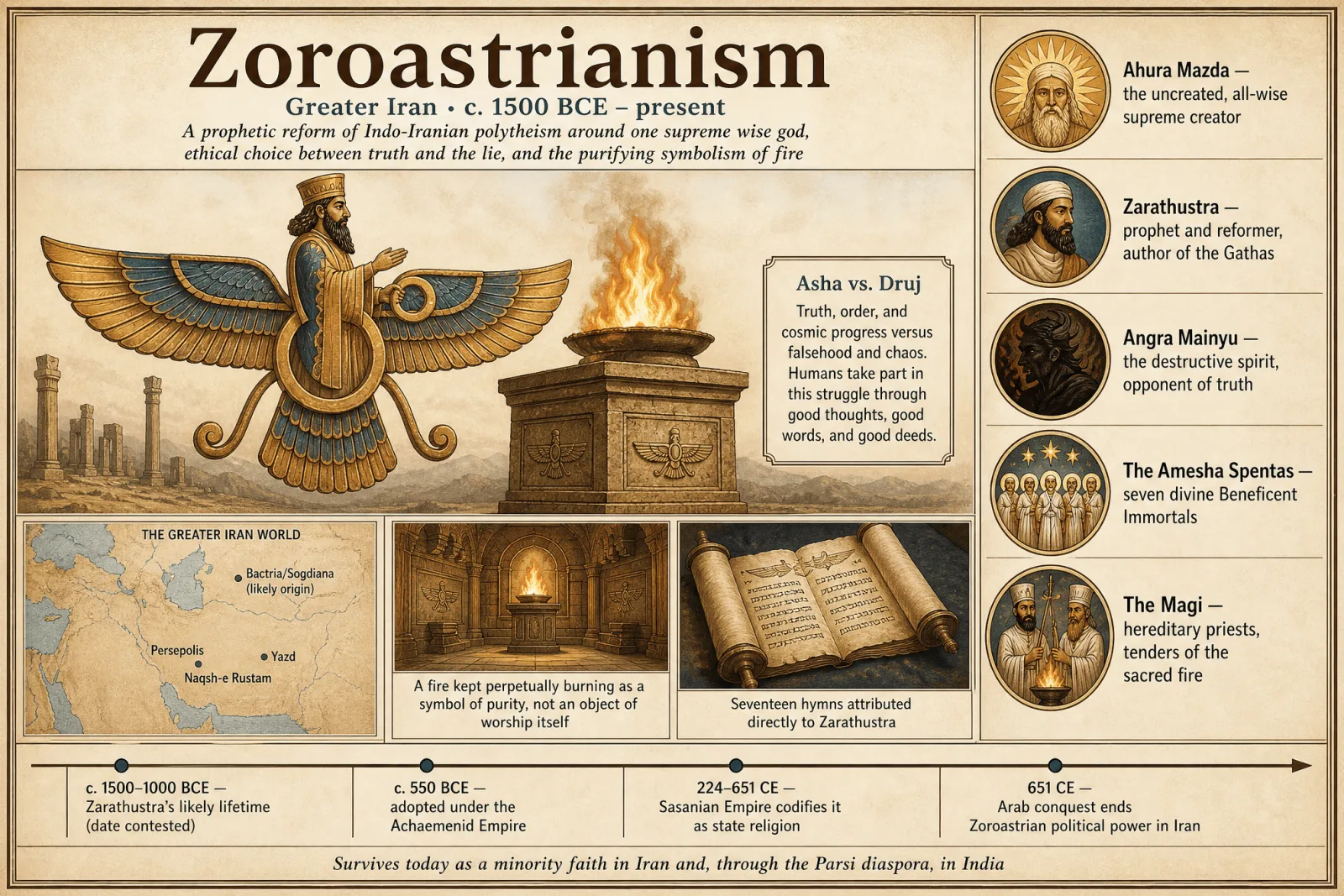
Overview
Zoroastrianism is one of the world's oldest continuously practiced religions, founded by the prophet Zarathustra (Zoroaster in Greek) in ancient Iran. It centers on the worship of Ahura Mazda ('Wise Lord'), the supreme creator deity, and teaches a dualistic cosmology in which the forces of truth and order (asha) are locked in cosmic struggle against falsehood and chaos (druj), led by the destructive spirit Angra Mainyu (Ahriman). Zoroastrianism emphasizes individual moral responsibility, free will, and the power of human beings to choose between good and evil through 'good thoughts, good words, good deeds' (humata, hukhta, hvarshta). The religion profoundly influenced the development of Judaism, Christianity, and Islam through concepts such as angels and demons, heaven and hell, resurrection, final judgment, and apocalyptic eschatology. Zoroastrian ritual centers on the maintenance of sacred fires, which symbolize divine truth, purity, and the presence of Ahura Mazda; priests (magi, later mobed) perform elaborate purification rites and recite prayers from the Avesta, the sacred scripture composed in the ancient Avestan language.
The historical context of Zoroastrianism spans over three millennia. The prophet Zarathustra is traditionally placed in the sixth century BCE by classical sources, though modern scholarship increasingly suggests an earlier date—possibly between 1500 and 1000 BCE—based on linguistic analysis of the oldest Avestan texts (the Gathas, hymns attributed to Zarathustra himself). The dating of Zarathustra remains contested, and his historical biography is obscure; what survives are his hymns, which reveal a prophetic reformer who experienced visions of Ahura Mazda and preached against the polytheistic rituals and animal sacrifices of the older Indo-Iranian religion. Zoroastrianism became the state religion of three successive Iranian empires: the Achaemenid Empire (550–330 BCE), founded by Cyrus the Great; the Parthian Empire (247 BCE–224 CE); and the Sasanian Empire (224–651 CE), during which Zoroastrianism reached its apogee as an organized, hierarchical state religion with a priestly class, codified scriptures, and elaborate theology. The Arab-Islamic conquest of Iran (633–654 CE) brought the end of Zoroastrian political dominance. Many Zoroastrians converted to Islam over the following centuries under varying degrees of pressure, including discriminatory jizya (poll tax), legal disabilities, and periodic persecution. Some Zoroastrians fled to India (arriving between the eighth and tenth centuries CE), where their descendants, the Parsis, preserved and adapted the tradition. Iranian Zoroastrians (Zartoshtis) who remained became a marginalized religious minority.
Today, Zoroastrianism is a small but enduring faith. The global Zoroastrian population is estimated at approximately 100,000–200,000, divided primarily between Iran (where the 2016 census recorded about 23,000 Zoroastrians, though community estimates are higher) and India (where the Parsi community numbered about 57,000 in the 2011 census, down from over 114,000 in 1941 due to low fertility, high median age, emigration, and intermarriage). Smaller diaspora communities exist in Pakistan, the United States, Canada, the United Kingdom, and Australia. Iranian Zoroastrians and Parsis share core beliefs and scriptures but differ in ritual practice, liturgical pronunciation, calendar, and social norms (for example, Parsis traditionally prohibited conversion and required patrilineal descent, though reformist Parsis now debate these boundaries). Contemporary Zoroastrians grapple with demographic decline, questions of identity and authenticity, the tension between orthodoxy and reform, the role of the priesthood, the status of women, interfaith marriage, conversion, and the relationship between Zoroastrianism and modern Iranian and Indian national identities. Despite its small numbers, Zoroastrianism's historical legacy, theological innovations, and cultural contributions—especially in the fields of ethics, law, astronomy, and religious pluralism—remain significant.
Historical Development
The origins of Zoroastrianism lie in the prophetic reform movement initiated by Zarathustra (Zoroaster), a historical figure whose life and times are shrouded in uncertainty. Classical Greek sources, including Aristotle and later Hellenistic writers, placed Zarathustra thousands of years before their own era, reflecting Greek fascination with ancient Eastern wisdom. Zoroastrian tradition, codified in the later Pahlavi texts (Middle Persian religious literature from the Sasanian and early Islamic periods), dates Zarathustra to '258 years before Alexander,' suggesting circa 628–551 BCE. However, modern linguistic and philological scholarship, pioneered by scholars such as Mary Boyce, Prods Oktor Skjærvø, and others, dates the Gathas—the oldest portion of the Avesta and the only texts confidently attributed to Zarathustra himself—to a much earlier period, likely between 1500 and 1000 BCE, based on their archaic language, which closely resembles Rigvedic Sanskrit. The dating of Zarathustra is contested and remains one of the central unsolved problems in the study of ancient Iranian religion. What is clear from the Gathas is that Zarathustra was a priest (zaotar) and visionary prophet who experienced revelations from Ahura Mazda and preached a radical monotheistic or quasi-monotheistic message emphasizing ethical dualism, individual moral choice, and the ultimate triumph of truth over falsehood.
Zarathustra's teachings emerged from the older Indo-Iranian religious tradition shared by the Iranians and the Indo-Aryans (whose religion is preserved in the Rigveda). This tradition featured a pantheon of deities (daevas and ahuras), veneration of natural elements (fire, water, earth), elaborate sacrificial rituals, and a priestly class responsible for maintaining cosmic order. Zarathustra rejected the worship of the daevas (whom he redefined as demons or false gods) and elevated Ahura Mazda as the sole uncreated creator, assisted by six divine emanations or aspects called the Amesha Spentas ('Bounteous Immortals'): Vohu Manah (Good Mind), Asha Vahishta (Best Truth), Khshathra Vairya (Desirable Dominion), Spenta Armaiti (Holy Devotion), Haurvatat (Wholeness), and Ameretat (Immortality). The Gathas depict a cosmic struggle between the twin spirits: Spenta Mainyu (the Bounteous Spirit, associated with Ahura Mazda) and Angra Mainyu (the Destructive Spirit), who made an existential choice at the beginning of creation, one choosing truth (asha) and the other falsehood (druj). This ethical dualism—not a metaphysical dualism of two equal gods—distinguishes Zoroastrianism. Human beings possess free will and must choose between the two paths; their choices have cosmic consequences and determine their fate in the afterlife.
The adoption of Zoroastrianism by the Achaemenid dynasty (founded by Cyrus the Great, who conquered Media, Lydia, and Babylon, establishing the first Persian Empire in 550 BCE) is debated. Cyrus and his successors, especially Darius I (reigned 522–486 BCE), invoked Ahura Mazda in royal inscriptions as the supreme deity who granted them kingship, suggesting Zoroastrian influence. However, other deities, including Mithra and Anahita, continued to be venerated, indicating religious pluralism or syncretism. The Achaemenids practiced religious tolerance: Cyrus famously allowed the exiled Jews to return to Jerusalem and rebuild their Temple, earning him the title of 'messiah' in the Hebrew Bible (Isaiah 45:1). Under Darius and Xerxes, Ahura Mazda was increasingly portrayed as the sole legitimate deity, and inscriptions condemn the worship of the daevas. The royal tombs at Naqsh-e Rostam near Persepolis bear elaborate reliefs showing the king worshiping before a fire altar, with the Faravahar symbol (a winged disk often interpreted as a representation of the divine glory or the guardian spirit, fravashi) hovering above. Despite the prominence of Zoroastrian themes in royal ideology, it is unclear whether Zoroastrianism was a state religion in the Achaemenid period or whether it coexisted with older Iranian polytheism and local cults.
The Parthian Empire (247 BCE–224 CE), founded by the Arsacid dynasty, is even less well documented regarding religion. The Parthians were influenced by Hellenistic culture following Alexander the Great's conquest of the Persian Empire (334–330 BCE) and the subsequent rule of the Seleucid dynasty. Zoroastrianism likely continued to be practiced, but alongside Greek and other Iranian religious traditions. The Sasanian Empire (224–651 CE) marked the florescence of Zoroastrianism as an institutionalized, state-sponsored religion. Ardashir I, the founder of the Sasanian dynasty, claimed descent from the Achaemenids and promoted Zoroastrianism as the empire's official faith. The high priest (mowbedan mowbed, 'priest of priests') became one of the most powerful figures in the empire, and a formal ecclesiastical hierarchy was established. The Sasanian period saw the compilation and codification of the Avesta, which had previously been transmitted orally; the creation of the Zand (Pahlavi commentaries and translations of the Avesta); and the composition of extensive theological, legal, and apologetic literature in Middle Persian (Pahlavi). Zoroastrian orthodoxy was enforced, and heresies such as Zurvanism (a variant that posited Zurvan, 'Time,' as the ultimate principle, father of both Ahura Mazda and Angra Mainyu) and Mazdakism (a communistic religious movement) were suppressed. The Sasanian Zoroastrian establishment also persecuted Christians, Manichaeans, Jews, and Buddhists at various times, though treatment varied by reign.
The Arab-Islamic conquest of the Sasanian Empire (beginning in 633 CE and culminating in the Battle of Nahavand in 642 CE and the death of the last Sasanian king, Yazdegerd III, in 651 CE) was catastrophic for Zoroastrianism. The new Muslim rulers initially tolerated Zoroastrians as 'People of the Book' (ahl al-kitab), allowing them to practice their religion in exchange for the payment of jizya (poll tax) and acceptance of second-class legal status (dhimmi). However, Zoroastrians faced significant social and economic pressure to convert. Over the following centuries, the majority of Iranians gradually converted to Islam, and Zoroastrian communities shrank. Some Zoroastrians, unwilling to accept dhimmi status or unable to pay the jizya, emigrated. A group of Zoroastrians, according to the Qissa-i Sanjan (a 16th-century Persian epic poem recounting the migration), fled from the region of Greater Khorasan and sailed to the western coast of India, landing at Sanjan in Gujarat. The Qissa places this migration in the eighth century, though modern scholarship debates the precise date and suggests waves of migration over several centuries. These migrants, who became known as Parsis (Persians), established the first fire temple in India around 721 CE (according to tradition) and preserved Zoroastrian ritual, scriptures, and priestly lineages. Parsis thrived under the relatively tolerant rule of Hindu kingdoms and later the British colonial administration, and they became a prosperous, educated, and influential minority in India, particularly in Mumbai (Bombay). Meanwhile, Zoroastrians who remained in Iran (Zartoshtis) endured periodic persecution, forced conversions, and legal discrimination under successive Islamic dynasties, though some communities in Yazd, Kerman, and Tehran survived and maintained their faith. In the 20th century, the Pahlavi dynasty (1925–1979) promoted Iranian nationalism and pre-Islamic heritage, improving the status of Zoroastrians in Iran, though this was reversed after the 1979 Islamic Revolution, which reintroduced certain legal disabilities for religious minorities.
Core Worldview and Doctrines
Zoroastrianism's central theological affirmation is the supremacy and goodness of Ahura Mazda, the 'Wise Lord,' the uncreated, eternal, omniscient, and omnipotent creator of the universe. Ahura Mazda is the source of all that is good, true, and orderly. The universe, according to Zoroastrian cosmology, was created in a perfect state but was invaded by Angra Mainyu (Ahriman), the Destructive Spirit, who introduced death, disease, suffering, and moral evil. This dualistic cosmology is not metaphysical dualism in the strict sense—Angra Mainyu is not a co-eternal god but a destructive force that will ultimately be defeated. The cosmic history of Zoroastrianism unfolds in three epochs: creation (bundahishn), when the world was perfect; mixture (gumezishn), the current era in which good and evil coexist and struggle; and separation (wizarishn), the future time when good and evil will be finally separated, evil will be destroyed, and the world will be restored to perfection in a state called frashokeret (the 'making wonderful' or final renovation of the universe). This eschatological hope distinguishes Zoroastrianism from cyclical cosmologies and anticipates Judeo-Christian-Islamic apocalyptic thought.
The ethical dualism of Zoroastrianism is expressed in the fundamental opposition between asha (truth, order, righteousness) and druj (falsehood, chaos, wickedness). Asha is the cosmic principle of truth and right order that governs both the physical universe and moral life; to follow asha is to live in harmony with the divine will and the natural order. Druj is the principle of deception, disorder, and destruction, and to follow druj is to align oneself with Angra Mainyu. Human beings are endowed with free will and must choose between asha and druj, between good and evil. The moral imperative of Zoroastrianism is encapsulated in the threefold maxim: humata, hukhta, hvarshta—'good thoughts, good words, good deeds.' Zoroastrianism emphasizes personal moral responsibility; each individual's choices have consequences not only for their own soul but for the cosmic struggle between good and evil. The righteous support Ahura Mazda and hasten the final victory of good, while the wicked serve Angra Mainyu and prolong the era of mixture.
Zoroastrianism posits a rich angelology and demonology. The six Amesha Spentas ('Bounteous Immortals')—Vohu Manah (Good Mind), Asha Vahishta (Best Truth), Khshathra Vairya (Desirable Dominion), Spenta Armaiti (Holy Devotion), Haurvatat (Wholeness), and Ameretat (Immortality)—are hypostases or emanations of Ahura Mazda, representing divine qualities and aspects of creation (fire, metals, earth, water, plants, and cattle, respectively). They are sometimes understood as archangels or as aspects of God. Yazatas ('beings worthy of worship') are lesser divine beings, including ancient Iranian deities such as Mithra (yazata of covenant, light, and justice), Anahita (yazata of waters and fertility), and Sraosha (yazata of obedience and divine command). These yazatas were reinterpreted within the Zoroastrian framework as servants of Ahura Mazda rather than independent gods. Opposing the divine beings are the daevas (demons), evil spirits led by Angra Mainyu, who promote falsehood, violence, and corruption. The daevas include personifications of vices such as Aeshma (Wrath), Aka Manah (Evil Mind), and Druj (the Lie).
Zoroastrian anthropology holds that human beings are composite beings, consisting of a material body (tan), a soul (urvan), and a fravashi (a pre-existing spiritual essence or guardian spirit that exists before birth and continues after death). The fravashi fights on behalf of the individual in the cosmic struggle and is venerated in Zoroastrian ritual, especially during the festival of Farvardigan (Muktad), when the souls of the deceased are commemorated. At death, the soul lingers near the body for three days before journeying to the Chinvat Bridge (the Bridge of Judgment), which spans the abyss between earth and the afterlife. At the bridge, the soul's thoughts, words, and deeds are weighed; the righteous cross safely into the House of Song (paradise), while the wicked fall into the House of Lies (hell), a place of torment and darkness. However, punishment is not eternal; at the end of time, all souls will be purified, and even the wicked will be redeemed and reunited with Ahura Mazda in the final renovation.
Eschatology is central to Zoroastrianism. The coming of a savior figure, the Saoshyant ('one who brings benefit'), is prophesied in the Avesta. At the end of the current era of mixture, the Saoshyant will be born of a virgin impregnated by the preserved seed of Zarathustra (in one version) and will lead the final battle against Angra Mainyu and the forces of evil. The dead will be resurrected in bodily form and judged. A river of molten metal will flow across the earth, purifying both the living and the dead; the righteous will pass through it unharmed, but the wicked will be purged of their sins. Angra Mainyu and his demons will be destroyed, death and evil will be annihilated, and the universe will be restored to its original perfect state. All souls will be reunited with their bodies, and humanity will live forever in a paradise on earth in the presence of Ahura Mazda. This eschatological vision influenced Jewish apocalypticism (especially during and after the Babylonian Exile), Christian eschatology (the resurrection of the dead, final judgment, and the kingdom of God), and Islamic eschatology (the Day of Judgment, the bridge Sirat, and the final paradise).
Sacred Texts and Canon
The Avesta is the sacred scripture of Zoroastrianism, composed in the Avestan language, an ancient Iranian language closely related to Vedic Sanskrit. The Avesta as it exists today is only a fragment of a much larger corpus that was transmitted orally for centuries before being written down, possibly during the Sasanian period (224–651 CE). The complete Avesta, according to later Pahlavi sources, comprised 21 books (nasks), encompassing religious doctrine, ritual, law, cosmology, and legend, but much of it was lost during the upheavals of the Arab conquest and subsequent centuries. The extant Avesta consists of several distinct parts. The most ancient and sacred is the Yasna ('Worship'), a liturgical text recited during the central Zoroastrian ritual; embedded within the Yasna are the Gathas, seventeen hymns attributed to Zarathustra himself, composed in Old (Gathic) Avestan. The Gathas are the most authoritative texts in Zoroastrianism, revered as the direct words of the prophet. They are complex, allusive, and often obscure, reflecting Zarathustra's visionary encounters with Ahura Mazda, his ethical teachings, and his condemnation of the daevas and their worshipers.
The Visperad ('All the Lords') is a supplementary liturgical text, an extension of the Yasna. The Vendidad (Vidēvdād, 'Law Against Demons') is a priestly code concerned with purity laws, rituals of purification, and regulations to combat demonic contamination. It covers topics such as the treatment of corpses (which are considered highly polluting), the care of dogs and other animals, the purification of those who have been defiled, and the penalties for various ritual infractions. The Vendidad reflects the Zoroastrian emphasis on physical and spiritual purity, particularly the avoidance of contamination by corpses, which are believed to be immediately invaded by the corpse-demon Nasu. The Yashts ('Hymns of Praise') are a collection of 21 hymns dedicated to various yazatas, including Mithra (Yasht 10), Anahita (Yasht 5), and the Fravashis (Yasht 13). The Yashts preserve much older Iranian mythology and provide detailed descriptions of the yazatas' powers and the benefits they bestow on their worshipers. The Khordeh Avesta ('Little Avesta') is a collection of daily prayers and short texts used by lay Zoroastrians, including the Ashem Vohu, Yatha Ahu Vairyo, and other invocations.
In addition to the Avesta, Zoroastrian literature includes a vast body of exegetical, theological, legal, and cosmological texts composed in Middle Persian (Pahlavi) during and after the Sasanian period. The Zand ('Explanation') comprises Pahlavi translations and commentaries on the Avesta, providing interpretations and elaborations on the original scriptures. The Denkard ('Acts of Religion'), compiled in the ninth and tenth centuries CE, is an encyclopedic compendium of Zoroastrian doctrine, cosmology, eschatology, ethics, and polemics against heretics, Manichaeans, Christians, and Muslims. It is one of the most important sources for Zoroastrian theology and history. The Bundahishn ('Primal Creation') is a cosmogonic and cosmological text that narrates the creation of the world by Ahura Mazda, the assault of Angra Mainyu, and the structure of the universe, including descriptions of the celestial bodies, geography, and the various classes of beings (humans, animals, plants, and spiritual entities). The Arda Viraz Namag ('Book of Arda Viraz') is an apocalyptic text recounting the journey of the righteous priest Arda Viraz to heaven and hell, where he witnesses the rewards of the righteous and the punishments of the wicked. It influenced later Jewish, Christian, and Islamic visions of the afterlife, including Dante's Divine Comedy. The Shkand-Gumanic Vijar ('Doubt-Dispelling Exposition') is an apologetic work defending Zoroastrianism against the criticisms of Jews, Christians, Muslims, and Manichaeans, addressing questions of theodicy, free will, and the existence of evil.
The transmission and preservation of Zoroastrian texts have been shaped by historical vicissitudes. During the Islamic period, Zoroastrian priests (mobed) in Iran and Parsi priests in India maintained and copied the Avesta and Pahlavi texts by hand, despite the decline in the number of literate priests and the challenges of maintaining a religious tradition in diaspora and under minority status. In the 19th century, European Orientalists such as Anquetil-Duperron (who first translated the Avesta into a European language, French, in 1771), Martin Haug, and others began to study and publish Zoroastrian texts, sparking renewed scholarly and communal interest. Parsi reformers such as Dastur Dhalla engaged with Western scholarship and debated the interpretation of Zoroastrian doctrines in light of modernity. The establishment of the K. R. Cama Oriental Institute in Mumbai and the presence of Zoroastrian scholars in Western universities have ensured the continued study and preservation of the Avestan and Pahlavi literary corpus.
Practices and Observances
Fire is the central symbol and sacred element in Zoroastrian ritual. It represents asha (truth and order), the divine presence of Ahura Mazda, and the light that dispels darkness and falsehood. Zoroastrians do not worship fire itself—fire worship is a persistent misconception—but rather venerate fire as a visible manifestation of divine truth and purity. Zoroastrian worship takes place in fire temples (atashkadeh or dar-e mehr), where a sacred fire is maintained continuously and tended by priests. There are three grades of sacred fire, each consecrated with elaborate rituals involving the gathering and purification of fires from multiple sources. The highest grade, Atash Behram ('Victorious Fire'), requires the collection and purification of sixteen different types of fire (from lightning, a potter's kiln, a metalworker's furnace, and other sources) over a period of up to a year, and only a handful of Atash Behrams exist, most of them in India. The fire is placed in a silver or brass vessel (afarghan) on a stone pedestal in the inner sanctum of the temple, and priests perform rituals before it, offering sandalwood and prayers five times a day. Lay worshipers do not enter the inner sanctum but pray in the outer hall, facing the fire through a doorway or window.
Purity (purity from pollution by death, bodily effluvia, and moral defilement) is a fundamental concern in Zoroastrian practice. Corpses are considered highly polluting because they are immediately invaded by the corpse-demon Nasu, and elaborate purification rituals are required for anyone who has come into contact with a dead body. Traditional Zoroastrian funerary practice, designed to avoid polluting the sacred elements of earth, fire, and water, involves exposing the corpse to vultures and other carrion birds in structures called dakhmas (Towers of Silence). The corpse is carried by corpse-bearers (nasasalars) to the tower, placed on a stone platform divided into three concentric rings (for men, women, and children), and left to be consumed by vultures. Once the bones are picked clean and bleached by the sun, they are placed in a central ossuary pit. This practice, once common in Iran and still practiced by orthodox Parsis in Mumbai (at the Doongerwadi), has declined due to the near-extinction of vultures (caused by the veterinary drug diclofenac, which is toxic to scavenging birds), urbanization, changing attitudes, and legal prohibitions (exposure of corpses was banned in Iran in the 1960s–1970s). Many Zoroastrians now practice burial in cement-lined graves (to prevent contact with the earth) or cremation, though the latter is controversial because it involves polluting fire with a corpse.
Zoroastrian ritual life includes daily prayers (farajyat, 'duty'), which practicing Zoroastrians recite five times a day: at sunrise, noon, sunset, midnight, and dawn. These prayers, drawn from the Khordeh Avesta, include the Ashem Vohu (a short invocation of asha), the Yatha Ahu Vairyo (the Ahuna Vairya, the most sacred mantra), and other formulas. Prayers are recited in Avestan, a language no longer spoken, and the tradition emphasizes the sacred power of the words themselves (mantra), independent of the reciter's comprehension. Before praying, Zoroastrians perform a ritual ablution (padyab) to purify themselves. Prayer is accompanied by the untying and retying of the kusti (a sacred cord woven of 72 threads of lamb's wool, symbolizing the 72 chapters of the Yasna) worn around the waist over a white undergarment (sudra or sedreh), which all initiated Zoroastrians wear as symbols of their faith. The investiture ceremony (navjote among Parsis, sedreh-pushi among Iranian Zoroastrians), typically performed for children between the ages of seven and twelve, is the initiation into the Zoroastrian community, in which the child receives the sudra and kusti and makes the formal profession of faith.
Zoroastrian festivals (jashans or gahambars) celebrate the agricultural cycle, commemorate the creation, and honor the divine beings. The Zoroastrian calendar (which exists in multiple versions, causing communal disputes) divides the year into twelve months of 30 days each, plus five intercalary days, with each day and month named after a yazata. The most important festival is Nowruz (New Day), the Persian New Year, celebrated at the spring equinox (around March 21). Nowruz is a universal Iranian festival, celebrated by Zoroastrians, Muslims, and others throughout the Persian cultural sphere, and it involves spring cleaning, family gatherings, the setting of the haft-sin table (with seven symbolic items), and communal feasting. For Zoroastrians, Nowruz also has religious significance as the day of creation. The six seasonal festivals (gahambars) mark key moments in the agricultural year and commemorate the six stages of creation; they are communal celebrations involving prayers, feasting, and charitable giving. Sadeh (mid-winter fire festival) celebrates the discovery of fire and the triumph of light over darkness; large bonfires are kindled, and Zoroastrians gather to pray and celebrate. Farvardigan (Muktad or Hamaspathmaedaya), the ten-day festival at the end of the year, is dedicated to the fravashis (guardian spirits) of the deceased; families commemorate their ancestors, and priests perform special liturgies. Khordad Sal and Zartosht-no-diso commemorate the birth and death of Zarathustra, respectively.
Internal Diversity: Iranian Zoroastrians and Parsis
The Zoroastrian community is divided into two primary groups: Iranian Zoroastrians (Zartoshtis) and Parsis (Indian Zoroastrians). Both groups share the same core scriptures (the Avesta), fundamental beliefs (the supremacy of Ahura Mazda, ethical dualism, the cosmic struggle between good and evil, and eschatological hope), and the veneration of fire, but they differ in ritual practice, liturgical pronunciation, calendar, and social customs. Iranian Zoroastrians, numbering approximately 23,000–30,000 (according to the 2016 Iranian census and community estimates), live primarily in Tehran, Yazd, and Kerman. They have historically been a marginalized minority in an Islamic society, facing legal and social discrimination, though they have also maintained a distinct identity and cultural resilience. Under the Pahlavi dynasty (1925–1979), Zoroastrians experienced a revival of status and pride in pre-Islamic Iranian heritage, but the 1979 Islamic Revolution reintroduced certain legal disabilities, such as restrictions on testimony in court, inheritance rights, and public religious expression. Despite these challenges, Iranian Zoroastrians have preserved ancient pilgrimage sites, fire temples, and communal institutions, and they continue to practice traditional rituals, including the maintenance of sacred fires and the celebration of festivals.
The Parsi community of India, numbering approximately 57,000 (according to the 2011 Indian census), is descended from Zoroastrians who migrated from Iran to Gujarat beginning in the eighth to tenth centuries CE. The Qissa-i Sanjan, a 16th-century Persian poem, recounts that the Hindu king Jadi Rana granted the refugees asylum on the condition that they adopt Gujarati language, dress, and some local customs, and that they explain their religion to him. The Parsis established the Iranshah Atash Behram, the holiest fire in India (consecrated according to tradition in 721 CE and now enshrined in Udvada, Gujarat), and developed a distinct Parsi identity that blends Iranian Zoroastrian tradition with Indian cultural elements. Parsis speak Gujarati as their mother tongue, though they preserve liturgical Avestan and some Persian (especially in religious contexts). Parsi cuisine, dress, and social customs reflect Indian influence. Under British colonial rule, Parsis became one of the most prosperous and influential communities in India, contributing significantly to commerce, industry, education, and public service; prominent Parsi families such as the Tatas (industrialists), Wadias (shipbuilders), and Godrej (industrialists) shaped modern India. Parsis are concentrated in Mumbai (Bombay), though communities also exist in Pune, Surat, Navsari, and other cities.
Ritual differences between Iranian Zoroastrians and Parsis include pronunciation of Avestan prayers (Parsis follow the Indian pronunciation tradition taught by their priestly lineages; Iranians follow the Iranian tradition), calendar systems (multiple Zoroastrian calendars exist, differing by up to a month, leading to different dates for festivals such as Nowruz), and funerary practices (orthodox Parsis in Mumbai still practice exposure of corpses in Towers of Silence, while most Iranian Zoroastrians now bury their dead in cement-lined graves or, increasingly, cremate). The priesthood (mobed in Iranian usage, dastur or ervad among Parsis) is hereditary in both communities, restricted to male descendants of priestly families. However, the training, ordination, and roles of priests differ somewhat between Iran and India. Parsi priests undergo elaborate initiation rites (navar and maratab) and maintain a complex system of ritual purity; Iranian priests have adapted to a minority context with fewer resources and a less centralized ecclesiastical structure.
Social and religious controversies divide the Zoroastrian community, particularly the Parsi community in India. Traditionally, Parsis have defined membership by patrilineal descent (a child is Parsi if the father is Parsi) and have forbidden both intermarriage (a Parsi woman who marries a non-Parsi was traditionally excommunicated and lost her Parsi identity) and conversion (Zoroastrianism does not accept converts). These rules have contributed to demographic decline, as intermarriage rates have increased and many Parsis, especially women, marry outside the community. Reformist Parsis advocate for the acceptance of children of Parsi mothers (patrilineal descent), the reinstatement of Parsi women who marry non-Zoroastrians, and the acceptance of sincere converts (especially spouses of Parsis). Orthodox Parsis, led by traditionalist priests and institutions such as the Bombay Parsi Punchayet (the community trust that administers Parsi properties and fire temples in Mumbai), resist these changes, arguing that they violate ancient tradition and threaten Zoroastrian purity and identity. Iranian Zoroastrians, facing similar demographic challenges, have been somewhat more flexible, and some Iranian mobeds have accepted conversion and intermarriage. Diaspora Zoroastrian communities in North America, Europe, and Australia tend to be more liberal, accepting converts and interfaith families, reflecting the pragmatic realities of minority life in pluralistic societies.
Communities and Demographics
The global Zoroastrian population is estimated at approximately 100,000–200,000, making Zoroastrianism one of the smallest major world religions. Accurate demographic data is difficult to obtain due to differing definitions of who counts as a Zoroastrian (by birth only, or including converts?), the challenges of census-taking in diaspora communities, and political sensitivities in Iran. The 2012 study by the Federation of Zoroastrian Associations of North America (FEZANA) estimated a global Zoroastrian population of approximately 111,691–121,962, with the largest populations in India (approximately 57,000–61,000, according to the 2011 Indian census) and Iran (approximately 19,000–25,000, according to the 2006 and 2016 Iranian censuses, though community estimates suggest higher numbers, up to 30,000). The Parsi population in India has been in steep decline since the mid-20th century: in 1941, there were approximately 114,890 Parsis; by 2011, the number had fallen to 57,264, a decline of nearly 50%. This decline is attributed to low fertility rates (Parsis have one of the lowest total fertility rates of any community in the world, well below replacement level), high median age, emigration (especially to North America, the United Kingdom, and Australia), and intermarriage (about 40–50% of Parsis now marry outside the community).
Iranian Zoroastrians (Zartoshtis) have also faced demographic challenges, including historical persecution, forced conversions, legal discrimination, emigration, and low birth rates. The 2016 Iranian census recorded 23,109 Zoroastrians, a slight increase from 19,823 in 2006, though some scholars and community leaders believe the true number is higher, as some Zoroastrians may not identify themselves to census-takers due to fear of discrimination or a desire for privacy. Iranian Zoroastrians are concentrated in Tehran (where a significant community has developed since the 20th century, drawn by economic opportunities), Yazd (historically the heartland of Iranian Zoroastrianism, with ancient fire temples, pilgrimage sites, and a visible Zoroastrian presence), and Kerman. Under the Islamic Republic of Iran, Zoroastrians are recognized as a protected religious minority (ahl al-kitab, People of the Book) and are allowed to practice their religion, maintain their own schools and community centers, and elect one representative to the Iranian parliament (Majlis). However, they face legal disabilities in matters of inheritance, testimony, and marriage, and societal prejudice persists.
Diaspora Zoroastrian communities have grown significantly since the mid-20th century, driven by emigration from India, Iran, and Pakistan. The largest diaspora communities are in the United States (estimated 10,000–20,000), Canada (approximately 5,000–10,000), the United Kingdom (approximately 5,000), and Australia (approximately 3,000–5,000). Diaspora Zoroastrians have established associations, community centers, and fire temples in major cities such as New York, Los Angeles, Toronto, London, and Sydney. These communities are diverse, including both Parsis and Iranian Zoroastrians (and increasingly individuals of mixed heritage), and they face the challenges of transmitting language, ritual, and identity to younger generations born and raised in secular, pluralistic societies. Diaspora Zoroastrians have pioneered innovations such as youth summer camps, online religious education, interfaith engagement, and the founding of new fire temples and cultural centers. Organizations such as FEZANA, the World Zoroastrian Organisation, the Zoroastrian Association of Metropolitan Chicago, and the California Zoroastrian Center coordinate communal activities, publish newsletters and journals, and advocate for the community's interests.
Contemporary Zoroastrian identity is shaped by the tension between tradition and modernity, the memory of ancient glory and the reality of minority status, and the challenges of demographic decline and cultural assimilation. Zoroastrians debate questions of conversion (should non-Zoroastrians be allowed to convert?), intermarriage (should children of mixed marriages be accepted as Zoroastrians?), the role of women (can women become priests? should matrilineal descent be recognized?), the interpretation of scriptures (should the Avesta be read literally or symbolically?), and the relationship between religion and ethnicity (is Zoroastrianism a religion, an ethnicity, or both?). Some Zoroastrians embrace a universalist interpretation of their faith, emphasizing ethical monotheism, environmental stewardship, and the compatibility of Zoroastrianism with modernity and science. Others advocate for a return to traditional orthodoxy, the maintenance of ritual purity, and the preservation of ethnic and cultural boundaries. Despite these internal debates and the challenges of demographic decline, Zoroastrianism endures as a living tradition, sustained by devoted priests, engaged laypeople, and a diasporic network that spans the globe.
Sacred Places and Pilgrimage Sites
Yazd Atash Behram, Yazd, Iran: Yazd, a desert city in central Iran, is the heart of contemporary Iranian Zoroastrianism. The Yazd Atash Behram (Fire Temple), built in 1934, houses a sacred fire that has reportedly burned continuously since 470 CE, making it one of the oldest continuously burning fires in the Zoroastrian world. The fire was moved multiple times over the centuries to protect it from invaders and persecution before being enshrined in its current location. The Yazd Atash Behram is the holiest fire temple in Iran and a major pilgrimage site for Iranian Zoroastrians. The temple's elegant brick architecture, with its distinctive fire symbol on the facade, is a landmark of Yazd. Approximately 25,000 Iranian Zoroastrians and Parsi pilgrims from India visit the fire temple annually to pray and renew their connection to the ancient faith. The Historic City of Yazd, which preserves traditional Persian architecture, wind towers (badgirs), qanats (underground water channels), and a distinct Zoroastrian quarter, was inscribed on the UNESCO World Heritage List in 2017. The city's Zoroastrian heritage is visible in its fire temples, ossuaries, and communal institutions, and it serves as a living symbol of Zoroastrian continuity in Iran.
Chak Chak (Pir-e Sabz), near Yazd, Iran: Chak Chak, also called Pir-e Sabz ('Green Pir'), is the most sacred mountain shrine of Zoroastrianism, located approximately 52 kilometers from Yazd in the arid mountains near the town of Ardakan. The name 'Chak Chak' ('Drip-Drip' in Persian) derives from the sound of water perpetually dripping from the rocks inside the shrine's grotto. According to Zoroastrian tradition, Chak Chak is where Nikbanou, the daughter of the last Sasanian king Yazdegerd III, fled during the Arab conquest of Iran (circa 640 CE). Cornered by the Arab army and facing capture, she prayed to Ahura Mazda for deliverance, and the mountain miraculously opened to shelter her. The dripping water is said to be her tears of grief, and an ancient plane tree growing beside the spring is believed to have sprouted from her staff. The shrine is a man-made grotto cut into the cliff face, reached by climbing approximately 300–360 stone steps. Inside, a sacred fire burns continuously, and the walls are darkened by centuries of soot. Each year from June 14 to 18, thousands of Zoroastrians from Iran, India, and the diaspora gather at Chak Chak for a major pilgrimage (ziyarat), during which they recite prayers from the Avesta, light candles, share traditional foods (including seerag bread), and celebrate their faith. The pilgrimage is restricted to Zoroastrians during these days, though the site is open to tourists at other times. Chak Chak embodies the themes of refuge, resilience, and the sanctity of fire, water, and rock in Zoroastrian spirituality.
Persepolis and Naqsh-e Rostam, Fars Province, Iran: Persepolis, the ceremonial capital of the Achaemenid Empire, and the nearby necropolis of Naqsh-e Rostam are among the most important archaeological sites in Iran and hold profound symbolic significance for Zoroastrians as monuments to the empire during which Zoroastrianism first became associated with royal power. Persepolis, founded by Darius I around 518 BCE and expanded by Xerxes and Artaxerxes I, was inscribed on the UNESCO World Heritage List in 1979. The site's monumental staircases, palaces, and reliefs depict the Achaemenid kings receiving tribute from the peoples of the empire, and many of the inscriptions invoke Ahura Mazda as the supreme deity who granted the king his throne. The reliefs show the king worshiping before a fire altar, and the Faravahar symbol—a winged disk often interpreted as a representation of divine glory or the fravashi—is prominently displayed. Naqsh-e Rostam, located a few kilometers from Persepolis, contains the rock-cut tombs of four Achaemenid kings (Darius I, Xerxes I, Artaxerxes I, and Darius II) carved into a cliff face. The tombs are adorned with reliefs showing the king standing on a throne supported by representatives of the subject nations, with the Faravahar hovering above. At the foot of the cliff stands the enigmatic Ka'ba-ye Zartosht (Kaaba of Zoroaster), a square stone tower whose function is debated (theories include fire temple, royal treasury, or mausoleum). The site also features Sasanian-era reliefs depicting the investiture of kings and the triumph of Shapur I over the Roman emperors Valerian and Philip the Arab. For Zoroastrians, Persepolis and Naqsh-e Rostam are symbols of the golden age of Zoroastrianism and the grandeur of pre-Islamic Iranian civilization, and they are visited as sites of historical and spiritual pilgrimage.
Towers of Silence (Dakhmas), Yazd, Iran, and Mumbai, India: The Towers of Silence (dakhmas) are circular stone platforms used traditionally by Zoroastrians for the disposal of the dead through exposure to vultures and the elements, a practice rooted in the belief that corpses pollute the sacred elements of earth, water, and fire. The dakhmas near Yazd, located about 15 kilometers south of the city on two hilltops, date from the 17th century and were last used in the 1960s–1970s, when the practice was banned by the Iranian government. The older tower commands a panoramic view of the desert and the city below, and it remains a site of historical and cultural significance, visited by Zoroastrians and tourists as a monument to traditional Zoroastrian funerary practice. In Mumbai, India, the Doongerwadi, a 54-acre forested hilltop on Malabar Hill, houses the Towers of Silence used by the Parsi community. The Doongerwadi's main tower, approximately 300 years old, is situated in a serene, tree-covered sanctuary inhabited by peacocks and other birds. Orthodox Parsis continue to practice exposure of corpses at Doongerwadi, though the near-extinction of vultures (caused by the veterinary drug diclofenac) has created practical and spiritual challenges. In the absence of vultures, solar concentrators were installed to accelerate decomposition, but they are now defunct, and the community debates whether to restore them, attempt to reintroduce vultures through aviaries, or adopt cremation or burial. The Doongerwadi is closed to non-Zoroastrians, reflecting its sacred and private nature. The Towers of Silence symbolize Zoroastrian reverence for the purity of the elements and the belief that death, though inevitable, must be managed with ritual care to prevent pollution and uphold cosmic order.
Udvada Iranshah Atash Behram, Gujarat, India: Udvada, a small coastal town in Gujarat, is the most sacred pilgrimage site for Parsi Zoroastrians. The Iranshah Atash Behram, housed in Udvada since 1742, is the holiest fire in India and one of only nine Atash Behrams in the world (eight of which are in India). According to Parsi tradition, the Iranshah fire was brought from Iran by the first Zoroastrian refugees who arrived in Gujarat, and it was consecrated in Sanjan (about 30 kilometers south of Udvada) around 721 CE after a lengthy and elaborate ritual requiring the collection and purification of sixteen types of fire. Over the centuries, the fire was moved multiple times for safety—to the Bahrot caves to escape the armies of the Delhi Sultanate (14th century), to Bansda, and then to Navsari, where it remained for over two centuries. In 1742, the Sanjana priestly families, who have the hereditary responsibility of tending the fire, moved it to Udvada, where it has remained. The current fire temple building was constructed in 1894 by Motlibai Wadia. The Iranshah fire is tended continuously by the nine Sanjana priestly families, and only Zoroastrian priests who have undergone the samel examination (proving their ritual expertise) are permitted to enter the inner sanctum and offer prayers before the fire. Parsis from across India and the diaspora make pilgrimage to Udvada to pray before the Iranshah, especially during festivals and significant life events. The Iranshah is a symbol of Parsi identity, continuity, and the preservation of the sacred fire tradition that links the Parsis to their Iranian homeland and to the ancient lineage of Zarathustra.
Sanjan, Gujarat, India: Sanjan, a small town on the coast of Gujarat, is revered by Parsis as the site of their first settlement in India. According to the Qissa-i Sanjan, a group of Zoroastrian refugees fleeing persecution in Iran landed at Sanjan (the date is debated, but traditionally placed in the eighth to tenth centuries CE), where the local Hindu king Jadi Rana granted them asylum on the condition that they adopt local dress, speak Gujarati, explain their religion, and agree not to proselytize or carry weapons. The refugees established the first Zoroastrian community in India and consecrated the Iranshah Atash Behram in Sanjan around 721 CE. The fire remained in Sanjan for several centuries until the town was attacked by the armies of the Delhi Sultanate in the late 14th century, forcing the priests to flee with the fire to the Bahrot caves. Today, Sanjan is a pilgrimage site for Parsis, who visit to honor the memory of their ancestors and to commemorate the arrival of Zoroastrianism in India. A memorial column (stambh) marks the traditional site of the first landing, and an annual jashne (celebration) is held in Sanjan to remember the historic migration. Sanjan symbolizes the Parsi narrative of exile, refuge, and resilience, and it is central to Parsi communal identity and historical memory.
Contemporary Debates and Contested Issues
The dating and historicity of Zarathustra remain among the most contested issues in Zoroastrian studies. Classical Greek sources and later Zoroastrian tradition place Zarathustra in the sixth century BCE ('258 years before Alexander'), but modern linguistic scholarship, based on the archaic language of the Gathas (Old Avestan, closely related to Rigvedic Sanskrit), suggests an earlier date, likely between 1500 and 1000 BCE. Some scholars place Zarathustra as early as 1500–1200 BCE, contemporary with the composition of the Rigveda; others favor 1000–600 BCE. The lack of external historical evidence for Zarathustra's life (no contemporary non-Zoroastrian source mentions him) complicates the debate. The question of dating has implications for understanding the development of Iranian religion, the relationship between Zoroastrianism and Vedic religion, and the possible influence of Zoroastrianism on other religious traditions (Judaism, Buddhism, Greek philosophy). Scholars including Mary Boyce, Prods Oktor Skjærvø, and Gherardo Gnoli have contributed to this ongoing discussion, but no consensus has been reached, and the dating of Zarathustra remains an open question.
Conversion and identity boundaries are hotly debated within the Zoroastrian community, particularly among Parsis in India. Traditionally, Zoroastrianism has been defined as an ethnoreligious community: one is born a Zoroastrian (by patrilineal descent among Parsis, or by descent from a Zoroastrian parent among Iranian Zoroastrians) rather than becoming one through conversion. This traditional stance, rooted in centuries of minority experience and the desire to preserve communal identity, has led to the prohibition of conversion and the excommunication of Zoroastrian women who marry non-Zoroastrians. However, these restrictions have contributed to demographic decline, as intermarriage rates increase and many children of mixed parentage are excluded from the community. Reformist Zoroastrians, including some priests, scholars, and laypeople, argue that Zoroastrianism should return to its universalist origins (the Gathas do not restrict the faith to a particular ethnicity) and accept sincere converts, especially spouses of Zoroastrians, in order to ensure the survival of the religion. Orthodox opponents argue that conversion violates sacred tradition, dilutes the ethnic and cultural purity of the community, and risks fraudulent conversions by those seeking material benefits. The debate is particularly fierce among Parsis, where legal battles have been fought over the right of converted individuals to enter fire temples and to receive Zoroastrian funerary rites. In Iran, some mobeds have quietly accepted conversion, and the global diaspora is increasingly open to converts, reflecting pragmatic adaptation to minority status.
The status and role of women in Zoroastrian religious life is another contested issue. In ancient Zoroastrianism, women participated in religious rituals, and the Avesta mentions female priests and religious teachers. However, over the centuries, under the influence of patriarchal social norms in both Iran and India, women were increasingly excluded from priestly functions and from certain sacred spaces (such as the inner sanctum of fire temples). Today, women are not permitted to become ordained priests (mobed/dastur) in orthodox Zoroastrian communities, and in some fire temples, menstruating women are prohibited from entering or performing certain rituals, reflecting ancient purity laws. Reformist Zoroastrians, especially in the diaspora, challenge these restrictions, arguing that they have no scriptural basis and that women should be allowed full participation in religious life, including ordination as priests. Some progressive Zoroastrian communities in North America have ordained female mobeds, though these ordinations are not recognized by orthodox institutions. The question of matrilineal descent (whether a child of a Zoroastrian mother and non-Zoroastrian father should be accepted as a Zoroastrian) is also debated, with reformists advocating for recognition of matrilineal descent and traditionalists insisting on patrilineal descent as the only legitimate criterion.
Funerary practices and the future of the dakhma (Tower of Silence) system are urgent practical and theological issues. The traditional Zoroastrian practice of disposing of corpses by exposure to vultures in dakhmas, designed to avoid polluting the sacred elements, has become nearly impossible due to the collapse of vulture populations in South Asia (caused by the veterinary drug diclofenac) and legal prohibitions in Iran. Orthodox Parsis in Mumbai continue to use the Towers of Silence at Doongerwadi, but without sufficient vultures, the corpses decompose slowly, creating hygiene concerns. Solar concentrators were installed to accelerate decomposition, but they have proven ineffective and are now defunct. The community debates whether to invest in vulture aviaries (breeding vultures in captivity to release at Doongerwadi), modify the dakhma system, or adopt alternative funerary methods such as cremation or burial. Cremation is controversial because it involves burning a corpse with sacred fire, which many Zoroastrians consider polluting; burial is slightly more acceptable if the grave is lined with concrete to prevent contact with the earth. In Iran and the diaspora, where dakhmas are no longer used, most Zoroastrians now practice burial or cremation, but the theological and ritual implications of abandoning the traditional method are still debated. The question reflects broader tensions between tradition and modernity, scriptural authority and practical necessity, and the desire to preserve ancient practices versus the need to adapt to contemporary realities.
Key Terms
- Ahura Mazda
- The 'Wise Lord,' the supreme creator deity in Zoroastrianism, uncreated, eternal, omniscient, and the source of all that is good and true.
- Zarathustra (Zoroaster)
- The prophet and founder of Zoroastrianism, whose hymns (the Gathas) are the oldest and most sacred texts of the religion. His historical dating is contested (possibly 1500–1000 BCE or 6th century BCE).
- Asha
- Truth, order, righteousness; the cosmic principle that governs both the physical universe and moral life. To follow asha is to align oneself with Ahura Mazda and the divine will.
- Druj
- Falsehood, chaos, wickedness; the principle of deception and disorder, opposed to asha. To follow druj is to serve Angra Mainyu.
- Angra Mainyu (Ahriman)
- The Destructive Spirit, the embodiment of evil, who invaded the perfect creation and introduced death, disease, and suffering. Opposed to Ahura Mazda and the Bounteous Spirit (Spenta Mainyu).
- Amesha Spentas
- The 'Bounteous Immortals,' six divine emanations or aspects of Ahura Mazda: Vohu Manah (Good Mind), Asha Vahishta (Best Truth), Khshathra Vairya (Desirable Dominion), Spenta Armaiti (Holy Devotion), Haurvatat (Wholeness), and Ameretat (Immortality).
- Avesta
- The sacred scripture of Zoroastrianism, composed in the Avestan language. It includes the Gathas (hymns of Zarathustra), the Yasna (liturgy), the Yashts (hymns to divine beings), and the Vendidad (purity laws).
- Gathas
- The seventeen hymns attributed to Zarathustra, composed in Old Avestan, and considered the most sacred and authoritative texts in Zoroastrianism.
- Frashokeret
- The 'making wonderful,' the final renovation of the universe at the end of time, when evil will be destroyed, the dead will be resurrected, and the world will be restored to its original perfect state.
- Saoshyant
- The savior figure prophesied to appear at the end of time, who will lead the final battle against evil and usher in the frashokeret.
- Chinvat Bridge
- The Bridge of Judgment, which the soul crosses after death. The righteous cross safely into paradise (House of Song), while the wicked fall into hell (House of Lies).
- Atash Behram
- The highest grade of sacred fire in Zoroastrianism, consecrated through the ritual purification of sixteen types of fire over many months. Only a few Atash Behrams exist, primarily in India.
- Dakhma (Tower of Silence)
- A circular stone structure used traditionally by Zoroastrians for the disposal of corpses by exposure to vultures, designed to avoid polluting the sacred elements of earth, fire, and water.
- Navjote (Sedreh-pushi)
- The investiture ceremony in which a child (typically between ages 7 and 12) is initiated into the Zoroastrian community and receives the sacred shirt (sudra) and cord (kusti).
- Kusti
- A sacred cord woven of 72 threads of lamb's wool, symbolizing the 72 chapters of the Yasna, worn around the waist by all initiated Zoroastrians as a symbol of faith.
- Nowruz
- The Persian New Year, celebrated at the spring equinox (around March 21), and one of the most important Zoroastrian festivals, marking the creation of the world.
- Parsi
- An Indian Zoroastrian, descended from Zoroastrians who migrated from Iran to India between the 8th and 10th centuries CE. The Parsi community is centered in Mumbai and speaks Gujarati.
- Fravashi
- The pre-existing spiritual essence or guardian spirit of an individual, which exists before birth, fights on behalf of the soul in the cosmic struggle, and is venerated after death.
- Yazata
- A 'being worthy of worship,' a class of divine beings in Zoroastrianism, including Mithra (covenant and justice), Anahita (waters and fertility), and Sraosha (obedience and divine command).
- Humata, Hukhta, Hvarshta
- Good thoughts, good words, good deeds—the threefold ethical maxim that summarizes the moral imperative of Zoroastrianism.
Further Reading
- Encyclopaedia Britannica: Zoroastrianism
- Encyclopaedia Britannica: Zarathushtra
- Mary Boyce, A Persian Stronghold of Zoroastrianism (Oxford University Press, 1977)
- Prods Oktor Skjærvø, The Spirit of Zoroastrianism (Yale University Press, 2011)
- The Wiley Blackwell Companion to Zoroastrianism (eds. Stausberg, Vevaina, Tessmann; Wiley-Blackwell, 2015)
- The Oxford Handbook of Ancient Iran (ed. D. T. Potts; Oxford University Press, 2013)
- The Cambridge Companion to Ancient Mediterranean Religions (ed. Barbette Stanley Spaeth; Cambridge University Press, 2013)
- Pew Research Center: Religious Composition of India (2021)
- UNESCO World Heritage: Persepolis
- UNESCO World Heritage: Historic City of Yazd
- Jenny Rose, Zoroastrianism: An Introduction (I.B. Tauris, 2011)
- Encyclopaedia Iranica: Mary Boyce
Practices
- Fire temples
- Sacred thread (kusti)
- Purity rituals
- Charity
Core ideas
- Afterlife
- Chinvat Bridge to heaven or hell
- Sin
- Choosing the lie (druj) over truth (asha)
- Monotheism
- Ahura Mazda, uncreated Wise Lord
Sacred texts
The primary collection of Zoroastrian scripture, transmitted orally for centuries before being written in Middle Persian. Only about one quarter of the original corpus survives today. It contains hymns, liturgies, and laws attributed to the prophet Zarathustra and his followers.
Seventeen hymns composed in Old Avestan, widely regarded as the words of Zarathustra himself. They praise Ahura Mazda and call humanity to choose asha (truth) over druj (the lie). The Gathas are the theological heart of the faith and are recited in every major Zoroastrian ceremony.
A legal and ritual text focused on purity, the battle against evil, and proper conduct toward fire, water, earth, and plants. It preserves myths of creation and the origin of death and disease. Priests consult it for rules governing daily life and ritual cleanliness.