Manichaeism
A world religion of light and darkness, from Persia to China.
Overview
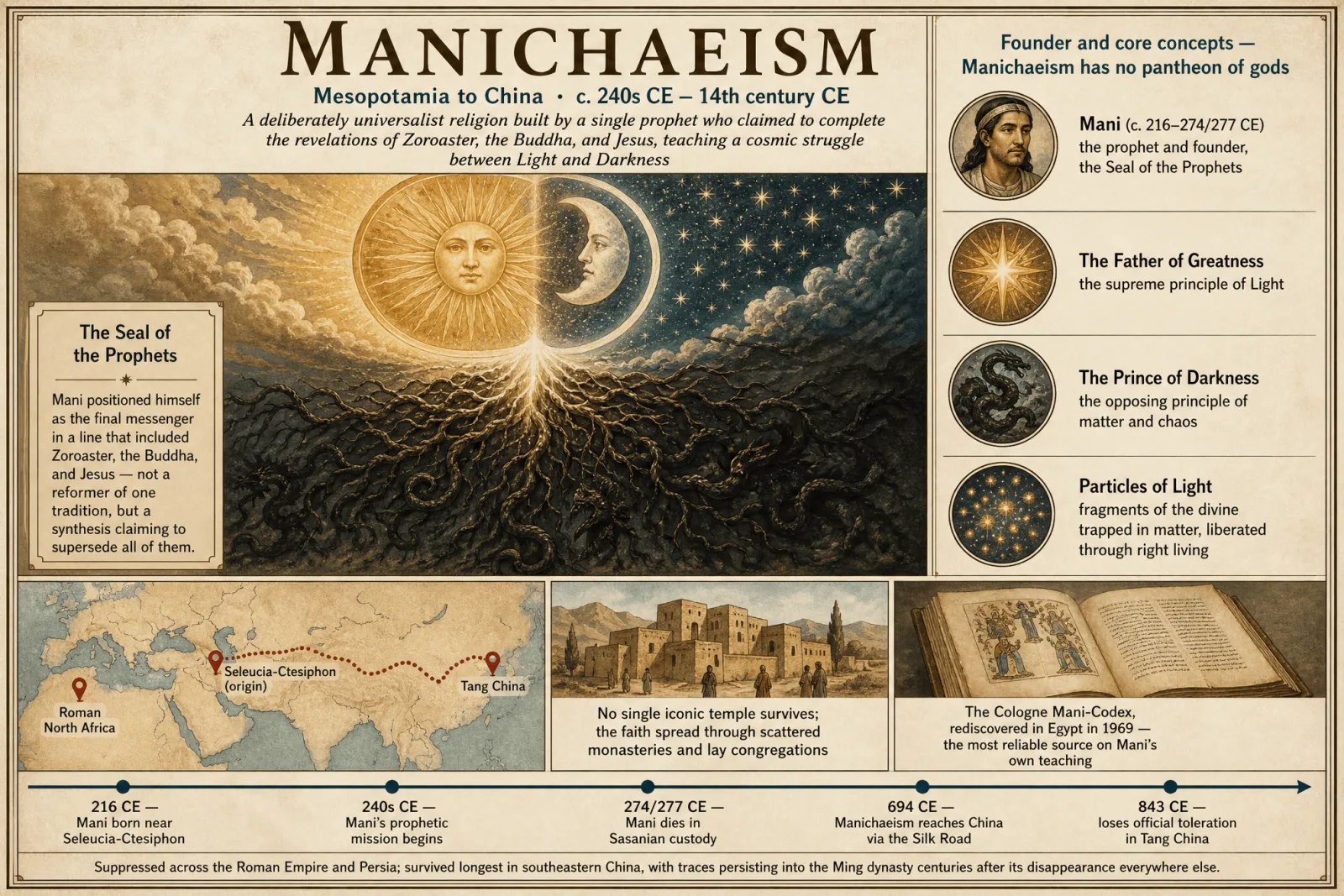
Manichaeism was a dualistic religious system founded by the prophet Mani (216–276 CE) in third-century Sasanian Mesopotamia (modern Iraq and Iran). Mani proclaimed himself the final prophet in a lineage including Zoroaster, Buddha, and Jesus, bringing a definitive revelation that synthesized elements from Zoroastrianism, Christianity, and Buddhism into a comprehensive cosmological and ethical framework. At the heart of Manichaean teaching was a radical dualism: two co-eternal primordial principles—the Realm of Light (good, spirit) and the Realm of Darkness (evil, matter)—engaged in cosmic conflict, with the present world understood as an accidental mixture of these two realms. Salvation involved liberating particles of Light trapped in matter through ascetic discipline, ritual purity, and the transmission of gnosis (knowledge).
Mani was a charismatic missionary and prolific author who composed his scriptures in Syriac (Eastern Aramaic), intending them to be translated into all languages as his religion spread. Unlike earlier religious movements that relied on oral tradition or later textual codification, Mani deliberately created an authoritative canon—seven works including his *Living Gospel*, *Treasure of Life*, and *Book of Mysteries*—and commissioned illustrated manuscripts (including an *Arzhang* or 'Picture Book') to ensure doctrinal uniformity. The Manichaean Church was hierarchically organized, dividing adherents into the Elect (the Chosen, who practiced strict vegetarianism, celibacy, and asceticism) and the Hearers (Auditors, lay supporters who provided for the Elect and followed less rigorous rules, hoping for rebirth as Elect in a future life).
Manichaeism spread with remarkable speed along the trade routes of Eurasia, from the Roman Empire in the west to China in the east, becoming a truly transregional religion by the fourth century CE. In the Roman Empire, it attracted intellectuals (notably the young Augustine of Hippo before his conversion to Christianity) and faced severe persecution from both pagan and Christian authorities. In Central Asia and China, it gained royal patronage, especially among the Uighur Turks, and persisted until the Mongol conquests (13th–14th centuries). Despite its early success and sophisticated organization, Manichaeism was gradually eradicated through persecution, competition with other religions, and the loss of its institutional infrastructure. By the 15th century, it had ceased to exist as a living religious community, though its textual and artistic legacy survived in fragments discovered at sites like Turfan in western China and Kellis in Egypt, revolutionizing 20th-century scholarly understanding of this once-global faith.
Mani and the Origins of Manichaeism (216–276 CE)
Mani was born in 216 CE in Mesopotamia, likely near Ctesiphon, the capital of the Sasanian Persian Empire, in a region of intense religious pluralism where Zoroastrian, Christian, Jewish, Buddhist, and Gnostic communities coexisted and competed. According to the Cologne Mani Codex (CMC)—a tiny Greek parchment codex discovered in Egypt and published in the 1970s–80s by Albert Henrichs and Ludwig Koenen—Mani grew up within a Jewish-Christian baptismal sect, the Elchasaites (or Elkesaites), a group that practiced ritual washings, vegetarianism, and observed Jewish law while venerating Jesus. The CMC describes Mani receiving visions from a celestial 'Twin' or 'Companion' (his divine alter ego, understood as his higher self or heavenly counterpart) at ages 12 and 24, instructing him to break with the Elchasaites and proclaim a universal revelation.
After his second revelation at age 24 (circa 240 CE), Mani began his public mission, traveling to India (possibly the Indus valley and regions under Kushan influence) where he encountered Buddhist communities, an experience that profoundly shaped his cosmology and missionary strategy. Returning to Mesopotamia, Mani gained the favor of the Sasanian king Shapur I (reigned 240–270 CE), who granted him permission to preach throughout the empire. Mani consciously modeled himself as a world-teacher and final prophet, claiming to complete and correct the teachings of his predecessors (Zoroaster, Buddha, Jesus), whom he regarded as authentic but partial revealers whose messages had been corrupted by their followers' failure to write them down and translate them universally. Mani, by contrast, composed his own scriptures in Syriac and commissioned translations, illustrations, and the establishment of an organized Church to prevent such corruption.
Mani's fortunes changed with the death of Shapur I. Under Shapur's successor, Bahram I (reigned 274–277 CE), the Zoroastrian priesthood, led by the powerful magus Kartir, pressured the king to suppress Manichaeism as a threat to Zoroastrian orthodoxy. Mani was imprisoned, tried, and executed (or died in chains) in 276 CE, likely at Gundeshapur, though later traditions claimed he was flayed alive and his body displayed. His death did not halt the movement; his disciples, especially Mar Ammo and others, continued missionary work, spreading Manichaeism westward into the Roman Empire and eastward into Central Asia.
Manichaeism reached the Roman Empire by the late third century, spreading through Syria, Egypt, North Africa, and into Europe. It appealed to educated urbanites and those dissatisfied with institutional Christianity, offering a systematic explanation of the problem of evil (the dualistic cosmology absolved God of responsibility for suffering), sophisticated cosmology, and a clearly defined path to salvation. The Egyptian oasis of Kellis (Ismant el-Kharab) in the Dakhleh Oasis, excavated since the 1980s, has yielded the richest trove of Manichaean documents from the Roman world: Coptic and Greek codices, personal letters, liturgical texts, and biblical materials dating to the fourth–fifth centuries. These texts reveal a flourishing community integrating Manichaean practice with local Egyptian Christianity, sometimes syncretistically.
Augustine of Hippo (354–430 CE) was a Manichaean 'Hearer' for nine years before converting to Christianity in 386 CE. His subsequent anti-Manichaean polemics (*Against Faustus the Manichaean*, *On the Usefulness of Belief*, and others) provide valuable (if hostile) information about Manichaean beliefs and practices in North Africa. Augustine criticized Manichaeism for its dualism, rejection of the Old Testament, docetic Christology (denying Jesus' true physical incarnation), and what he saw as absurd cosmological claims (e.g., Light particles imprisoned in plants requiring vegetarian Elect to consume and 'liberate' them). Despite this, Augustine admitted that Manichaean ethics and their critique of Old Testament violence had initially attracted him.
Roman imperial authorities, both pagan and Christian, persecuted Manichaeism. The pagan emperor Diocletian issued an edict in 297 CE condemning Manichaeism as a Persian superstition threatening Roman traditional religion, ordering the burning of Manichaean books and the execution of adherents. After Constantine's conversion, Christian emperors intensified persecution: Theodosius I (late 4th century) issued laws punishing Manichaeans with death and confiscation of property. By the fifth century, Manichaeism in the western Roman Empire had been driven underground or eradicated, though remnants persisted in North Africa until the Islamic conquests and in the eastern Mediterranean somewhat longer.
Manichaeism flourished longest in Central Asia and China, where it benefited from trade-route networks, periods of royal patronage, and a more tolerant religious environment. The oasis cities along the Silk Road—Turfan (in the Tarim Basin, modern Xinjiang, China), Gaochang, and others—became major Manichaean centers. Thousands of manuscript fragments in Middle Persian, Parthian, Sogdian, Old Turkish, Chinese, and other languages were discovered in the early 20th century by German, French, and British expeditions to Turfan. These texts, now scattered across Berlin, London, Paris, and other collections, include portions of Mani's original scriptures, hymns, theological treatises, liturgical texts, and administrative documents, providing unparalleled insight into Manichaean doctrine, practice, and daily life.
In the 8th century, Manichaeism became the state religion of the Uighur Khaganate (744–840 CE), a Turkic empire controlling much of Central Asia. The Uighur khagans' patronage led to the construction of Manichaean monasteries, commissioning of scriptures and artworks, and the integration of Manichaean clergy into the imperial court. This period represents the zenith of Manichaean political power. However, the collapse of the Uighur Khaganate in 840 CE (due to internal strife and external invasions) removed this patronage, though Manichaean communities persisted in Turfan and other cities for centuries afterward, gradually declining under pressure from Buddhism and Islam.
Manichaeism entered China as early as the 7th century, initially facing suspicion from Tang dynasty authorities. The religion was sometimes called 'The Religion of Light' (明教, Míngjiào) in Chinese sources. While never achieving mass conversion, Manichaeism attracted followers among foreign merchants (Sogdians, Persians) and some Chinese intellectuals. The religion's fortunes improved when Uighur rulers (who had adopted Manichaeism) allied with the Tang emperors; Manichaean temples were permitted in Chinese cities. However, after the Uighur collapse and the Tang dynasty's suppression of foreign religions in 843 CE, Manichaeism was officially banned. Despite this, isolated Manichaean communities survived, especially in southeastern China (Fujian Province, around Quanzhou). Scholarly debate continues about whether a temple discovered near Quanzhou preserves continuity with medieval Manichaeism or represents a later, heavily Buddhicized reinterpretation. By the 14th century, Mongol invasions and the rise of Islam and Neo-Confucianism had extinguished the last Manichaean communities.
Manichaeism's extinction as a living tradition resulted from multiple factors: sustained persecution by rival religions (Zoroastrian, Christian, Islamic, and Buddhist authorities all viewed it as heretical or threatening), lack of political protection after the fall of supportive regimes (especially the Uighurs), competition from more successful missionary religions, and the destruction of its textual and institutional infrastructure. Medieval Islamic, Christian, and Chinese sources preserve hostile accounts—the 10th-century Baghdad polymath Ibn al-Nadim in his *Fihrist* provides the most extensive medieval Islamic description of Manichaeism, listing Mani's works and doctrines but portraying the religion as defunct by his time.
European knowledge of Manichaeism from the medieval period through the 19th century derived almost entirely from Christian heresiological texts (Augustine, Epiphanius, Theodore bar Khoni) and Islamic polemics, leading to a distorted understanding emphasizing the religion's alleged 'absurdities' and moral dangers. The term 'Manichaean' became a byword for dualism and heresy in Christian theology. Serious historical study began in the 19th century with the editing of Syriac and Arabic sources, but transformative breakthroughs came with 20th-century archaeological discoveries.
The first major discovery was the Coptic Manichaean codices from Medinet Madi (Narmouthis) in Egypt's Fayyum, found around 1929 and published by C. Schmidt and H.J. Polotsky in 1933. These included Mani's Epistles, Psalms, Kephalaia (Chapters), and other texts in Coptic translation. The second major find was the Central Asian manuscripts from Turfan, excavated by German expeditions (1902–1914), revealing Manichaeism's eastern forms. The third pivotal discovery was the Cologne Mani Codex (CMC), acquired in the 1960s and published 1975–1988, providing the first detailed biography of Mani. More recently, the Kellis papyri (1980s–1990s) and continued scholarly work on the Turfan fragments have filled out understanding of Manichaean daily life, liturgy, and community organization. Scholars like Samuel Lieu, Jason BeDuhn, Iain Gardner, and others have used these sources to reconstruct Manichaeism not as a heretical curiosity but as a sophisticated, transregional religious tradition.
Dualistic Cosmology: Light and Darkness
Manichaean cosmology begins with two uncreated, co-eternal, and absolutely opposed principles: the Father of Greatness (also called the Father of Light), ruling the Realm of Light, and the King of Darkness (also called the Prince of Darkness), ruling the Realm of Darkness. These two realms were originally separate, but the King of Darkness, perceiving the Light, attacked it, initiating the cosmic conflict that defines the present age. To defend the Light, the Father of Greatness emanated a series of divine beings—the Primal Man (Ohrmizd in Iranian texts), the Living Spirit, and the Third Messenger—who battled the forces of Darkness. In the course of this struggle, portions of Light were captured and imprisoned within matter, creating the material world as an accidental mixture of Light and Darkness.
The visible cosmos—sun, moon, stars, earth, plants, animals, humans—is understood as a temporary construct designed to extract and purify the trapped Light, returning it to its source. The Sun and Moon are celestial ships or vessels collecting liberated Light particles and transporting them back to the Realm of Light. Humans are microcosms of this cosmic drama: each human possesses a Light-soul (the divine spark) imprisoned in a material body (the product of Darkness). The goal of human existence is to awaken to this reality through gnosis, practice ascetic purity to avoid further entrapping Light in matter (through procreation or consuming meat, which binds Light), and await the soul's liberation at death, when the righteous ascend to the Light while the wicked remain in bondage.
This dualism differs from Gnostic dualisms (which often posit a single divine source whose emanations go astray) by asserting the absolute independence and co-eternity of Light and Darkness. Unlike Zoroastrianism, which subordinates evil (Angra Mainyu) to the supreme god Ahura Mazda and predicts evil's ultimate defeat, Manichaeism treats the two principles as ontologically equal, though morally opposed. The final eschatological event—the Great War and the Final Conflagration—will separate Light and Darkness completely, after which the material cosmos will be destroyed and the two realms will exist eternally apart, with no possibility of future mixture.
Mani understood himself as the culminating figure in a series of prophets sent by the Father of Greatness to remind humanity of its divine origin and teach the path of liberation. He identified Zoroaster (as a prophet to Persia), Buddha (Siddhartha Gautama, as a prophet to India), and Jesus (as a prophet to the West) as his predecessors. Each had revealed truth appropriate to their time and place, but their teachings had been corrupted: Zoroastrians had added ritual impurities, Buddhists had mixed in idolatry, and Christians had falsely claimed Jesus had a physical body and had adopted the violent Old Testament. Mani saw himself as the 'Apostle of Jesus Christ,' the 'Seal of the Prophets' (a title later adopted by Islam for Muhammad), and the Paraclete (the 'Comforter' promised in the Gospel of John), sent to restore and complete the revelation.
Mani's claim to prophetic finality was grounded in his deliberate creation of scripture and organization to prevent future corruption. Unlike earlier prophets whose teachings were transmitted orally and later written down by followers (allowing distortion), Mani wrote his own scriptures in his lifetime, established a fixed canon, commissioned translations, and founded a hierarchical Church to preserve doctrinal purity. He reportedly composed seven canonical works: the *Shapurakan* (dedicated to King Shapur I), the *Living Gospel* (replacing the Christian Gospels), the *Treasure of Life*, the *Pragmateia* (Treatise), the *Book of Mysteries*, the *Book of Giants* (an apocalyptic narrative expanding on the Genesis Nephilim), and the *Epistles*. He also created the *Arzhang* (Picture Book), an illustrated manuscript intended to communicate doctrine visually across linguistic barriers. Most of these works are lost, surviving only in fragments or quotations.
Manichaeism divided its adherents into two classes with distinct ethical obligations and soteriological destinies: the Elect (Electi, the Chosen Ones) and the Hearers (Auditores, Auditors, Catechumens). The Elect were an ascetic elite who had undergone full initiation and practiced the Three Seals: the Seal of the Mouth (strict vegetarianism, consuming only plants to liberate their Light, and avoidance of blasphemy), the Seal of the Hands (refusal to harm living beings, including plants, and refraining from manual labor that might kill or injure), and the Seal of the Breast (complete sexual abstinence and celibacy to prevent procreation, which would further entrap Light in matter). The Elect lived communally, itinerant or in monastic settings, supported entirely by the Hearers, and spent their days in prayer, hymn-singing, fasting, and the confession of sins.
The Hearers formed the lay majority, supporting the Elect materially (providing food, clothing, shelter) while following a less rigorous ethical code. Hearers could marry, own property, and engage in trade or agriculture, though they were encouraged to minimize harm to living beings and to observe fasts and prayer schedules. Hearers hoped that through supporting the Elect and accumulating merit, they would be reborn as Elect in a future life, eventually achieving liberation. This two-tiered structure parallels Buddhist monk/layperson distinctions and early Christian ascetic/lay divisions, but Manichaean theology made the distinction ontologically sharper: only the Elect could achieve immediate liberation at death; Hearers required multiple rebirths.
The Church was hierarchically organized: at the top stood the Teacher (Mani himself, and after his death, a successor), below whom were twelve Apostles (corresponding to Jesus' apostles), seventy-two Bishops (overseeing regional communities), and 360 Presbyters (Elders). Below them were the Elect, and below them the Hearers. This structure, described in Manichaean texts and confirmed by inscriptions and papyri from Kellis, demonstrates sophisticated institutional organization facilitating the religion's rapid expansion and maintaining doctrinal uniformity across vast distances.
Scriptures, Manuscripts, and Textual Transmission
Mani's seven canonical works formed the Manichaean scriptural corpus, originally composed in Syriac (Eastern Aramaic) and translated into Greek, Latin, Coptic, Middle Persian, Parthian, Sogdian, Old Turkish, and Chinese. The Living Gospel was Mani's replacement for the Christian Gospels, narrating his revelations and cosmological teachings. The Treasure of Life was a massive theological compendium. The Book of Mysteries (or *Book of Secrets*) contained esoteric teachings reserved for advanced initiates. The Book of Giants expanded on the Genesis flood narrative, portraying a cosmic battle between giants (offspring of fallen angels) and divine forces. The Epistles were letters Mani wrote to communities and individuals, addressing doctrinal and pastoral issues. Only fragments of these works survive, reconstructed from quotations in polemical sources and manuscript finds.
The Cologne Mani Codex (CMC), published by Henrichs and Koenen (1975–1988), is a miniature Greek parchment codex (4.5 × 3.8 cm, the smallest ancient book known) dating to the fifth century. It preserves a biography of Mani titled *On the Origin of His Body*, compiled from earlier sources, describing his upbringing among the Elchasaites, his visions of the Twin, his missionary journeys, and his debates with religious rivals. The CMC revolutionized Manichaean studies by providing a narrative of Mani's life independent of hostile heresiological accounts.
The Coptic Manichaean codices from Medinet Madi (discovered circa 1929) include the *Kephalaia* (Chapters, theological teachings), the *Psalm-Book* (hymns and liturgical texts), the *Homilies*, and portions of Mani's *Epistles*. The Kellis papyri (excavated from the 1980s onward at Ismant el-Kharab in Egypt's Dakhleh Oasis) include Greek and Coptic liturgical texts (notably *P. Kell. Gr. 98*, a prayer mirroring Parthian liturgical fragments from Turfan), personal letters revealing daily life of Hearers, and biblical commentaries showing Manichaean engagement with Christian scripture. The Turfan manuscripts (found in Chinese Turkestan, early 20th century) preserve Middle Iranian and Old Turkish Manichaean texts, including hymn cycles, confessional prayers, cosmological treatises, and fragments of Mani's scriptures. Iain Gardner, Samuel Lieu, Jason BeDuhn, and others have worked for decades to edit, translate, and interpret these dispersed materials, producing the *Corpus Fontium Manichaeorum* (Corpus of Manichaean Sources), an ongoing multi-volume critical edition.
Liturgy, Prayer, and Ritual
Manichaean worship centered on communal prayer, hymn-singing, and the liturgical cycle. The Daily Prayers (observed four times daily by the Elect, less frequently by Hearers) were directed to divine emanations: the Father of Greatness, the Living Spirit, the Third Messenger, and the Sun and Moon as Light-bearers. Texts from Turfan and Kellis preserve these prayers, which include prostrations, confessions of sins, and petitions for liberation. The Confession (Bema ritual) was a weekly or monthly practice where the Elect publicly confessed their sins—even inadvertent ones, like accidentally crushing an insect or breaking a fruit—to be absolved and ritually purified.
The Bema Feast (from Greek *bēma*, 'platform' or 'throne') was the most important annual festival, commemorating Mani's death and martyrdom. Held in early spring, the ritual involved placing an empty throne (representing Mani's presence) on a five-stepped platform, surrounding it with fruits, flowers, and candles, and reciting hymns and readings from Mani's works. The Bema symbolized Mani's continued spiritual presence and the hope of final liberation. Meals were communal: the Elect consumed only vegetarian food provided by Hearers, and their eating was understood as a sacramental act—liberating Light particles trapped in plants by digesting them and transmitting them (through breath, bodily fluids, and ultimately death) back to the Light.
Fasting was rigorously observed, especially by the Elect, who abstained from food for extended periods and practiced weekly fasts. Hymns, many surviving in Coptic, Parthian, and Chinese, were sung during worship, praising Light deities, lamenting the soul's imprisonment in matter, and expressing longing for liberation. These hymns are poetic and theologically rich, reflecting the sophisticated literary culture of Manichaeism.
Manichaean ethics derived from the cosmological imperative to avoid further mixing Light and Darkness. The Three Seals governed the Elect's lives: the Seal of the Mouth prohibited eating meat, drinking alcohol, and blasphemy; the Seal of the Hands forbade killing, injuring living beings, or engaging in manual labor (harvesting, construction) that might harm life; and the Seal of the Breast required absolute celibacy and sexual abstinence. These rules aimed to prevent the Elect from trapping additional Light particles in matter (through procreation or violence) and to liberate Light through their own bodies as vessels of purification.
Hearers followed a milder ethical code: they could marry (within limits—sexual relations solely for procreation, not pleasure), own property, and work, but were encouraged to minimize harm, observe fasts, support the Elect, and attend prayers. Both Elect and Hearers practiced almsgiving (though in Manichaeism, 'alms' meant Hearers supporting the Elect, reversing the typical direction of charity). The ethical life was not about reward and punishment in the afterlife (in the conventional sense) but about ontological necessity: liberating Light required ascetic purity; failure meant rebirth in matter, prolonging the soul's suffering.
Augustine of Hippo, in his polemics, criticized Manichaean ethics as absurd (e.g., claiming the Elect liberated Light by eating vegetables but would be guilty of murder if they harvested the vegetables themselves, requiring Hearers to do so). Despite this caricature, Manichaean ethics were internally coherent within their cosmological framework and represented a serious attempt to live in accord with a dualistic worldview.
Regional Variations and Syncretism
Despite Mani's efforts to establish doctrinal uniformity through scripture and institutional hierarchy, Manichaeism adapted to diverse cultural contexts. In the Roman Empire, Manichaean communities engaged with Christian scripture and terminology, sometimes syncretistically. The Kellis papyri show Manichaeans in Egypt using Christian biblical texts, attending church services, and employing Christian rhetorical forms, while maintaining distinctively Manichaean cosmology and ritual. Whether this represents deliberate syncretism, crypto-Manichaeism (hiding within Christian communities to avoid persecution), or a fluid boundary between Manichaeism and Christianity remains debated.
In Central Asia and China, Manichaeism absorbed Buddhist and Zoroastrian elements. The Turfan manuscripts include Manichaean texts using Buddhist terminology: Mani was called 'Buddha of Light,' the Realm of Light was identified with Buddhist *nirvana*, and Manichaean cosmology was expressed through Buddhist concepts of karma and rebirth (reinterpreted in dualistic terms). Iconography from Turfan shows Manichaean deities depicted in styles blending Greco-Roman, Iranian, and East Asian artistic traditions. In China, Manichaeism was sometimes called 'The Religion of Light' and incorporated Chinese religious vocabulary, though it remained distinct from Buddhism, Taoism, and Confucianism.
Whether these regional variations represent 'corruption' of Mani's vision or the natural adaptation of a missionary religion to new audiences is contested. Scholars like Samuel Lieu emphasize the religion's transregional coherence (liturgical texts from Egypt and Turfan show striking similarities, suggesting ongoing communication and shared authoritative sources), while others stress the flexibility required for survival in diverse imperial contexts.
Why Manichaeism Became Extinct
Manichaeism is the only major world religion of Late Antiquity to have become completely extinct as a living tradition. Several factors explain this outcome: Persecution was relentless and geographically widespread. Unlike Christianity (which survived Roman persecution and eventually gained imperial support) or Buddhism (which found refuge in multiple kingdoms), Manichaeism faced hostility from Zoroastrian, Christian, Muslim, and Buddhist authorities simultaneously. Zoroastrian magi saw it as a heretical perversion of Zoroaster's teachings; Christians condemned its dualism and rejection of the Old Testament; Muslims regarded it as a deviant sect; Chinese and Uighur Buddhist authorities opposed it as foreign. No major empire provided lasting protection after the collapse of Uighur patronage in the 9th century.
Institutional vulnerability compounded the problem. Manichaeism's strict division between Elect and Hearers meant that the religion depended on the Elect (a small, celibate, itinerant minority) to maintain doctrinal knowledge, perform rituals, and initiate new members. Once the Elect were killed or dispersed by persecution, the Hearers (who lacked full initiatory knowledge) could not sustain the tradition. Unlike Buddhism or Christianity, where monastic and lay communities could independently preserve the faith, Manichaeism's rigid hierarchy made it fragile: eliminate the Elect, and the Church collapsed.
Competition from more successful religions eroded Manichaean communities. Christianity, Islam, and Buddhism offered comparable soteriological benefits (salvation, ethical frameworks, community) without the stringent ascetic demands and social marginalization that Manichaeism entailed. As these religions gained imperial backing (Christianity in Rome, Islam in the Middle East, Buddhism in Central Asia and China), Manichaeism's appeal diminished. The destruction of texts and institutional memory through book-burnings, forced conversions, and the erasure of monasteries meant that by the medieval period, even where Manichaean communities had existed, the knowledge required to reconstitute them was lost. The religion survives today only as an object of historical study, though its textual and archaeological legacy continues to yield new insights.
Sacred Geography and Archaeological Sites
Ctesiphon, the Sasanian capital on the Tigris River (near modern Baghdad, Iraq), was the heart of Manichaeism's origins. Mani preached at the royal court, gained Shapur I's favor, and established his first communities in and around Ctesiphon. The city served as the administrative center of the Manichaean Church under Mani's leadership, though no Manichaean archaeological remains have been conclusively identified there due to the site's destruction and later urban development.
Kellis (Ismant el-Kharab) in Egypt's Dakhleh Oasis is the most extensively excavated Manichaean site. The small Roman-era village, active circa 300–400 CE, included a Christian church and a Manichaean community (possibly overlapping membership). Excavations since the 1980s have recovered Coptic and Greek Manichaean codices, liturgical texts (including P. Kell. Gr. 98, a prayer with parallels in Turfan), personal letters, biblical manuscripts, and domestic artifacts revealing daily life. The site demonstrates Manichaeism's integration into provincial Roman Egypt and its coexistence (or syncretism) with Christianity. Iain Gardner, Samuel Lieu, and others have published extensive studies of the Kellis materials, now housed in Oxford and other collections.
Turfan (Turpan) and Gaochang in the Tarim Basin of Xinjiang, western China, were major centers of Central Asian Manichaeism from the 5th through the 13th centuries. German, French, and British expeditions (1902–1914) recovered thousands of manuscript fragments in Middle Persian, Parthian, Sogdian, Old Turkish, and Chinese from monastery ruins and caves in the Turfan region. These include hymn cycles, liturgical texts, theological treatises, administrative documents, and illuminated manuscripts. The Turfan materials reveal a flourishing, institutionally sophisticated Manichaean Church benefiting from Uighur royal patronage and Silk Road trade networks. The manuscripts are now dispersed across Berlin (Staatsbibliothek and Museum für Asiatische Kunst), London (British Library), Paris (Bibliothèque Nationale), and St. Petersburg (Institute of Oriental Studies), with ongoing digitization and publication projects.
Quanzhou (Zayton) in Fujian Province, southeastern China, preserves possible traces of late medieval Chinese Manichaeism. A temple discovered near Quanzhou, known locally as the 'Temple of the Religion of Light,' contains a stone statue identified by some scholars as Mani and inscriptions referencing dualistic cosmology. Whether this represents continuity with medieval Manichaeism, a heavily Buddhicized reinterpretation, or a modern reinvention is debated. Samuel Lieu and others have conducted research suggesting that isolated Manichaean or quasi-Manichaean communities persisted in southern China into the Ming dynasty (14th–17th centuries), though hard evidence is limited.
Baghdad in the Abbasid period (8th–10th centuries) served as a site of memory for Manichaeism rather than a living center. The polymath Ibn al-Nadim, writing his *Fihrist* (circa 987), included a detailed chapter on Manichaeism, listing Mani's works, summarizing doctrines, and noting that the religion was nearly extinct in his time. Al-Nadim's sources included former Manichaeans who had converted to Islam and access to surviving Manichaean manuscripts, making his account one of the most valuable medieval Islamic records of the religion.
Scholarly Debates and Interpretive Challenges
The relationship between Manichaeism and Gnosticism remains contested. Early 20th-century scholarship, influenced by the discovery of Coptic Gnostic texts (Nag Hammadi library), often classified Manichaeism as a Gnostic sect. However, contemporary scholars like Jason BeDuhn and Samuel Lieu emphasize key differences: Manichaeism's absolute dualism (two co-eternal principles) contrasts with Gnostic monism (a single divine source whose emanations fall into error); Manichaeism's institutional organization, scriptural canon, and missionary strategy differ from the diverse, decentralized Gnostic movements; and Mani positioned himself as the successor to Zoroaster, Buddha, and Jesus, not as a Christian heresiarch. The consensus now treats Manichaeism as a distinct religious tradition, though it shared a late antique milieu with Gnosticism and borrowed some Gnostic motifs.
How 'Zoroastrian,' 'Christian,' or 'Buddhist' was Manichaeism? Scholars debate the relative weight of these influences. Mani was raised in a Jewish-Christian sect and used Christian terminology, but his cosmology owes more to Zoroastrian dualism (Ahura Mazda vs. Angra Mainyu) radicalized. His encounters with Buddhism in India shaped his ascetic ethics, concept of rebirth, and missionary organization. Geo Widengren, Geo Gnoli, and others have emphasized Iranian elements; Kurt Rudolph and Hans-Joachim Klimkeit stressed Christian and Gnostic components. Current scholarship recognizes Manichaeism as a genuinely synthetic tradition that deliberately drew on multiple sources to create something new, rather than a derivative or syncretic hodgepodge.
The Kellis community: Manichaean or Christian? Some papyri from Kellis show individuals identifying as Christian, attending church, and copying biblical texts, yet also engaging in distinctively Manichaean practices. Iain Gardner and Samuel Lieu have debated whether this reflects crypto-Manichaeism (hiding Manichaean identity under Christian cover to avoid persecution), genuine dual religious belonging (Late Antique religious boundaries being fluid), or a spectrum of commitment (some individuals more Christian, others more Manichaean). This debate has implications for understanding Late Antique religious identity and the nature of 'orthodoxy' and 'heresy.'
Did Manichaeism survive beyond the 14th century? Claims of Manichaean continuity in China, especially around Quanzhou, are controversial. While some scholars see the 'Religion of Light' temple and related practices as evidence of survival, others argue that these are modern constructions or heavily Buddhicized traditions that lost distinctively Manichaean features (the Elect-Hearer distinction, the Three Seals, the specific cosmology). Recent UNESCO-sponsored research has explored these claims, but definitive conclusions remain elusive. The consensus is that Manichaeism as an organized, recognizable religious tradition did not survive the Mongol period, though folk practices and vague memories may have lingered.
Key Terms
- Mani
- Prophet and founder of Manichaeism (216–276 CE), born in Sasanian Mesopotamia, executed under Bahram I.
- Father of Greatness (Father of Light)
- The supreme deity of the Realm of Light, source of all good and spirit.
- King of Darkness (Prince of Darkness)
- The ruler of the Realm of Darkness, source of evil and matter.
- Primal Man (Ohrmizd)
- A divine emanation sent to battle Darkness, whose defeat led to the imprisonment of Light in matter.
- Living Spirit
- A divine emanation who created the visible cosmos as a mechanism to liberate trapped Light.
- Third Messenger
- A divine emanation who reveals gnosis to humanity, teaching the path of liberation.
- Elect (Electi)
- The ascetic elite of the Manichaean Church, practicing the Three Seals and living in full renunciation.
- Hearers (Auditores)
- Lay Manichaeans who supported the Elect materially and followed a milder ethical code.
- Three Seals
- The Seal of the Mouth, Hands, and Breast—ethical prohibitions governing the Elect's lives (vegetarianism, non-violence, celibacy).
- Living Gospel
- Mani's replacement for the Christian Gospels, narrating his revelations (mostly lost).
- Cologne Mani Codex (CMC)
- A miniature Greek parchment codex containing a biography of Mani, published 1975–1988.
- Bema Feast
- Annual festival commemorating Mani's martyrdom, featuring an empty throne symbolizing his presence.
- Twin (Syzygos)
- Mani's celestial companion or divine alter ego, source of his revelations.
- Kellis (Ismant el-Kharab)
- Archaeological site in Egypt yielding the richest Roman-era Manichaean papyri and codices.
- Turfan
- Central Asian oasis city in Xinjiang, China, source of thousands of Manichaean manuscript fragments.
- Seal of the Prophets
- Mani's self-designation as the final, culminating prophet completing earlier revelations.
Further Reading
- Iain Gardner and Samuel N.C. Lieu, Manichaean Texts from the Roman Empire (Cambridge University Press, 2004)
- Iain Gardner and Jason BeDuhn, The Founder of Manichaeism: Rethinking the Life of Mani (Cambridge University Press, 2020)
- Jason BeDuhn, The Manichaean Body: In Discipline and Ritual (Johns Hopkins University Press, 2000)
- Samuel N.C. Lieu, Manichaeism in the Later Roman Empire and Medieval China (2nd ed., Mohr Siebeck, 1992)
- Samuel N.C. Lieu, Manichaeism in Mesopotamia and the Roman East (Brill, 1994)
- Albert Henrichs and Ludwig Koenen, 'Der Kölner Mani-Kodex,' Zeitschrift für Papyrologie und Epigraphik (1975–1982)
- Iain Gardner, Jason BeDuhn, and Paul Dilley, Mani at the Court of the Persian Kings (Brill, 2015)
- Nils Arne Pedersen (ed.), The Manichaean Church in Kellis (Brill, 2022)
- Nils Arne Pedersen, Religion and the Everyday Life of Manichaeans in Kellis (Brill, 2023)
- Hugo Lundhaug and Zsuzsanna Gulácsi, 'Towards a Comparative Manichaean Manuscriptology,' ISAW Papers 29.4 (2022)
Practices
- Vegetarianism
- Confession
- Ritual meals
- Missionary journeys
Core ideas
- Liberation
- Release of light-particles from matter
- Sin
- Feeding the body feeds darkness
Sacred texts
A Middle Persian text composed for King Shapur I, presenting Mani's teachings on the cosmic struggle between light and darkness. It outlines the three ages of world history and the role of prophets across cultures. The work was once widely circulated along Silk Road trade routes.
Mani's own account of his divine calling and mission to complete the revelations of Buddha, Zoroaster, and Jesus. It presented Manichaeism as the final, universal religion synthesizing earlier traditions. Only fragments survive in Coptic, Middle Persian, and Chinese translations.
An illustrated 'Picture Book' attributed to Mani, using paintings to teach cosmology to audiences across languages and literacy levels. It depicted the realms of light, the material prison, and the path of liberation. Church authorities ordered its destruction, and no copy survives intact today.