Overview
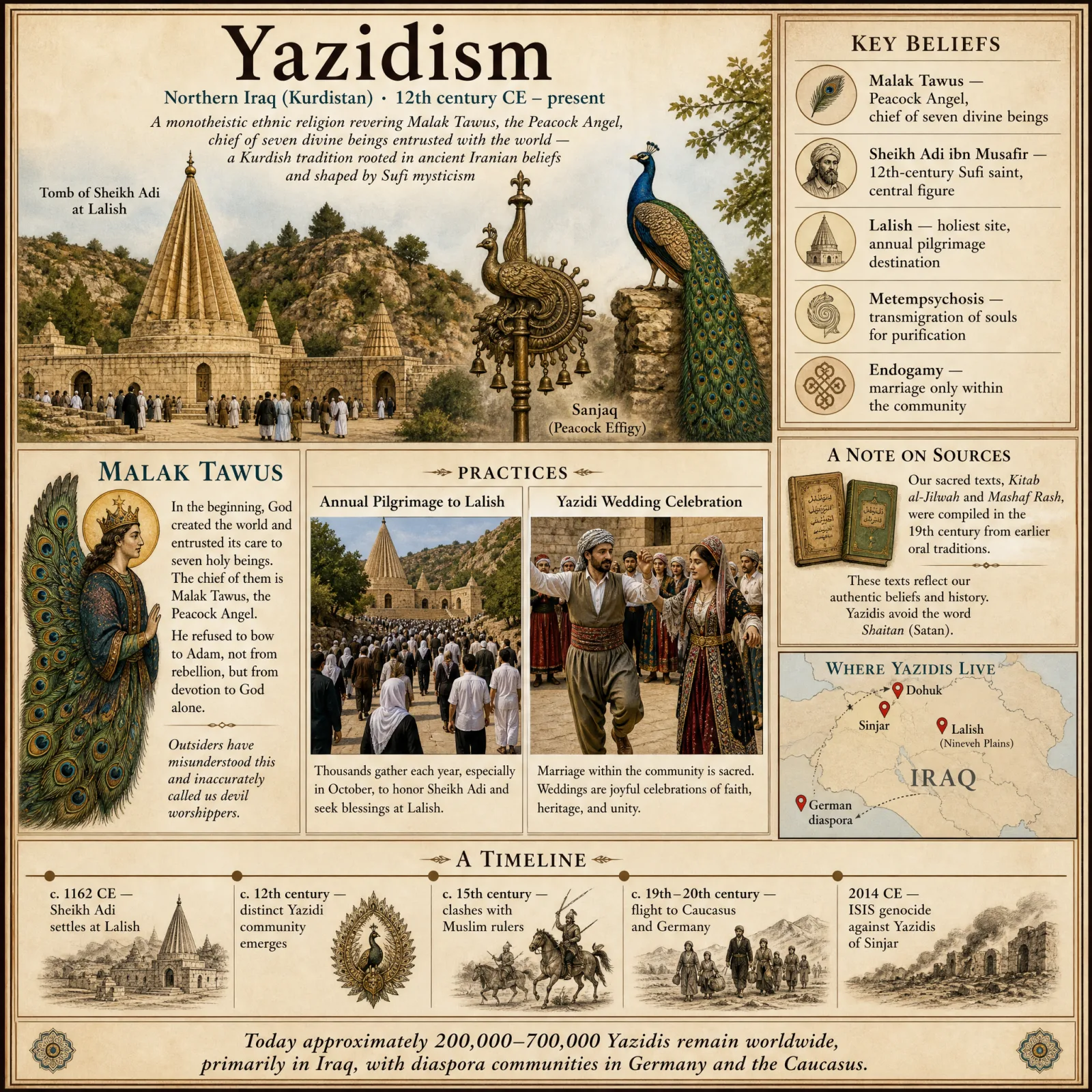
Yazidism (Kurdish: Êzîdîtî, ئێزیدیتی; also Yezidism) is a monotheistic, non-proselytizing religion practiced by the Yazidi (Êzidî) people, a primarily Kurdish-speaking ethno-religious community indigenous to northern Mesopotamia (modern northern Iraq, southeastern Turkey, northeastern Syria, and parts of Armenia and Georgia). The Yazidi religion is a complex syncretic system blending elements from ancient Iranian religions (including Zoroastrianism and pre-Zoroastrian traditions), Sufi Islam, Christianity, Judaism, and indigenous Mesopotamian beliefs, centered on the veneration of God (Xwedê) and the supreme angelic figure Tawûsî Melek (تهوسی مهلهک, 'Peacock Angel'), who serves as God's representative on earth and the leader of seven divine angels. Yazidism is a religion of orthopraxy (correct practice) rather than orthodoxy (correct belief), emphasizing ritual purity, caste endogamy, pilgrimage, and the maintenance of strict social and religious boundaries. Yazidis have been historically and tragically misunderstood by outsiders—particularly Muslims and Christians—as 'devil worshippers' due to the superficial resemblance between Yazidi narratives of Tawûsî Melek and Abrahamic accounts of Satan or the fallen angel. This is a profound misreading: Tawûsî Melek is not a malevolent figure in Yazidism but a benevolent, obedient servant of God, and Yazidis do not acknowledge the existence of an independent evil spirit or devil. The 'devil worship' accusation is an outsider projection of Abrahamic theological categories onto a fundamentally different religious system and has been used to justify centuries of violent persecution, including the 2014 genocide by the Islamic State (ISIS/ISIL), which the United Nations formally recognized as genocide.
Yazidism's origins are historically obscure and contested. The Yazidi community itself traces its roots to ancient Mesopotamian and Iranian religions, asserting continuity with pre-Islamic Kurdish religious practices. Academic scholarship identifies the crystallization of Yazidism as a distinct religious system in the 12th-13th centuries CE, centered on the figure of Sheikh Adi ibn Musafir (c. 1072/1078–1162/1163 CE), an Arab Sufi mystic of Umayyad descent who settled in the valley of Lalish (northern Iraq) and established a Sufi order (the Adawiyya) among local Kurdish communities. Over time, Sheikh Adi's Sufi teachings merged with pre-existing local religious practices—likely including Zoroastrian, Manichaean, and folk traditions—to form the syncretic religion now known as Yazidism. After Sheikh Adi's death, his tomb at Lalish became the holiest pilgrimage site in Yazidism, and Sheikh Adi himself was venerated as a saint and later quasi-divine figure within Yazidi cosmology, forming part of the Yazidi Holy Trinity (God, Tawûsî Melek/Sheikh Adi, and Sultan Êzî). The name 'Yazidi' is debated: it may derive from the Umayyad Caliph Yazid I (r. 680–683 CE), the Old Iranian word *yazd* ('angel' or 'divine being'), or the Kurdish/Persian *ēzīd* ('worshipper of God'). Yazidis themselves prefer the endonym Êzidî and trace their identity to ancient roots, rejecting external labels.
Yazidism is a closed, endogamous religion: Yazidis are born, not converted. Marriage outside the Yazidi community, or across Yazidi caste boundaries, is forbidden and results in expulsion. The Yazidi community is stratified into three hereditary castes: Sheikhs (شێخ, religious leaders descended from Sheikh Adi's lineage), Pîrs (پیر, spiritual guides), and Murids (مرید, the laity). Each caste has specific ritual roles, and intermarriage is prohibited. This strict endogamy and social structure have preserved Yazidi identity but also made the community vulnerable to population decline and external threats. Yazidism lacks a single authoritative written scripture; religious knowledge is transmitted orally through sacred hymns called qewls (قهوڵ, sung religious poems), and two contested texts—the Meshefa Reş ('Black Book') and Kitêba Cilwe ('Book of Revelation')—whose authenticity and origins are debated by scholars (some argue they were fabricated or heavily edited in the early 20th century). Yazidi religious authority is vested in the Mîr (Prince), the hereditary spiritual and temporal leader of all Yazidis, and the Baba Sheikh, the chief religious authority. As of 2024, the Mîr is Hazim Tahsin Beg, who succeeded his father Tahsin Beg (1933–2019) following the latter's death. The global Yazidi population is estimated at 700,000–1,000,000, though reliable census data is lacking. The largest Yazidi populations are in Iraq (primarily in the Nineveh Plains, Shekhan, and Sinjar regions), with significant diaspora communities in Germany, Armenia, Georgia, and other countries, many of whom fled persecution and genocide.
Historical Development and Persecution
The historical origins of Yazidism are obscure and contested, with Yazidi tradition asserting ancient roots and scholars debating the religion's formation and development. Yazidis themselves claim descent from Adam alone (not Eve), asserting a separate origin from other humans, and trace their religious heritage to ancient Mesopotamian and Iranian traditions, including connections to Zoroastrianism, Mithraism, and indigenous Kurdish paganism. This narrative emphasizes Yazidism's indigeneity and antiquity, positioning it as the original religion of the Kurdish people. However, historical and textual evidence for these claims is sparse. The earliest references to communities resembling the Yazidis appear in Islamic sources from the 11th-13th centuries CE, describing Adawiyya, followers of Sheikh Adi ibn Musafir, as a Sufi order in the Mosul region (northern Iraq). The scholarly consensus is that Yazidism crystallized as a distinct religion during the 12th-13th centuries CE through the synthesis of Sheikh Adi's Sufi teachings with pre-existing local religious practices among Kurdish communities in the Lalish valley and surrounding regions.
Sheikh Adi ibn Musafir (Arabic: شيخ عدي بن مسافر, c. 1072/1078–1162/1163 CE) is the pivotal historical figure in Yazidism's formation. Born in the Beqaa Valley (modern Lebanon) to a family of Arab Umayyad descent, Sheikh Adi studied Islamic mysticism (Sufism) in Baghdad under prominent teachers before traveling to the Lalish valley in northern Iraq (near modern Dohuk), where he established a Sufi monastery and gathered a following among local Kurdish communities. His teachings emphasized asceticism, devotion to God, and ethical living. After his death in 1162/1163 CE, Sheikh Adi was buried at Lalish, and his tomb became a pilgrimage site for both Muslims and non-Muslims. Over the following centuries, Sheikh Adi's followers (the Adawiyya) increasingly diverged from mainstream Islam, incorporating pre-Islamic religious elements (Zoroastrian, Manichaean, and local folk practices) and venerating Sheikh Adi as a saint and later a quasi-divine figure. By the 15th-16th centuries, the community was recognized as a distinct, non-Islamic religious group, referred to as Yazidis in Arabic sources. The process by which Sufism merged with indigenous Kurdish religious practices to form Yazidism is historically complex and debated, but scholars agree that Yazidism represents a unique synthesis rather than a simple survival of ancient religion or a deviant form of Islam.
The name 'Yazidi' and its origins are contested. Three main theories exist: (1) derivation from the Umayyad Caliph Yazid I ibn Muawiya (r. 680–683 CE), whose name appears in Yazidi religious texts and whom Yazidis venerate as Sultan Êzî (part of the Yazidi Holy Trinity), though this association has fueled Muslim hostility (Yazid I is reviled in Shia Islam for his role in the Battle of Karbala and the death of Husayn ibn Ali); (2) derivation from the Old Iranian word *yazd* or *yazata*, meaning 'angel,' 'divine being,' or 'worthy of worship,' connecting Yazidism to ancient Iranian religions; (3) derivation from the Kurdish/Persian word *ēzīd* or *īzad*, meaning 'worshipper of God' or 'divine.' Yazidis themselves prefer the endonym Êzidî and reject the 'Yazidi' label as an outsider imposition, asserting their identity's ancient, non-Islamic origins.
Yazidis have endured centuries of persecution, marginalization, and violence, particularly at the hands of Muslim rulers and communities who regarded them as heretics, apostates, or 'devil worshippers.' Yazidi oral tradition recounts seventy-three genocidal campaigns (ferman, فهرمان, from the Persian word for 'decree' or 'edict') against their community throughout history, though the historicity and details of many of these events are difficult to verify. Documented persecutions include: (1) Ottoman campaigns (late 19th–early 20th centuries): The Ottoman Empire, viewing Yazidis as infidels and tax evaders who refused military conscription, launched violent campaigns against Yazidi communities in the Sinjar and Shekhan regions. In 1890-1892, Ottoman forces issued an ultimatum for Yazidis to convert to Islam; upon refusal, they occupied Yazidi homelands, massacred inhabitants, destroyed villages, and enslaved women and children. Thousands of Yazidis were killed or displaced, and many fled to remote mountain regions for safety. (2) Iraqi state persecution (20th century): Under various Iraqi regimes, Yazidis faced discrimination, forced assimilation (pressured to identify as Arabs rather than Kurds), and restrictions on religious practice. Saddam Hussein's government destroyed Yazidi villages, forcibly relocated communities, and pressured Yazidis to convert to Islam or identify as Arabs. (3) Post-2003 Iraq: Following the 2003 U.S. invasion and the collapse of Saddam Hussein's regime, Yazidis faced increased attacks from Islamist extremists who targeted them as 'infidels' and 'devil worshippers.' Between 2003 and 2007, an estimated 335 Yazidis were killed in direct or indirect attacks. In August 2007, coordinated suicide truck bombings in the Yazidi towns of Qahtaniya and Jazeera (Sinjar region) killed over 500 people, making it one of the deadliest single attacks of the Iraq War.
The most catastrophic event in recent Yazidi history is the 2014 genocide (known to Yazidis as the 74th ferman) perpetrated by the Islamic State (ISIS/ISIL/Daesh) during its control of large parts of Iraq and Syria (2014-2017). On August 3, 2014, ISIS launched a systematic genocidal campaign against Yazidi communities in the Sinjar region (Şingal, شنگال) of northern Iraq. ISIS fighters surrounded Yazidi towns and villages, offering inhabitants three choices: convert to Islam, pay a religious tax (*jizya*), or face death. Yazidis, who could not convert (Yazidism does not permit conversion), fled en masse. Approximately 30,000–50,000 Yazidis were trapped on Mount Sinjar (Jabal Sinjar), a barren mountain where they faced starvation, dehydration, and exposure, with minimal access to food, water, or shelter. Over the following days and weeks, ISIS systematically massacred Yazidi men and boys (especially those over 12 years old), executed elderly individuals, and kidnapped and enslaved Yazidi women and girls, subjecting them to sexual slavery, forced marriage, and brutal treatment. Yazidi boys were forcibly converted to Islam, indoctrinated into ISIS ideology, and trained as child soldiers.
The scale of the 2014 Yazidi genocide is staggering and well-documented by international organizations, scholars, and journalists. Academic studies estimate that approximately 5,000 Yazidis were killed in August 2014 alone, with thousands more dying from indirect causes (starvation, dehydration, injuries). An estimated 10,800 Yazidi women and girls were kidnapped and enslaved, trafficked to ISIS-controlled territories in Iraq and Syria, and sold in slave markets. Yazidi boys, some as young as seven years old, were abducted, forcibly converted, and trained for combat roles and suicide missions. The United Nations Human Rights Council declared in August 2016 that ISIS committed genocide against the Yazidis, fulfilling the criteria of the 1948 Genocide Convention: killing members of the group, causing serious bodily and mental harm, deliberately inflicting conditions of life calculated to destroy the group, imposing measures to prevent births, and forcibly transferring children. The UN Independent International Commission of Inquiry on Syria (2016, 2017) concluded that ISIS 'sought to destroy the Yazidis through killings, sexual slavery, enslavement, torture, inhuman and degrading treatment, and forcible transfer, causing serious bodily and mental harm.' By 2015, over 71% of the global Yazidi population was displaced, with most refugees fleeing to Iraq's Kurdistan Region, Syria's Rojava, or emigrating to Europe (especially Germany). As of 2024, thousands of Yazidis remain missing, and many survivors suffer profound psychological trauma. The genocide decimated the Yazidi community in Iraq, destroyed cultural heritage sites (ISIS systematically demolished Yazidi shrines, mausoleums, and sacred sites, including many on Mount Sinjar), and created a massive humanitarian and existential crisis for the Yazidi people.
International responses to the genocide included military intervention: the United States launched airstrikes against ISIS positions on Mount Sinjar in August 2014, facilitating the rescue of trapped Yazidis, and Kurdish Peshmerga forces (Iraqi Kurdistan) and Syrian Kurdish YPG/YPJ fighters opened humanitarian corridors to evacuate survivors. However, accountability and justice remain elusive. The UN established the United Nations Investigative Team to Promote Accountability for Crimes Committed by Da'esh/ISIL (UNITAD) in 2017 to collect evidence for prosecuting ISIS members for genocide, crimes against humanity, and war crimes, but its mandate ended in 2024 with limited results. Most successful prosecutions have occurred in European courts (Germany, Sweden) under universal jurisdiction. Yazidi survivors and activists continue to advocate for international recognition, justice, and support for rebuilding their community. The genocide fundamentally altered Yazidi demographics, culture, and collective memory, and its legacy continues to shape Yazidi identity and diaspora communities worldwide.
Core Beliefs and Cosmology
Yazidism is a monotheistic religion centered on the worship of God (Kurdish: Xwedê, خوهدێ; also Êzdan, ئێزدان, or Heq, حهق, 'Truth'), the supreme creator who brought the universe into existence and sustains all life. God is transcendent, infinite, merciful, and all-powerful, and is the ultimate source of all goodness. However, God is also understood as passive or withdrawn from direct involvement in the world's daily affairs, having delegated management of creation to seven divine beings, or angels, led by Tawûsî Melek (تهوسی مهلهک, 'Peacock Angel'). Yazidi cosmology emphasizes the mediation between God and humanity through these angelic intermediaries, and the central role of ritual purity, pilgrimage, and ethical conduct in maintaining cosmic and social order. Yazidis face the sun during prayer, a practice that has led outsiders to mislabel them 'sun worshippers,' though Yazidis clarify that the sun is a symbol of God's divine light and creative power, not an object of worship itself. Fire, water, air, and earth are considered sacred elements that must not be polluted, reflecting ancient Iranian (Zoroastrian) influences.
The Yazidi creation myth, preserved in oral tradition and sacred hymns (qewls), begins with God dwelling alone in a white pearl (Kurdish: dur, دوور) formed from His own pure light. God first created an esoteric (spiritual) world, then an exoteric (material) world. Before creating the material universe, God created seven divine beings (often called 'angels' in scholarly literature, though their nature is more complex), the leader of whom is Tawûsî Melek ('Peacock Angel'). God assigned all worldly affairs to these seven angels, with Tawûsî Melek as their chief and God's representative on earth. The seven angels are: (1) Tawûsî Melek (Peacock Angel), the supreme angel, ruler of the world; (2) Derdaîl (or Sheikh Sin), associated with the planet Mercury; (3) Israil (or Sheikh Shams), associated with the sun; (4) Mikhail (or Sheikh Fexreddin), associated with the moon; (5) Azraîl (or Sejadin), associated with death and the afterlife; (6) Shimkaîl (or Nasirdin), associated with protection; (7) Nuraîl (or Sheikh Bakir), associated with sustenance and provision. These angels are venerated alongside various Yazidi saints (pîr, پیر), including Sheikh Adi, who is considered a manifestation or incarnation of Tawûsî Melek himself.
Tawûsî Melek (Peacock Angel) is the most central and controversial figure in Yazidi theology. Yazidis venerate Tawûsî Melek as the chief of the seven angels, God's representative on earth, and the active force sustaining creation. Iconographically, Tawûsî Melek is represented by the image of a blue or green peacock, a symbol of beauty, pride, and divine majesty. Yazidi shrines often feature brass or bronze sanjaq (سهنجهق, sacred peacock standards), which are carried during pilgrimages and religious ceremonies. According to Yazidi cosmology, after the seven angels were created, God commanded them to bow to no one but Himself. God then created Adam (the first human) as a body without a soul. God ordered the seven angels to bow to Adam, but Tawûsî Melek refused, stating he would bow only to God. God praised Tawûsî Melek for his obedience and loyalty, and entrusted him with the governance of the world. Tawûsî Melek then breathed life (the soul) into Adam, completing human creation. This narrative is the source of the tragic and false accusation that Yazidis are 'devil worshippers,' as it superficially resembles Islamic and Christian narratives of Satan (Iblis/Lucifer), the angel who refused to bow to Adam and was cast out of heaven. However, this is a profound misreading: in Yazidism, Tawûsî Melek's refusal is an act of supreme obedience to God's original command (to bow to no one but God), not rebellion or sin. Tawûsî Melek is not a fallen, evil, or malevolent figure but a loyal, benevolent servant of God. Yazidis do not acknowledge the existence of an independent evil spirit, devil, or Satan; they believe God is all-powerful and all-good, and that evil arises from human actions, not from a cosmic adversary.
The 'devil worship' accusation has plagued Yazidis for centuries and is rooted in outsider misunderstanding and deliberate distortion. Muslims and Christians, encountering Yazidi veneration of Tawûsî Melek and hearing narratives of an angel who refused to bow to Adam, projected their own theological categories (the fallen angel, Satan, Iblis, Ahriman) onto Yazidism, concluding—erroneously—that Yazidis worship the devil. This misreading was compounded by several factors: (1) Yazidi taboos: Yazidis traditionally avoid uttering the Arabic word Shaitan (الشیطان, Satan) and similar-sounding words containing the consonants š (sh) and ṭ/t, as mentioning the names or epithets used by other faiths for the 'evil spirit' is considered sinful in Yazidism. This is because acknowledging evil as an independent entity would diminish God's omnipotence. Outsiders, observing that Yazidis refused to curse Satan or attend gatherings where the devil was condemned, mistakenly concluded that Yazidis venerated Satan. (2) Misidentification with Islamic/Christian theology: The Tawûsî Melek narrative was superficially similar to the story of Iblis (in Islam) or Lucifer (in Christianity), leading to the false equation Tawûsî Melek = Satan. (3) Polemical distortion: Muslim and Christian sources, hostile to Yazidism, actively promoted the 'devil worship' label to justify persecution, marginalization, and forced conversion. It cannot be emphasized enough that this accusation is false, offensive, and has been used to justify horrific violence, including genocide, against Yazidis. Modern scholars unanimously reject the 'devil worship' label and recognize Tawûsî Melek as a benevolent, obedient angel within a monotheistic, non-dualistic framework. Yazidism does not have a concept of Satan or an independent evil force; Yazidi theology holds that humans themselves construct the concept of a devil figure to externalize and explain their own moral failings.
The Yazidi Holy Trinity consists of God (Xwedê), Tawûsî Melek (identified with Sheikh Adi), and Sultan Êzî (associated with the Umayyad Caliph Yazid I, though this connection is debated). Yazidis believe in the transmigration of souls (reincarnation): after death, the soul is judged based on its deeds in life and reincarnated into a new body, either within the Yazidi community (if the person lived righteously) or outside it (if the person sinned). Reincarnation continues until the soul achieves spiritual perfection and union with the divine. There is no eternal hell in Yazidism; punishment for sins is temporary (in the afterlife state or through unfavorable reincarnation), and all souls ultimately progress toward purification. Yazidis believe they are a chosen people, created separately from other humans (descended from Adam alone, not Adam and Eve), and that they will be rescued and protected by God at the End of Time. This belief in chosenness and separate origin reinforces Yazidi endogamy and communal boundaries.
Sacred Texts and Oral Tradition
Yazidism is primarily an oral religious tradition, transmitted through sacred hymns, prayers, and teachings passed down orally from generation to generation by religious specialists (Sheikhs, Pîrs, and qewals, قهوال, religious bards/singers). Until the 20th century, Yazidis did not possess a written scriptural canon, and religious knowledge was preserved through memorization and ritual performance. The most important oral texts are qewls (قهوڵ, plural: qewlê, قهوڵێ), sacred hymns sung in Kurdish (Kurmanji dialect) during religious ceremonies, pilgrimages, and communal gatherings. Qewls recount Yazidi cosmology, creation myths, the lives of saints (Sheikh Adi, Sultan Êzî, and others), ethical teachings, and ritual instructions. Qewls are performed by qewals, hereditary religious singers who are members of the Sheikh or Pîr castes, accompanied by the def (دەف, a frame drum) and the tembûr (تەمبوور, a long-necked lute). Qewls are considered sacred and efficacious; their performance is believed to invoke divine blessings, transmit spiritual power, and maintain the connection between the human and divine realms. The oral tradition, while preserving Yazidi identity and religious continuity, also poses challenges: knowledge can be lost if transmission breaks down, and variations and interpretations can arise across communities.
Two texts are traditionally cited as Yazidi 'scriptures,' though their authenticity, origins, and status are highly contested by scholars: the Meshefa Reş (مهشهفا ڕهش, 'Black Book') and the Kitêba Cilwe (کتێبا جلوه, 'Book of Revelation'). Both texts first appeared in print in the early 20th century and claim to contain ancient Yazidi teachings. However, modern scholarship has cast serious doubt on their authenticity. The Meshefa Reş purportedly recounts Yazidi sacred history, cosmology, and eschatology, including the creation of the world, the role of Tawûsî Melek, the lives of Yazidi saints, and prophecies about the End of Time. The Kitêba Cilwe is presented as a revelation from Tawûsî Melek, outlining Yazidi theology, commandments, and ritual practices. Both texts were first published in the West by non-Yazidi scholars in the early 1900s, and their origins are murky. Some scholars argue that the texts were fabricated by outsiders (Christian missionaries, Orientalist scholars, or hostile Muslim polemicists) to discredit Yazidis or satisfy Western curiosity about 'exotic' religions. Others suggest the texts may contain genuine Yazidi oral traditions that were written down, edited, or embellished by early 20th-century Yazidi intellectuals attempting to codify their religion in response to external pressures. Many contemporary Yazidis and scholars reject the Meshefa Reş and Kitêba Cilwe as inauthentic or heavily corrupted, preferring to rely on the oral qewls as the authoritative source of Yazidi religious teaching.
The transition from oral to written culture has been a major challenge and opportunity for Yazidism. Beginning in the 1970s, some Yazidi intellectuals began writing down qewls and other oral traditions to preserve them for future generations, especially in the context of diaspora and displacement. This process accelerated after the 2014 genocide, as Yazidi scholars and activists recognized the urgent need to document and safeguard their religious heritage. Written collections of qewls, ritual manuals, and theological treatises have been published in Kurdish, Arabic, and European languages, facilitating Yazidi religious education and interfaith dialogue. However, the shift to written culture also raises questions about authority, interpretation, and the role of orality: Who decides which versions of qewls are authoritative? How should variations and regional differences be handled? Can written texts capture the performative, communal, and affective dimensions of oral tradition? These debates continue within the Yazidi community and among scholars.
Practices, Rituals, and Social Structure
Yazidism is a religion of orthopraxy (correct practice) rather than orthodoxy (correct belief): religious identity and standing are determined by ritual observance, purity, caste membership, and communal participation, not by professed theological doctrines. Ritual purity is central to Yazidi practice. Yazidis must avoid polluting the sacred elements (fire, water, air, earth): spitting in water, extinguishing fire with breath, or defiling the earth with impurities is forbidden. Yazidis remove their shoes before entering sacred spaces (shrines, tombs, the Lalish valley) to avoid polluting the ground. Food taboos include prohibitions on eating lettuce (due to a legendary association with a miracle by Sheikh Adi), pumpkin, and certain fish. Yazidis traditionally avoid wearing the color blue (associated with Tawûsî Melek and considered too sacred for ordinary use, though this taboo has relaxed in diaspora communities).
Caste and endogamy are fundamental to Yazidi social organization. The Yazidi community is divided into three hereditary, endogamous castes: (1) Sheikhs (شێخ, religious elites, descended from Sheikh Adi's companions and disciples), (2) Pîrs (پیر, spiritual guides and ritual specialists), and (3) Murids (مرید, 'disciples,' the laity, the majority of the Yazidi population). Each caste has specific religious roles and responsibilities. Sheikhs perform religious rituals, lead prayers, and serve as intermediaries between God and the community; Sheikhs are further subdivided into three main lineages (Sheikh Shams, Sheikh Fexreddin, Sheikh Abu Bekir). Pîrs guide the spiritual development of individual Murids, transmit religious teachings, and participate in life-cycle rituals (baptism, marriage, death). Murids are the lay majority, responsible for supporting the Sheikhs and Pîrs, maintaining shrines, and observing religious commandments. Marriage between castes is strictly forbidden, and violations result in expulsion from the community. Each Murid family is spiritually linked to a specific Sheikh and Pîr family; this relationship is hereditary and cannot be changed. The caste system reinforces social cohesion and religious authority but has also been criticized (especially by diaspora Yazidis and secular Kurds) as rigid and discriminatory.
Yazidis are born, not converted: there is no mechanism for conversion into Yazidism, and marriage to a non-Yazidi (Muslim, Christian, or other) is forbidden and results in automatic expulsion. Children of mixed marriages are not considered Yazidi. This strict endogamy has preserved Yazidi identity and distinctiveness but has also contributed to population decline, genetic issues (due to a limited gene pool), and vulnerability to existential threats (the 2014 genocide significantly reduced the Yazidi population and disrupted traditional marriage networks). In recent decades, especially in diaspora communities, some Yazidis have begun questioning or relaxing caste and endogamy rules, advocating for reforms to allow intermarriage or interfaith marriages, but these debates remain contentious and are resisted by traditional religious authorities.
Pilgrimage is a central Yazidi practice. Every Yazidi is expected to undertake a pilgrimage to Lalish (Kurdish: Laliş, لالش) at least once in their lifetime, ideally during the annual Cejna Cemaîya (Feast of the Assembly, held in late September or early October), a six-day pilgrimage and festival. Pilgrims to Lalish walk barefoot through the sacred valley (to avoid polluting the ground), visit the tomb of Sheikh Adi, bathe in the sacred spring Kaniya Spi (White Spring, believed to have healing and purifying properties), light oil lamps at shrines, tie sacred knots on mulberry trees (believed to bind prayers and wishes), and participate in communal prayers, feasts, and dances. Baptism (mor kirinê, مۆر کرنێ) is performed at Lalish or other sacred springs, usually during infancy, by immersing the child in water from Kaniya Spi or another sanctified source. Baptism initiates the child into the Yazidi community and is required for full religious status. Pilgrimage to Mount Sinjar and local Yazidi shrines (mausoleums, mazar, مهزار) is also common, with communities visiting shrines on feast days, seeking blessings, healing, or intercession from saints.
Festivals and holy days mark the Yazidi liturgical calendar. Major festivals include: (1) Cejna Cemaîya (Feast of the Assembly, late September/early October), the most important pilgrimage to Lalish; (2) Cejna Êzî (Feast of Sultan Êzî, mid-December), commemorating Sultan Êzî and involving fasting, prayers, and communal meals; (3) Cejna Bilindê (Feast of the Ascension, late February/early March), celebrating the ascension of Tawûsî Melek; (4) Cejna Rojîyê (Feast of Fasting, December–January), a three-day fast commemorating the winter solstice and rebirth of the sun; (5) Cejna Xıdır Ilyasê (Feast of Khidr and Elijah, mid-February), honoring two prophetic figures shared with Islam and Christianity. Festivals involve communal prayers, feasts, music, dances, and ritual reenactments of sacred narratives. Yazidis also observe Serê Salê (Kurdish New Year, celebrated on the first Wednesday of April, coinciding with Newroz), lighting fires and celebrating the renewal of creation.
Life-cycle rituals include baptism, circumcision (for boys, performed during infancy or childhood), marriage, and funerary rites. Marriage is arranged within caste boundaries and involves elaborate rituals, including the exchange of bread and salt (symbolizing unity and kinship), blessings by Sheikhs and Pîrs, and communal celebrations. Death and burial: Yazidis bury their dead in cemeteries near shrines or in family plots, with the body oriented toward the rising sun. Funerary prayers are recited, and mourning rituals (including communal meals and visits to the grave) continue for 40 days. Yazidis believe the soul transmigrates after death, so death is not final but a transition to the next incarnation. Prayer is performed individually and communally, facing the sun (at sunrise, noon, and sunset), with Yazidis reciting prayers in Kurdish or Arabic, often invoking God, Tawûsî Melek, and Sheikh Adi.
Regional and Diaspora Diversity
Historically, the Yazidi heartland has been northern Mesopotamia, specifically the regions of Shekhan (including the Lalish valley), Sinjar (Şingal), and the Nineveh Plains in northern Iraq, as well as adjacent areas in southeastern Turkey (especially around Diyarbakır and Mardin), northeastern Syria (especially the Afrin and Hasakah regions), and parts of Armenia and Georgia (the Caucasus Yazidis, descendants of 19th-century migrants from the Ottoman Empire). Each region has developed distinct Yazidi cultural practices, dialects, and local traditions while maintaining core religious beliefs and structures. Shekhan Yazidis (centered on Lalish and the town of Ain Sifni) have been the religious and cultural center of Yazidism, housing the holiest shrine (Sheikh Adi's tomb) and the traditional residence of the Mîr and Baba Sheikh. Sinjar Yazidis (Şingal), historically the largest Yazidi population in Iraq, were the primary victims of the 2014 genocide; the Sinjar region is also significant for its concentration of Yazidi shrines and mausoleums on Mount Sinjar, believed to stabilize the mountain and the world. Caucasus Yazidis (Armenia, Georgia) migrated from the Ottoman Empire in the 19th-early 20th centuries to escape persecution, and have developed distinct cultural identities influenced by Russian, Armenian, and Georgian contexts. Armenian Yazidis, for example, have stronger integration into Armenian society, with some adopting Christianity or identifying as ethnic Armenians while maintaining Yazidi religious practices.
The 2014 genocide and subsequent displacement have fundamentally reshaped Yazidi demographics and identity. Over 71% of the global Yazidi population was displaced by 2015, with most refugees fleeing to: (1) Iraq's Kurdistan Region (Dohuk, Erbil), where large refugee camps (e.g., Sharya, Kabarto, Essyan) house tens of thousands of Yazidis; (2) Syria's Rojava (Autonomous Administration of North and East Syria), where Yazidis found refuge among Syrian Kurds; (3) Europe, especially Germany, which has granted asylum to over 150,000 Yazidis, making Germany the largest Yazidi diaspora community outside the Middle East. Smaller diaspora communities exist in Sweden, the Netherlands, France, the United Kingdom, Canada, the United States, and Australia. Diaspora Yazidis face challenges of integration, identity preservation, and intergenerational religious transmission: many young diaspora Yazidis speak limited Kurdish, have minimal access to religious education (due to the absence of Sheikhs, Pîrs, and qewals), and navigate tensions between traditional religious practices (caste endogamy, ritual purity) and Western secular norms (individualism, interfaith marriage, gender equality). Some diaspora communities have established Yazidi cultural centers, temples (rebuilding shrines in Germany, France), and educational programs to preserve language, religion, and identity. Others have become more secular or assimilated into host societies.
Internal debates and reforms are ongoing within the Yazidi community, particularly in diaspora contexts. Issues include: (1) Caste and endogamy reform: some progressive Yazidis advocate abolishing or relaxing caste boundaries and endogamy rules, arguing they are discriminatory, unsustainable (given population decline), and incompatible with modern human rights norms. Traditional religious authorities and conservative Yazidis resist these reforms, asserting that caste and endogamy are integral to Yazidi identity and religious law. (2) Conversion and intermarriage: a small but growing movement advocates allowing conversion into Yazidism (to permit non-Yazidi spouses to join the community) and recognizing children of mixed marriages as Yazidi. Religious authorities have historically rejected these proposals, but some limited accommodations have been made (e.g., the Mîr and spiritual leaders have occasionally issued statements recognizing children born to Yazidi women and non-Yazidi men, a reversal of traditional patrilineal descent rules, though this remains controversial). (3) Gender roles: Yazidi society is traditionally patriarchal, with religious leadership and authority vested in men (Sheikhs, Pîrs, Mîr). However, women play important roles in ritual life (as participants in pilgrimages, festivals, and life-cycle rites) and as bearers of cultural knowledge (teaching children prayers, stories, and traditions). Some diaspora Yazidi women have become activists, scholars, and public voices for the community (e.g., Nadia Murad, Nobel Peace Prize laureate and genocide survivor). Debates about women's religious leadership, equality, and autonomy continue.
Demographics and Contemporary Communities
Estimating the global Yazidi population is extremely difficult due to lack of reliable census data, statelessness, displacement, and the 2014 genocide's devastating impact. Pre-genocide estimates (2014) placed the worldwide Yazidi population at approximately 700,000–1,000,000, with the vast majority (approximately 550,000–700,000) living in Iraq, primarily in the Sinjar region (Şingal, approximately 400,000 Yazidis before 2014), Shekhan (including Lalish, Ain Sifni, Baadre, approximately 80,000–100,000), Bashiqa and Bahzani (Nineveh Plains, approximately 30,000), and scattered communities in Dohuk, Erbil, and Mosul. Other significant pre-2014 populations included Turkey (approximately 1,000–5,000, mostly in Istanbul and Diyarbakır, though many Turkish Yazidis hide their identity due to stigma), Syria (approximately 80,000–100,000, concentrated in Afrin and Hasakah), Armenia (approximately 40,000–50,000, the largest Yazidi community in the Caucasus), and Georgia (approximately 5,000–10,000). Smaller communities existed in Russia, Iran, and elsewhere.
The 2014 genocide decimated the Iraqi Yazidi population. Approximately 5,000 Yazidis were killed (conservative estimates; actual numbers may be higher), 10,800 women and girls were kidnapped and enslaved, and over 360,000 Yazidis were displaced from Sinjar alone. Many Yazidis fled to Iraqi Kurdistan (Dohuk, Erbil), where they remain in refugee camps or informal settlements. As of 2024, the Sinjar region remains devastated, depopulated, and insecure, with only a fraction of the pre-2014 population having returned (estimates range from 20,000–80,000 returnees). Many Yazidis, especially young families, have emigrated permanently, viewing return as unsafe or impossible. The German Yazidi diaspora is now estimated at 150,000–200,000, making it the largest Yazidi community outside the Middle East and a critical center for Yazidi cultural and religious preservation. German Yazidis have established cultural centers, shrines, and educational programs, and have become politically active in advocating for international recognition of the genocide and support for survivors.
The Yazidi diaspora (Germany, Sweden, Netherlands, France, UK, Canada, USA, Australia) faces profound challenges: trauma from genocide and displacement, integration into non-Kurdish-speaking societies, preservation of language and religious identity, and rebuilding community structures (caste hierarchies, religious authorities) in new contexts. Many diaspora Yazidis, especially younger generations, are becoming increasingly secular, assimilated, or distanced from traditional religious practices. Interfaith marriages, while still taboo, are becoming more common in diaspora communities, creating tensions between tradition and modernity. Diaspora Yazidis have also become prominent advocates and activists: Nadia Murad, a Yazidi genocide survivor, won the 2018 Nobel Peace Prize for her advocacy against sexual violence and for justice for Yazidi victims. Murad and other Yazidi activists have brought international attention to the genocide, lobbied for accountability (including ICC referrals and national prosecutions), and demanded support for survivors and community reconstruction.
The political status of Yazidis in Iraq remains precarious. Yazidis have historically lacked political representation and autonomy, and the Sinjar region is contested between the Iraqi federal government, the Kurdistan Regional Government (KRG), and various armed factions (including the PKK-affiliated Sinjar Resistance Units, YBŞ). Security, governance, and reconstruction in Sinjar remain stalled, deterring Yazidi return. Yazidis have demanded international protection, autonomous governance (a Yazidi-administered zone in Sinjar), and guarantees against future attacks. Efforts to rebuild destroyed shrines and cultural heritage sites (e.g., Mam Rashan Shrine on Mount Sinjar, destroyed by ISIS and under reconstruction with international support) are ongoing but face funding, security, and political challenges. The future of the Yazidi community—whether in Iraq, in diaspora, or both—remains uncertain, shaped by ongoing trauma, displacement, demographic decline, and debates about identity, tradition, and adaptation.
Sacred Places and Shrines
Lalish (لالش, Laliş), Shekhan District, Nineveh Governorate, Iraq: Lalish is the holiest site in Yazidism, a mountain valley located approximately 58 km north of Mosul, 10 km southeast of Dohuk, and 12 km northwest of the town of Ain Sifni (Shekhan), in the Kurdistan Region of Iraq. Lalish is the location of the sanctuary and tomb of Sheikh Adi ibn Musafir (d. 1162/1163 CE), the pivotal figure in Yazidism's formation, and serves as the spiritual center of the Yazidi religion. The entire Lalish valley is considered sacred ground: Yazidis remove their shoes upon entering the valley to avoid polluting the earth, and the valley's springs, trees, rocks, and buildings are imbued with spiritual significance. The sanctuary of Sheikh Adi (also called Perestgeha Lalish, 'Lalish Temple') is a complex of buildings centered on Sheikh Adi's tomb, featuring distinctive fluted conical domes (symbolizing the sun's rays in Yazidi cosmology) that are iconic of Yazidi architecture. The sanctuary includes prayer halls, chambers for ritual offerings, and spaces for communal gatherings. Adjacent to the main sanctuary are the tombs of Sheikh Shams (another Yazidi saint), the Ezdina Mir mausoleum, and the baptistery of Kaniya Spi (White Spring). Kaniya Spi, a sacred spring flowing from a cave beneath the sanctuary, is believed to have healing and purifying properties; Yazidis are baptized in its waters, and pilgrims drink and bathe in the spring during pilgrimages. The Zemzem spring (another sacred water source in Lalish, named after the Islamic Zamzam well in Mecca, reflecting syncretic influences) is located in a cave and is also venerated. Lalish is the site of the annual Cejna Cemaîya (Feast of the Assembly), the most important Yazidi pilgrimage and festival (held in late September/early October), attracting thousands of pilgrims from Iraq and the diaspora. Pilgrims walk barefoot through the valley, visit Sheikh Adi's tomb, light oil lamps, tie sacred knots on mulberry trees, bathe in Kaniya Spi, and participate in communal prayers, dances, and feasts. Lalish is also the residence of the Baba Sheikh (the chief religious authority) and the administrative center of Yazidi religious institutions. The sanctuary and valley are managed by the Supreme Yazidi Spiritual Council and hereditary guardians (micewir, میجهویر, descendants of Sheikh Adi's disciples) responsible for maintaining the site and facilitating pilgrimage. Lalish has been repeatedly attacked and desecrated throughout history (during Ottoman persecutions, the sanctuary was temporarily converted into a Quranic school), but has been rebuilt and remains the beating heart of Yazidi spiritual life. UNESCO has included Lalish on Iraq's Tentative List for World Heritage designation, recognizing its outstanding universal value.
Mount Sinjar (Jabal Sinjar, Çiyayê Şingalê), Sinjar District, Nineveh Governorate, Iraq: Mount Sinjar (Şingal, شنگال) is a mid-altitude mountain range (culminating at 1,462 meters) in northwestern Iraq, near the Syrian border, and is sacred to the Yazidi people. According to Yazidi belief, God created Mount Sinjar with a mausoleum (mazar, مهزار) on each of its summits to ensure the mountain remained stable, and by extension, to stabilize the world. Mount Sinjar is home to dozens of Yazidi shrines, mausoleums, and sacred sites, most located in remote, isolated areas on mountain peaks or slopes, reflecting both the need for security (Yazidis retreated to mountains to escape persecution) and the ascetic lifestyle of early Yazidi 'saints.' The mausoleums on Mount Sinjar are characterized by fluted conical domes, wall niches for burning oil wicks (for making wishes and prayers), and stuna miraza ('prince's columns,' votive pillars where pilgrims light candles). Major shrines on Mount Sinjar include: Mam Rashan Shrine (dedicated to Pîr Mehmed Reşan, a Yazidi holy figure associated with agriculture, rain, and the annual harvest), built in the 12th century and destroyed by ISIS in 2014, now under reconstruction with international support (World Monuments Fund, Aliph Foundation); Sheikh Sherfeddin Shrine; Sheikh Mend Shrine; and numerous smaller mausoleums dedicated to local saints and martyrs. Mount Sinjar was the site of the catastrophic August 2014 genocide: when ISIS attacked Yazidi towns and villages in the Sinjar region, approximately 30,000–50,000 Yazidis fled to Mount Sinjar, where they were trapped for days without food, water, or shelter, facing starvation and ISIS gunfire. Thousands died on the mountain before U.S. airstrikes and Kurdish forces evacuated survivors. The mountain is now a symbol of both tragedy and resilience for Yazidis worldwide, and efforts to rebuild destroyed shrines and commemorate victims are ongoing. Pilgrimage to Mount Sinjar and its shrines remains important for Yazidis, though security concerns and displacement have limited access.
Bashiqa (Bashîqa), Nineveh Governorate, Iraq: Bashiqa is a historically Yazidi town in the Nineveh Plains, approximately 30 km northeast of Mosul, and has been inhabited by Yazidis for centuries. Bashiqa is home to several important Yazidi shrines and mausoleums, including the Mam Zeki Shrine and the Sheikh Muhammad Shrine, and has served as a center of Yazidi cultural and religious life. The town also has Christian and Kurdish Muslim populations, and has historically been a site of coexistence and tension. Bashiqa was occupied by ISIS during 2014-2016 and suffered significant destruction; Yazidi shrines were demolished, and the Yazidi population fled. Iraqi and Kurdish forces liberated Bashiqa in late 2016, and some Yazidis have returned, but the community remains smaller and more vulnerable than before 2014.
Other sacred sites: Yazidi sacred geography includes numerous local shrines, mausoleums (mazar), and holy sites across Iraq, Turkey, Syria, Armenia, and Georgia. These sites are dedicated to Yazidi saints (pîr), martyrs, and legendary figures, and serve as centers for local pilgrimage, healing rituals, and communal gatherings. Many shrines feature distinctive fluted conical domes, chambers for oil lamps, and courtyards for festivals. Yazidi shrines in Turkey (e.g., near Diyarbakır and Viranşehir) have largely been destroyed or abandoned due to persecution and emigration. Shrines in Armenia and Georgia serve diaspora communities and have become centers for Yazidi cultural preservation in the Caucasus.
Contemporary Challenges and Contested Issues
The most urgent contemporary challenge facing Yazidis is the aftermath of the 2014 genocide and the question of survival, justice, and reconstruction. The genocide decimated the Iraqi Yazidi population, destroyed cultural heritage, and displaced over 360,000 people, with many remaining in refugee camps or emigrating permanently. Accountability and justice for the genocide remain elusive: while the UN and international courts have recognized the atrocities as genocide, few ISIS perpetrators have been prosecuted, and most convictions have occurred in European courts (Germany, Sweden) under universal jurisdiction rather than in Iraq or through an international tribunal. Yazidi activists, led by Nobel laureate Nadia Murad and organizations such as Yazda (a Yazidi rights organization), have demanded: (1) formal recognition of the genocide by all nations; (2) referral of ISIS crimes to the International Criminal Court (ICC) or establishment of an ad hoc tribunal; (3) prosecution of ISIS members and collaborators; (4) support for survivors (medical, psychological, economic assistance); (5) recovery and repatriation of kidnapped women and children (thousands remain missing; some escaped or were freed, but reintegration is traumatic and stigmatized); (6) reconstruction of Sinjar and other Yazidi areas; (7) protection and autonomy for Yazidis in Iraq (a Yazidi-administered zone in Sinjar, international security guarantees). Progress on these demands has been slow and inadequate, frustrating survivors and advocates.
The depopulation and insecurity of Sinjar is a critical issue. The Sinjar region remains contested between the Iraqi federal government, the Kurdistan Regional Government (KRG), and armed factions (including PKK-affiliated Yazidi militias such as the Sinjar Resistance Units, YBŞ/YJŞ). Competing governance structures, lack of basic services, unexploded ordnance, destroyed infrastructure, and ongoing military tensions have deterred Yazidi return; as of 2024, only an estimated 20,000–80,000 Yazidis (out of pre-2014 population of 400,000) have returned to Sinjar. Many returnees live in precarious conditions, and young families overwhelmingly choose to remain displaced or emigrate. The 2020 Sinjar Agreement (brokered by the UN between Iraq and the KRG) aimed to stabilize governance, remove armed factions, and facilitate reconstruction, but implementation has stalled, and Yazidis feel excluded from decision-making about their own homeland. Yazidis demand international involvement, autonomous governance, and guarantees of safety before large-scale return can occur.
Caste, endogamy, and social reform are contentious internal debates. The Yazidi caste system (Sheikhs, Pîrs, Murids) and strict endogamy (no intermarriage between castes or with non-Yazidis) have preserved religious identity but are increasingly criticized as discriminatory, unsustainable (given population decline and diaspora realities), and incompatible with modern human rights norms. Progressive Yazidis, especially in diaspora communities, advocate abolishing or relaxing caste boundaries, allowing interfaith marriages, and recognizing children of mixed marriages as Yazidi. Traditional religious authorities (the Mîr, Baba Sheikh, and senior Sheikhs) resist these reforms, arguing they would undermine Yazidi identity and violate religious law. Some limited accommodations have been made (e.g., statements by the Mîr recognizing children born to Yazidi women and non-Yazidi men, a reversal of patrilineal descent rules), but broader reforms remain controversial and divisive.
The authenticity of Yazidi texts (the Meshefa Reş and Kitêba Cilwe) is an ongoing scholarly and internal debate. As discussed in the 'texts' section, both texts are contested: some scholars argue they were fabricated by outsiders or heavily edited in the early 20th century, while others suggest they contain genuine Yazidi oral traditions. Many contemporary Yazidis reject these texts or view them with skepticism, preferring to rely on oral qewls as authoritative. The debate reflects broader tensions about authority, authenticity, and the transition from oral to written religious culture.
Identity and ethnicity are debated: Are Yazidis a distinct ethnic group, or a religious community within the Kurdish people? Historically, most Yazidis speak Kurdish (Kurmanji dialect) and have been culturally Kurdish, but Yazidis have often been marginalized or excluded by Muslim Kurds due to religious differences. Some Yazidis assert a distinct ethnic identity separate from Kurds, emphasizing their unique religious heritage and separate origins (the belief in descent from Adam alone). Others identify as both Yazidi (religiously) and Kurdish (ethnically), viewing Yazidism as the original Kurdish religion. This debate has political implications: should Yazidis seek autonomy or integration within Kurdish institutions (e.g., the Kurdistan Regional Government in Iraq)? Should they align with Kurdish nationalist movements or maintain independence? These questions remain contested and vary by region and individual.
Key Terms
- Yazidism / Êzîdîtî (ئێزیدیتی)
- The monotheistic, syncretic religion of the Yazidi people, blending ancient Iranian, Sufi, and Mesopotamian traditions.
- Yazidi / Êzidî (ئێزیدی)
- A member of the Yazidi ethno-religious community, primarily Kurdish-speaking, indigenous to northern Mesopotamia.
- Tawûsî Melek (تهوسی مهلهک)
- Peacock Angel; the supreme angel in Yazidi cosmology, God's representative on earth, leader of the seven divine angels. NOT Satan or a devil figure.
- Xwedê (خوهدێ)
- God; the supreme, transcendent creator in Yazidism, merciful and all-powerful.
- Sheikh Adi ibn Musafir (شيخ عدي بن مسافر)
- Arab Sufi mystic (c. 1072–1162 CE) who settled in Lalish and became the pivotal figure in Yazidism's formation; venerated as a saint and quasi-divine figure.
- Lalish (لالش)
- Sacred mountain valley in northern Iraq, site of Sheikh Adi's tomb and the holiest pilgrimage destination in Yazidism.
- Qewl (قهوڵ)
- Sacred hymn sung in Kurdish during Yazidi religious ceremonies, transmitting cosmology, myths, and teachings orally.
- Endogamy
- Marriage within a defined social group; in Yazidism, marriage is restricted within caste boundaries and forbidden with non-Yazidis.
- Sheikh (شێخ)
- Member of the highest Yazidi caste, religious leaders descended from Sheikh Adi's companions; perform rituals and lead prayers.
- Pîr (پیر)
- Member of the second Yazidi caste, spiritual guides who transmit teachings and guide individual Murids' spiritual development.
- Murid (مرید)
- Disciple; member of the laity, the majority of the Yazidi population.
- Mîr (میر)
- Prince; hereditary spiritual and temporal leader of all Yazidis. Current Mîr: Hazim Tahsin Beg (since 2019).
- Baba Sheikh (بابا شێخ)
- Chief religious authority in Yazidism, responsible for religious law, rituals, and leadership.
- Kaniya Spi (کانیا سپی)
- White Spring; sacred spring at Lalish used for baptism, believed to have healing and purifying properties.
- Sanjaq (سهنجهق)
- Sacred peacock standard (brass or bronze peacock figure) representing Tawûsî Melek, carried during pilgrimages and ceremonies.
- Cejna Cemaîya (جەژنا جەمایا)
- Feast of the Assembly; annual six-day pilgrimage to Lalish (late September/early October), the most important Yazidi festival.
- Ferman (فهرمان)
- Decree or edict; Yazidi term for genocidal campaigns against their community. The 2014 ISIS genocide is called the '74th ferman.'
- Meshefa Reş (مهشهفا ڕهش)
- Black Book; contested Yazidi text claiming to contain sacred history and cosmology. Authenticity debated by scholars.
- Kitêba Cilwe (کتێبا جلوه)
- Book of Revelation; contested Yazidi text presented as revelation from Tawûsî Melek. Authenticity debated.
- Mount Sinjar / Şingal (شنگال)
- Sacred mountain range in northwestern Iraq, home to dozens of Yazidi shrines; site of the 2014 genocide and mass displacement.
Further Reading
- Christine Allison, The Yezidi Oral Tradition in Iraqi Kurdistan (Routledge, 2001)
- Philip G. Kreyenbroek & Khalil Jindy Rashow, God and Sheikh Adi are Perfect: Sacred Poems and Religious Narratives from the Yezidi Tradition (Harrassowitz Verlag, 2005)
- Birgül Açıkyıldız, The Yezidis: The History of a Community, Culture and Religion (I.B. Tauris / Bloomsbury Academic, 2010/2014)
- Khanna Omarkhali, The Yezidi Religious Textual Tradition (University of Göttingen, 2017)
- UNESCO World Heritage Centre: Lalish Temple (Tentative List)
- UN Human Rights Council: They Came to Destroy - ISIS Crimes Against the Yazidis (2016)
- Valeria Cetorelli et al., Mortality and kidnapping estimates for the Yazidi population in the area of Mount Sinjar, Iraq, in August 2014 (PLOS Medicine, 2017)
- Kjell Anderson & Fazil Moradi, The Islamic State's Êzîdî Genocide in Iraq: The Sinjār Operations (Genocide Studies International, 2016)
- Oxford Handbook: Genocide against the Êzidîs in Iraq (Oxford University Press, 2020)
- Mesopotamia Heritage: The Spiritual Centre of Lalish and the Mausoleum of Sheikh Adi
- Encyclopaedia Britannica: Yazidism
Practices
- Annual Lalish pilgrimage
- Baptism (mor kirin)
- Caste traditions
Core ideas
- Deity
- Xwedê, served by seven angels incl. Melek Taus
- Sin
- Marriage outside caste; certain foods
Sacred texts
The 'Black Book,' the primary written scripture of Yazidism, kept at the Lalish sanctuary in Iraqi Kurdistan. It recounts the creation of the world by Xwedê and the role of Melek Taus, the Peacock Angel, as God's chief emissary. Access is restricted to Yazidi clergy, and the text is never read aloud in public.
The 'Book of Revelation' or 'Book of Illumination,' containing hymns and prayers traditionally transmitted orally among Yazidi sheikhs and pirs. It praises the seven angels and the Peacock Angel's role in creation and redemption. Like much Yazidi scripture, it blends written and oral transmission within a closed community.