Overview
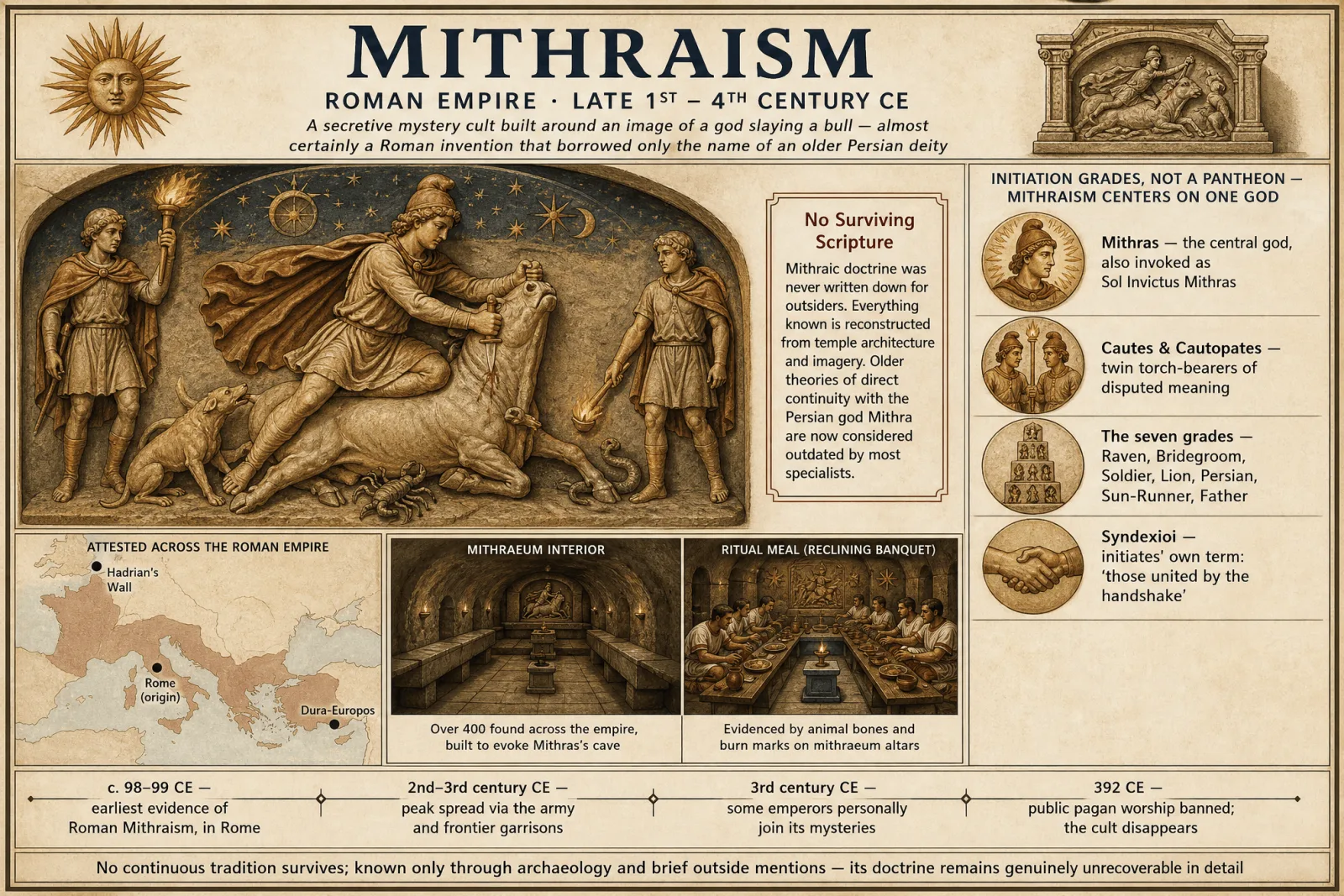
Mithraism, also known as the Mysteries of Mithras or the Roman Cult of Mithras, was an initiatory mystery religion practiced in the Roman Empire from approximately the 1st to the 4th centuries CE. The cult centered on the god Mithras, depicted iconographically in Persian-style dress (Phrygian cap, trousers, cloak) performing the tauroctony—the ritual slaying of a bull—surrounded by symbolic figures including a dog, snake, scorpion, raven, and two torch-bearing attendants (Cautes and Cautopates). Mithraism was an exclusively male cult, organized into seven ascending grades of initiation, and practiced in underground or cave-like temples called mithraea (singular: mithraeum). The religion spread rapidly through the Roman military, merchant networks, and imperial administration, with archaeological evidence concentrated in frontier provinces (the Rhine-Danube limes, Hadrian's Wall), port cities (Ostia, Rome, Dura-Europos), and urban centers across the empire.
Despite superficial Persian elements—Mithras shares his name with the Vedic-Avestan deity Mitra/Mithra, and the cult employed Iranian vocabulary (e.g., *nama* for ritual greeting)—modern scholarship has largely abandoned the early 20th-century hypothesis, championed by Franz Cumont, that Roman Mithraism was a direct transplant of Iranian Zoroastrian religion. The consensus since the 1970s, articulated by scholars such as Richard Gordon, Roger Beck, and Manfred Clauss, holds that Roman Mithraism was a new religious creation of the Roman imperial period, deliberately constructed to appear exotic and ancient by appropriating Persian imagery and terminology. The cult exhibits no clear Iranian theological content: the tauroctony, the seven-grade hierarchy, the mithraeum as ritual space, and the initiatory banquet have no known Iranian precedents. The religion's appeal lay in its promise of salvation through initiation, its hierarchical structure offering upward mobility, its fraternal community bonding initiates across social classes, and its astrological-cosmological symbolism interpreted by scholars as encoding celestial knowledge, soul ascent, or the structure of the cosmos.
Mithraism flourished from the late 1st century CE through the 3rd century, with its zenith circa 200–270 CE, before declining precipitously in the 4th century. The religion left no authoritative texts explaining its theology, mythology, or rituals; all knowledge derives from archaeology (mithraea, inscriptions, reliefs), hostile or incidental references by Christian and pagan authors, and iconographic analysis. By the early 5th century, Mithraism had vanished: mithraea were destroyed, buried, or converted into Christian churches, and the cult left no successor communities. The reasons for its extinction include competition with Christianity (which became the state religion under Constantine in the early 4th century), Christian persecution and iconoclasm, the cult's dependence on a narrow social base (soldiers, merchants, freedmen), and the absence of textual authority or institutional infrastructure to ensure continuity. Mithraism remains one of the most extensively studied yet enigmatic religions of antiquity, with ongoing scholarly debates about its origins, the meaning of its central icon (the tauroctony), and the nature of its soteriological promises.
Historical Development
The origins of Roman Mithraism are contested and obscure. The god's name—Mithras—is clearly derived from the Indo-Iranian deity Mitra (Vedic) or Mithra (Avestan), a god of covenants, oaths, light, and cosmic order in ancient Iranian and Indian religion. Vedic Mitra and Avestan Mithra are attested in texts such as the Rigveda (circa 1500 BCE) and the Avesta (Zoroastrian scripture, compiled circa 1st millennium BCE–Sasanian period), where Mithra is invoked as a powerful yazata (divine being) associated with the sun, truth, and the enforcement of contracts. However, the Iranian Mithra is never depicted slaying a bull, and Zoroastrian sources do not describe initiatory mysteries, grades of membership, or underground temples. The question confronting scholars is whether Roman Mithraism represents continuity with, adaptation of, or complete reinvention using the Iranian deity's name and prestige.
Franz Cumont, the Belgian scholar who founded modern Mithraic studies with his monumental *Textes et monuments figurés relatifs aux mystères de Mithra* (1896–1899), proposed that Roman Mithraism was essentially Romanized Zoroastrianism, transmitted westward via the Iranian diaspora in Anatolia, particularly through Hellenized Magi (*Magusaeans*) and the kingdom of Commagene (a client state blending Greek, Persian, and local traditions). Cumont argued that the tauroctony depicted a myth of cosmic creation found in Iranian tradition, that Mithraic eschatology paralleled Zoroastrian beliefs in judgment and resurrection, and that the cult's seven grades corresponded to planetary spheres in Zoroastrian cosmology. This 'default transmission scenario' dominated Mithraic scholarship for seven decades and shaped popular understanding of the cult as an 'oriental mystery religion' competing with Christianity.
The Cumontian paradigm began to unravel at the First International Congress of Mithraic Studies held in Manchester in 1971, where scholars including John R. Hinnells and Richard Gordon presented evidence undermining Cumont's Iranian thesis. Critics noted that no Iranian textual or archaeological source describes bull-slaying by Mithra, that Zoroastrianism lacks initiatory mysteries and graded hierarchies, and that the mithraeum as an architectural and ritual space has no Iranian precedent. Gordon argued in his influential essay 'Franz Cumont and the Doctrines of Mithraism' (1975) that Cumont had imposed a speculative theological superstructure onto fragmentary evidence, reading Iranian ideas into Roman material where none existed. Subsequent scholars—Richard Merkelbach, Manfred Clauss, Roger Beck—developed the thesis that Roman Mithraism was a new creation of the 1st century CE Roman world, deliberately fashioned to appear ancient and exotic by borrowing Persian imagery (Phrygian cap, name, vocabulary) while constructing an entirely novel religious system rooted in Greco-Roman mystery cult traditions, astrological speculation, and the social needs of imperial subjects.
The earliest securely dated archaeological evidence for Mithraism comes from the port city of Ostia Antica (near Rome) and from Rome itself, with inscriptions and mithraea dated to the late 1st century CE, particularly the Flavian period (69–96 CE). The concentration of early evidence in Rome and Ostia has led Clauss and others to propose that the cult may have originated in or near the capital, perhaps invented by a religious entrepreneur or adapted from existing mystery cults by someone familiar with Iranian motifs. From this Italian heartland, Mithraism spread rapidly along military and trade routes, carried by soldiers, merchants, freedmen, and imperial administrators. By the 2nd century CE, mithraea appeared across the empire: in the Rhineland and Danubian provinces (where Roman legions were stationed), in Britain (especially along Hadrian's Wall), in North Africa, in Asia Minor, and in the eastern provinces including Syria. The cult's appeal was particularly strong among soldiers and lower-ranking officers in the Roman military, though merchants, imperial slaves and freedmen, minor officials, and artisans also joined. Women were excluded from initiation, a distinctive feature that set Mithraism apart from some other mystery cults.
Mithraism began to decline in the 4th century CE, coinciding with Christianity's rise to dominance. Constantine's Edict of Milan (313 CE) legalized Christianity, and subsequent emperors—particularly Theodosius I (r. 379–395 CE)—elevated Christianity to the status of state religion, issuing edicts banning pagan sacrifices and closing temples. Archaeological evidence documents the deliberate destruction and desecration of mithraea in the late 4th and early 5th centuries. At sites such as Carrawburgh on Hadrian's Wall, tauroctony reliefs were smashed and torch-bearer statues decapitated. In Rome, Christian churches were built directly atop mithraea: the Basilica of San Clemente and the Church of Santa Prisca both overlie earlier Mithraic temples, symbolically 'burying' the pagan cult beneath Christian sacred space. By the early 5th century, Mithraism had ceased to exist as a living tradition. The cult lacked institutional infrastructure, central authority, or authoritative texts preserving theology; each mithraeum operated independently, making the religion vulnerable to localized suppression. The exclusion of women limited demographic reach, while reliance on animal sacrifice became untenable as Christian emperors banned such practices.
Beliefs and Cosmology
The tauroctony—the image of Mithras slaying a bull—is the defining iconographic motif of Roman Mithraism, present in virtually every mithraeum. The scene depicts Mithras, dressed in Persian attire (Phrygian cap, tunic, trousers, flowing cloak), kneeling on a bull's back, gripping its nostrils with his left hand and plunging a dagger into its shoulder with his right. The bull's tail transforms into wheat stalks, and from the wound flow blood and seed. Surrounding the central figures are a dog and a snake drinking the bull's blood, a scorpion attacking the bull's genitals, and a raven perched nearby. Flanking the scene are two torch-bearing youths: Cautes (torch raised, symbolizing dawn, spring, life) and Cautopates (torch lowered, symbolizing dusk, autumn, death). Above the scene, a crescent moon and the sun god Sol (often shown in a chariot) observe; below, the scene sometimes includes zodiacal symbols or cosmic imagery.
The tauroctony's meaning has been the subject of intense scholarly debate, as no ancient text explains it directly. Franz Cumont interpreted it as depicting an Iranian creation myth: Mithras slaying the primordial bull from whose body the world's fertility and life emerged. However, no Iranian source describes Mithra performing such an act. David Ulansey (1989) proposed a revolutionary astronomical interpretation: the tauroctony represents the precession of the equinoxes, with the bull as constellation Taurus, the dog as Canis Minor, the snake as Hydra, the scorpion as Scorpio, and the raven as Corvus. Mithras' act symbolizes cosmic power to shift the celestial equator, demonstrating his mastery over the heavens.
Roger Beck, the leading Mithraic scholar of the late 20th and early 21st centuries, developed a 'star-map' interpretation. Beck argued that the tauroctony functioned as an astrological-cosmological diagram, encoding celestial knowledge and facilitating the initiate's mental 'soul journey' through the planetary spheres. The mithraeum itself was understood by initiates as a model of the cosmos, and rituals enacted within it allowed participants to experience ascent and descent through the celestial realms, achieving gnosis (knowledge) of their place in the cosmic order. Beck emphasized that the tauroctony was not a narrative myth to be believed but an image-as-tool for meditation, ritual performance, and cosmological understanding. More recently, scholars have critiqued reductionist symbolic interpretations, arguing that the tauroctony must be understood in its ritual context: as an image invoking divine power, offering protection, and facilitating salvific transformation for initiates.
Mithraism was organized into seven grades (or ranks) of initiation: Corax (Raven), Nymphus (Bridegroom), Miles (Soldier), Leo (Lion), Perses (Persian), Heliodromus (Sun-Runner), and Pater (Father). Each grade was associated with a planetary deity (Corax with Mercury, Nymphus with Venus, Miles with Mars, Leo with Jupiter, Perses with the Moon, Heliodromus with the Sun, and Pater with Saturn), ritual symbols, and specific duties or privileges. The progression through grades involved initiations with ordeals, oaths of secrecy, and ritual performances. Tertullian describes a crown offered on a sword-point during the *Miles* initiation, which the candidate rejects, declaring 'Mithras is my crown.' The Leo grade involved a honey ritual: initiates' hands and tongues were purified with honey instead of water. The Pater (Father) was the highest grade and the leader of a local mithraeum, responsible for conducting rituals, overseeing initiations, and maintaining the community.
The seven-grade structure has been interpreted as reflecting astrological cosmology: the soul's descent through the seven planetary spheres to incarnation on earth, and its subsequent ascent through the same spheres to achieve salvation and return to the divine realm beyond the fixed stars. Porphyry describes the Mithraic grades as corresponding to the soul's journey through the cosmos, with each planet imparting qualities or challenges to the initiate. The progression from Corax (the lowest, earthbound grade) to Pater (the highest, Saturnian grade) thus enacted a ritual ascent, transforming the initiate from a novice bound by material existence into a spiritually elevated 'Father' who had mastered cosmic knowledge and achieved proximity to the divine.
Textual Absence and Scholarly Reconstruction
Roman Mithraism is unique among major ancient religions in leaving no authoritative sacred texts. No Mithraic liturgies, theological treatises, mythic narratives, or ritual manuals survive from antiquity. This absence reflects the cult's secretive nature and reliance on oral transmission, initiatory knowledge restricted to members, and ritual performance rather than scriptural study. Mithraic 'doctrine' was embodied in practice, iconography, and lived experience rather than codified in writing. The religion's rapid extinction in the 4th–5th centuries, combined with Christian destruction of cult sites and objects, ensured that any texts that may have existed were lost.
Scholarly reconstruction of Mithraism relies on four main types of evidence: archaeological remains (mithraea, reliefs, inscriptions, artifacts), iconographic analysis (the tauroctony and associated imagery), incidental references in Greco-Roman literature (primarily hostile Christian polemics), and philosophical commentaries by late antique authors. The most important literary sources are Porphyry (*On the Cave of the Nymphs*, 3rd century CE, a Neoplatonic allegorical reading providing insight into Mithraic cosmology) and Jerome (*Letter to Laeta*, 4th century CE, listing the seven grades and their planetary associations). Christian polemicists—Tertullian, Justin Martyr, Firmicus Maternus—provide hostile but informative descriptions of Mithraic rituals, particularly initiation rites and the sacred meal, which they condemn as diabolical imitations of Christian sacraments.
Modern Mithraic scholarship began with Franz Cumont, whose *Textes et monuments figurés relatifs aux mystères de Mithra* (1896–1899) collected all known textual and material evidence and proposed the first comprehensive reconstruction. Cumont's interpretation—Mithraism as Romanized Zoroastrianism—dominated until critiqued by Richard Gordon (1975) and subsequent scholars. Manfred Clauss (*The Roman Cult of Mithras*, 1990/2000) shifted focus to archaeology and inscriptions, arguing for a Roman origin. Roger Beck (*The Religion of the Mithras Cult in the Roman Empire*, 2006; *The Mind of Mithraists*, 2014) developed cognitive and astrological interpretations, emphasizing the mithraeum as a 'celestial laboratory' and the tauroctony as a star map.
Ritual Practice
Mithraic ritual centered on the communal meal (*agape* or banquet), conducted in the mithraeum with initiates reclining on benches flanking the central aisle. Evidence from inscriptions, wall paintings (particularly at Santa Prisca in Rome), and archaeological remains suggests that the meal replicated the mythic banquet of Mithras and Sol (the sun god) after the bull-slaying. The ritual meal likely involved bread and wine, paralleling Christian Eucharist and Greco-Roman *symposia*, and may have included meat (remnants of animal bones have been found in some mithraea, suggesting sacrificial feasts). The meal reinforced communal bonds among initiates, symbolized cosmic harmony, and enacted the myth central to the cult's soteriology.
Rituals also included processions, hymns, prayers, and dramatic reenactments of mythic events. Inscriptions refer to initiates 'serving' (*ministrare*) Mithras, and some scholars speculate that rituals involved role-playing or liturgical drama, with initiates donning masks or costumes representing grades, planetary deities, or mythic figures. The dimly lit, confined space of the mithraeum, combined with ritual action, music, and perhaps the use of incense, created a powerful sensory and psychological environment conducive to religious experience and the internalization of cosmological symbolism.
The mithraeum was architecturally distinctive: a small, rectangular, cave-like structure, typically seating 20–40 initiates, with a central aisle and two raised stone benches (*podia*) running along the sides. At the far end stood a niche or apse containing the tauroctony relief or statue. The ceiling was often vaulted to simulate a cave and painted with stars, constellations, or zodiacal symbols, emphasizing the mithraeum's function as a 'model of the cosmos.' Mithraea were deliberately hidden or underground, built in basements, natural caves, or converted rooms within larger buildings.
Initiations were secretive and guarded by oaths. Christian writers complain that Mithraists swore oaths of silence, preventing outsiders from learning the cult's mysteries. This secrecy enhanced the cult's allure, created strong in-group cohesion among members, and distinguished Mithraism from public Greco-Roman religion. Exclusion of women was absolute: no inscriptions record female initiates, and literary sources confirm that the cult was male-only. The reasons are debated, but the exclusion limited the cult's demographic reach and contributed to its eventual extinction.
Regional Variations
While Mithraism exhibited remarkable iconographic consistency across the Roman Empire—the tauroctony, the seven grades, the mithraeum layout—regional variations existed. Italian mithraea (Rome, Ostia) tend to be larger, more elaborate, and decorated with higher-quality sculpture and painting. Frontier mithraea along the Rhine-Danube limes and Hadrian's Wall are often smaller, simpler structures attached to military forts. Eastern mithraea (Syria, Asia Minor) sometimes incorporate local architectural elements and iconography, suggesting adaptation to regional tastes.
The cult's social composition varied regionally. In Rome and Ostia, inscriptions show a mix of freedmen, merchants, imperial slaves, minor officials, and some elites. In frontier provinces, soldiers and lower-ranking officers dominated. The cult rarely attracted the highest echelons of Roman society—senators and emperors did not join, preferring traditional state cults or other mystery religions. Mithraism's appeal lay in its fraternal, egalitarian ethos: within the mithraeum, initiates of different social ranks shared the sacred meal and addressed each other as 'brother' (*frater*), transcending normal social hierarchies.
Extinction and Disappearance
Mithraism's extinction in the 4th–5th centuries CE resulted from multiple converging factors. Competition with Christianity was decisive: both religions offered salvation, initiatory entry, a sacred meal, and fraternal community, but Christianity possessed structural advantages. Christianity welcomed women and families, creating intergenerational communities; Mithraism excluded women, limiting its demographic base. Christianity developed centralized authority (bishops, councils, creeds), ensuring doctrinal continuity; Mithraism lacked central authority, making it vulnerable to localized suppression. Christianity possessed authoritative texts (the Bible, liturgical manuals); Mithraism relied on oral tradition and ritual performance, which could not survive community disruption.
Christian persecution and iconoclasm accelerated decline. Theodosius I's edicts (late 4th century) banned pagan sacrifices and ordered temple closures. Christian mobs attacked mithraea: reliefs were smashed (as at Carrawburgh), statues beheaded, and temples desecrated or converted. The construction of churches atop mithraea—San Clemente and Santa Prisca in Rome—symbolically buried the pagan cult beneath Christian sacred space. Christian polemicists demonized Mithraism, and Augustine condemned Mithraic rituals as diabolical.
Structural fragility compounded external pressures. Mithraism's small, independent mithraea lacked economies of scale and could not mobilize collective resistance. The cult's reliance on a narrow social base—soldiers, merchants, freedmen—made it vulnerable to demographic shifts. The Christianization of the Roman army in the 4th century removed a key recruitment pool. The absence of textual authority meant that once ritual knowledge was lost (through the death or conversion of Paters and higher-grade members), it could not be recovered. By the early 5th century, Mithraism had ceased to exist: no inscriptions, no mithraea, no communities.
Mithraea and Sacred Sites
Santa Prisca Mithraeum (Rome) is one of the most important and well-preserved mithraea, located beneath the Church of Santa Prisca on the Aventine Hill. Built in the early 3rd century CE, the mithraeum features elaborate wall paintings depicting the seven grades, ritual scenes, and inscriptions. The paintings show a procession of initiates labeled with their grades (Corax, Nymphus, Miles, Leo, Perses, Heliodromus, Pater), offering rare visual evidence for the cult's hierarchy. The site was intentionally filled in and buried when the church was constructed above, preserving the paintings in remarkable condition.
San Clemente Mithraeum (Rome) lies beneath the 12th-century Basilica of San Clemente, itself built atop a 4th-century church, which in turn overlies a 1st-century insula (apartment building) containing the mithraeum. The stratification of Christian churches atop a Mithraic temple dramatically illustrates the religion's burial and displacement. The mithraeum, dated to the late 2nd or early 3rd century CE, features a well-preserved tauroctony relief, benches, and an altar. The site is open to visitors and provides one of the most accessible examples of a mithraeum in its original context.
Carrawburgh Mithraeum (Brocolitia Roman Fort, Hadrian's Wall, Britain) is the best-preserved Mithraic temple in Britain, located near a spring sacred to the water nymph Coventina. Built in the early 3rd century CE and destroyed circa 300 CE (possibly by Christians), the site preserves altars, inscriptions, and the foundations of the mithraeum. The tauroctony relief and torch-bearer statues were found deliberately smashed, evidence of iconoclastic destruction.
Dura-Europos Mithraeum (Syria) is a rare eastern example, discovered during excavations in the 1930s at the Roman garrison town on the Euphrates. Built circa 168–256 CE, the mithraeum was preserved when the entire town was abandoned and buried by defensive earthworks during the Sasanian siege. The site features wall paintings showing initiation scenes, the grades, and Mithraic deities, now displayed at Yale University Art Gallery.
Ostia Antica (near Rome) contains at least 18 identified mithraea, more than any other site, making it the most important center for Mithraic archaeology. Ostia's mithraea range from small private chapels to elaborate complexes such as the Mithraeum of the Seven Spheres (named for a mosaic floor depicting planetary spheres), the Mithraeum of Felicissimus (with a mosaic showing the seven grades and their symbols), and the Mithraeum of the Serpents. The concentration of mithraea in Ostia reflects the city's role as Rome's port and its diverse population of merchants, sailors, and freedmen.
Scholarly Debates
The Iranian Origin Debate: The question of Mithraism's relationship to Iranian religion remains contentious. The Cumontian hypothesis—that Roman Mithraism was Romanized Zoroastrianism—has been largely rejected, but the nature of the connection (if any) between Roman Mithras and Iranian Mithra is unresolved. Some scholars (Richard Gordon, Manfred Clauss) argue for complete discontinuity: Roman Mithraism was a new creation borrowing only the god's name and Persian imagery for exotic prestige. Others (Mary Boyce) maintain that some Iranian elements—reverence for oaths, solar associations, dualistic cosmology—may have been transmitted via the Iranian diaspora in Anatolia. A middle position (Roger Beck) suggests creative adaptation: Roman Mithraism drew on Iranian traditions selectively, reinterpreting them within Greco-Roman frameworks.
Interpreting the Tauroctony: Scholarly interpretations of the central icon diverge sharply. Astronomical theories (Ulansey, Beck) read the tauroctony as a star map or celestial diagram, encoding precession of the equinoxes, planetary movements, or astrological knowledge. Critics argue that this imposes modern astrophysical concepts onto ancient imagery. Mythological interpretations (Cumont, Merkelbach) understand the bull-slaying as a narrative myth—Mithras as cosmic hero, the bull as primordial creature—though no ancient text describes such a myth. Ritual-centered approaches (recent scholarship) emphasize that the tauroctony was not a static symbol to be 'decoded' but a ritual image invoking divine power, mediating salvation, and shaping initiates' religious experience through embodied practice.
Mithraism and Christianity: Early scholars emphasized parallels between Mithraic and Christian rituals—initiatory baptism, sacred meal, resurrection symbolism—and speculated about mutual influence or borrowing. Christian polemicists claimed Mithraism was demonic parody. Current consensus rejects direct borrowing in either direction, viewing similarities as reflecting shared Greco-Roman religious milieu: both religions drew on common Mediterranean and Near Eastern traditions (mystery cults, sacrifice, communal meals, initiatory rituals), adapting them to distinct theological and social ends. Mithraism's exclusion of women, lack of scriptural authority, and narrow social base distinguished it from Christianity, explaining its eventual defeat in their 4th-century competition.
Key Terms
- Mithras
- The god of the Roman mystery cult, depicted as a young man in Persian dress slaying a bull (the tauroctony).
- Tauroctony
- The central iconographic scene of Mithras slaying a bull, surrounded by symbolic animals and figures.
- Mithraeum
- The underground or cave-like temple where Mithraic rituals were conducted, understood as a model of the cosmos.
- Seven Grades
- The hierarchical levels of initiation in Mithraism—Corax (Raven), Nymphus (Bridegroom), Miles (Soldier), Leo (Lion), Perses (Persian), Heliodromus (Sun-Runner), Pater (Father).
- Cautes and Cautopates
- The two torch-bearing attendants flanking the tauroctony, representing dawn/spring/life (torch raised) and dusk/autumn/death (torch lowered).
- Pater
- The highest grade of initiation, leader of a local mithraeum responsible for conducting rituals and overseeing the community.
- Sol
- The sun god, often depicted in Mithraic iconography feasting with Mithras after the bull-slaying.
- Podia
- The raised benches flanking the central aisle of the mithraeum, where initiates reclined during ritual meals.
- Franz Cumont
- Belgian scholar (1868–1947) who founded modern Mithraic studies, proposing (now largely rejected) that Roman Mithraism derived from Iranian Zoroastrianism.
- Roger Beck
- Leading 20th–21st century Mithraic scholar (1937–2023), who developed cognitive and astrological interpretations of the cult.
- Manfred Clauss
- German scholar whose work emphasized archaeological evidence and argued for Roman origin of the cult.
Further Reading
- Manfred Clauss, The Roman Cult of Mithras: The God and his Mysteries, trans. Richard Gordon (Edinburgh University Press, 2000)
- Roger Beck, The Religion of the Mithras Cult in the Roman Empire: Mysteries of the Unconquered Sun (Oxford University Press, 2006)
- Roger Beck, The Mind of Mithraists: Historical and Cognitive Studies in the Roman Cult of Mithras (Bloomsbury, 2014)
- Richard Gordon, 'Franz Cumont and the Doctrines of Mithraism' in J.R. Hinnells (ed.), Mithraic Studies (Manchester University Press, 1975)
- David Ulansey, The Origins of the Mithraic Mysteries: Cosmology and Salvation in the Ancient World (Oxford University Press, 1989)
- Roger Beck, 'Mithraism' in Encyclopaedia Iranica Online
- Csaba Szabó, 'In memoriam Roger L. Beck (1937-2023): His life and impact on the study of Roman Mithras,' Journal of Ancient History and Archaeology 11/1 (2024)
- Luther H. Martin, 'Seeing the Mithraic Tauroctony,' Numen 68 (2021)
- Against Reductionism: A Ritual-Centered Reappraisal of Mithra in Iranian and Roman Traditions (Zenodo preprint, 2026)
- Ostia Antica: Mithraea Archaeological Documentation
Practices
- Initiation grades
- Ritual meals
- Bull-slaying rite (tauroctony)
Core ideas
- Salvation
- Liberated ascent of the soul through the planets
- Deity
- Mithras, a solar intermediary
Sacred texts
Mithraism was a secret initiatory cult whose written scriptures were never publicly circulated and have almost entirely perished. What remains are inscriptions in mithraea across the Roman Empire and the rich iconography of the tauroctony — Mithras slaying the cosmic bull. Initiates learned the faith's seven grades and salvation myth through ritual drama rather than reading.