Overview
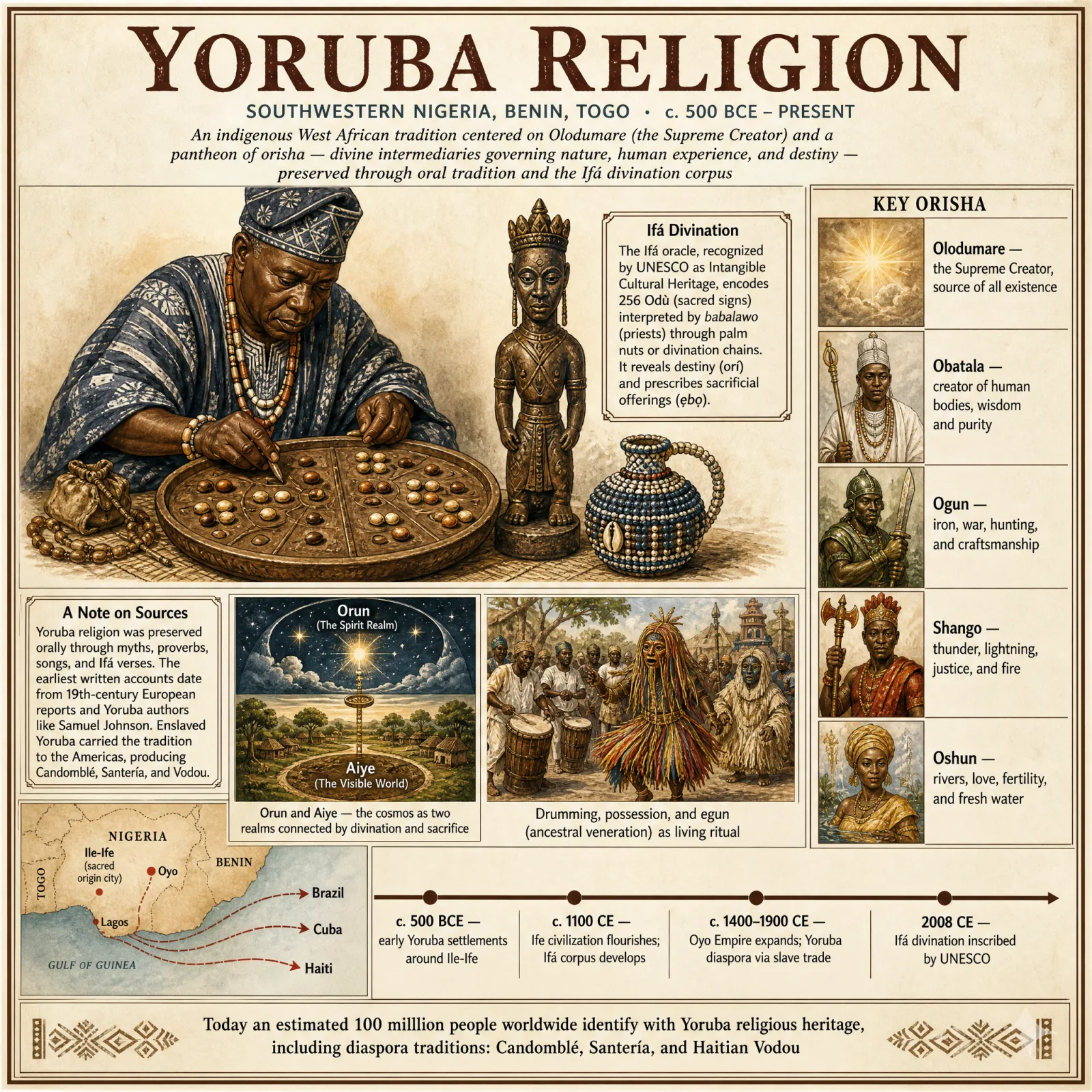
Yoruba Religion, also known as Òrìṣà (orisha) worship or Ìṣẹ̀ṣe (the tradition of our ancestors), is the indigenous religious tradition of the Yoruba-speaking peoples of southwestern Nigeria and parts of Benin and Togo. It is a complex, orally transmitted system of belief and practice centered on the worship of a pantheon of deities called òrìṣà (orishas), who serve as intermediaries between humanity and the supreme creator deity, Olódùmarè (also called Olórun). The religion encompasses a rich cosmology, elaborate ritual practices, divination systems (especially Ifá), ancestral veneration, sacred kingship, festivals, and material culture including shrines, sculptural arts, textiles, and beadwork. Yoruba religious thought emphasizes the interconnection between the spiritual and material worlds, the importance of good character (ìwà), and the reciprocal relationship between humans and the divine through sacrifice (ẹbọ) and offerings.
The òrìṣà are multifaceted divine beings, each associated with specific natural forces, moral qualities, social roles, and human concerns. Major òrìṣà include Ṣàngó (thunder and kingship), Ògún (iron, war, and technology), Ọbàtálá (creativity and purity), Ọṣun (rivers, fertility, and beauty), Yemọja (motherhood and the ocean), Oya (wind, transformation, and the Niger River), and Èṣù (communication, chance, and divine messenger). Each òrìṣà has devotees, priests, shrines, festivals, and associated ritual objects. Worship involves prayer, song, dance, drumming, possession trance, and sacrificial offerings of food, animals, and kola nuts. Òrìṣà devotion is not exclusive; individuals may honor multiple òrìṣà depending on lineage, personal calling, or life circumstances. The hereditary priesthood, including babaláwo (Ifá diviners) and priests and priestesses of specific òrìṣà, maintains ritual knowledge, initiates new practitioners, and serves as intermediaries between the divine and human realms.
Yoruba Religion has profoundly influenced the religious landscape of the Atlantic world due to the forced migration of enslaved Yoruba people during the transatlantic slave trade (18th–19th centuries). Òrìṣà traditions were carried to the Americas, where they blended with Catholicism, Indigenous religions, and other African traditions to form new religious systems including Santería (Cuba), Candomblé (Brazil), Vodou (Haiti), and Oyotunji (United States). Despite centuries of missionary activity, colonialism, and the spread of Christianity and Islam in Yorubaland, traditional Yoruba Religion persists as a living tradition. Contemporary practitioners navigate multiple religious identities, participating in òrìṣà worship while also identifying as Christian or Muslim, a phenomenon scholars call religious pluralism or syncretism. In recent decades, a revitalization movement has emerged, particularly among diaspora communities and urban Yoruba elites, reclaiming òrìṣà worship as a source of cultural identity, resistance to colonial legacies, and connection to African heritage.
Historical Development and Continuity
The origins of Yoruba Religion are difficult to date precisely due to the oral nature of the tradition and the lack of written records before the 19th century. Archaeological evidence, including terracotta sculptures from Ife and bronze castings from Benin, suggests that Yoruba religious and artistic traditions have deep historical roots, extending back to at least the first millennium CE. The city of Ilé-Ifẹ̀ (Ife) holds a central place in Yoruba cosmology as the site of creation, where Olódùmarè sent the òrìṣà Ọbàtálá (or Odùduwà, in some accounts) to create land, humans, and civilization. Archaeological excavations at Ife have uncovered naturalistic terracotta and bronze heads, stone sculptures, and ritual paraphernalia dating to the 12th–15th centuries CE, confirming the city's ancient significance as a religious and political center. The Oni (king) of Ife is regarded as a spiritual leader and the direct descendant of Odùduwà, the legendary progenitor of the Yoruba people, and Ife remains a pilgrimage site for Yoruba and diaspora devotees.
By the 16th and 17th centuries, Yoruba-speaking peoples were organized into a network of city-states and kingdoms, including Ọ̀yọ́, Ifẹ̀, Ìjẹ̀ṣà, Èkìtì, Ìjẹ̀bú, and Kétu, each with its own ruling dynasty, patron òrìṣà, and ritual calendar. The Ọ̀yọ́ Empire, which dominated the region from the 17th to the early 19th century, was particularly influential in shaping Yoruba religious and political institutions. The Aláàfin (king) of Ọ̀yọ́ was regarded as a sacred ruler, a descendant of Ṣàngó, the òrìṣà of thunder and former king deified after his death. The collapse of the Ọ̀yọ́ Empire in the early 19th century led to a series of civil wars and mass displacement, which paradoxically facilitated the spread and consolidation of Yoruba religious practices as refugees and migrants carried their òrìṣà cults to new regions. It was during this period that large numbers of Yoruba were captured and sold into slavery in the Americas, bringing òrìṣà worship to Cuba, Brazil, Trinidad, and other New World destinations.
The 19th century marked a watershed in Yoruba religious history due to the encounter with Christianity and Islam. Christian missionaries, especially the Anglican Church Missionary Society (CMS), arrived in Yorubaland in the 1840s, accompanied by repatriated ex-slaves from Sierra Leone and Brazil, some of whom had converted to Christianity or Islam abroad. As historian J.D.Y. Peel has argued in *Religious Encounter and the Making of the Yoruba* (Indiana, 2000), it was through this encounter with Christianity that the Yoruba came to understand themselves as a unified ethnic and religious community, distinct from neighboring groups. Missionaries condemned òrìṣà worship as "paganism" and sought to suppress practices such as animal sacrifice, possession trance, and the veneration of "idols." However, many Yoruba converts adopted a syncretic approach, maintaining òrìṣà devotion alongside Christian or Muslim practice. The colonial period (British rule from 1901 to 1960) brought further pressure, as colonial authorities allied with missions to discourage traditional religion. Despite this, òrìṣà shrines, festivals, and divination practices persisted, often operating discreetly or under the protection of sympathetic traditional rulers. Since Nigerian independence in 1960, there has been a gradual resurgence of interest in traditional religion, particularly among intellectuals, artists, and diaspora communities seeking to reclaim pre-colonial African identity.
Cosmology, Theology, and Ethics
Yoruba cosmology envisions a universe composed of two interconnected realms: Òrun (the invisible, spiritual world) and Ayé (the visible, material world). Òrun is the abode of Olódùmarè (the supreme creator), the òrìṣà, and the ancestors (egúngún), while Ayé is the realm of human existence, characterized by change, suffering, and moral choice. The boundary between these two realms is porous; the òrìṣà and ancestors can intervene in human affairs, and humans can communicate with the divine through ritual, sacrifice, and divination. The ultimate goal of human life is to fulfill one's destiny (orí, literally "head," understood as one's spiritual essence and fate), cultivate good character (ìwà), and maintain harmonious relationships with the òrìṣà, ancestors, and community. At death, the individual's spirit returns to Òrun, where it may eventually be reborn into the same lineage, ensuring continuity between past, present, and future generations.
Olódùmarè (or Olórun, "Owner of Heaven") is the supreme, distant creator deity, the source of all existence and ultimate arbiter of fate. Olódùmarè is beyond direct human worship and does not have temples or priests; instead, humans approach the divine through the òrìṣà, who are Olódùmarè's agents and ministers. The òrìṣà are not mere personifications of natural forces but complex beings with personalities, preferences, taboos, and ethical demands. They embody both creative and destructive potentials: Ṣàngó's thunder can punish wrongdoers or bless worshippers; Ògún's iron can be used for agriculture or warfare; Ọṣun's waters can bring fertility or cause floods. The òrìṣà require regular attention—offerings of food, drink, and animals—and in return, they provide protection, health, prosperity, and guidance. Neglect or offense can result in misfortune, illness, or death, interpreted as the òrìṣà's displeasure.
Ifá is the divination system par excellence in Yoruba Religion, serving as the primary means of communication between humans and the divine. The babaláwo (Ifá priest, literally "father of secrets") is a highly trained specialist who consults the oracle on behalf of clients seeking guidance on illness, marriage, business, or other life decisions. Ifá divination involves casting palm nuts (ikin) or a divining chain (ọ̀pẹ̀lẹ̀) to produce one of 256 odù (signs), each associated with a corpus of oral verses (Ifá literary corpus) containing myths, proverbs, ethical teachings, and prescriptions for sacrifice. The babaláwo interprets the relevant verses, diagnoses the client's problem, and prescribes ẹbọ (sacrifice or offering) to appease the òrìṣà or ancestors. Ifá is understood as a distinct system of knowledge, often personified as the òrìṣà Ọ̀rúnmìlà (also called Ifá), the witness to human destiny and Olódùmarè's spokesperson. While Ifá is central to Yoruba Religion, it is not identical to òrìṣà worship as a whole; many people consult Ifá without being initiated into specific òrìṣà cults, and not all òrìṣà devotees are Ifá initiates.
Yoruba ethics emphasize ìwà (good character) as the foundation of a meaningful life. The proverb "Ìwà l'ẹwà" ("Character is beauty") encapsulates the belief that moral integrity, respect, generosity, and humility are more valuable than wealth, power, or physical appearance. Ethical conduct includes fulfilling obligations to family, community, and the òrìṣà, speaking truthfully, avoiding violence except in just cause, and maintaining ritual purity. Ancestral veneration reinforces moral continuity: the living honor deceased family members through prayers, offerings, and festivals such as Egungun masquerades, in which masked performers embody the spirits of ancestors, offering blessings and reminding the living of their duties. The ancestors, in turn, are believed to watch over their descendants and intercede with the òrìṣà on their behalf.
Oral Literature and Sacred Knowledge
Yoruba Religion is primarily an oral tradition, with sacred knowledge transmitted through memorization, performance, and initiation rather than written texts. The most important body of oral literature is the Ifá corpus (Odù Ifá), a vast collection of verses associated with the 256 odù (divination signs). Each odù contains numerous ese (verses or poems) that recount myths, historical events, moral teachings, and ritual prescriptions. The Ifá corpus has been described as an encyclopedia of Yoruba culture, preserving knowledge about cosmology, ethics, medicine, history, and social organization. William Bascom's *Ifá Divination: Communication between Gods and Men in West Africa* (Indiana, 1969) and *Sixteen Cowries: Yoruba Divination from Africa to the New World* (Indiana, 1980) are foundational scholarly works documenting the structure and content of Ifá and related divination systems. The transmission of Ifá knowledge is tightly controlled; babaláwo undergo years of apprenticeship, memorizing thousands of verses and learning the esoteric meanings of signs, herbs, and rituals.
Oríkì (praise poetry) is another central genre of Yoruba oral literature, performed primarily by women to honor individuals, lineages, òrìṣà, and towns. Oríkì recitations invoke the names, deeds, and attributes of their subjects, establishing spiritual connections and calling forth blessings or divine presence. Each òrìṣà has a body of oríkì that practitioners chant during rituals, festivals, and possession ceremonies. Karin Barber's *I Could Speak Until Tomorrow: Oríkì, Women, and the Past in a Yoruba Town* (Edinburgh, 1991) is a landmark ethnographic study of oríkì performance, showing how women use this genre to interpret history, assert social claims, and mediate between the human and spiritual worlds. Oríkì is dynamic and improvised; performers adapt and expand texts in response to context, audience, and inspiration, making it a living, evolving tradition.
While Yoruba Religion traditionally lacked written scripture, literacy and print culture have influenced the tradition since the 19th century. Missionaries and educated Yoruba converts produced written accounts of òrìṣà worship, Ifá divination, and festivals, often with the goal of documenting a "vanishing" tradition or defending it against colonial and missionary criticism. In the 20th century, Yoruba intellectuals and priests began publishing Ifá verses, ritual manuals, and theological treatises in Yoruba and English, making previously esoteric knowledge accessible to wider audiences, including diaspora communities. This "textualization" of Yoruba Religion has been both a tool of preservation and a source of controversy; some practitioners argue that publishing sacred knowledge violates initiatory secrecy and commodifies spiritual power, while others see it as necessary for cultural survival and global dissemination.
Rituals, Festivals, and Observances
Yoruba religious practice revolves around the maintenance of shrines (ilé òrìṣà, "house of the òrìṣà"), where devotees honor their patron deities through regular offerings and prayers. A shrine may be as simple as a pot or calabash containing sacred stones, herbs, and other materials, or as elaborate as a dedicated building with altars, sculptural representations, and ritual paraphernalia. Priests and priestesses (often hereditary within lineages) are responsible for maintaining shrines, conducting rituals, and initiating new devotees. Initiation into an òrìṣà cult typically involves a period of seclusion, instruction in ritual knowledge and taboos, ritual washing and scarification, and the "seating" of the òrìṣà in the initiate's head through prayers, offerings, and, in some traditions, possession trance. Initiates receive a new name, ritual regalia (including beads, cloth, and implements specific to their òrìṣà), and lifelong obligations to honor their deity.
Sacrifice (ẹbọ) is the central ritual act in Yoruba Religion, understood as the means by which humans nourish, please, and communicate with the òrìṣà and ancestors. Sacrifices range from simple offerings of water, kola nuts, and palm oil to the ritual slaughter of chickens, goats, and, in major festivals, cattle. The choice of sacrifice is determined by divination (Ifá or other methods), which identifies what the òrìṣà or ancestors require to resolve a problem or grant a blessing. The sacrificial act involves prayers, invocations, drumming, and the pouring of the animal's blood on the shrine, after which the meat is cooked and shared among priests, initiates, and community members. Far from being "primitive" or "superstitious," sacrifice embodies reciprocity: humans give to the divine in recognition of their dependence on spiritual forces, and the divine reciprocates with protection, health, and prosperity.
Festivals are the most public and communal expressions of Yoruba Religion, drawing participants from across towns, regions, and, increasingly, the diaspora. Each òrìṣà has an annual festival, often timed to seasonal cycles such as harvest or the onset of rains. The Ọṣun-Ọṣogbo Festival (held in August in Osogbo, Osun State) is the largest and most internationally recognized òrìṣà festival, attracting tens of thousands of devotees, tourists, and scholars. The festival includes processions to the Osun River, offerings to the goddess Ọṣun, divination, drumming, dancing, and possession ceremonies. The Ṣàngó Festival in Ọ̀yọ́ honors the thunder god and former king, featuring displays of Ṣàngó devotees' fire-eating and trance performances. Egungun masquerades, held in various Yoruba towns, honor ancestors through masked dancers embodying the spirits of the deceased, who bless the living, mediate disputes, and remind the community of its moral obligations. Festivals serve multiple functions: religious (honoring the òrìṣà and ancestors), social (reinforcing community identity and solidarity), economic (attracting visitors and commerce), and political (affirming the authority of traditional rulers and priests).
Possession trance is a key mode of divine-human interaction. During festivals, drumming and singing invoke the òrìṣà, who may "mount" (possess) initiated devotees, causing them to dance, speak, and act as the deity. Possession is understood not as loss of control but as the òrìṣà's direct presence and communication. The possessed individual may offer prophecies, healing, or blessings, and witnesses interpret the òrìṣà's gestures and utterances as messages. Scholars such as Margaret Thompson Drewal have analyzed possession as a form of embodied performance and theology, in which the divine is made tangible and accessible to the community.
Regional Variations and Contemporary Pluralism
Yoruba Religion is not monolithic; significant regional and local variations exist in the pantheon of òrìṣà, ritual practices, myths, and institutional structures. In Ọ̀yọ́, Ṣàngó is the preeminent òrìṣà, closely tied to the royal lineage and political authority. In Ifẹ̀, Ọbàtálá and the creation myths centered on Odùduwà predominate. In Ìjẹ̀bú, Ògún (the òrìṣà of iron and war) is particularly prominent. Coastal and riverine communities, such as those in Ọ̀ṣun and Ògùn states, emphasize water-related òrìṣà like Ọṣun and Yemọja. These variations reflect local histories, ecological contexts, and the influence of specific lineages and rulers. The Yoruba concept of the òrìṣà is flexible; new òrìṣà can be added (through deification of ancestors or adoption from neighboring groups), and òrìṣà cults can rise or decline in importance over time.
The relationship between Yoruba Religion, Christianity, and Islam is complex and multifaceted. Many Yoruba identify as Christian or Muslim while maintaining some degree of involvement in òrìṣà worship, ancestral veneration, or Ifá divination. This religious pluralism is not necessarily experienced as contradiction; individuals may consult a babaláwo for a major decision while attending church on Sunday, or honor òrìṣà at family shrines while observing Islamic prayers. J.D.Y. Peel's *Christianity, Islam, and Orisa-Religion* (University of California Press, 2015) examines this coexistence, arguing that Yoruba religious culture is characterized by pragmatism, openness to multiple sources of spiritual power, and a focus on efficacy (what "works") rather than doctrinal orthodoxy. However, tensions also exist: some Christian and Muslim leaders condemn òrìṣà worship as "idolatry" or "devil worship," and some òrìṣà devotees reject Christianity and Islam as foreign impositions. Pentecostal Christianity, in particular, has adopted a militant stance against traditional religion, conducting "deliverance" rituals to "free" converts from òrìṣà influence.
In recent decades, a revitalization movement has emerged, particularly among urban elites, artists, intellectuals, and diaspora Yoruba. This movement reclaims òrìṣà worship as a source of cultural pride, resistance to neocolonialism, and connection to African heritage. Organizations such as the International Congress of Orisa Tradition and Culture promote the study, preservation, and global dissemination of òrìṣà practices. Some practitioners advocate for a "pure" or "orthodox" Yoruba Religion, rejecting syncretism with Christianity or Islam and emphasizing pre-colonial authenticity. Others embrace a more inclusive approach, seeing òrìṣà worship as compatible with other faiths or as part of a broader African spirituality. The proliferation of òrìṣà shrines, festivals, and initiations in diaspora communities (especially in the United States, United Kingdom, and Brazil) has created new networks of exchange, with Nigerian priests traveling abroad to conduct initiations and diaspora devotees making pilgrimages to Yorubaland.
Contemporary Demographics and Global Presence
Estimating the number of Yoruba Religion practitioners is difficult due to the lack of official census categories for traditional African religions and the prevalence of religious pluralism (individuals who identify as Christian or Muslim while also practicing òrìṣà worship). Nigeria's population includes approximately 40–50 million Yoruba speakers, concentrated in the southwestern states of Lagos, Ogun, Oyo, Osun, Ondo, and Ekiti, as well as parts of Kwara and Kogi states. Smaller Yoruba populations exist in Benin (where they are called Nago) and Togo. While the majority of Yoruba identify as Christian or Muslim in census data, a significant minority continues to practice traditional religion exclusively or alongside other faiths. Scholars estimate that millions of Yoruba maintain some form of òrìṣà devotion, even if they do not identify publicly as traditional religionists due to social stigma or legal pressures.
The Yoruba diaspora in the Americas represents a major demographic and cultural extension of Yoruba Religion. During the transatlantic slave trade (especially the 18th and 19th centuries), hundreds of thousands of Yoruba were forcibly transported to Cuba, Brazil, Trinidad, Haiti, and other Caribbean and South American destinations. Despite the brutal conditions of slavery and colonial prohibitions on African religions, enslaved Yoruba preserved òrìṣà worship, often syncretizing it with Catholicism to avoid persecution. In Cuba, this resulted in Santería (or Lucumí), in which òrìṣà are identified with Catholic saints (e.g., Ṣàngó with St. Barbara, Ọṣun with Our Lady of Charity). In Brazil, Candomblé developed, maintaining stronger Yoruba linguistic and ritual elements. In Haiti, Yoruba òrìṣà (called lwa in Haitian Creole) were incorporated into Vodou alongside Fon/Dahomean and Kongo deities. In the 20th and 21st centuries, these diaspora traditions have undergone "re-Africanization," with practitioners seeking direct connections to Yoruba sources, learning Yoruba language, traveling to Nigeria for initiations, and differentiating themselves from Catholic syncretism. The result is a transnational òrìṣà religious network linking Africa, the Caribbean, Latin America, North America, and Europe.
In the United States, Yoruba Religion has grown significantly since the 1960s, driven by the Black Power movement, African cultural nationalism, and Caribbean immigration. Organizations such as the Oyotunji African Village in South Carolina (founded 1970) and urban òrìṣà temples in New York, Miami, Los Angeles, and other cities serve as centers for initiation, festivals, and education. African Americans, Afro-Caribbeans, and increasing numbers of white and Latinx Americans have been initiated into òrìṣà cults, creating a diverse and sometimes contentious community. Issues of cultural appropriation, authenticity, authority (who can legitimately initiate and teach), and the relationship between òrìṣà worship and racial identity are ongoing debates. In Europe, especially the United Kingdom, òrìṣà communities have formed among Nigerian and Caribbean migrants, and some European converts have also been initiated. Globalization, the internet, and social media have facilitated the spread of Yoruba religious knowledge, with online forums, YouTube channels, and virtual consultations supplementing traditional in-person transmission.
Sacred Geography
Ilé-Ifẹ̀ (commonly called Ife) is the most sacred city in Yoruba cosmology, revered as the birthplace of humanity and civilization. According to Yoruba creation myths, Olódùmarè sent the òrìṣà Ọbàtálá (or Odùduwà, in alternative versions) down from Òrun with a calabash of sand, a chicken, and a palm nut. Ọbàtálá scattered the sand on the primordial waters, the chicken spread it with its feet, and the palm nut grew into the first tree, establishing land at the site of Ife. Olódùmarè then created the first humans at Ife, making it the cradle of Yoruba civilization. Located in present-day Osun State, Ife is home to the Oni (king), who is regarded as a spiritual leader and the direct descendant of Odùduwà. The city contains numerous sacred sites, including the Oòni's Palace, shrines to major òrìṣà, and the Ife Museum, which houses terracotta and bronze sculptures dating to the 12th–15th centuries. Jacob Olupona's *City of 201 Gods: Ilé-Ifè in Time, Space, and the Imagination* (University of California Press, 2011) provides an in-depth ethnographic and historical study of Ife's religious significance, documenting the city's festivals, rituals, and the interplay between traditional and modern institutions. Pilgrims from across Yorubaland and the diaspora visit Ife to pay homage to their ancestral and spiritual origins.
Osun-Osogbo Sacred Grove, located on the outskirts of Osogbo in Osun State, is a UNESCO World Heritage Site (inscribed 2005) and the most internationally renowned òrìṣà sanctuary. The grove is a dense forest along the Osun River, containing over forty shrines, sculptures, and sacred sites dedicated to the river goddess Ọṣun and other òrìṣà. The grove is believed to be the dwelling place of Ọṣun, who welcomed the founders of Osogbo centuries ago and established a covenant with them. The annual Osun-Osogbo Festival (held in August) draws tens of thousands of participants, including Yoruba devotees, diaspora practitioners (especially from Brazil, Cuba, and the United States), tourists, scholars, and government officials. The festival includes a grand procession from the Ataoja's (king's) palace to the Osun River, during which a virgin carrying a calabash of offerings leads the crowd. At the riverbank, priests and priestesses perform sacrifices and prayers, and devotees make offerings of honey, gin, kola nuts, and other items sacred to Ọṣun. The grove is also famous for its sculptures and shrines created by the late Austrian artist Susanne Wenger (known in Yoruba as Adunni Olorisha), who became an Ọṣun priestess and worked with local artists to revitalize the grove's material culture in the mid-20th century. UNESCO's recognition has brought global attention to the site, but it also faces challenges including pollution of the Osun River, urban encroachment, and the need to balance tourism with sacred preservation.
Ọ̀yọ́, the ancient capital of the Ọ̀yọ́ Empire, is the spiritual center of Ṣàngó worship. Ṣàngó, the òrìṣà of thunder, lightning, and kingship, was a historical king of Ọ̀yọ́ (possibly the fourth Aláàfin) who was deified after his death. According to myth, Ṣàngó did not die but ascended into the sky, where he gained control over thunder and fire. The Aláàfin's Palace in Ọ̀yọ́ contains shrines to Ṣàngó and other royal ancestors, and the king performs annual rituals to honor his divine forebear. The Koso (Ṣàngó Festival) in Ọ̀yọ́ is a major event featuring drumming, possession trance, and displays by Ṣàngó devotees who demonstrate immunity to fire and electricity. Ṣàngó's primary shrine is maintained by hereditary priests, and pilgrims visit to seek blessings for justice, power, and protection against enemies.
Sacred groves and shrines are found throughout Yorubaland, each associated with specific òrìṣà or ancestral spirits. Ògún shrines are typically located near roads, markets, and forges, reflecting his role as the òrìṣà of iron, technology, and warfare. Yemọja shrines are found along rivers and coastlines, honoring the mother goddess of the ocean. Ọbàtálá shrines are often situated on hills or in groves, emphasizing purity and creativity. Many of these sites have been threatened by urbanization, road construction, and the conversion of sacred forests to agricultural land. However, efforts to preserve and revitalize sacred groves are underway, supported by traditional rulers, cultural organizations, and international heritage agencies. In the diaspora, practitioners have established òrìṣà shrines and temples in urban environments, adapting traditional spatial and ritual forms to new contexts. For example, the Oyotunji African Village in South Carolina recreates a Yoruba town structure with shrines, a palace, and communal spaces, serving as both a religious center and a site of cultural education.
Scholarly and Theological Controversies
One of the central debates in the study of Yoruba Religion concerns the nature and origin of the òrìṣà. Are they ancient deities inherited from a proto-Yoruba religious system, or are they deified ancestors and historical figures who were later mythologized? This question has implications for how scholars interpret Yoruba mythology, ritual, and identity. Some scholars, following E.B. Tylor's "animist" theory, argue that òrìṣà worship originated in the deification of natural forces (rivers, thunder, iron) and gradually acquired anthropomorphic characteristics. Others, influenced by Euhemerist perspectives, emphasize the historical roots of òrìṣà such as Ṣàngó (a historical king of Ọ̀yọ́) and Odùduwà (a legendary founding ancestor). Contemporary Yoruba theologians and priests often embrace both interpretations, seeing òrìṣà as simultaneously cosmic forces and ancestral figures, whose power and meaning cannot be reduced to a single origin narrative. The debate also touches on issues of authenticity and authority: who has the right to define what òrìṣà are—Yoruba practitioners, foreign scholars, or diaspora communities?
The relationship between Yoruba Religion and Ifá divination is another contested issue. While Ifá is widely recognized as a central element of Yoruba Religion, some scholars and practitioners distinguish between Ifá as a system of divination and knowledge (presided over by babaláwo) and òrìṣà worship as a set of devotional cults (presided over by òrìṣà priests and priestesses). In practice, these spheres overlap—babaláwo often participate in òrìṣà rituals, and òrìṣà priests consult Ifá—but tensions can arise over status, authority, and resources. Some babaláwo claim primacy, arguing that Ifá (personified as Ọ̀rúnmìlà) is the supreme òrìṣà and that all other cults ultimately depend on Ifá's guidance. Òrìṣà priests may counter that their direct relationship with their patron deity is sufficient and that Ifá is one mode of divination among many (including possession trance, cowrie divination, and dreams). These debates have intensified in the diaspora, where lineage-based authority structures are less established and different traditions compete for legitimacy.
The question of syncretism versus orthodoxy is a contentious issue in contemporary Yoruba Religion. In the diaspora, especially in Santería and Candomblé, òrìṣà worship has historically been syncretized with Catholicism, with òrìṣà identified with saints and rituals incorporating Catholic prayers and symbols. In the late 20th century, a "re-Africanization" movement emerged, with diaspora practitioners seeking to purify their practice by removing Catholic elements, learning Yoruba language, and establishing direct connections with Nigerian sources. This movement has been championed by scholars such as Jacob Olupona, who, in *Òrìṣà Devotion as World Religion* (University of Wisconsin Press, 2008), documents the global expansion of Yoruba Religion and the efforts to create a transnational òrìṣà orthodoxy. However, this project is complicated by the fact that Yoruba Religion in Nigeria itself has been influenced by Christianity and Islam, and that there is no centralized authority to define "authentic" practice. Some practitioners embrace syncretism as a creative and adaptive response to historical oppression, while others view it as a distortion to be corrected. The tension between fidelity to Nigerian sources and diaspora innovation remains an ongoing negotiation.
Finally, the commodification and globalization of Yoruba Religion raise ethical and scholarly questions. The growth of internet-based òrìṣà communities, commercial initiation services, and the sale of ritual objects and knowledge have made Yoruba Religion more accessible to global audiences. However, critics argue that this commodification trivializes sacred practices, violates initiatory secrecy, and enables cultural appropriation by non-Yoruba practitioners who lack deep cultural and linguistic knowledge. Issues of intellectual property (who owns Ifá verses, oríkì, or ritual procedures?), cultural authority (who can legitimately initiate and teach?), and the ethics of scholarship (should sacred knowledge be published?) are hotly debated. Scholars such as Henry Drewal and Margaret Thompson Drewal have worked closely with Yoruba practitioners to document religious practices in ways that respect community norms, but tensions persist. The challenge is to balance the desire for cultural preservation and global dissemination with respect for the living tradition and the authority of its custodians.
Key Terms
- Òrìṣà (Orisha)
- Divine beings who serve as intermediaries between Olódùmarè (the supreme creator) and humanity. Each òrìṣà has specific domains, personalities, and ritual requirements.
- Olódùmarè (Olórun)
- The supreme creator deity, the source of all existence, distant and beyond direct worship.
- Òrun
- The invisible, spiritual realm, the abode of Olódùmarè, the òrìṣà, and the ancestors.
- Ayé
- The visible, material world, the realm of human existence.
- Ifá
- The primary divination system in Yoruba Religion, presided over by babaláwo (Ifá priests) and personified as the òrìṣà Ọ̀rúnmìlà.
- Babaláwo
- "Father of secrets," an Ifá divination priest who has undergone extensive training and initiation.
- Odù
- The 256 divination signs in Ifá, each associated with a corpus of oral verses (ese) containing myths, teachings, and ritual prescriptions.
- Ẹbọ
- Sacrifice or offering, the central ritual act through which humans communicate with and nourish the òrìṣà and ancestors.
- Orí
- Literally "head," understood as one's spiritual essence and personal destiny, chosen before birth in Òrun.
- Ìwà
- Character, moral conduct, the foundation of ethical life. The proverb "Ìwà l'ẹwà" means "Character is beauty."
- Oríkì
- Praise poetry, a central oral genre performed to honor individuals, lineages, òrìṣà, and towns, invoking spiritual presence and blessings.
- Egungun
- Ancestors; also refers to masquerade festivals in which masked dancers embody ancestral spirits.
- Ilé-Ifẹ̀ (Ife)
- The most sacred city in Yoruba cosmology, believed to be the site of creation and the cradle of Yoruba civilization.
- Osun-Osogbo Sacred Grove
- A UNESCO World Heritage Site dedicated to the river goddess Ọṣun, site of the annual Osun-Osogbo Festival.
- Ṣàngó
- Òrìṣà of thunder, lightning, and kingship; a former king of Ọ̀yọ́ who was deified after his death.
- Ògún
- Òrìṣà of iron, war, technology, and the forge, patron of blacksmiths, hunters, and warriors.
- Ọbàtálá
- Òrìṣà of creation, purity, and wisdom, credited with shaping human bodies in the womb.
- Ọṣun
- Òrìṣà of rivers, fertility, beauty, and love, associated with the Osun River and the color yellow.
- Yemọja
- Òrìṣà of motherhood and the ocean, protector of women and children.
- Oya
- Òrìṣà of wind, transformation, and the Niger River, associated with storms and the marketplace.
- Èṣù
- Òrìṣà of communication, chance, and the crossroads, the divine messenger who carries sacrifices to the òrìṣà and can cause or prevent misfortune.
- Ìṣẹ̀ṣe
- "The tradition of our ancestors," a contemporary term used by revitalization movements to refer to Yoruba traditional religion.
- Oni
- The sacred king of Ilé-Ifẹ̀, regarded as the spiritual leader of all Yoruba and descendant of Odùduwà.
- Aláàfin
- The title of the king of Ọ̀yọ́, a sacred ruler and descendant of Ṣàngó.
Further Reading
- Peel, J.D.Y. *Religious Encounter and the Making of the Yoruba*. Indiana University Press, 2000.
- Peel, J.D.Y. *Christianity, Islam, and Orisa-Religion: Comparative Studies of Three Religions in Interaction and Transformation*. University of California Press, 2015.
- Barber, Karin. *I Could Speak Until Tomorrow: Oríkì, Women, and the Past in a Yoruba Town*. Edinburgh University Press, 1991.
- Olupona, Jacob K. *City of 201 Gods: Ilé-Ifè in Time, Space, and the Imagination*. University of California Press, 2011.
- Olupona, Jacob K., and Terry Rey (eds.). *Òrìsà Devotion as World Religion: The Globalization of Yorùbá Religious Culture*. University of Wisconsin Press, 2008.
- Bascom, William R. *Ifá Divination: Communication between Gods and Men in West Africa*. Indiana University Press, 1969.
- Bascom, William R. *Sixteen Cowries: Yoruba Divination from Africa to the New World*. Indiana University Press, 1980.
- Drewal, Henry John, and Margaret Thompson Drewal. *Gelede: Art and Female Power among the Yoruba*. Indiana University Press, 1990.
- UNESCO World Heritage Centre. "Osun-Osogbo Sacred Grove."
- National Commission for Museums and Monuments. "Osun Osogbo Sacred Grove."
Practices
- Ifá divination
- Orisha festivals
- Ebo (offerings)
- Egungun masquerade
Core ideas
- Deity
- Olodumare and hundreds of orishas
- Afterlife
- Ancestors (egun) guide the living
Sacred texts
Yoruba religion's wisdom literature lives in the Ifá corpus — 256 odu, each with hundreds of associated verses, stories, and rituals. Babalawos spend decades memorizing this material and consult it through divination with palm nuts or a divining chain. It governs everything from naming ceremonies to moral guidance and offerings to the orishas.