Ancient Egyptian Religion
Pharaohs, mummification, and the weighing of the heart.
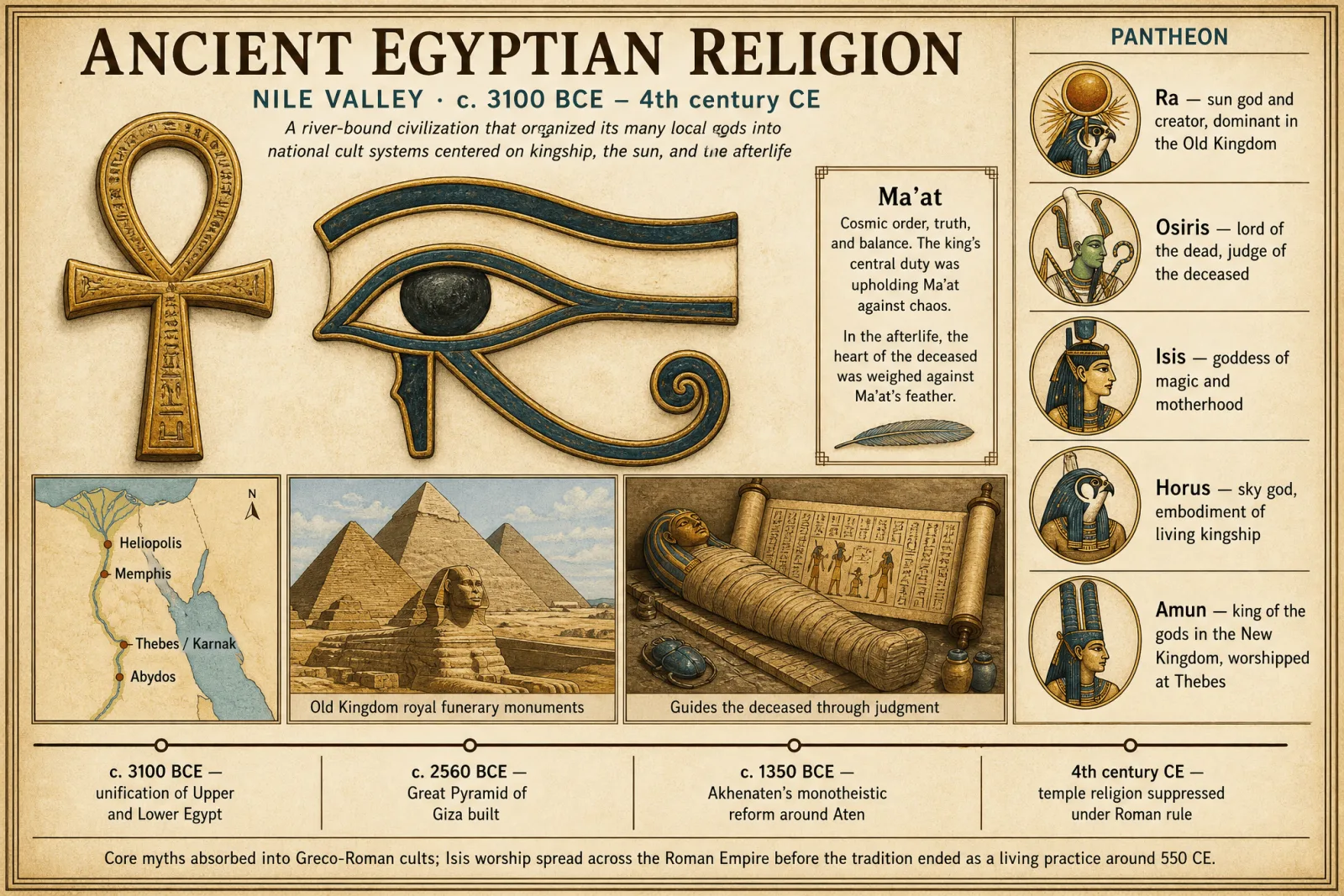
Overview
Ancient Egyptian Religion was the complex polytheistic belief system of the ancient Egyptian civilization, practiced from the Pre-Dynastic period (circa 3500 BCE) through the Greco-Roman period until the triumph of Christianity in the fourth and fifth centuries CE. This tradition spanned over three millennia, evolving through political transformations—Old, Middle, and New Kingdoms, Intermediate Periods, Late Period, Ptolemaic, and Roman rule—while maintaining core cosmological concepts, ritual practices, and sacred geography centered on the Nile Valley.
At the heart of Egyptian religion was the concept of ma'at: cosmic order, truth, justice, and harmony. Ma'at was simultaneously an abstract principle, a mode of ethical conduct, and a goddess whose feather served as the measure against which the hearts of the dead were weighed. Maintaining ma'at was the primary responsibility of the pharaoh, who acted as the intermediary between the divine and human realms, and the goal of temple cult, which sustained the gods through daily ritual and festival. The forces of isfet (chaos, disorder, injustice) constantly threatened to overwhelm ma'at, requiring perpetual vigilance and ritual action.
Egyptian cosmology understood the universe as structured in layers: the sky (personified as the goddess Nut), the earth (the god Geb), the Duat (underworld/netherworld), and the primordial waters of Nun from which creation emerged. The gods were not transcendent beings but immanent forces embedded in nature and society, manifesting in multiple forms and aspects. A deity could be simultaneously one and many, local and universal, human-headed and animal-headed, benevolent and dangerous. This fluidity—often misunderstood as confusion by later observers—was central to Egyptian theological sophistication, allowing for regional variation, historical change, and the coexistence of different creation myths and divine genealogies without contradiction.
The Old Kingdom: Pyramid Age and Royal Solar Theology
The Old Kingdom (circa 2686–2181 BCE) established the foundations of Egyptian religious practice and monumental architecture. The Pyramid Texts, inscribed on the walls of royal pyramids at Saqqara beginning with King Unas (circa 2375 BCE), are the oldest corpus of religious literature in the world. These spells and incantations were designed to ensure the deceased king's transformation into an akh (effective spirit) and his ascent to the sky to join the imperishable stars or sail with the sun god Re across the heavens.
The solar cult of Re (also Ra), centered at Heliopolis (Iunu, 'Pillar City'), became dominant during the Old Kingdom, particularly from the Fourth Dynasty onward. Pharaohs adopted the title 'Son of Re,' linking royal authority to the daily cosmic drama of the sun's journey. The theology of Heliopolis described creation emerging from the primordial mound (benben) when the creator god Atum (later syncretized with Re as Atum-Re or Re-Atum) generated the first gods through self-creation, spitting out Shu (air) and Tefnut (moisture), who gave birth to Geb (earth) and Nut (sky), who in turn produced Osiris, Isis, Seth, and Nephthys.
The pyramids of Giza—the Great Pyramid of Khufu, the Pyramid of Khafre, and the Pyramid of Menkaure—represent the apex of Old Kingdom mortuary architecture, conceived as resurrection machines facilitating the king's transformation and ascent. The massive investment of labor and resources in royal funerary complexes reflected the centrality of the divine king in maintaining cosmic order. However, non-royal individuals also developed mortuary practices, building mastaba tombs near royal pyramids and commissioning funerary texts and offerings to secure their own afterlife.
The First Intermediate Period (circa 2181–2055 BCE) saw the fragmentation of central authority and the proliferation of regional power centers. The Middle Kingdom (circa 2055–1650 BCE) reunified Egypt under the Theban Eleventh Dynasty and witnessed significant religious developments, particularly the 'democratization' of the afterlife. Funerary texts that had been exclusively royal—Pyramid Texts—were adapted and expanded into the Coffin Texts, inscribed on the coffins of non-royal elites. These texts asserted that any individual, not only the king, could achieve immortality through proper ritual and ethical conduct.
The cult of Osiris, god of the dead and resurrection, became increasingly important during this period. Osiris's mythology—murdered by his brother Seth, mourned and resurrected by his wife Isis, avenged by his son Horus—provided a narrative model for death and rebirth accessible to all Egyptians. Abydos, believed to be Osiris's burial place, became the most important pilgrimage site in Egypt. Individuals sought to be buried near Abydos or to have a cenotaph (symbolic tomb) erected there, and the annual Osiris mysteries reenacted the god's death and resurrection.
The Middle Kingdom also saw the flourishing of 'personal piety'—direct individual relationship with deities expressed through votive offerings, stelae inscribed with prayers, and ethical teachings. Wisdom literature from this period, such as the 'Teaching of Amenemhat' and the 'Loyalist Instruction,' emphasized ma'at as a guide for ethical living: speaking truth, acting justly, caring for the vulnerable, and fulfilling social obligations.
The New Kingdom (circa 1550–1077 BCE), Egypt's imperial age, transformed Egyptian religion through military expansion, immense wealth, and the elevation of Amun to supreme status. Thebes (modern Luxor) became the religious capital, and the Karnak temple complex, dedicated to Amun-Re (Amun syncretized with the solar deity Re), grew into the largest religious structure ever built. Amun, originally a local Theban god associated with wind and fertility, was reimagined as 'King of the Gods,' creator and sustainer of the cosmos, and patron of the pharaoh's military campaigns.
The immense wealth flowing into Amun's temples from military conquests made the priesthood of Amun extraordinarily powerful, eventually rivaling the pharaoh's authority. High priests of Amun controlled vast landholdings, administered armies of temple workers, and influenced political decisions. The daily cult ritual at Karnak—opening the shrine, washing and clothing the god's statue, presenting food offerings and ma'at—was performed by priests on behalf of the king, who theoretically remained the sole legitimate officiant of all divine cult.
The Book of the Dead—a misleading modern title for what Egyptians called 'Book of Coming Forth by Day'—emerged during the New Kingdom as a compilation of spells, hymns, and vignettes designed to guide and protect the deceased through the dangers of the Duat (underworld) to achieve justified vindication before Osiris. Unlike the Pyramid Texts or Coffin Texts, the Book of the Dead was not a single fixed text but a flexible genre: individuals commissioned personalized papyrus scrolls selecting spells from a common repertoire, illustrated with vignettes. The most famous scene, the 'Weighing of the Heart,' depicts the deceased's heart (the seat of consciousness and moral character) weighed against the feather of Ma'at, with the monster Ammit ready to devour the unjustified.
The reign of Akhenaten (circa 1353–1336 BCE) represents the most radical religious transformation in Egyptian history. Akhenaten elevated the Aten—the physical disk of the sun—to exclusive worship, suppressed the cults of other gods (particularly Amun), and moved the capital from Thebes to a newly built city, Akhetaten (modern Amarna, 'Horizon of the Aten'). The king changed his name from Amenhotep ('Amun is Satisfied') to Akhenaten ('Effective Spirit of the Aten') and presented himself as the sole intermediary through whom the Aten's blessings flowed to humanity.
Scholarly debate continues over whether Atenism constituted true monotheism, henotheism (worship of one god while acknowledging others' existence), or monolatry (exclusive worship without denying other gods). Archaeological evidence from the Amarna Workmen's Village reveals that ordinary Egyptians continued to venerate traditional household deities like Bes and Taweret, and even within royal theology, Ma'at remained personified as a goddess. The elevation of Akhenaten and his queen Nefertiti to semi-divine status further complicates claims of monotheism. Most contemporary scholars interpret Atenism as a state-directed henotheistic reform that combined theological innovation with political strategy: centralizing religious authority in the king and dismantling the economic and political power of the Amun priesthood.
The Amarna reform did not survive Akhenaten's death. His successors—Smenkhkare, Tutankhamun, and Ay—restored traditional cults, and the city of Akhetaten was abandoned. The Nineteenth Dynasty pharaoh Horemheb systematically erased Akhenaten's name from monuments, and later king lists omitted him entirely. The Amarna Period became a cautionary tale about the dangers of deviating from ma'at and neglecting the traditional gods.
The Third Intermediate Period and Late Period (circa 1077–332 BCE) saw Egypt's political fragmentation, foreign rule (Libyan, Nubian, and Persian dynasties), and yet remarkable religious conservatism. Temples continued to function, scribes copied and preserved ancient texts, and animal cults—particularly sacred bulls (Apis at Memphis, Buchis at Thebes), cats (Bastet at Bubastis), and ibises (Thoth at Hermopolis)—proliferated. The cult of Isis expanded beyond Egypt, and Osiris's mythology became central to popular piety.
The Ptolemaic period (332–30 BCE), established after Alexander the Great's conquest, witnessed the fusion of Greek and Egyptian religious traditions. The Ptolemies commissioned massive temple building projects—Philae (dedicated to Isis), Edfu (Horus), Dendera (Hathor), Kom Ombo (Sobek and Horus)—decorated with traditional Egyptian iconography and inscribed with hieroglyphic texts preserving theological knowledge. Serapis, a syncretistic deity combining Osiris, Apis, and Greek gods, was promoted by the Ptolemies to unite Greek and Egyptian populations.
Under Roman rule (30 BCE–395 CE), Egyptian temples remained active, with the latest hieroglyphic inscription dating to 394 CE at Philae. However, the rise of Christianity, imperial edicts against 'pagan' cults, and the closure of temples in the fourth and fifth centuries CE ended ancient Egyptian religious practice. The last priests who could read hieroglyphs died, and the temple at Philae—the last functioning Egyptian temple—was closed by Justinian I in the sixth century. Ancient Egyptian religion survived in transformed, often demonized forms in Christian and Islamic Egyptian folklore, and in the Coptic language, descended from ancient Egyptian, which preserves liturgical traces of pharaonic religious vocabulary.
Ma'at: Order, Truth, and Justice
Ma'at is the single most important concept in ancient Egyptian religion and ethics. The term encompasses cosmic order, truth, justice, balance, and proper conduct. Ma'at was understood as the fundamental structure of reality, established at creation when the creator god separated order from chaos (Nun, the primordial waters). Without ma'at, the cosmos would collapse back into undifferentiated chaos. Thus, maintaining ma'at was an existential imperative, not merely a moral preference.
Ma'at was personified as a goddess, daughter of Re, who accompanied the sun god on his daily journey and was presented to him as an offering in temple ritual. The iconography of Ma'at—a woman wearing an ostrich feather on her head—is ubiquitous in Egyptian art, and kings are frequently depicted presenting a small figure of Ma'at to a deity, symbolizing their fulfillment of divine order. The feather of Ma'at served as the standard in the judgment of the dead: the heart of the deceased was weighed against the feather, and only those whose hearts balanced—meaning they had lived in accordance with ma'at—achieved eternal life.
Ma'at functioned on multiple levels: cosmic (the regular cycles of the sun, moon, Nile flood), political (the pharaoh's role in maintaining order and justice), social (harmonious relationships, fulfilling obligations, speaking truth), and personal (ethical conduct, honesty, generosity, humility). Wisdom literature repeatedly emphasizes that living according to ma'at brings success, prosperity, and a good afterlife, while violating ma'at leads to social ostracism, divine punishment, and annihilation in the afterlife.
The Osiris myth provided the narrative foundation for Egyptian conceptions of death, resurrection, and kingship. According to the myth (synthesized from various sources, most completely in Plutarch's Greek account), Osiris was a primordial king who ruled Egypt during a golden age, teaching agriculture, law, and civilization. His jealous brother Seth murdered him, dismembered his body, and scattered the pieces across Egypt. Isis, Osiris's devoted wife and sister, searched for and reassembled his body, and through her powerful magic (heka), she briefly resurrected him, conceiving their son Horus. Osiris then descended to the Duat to become the eternal king and judge of the dead.
Horus, raised in secret by Isis in the Nile Delta marshes, grew to manhood and challenged Seth for the throne of Egypt. After a prolonged conflict adjudicated by the divine tribunal, Horus was recognized as the rightful king, and Seth was assigned dominion over the desert and foreign lands. This mythic conflict established a paradigm: every reigning pharaoh was the living Horus, and every deceased pharaoh became Osiris, ensuring the continuity of legitimate kingship.
The deceased, by undergoing proper mummification and funerary rites, became 'Osiris [Name],' identifying with the god's death and resurrection. The journey through the Duat, described in funerary texts, involved navigating gates guarded by demons, reciting spells, and ultimately reaching the Hall of Ma'at (or Hall of Two Truths) where Osiris presided over the judgment. The heart (ib), containing the person's consciousness and moral record, was weighed against the feather of Ma'at. Anubis, the jackal-headed god of mummification, performed the weighing, while Thoth, god of wisdom and writing, recorded the result. Those found justified (maa-kheru, 'true of voice') entered the Field of Reeds (Aaru), a paradise resembling idealized Egypt. Those whose hearts were heavy with wrongdoing were devoured by Ammit, the 'Devourer,' suffering a 'second death' from which there was no return.
Egyptian anthropology understood the human person as composed of multiple, interdependent elements, not a simple body-soul dualism. The ka (often inadequately translated as 'life force' or 'vital essence') was the aspect of a person that sustained life, distinct from but intimately connected to the physical body. The ka was created at birth, departed at death, but required sustenance in the afterlife through offerings left at the tomb. The ka statue, placed in the tomb's serdab (sealed chamber), served as a material anchor for the ka.
The ba (often translated as 'soul' or 'personality') was the mobile, individualized aspect of a person, depicted as a human-headed bird. During life, the ba remained unified with the body, but after death, the ba could travel between the tomb, the underworld, and the world of the living. The ba needed to reunite with the mummified body each night to be regenerated; thus, the preservation of the body through mummification was essential. Tomb paintings often depict the ba hovering over the mummy or perched on a tree outside the tomb receiving offerings.
The akh ('effective spirit' or 'transfigured spirit') was the result of the successful unification of ka and ba in the afterlife through proper ritual. The deceased who passed the judgment of Osiris and received funerary offerings became an akh, capable of interceding on behalf of the living, inhabiting the stars, or sailing with Re in the solar barque. Becoming an akh was the ultimate goal of mortuary practice. Other components included the ren (name, which had to be preserved through inscriptions), the ib (heart/mind), and the sheut (shadow).
Ancient Egyptian religion did not possess a single, authoritative creation myth but rather multiple, regionally specific cosmogonies that coexisted without apparent contradiction. The Heliopolitan cosmogony, associated with Heliopolis, described the self-created god Atum (or Atum-Re) emerging from the primordial waters of Nun on the benben mound, then generating Shu and Tefnut through masturbation or expectoration. These deities produced Geb and Nut, who gave birth to the Ennead (group of nine gods): Osiris, Isis, Seth, Nephthys, and (in some versions) Horus.
The Memphite cosmogony, preserved on the Shabaka Stone (a Twenty-fifth Dynasty copy of an older text), presented Ptah, the craftsman god of Memphis, as the ultimate creator who brought the world into existence through thought (in his heart) and speech (on his tongue). This theology elevated mental and verbal creation over physical generation, positioning Ptah as prior to Atum and the Heliopolitan gods, whom he created by speaking their names.
The Hermopolitan cosmogony, associated with Hermopolis (Khmun), described creation emerging from the interaction of four pairs of primordial deities (the Ogdoad): Nun and Naunet (water), Heh and Hauhet (infinity), Kek and Kauket (darkness), and Amun and Amaunet (hiddenness). From their interaction, a cosmic egg or lotus emerged from which the sun god was born. These varying cosmogonies reflect the theological claims of different priestly centers, but Egyptians did not treat them as mutually exclusive. A deity could be simultaneously creator and created, one and many, cause and effect—a theological fluidity that modern interpreters often find paradoxical but that ancient Egyptians navigated with ease.
Sacred Texts and Religious Literature
Ancient Egyptian religious literature spans three millennia and encompasses royal inscriptions, temple hymns, funerary texts, wisdom literature, magical spells, and mythological narratives. The Pyramid Texts (circa 2375–2180 BCE), the oldest religious corpus in the world, comprise over 800 spells inscribed on the walls of royal pyramids at Saqqara. These texts facilitated the deceased king's transformation into an akh and his ascent to the sky or union with the sun god.
The Coffin Texts (circa 2100–1600 BCE) adapted and expanded the Pyramid Texts for non-royal use, inscribing them on wooden coffins. These texts democratized access to the afterlife, asserting that any individual who knew the proper spells and lived ethically could achieve immortality. The Book of the Dead (circa 1550 BCE–50 BCE), more accurately called the 'Book of Coming Forth by Day,' was not a single book but a flexible corpus of approximately 200 spells. Individuals commissioned personalized papyrus scrolls, selecting spells relevant to their needs and means, illustrated with vignettes. Spell 125, the 'Negative Confession' and 'Weighing of the Heart,' is the most famous, depicting the deceased declaring innocence of specific sins before forty-two divine judges and undergoing judgment before Osiris.
The Amduat ('That Which is in the Underworld') and the Book of Gates are underworld books depicting the sun god Re's nightly journey through the twelve hours of the Duat, his battles with the serpent Apophis (embodiment of chaos), and his regeneration before dawn. These texts, inscribed in royal tombs in the Valley of the Kings at Thebes, provided maps and knowledge for the king's posthumous journey with Re.
Hymns to the gods—particularly the Great Hymn to the Aten (from Akhenaten's reign), the Hymn to Amun-Re at Karnak, and hymns to Osiris and Isis—express theological concepts, praise divine attributes, and narrate mythic episodes. Wisdom literature, such as the 'Teaching of Ptahhotep,' 'Teaching of Amenemope,' and 'Teaching of Any,' conveys ethical maxims and practical advice for living according to ma'at. These texts were not 'scripture' in the Abrahamic sense—there was no concept of canonical revelation—but rather repositories of priestly knowledge, liturgical formulae, and cultural wisdom transmitted through scribal schools and temple scriptoria (Houses of Life, per-ankh).
Temple Cult: The Daily Ritual
The temple was understood as the 'house of the god' (per-netjer), the earthly residence where the deity's ka dwelled in the cult statue. The primary purpose of temple ritual was to sustain the god through offerings and maintain ma'at, ensuring the cosmos continued to function. The daily temple ritual, preserved in texts from New Kingdom temples (particularly Karnak, Abydos, and later Ptolemaic temples), was theoretically performed by the pharaoh but in practice conducted by priests deputized on his behalf.
The ritual began at dawn with the high priest entering the innermost sanctuary, breaking the clay seal on the shrine's doors, opening them, and awakening the god with hymns. The priest would then purify the statue with water and natron, anoint it with sacred oils, dress it in linen garments, adorn it with jewelry, and apply cosmetics. Offerings of food, drink, incense, and flowers were presented, culminating in the presentation of ma'at (a small figurine of the goddess) to the deity. The priest would then back out of the sanctuary, sweeping away his footprints and resealing the doors. This ritual was repeated three times daily at major temples.
The offerings presented to the gods—bread, beer, meat, fowl, vegetables, fruits—were redistributed after the ritual in a system called 'reversion of offerings.' Temple personnel, from high priests to low-ranking workers, received portions as compensation, linking divine cult to economic redistribution. Major temples like Karnak employed thousands of people: priests (of various grades), singers, musicians, scribes, craftsmen, farmers, and laborers, and controlled vast agricultural estates. The temple functioned simultaneously as religious center, economic institution, and locus of political power.
While daily temple ritual was conducted behind closed doors, visible only to priests, religious festivals brought the gods out in procession, allowing the public to participate in divine cult. The Opet Festival at Thebes, celebrated annually during the inundation season, involved transporting the cult statues of Amun, Mut, and Khonsu from Karnak to Luxor Temple (approximately 2.4 kilometers) in ornate barque shrines carried by priests or floated on the Nile. The festival lasted several weeks and included rituals renewing the king's divine mandate and symbolically uniting Amun with the pharaoh.
The Beautiful Festival of the Valley (Heb Nefer en inet) at Thebes involved Amun's statue crossing the Nile from Karnak to visit the mortuary temples on the west bank, where families gathered at ancestral tombs for feasting and offerings. This festival affirmed the connection between the living, the dead, and the gods. The Sed Festival (Heb-Sed) was a royal jubilee celebrating the king's continued vitality and renewing his kingship, typically held after thirty years of rule and then at shorter intervals.
Oracular consultation was a feature of festival processions: as the divine barque was carried, petitioners would pose yes-or-no questions, and the movement of the barque (caused by the priests) indicated the god's response. This practice allowed ordinary Egyptians to interact directly with divine authority, seeking decisions on legal disputes, business ventures, or personal matters.
Mummification was the process of preserving the body to serve as a permanent dwelling for the ba and anchor for the ka. The procedure, lasting seventy days, involved removing internal organs (except the heart, which was left in place as the seat of consciousness), desiccating the body with natron (a naturally occurring salt), anointing it with resins and oils, and wrapping it in linen bandages interspersed with amulets. The brain was discarded as unimportant, while the viscera (liver, lungs, stomach, intestines) were preserved in canopic jars under the protection of the four sons of Horus.
The 'Opening of the Mouth' ceremony, performed on the mummy at the tomb entrance, ritually reanimated the deceased's senses, allowing the ka and ba to re-enter the body, partake of offerings, and function in the afterlife. Priests used ritual implements—an adze, a peseshkef blade—to touch the mummy's mouth, eyes, ears, and nose, accompanied by recitations declaring the deceased's senses restored.
Tomb architecture varied by period and social status: pyramid complexes for Old Kingdom royalty, rock-cut tombs in the Valley of the Kings and Valley of the Queens for New Kingdom pharaohs and nobles, simple shaft graves for commoners. Tomb decoration—painted scenes of daily life, agricultural labor, feasting, funerary processions, and excerpts from funerary texts—served magical purposes, ensuring the deceased's continued existence and providing substitute offerings if actual offerings ceased.
Magic (heka) was not superstition opposed to religion but an integral, respectable aspect of Egyptian religiosity, understood as a divine force present at creation. Heka was personified as a god and was wielded by deities, pharaohs, and trained specialists (hekau, 'magicians' or 'lector priests'). Magical practice involved spoken spells (rau), written amulets, ritual gestures, and the manipulation of symbolically charged materials.
Healing practices combined empirical medicine (surgical procedures, herbal remedies, anatomical knowledge) with magical-religious treatments. Illness was often attributed to demonic possession, the anger of a deity, or the malice of enemies employing harmful magic. Medical papyri (such as the Ebers Papyrus and Edwin Smith Papyrus) preserve both rational diagnoses and treatments and magical spells to be recited over medicines or worn as amulets.
Popular religion—the religious practices of non-elite Egyptians—centered on household deities like Bes (a dwarf god protecting mothers and children), Taweret (a hippopotamus goddess of childbirth), and Hathor (goddess of love, music, and drunkenness). Votive stelae, amulets, and small household shrines attest to direct personal devotion. Individuals appealed to gods for protection, justice, fertility, and success, often through letters to the dead written on pottery bowls and placed in tombs, asking deceased relatives to intercede with the divine on behalf of the living.
Regional Variation and Syncretism
While Egyptian religion exhibited remarkable continuity over three millennia, significant regional variation existed. Major cult centers promoted their patron deities as supreme creators: Heliopolis championed Atum-Re, Memphis elevated Ptah, Thebes exalted Amun, and Hermopolis honored Thoth. Local manifestations of nationally recognized gods often had distinct characteristics: Hathor of Dendera, Horus of Edfu, Sobek of Kom Ombo, and Khnum of Elephantine maintained individual cult traditions and mythologies.
Syncretism—the merging of deities—was a common theological strategy. Amun and Re combined as Amun-Re, Ptah and Sokar and Osiris formed a triad (Ptah-Sokar-Osiris), and countless hyphenated divine names attest to fluid divine identities. This was not confusion but sophisticated theology: deities could be understood as aspects of one another, sharing attributes while retaining distinct identities. The phrase 'all gods are three: Amun, Re, and Ptah' expresses this unity-in-multiplicity.
Social stratification also produced religious diversity. Elite religion, centered on temples and monumental tombs, emphasized royal and state theology, literacy, and access to expensive mummification and funerary texts. Popular religion, known from domestic contexts, focused on protective magic, childbirth, fertility, and direct appeals to gods for everyday concerns. Gender also shaped religious experience: women served as priestesses (particularly of Hathor), musicians, and ritual mourners, though the highest priestly offices were typically male-dominated. The role of God's Wife of Amun at Thebes, however, became exceptionally powerful in the Third Intermediate Period, with royal women holding political as well as religious authority.
Ancient Egyptian Religion as a Historical Tradition
Ancient Egyptian religion is a historical tradition no longer practiced in its original form, with no continuous community of practitioners. The last hieroglyphic inscription was carved in 394 CE at the temple of Isis at Philae, and the temple was closed by imperial decree in the sixth century CE. The ability to read hieroglyphs was lost by the end of the Roman period, and knowledge of ancient Egyptian theology, mythology, and ritual survived only fragmentarily in Greek and Roman accounts (particularly Herodotus, Diodorus Siculus, Plutarch, and Apuleius) and in demonized form in Christian polemics.
Modern engagement with ancient Egyptian religion is primarily scholarly and museological. The decipherment of hieroglyphs by Jean-François Champollion in 1822 opened the textual record, and systematic archaeological excavation—beginning in the nineteenth century and continuing today—has recovered temples, tombs, papyri, and artifacts. Egyptology as an academic discipline emerged in the late nineteenth and early twentieth centuries, with major centers at universities in Europe, North America, and Egypt, and at institutions such as the Egypt Exploration Society (UK), the German Archaeological Institute, and the Institut Français d'Archéologie Orientale (Cairo).
The UCLA Encyclopedia of Egyptology, the British Museum, the Metropolitan Museum of Art, the Egyptian Museum in Cairo, and the Petrie Museum at University College London house extensive collections and produce ongoing research. Digital initiatives, including online databases of funerary texts and temple inscriptions, make primary sources accessible. There are neopagan movements (Kemeticism, Kemetic Orthodoxy) that seek to reconstruct or revive ancient Egyptian religious practices, though these are modern creations without historical continuity and are practiced by small, geographically dispersed communities primarily in North America and Europe. Academic Egyptology maintains critical distance from such movements, focusing on historical reconstruction through philological, archaeological, and comparative methods.
Sacred Geography of Ancient Egypt
Heliopolis (Iunu, 'Pillar City'): Located near modern Cairo, Heliopolis was the cult center of Atum-Re and the site of the original benben stone (a conical or pyramidal sacred stone symbolizing the primordial mound of creation). Heliopolitan theology was foundational to Egyptian solar religion and influenced royal ideology throughout Egyptian history. Little remains of the ancient city due to stone robbing and urban development.
Memphis (Men-nefer, 'Enduring and Beautiful'): The administrative capital of Egypt for much of the Old Kingdom and Middle Kingdom, Memphis was the cult center of Ptah, god of craftsmen and creation through divine speech. The Apis bull, believed to be the living manifestation of Ptah, was kept in a special enclosure and upon death was mummified and buried in the Serapeum at Saqqara, the vast necropolis serving Memphis.
Thebes/Karnak/Luxor (Waset): Thebes (modern Luxor) became Egypt's religious capital during the New Kingdom. The Karnak temple complex, the largest religious structure ever built, was dedicated to Amun-Re, with smaller temples for Mut and Khonsu. The temple's Hypostyle Hall, with 134 massive columns, exemplifies New Kingdom monumental architecture. Luxor Temple, connected to Karnak by a sphinx-lined processional avenue, was the focus of the Opet Festival. The Valley of the Kings and Valley of the Queens, on Thebes' west bank, contain the rock-cut tombs of New Kingdom pharaohs and royal women, including Tutankhamun, Seti I, and Ramesses II. Mortuary temples, such as the Ramesseum, Medinet Habu, and Deir el-Bahari (Hatshepsut's temple), lined the west bank, where offerings were presented to the deceased kings.
Abydos (Abdju): The cult center of Osiris and Egypt's most sacred pilgrimage site, Abydos was believed to be the burial place of Osiris's head. Pharaohs from the First Dynasty onward built tombs and cenotaphs at Abydos, and the annual Osiris Mysteries, reenacting the god's death and resurrection, drew pilgrims from across Egypt. The temple of Seti I at Abydos preserves some of the finest relief carving in Egypt and a king list documenting royal succession.
Giza: The Giza plateau, near Cairo, is the site of the three great pyramids—Khufu, Khafre, and Menkaure—and the Great Sphinx (a colossal statue with a lion's body and human head, likely representing Khafre). These Fourth Dynasty monuments epitomize Old Kingdom royal mortuary architecture and solar theology, with the pyramid form itself understood as a petrified ray of sunlight facilitating the king's ascent to the sky.
Philae (Pilak): An island in the Nile near Aswan, Philae was the cult center of Isis and one of the last functioning temples of ancient Egyptian religion. The temple, built during the Ptolemaic and Roman periods, displays traditional Egyptian architecture and decoration. Philae remained active long after other temples closed, serving as a center for Isis worship and Nubian pilgrimage until its closure in the sixth century CE. The temple was relocated to the nearby island of Agilkia in the 1970s to save it from flooding caused by the Aswan High Dam.
Amarna (Akhetaten): The short-lived capital built by Akhenaten, Amarna ('Horizon of the Aten') served as the center of Aten worship during the Eighteenth Dynasty. The city, located in Middle Egypt, was abandoned after Akhenaten's death and never reoccupied, preserving a unique archaeological snapshot of this brief, radical period. Excavations have revealed temples without roofs (to allow sunlight in), palaces, administrative buildings, and the tombs of Akhenaten's officials in the surrounding cliffs.
Contemporary Scholarly Debates
The nature of Akhenaten's reform remains contested. Was Atenism genuine monotheism, the first in history, or henotheism/monolatry, worshiping one god while acknowledging others' existence? Was it primarily a theological revolution driven by Akhenaten's visionary piety, or a political strategy to dismantle the economic and political power of the Amun priesthood? Recent scholarship emphasizes the political-economic dimensions while acknowledging genuine theological innovation, and argues that evidence from non-elite contexts (household shrines, amulets) suggests Atenism remained confined to the royal court and did not transform popular religion.
The concept of 'monotheism' in relation to Egyptian theology is itself problematic. Did late Egyptian theology, particularly in the Ramesside period, develop a conception of a supreme, transcendent deity encompassing all others, approaching monotheism? Jan Assmann and Erik Hornung have debated this extensively, with Hornung arguing for fundamental polytheism and Assmann identifying tendencies toward 'implicit monotheism' in hymns addressing a deity as 'the one who made himself into millions.' The theological fluidity and multiplicity characteristic of Egyptian religion resists the categories 'monotheism' and 'polytheism,' which may be inadequate analytical frameworks.
The interpretation of the Book of the Dead has shifted from viewing it as a fixed scriptural text to recognizing it as a flexible, personalized genre compiled in temple scriptoria (Houses of Life). Scholars now understand that many spells had non-mortuary origins in temple cult and were adapted for funerary use. This challenges earlier assumptions about a strict boundary between 'temple religion' and 'mortuary religion,' revealing instead a shared pool of priestly knowledge deployed in multiple contexts.
The extent of 'democratization' of the afterlife in the Middle Kingdom is debated. Did the Coffin Texts truly make eternal life accessible to all, or only to those with sufficient wealth to commission funerary texts and tombs? How did non-elite Egyptians, the vast majority of the population, conceptualize the afterlife? Archaeological evidence from cemetery contexts suggests that even simple burials included basic provisions and amulets, indicating widespread belief in post-mortem existence, but the nature of the non-elite afterlife remains less well understood than elite conceptions documented in expensive papyri and tomb decoration.
Key Terms
- Ma'at
- Cosmic order, truth, justice, harmony; both a principle and a goddess.
- Isfet
- Chaos, disorder, injustice; the opposite of ma'at.
- Ka
- Vital life force, sustained after death through offerings.
- Ba
- Soul or personality, depicted as a human-headed bird, mobile after death.
- Akh
- Transfigured spirit, the successful union of ka and ba in the afterlife.
- Duat
- The underworld or netherworld, realm of the dead and the sun god's nightly journey.
- Heka
- Magic, a divine force used by gods, pharaohs, and magicians.
- Amun-Re
- King of the gods, syncretism of Amun (Theban god) and Re (solar deity).
- Osiris
- God of the dead, resurrection, and agriculture; judge of the deceased.
- Isis
- Goddess of magic, motherhood, and protection; wife of Osiris, mother of Horus.
- Horus
- Sky god, royal deity; son of Osiris and Isis; every living pharaoh was Horus.
- Re (Ra)
- The sun god, creator and sustainer; traveled across the sky by day and through the Duat by night.
- Ptah
- Creator god of Memphis, brought the world into existence through thought and speech.
- Thoth
- God of wisdom, writing, and magic; scribe of the gods; depicted as ibis or baboon.
- Anubis
- Jackal-headed god of mummification and the necropolis; conducted the weighing of the heart.
- Aten
- The solar disk; elevated to exclusive worship by Akhenaten during the Amarna Period.
Further Reading
- UCLA Encyclopedia of Egyptology (eScholarship repository)
- UCL Digital Egypt for Universities: Daily Cult
- UCL Petrie Museum of Egyptian and Sudanese Archaeology
- Foy Scalf (ed.), Book of the Dead: Becoming God in Ancient Egypt (Oriental Institute, University of Chicago, 2017)
- Rita Lucarelli, 'The Book of the Dead in Temples' in Oxford Handbook of the Book of the Dead (Oxford University Press, 2016)
- Digital Karnak Project (UCLA): The Daily Ritual
- Paul John Frandsen, 'Judgment and Afterlife in Ancient Egypt' in Journal of Contemporary Rituals and Traditions (2024)
- Jan Assmann, The Mind of Egypt (Harvard University Press, 2003)
- Erik Hornung, Conceptions of God in Ancient Egypt: The One and the Many (Cornell University Press, 1982)
- Academic article: 'Religious Revolution or Political Strategy? Akhenaten's Reform' (2024)
Practices
- Mummification
- Temple cult
- Funerary rites
- Solar worship
Core ideas
- Afterlife
- Field of Reeds for the justified
- Judgement
- Heart weighed against maat
- Liberation
- Eternal union with the gods
Sacred texts
The oldest religious writings in the world, carved inside Fifth and Sixth Dynasty pyramids around 2400 BCE. These spells and hymns guided the pharaoh's soul through the afterlife, invoking Osiris and the gods of the Duat. They form the foundation of all later Egyptian funerary literature.
A collection of spells written on papyrus scrolls and placed in tombs from the New Kingdom onward. The most famous passage describes the weighing of the heart against the feather of Maat before Osiris. It offered ordinary Egyptians, not just kings, a map to navigate judgment and reach the Field of Reeds.
Middle Kingdom spells painted inside wooden coffins, democratizing afterlife knowledge once reserved for royalty. They expanded on Pyramid Text themes with new spells for protection, transformation, and cosmic travel. Many motifs in the Book of the Dead first appear here.