Overview
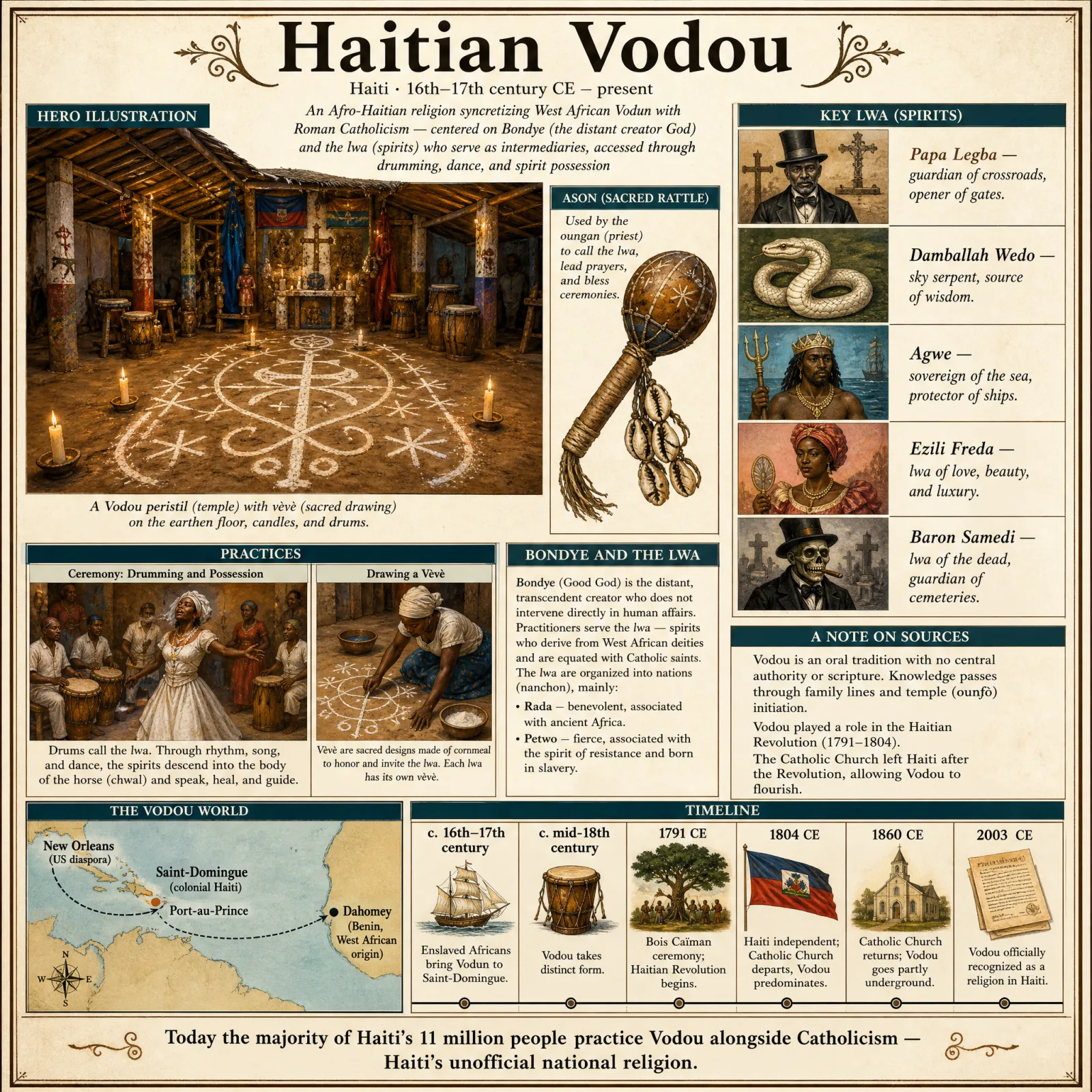
Haitian Vodou is an Afro-Caribbean religion that crystallized during the eighteenth and early nineteenth centuries in the French colony of Saint-Domingue (modern Haiti), forged in the crucible of plantation slavery from West and Central African spiritual traditions—primarily Fon, Yoruba, and Kongo—blended with French Catholicism, indigenous Taíno influences, and the specificities of Haitian revolutionary and post-independence experience. Vodou is not a survival of a single African religion but a creolized synthesis, created through generations of enslaved Africans negotiating spiritual continuity under conditions of extreme violence, cultural rupture, and forced conversion. The religion centers on relationships with lwa (also spelled loa)—spirits who serve as intermediaries between humans and Bondye (Bon Dieu, the Good God, cognate with the Christian deity but remote and accessible only through the lwa), governing natural forces, ancestral lineages, personal destinies, and moral-spiritual order.
Vodou practice unfolds primarily in peristyles (also called ounfò or kay mistè)—sacred enclosures, typically open-sided roofed structures with central posts (poto mitan) around which drumming, dancing, singing, and spirit possession occur. Each peristyle is led by an oungan (male priest) or manbo (female priest), initiated leaders who divine, heal, conduct ceremonies, and mediate between humans and lwa. The religion organizes lwa into nanchons (nations)—ritual families identified with African ethnic-geographic origins: Rada (Dahomean/Fon-derived, cool, benevolent), Petwo (Haitian-created, hot, powerful, associated with the revolution), Nago (Yoruba-derived), Kongo (Central African), and others. Each nanchon has distinct drum rhythms, songs, ritual protocols, and lwa personalities. Possession trance (monte, mounted, or kriz, crisis) is Vodou's central ritual technology: during ceremonies, lwa 'mount' devotees like riders on horses, the human personality temporarily displaced while the lwa speaks, dances, gives counsel, and interacts with the community.
Throughout Haiti's history—from slavery through independence (1804) to the present—Vodou has faced relentless persecution: colonial authorities criminalized African gatherings, post-independence Haitian governments banned 'superstitious practices' to appear civilized to racist international powers, the Catholic Church conducted anti-superstition campaigns (1896, 1913–18, 1939–42) destroying ritual objects and forcing renunciations, and the U.S. military occupation (1915–34) reinforced repression while sensationalizing 'voodoo' in American popular culture. Legal prohibition persisted until 1987, when Haiti's post-Duvalier constitution finally recognized religious freedom. Despite centuries of marginalization, Vodou remained the majority religion of Haiti's rural peasantry and urban poor, providing healing, justice, community organization, moral-spiritual frameworks, and cultural identity. In contemporary Haiti, Vodou coexists uneasily with Catholicism and rapidly expanding evangelical Protestantism, which often demonizes Vodou as devil worship.
Today, Vodou is practiced across Haiti—in rural lakous (ancestral compound communities), urban peristyles, and diaspora temples in North America (especially New York, Miami, Montreal) and Europe. Estimates of practitioners vary widely due to dual religious belonging (many Haitians identify as both Catholic and Vodouisant) and stigma that discourages open identification; scholars estimate 50–80% of Haiti's population (approximately 5–8 million people) engage with Vodou to varying degrees, from full initiation to occasional consultations. Vodou functions simultaneously as religion, healing system, judicial mechanism (resolving disputes through spiritual authority), artistic tradition (feeding Haiti's music, visual arts, and carnival), and site of cultural resistance. International recognition has grown: UNESCO designated specific Vodou practices as Intangible Cultural Heritage, and Haitian governments since the 1990s have cautiously embraced Vodou as national patrimony, though stigma, evangelical hostility, and elite anti-Vodou prejudice persist.
Historical Development
Vodou's origins lie in the French slave trade, which forcibly transported approximately 790,000 Africans to Saint-Domingue between the 1680s and 1791, creating the Caribbean's most brutal plantation economy. Unlike other Caribbean colonies, Saint-Domingue received concentrated shipments from specific African regions at different periods: Fon-Ewe speakers from the Bight of Benin (Kingdom of Dahomey, present-day Benin and Togo) were especially prominent in the mid-to-late 18th century, followed by Yoruba and Kongo peoples. This regional clustering, combined with the colony's notoriously high mortality rates that required constant fresh African imports, meant that African-born (bossale) enslaved people constituted unusually high percentages of the population, facilitating cultural transmission and religious reconstitution despite diaspora's fractures.
The term 'Vodou' (also spelled Vaudou, Voodoo, Vodun) derives from the Fon word vodún, meaning spirit or deity, reflecting Dahomean influence in the religion's formation. Colonial documents rarely mention 'vaudoux' by name before the late 18th century; instead, they reference calenda (African dances), dances du Don Pèdre, and bamboula gatherings, which authorities suspected of concealing conspiracies. The Code Noir (1685), French colonial slave law, mandated Catholic baptism for all enslaved people and prohibited African religious practices, but enforcement was inconsistent. Enslaved Africans attended Catholic Mass, received sacraments, and joined confraternities (religious brotherhoods), while simultaneously maintaining African spiritual practices in clandestine gatherings, creating the syncretic Catholic-African fusion that characterizes Vodou. Scholars debate how much syncretism was strategic disguise versus genuine theological integration; evidence suggests both occurred, varying by individual, community, and period.
The most contested event in Vodou history is the Bois Caïman ceremony (Bwa Kayiman in Kreyòl) of August 1791, traditionally remembered as a Vodou ritual that catalyzed the Haitian Revolution. According to later accounts, enslaved leaders including Dutty Boukman (an oungan) and Cécile Fatiman (a manbo) conducted a ceremony in a clearing near Le Cap (modern Cap-Haïtien), sacrificing a black pig, distributing its blood among approximately 200 participants who swore an oath of secrecy and revolt. The ceremony is depicted as binding revolutionaries through spiritual power, invoking African gods against European oppressors. However, historians including David Geggus caution that the earliest written account (by French physician Antoine Dalmas, published 1814) mentions a ritual but provides few details; the vivid elements familiar today—Boukman's prayer ('The god of the whites orders crime, our god orders vengeance'), the storm, the specific ritual actions—appear in later 19th and 20th-century retellings by abolitionists, Haitian nationalists, and anthropologists who sought to center Vodou in revolutionary mythology. Geggus concludes that a strategic gathering likely occurred, but its precise ritual nature and centrality to the revolution remain contested. Regardless of empirical uncertainties, Bois Caïman functions as foundational myth, symbolizing Vodou as religion of resistance and liberation.
Post-independence Haiti (1804) faced a paradox: the first black republic, born of slave revolt, sought international recognition from racist European powers and the United States that viewed black self-governance as threatening. Successive Haitian governments, from Jean-Jacques Dessalines through the 19th century, criminalized African-derived practices (termed sortilèges/spells, then pratiques superstitieuses/superstitious practices) to appear civilized, while privately many elites patronized Vodou. The 1835 Penal Code outlawed 'spells,' enforced sporadically but providing legal basis for persecution. Enforcement intensified when convenient—suppressing rural organization, extracting bribes, demonstrating modernity to foreign observers—while tolerating Vodou when politically expedient. Kate Ramsey's scholarship demonstrates that these anti-Vodou laws constructed the pejorative category of 'voodoo' as backward sorcery, reinforcing economic exploitation and political marginalization of the peasant majority who practiced Vodou.
The Catholic Church, which had abandoned Haiti after independence, returned in 1860 via Concordat with Rome, bringing predominantly French clergy who viewed Vodou as paganism to be eradicated. The church conducted 'rejet' (rejection) campaigns: 1896, 1913–18, and most severely 1939–42, during which priests mobilized mobs to destroy ounfòs, burn ritual objects (including sacred drums, altar cloths, oleographs), uproot sacred trees, and force mass renunciations. The 1939–42 'anti-superstition campaign' (campagne anti-superstitieuse), backed initially by President Élie Lescot's government, involved parish-by-parish sweeps, public bonfires of Vodou objects, and coerced oaths renouncing 'Satan and all his works.' Anthropologist Alfred Métraux, conducting fieldwork during this period, documented the campaign's violence and the Vodouisant community's strategic responses—hiding objects, outward compliance while maintaining private practice, and occasional violent resistance.
The U.S. military occupation of Haiti (1915–34) brought new forms of repression and misrepresentation. Marines enforced anti-Vodou laws, arrested oungans and manbos, and confiscated ritual objects (some of which ended up in U.S. museums). Simultaneously, Marines and journalists sensationalized 'voodoo' for American audiences, producing lurid accounts of cannibalism, zombies, and sexual orgies that fed racist fantasies. William Seabrook's bestseller *The Magic Island* (1929) popularized zombie mythology, while the 1932 film *White Zombie* introduced Vodou to Hollywood horror genre. This dual dynamic—intensified persecution in Haiti, profitable exoticization in the U.S.—established 'voodoo' as a global signifier of primitive otherness, a stereotype Vodou practitioners and scholars have struggled against ever since.
A shift occurred mid-20th century with the Haitian indigenist movement and the anthropological work of Jean Price-Mars (*Ainsi Parla l'Oncle*, 1928), who argued that Haiti's cultural authenticity lay in African heritage, not European imitation. François Duvalier ('Papa Doc'), president 1957–71, strategically aligned with Vodou to consolidate power, presenting himself as oungan-president and incorporating Vodou symbolism into his regime while simultaneously repressing politically independent ounfòs. His son Jean-Claude ('Baby Doc'), president 1971–86, relaxed persecution somewhat. The 1987 post-Duvalier constitution finally granted religious freedom, and in 2003, President Jean-Bertrand Aristide officially recognized Vodou as a religion on par with Christianity. Since the 1990s, Haitian governments have cautiously promoted Vodou as cultural patrimony and tourism asset, though political support remains ambivalent.
Contemporary Vodou faces new pressures: evangelical Protestant expansion (Pentecostal and Charismatic churches have grown rapidly since the 1970s, now constituting approximately 25–30% of Haiti's population) brings aggressive anti-Vodou proselytization and occasional mob violence against peristyles. The 2010 earthquake, which killed an estimated 220,000–300,000 people, sparked evangelical claims that Haiti's 'pact with the devil' (referencing Bois Caïman) caused divine punishment, intensifying stigma. Economic migration, urbanization, and generational change threaten transmission: younger Haitians often lack access to rural ounfò training, and initiatory costs are prohibitive. Nonetheless, Vodou persists through adaptability: urban peristyles, diaspora temples in New York and Miami, hybrid practices blending Vodou with other spiritual traditions, and increasing academic and artistic engagement.
Worldview and Cosmology
Haitian Vodou posits a multi-layered cosmos: Bondye (Bon Dieu, the Good God) stands remote at the apex, an impersonal creator who set the universe in motion but does not intervene in human affairs directly. Bondye is not worshipped; the phrase 'Bondye bon' (God is good) reflects trust in ultimate benevolence but acknowledges divine inaccessibility. Between Bondye and humans stand the lwa—spirits who actively govern natural forces, human experiences, ancestral lineages, and moral-spiritual order. Lwa are not gods in the polytheistic sense (Vodou considers itself monotheistic with Bondye as sole deity) but intermediaries, functionaries, ancestors elevated to spiritual power, or personifications of cosmic principles. The relationship is transactional and reciprocal: humans serve lwa through offerings, rituals, and obedience to taboos; lwa provide protection, healing, prosperity, justice, and spiritual guidance. Neglecting one's lwa brings misfortune; proper service (sèvis lwa) maintains balance.
Lwa are organized into nanchons (nations)—ritual families reflecting African ethnic-geographic origins, though Haitian-born lwa also exist. The Rada nanchon derives from Dahomey (Fon-Ewe peoples), characterized as 'cool,' ancient, benevolent, and associated with water, agriculture, and ancestral wisdom. Major Rada lwa include: Danbala Wedo (primordial serpent, creator, purity, wisdom, depicted as white snake); Ayida Wedo (Danbala's wife, rainbow, continuity); Legba (guardian of crossroads, communication, elder opener of gates, associated with Saint Peter); Loko (healing, trees, priestly knowledge); Azaka (agriculture, peasant life, associated with Saint Isidore); and the Èzili family (Èzili Freda, love, beauty, luxury; Èzili Dantò, fierce motherhood, protection, associated with Black Madonna of Częstochowa/Our Lady of Mount Carmel). Rada ceremonies use ason rattles, white clothing, and slower, contemplative rhythms.
The Petwo nanchon (also spelled Petro) is Haitian-created, emerging from maroon communities and the revolutionary crucible, characterized as 'hot,' aggressive, fast-moving, and associated with fire, transformation, and justice. Petwo lwa are not evil but powerful and dangerous if mishandled, invoked for protection against enemies, justice for wrongs, and radical change. Major Petwo lwa include: Èzili Dantò (who straddles Rada and Petwo); Simbi (sorcery, magic, water-crossroads hybridity); Ti Jan Petwo (fierce, protective); Marinèt (violent justice, associated with screech owl); and Kalfou (Petwo counterpart to Legba, master of crossroads at night, associated with sorcery). Petwo ceremonies feature whip-cracking, gunpowder, red colors, and rapid, driving rhythms. The Rada-Petwo distinction is not absolute—many lwa have aspects in both nanchons, and ceremonies often honor both.
Additional nanchons include: Nago (Yoruba-derived), featuring Ogou (war, iron, fire, politics, associated with Saint James the Greater), a lwa family of warriors and leaders; Kongo (Central African), associated with death, ancestors, and the earth; Ibo (reflecting Igbo influence); and Gede (ancestral dead, especially Baron Samdi/Baron Samedi and the Gede family, who govern cemeteries, sexuality, death, and regeneration, known for obscene humor and truth-telling). Gede are unique—neither Rada nor Petwo, they bridge life and death, appearing at ceremonies in purple and black, wearing sunglasses, speaking nasally, performing sexual dances, and offering blunt wisdom.
Possession trance (kriz lwa, crisis of the lwa; or chwal, horse, as the possessed is the lwa's mount) is Vodou's central ritual mechanism. During drumming ceremonies, lwa 'mount' devotees, displacing ordinary consciousness while the lwa inhabits the body, speaks, gestures, dances, gives counsel, and interacts with the community. Possession is not acting but genuine altered state, physiologically and phenomenologically distinct from baseline consciousness. Each lwa has characteristic behaviors, speech patterns, preferences (favorite foods, drinks, gestures), and the possessed manifests these precisely. For example: Danbala undulates like a serpent, speaks in hisses, prefers eggs and white offerings; Ogou speaks militaristically, drinks rum with gunpowder, demands respect; Gede jokes obscenely, smokes cigars, eats hot peppers. Possession demonstrates the lwa's presence, renews the community's connection to the spirits, provides oracular guidance, and channels healing power. Not everyone becomes possessed; ounsi kanzo (initiated devotees) are most likely, though lwa can mount anyone they choose.
Morality in Vodou is situational and relational rather than based on universal commandments. Ethical life centers on maintaining balance: serving one's lwa, respecting elders and oungan/manbo, honoring ancestors, fulfilling ritual obligations, and navigating social-spiritual reciprocity. Lwa are not purely good or evil; they embody moral ambiguity—capable of blessing and cursing, protecting and punishing. Vodou does not dichotomize good versus evil in Christian terms. Sorcery (magic for harm, often called maji or travay) exists as a ritual technology, condemned when directed unjustly but sometimes justified as redress for wrongs when legal systems fail. The boundary between religion and magic is porous; what matters is context, intention, and whether actions maintain or disrupt communal balance.
The self in Vodou is composite: gwo bonanj (big guardian angel, life force, seat of consciousness), ti bonanj (little guardian angel, soul), and kò kadav (corporal body). At death, the gwo bonanj departs, the ti bonanj lingers, and the body decays. Funerary rites (dènyèsman, last rites; and the more elaborate sèvis pou mò, service for the dead) ensure the ti bonanj's peaceful transition to Ginen (Guinea, mythic Africa, ancestral realm) where it joins the lwa and ancestors. A ritual called retire mo nan dlo (remove the dead from the water) conducted one year and one day post-death retrieves the deceased's spiritual essence, placing it in a govi (clay jar) on the family altar, making the ancestor accessible for consultation and veneration. Vodou's afterlife is not reward-punishment but ancestral continuity; the dead remain involved in the living's affairs, providing guidance, demanding service, and maintaining lineage cohesion.
Oral Traditions and Ritual Knowledge
Haitian Vodou has no written scripture. Sacred knowledge is transmitted orally through chante (songs), priyè (prayers), odyans (divination readings), and istwa (stories, myths), all passed through initiatory apprenticeship and memorization. This orality reflects African roots, where religious authority resides in embodied knowledge—what one has learned through initiation, practice, and spirit relationship—rather than textual exegesis. It also reflects historical necessity: literacy was forbidden to enslaved Africans, and during centuries of persecution, written Vodou materials risked confiscation. Orality has allowed Vodou remarkable flexibility, regional variation, and adaptation, but also creates challenges for standardization, historical documentation, and transmission in diaspora contexts where traditional apprenticeship networks are disrupted.
The foundational oral corpus consists of chante lwa—songs invoking and praising the lwa, sung in Haitian Kreyòl mixed with African-derived 'langaj' (ritual language preserving Fon, Yoruba, and Kongo vocabulary that most practitioners do not understand as spoken language but memorize phonetically). Each lwa has a repertoire of songs identifying their character, domain, and relationships. For example, songs to Legba request opening of spiritual pathways ('Attibon Legba, louvri baryè pou mwen'), while songs to Ogou invoke military power and courage. The oungan or manbo, supported by choir (ounjenikon), leads call-and-response singing, accompanied by sacred drums—Rada ceremonies use three drums (manman, largest; segon, medium; boula, smallest), while Petwo uses two (manman and boula). Rhythms are lwa-specific; skilled drummers (ountògi) 'call' lwa through precise polyrhythmic patterns that induce trance. Musical knowledge is proprietary; each ounfò guards its repertoire, though core songs are widely shared.
Priyè lwa (prayers to the lwa) open ceremonies, often in French with Kreyòl and langaj interspersed, invoking Catholic saints syncretized with lwa, reciting litanies, and requesting permission from Papa Legba to open communication with the spirit world. Prayers follow hierarchical structure: Bondye, then Catholic Trinity and saints, then lwa in order (Rada before Petwo), then ancestral dead, then specific petitions. These long, formulaic prayers—called priyè Ginen (Guinea prayers) or priyè deyò (outside prayers, conducted before entering the peristyle)—are memorized verbatim by oungans and manbos, who must recite them flawlessly to demonstrate competence and respect. Variations exist regionally, but core structures persist.
Divination knowledge is jealously guarded. Vodou divination methods include: throwing shells or cards while invoking lwa to read patterns; interpreting dreams (visions from lwa often come during sleep); observing lwa manifestations during possession (lwa speak directly through possessed bodies, providing counsel); and consulting vèvè (ritual ground drawings) for symbolic insight. Unlike Cuban Santería's dilogun (cowrie shell) system or West African Ifá's 256-odu corpus, Haitian Vodou divination is less standardized, varying by oungan/manbo lineage and lwa affinity. The oungan or manbo interprets signs based on years of training, spirit guidance, and intuition. Written manuals (grimoires) exist—some practitioners keep personal notebooks recording rituals, herbal formulas, and divination interpretations—but these are private, not circulated, and considered inferior to oral-embodied transmission.
Initiation knowledge (konesans, knowledge) is Vodou's most secret textual tradition. The initiation process—kanzo—transforms an initiate (ounsi) into a fully empowered servant of the lwa, often over multiple stages (lave tèt, head washing; kanzo senp, simple initiation; ason, elevation to oungan/manbo). Kanzo involves seclusion (djevo, isolation in a ritual chamber for days or weeks), ordeals (fasting, ritual baths, exposure to fire in Petwo initiations), revelation of sacred knowledge (names of lwa, secret songs, ritual protocols), and spirit marriage (maryaj lwa, lifelong bond with a specific lwa who becomes the initiate's spiritual spouse). The precise rituals, songs, and hermeneutics are lineage-specific, taught master-to-apprentice, and bound by oaths of secrecy. Breaking these oaths risks spiritual punishment from the lwa and social ostracism.
Since the mid-20th century, anthropologists and Vodou scholars—including Alfred Métraux (*Voodoo in Haiti*, 1959), Karen McCarthy Brown (*Mama Lola*, 1991), Leslie Desmangles (*The Faces of the Gods*, 1992), and others—have documented Vodou, creating substantial written archives. This has sparked debates within the community: some practitioners welcome documentation as preservation, legitimation, and defense against misrepresentation; others view it as profanation of secrets meant only for initiates. The tension intensifies in the digital age—YouTube videos of ceremonies, social media posts, online forums—disrupting traditional gatekeeping while making Vodou accessible to diaspora practitioners, scholars, and spiritual seekers. Younger initiates navigate between honoring secrecy and pragmatic need for resources, especially in diaspora where lineage-based transmission is harder to maintain.
Ritual Practices and Ceremonies
Vodou practice centers on the peristyle (also ounfò or kay mistè)—a sacred enclosure, typically an open-sided roofed structure built adjacent to or as part of an oungan or manbo's residential property. The peristyle contains: the poto mitan (central post), cosmological axis connecting earth to sky, around which dancing and drumming occur; badji (inner sanctum), a room housing altar objects, sacred stones (pwen), and ritual implements, accessible only to initiated ounsi; vèvè (ground drawings) made with cornmeal, ash, or flour, depicting lwa symbols and inviting their presence; and reposwa (outdoor shrines) for specific lwa, often near trees, springs, or cemeteries. Each peristyle is autonomous; no centralized Vodou church or hierarchy exists. Authority derives from initiation, lineage (from which oungan/manbo one received ason, the sacred rattle conferring priesthood), spiritual power (ability to divine accurately, heal, manage possession), and community recognition.
Consulting an oungan or manbo (konsiltasyon) is Vodou's most frequent ritual interaction. Clients seek divination for illness, misfortune, relationship problems, economic struggles, spiritual imbalance, or decisions requiring lwa guidance. The oungan/manbo conducts a reading (often through shell divination, card readings, or possession-based consultation where a lwa speaks directly), identifies which lwa are involved, diagnoses spiritual causes, and prescribes remedies (travay): offerings (manje lwa, feeding the lwa—specific foods, drinks, colors each lwa prefers); ritual baths (ben, herbal baths for purification or empowerment); pwen (protective charms, packets containing herbs, stones, and spiritual force); or more elaborate ceremonies. Clients pay for consultations and ritual work; fees vary by region, ounfò, and client relationship. Vodou functions as healthcare system for Haiti's majority who lack access to Western medicine, addressing physical-spiritual illness holistically.
Animal sacrifice (sakrifis, offering) is central and controversial. Vodou understands sacrifice as feeding the lwa, releasing life force (vital energy in blood) to the spirits, and establishing reciprocal exchange. Animals—chickens, roosters, goats, pigs, doves, cattle (for major ceremonies)—are consecrated through prayers and songs, ritually killed (throat cut while invoking the lwa), and their blood offered to pwen (sacred stones or objects housing lwa essence). The meat is cooked and shared: portions for the lwa (placed on altars or buried), the oungan/manbo, and participants. Sacrifice is not gratuitous violence but sacred nourishment, undertaken with prayers, respect, and specific protocols. It faces criticism from animal rights advocates, evangelical Christians (who associate it with devil worship), and some diaspora practitioners who seek bloodless alternatives. Vodou communities defend sacrifice as constitutionally protected religious practice and more ethical than industrial slaughter.
Initiation (kanzo) transforms a lay participant (sèvitè, servant of the lwa) into an initiated priest/priestess (ounsi kanzo, initiated devotee; or at higher levels, oungan/manbo). The process involves: selection (often through divine calling—repeated dreams, illnesses, or lwa demands conveyed through divination); seclusion in djevo (ritual chamber) for 7–21 days; ordeals (fasting, ritual baths, sleep deprivation, exposure to fire for Petwo initiations); ritual death-rebirth (symbolic passage through the waters of Ginen and return); revelation of secret knowledge (konesans—sacred songs, lwa names, ritual protocols); and public presentation where the newly initiated dances in white clothing, demonstrating their connection to the lwa. Post-initiation, the ounsi observes a year-long probationary period with strict taboos (wearing white, avoiding certain foods, limited social interaction). Kanzo is expensive—requiring animals, ritual materials, fees for the initiating oungan/manbo, and feeding participants—placing it beyond reach of many Haitians, though communities often pool resources to support initiates.
Public ceremonies (sèvis lwa, service for the lwa; or fèt, feast) are multi-hour communal celebrations. A typical ceremony structure includes: opening prayers (priyè Ginen) invoking Legba to open spiritual pathways; libations and offerings at outdoor altars and crossroads for Legba and other lwa; procession into the peristyle; saluting the poto mitan and cardinal directions; drumming and singing, beginning with Rada rhythms, invoking lwa sequentially (Legba, Loko, Ayizan, Danbala, etc.); spirit possession (lwa mount devotees, who dance, interact with participants, give counsel, receive offerings); transition to Petwo rhythms if the ceremony includes Petwo lwa; and closing rituals thanking the lwa and dismissing them. Ceremonies occur for multiple occasions: annual fèt for specific lwa (e.g., Èzili Dantò on July 16, aligned with Our Lady of Mount Carmel feast day), initiations, healing rituals, funerary services, community problem-solving, or simply maintaining relationships with the lwa.
Pilgrimage (pelerinaj) is an important communal practice. Major pilgrimage sites include: Saut-d'Eau (Sodo, near Ville-Bonheur), a waterfall where the Virgin Mary (syncretized with Èzili Dantò and other lwa) reportedly appeared in 1849, drawing thousands annually (especially July 14–16, the Feast of Our Lady of Mount Carmel) who bathe under the falls, make offerings, and seek blessings from water spirits Danbala and Ayida Wedo; Plaine du Nord (near Cap-Haïtien), associated with Ogou and the church of Saint Jacques, where pilgrims make offerings and bathe in sacred mud pits (twou); and Souvenance (near Gonaïves), a weeklong Rada ceremony during Easter (Good Friday through the following Friday), the most 'African' of Haitian pilgrimages, featuring drumming cycles (asòtò), dances, and sacrifices honoring Dahomean-derived lwa in a lakou (ancestral compound) that has maintained Rada tradition for over two centuries. Pilgrimage blends Catholic saint devotion and Vodou lwa service seamlessly, embodying Vodou's syncretic character.
Daily Vodou practice for non-initiated practitioners (who constitute the majority) includes: household altars with images of Catholic saints, candles, water, and offerings to deceased ancestors and lwa; prayers and invocations; occasional consultations with oungan/manbo for divination, healing, or problem-solving; participation in community ceremonies; and observance of taboos (respecting lwa associated with one's family, avoiding days of the week or colors prohibited by one's lwa). Even Haitians who identify primarily as Catholic often 'serve the lwa' privately or participate in Vodou rites during crises, reflecting what scholars call 'religious simultaneity' rather than strict category boundaries.
Regional and Diasporic Variations
Vodou's most fundamental division is between Rada and Petwo nanchons (nations), but these are better understood as ritual modalities than rigid categories. Rada derives from Dahomean Fon-Ewe traditions, characterized by 'cool' (frèt), slower, more contemplative ceremonies, white clothing, use of ason (sacred rattle), and lwa associated with water, agriculture, and ancestral wisdom. Petwo is Haitian-created, emerging from maroon communities and revolutionary experience, characterized by 'hot' (cho), rapid, aggressive ceremonies, red clothing, gunpowder, whip-cracking, and lwa associated with fire, transformation, and justice. Many ounfòs serve both Rada and Petwo lwa, conducting ceremonies in both modes, though some specialize. The division is not moral (Rada=good/Petwo=evil) but energetic and functional—Rada for healing, blessing, long-term prosperity; Petwo for urgent problems, protection, justice against enemies.
Geographic variation is significant. Port-au-Prince and other urban areas host densely packed peristyles in poor neighborhoods (like Cité Soleil, Bel-Air), where Vodou provides community organization, dispute resolution, and identity amid poverty and state neglect. Urban Vodou faces challenges—noise ordinances (drumming complaints from neighbors), lack of space for sacred groves or seclusion, police harassment, and evangelical opposition. Rural Haiti (especially the Artibonite Valley, Central Plateau, and Northwest) preserves more 'traditional' forms: lakous (extended family compounds) where multiple generations live together, maintaining ancestral altars and conducting ceremonies in dedicated peristyles or open-air spaces. Rural Vodou integrates with agricultural cycles—ceremonies align with planting and harvest, lwa are invoked for rain and fertile soil, and land is understood as spiritually alive, inhabited by lwa and ancestors. Deforestation, land degradation, and rural-to-urban migration threaten this integration.
Regional ritual styles vary: Artibonite Valley (especially Souvenance, Badjo, Soukri) is the heartland of Rada tradition, preserving Dahomean-derived ceremonies with minimal Catholic overlay. South Department (around Jacmel, Les Cayes) has strong Petwo influence, with ceremonies often more intense and focused on justice/protection. Northwest blends Rada, Nago, and Kongo influences. Northeast (near Cap-Haïtien) has historical connections to the colonial plantation belt and revolutionary sites like Bois Caïman, making it symbolically important though ceremonies there resemble other regions. Within each region, individual ounfòs maintain lineage-specific practices—songs, rhythms, lwa emphases, ritual sequences—passed through initiation and jealously guarded as proprietary knowledge.
Diaspora Vodou emerged with large-scale Haitian migration beginning in the 1960s (fleeing Duvalier dictatorship) and accelerating in the 1980s–1990s (economic collapse, political instability). New York City (especially Brooklyn and Queens) hosts the largest diaspora Vodou community, with dozens of peristyles conducting regular ceremonies. Diaspora ounfòs face challenges: legal restrictions (noise ordinances limit drumming; animal sacrifice is legally ambiguous), sourcing ritual materials (specific herbs, sacred objects), maintaining initiatory connections with Haiti (requiring periodic travel for kanzo or consultations with elders), and generational transmission (younger Haitian-Americans often lack Kreyòl fluency and resist Vodou due to stigma or assimilation pressures). However, diaspora Vodou also innovates: urban peristyles serve as cultural centers, preserving Kreyòl and Haitian identity; ceremonies attract non-Haitian spiritual seekers; and digital technologies (WhatsApp groups, YouTube channels) create transnational ritual networks connecting diaspora and Haiti.
Miami, Montreal, and Boston also host significant Vodou communities. Europe (especially France and French overseas territories like Guadeloupe, Martinique) has smaller diaspora populations; here, Vodou blends with other Caribbean traditions. Dominican Republic, despite official anti-Haitianism, hosts Vodou among Haitian migrant communities and Dominicans of Haitian descent, though practice is clandestine due to xenophobia and police harassment.
Vodou's relationship to other Afro-Caribbean traditions generates both exchange and tension. Cuban Santería/Regla de Ocha (Yoruba-derived) and Brazilian Candomblé (Yoruba/Fon/Bantu-derived) share structural similarities with Vodou—spirit possession, divination, animal sacrifice, syncretism with Catholicism—but differ in pantheons, liturgical languages, and ritual protocols. Since the 1990s, transnational networks (conferences, ritual exchanges, scholarly forums) have linked practitioners across the Caribbean and diaspora, facilitating comparative knowledge while also sparking debates about authenticity, hierarchy (which tradition is 'older' or 'purer'), and commercialization. Some Haitian oungans have learned Santería's Ifá divination or adopted Cuban practices; others resist this as foreign contamination of Haitian tradition.
Within Haiti, Vodou increasingly overlaps with Protestantism, creating hybrid identities: some Haitians identify as 'Christian Vodouisants,' attending church on Sundays and peristyles for healing or protection, seeing no contradiction. Evangelical churches, however, demand complete renunciation of Vodou (reje, rejection), and converts sometimes destroy family altars, refuse ancestral veneration, and condemn Vodou as demonic. This Protestant-Vodou conflict, intensifying since the 1970s, has become violent at times: evangelical mobs have attacked peristyles, burned ounfòs, and killed oungans accused of sorcery. The tension reflects broader struggles over Haitian identity, class (Protestantism is upwardly mobile; Vodou is associated with poverty), and globalization (evangelical Christianity connects Haiti to international networks; Vodou is seen as backward).
Contemporary Practice and Demographics
Estimating Vodou's practitioner population is notoriously difficult. The 2003 Haitian census reported approximately 2.1% self-identifying as Vodou, but scholars universally recognize this as a severe undercount due to stigma, dual religious belonging, and the question's framing. Most Haitians who practice Vodou also identify as Catholic or Protestant, understanding these as compatible rather than exclusive. Ethnographic studies and surveys suggest 50–80% of Haiti's population (approximately 5–8 million people out of 11–12 million total) engage with Vodou to varying degrees: from full initiation as oungan/manbo, to regular peristyle participation, to occasional consultations for healing or divination, to simply 'serving the lwa' at household altars. Vodou is most prevalent among rural peasantry and urban poor, though middle-class and elite Haitians also participate, often discreetly.
Socially, Vodou remains Haiti's majority religion despite marginalization. It functions simultaneously as: spiritual practice (relationships with lwa, ancestors, and Bondye); healing system (addressing illness understood as spiritual imbalance, witchcraft, or lwa displeasure); judicial mechanism (resolving disputes through oungan/manbo authority when state courts are inaccessible or corrupt); mutual aid network (peristyles organize community support—labor exchanges, funeral assistance, feeding ceremonies that redistribute food); and cultural identity (preserving Kreyòl, African heritage, and Haitian uniqueness against foreign influences). For Haiti's majority—poor, Black, rural or urban slum-dwelling—Vodou provides resources and recognition the state and church historically denied.
Gender dynamics in Vodou are relatively egalitarian compared to many religions. Women serve as manbos (female priests) with full authority equal to male oungans, and legendary manbos—Cécile Fatiman (Bois Caïman), Mama Lola (subject of Karen McCarthy Brown's ethnography), Mama Zèl (20th-century Port-au-Prince manbo)—are revered. Approximately 60% of Vodou leaders are women, reflecting historical patterns: during slavery and persecution, women often maintained spiritual practices within domestic space, and the manbo role provided Black women authority unavailable in colonial or post-independence society. However, gender is ritually complex: manbos and oungans can be 'married' to lwa of either gender, and possession by opposite-gender lwa creates gender fluidity. LGBTQ+ Haitians have historically found Vodou more accepting than Catholicism or Protestantism—some lwa (like Èzili Dantò, Baron Samdi, and Gede) are associated with gender non-conformity and sexual fluidity, and masisi (gay men) sometimes serve as ounsi or oungan. Nonetheless, homophobia exists within some Vodou communities, influenced by broader Haitian social conservatism.
Economically, Vodou practitioners span Haiti's class spectrum, though it remains disproportionately concentrated among the poor. Oungan and manbo occupy ambiguous class positions: some are impoverished peasants who inherited priesthood through family lineage; others are economically successful, supported by fees from consultations, initiations, and healing work, and respected as community authorities. Elite Haitians often engage Vodou privately while publicly identifying as Catholic or secular, maintaining household altars and consulting oungans during crises but distancing themselves from Vodou publicly to avoid stigma. This class ambivalence reflects Haiti's colonial legacy: the Francophone mulatto elite historically aligned with Catholicism and European culture, viewing Vodou as backward, while Vodou provided the majority's cultural resistance to elite domination.
Diaspora Vodou communities are substantial. Estimates suggest 1–2 million Haitians live in the United States (concentrated in New York, Miami, Boston), 150,000–200,000 in Canada (especially Montreal), 100,000+ in France, and 500,000–1 million in the Dominican Republic. Among diaspora populations, Vodou practice varies: some maintain active participation, traveling to Haiti for initiations or building peristyles abroad; others retain household altars and consult oungans occasionally; younger Haitian-Americans often distance themselves from Vodou due to assimilation pressures, evangelical conversion, or stigma. Diaspora peristyles serve as cultural centers, preserving Kreyòl, Haitian identity, and community cohesion, while also innovating—adapting ceremonies to urban environments, using digital technologies for transnational ritual networks, and attracting non-Haitian spiritual seekers.
Non-Haitian engagement with Vodou is growing and controversial. Since the 1990s, 'New Orleans Voodoo' (a commercialized, tourist-oriented version loosely inspired by Louisiana Voudou, which itself derives from Haitian Vodou via 18th–19th-century migration) has popularized Vodou aesthetics—gris-gris bags, 'voodoo dolls,' Marie Laveau mythology—bearing little resemblance to Haitian practice. Some non-Haitians seek initiation in Haitian Vodou, raising debates about cultural appropriation, racial dynamics (mostly white seekers initiated by Black Haitian priests), and whether Vodou is ethnically specific or universally accessible. Haitian practitioners hold diverse views: some welcome non-Haitian initiates as affirming Vodou's universality and generating income; others view it as spiritual colonialism. The tension mirrors broader debates about race, authenticity, and commodification in Afro-diasporic religions.
Sacred Sites and Pilgrimage Centers
Saut-d'Eau (also spelled Sodo in Kreyòl), a waterfall near the town of Ville-Bonheur in central Haiti's Artibonite Department, is the most famous Vodou pilgrimage site. The falls, created by the devastating May 7, 1842 earthquake, quickly became associated with water spirits Danbala Wedo and Ayida Wedo. In July 1849, a peasant farmer reported seeing the Virgin Mary in a palm tree near the site; the apparition was investigated and officially recognized, and President Faustin Soulouque ordered a chapel built (now the yellow church of Notre Dame du Mont Carmel in Ville-Bonheur). The annual pilgrimage occurs July 14–16 (Feast of Our Lady of Mount Carmel), drawing tens of thousands who make the seven-hour trek (often on foot or donkey) from cities and rural areas. Pilgrims bathe under the thundering waterfall, make offerings of perfume, flowers, candles, and food to Danbala, Ayida Wedo, and Èzili (the Virgin Mary's Vodou counterpart), and seek healing, blessings, and spiritual power. Possession trance is common—pilgrims stepping under the falls often become 'mounted' by lwa. The site embodies Vodou syncretism: the Catholic chapel and Virgin's image coexist with Vodou altar spaces, offerings to African lwa, and ceremonies conducted by oungans and manbos. Scholars call Saut-d'Eau 'the Mecca of Vodou,' a place where Catholic and Vodou practice blend indistinguishably.
Bois Caïman (Bwa Kayiman in Kreyòl), a forested area near Cap-Haïtien in northern Haiti, is remembered as the site of the August 1791 Vodou ceremony that catalyzed the Haitian Revolution. Historical debates notwithstanding, Bois Caïman functions as sacred ground in Haitian collective memory—the place where enslaved Africans invoked their gods, swore oaths of liberation, and launched the world's only successful slave revolution. The exact location is uncertain (the forest has long since been cleared), but commemorative sites exist near Plaine du Nord, marked by monuments and used for August pilgrimage and revolutionary remembrance ceremonies. For Vodou practitioners, Bois Caïman symbolizes the religion's role in Haitian independence and resistance, validating Vodou as patriotic rather than primitive. The contested historicity of the ceremony reflects broader tensions: nationalists and Vodou advocates emphasize it to center African spirituality in Haiti's founding; skeptics caution against romanticizing or inventing traditions. Regardless, Bois Caïman remains potent as foundational myth, and pilgrimages there honor revolutionary martyrs and lwa associated with the revolution, especially Ogou and Èzili Dantò.
Souvenance (Souvnans in Kreyòl), a lakou (ancestral compound) near Gonaïves in the Artibonite Valley, is the heartland of Rada tradition and the most 'African' of Haitian pilgrimage sites. Founded in the late 18th or early 19th century (oral tradition credits Jean-Baptiste Bois, 'Papa Bois,' around 1791; other accounts date it to 1815), Souvenance has maintained Dahomean-derived Rada ceremonies for over two centuries with minimal Catholic overlay. The annual pilgrimage occurs during Easter week (Good Friday through the following Friday), featuring the fèt Daome (Dahomey feast)—a weeklong cycle of drumming, dancing, singing, and sacrifices honoring Rada lwa in their nanchon order. The asòtò, a massive set of sacred Dahomean drums, is brought out only during this ceremony, drummed continuously for days, inducing trance and channeling ancestral power. Unlike Saut-d'Eau or Plaine du Nord, Souvenance does not graft onto Catholic saint worship; it is explicitly Vodou, celebrating African heritage and spiritual continuity. The site attracts hundreds of Vodouisants, scholars, and cultural observers annually. In recent years, gang violence and insecurity have made pilgrimage dangerous, yet Souvenance persists as a patrimonial site recognized by UNESCO and the Haitian government as intangible cultural heritage.
Plaine du Nord (near Cap-Haïtien) hosts an annual pilgrimage on July 25 (Feast of Saint James the Greater, syncretized with Ogou), drawing thousands who make offerings at the church of Saint Jacques and bathe in sacred mud pits (twou) nearby, seeking healing and blessings from Ogou, lwa of war, iron, and political power. The site is associated with the revolutionary period and the northern plantation belt, making it symbolically tied to resistance and martial strength. Pilgrims wear red and blue (Ogou's colors), drink rum mixed with gunpowder, and engage in military-style salutes and gestures when possessed by Ogou. The ceremony blends Catholic Mass (held in the church) with outdoor Vodou rituals seamlessly, officiated by both Catholic priests and Vodou oungans.
Nan Campèche (Plaine du Cul-de-Sac, near Port-au-Prince) is a sacred pool (source d'eau) associated with Simbi, a Petwo lwa of magic, sorcery, and water-crossroads hybridity. Pilgrims visit year-round but especially on Good Friday and other holy days, making offerings of coins, candles, and ritual foods into the water, seeking Simbi's intervention for protection, justice, or magical empowerment. The site is less publicly celebrated than Saut-d'Eau or Souvenance (Petwo lwa are more secretive than Rada), but it is important to oungans and practitioners seeking Simbi's power.
Cemeteries (especially the National Cemetery of Port-au-Prince and cemeteries in Gonaïves, Cap-Haïtien) are sacred spaces for Gede lwa, who govern death, sexuality, regeneration, and truth-telling. Baron Samdi (Baron Samedi, Baron Saturday), chief of the Gede, is associated with the first grave dug in each cemetery. Vodouisants visit cemeteries to honor ancestors, petition Gede for healing (especially from illnesses resistant to other treatments), and conduct rituals at the crossroads where cemetery paths meet. The annual Fèt Gede (Feast of the Dead, November 1–2, aligned with All Saints' and All Souls' Days) is celebrated with cemetery pilgrimages, offerings of rum, coffee, cigars, and bread to Gede, dancing, drumming, and possession by Gede who joke, speak obscenely, and offer blunt wisdom.
Lakous (ancestral compound communities) throughout rural Haiti function as sacred geography, though less famous than pilgrimage sites. Each lakou centers on a founding family's peristyle, housing ancestral altars, ritual spaces, and pwen (spiritual forces) that protect and empower the community. Major lakous include Badjo and Soukri (near Gonaïves, alongside Souvenance), known for preserving Rada and Nago traditions. Lakous are threatened by urbanization, land degradation, and economic pressures forcing younger generations to migrate, yet they remain vital to rural Vodou practice and cultural transmission.
Contested Questions and Contemporary Challenges
Syncretism vs. African Authenticity: The central debate concerns Vodou's Catholic elements. Historically, enslaved Africans syncretized lwa with Catholic saints—Danbala with Saint Patrick (serpent iconography), Èzili with the Virgin Mary, Ogou with Saint James—as protective camouflage under slavery and persecution, and possibly as genuine theological synthesis. 'Purists' argue syncretism was strategic disguise, now unnecessary, and that Vodou should eliminate Catholic vestiges—rejecting saint images, refusing Catholic terms, and reclaiming 'pure' African identity. 'Syncretists' counter that Catholic-African fusion is authentically Haitian, reflecting centuries of creative adaptation, and that 'pure' African religion never existed in Haiti—Vodou is inherently creolized. This debate intensified with re-Africanization movements since the 1980s, as some Haitian oungans traveled to Benin/Togo seeking Dahomean Vodun connections or adopted Nigerian Yoruba practices. Who determines orthodoxy? Is Vodou African, Haitian, or Afro-Caribbean? These questions lack consensus.
Bois Caïman: History or Myth?: The contested historicity of the 1791 Bois Caïman ceremony divides scholars and practitioners. Historians like David Geggus argue that evidence is thin—the earliest account (Dalmas, published 1814) mentions a ritual but provides few details; vivid elements (Boukman's prayer, the storm, Cécile Fatiman) appear in later 19th–20th-century sources and may be embellishments by abolitionists and nationalists seeking to center Vodou in revolutionary mythology. Geggus concludes a strategic meeting likely occurred, but its precise ritual nature remains uncertain. However, for many Haitians, Bois Caïman's symbolic truth matters more than empirical verification—it represents Vodou as religion of liberation, validating Haiti's revolutionary identity and refuting claims that Vodou is apolitical superstition. Attempts to 'debunk' Bois Caïman are perceived as anti-Vodou prejudice, while uncritical acceptance risks romanticization. The debate reflects tensions between historical method and cultural memory.
Magic, Sorcery, and Morality: Vodou's inclusion of maji (magic for harm, often called travay/work or pwen) creates moral and legal dilemmas. Vodou does not dichotomize religion versus magic; ritual technologies for healing and harming exist along a continuum. Most oungans and manbos claim to practice only 'good' Vodou, offering protection and healing, while condemning bòkò (sorcerers who work harm for pay). However, the boundary is porous—the same ritual knowledge used for protection can be inverted for attack. Sorcery accusations are common in Haitian communities, sometimes leading to mob violence against suspected bòkò, especially when misfortunes (crop failures, illness clusters, sudden deaths) are attributed to spiritual malice. Critics (especially evangelicals) cite sorcery as proof of Vodou's evil; defenders argue that sorcery is not intrinsic to Vodou but a perversion of spiritual power, comparable to clerical abuse in other religions. The debate also intersects with justice: when state courts fail, is spiritual redress through maji justified?
Zombification and Exploitation: The Haitian zombie—a corpse raised by a bòkò through secret powders and rituals, enslaved as mindless labor—is real in Haitian experience but wildly misrepresented in Western popular culture. Ethnobotanist Wade Davis proposed that zombification involves tetrodotoxin (pufferfish poison) inducing death-like coma, with victims buried alive and exhumed, brain-damaged by oxygen deprivation, then controlled by dissociative drugs. His theory remains contested, but documented cases suggest zombification happens, albeit rarely, as punishment or to create captive labor. For Vodouisants, zombification is evil—violating the person's ti bonanj (soul), preventing peaceful transition to Ginen (ancestral realm), and reducing humans to property, echoing slavery's horrors. Evangelical Christians exploit zombie discourse to demonize Vodou, while Hollywood sensationalizes it. Scholars and Vodou advocates struggle to contextualize zombification: real but rare, condemned by mainstream Vodou, and exploited by outsiders to misrepresent the religion.
Commercialization and Cultural Appropriation: Vodou's aesthetics—vèvè, ritual objects, lwa imagery, Kreyòl incantations—circulate as commodities: tourist shops sell 'voodoo dolls' (which do not exist in actual Vodou), 'authentic' ceremonies are staged for tourists, and non-Haitian spiritual entrepreneurs market 'voodoo spells' online. Some diaspora oungans initiate non-Haitians for high fees, raising questions about who owns Vodou—is it Haitian cultural patrimony (requiring racial-ethnic belonging) or universal spiritual path (accessible to anyone who studies and commits)? Opinions vary widely among practitioners. Some welcome non-Haitian initiates and commercial success as validating Vodou and generating income for impoverished oungans; others view it as theft, spiritual colonialism, and dilution. The tension mirrors broader debates about race, authenticity, and commodification in Afro-diasporic religions.
Evangelical Hostility and Violence: Haiti's evangelical Protestant expansion (Pentecostal and Charismatic churches growing from <10% in 1970 to 25–30% today) poses the most immediate threat to Vodou. Evangelical theology often frames Vodou as literal devil worship, demanding converts completely reject (reje) Vodou—destroying family altars, refusing ancestral veneration, condemning lwa as demons. Anti-Vodou rhetoric intensified after the 2010 earthquake, when evangelical pastors (including Pat Robertson internationally) claimed Haiti's 'pact with the devil' at Bois Caïman caused divine punishment. This sparked mob violence: peristyles burned, oungans killed, Vodouisants forced to flee. The Haitian government, dependent on evangelical NGO aid, has been reluctant to protect Vodou practitioners. The conflict reflects struggles over Haitian identity, class (Protestantism is upwardly mobile; Vodou associated with poverty), and globalization (evangelicalism connects Haiti to international networks; Vodou is local and marginalized).
Generational Transmission and Survival: Vodou faces existential threats: urbanization disrupts rural lakou transmission; economic migration separates youth from elders who hold knowledge; initiatory costs are prohibitive (kanzo can cost thousands of U.S. dollars, unaffordable for most Haitians); stigma drives younger generations toward Christianity or secular identities; and digital modernity offers alternative worldviews. Elders lament that young Haitians lack Kreyòl fluency, disrespect elders, and prioritize material success over spiritual relationships. However, countervailing trends exist: diaspora peristyles maintain practice abroad; academic study legitimates Vodou; UNESCO recognition as cultural heritage provides institutional support; and artists, musicians, and intellectuals celebrate Vodou as Haitian cultural identity. Whether these suffice to ensure Vodou's survival into the 22nd century remains uncertain.
Key Terms
- Vodou (Vaudou, Voodoo, Vodun)
- Afro-Caribbean religion of Haiti, creolized synthesis of West/Central African traditions and Catholicism, centered on relationships with lwa.
- Lwa (loa)
- Spirits who serve as intermediaries between humans and Bondye; govern natural forces, human experiences, ancestral lineages, and moral-spiritual order.
- Bondye (Bon Dieu, Good God)
- Supreme creator deity, remote and impersonal; not worshipped directly but accessed through lwa.
- Nanchon (nation)
- Ritual family of lwa identified with African ethnic-geographic origins (Rada, Petwo, Nago, Kongo, etc.); each has distinct drum rhythms, songs, and ritual protocols.
- Rada
- Nanchon derived from Dahomey (Fon-Ewe peoples); characterized as 'cool,' ancient, benevolent; associated with water, agriculture, ancestral wisdom.
- Petwo (Petro)
- Haitian-created nanchon; characterized as 'hot,' aggressive, fast-moving; associated with fire, transformation, justice, and the revolution.
- Ginen (Guinea)
- Mythic Africa, ancestral realm where the dead reside and from which lwa originate; spiritual homeland.
- Peristyle (ounfò, kay mistè)
- Sacred enclosure where Vodou ceremonies occur; typically open-sided roofed structure with poto mitan (central post).
- Oungan
- Male Vodou priest; initiated leader who divines, heals, conducts ceremonies, mediates between humans and lwa.
- Manbo
- Female Vodou priest; initiated leader with same authority as oungan.
- Ounsi
- Initiated devotee; servant of the lwa who participates in ceremonies and may become possessed.
- Kanzo
- Initiation process transforming lay participant into ounsi or elevating ounsi to oungan/manbo; involves seclusion, ordeals, revelation of secret knowledge.
- Possession trance (kriz lwa, monte, chwal)
- Altered state where lwa 'mounts' a devotee like a rider on a horse, displacing ordinary consciousness; the lwa speaks, dances, and interacts through the possessed body.
- Sèvis lwa (service for the lwa)
- Ritual practice of serving lwa through offerings, ceremonies, and obedience; maintaining reciprocal relationships.
- Vèvè
- Ritual ground drawings made with cornmeal, ash, or flour, depicting lwa symbols and inviting their presence during ceremonies.
- Poto mitan
- Central post in a peristyle; cosmological axis connecting earth to sky, around which drumming, dancing, and possession occur.
- Ason
- Sacred rattle made from a calabash gourd with beads and snake vertebrae; symbol of priestly authority, used to invoke lwa.
- Pwen (point)
- Spiritual force or power; also charm/amulet containing herbs, stones, and spiritual essence for protection or empowerment.
- Manje lwa (feeding the lwa)
- Offerings of specific foods, drinks, and items each lwa prefers; central to maintaining lwa relationships.
- Travay (work)
- Ritual work prescribed by oungan/manbo—offerings, baths, ceremonies—to address spiritual problems; also magic for harm.
- Bòkò
- Sorcerer who practices maji (harmful magic) for pay; term is pejorative, condemned by mainstream Vodou.
- Lakou
- Ancestral compound community in rural Haiti; extended family living together, maintaining peristyle and ancestral altars.
- Danbala Wedo
- Primordial Rada serpent lwa; governs creation, purity, wisdom; depicted as white snake, associated with water.
- Ayida Wedo
- Danbala's wife, rainbow lwa; governs continuity, cosmic balance.
- Legba (Papa Legba)
- Rada lwa, guardian of crossroads and gateways; elder opener of spiritual pathways; must be invoked first in ceremonies; associated with Saint Peter.
- Ogou (Ogoun)
- Nago lwa of war, iron, fire, and political power; patron of warriors, politicians, and blacksmiths; associated with Saint James the Greater.
- Èzili Freda
- Rada lwa of love, beauty, luxury, and femininity; associated with Our Lady of Sorrows or Our Lady of Mount Carmel.
- Èzili Dantò
- Fierce Petwo lwa of motherhood, protection, and vengeance; associated with Black Madonna of Częstochowa.
- Baron Samdi (Baron Samedi, Baron Saturday)
- Chief of Gede family, governor of cemeteries and death; depicted in black suit, top hat, and sunglasses; speaks with nasal voice; associated with Saint Gerard or Saint Expedite.
- Gede
- Family of lwa governing death, sexuality, regeneration, and truth-telling; known for obscene humor, truth-telling, and healing; celebrated November 1–2.
- Gwo bonanj / Ti bonanj
- Components of the self—gwo bonanj is life force/consciousness; ti bonanj is soul/essence that survives death.
- Zonbi (zombie)
- Corpse raised by bòkò through ritual and poisons; enslaved as mindless labor; condemned as evil in mainstream Vodou.
Further Reading
- Karen McCarthy Brown, Mama Lola: A Vodou Priestess in Brooklyn (University of California Press, 1991/2001)
- Leslie G. Desmangles, The Faces of the Gods: Vodou and Roman Catholicism in Haiti (University of North Carolina Press, 1992)
- Kate Ramsey, The Spirits and the Law: Vodou and Power in Haiti (University of Chicago Press, 2011)
- Alfred Métraux, Voodoo in Haiti (Oxford University Press, 1959; Schocken Books, 1972)
- Laënnec Hurbon, 'Haitian Vodou', in The Cambridge Encyclopedia of Anthropology (2022)
- Terry Rey, 'Toward an ethnohistory of Haitian pilgrimage', Journal de la Société des Américanistes (2005)
- Yvonne Daniel, 'Inscribing/Inscribed: Bodies and Landscape in the Ritual of Embodied Remembrance at Souvenance Mystique', Choreographic Practices (2015)
- Elizabeth McAlister, 'The Madonna of 115th Street Revisited: Vodou and Haitian Catholicism in the Age of Transnationalism', PhD dissertation, Yale University (1998)
- David Geggus, Haitian Revolutionary Studies (Indiana University Press, 2002) [on Bois Caïman debates]
- IPIMH (Institut du Patrimoine et de la Mémoire d'Haïti), 'Les festivités vodou à Souvenance' (research documentation)
Practices
- Drumming ceremonies
- Altar service
- Possession trance
- Ancestor veneration
Core ideas
- Deity
- Bondye above; the lwa as intermediaries
- Soul
- Two souls — gros-bon-ange and ti-bon-ange
Sacred texts
Haitian Vodou has no single written scripture; its theology is transmitted through songs, prayers, and ritual knowledge passed from houngan and mambo to initiates. Creation stories of Bondye and the lwa, along with hundreds of ritual songs, are learned by heart across generations. This oral corpus was forged in slavery, blending Yoruba, Kongo, and Catholic elements into a living tradition.