Overview
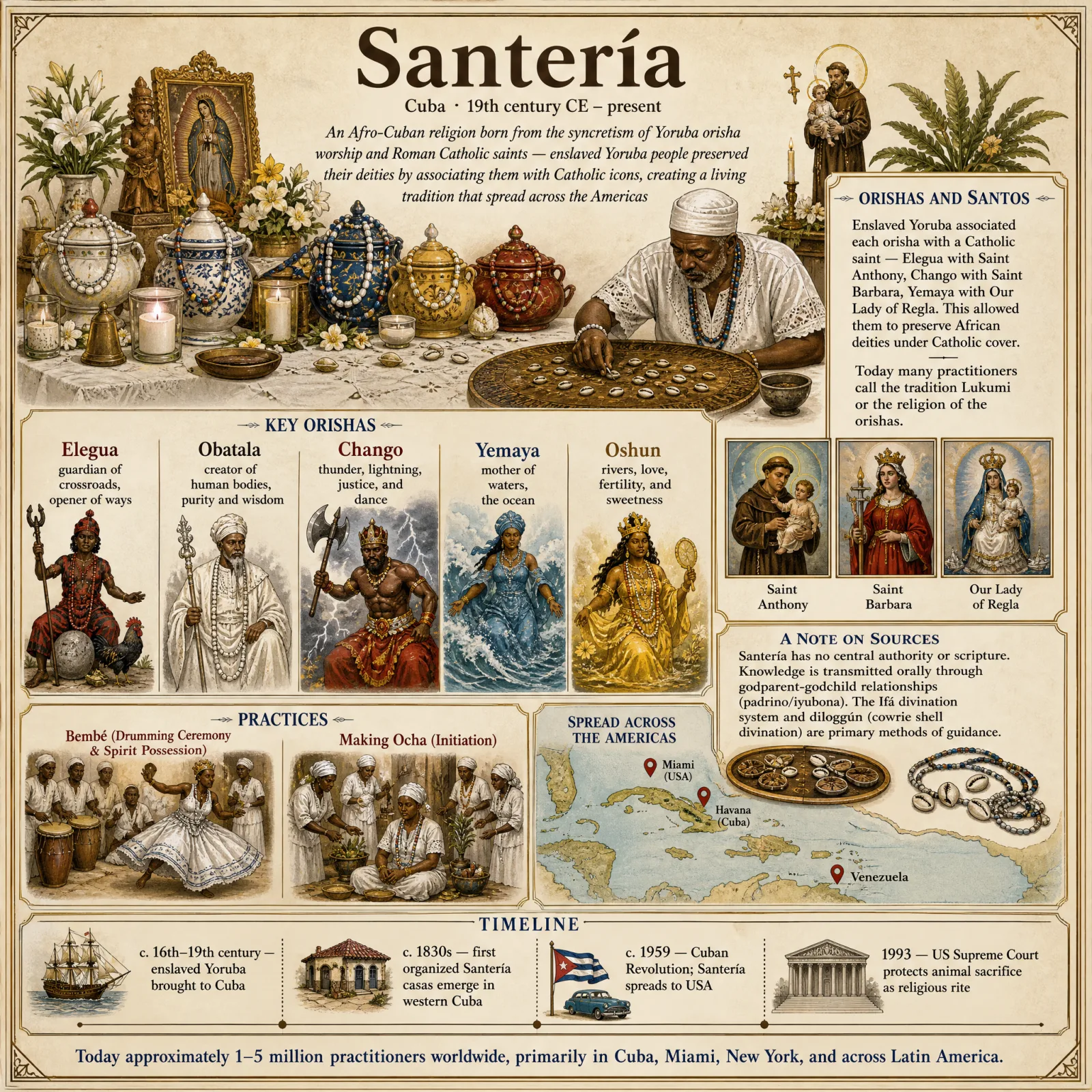
Santería—also known as Regla de Ocha (the Rule of Orisha) or La Religión Lucumí—is an African diaspora religion that developed in colonial Cuba during the 19th century through the forced encounter of enslaved Yoruba peoples with Spanish Catholicism and, later, Spiritism. The name 'Santería' (literally 'way of the saints') arose from the practice of correlating Yoruba orisha (deities) with Catholic saints, a strategy that allowed enslaved Africans to maintain their religious traditions under the guise of Catholic devotion. Many contemporary practitioners prefer 'Regla de Ocha' or 'Lucumí' to avoid the term's colonial connotations and to emphasize the religion's African roots and autonomy from Catholicism.
At the heart of Santería is the worship of orisha—spiritual forces who govern natural phenomena, human endeavors, and moral qualities. Each orisha possesses distinct attributes, sacred colors, ritual foods, drum rhythms, and dance movements. Practitioners (creyentes or santeros/santeras when initiated) cultivate personal relationships with orisha through divination, sacrifice, possession trance, and the maintenance of altars (soperas containing sacred stones, or otanes). Unlike hierarchical world religions, Santería has no central authority, scripture, or standardized doctrine; instead, knowledge is transmitted through initiation lineages (ramas) under the guidance of godparents (padrinos/madrinas) within house-temples (ilés or casas de santo).
Santería emerged primarily in western Cuba—especially Havana, Matanzas, and the town of Regla—where concentrations of enslaved Yoruba speakers (called Lucumí in Cuba) formed mutual-aid societies known as cabildos de nación. These cabildos preserved language, ritual knowledge, drumming traditions, and collective memory despite slavery's ruptures. Following Cuban independence (1898) and the Revolution (1959), Santería spread throughout the island and, via emigration, to the United States (especially Florida, New York, New Jersey, California), Mexico, Venezuela, Puerto Rico, and Europe. Today, Santería is practiced by Cubans and non-Cubans, Afro-descendants and converts of diverse backgrounds, in configurations that range from Cuban-centered orthodoxy to syncretic innovations. Its flexible, non-dogmatic structure has enabled both continuity and adaptation across nearly two centuries.
Historical Development
Santería's roots lie in the Yoruba-speaking regions of southwestern Nigeria and the Kingdom of Dahomey (present-day Benin), from which hundreds of thousands of captives were forcibly transported to Cuba during the transatlantic slave trade, particularly between 1790 and 1870. Unlike earlier African populations in Cuba (Kongolese, who formed Palo Monte traditions), Yoruba arrivals—collectively labeled 'Lucumí' by Spanish colonizers—came relatively late but in concentrated waves, especially after the collapse of the Oyo Empire in the early 19th century. This demographic concentration allowed Lucumí slaves to reconstitute elements of Yoruba religious life within the oppressive constraints of plantation society and Spanish colonial law.
Central to this reconstitution were the cabildos de nación, mutual-aid societies organized by African ethnic groups that Spanish authorities tolerated as mechanisms of social control. Ostensibly Catholic confraternities dedicated to patron saints, cabildos functioned covertly as spaces for African religious practice. In Havana, Matanzas, and Regla, Lucumí cabildos preserved orisha worship, divination systems (dilogun, Ifá), ritual drumming (batá), and initiation protocols. The cabildo system allowed enslaved and free Afro-Cubans to pool resources, bury their dead, celebrate feast days, and teach the next generation. Key figures emerged: Adeshina (Remigio Herrera), a Yoruba-born babalawo who arrived in Matanzas around 1850, founded the Cabildo Yemayá in Regla (1866) and trained generations of priests; Oba Tero (Josefa García), a powerful priestess, established influential lineages in Matanzas. These individuals and their godchildren formed ramas (branches) that persist to the present.
The religion's name, 'Santería,' reflects the strategic syncretism enslaved Yoruba employed to survive. Each orisha was publicly identified with a Catholic saint: Changó with Santa Bárbara, Yemayá with Our Lady of Regla, Oshún with Our Lady of Charity (Cuba's patron), Obatalá with Our Lady of Mercy, Elegguá with the Holy Child of Atocha or Saint Anthony. This correspondence was not theological equivalence but protective camouflage—slaves could venerate orisha under the noses of masters and priests who saw only Catholic piety. Scholars debate whether this syncretism was purely tactical or whether practitioners genuinely integrated Catholic elements. Contemporary practice varies: some santeros maintain both Catholic and Lucumí identities, attending Mass and orisha ceremonies; others reject Catholicism entirely, viewing the saint associations as historical artifacts to be discarded in favor of 'pure' African practice.
Following Cuba's abolition of slavery (1886) and independence from Spain (1898), Santería moved from clandestinity to semi-public visibility, though it remained legally precarious and socially stigmatized. Early 20th-century Cuban nationalism, influenced by scientific racism and modernization ideologies, portrayed African-derived religions as backward 'witchcraft' (brujería) incompatible with progress. Police raids on ilés, arrests of priests for 'illegal practice of medicine' or 'fraud,' and sensationalist media coverage depicting human sacrifice (overwhelmingly false accusations) reinforced marginalization. Nonetheless, Santería thrived in working-class Afro-Cuban neighborhoods, sustained by oral transmission, ritual innovation, and the pragmatic efficacy practitioners found in divination and healing.
The 1959 Cuban Revolution and subsequent socialist government initially suppressed all religions, including Santería, as 'superstition' or 'opiate of the masses.' Yet Santería proved resilient: unlike institutional Catholicism, which depended on hierarchies and property easily nationalized, Santería operated through decentralized household networks resistant to state control. By the 1980s, the Cuban government softened its stance, recognizing Afro-Cuban culture as part of national heritage. Santería became a subject of state-sponsored folklore troupes (Conjunto Folklórico Nacional), academic study, and even tacit official participation. The 1991 Fourth Congress of the Cuban Communist Party permitted party members to practice religion, further normalizing Santería.
Emigration, especially after the 1959 Revolution and the 1980 Mariel boatlift, carried Santería to the United States, where it took root in Cuban exile communities in Miami, Union City (New Jersey), New York, and Los Angeles. In these diaspora contexts, Santería encountered new challenges and opportunities: religious freedom allowed public practice, but cultural dislocation, generational transmission gaps, and commercialization (botánicas selling ritual goods, paid divinations for non-initiates) altered traditional structures. Transnational networks emerged, with U.S.-based priests traveling to Cuba for initiations and Cuban priests visiting diaspora communities. Since the 1990s, Santería has attracted non-Cuban converts—African Americans seeking ancestral connection, Latinos from non-Cuban backgrounds, and even white Americans drawn to its earth-centered spirituality—prompting debates over cultural ownership, authenticity, and the boundaries of tradition. Today, Santería exists as a global, multi-sited phenomenon, simultaneously rooted in Cuban history and evolving in response to contemporary contexts.
Worldview and Philosophy
Santería's cosmology centers on three tiers of spiritual reality: Olodumare (also Olorun or Olofi), the supreme creator deity who is distant and rarely invoked directly; the orisha, divine intermediaries who govern specific domains of nature and human life; and the ancestors (eggun or muertos), deceased family members and ritual elders who guide and protect the living. This structure mirrors Yoruba theology but with Cuban adaptations. Practitioners understand that Olodumare is too vast and remote for direct human approach, delegating interaction with creation to the orisha, who are more accessible, temperamental, and involved in daily affairs.
The orisha are not abstract principles but vivid personalities with preferences, moods, and moral complexities. They embody natural forces and human archetypes simultaneously: Changó is thunder, kingship, virility, dance, and justice, but also impulsiveness and womanizing; Oshún is rivers, love, fertility, beauty, and wealth, but also vanity and jealousy; Yemayá is the ocean, motherhood, and nurturing, but also fierce protectiveness and hidden depths; Obatalá is mountains, purity, wisdom, and creation, but also stubbornness; Oyá is wind, cemeteries, transformation, and female power, but also destructiveness. Each orisha has caminos (paths or avatars)—for instance, Changó has at least seven caminos, each emphasizing different aspects of his character. Practitioners do not worship all orisha equally; instead, through divination at initiation, each person learns which orisha 'owns their head' (santo de cabeza or eleda), establishing a lifelong tutelary relationship.
Central to Santería philosophy is the concept of aché (ashé), a Yoruba-derived term for spiritual power, life force, and the capacity to make things happen. Aché flows from Olodumare through the orisha to humans, animals, plants, and sacred objects. Rituals aim to accumulate, channel, and balance aché: offerings (ebo) feed aché to orisha; sacrifices release aché from animals to fortify spirits; music and dance circulate aché; consecrated objects (stones, necklaces, crowns) store aché. A person's well-being depends on maintaining proper aché—too little leads to misfortune, illness, or spiritual weakness; too much can be destabilizing. Divination (through cowrie shells, dilogun, or Ifá) diagnoses aché imbalances and prescribes corrective actions.
Santería posits a complex relationship between destiny (camino or suerte) and free will. Before birth, each person chooses their destiny in consultation with Olodumare, but upon incarnation, they forget this choice. Life's challenges and opportunities are not random but reflections of pre-birth agreements that can be revealed through divination. However, destiny is not deterministic—humans possess agency to improve or worsen their path through moral conduct (iwa), sacrifice, and alignment with their orisha. This philosophy encourages active ritual engagement rather than fatalism: if divination reveals an obstacle, one performs the prescribed ebo to 'sweeten' (endulzar) the path or 'close' (cerrar) negative influences.
Morality in Santería is situational and relational rather than based on universal commandments. Each orisha has taboos (ewos)—foods, colors, behaviors forbidden to their initiates—but these vary by orisha and individual divination. What is taboo for one person may be obligatory for another. General ethical principles include respect for elders (especially ritual elders), honoring one's word, reciprocity (helping those who help you), and maintaining ritual purity. However, Santería does not dichotomize 'good' and 'evil' in Christian terms; orisha can be beneficent or destructive depending on circumstances, and rituals exist both for healing and for harm (trabajos, or 'works,' can be protective or aggressive). This moral flexibility has attracted criticism from outsiders but reflects a pragmatic, context-sensitive ethics rooted in Yoruba thought.
Death in Santería is a transition, not an ending. The deceased become eggun, joining the ranks of ancestors who continue to influence the living. Proper funerary rituals (ituto for initiates) ensure the spirit's peaceful transition and prevent it from 'walking' (causing trouble). Ancestors are honored at a boveda (altar with water glasses) and consulted through Spiritist practices (often integrated into Santería despite coming from a different tradition). Initiates believe their orisha accompanies them through life and, at death, returns to the divine realm while the eggun remains as ancestral presence. Reincarnation is acknowledged but not emphasized; the focus is on this life and maintaining balance with spiritual forces.
Sacred Texts and Oral Literature
Santería has no written scripture comparable to the Bible or Quran. Instead, it transmits sacred knowledge orally through narrative (patakines or patakís), ritual performance, divination verses, praise songs (suyeres), and embodied practice. This orality reflects both African roots—Yoruba religious traditions were transmitted through apprenticeship and memorization—and historical necessity, as literacy was denied to enslaved Africans and written records risked exposure under slavery and later persecution. The absence of scripture has allowed Santería remarkable flexibility, as knowledge adapts through each transmission, yet it has also created challenges for standardization and authority claims.
The primary textual corpus consists of the odu (signs) of the dilogun divination system. Unlike Ifá's 256 odu, dilogun uses sixteen cowrie shells to generate patterns from zero to sixteen, each with associated patakines—mythological stories about the orisha that serve as interpretive keys. When a diviner casts shells for a client, the resulting odu indicates which orisha is speaking and which patakín applies. For example, odu 5 (Oshé) is governed by Oshún and might invoke stories of jealousy, rivers, or wealth; odu 9 (Osa) is governed by Oyá and relates to transformation, cemeteries, or conflicts. The diviner must memorize dozens of patakines per odu and select the relevant one based on context. This requires years of training under a godparent, with knowledge considered proprietary to each rama.
Patakines function as sacred myths, moral exemplars, and divination keys simultaneously. They narrate orisha interactions, conflicts, and resolutions, often with trickster elements and unexpected reversals. A typical patakín might recount how Elegguá outwitted death, how Changó and Oggún competed for Oshún's love, or how Obatalá created humanity. These stories are not historical accounts but paradigmatic truths—templates for understanding human dilemmas. During divination, the patakín's resolution suggests ritual prescriptions: if a story describes an orisha receiving a sacrifice and thereby overcoming an enemy, the client may be told to make a similar offering. Patakines are told in Cuban Spanish mixed with Lucumí (liturgical Yoruba vocabulary), preserving African language fragments even among Spanish-dominant practitioners.
Songs (cantos or suyeres) form another oral-textual category. Each orisha has signature songs sung during ceremonies, especially at tambores (drumming rituals). These songs, in Lucumí, invoke the orisha, recount their deeds, and facilitate possession trance. For instance, a song to Yemayá might address her as 'Yemayá Olokun, mother of the sea,' while one to Changó might praise his kingship and thunder. Drummers, singers, and initiates memorize extensive repertoires, with regional and lineage variations. Some songs are considered 'hot' (caliente)—so potent they reliably induce possession—and are used strategically. The secrecy surrounding certain songs and rhythms underscores their ritual power; non-initiates may hear generic versions but not the consecrated forms.
Initiation knowledge—the rituals, prayers (rezos), and procedures for making saints (hacer santo)—is the most closely guarded textual tradition. A santero learns these secrets progressively: first as aleyo (non-initiate), then as initiate, and finally as elder authorized to initiate others. Written libretas (notebooks) exist, kept privately by priests, but tradition emphasizes oral transmission and physical demonstration. The asiento (seating ceremony, when a person is initiated and 'crowned' with their orisha) involves hundreds of ritual steps—sacrifices, chants, dances, symbolic acts—performed over seven days. This knowledge circulates through lineage networks, with each rama claiming authentic transmission from founders like Adeshina or Oba Tero.
Recent decades have seen a shift toward documentation. Scholarly works by David Brown, Stephan Palmié, Joseph Murphy, and others have published aspects of Santería theology and practice, sparking debates within the community: some practitioners welcome academic engagement as validation and preservation; others view it as profanation of secrets meant only for initiates. Similarly, the internet has made ritual knowledge widely accessible—YouTube videos of ceremonies, online forums, digital libraries of patakines—disrupting traditional gatekeeping. Younger practitioners navigate between respect for secrecy and pragmatic need for accessible resources, especially in diaspora contexts where godparents may be geographically distant.
Practices and Rituals
Santería practice revolves around the ilé (house-temple), a private home transformed into sacred space through the presence of altars, consecrated objects, and ritual community. Each ilé is led by a santero/santera (initiated priest/priestess) who serves as padrino/madrina (godparent) to their ahijados (godchildren). The ilé functions as ritual center, divination clinic, initiatory space, and social network. Relationships within the ilé are structured by initiation seniority and orisha lineage: an elder initiated 20 years ago commands more authority than a recent initiate, regardless of age. This gerontocratic structure parallels Yoruba age-grade systems, though adapted to Cuban and diasporic contexts.
Divination (consulta) is the most frequent ritual practice, through which practitioners diagnose spiritual problems, identify responsible orisha or eggun, and receive prescriptions for restoration. The primary tool is the dilogun: sixteen cowrie shells opened on one side, cast on a mat, read according to how many fall face-up (ire = blessing, osogbo = obstacle). The diviner interprets the resulting odu, recites relevant patakines, and prescribes ebo (offerings). Ebo can range from simple (lighting candles, bathing with herbs, feeding one's orisha with honey or fruit) to complex (animal sacrifice, elaborate ceremonies, pilgrimage to specific sites). Clients pay for divination, but fees vary by region, practitioner, and relationship—godchildren may receive free or discounted consultations.
Animal sacrifice (matanza) is central and controversial. Santería views sacrifice as feeding the orisha, releasing aché from the animal into the spiritual realm, and creating reciprocal exchange. The animals—chickens, roosters, pigeons, goats, sheep, guinea fowl—are consecrated, ritually killed with prayers, and their blood offered to orisha stones in soperas. The meat is cooked and shared communally, with portions for the orisha (placed on altars), the priest, and participants. Sacrifice is not considered cruel; practitioners argue it is more humane than industrial slaughter and spiritually necessary. However, it has been legally contested in the U.S. (the landmark 1993 Supreme Court case Church of Lukumi Babalu Aye v. City of Hialeah struck down a municipal ban, affirming Santería's First Amendment protections) and remains a flashpoint for misunderstanding and prejudice.
The asiento (initiation, 'making saint,' or 'crowning') is the most intensive ritual, transforming an aleyo into a santero/santera. Preceded by a year or more of preparation (receiving elekes—beaded necklaces representing the five warrior orisha; receiving guerreros—Elegguá, Oggún, Ochosi, and Osun consecrated objects), the asiento lasts seven days in seclusion. The initiate undergoes head-shaving, ritual baths, animal sacrifices, and a climactic 'seating' where their orisha is 'fed' and placed on their head (a crown or vessel). The initiate emerges in white, symbolizing rebirth, and must observe strict taboos for a year (iyawó period): wearing white, avoiding mirrors and sunlight, not shaking hands, eating from separate utensils. The asiento is expensive—often $5,000–$15,000 in the U.S.—covering animals, godparent fees, drums, ceremonial items, and communal feasting. This cost has sparked criticism of commercialization, though defenders argue it maintains seriousness and supports ritual economy.
Tambores (drumming ceremonies) are communal celebrations honoring orisha. Batá drums—a set of three hourglass-shaped, double-headed drums (iyá, itótele, okónkolo)—are played in polyrhythmic patterns (toques) specific to each orisha. Consecrated batá contain añá (the spirit of the drum) and are restricted to male initiates of the Añá fraternity, though secular batá (aberinkula) can be played by anyone. Tambores feature singing, dancing, offerings of fruits and sweets, and, often, possession trance. When an orisha 'mounts' (monta) a devotee, the possessed individual (called the 'horse,' caballo) embodies the deity, speaking, dancing, and interacting with participants as that orisha. Possession is highly valued, interpreted as proof of the orisha's presence and favor, though it must be 'controlled'—elders intervene if a possession becomes disruptive or dangerous.
Home altars are daily practice sites. Each initiated santero maintains soperas (porcelain tureens) containing the otanes (stones) of their orisha, arranged on a shelf or in a special room (cuarto de santo). The stones are 'fed' regularly with water, rum, honey, or sacrificial blood; adorned with the orisha's colors and symbols (Changó's red and white, Oshún's yellow and mirrors, Yemayá's blue and seashells); and spoken to in prayers and requests. Many practitioners also maintain a boveda, a white-cloth-covered table with glasses of water representing ancestral spirits, often integrating Spiritist practices learned from Espiritismo Cruzado (a Cuban syncretic Spiritism).
Festivals (fiestas de santo) mark an orisha's feast day or a santero's initiation anniversary. These multi-hour events feature food, music, dance, and communal worship. Major dates include: September 7–8 for Yemayá (aligned with Our Lady of Regla); December 4 for Changó (Santa Bárbara); September 8 for Oshún (Our Lady of Charity); September 24 for Obatalá (Our Lady of Mercy). In Cuba, public processions and street parties blend Catholic and Lucumí elements; in the U.S., celebrations are often more private, held in homes or rented halls. These festivals reinforce community identity, transmit tradition to younger generations, and perform cultural continuity despite geographic and political displacement.
Internal Diversity and Variations
Santería is decentralized and heterogeneous, lacking the institutional structures (clergy hierarchies, councils, doctrinal statements) that standardize world religions. Authority is personal and lineage-based: each rama traces itself to founding priests (Adeshina, Oba Tero, Ferminita Gómez, Asunción Villalonga, and others) whose initiation protocols and divination interpretations differ subtly. Initiates often identify their rama publicly—'I'm from the rama of Adeshina through my madrina who was godchild of…'—to signal pedigree and authenticate practice. Inter-rama disputes over 'correct' ritual procedure, odu interpretation, or orisha attributes are common, with no mechanism for resolution beyond prestige and consensus.
Geographic variation is significant. Havana Santería, historically the most documented, emphasizes intellectual knowledge, complex ceremonies, and close Catholic syncretism. Matanzas Santería is considered more 'African,' preserving older Yoruba vocabulary, stricter taboos, and batá drumming traditions tied to the Añá lineage of Matanzas. Eastern Cuban Santería (Oriente) integrates more Kongolese elements from Palo Monte, creating hybrid practices. U.S. Santería has developed its own characteristics: English-language ceremonies (though Lucumí remains liturgical), adaptations to apartment living (quieter rituals, smaller animal sacrifices), legal constraints (some cities require permits for sacrifice), and clientele including non-Cubans. Transnational movement complicates simple geographic divisions—Cuban-trained priests practice in Miami, U.S.-born santeros travel to Havana for initiations—creating a fluid, multi-sited tradition.
Gender roles in Santería are complex and contested. Women can and do become powerful priestesses (Oba Tero, Ferminita Gómez, and contemporary leaders like Iyalocha Omi Laní); many orisha are female (Yemayá, Oshún, Oyá), and possession by male orisha often feminizes male practitioners ritually. However, patriarchal norms persist: women are barred from the Añá batá drumming fraternity due to beliefs about menstrual 'contamination' weakening the drums' aché; some lineages restrict women from certain initiatory roles; and machismo within Cuban culture shapes interpersonal dynamics. LGBTQ+ practitioners, especially gay men, have historically found Santería more accepting than Catholicism, though homophobia exists. Gender-nonconforming and transgender initiates navigate tensions between orisha identity (which orisha to receive, which gender presentations are appropriate) and social norms, with outcomes varying by lineage and individual negotiation.
The relationship to Catholicism varies widely. Some practitioners maintain dual identity, attending Mass and orisha ceremonies without conflict, viewing the saint-orisha correspondences as genuine theological overlap. Others reject Catholicism entirely, arguing that syncretism was historical necessity now obsolete; they advocate 'recovering' African purity by eliminating Catholic elements, using orisha names exclusively, and aligning with Nigerian Yoruba Traditionalists. This tension intensified in the 1990s–2000s when Nigerian-trained babaláwo criticized Cuban Santería as 'corrupted,' sparking the so-called 'Yoruba wars'—debates over legitimacy, authenticity, and who controls orthodox practice. Most practitioners pragmatically navigate between poles, selectively incorporating or rejecting Catholic elements based on personal conviction and community norms.
Commercialization and commodification are sources of internal debate. Botánicas (shops selling ritual supplies—candles, herbs, statues, beads) make Santería accessible but also visible to law enforcement and stigmatization. Online divination services, YouTube initiations, and 'pay-for-blessings' models challenge traditional gift-exchange reciprocity. Some elders lament loss of secrecy and ritual integrity; younger practitioners counter that adaptation is survival, especially for diaspora communities lacking direct access to Cuban godparents. Scholarship has also commodified Santería—academic conferences, museum exhibits, films, and books reduce complex traditions to consumable knowledge, though some practitioners engage strategically to correct stereotypes and assert legitimacy.
Global Communities and Contemporary Practice
Cuba remains Santería's heartland, with an estimated 60–80% of the population engaging with the religion in some capacity, whether as initiated priests, clients receiving divination, or participants in festivals. Practice is most dense in Havana, Matanzas, and Santiago de Cuba, where cabildos, ilés, and public ceremonies are visible features of urban life. Post-1991 liberalization allowed state recognition: Santería is taught at the University of Havana's Department of Religious Studies, featured in official tourism promotions ('authentic Afro-Cuban culture'), and practiced openly by government officials. However, tension persists between state folkloric framing and practitioners' insistence on Santería as living religion, not museum artifact.
The United States hosts the largest diaspora Santería population, concentrated in South Florida (Miami, Hialeah, Little Havana), New York City (the Bronx, Brooklyn, Queens), Union City/Newark (New Jersey), and Los Angeles. These communities formed through waves of Cuban emigration: 1959–1962 (post-Revolution exiles), 1965–1973 (Freedom Flights), 1980 (Mariel boatlift), 1994 (balsero crisis), and ongoing migration. U.S. Santería is socially stratified: working-class Cuban communities in Little Havana practice within tightly-knit ilés; middle-class practitioners in suburban New Jersey may pursue initiation as cultural heritage or spiritual fulfillment; Afro-Puerto Rican and Dominican communities in New York integrate Santería with Espiritismo and Palo Monte.
Santería has increasingly attracted non-Cuban practitioners since the 1990s. African Americans, especially those involved in Black nationalism or Pan-Africanism, view Santería as reconnection to African spirituality severed by slavery. Chicano and Latino communities integrate it into syncretic practices alongside curanderismo and Catholicism. White Americans, often from New Age or earth-based spirituality backgrounds, are drawn to Santería's emphasis on nature, direct spiritual experience, and lack of dogma. This diversification has sparked debates: some Cuban elders welcome it as proof of the religion's universal relevance; others view it as cultural appropriation or dilution. Non-Cuban initiates must navigate suspicion, linguistic barriers (ceremonies in Spanish/Lucumí), and accusations of 'playing Indian.' However, multi-ethnic ilés increasingly normalize diversity, especially among second-generation Cuban-Americans who see Santería as global heritage.
Puerto Rico, Venezuela, Colombia, and Mexico have substantial Santería populations, introduced through Cuban migration and media circulation. In Puerto Rico, Santería blends with Espiritismo and Taíno revivalist movements; Venezuelan Santería integrates with Maria Lionza cult practices; Mexican Santería overlaps with Santa Muerte devotion. These hybrid formations demonstrate Santería's adaptability and challenge neat national boundaries. Europe, especially Spain (Madrid, Barcelona) and Germany (Berlin, Hamburg), hosts growing communities, often among Latin American immigrants and Spanish converts. European Santería faces unique challenges: legal restrictions on animal sacrifice (stricter than U.S.), cultural unfamiliarity (less Christian-African syncretism resonance), and geographic distance from Cuban godparents.
Digital communities have transformed Santería practice. Facebook groups, WhatsApp chats, and forums allow initiates to consult across borders, share ritual knowledge, and organize transnational ceremonies. Online divination services—clients send photos, receive readings via video call—emerged during the COVID-19 pandemic and persist despite controversy over ritual efficacy without physical presence. YouTube channels by practitioners like Baba Eyiogbe and Iyá Oṣun Mẹwa offer teachings, ceremonial footage, and community-building, though elders worry about unauthorized disclosure. Digital technology has not replaced face-to-face initiation—asiento still requires physical presence—but has supplemented traditional transmission, creating layered, hybrid modalities of practice.
Contemporary Santería demographics are difficult to quantify precisely. The 2001 American Religious Identification Survey estimated 22,000 U.S. practitioners, but scholars like Joseph Murphy suggest hundreds of thousands engage with Santería in some capacity (clients, aleyo, occasional participants). In Cuba, where census data on religion is limited, estimates range from 500,000 to several million, depending on definitions (initiated priests vs. broader participation). Santería's non-proselytizing nature, emphasis on secrecy, and decentralization make accurate counts elusive. What is clear is that the religion continues to grow, adapt, and circulate globally while maintaining Cuban cultural roots and African spiritual foundations.
Sacred Sites and Ceremonial Centers
Regla (Havana Province, Cuba) is Santería's most iconic sacred geography. This small town across Havana Bay takes its name from the Virgin of Regla (Yemayá), whose sanctuary attracts Catholic pilgrims and Santería devotees annually on September 7. Regla was historically a free Black town and cabildo center, home to the legendary Cabildo Yemayá founded by Adeshina in 1866. The town's streets hosted processions of orisha disguised as Catholic saints, a tradition suppressed in the 1960s but revived in 2016. The Iglesia de Nuestra Señora de Regla houses a black Madonna venerated as Yemayá by santeros, who bring blue flowers, candles, and offerings. Regla remains a pilgrimage site where practitioners from Cuba and abroad come to 'greet' Yemayá, consult diviners working near the church, and connect with historical lineages. The waterfront, where Havana Bay meets the ocean, is used for Yemayá ceremonies involving offerings cast into the sea.
Matanzas (Matanzas Province, Cuba), called Cuba's 'African Athens,' was the epicenter of 19th-century Lucumí religious development. The city's concentration of enslaved Yoruba laborers on nearby sugar plantations created density necessary for ritual reconstruction. Key cabildos formed here, including the Cabildo Lucumí Santa Bárbara founded by Adeshina and the lineages of Oba Tero. Matanzas is renowned for preserving 'older' Santería—more extensive Lucumí vocabulary, stricter ritual protocols, and batá drumming traditions tied to the Añá spirit. The first consecrated batá drums in Cuba were crafted in Matanzas in the 1830s–1860s by Añabi, a Yoruba-born master drummer. Contemporary Matanzas hosts annual batá festivals, ilés maintaining historic ramas, and pilgrims seeking initiation from Matanzas lineages considered particularly 'authentic.'
Havana's historic quarters—Centro Habana, Habana Vieja, and the neighborhoods of Marianao and Guanabacoa—are dense with ilés, botánicas, and ritual sites. Specific addresses gain fame through association with powerful priests: the Calle Egido area, near the Mercado Cuatro Caminos, historically concentrated Afro-Cuban religious commerce; the Callejón de Hamel in Centro Habana is now a public art space celebrating Santería and Afro-Cuban culture, featuring murals of orisha and weekend rumba performances. Private homes function as temples—externally unmarked but internally transformed with altar rooms (cuartos de santo) where initiations, divinations, and tambores occur. Geographic knowledge is oral and relational: practitioners navigate Havana through networks of godparents, ritual kin, and reputed diviners rather than through addresses listed in directories.
El Cobre (Santiago de Cuba Province) is the national shrine to Our Lady of Charity (Virgen de la Caridad del Cobre), Cuba's patron saint and syncretized manifestation of Oshún. Pilgrims—Catholic and Santería alike—journey to El Cobre's basilica, especially on September 8 (Oshún's feast day), to petition the Virgin/Oshún for miracles. The shrine's history intertwines African and indigenous Cuban devotion with Spanish Catholicism: according to legend, three fishermen (two indigenous, one African slave) found the statue floating in the bay in 1608. Santeros bring offerings of honey, yellow flowers, candles, and personal petitions, leaving them at the shrine. Nearby, the Caridad River is used for ritual baths and offerings directly to Oshún, blending pilgrimage with private ceremony.
Miami and Little Havana (Florida, United States) constitute the largest U.S. Santería center. Botánicas line Calle Ocho (Southwest 8th Street), selling ritual supplies and advertising divination services. Ilés operate in private homes throughout Little Havana, Hialeah, and Kendall. The area's Cuban cultural density allows Santería to thrive publicly: tambores, initiations, and festivals occur frequently, though often discreetly to avoid zoning complaints or law enforcement scrutiny (despite legal protections, practitioners remain cautious). The Babalu Aye temple in Hialeah was the plaintiff in the landmark 1993 Supreme Court case affirming Santería's right to animal sacrifice. Miami's Santería is transnational—priests travel regularly between Miami and Havana, maintaining dual residences and conducting ceremonies in both locations—creating a fluid ritual geography.
New York City (especially the Bronx, Brooklyn, and Spanish Harlem) has hosted Santería since the 1940s–1950s, earlier than Miami. The city's Puerto Rican and Dominican populations integrated Santería with their own Spiritist and Catholic practices, creating a distinct regional variant. Botanicas concentrate along 116th Street (Spanish Harlem), Grand Concourse (the Bronx), and Flatbush Avenue (Brooklyn). New York's Santería is more ethnically diverse than Miami's, with African American, Dominican, Puerto Rican, and West African practitioners. The city's cosmopolitanism has fostered intellectual engagement—Santería scholars, artists, and cultural workers based in New York have produced significant literature, exhibitions, and advocacy work. However, urban density, high costs, and gentrification pressure ilés: ceremonies requiring loud drumming or outdoor space face challenges.
Los Angeles (California) has a smaller but growing Santería population, linked to Cuban and Latino migration and the city's broader spiritual marketplace. Practices here are more eclectic, often blending Santería with Mexican curanderismo, New Age spirituality, and holistic healing. Botanicas operate in East LA, Pico-Union, and Inglewood. The geographic dispersal of LA—compared to Miami or New York's density—means ilés are more isolated, relying on cars for travel to ceremonies and consultations. Some practitioners view LA Santería as more innovative and less tradition-bound, while others critique it as diluted.
Oyotunji Village (Sheldon, South Carolina, United States) is a unique case: an African-inspired intentional community founded in 1970 by Walter Eugene King (Oba Oseijeman Adefunmi I), an African American initiated in Cuba. Oyotunji bills itself as a Yoruba kingdom, practicing Santería and Ifá without Catholic syncretism and emphasizing African cultural revival, Yoruba language, and Pan-African identity. The village hosts initiations, festivals, and cultural education programs, attracting African American practitioners seeking 'de-syncretized' African religion. However, its authority is contested within Cuban Santería communities, some of whom view Oyotunji as Afrocentric invention rather than legitimate tradition. Nonetheless, it represents an important node of Santería's diversification and African American reclamation.
Debates and Contested Questions
Syncretism vs. African Purity: The central debate in contemporary Santería concerns Catholic elements. Historically, saint-orisha correspondences enabled survival under slavery and persecution, but do they remain necessary or desirable? 'Purists' argue for eliminating Catholic vestiges—using orisha names exclusively (Changó, not Santa Bárbara), rejecting Catholic prayers, and aligning with Nigerian Yoruba Traditional Religion. They view syncretism as colonial imposition to be shed. 'Syncretists' counter that the saint associations are now integral to Cuban Santería identity, not mere camouflage, and that severing them erases Cuban cultural creativity. This debate intensified with the 1990s Nigerian-Cuban reconnection ('Yoruba wars'), when Nigerian babaláwo criticized Cuban practices as 'corrupted.' Most practitioners occupy middle ground, selectively incorporating both African and Catholic elements.
Authenticity and Authority: Who determines 'correct' Santería? Decentralization means no pope, no council, no official doctrine. Authority rests in lineage prestige, initiation seniority, and demonstrated efficacy (successful divinations, powerful ceremonies, numerous godchildren). However, this creates competing claims: Cuban-trained priests assert primacy based on historical continuity; Nigerian Yoruba argue superiority based on unbroken African lineage; U.S.-born practitioners claim legitimacy through initiation regardless of ethnicity. Authenticity disputes play out over details—which odu interpretation is 'correct,' which sacrificial procedure 'traditional,' which songs 'original'—with no mechanism for resolution. Scholars like Stephan Palmié argue that Santería has always been heterogeneous and in flux, making static 'orthodoxy' a retrospective invention.
Race, Ethnicity, and Cultural Ownership: Is Santería a specifically Afro-Cuban ethnic religion or a universal spiritual path open to all? Cuban practitioners, especially Afro-Cubans, historically suffered marginalization and persecution for this tradition; some resent white American or European converts appropriating Santería without acknowledging its Black roots or experiencing anti-Black racism. African American practitioners argue that, as descendants of enslaved Africans, they have legitimate claim to Santería as ancestral heritage. White converts defend their participation as spiritual calling validated by initiation. The debate reflects broader tensions around cultural appropriation, commodification, and who profits from African-derived traditions. Most communities navigate this pragmatically: initiation erases outsider status (you're 'born' into the religion), but race and ethnicity remain socially salient.
Gender and Sexuality: Women's exclusion from batá drumming—the most visible Santería gender restriction—has been challenged by feminist scholars and practitioners. Defenders argue that taboos against menstrual 'contamination' are African tradition, part of orisha Añá's preferences, and not negotiable. Critics call this patriarchal rationalization disguised as tradition, noting that Yoruba culture itself is not static and Cuban Santería has modified other African practices. Some women have been initiated as batá drummers (Katherine Hagedorn, for instance), provoking controversy. LGBTQ+ inclusion is similarly contested: gay men are accepted in some ilés, stereotyped or excluded in others; transgender practitioners face questions about which orisha to receive and how gender non-conformity intersects with gendered orisha. These debates remain unresolved and vary by community.
Commercialization and Professionalization: Traditional Santería operated through gift-exchange reciprocity—godchildren gave offerings, labor, and respect; godparents provided initiation, knowledge, and protection. Money changed hands but was framed as ritual necessity (buying animals, materials) rather than payment for services. Contemporary practice, especially in the U.S., has become commercialized: divination consultations cost $50–$150; asiento initiations $5,000–$15,000; cleansings, ebos, and amulets priced and advertised. Botánicas operate as retail businesses. Some elders lament loss of sacred reciprocity, exploitation of gullible clients, and 'santeros de negocio' (business santeros) prioritizing profit. Others argue that diaspora economics necessitate professionalization—priests cannot rely on extended kin networks or informal economies available in Cuba. This tension reflects broader capitalist integration of African diaspora religions.
Secrecy, Disclosure, and Scholarship: How much Santería knowledge should be public? Traditional oral transmission emphasized secrecy—rituals, songs, odu interpretations revealed only to initiates, with penalties for disclosure. Academic scholarship (Brown, Palmié, Murphy, Clark) has published formerly esoteric knowledge, justifying it as preservation, anti-racist education, and religious legitimacy. Practitioners are divided: some collaborate with scholars, viewing documentation as safeguarding against loss; others see it as profanation, empowering non-initiates to misrepresent or exploit the religion. The internet has rendered the debate moot in some ways (everything is online) but intensified anxieties about who controls narrative and profit from Santería's cultural capital.
Animal Sacrifice and Public Perception: Sacrifice remains Santería's most controversial practice. Practitioners view it as humane (animals are treated respectfully, killed swiftly, and eaten, unlike industrial slaughter) and theologically necessary (feeding orisha maintains cosmic balance). Critics—animal rights activists, Christian fundamentalists, secular humanists—call it cruel, primitive, or Satanic. Media sensationalism (lurid stories of 'voodoo killings') perpetuates stigma. The 1993 Supreme Court case Church of Lukumi Babalu Aye v. City of Hialeah established legal protection, but social prejudice persists. Santeros navigate this by practicing discreetly, educating sympathetic outsiders, and asserting First Amendment rights. The debate is unlikely to be resolved, reflecting deep cultural divides over human-animal relations, religious freedom, and whose norms govern public space.
Key Terms
- Santería
- Popular name for the Cuban Yoruba-derived religion; means 'way of the saints' but considered pejorative by some practitioners who prefer Regla de Ocha or Lucumí.
- Regla de Ocha
- 'Rule of Orisha,' the practitioners' preferred term emphasizing orisha worship over saint syncretism.
- Lucumí
- Ethnic label for Yoruba-descended Cubans; also the religion's name and the liturgical language (archaic Yoruba mixed with Spanish).
- Orisha (oricha)
- Divine spirits governing natural forces and human domains; central to Santería worship. Major orisha include Changó, Yemayá, Oshún, Obatalá, Elegguá, Oggún, Oyá, and others.
- Olodumare (Olorun, Olofi)
- Supreme creator deity, remote and rarely invoked directly; delegates interaction with creation to orisha.
- Aché (ashé)
- Spiritual power, life force, the capacity to make things happen; flows from Olodumare through orisha to humans and objects.
- Ilé (casa de santo)
- House-temple where rituals occur; the community of practitioners centered on a godparent.
- Padrino/Madrina
- Godfather/godmother, the initiated priest/priestess who initiates and guides godchildren (ahijados).
- Rama
- Lineage or branch, tracing initiation through generations back to founding priests like Adeshina or Oba Tero.
- Asiento (hacer santo, coronación)
- Initiation ceremony, 'seating' or 'crowning' an individual with their orisha; transforms aleyo into santero/santera.
- Iyawó
- Newly initiated priest/priestess in their first year post-asiento; must wear white and observe strict taboos.
- Aleyo
- Non-initiated participant; someone who attends ceremonies, receives divination, but has not undergone asiento.
- Dilogun
- Cowrie shell divination; sixteen shells cast to produce odu (signs) interpreted by the diviner.
- Odu
- Divination signs or figures; dilogun has sixteen odu, each with associated patakines and orisha.
- Patakín (patakine)
- Sacred narrative, myth, or story about the orisha; used in divination to interpret odu and prescribe ritual action.
- Ebo (ebó)
- Offering or sacrifice prescribed by divination to restore balance, feed orisha, or resolve spiritual problems.
- Sopera
- Porcelain tureen (often a soup tureen) housing an orisha's otanes and ritual objects; placed on altars.
- Otán (otanes)
- Sacred stones representing and embodying the orisha; believed to contain aché.
- Elegguá (Elewá, Eshu-Elegba)
- Trickster orisha who controls crossroads, communication, and fate; must be propitiated first in all ceremonies.
- Changó (Shangó)
- Orisha of thunder, kingship, drums, and male virility; syncretized with Santa Bárbara.
- Yemayá (Yemoja)
- Orisha of the ocean, motherhood, and nurturing; syncretized with Our Lady of Regla.
- Oshún (Osun)
- Orisha of rivers, love, fertility, beauty, and wealth; syncretized with Our Lady of Charity.
- Obatalá (Obatala)
- Orisha of purity, wisdom, creation, and mountains; syncretized with Our Lady of Mercy.
- Oyá (Oya)
- Orisha of wind, cemeteries, and transformation; governs female power and change.
- Oggún (Ogun)
- Orisha of iron, war, labor, and technology; patron of blacksmiths, surgeons, and warriors.
- Tambor (toque, bembé)
- Drumming ceremony honoring orisha; features batá drums, singing, dancing, and often possession trance.
- Batá
- Sacred hourglass-shaped double-headed drums (iyá, itótele, okónkolo) used in ceremonies; consecrated batá contain añá (drum spirit).
- Añá
- The spirit of the batá drum; consecrated drums are 'of añá' and restricted to male initiates of the Añá fraternity.
- Possession (montar, subir el santo)
- Trance state in which an orisha 'mounts' (possesses) a devotee, who becomes the orisha's 'horse' (caballo).
- Eggun (muertos)
- Ancestors, deceased spirits; honored at boveda altars and consulted through Spiritist practices.
- Boveda
- Spiritist ancestor altar with white cloth and glasses of water representing spirits; common in Cuban Santería.
- Botánica
- Shop selling ritual supplies (candles, herbs, statues, oils, amulets); serves Santería, Spiritist, and other Afro-Caribbean practitioners.
Further Reading
- David H. Brown, Santería Enthroned: Art, Ritual, and Innovation in an Afro-Cuban Religion (University of Chicago Press, 2003)
- George Brandon, Santeria from Africa to the New World: The Dead Sell Memories (Indiana University Press, 1993)
- Stephan Palmié, The Cooking of History: How Not to Study Afro-Cuban Religion (University of Chicago Press, 2013)
- Joseph M. Murphy, Santería: An African Religion in America (Beacon Press, 1993)
- Mary Ann Clark, Where Men Are Wives and Mothers Rule: Santería Ritual Practices and Their Gender Implications (University Press of Florida, 2005)
- Katherine J. Hagedorn, Divine Utterances: The Performance of Afro-Cuban Santería (Smithsonian Institution Press, 2001)
- David H. Brown, 'La Division de La Habana: Territorial Conflict and Cultural Hegemony in the Followers of Oyo Lukumi Religion, 1850s-1920s', Cuban Studies 34 (2004)
- Miguel Barnet, 'La Regla de Ocha: The Religious System of Santería' in Sacred Possessions (Rutgers University Press, 1997)
- Church of Lukumi Babalu Aye v. City of Hialeah, 508 U.S. 520 (1993)
- Cabildo de Regla, 'A General History of Regla & Its Cabildo Processional Tradition'
Practices
- Bembé drumming
- Divination (Ifá/Diloggún)
- Animal offering
- Altars (soperas)
Core ideas
- Deity
- Olodumare above; orishas as emanations
- Afterlife
- Ancestors reborn or with the orishas
Sacred texts
Santería preserves its deepest teachings through the Ifá divination system, an oral corpus of 256 odu (signs) memorized by babalawos and Santería priests. Each odu carries myths, proverbs, and prescriptions for offerings to the orishas. The tradition was carried from West Africa to Cuba under slavery and passed down through initiation lineages rather than written books.