Sumerian Religion
The cradle of written myth, city-gods and ziggurats.
Overview
Sumerian Religion was the polytheistic belief system of the Sumerian civilization, which flourished in southern Mesopotamia (modern-day Iraq) from approximately the fourth millennium BCE until the end of the third millennium BCE. The Sumerians, the world's first urban civilization, developed writing (cuneiform), monumental architecture (ziggurats), and complex administrative systems centered on temple institutions. Their religious worldview understood the cosmos as governed by divine forces embodied in anthropomorphic gods and goddesses, with each city-state claiming a particular deity as its patron. These gods were not distant or abstract but active participants in human affairs, requiring service, offerings, and the maintenance of their earthly dwellings—the temples.
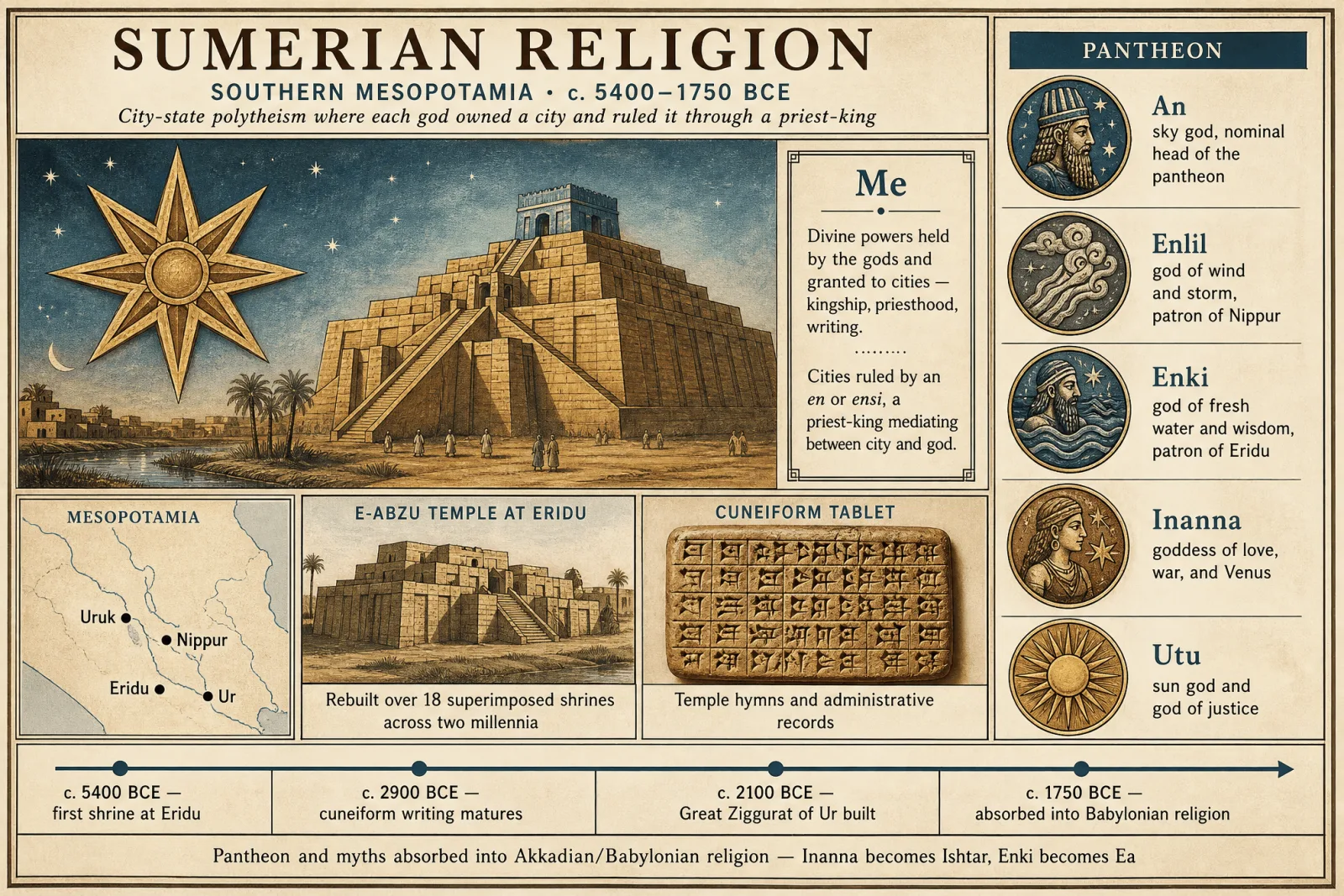
Sumerian religion cannot be separated from the socio-economic and political structures of Sumerian city-states. Temples functioned simultaneously as houses of the gods and as administrative centers controlling vast landholdings, managing labor, and redistributing resources. The me (divine powers or decrees) were understood as the fundamental principles that structured civilization—kingship, priesthood, agriculture, warfare, music, writing, and countless other aspects of human culture. These me were the property of the gods, distributed among them and occasionally transferred, as in the famous myth of Inanna's acquisition of the me from Enki, which elevated her city Uruk to prominence.
Sumerian religious thought is preserved in a rich corpus of cuneiform texts: hymns, lamentations, myths, incantations, and administrative records. The Electronic Text Corpus of Sumerian Literature (ETCSL) at Oxford and the Open Richly Annotated Cuneiform Corpus (ORACC) provide access to these materials in transliteration and translation. While Sumerian religion profoundly influenced later Mesopotamian traditions—Akkadian, Babylonian, and Assyrian—it is important not to collapse these distinct historical phases into a generic 'Mesopotamian' religion. Sumerian religious practices, deities, and texts had their own specificity, even as they were later adapted and transformed by Semitic-speaking populations. This article focuses on Sumerian religion in its historical context, examining its pantheon, sacred geography, ritual practices, and cosmological concepts.
The Uruk Period and the Emergence of Temple Institutions
The earliest evidence of distinctly Sumerian religious practices emerges during the Uruk period (circa 4000–3100 BCE), when the first cities developed in southern Mesopotamia. The city of Uruk itself was the largest and most influential, home to monumental temple complexes such as the Eanna (House of Heaven), dedicated to the goddess Inanna (later Ishtar). The Eanna precinct, excavated in the early 20th century, revealed massive platforms, columned halls, and evidence of centralized administration through the earliest cuneiform tablets—proto-literate economic records documenting offerings, labor, and temple resources.
Eridu, believed by the Sumerians themselves to be the first city, was home to the E-Abzu (House of the Abyss), the temple of Enki, god of wisdom and fresh water. Archaeological excavations have uncovered a sequence of temples at Eridu dating back to the Ubaid period (circa 5500–4000 BCE), suggesting continuity in sacred space over millennia. The temple platforms of the Uruk period evolved into the ziggurat form—stepped pyramidal structures topped by shrines—symbolizing artificial mountains that brought the earth closer to the heavens.
The development of cuneiform writing was intimately tied to temple administration. The earliest texts record transactions: deliveries of grain, animals, and labor to the temple estates. Writing emerged not for literary or religious purposes initially, but to manage the complex economic networks centered on the gods' households. Over time, scribes began recording hymns, myths, and rituals, creating a written canon of Sumerian religious literature.
The Early Dynastic period (circa 2900–2350 BCE) saw the consolidation of Sumerian city-states, each centered on a major temple and ruled by an ensi (governor-priest) or lugal (king). Competition for resources, particularly water and arable land, led to inter-city conflicts, which were understood in religious terms as conflicts between the patron deities of rival cities. The city of Lagash, for example, was under the protection of the god Ningirsu, while its neighbor Umma was associated with the god Shara. Wars between these cities were thus wars between gods, fought through their human servants.
Nippur occupied a unique position in the Sumerian religious landscape as the religious center of all Sumer, home to the Ekur (Mountain House), the temple of Enlil, the supreme god of the Sumerian pantheon. Unlike other cities, Nippur had no dynasty of its own and remained neutral in inter-city conflicts. Control of Nippur, or recognition by its priesthood, conferred religious legitimacy on Sumerian rulers. Hymns and inscriptions emphasize that kingship itself descended from heaven to Nippur and was distributed from there.
This period also produced the first royal inscriptions and the earliest literary texts, including hymns to gods and goddesses, wisdom literature, and narrative myths. The concept of divine kingship emerged: rulers claimed to have been chosen by the gods and acted as mediators between the divine and human realms. The king's duties included maintaining temples, conducting rituals, ensuring the gods' favor through offerings, and upholding ma'at (order, though this term is more Egyptian—Sumerians used concepts like nam-tar, destiny or fate).
The Akkadian conquest under Sargon of Akkad (circa 2334–2154 BCE) united Sumer and Akkad under a centralized empire. Akkadian, a Semitic language, became the language of administration, though Sumerian remained the language of religion and high culture. Akkadian rulers adopted Sumerian religious practices, venerating Sumerian gods while also promoting Semitic deities. The goddess Inanna/Ishtar became particularly prominent during this period, syncretized with Semitic war and fertility goddesses.
The Third Dynasty of Ur (circa 2112–2004 BCE) represents a Sumerian renaissance and the last period of Sumerian political dominance. Kings such as Ur-Nammu and Shulgi standardized ziggurat construction across major Sumerian cities—Ur, Uruk, Eridu, and Nippur—creating monumental structures that symbolized the piety and power of the Ur III state. The famous ziggurat of Ur, dedicated to the moon god Nanna, remains one of the best-preserved examples, with its massive mud-brick core and baked-brick facade.
Shulgi, one of the most accomplished Ur III kings, claimed divine status and was worshipped as a god during his lifetime, a practice that intensified royal cult. The bureaucracy of Ur III was extraordinarily detailed, with temple archives recording daily offerings, labor assignments, and temple incomes. This period produced some of the finest Sumerian hymns, lamentations, and literary texts, including the 'Self-Praise of Shulgi' and laments for destroyed cities.
The fall of the Ur III dynasty around 2004 BCE, precipitated by invasions of Elamites and Amorites, marked the end of Sumerian political power. Sumerian ceased to be a spoken language, surviving only as a learned, liturgical language used by scribes and priests, much as Latin functioned in medieval Europe. Succeeding dynasties—Old Babylonian, Kassite, Neo-Assyrian, and Neo-Babylonian—continued to venerate Sumerian gods, copy Sumerian literary texts, and conduct rituals in Sumerian, even as their own languages and cultures predominated.
The religious legacy of Sumer persisted for millennia. Sumerian myths were adapted into Akkadian versions (such as the Akkadian 'Descent of Ishtar' based on the Sumerian 'Inanna's Descent to the Netherworld'), Sumerian god lists were preserved and expanded in later scribal schools, and Sumerian temples continued to function under new management. The last cuneiform texts date to the first century CE, meaning that Sumerian religious tradition, in adapted form, endured for over 3,000 years.
The Pantheon: An, Enlil, Enki, and Inanna
The Sumerian pantheon was organized hierarchically, with major gods presiding over cosmic domains and lesser deities governing more specific aspects of life. An (Sky) was the father of the gods and the personification of the heavens, dwelling in the highest heaven. While theoretically supreme, An was often distant from human affairs in practice, with active governance delegated to other gods. His main cult center was Uruk, where he shared the Eanna temple precinct with Inanna.
Enlil (Lord Wind or Lord of the Atmosphere) was the most powerful god in the Sumerian pantheon, king of the gods and executor of divine decisions. His temple, the Ekur at Nippur, was the religious center of Sumer. Enlil controlled the Tablets of Destiny, which determined the fate of gods and humans, and wielded the power to grant or revoke kingship. He was a storm god whose rage could bring flood and destruction, as in the Sumerian flood myth where Enlil decides to destroy humanity (though Enki intervenes to save the pious Ziusudra).
Enki (Lord of the Earth or Lord of the Abzu) was the god of wisdom, magic, fresh water, and crafts. His temple, the E-Abzu at Eridu, was built over the apsu (the subterranean freshwater ocean believed to underlie the earth). Enki was a creator god, shaping humanity from clay and organizing the world through the distribution of the me. He was also a trickster and problem-solver, often intervening to protect humanity from the wrath of other gods. In 'Enki and the World Order,' he travels across Sumer, assigning functions to cities and deities.
Inanna (Queen of Heaven) was the most complex and multifaceted Sumerian goddess, associated with love, sexuality, fertility, warfare, and political power. Her primary cult center was the Eanna precinct in Uruk. Inanna was depicted as ambitious and transgressive, crossing boundaries and challenging divine hierarchies. The myth 'Inanna and Enki' recounts how she traveled to Eridu, got Enki drunk, and stole the me from him, bringing them to Uruk and thereby elevating her city to supremacy. Her 'Descent to the Netherworld' is one of the most famous Sumerian myths, in which she ventures into the realm of her sister Ereshkigal, dies, and is resurrected through the intervention of Enki.
The me are one of the most distinctive and complex concepts in Sumerian religious thought. The word literally means 'to be,' but as a noun it refers to divine powers, decrees, or norms that structure reality and legitimize civilization's institutions. The me are simultaneously abstract (principles governing kingship, priesthood, law) and concrete (objects that can be possessed, transferred, or stolen). They are the divine authorization required for any cultural practice to function.
Over a hundred me are listed in 'Inanna and Enki,' ranging from the exalted (kingship, godship, the noble crown) to the mundane (weaving, woodworking, leatherworking) to the paradoxical (strife, victory, falsehood, art of lovemaking). The me are morally neutral—they include both construction and destruction, truth and deceit, peace and war. Their possession by a deity confers the right to exercise that domain, and their acquisition by a city (through the patronage of its god) legitimizes that city's cultural and political prominence.
The myth 'Inanna and Enki' functions as an etiological narrative explaining Uruk's rise to preeminence: Inanna brought the me from Eridu (Enki's city, the oldest and most sacred) to Uruk, transforming Uruk into the greatest city of Sumer. This transfer of divine powers is not theft in a moral sense (though Enki regrets his generosity when sober) but a cosmic redistribution that legitimates historical change. The me concept reflects Sumerian understanding of civilization as a divine gift, dependent on the gods' favor and requiring constant ritual maintenance.
Nam-tar (literally 'destiny' or 'fate') is the Sumerian concept of the decreed fate of gods, humans, cities, and institutions. The gods, assembled in council, decree nam-tar for individuals and collectives. This decree is not necessarily immutable—gods can change their minds, and humans can petition for different fates through prayer and offerings—but it represents the divine will at a given moment. Enlil, as king of the gods, presided over the divine assembly and held the Tablets of Destiny, the physical record of all decrees.
Human kingship itself was understood as a me and a nam-tar: kingship descended from heaven, was bestowed on particular cities and individuals by divine decision, and could be withdrawn. The Sumerian King List, a historiographic document listing all kings from the mythical past to the recent past, presents kingship as moving from city to city ('After the flood had swept over, kingship descended from heaven [again]. Kingship was in Kish.'). This movement of kingship reflects changes in divine favor and cosmic order.
Personal nam-tar was also significant. Individuals had destinies decreed at birth by the goddess Nisaba or other divine scribes. Death was the ultimate decreed fate, universal and inescapable. The acceptance of mortality and the limits of human power is a recurring theme in Sumerian literature, as in the 'Death of Gilgamesh,' where even the great hero cannot escape his decreed death.
The Sumerian netherworld, known as Kur, Irkalla, or Arali, was conceived as a dark, gloomy place beneath the earth where all the dead went, regardless of moral conduct in life. It was not a place of punishment or reward but a shadowy continuation of existence, often described as the 'land of no return' or the 'house from which none who enter ever leave.' The dead ate only dust and clay and drank stagnant water, existing in a state of diminished life.
Ereshkigal (Queen of the Great Below) ruled the netherworld, dwelling in her palace Ganzir. She was a fearsome goddess, sister to Inanna, who enforced the boundary between the living and the dead. The dead had to pass through seven gates to enter her realm, shedding garments and divine powers at each gate until they arrived naked and powerless before her throne. Her attendant Namtar (the personification of fate and disease) served as her vizier, and the gatekeeper Neti guarded the entrance.
Death was permanent and irreversible in Sumerian thought, with rare exceptions (such as Inanna's resurrection, achieved only through divine intervention and substitution). The proper care of the dead—burial, funerary offerings, libations poured through pipes into the grave—was essential to ensure the dead remained in the netherworld and did not return as troublesome ghosts. Neglected dead, those without descendants to perform rituals, became restless spirits who could afflict the living. The relationship between the living and the dead was one of ongoing reciprocal obligation: the living provided sustenance, and the dead refrained from haunting.
Cuneiform Literature and Religious Texts
Sumerian religious literature is preserved in thousands of cuneiform tablets, most dating from the Old Babylonian period (early second millennium BCE) but recording compositions from earlier centuries. The Electronic Text Corpus of Sumerian Literature (ETCSL) at the University of Oxford has made nearly 400 Sumerian literary works accessible online, including myths, hymns, lamentations, wisdom literature, and royal inscriptions. These texts were copied and studied in scribal schools (edubba, 'tablet house') and formed the curriculum for scribal training.
Major mythological compositions include 'Inanna's Descent to the Netherworld,' 'Enki and Ninhursag,' 'Enki and the World Order,' 'Inanna and Enki: The Transfer of the Arts of Civilization,' 'The Flood Story,' and narratives about the hero Gilgamesh. Hymns praise individual gods and goddesses, often commissioned by kings to honor their patron deities and legitimize royal rule. Lamentations, such as the 'Lamentation over the Destruction of Ur' and the 'Lamentation over the Destruction of Sumer and Ur,' mourn the fall of cities and interpret destruction as divine abandonment.
Temple hymns describe the sacred geography of Sumer, listing temples and their deities, celebrating the me associated with each city, and affirming the centrality of temple cult. Wisdom literature, such as proverbs and disputations (e.g., 'The Debate between Summer and Winter'), conveys moral and practical teachings. Royal inscriptions recount building projects, military campaigns, and ritual performances, framing the king as the servant of the gods and the maintainer of cosmic order.
These texts were not static scripture but living traditions, adapted and reinterpreted over time. Sumerian religious literature influenced all subsequent Mesopotamian cultures, with many Sumerian myths, hymns, and prayers translated into Akkadian and other languages. The cuneiform corpus, accessible through resources like ORACC (Open Richly Annotated Cuneiform Corpus) at the University of Pennsylvania, remains an invaluable source for understanding Sumerian religious thought and practice.
Temple Cult and the Service of the Gods
The temple was the earthly residence of the god, and the primary purpose of cult was to provide for the god's needs as if the god were a living person of high status. The divine statue, housed in the inner sanctuary (cella) of the temple, was treated as the embodied presence of the deity. Priests awakened the god each morning with hymns, washed and dressed the statue, offered meals of bread, beer, meat, and fruit, and entertained the god with music and processions. These offerings were later redistributed to temple personnel and dependents, linking divine service to the temple economy.
Temple staff included a hierarchy of priests (sanga, gudu, išib) responsible for different aspects of ritual, as well as singers, musicians, craftsmen, and laborers. Women served as nadītu (cloistered devotees), lukur (cultic prostitutes or sacred women associated with Inanna), and en-priestesses (high priestesses who represented the deity). The en-priestess of Nanna at Ur, for example, resided in the gipar, a sacred complex within the temple precinct, and performed rituals representing the marriage of the god to the goddess.
Festivals marked the agricultural calendar, the lunar cycle, and mythological events. The Akitu (New Year) festival involved processions, ritual purifications, the renewal of kingship, and the recitation of creation myths. Festivals for Inanna included rites of sacred marriage (hieros gamos), in which the king, representing the shepherd-god Dumuzi, ritually united with a priestess representing Inanna to ensure fertility and abundance. These rituals enacted mythological narratives, making the eternal actions of the gods present and efficacious in the human world.
Animal sacrifice was central to Sumerian cult. Sheep, goats, and cattle were slaughtered and offered to the gods, with portions burned on altars and the remainder consumed in communal feasts. Offerings of grain, beer, oil, and textiles were also presented daily. These gifts maintained the reciprocal relationship between gods and humans: humans served the gods, and the gods, in turn, ensured cosmic order, fertility, and protection.
Divination was the means by which humans discerned divine will. The most important method was extispicy, the examination of the entrails (especially the liver) of sacrificed animals. Trained diviners (bārû) interpreted the patterns, markings, and anomalies of organs as messages from the gods. Dream interpretation, astrology, and the observation of omens (unusual events in nature or society) were also practiced. Omen compendia recorded thousands of protases (observed signs) and apodoses (predicted outcomes), forming a systematic science of divination.
Incantations (šiptu) and rituals (namsub) were performed to protect individuals from demons, illness, and misfortune. The Sumerian term namsub literally means 'binding' or 'control,' reflecting the understanding that ritual speech could compel spiritual forces. Exorcists (āšipu) performed purification rituals, using water, fire, and incantations to remove impurity and restore balance. Magic and religion were not distinct categories in Sumerian thought; both involved engaging with divine and supernatural powers through correct ritual procedure.
Sumerian burials were modest compared to those of later Mesopotamian or Egyptian elites, reflecting a worldview in which the afterlife was bleak and egalitarian. The dead were buried beneath house floors, in cemeteries, or in vaulted tombs, accompanied by pottery vessels, tools, and personal ornaments. Royal burials, such as those excavated at the Royal Cemetery of Ur (circa 2600 BCE), were exceptional in their wealth, including elaborate grave goods, jewelry, musical instruments, and evidence of human sacrifice (retainers buried with their rulers).
Regular funerary offerings were essential to sustain the dead in the netherworld. Descendants poured libations of water, beer, and oil through pipes or holes into the grave, and left food offerings at the tomb. The neglect of these offerings was believed to cause the dead to become restless ghosts (gidim) who could afflict the living with illness and misfortune. The 'unburied dead,' those who died violently or far from home without proper burial, were particularly dangerous and required special apotropaic rituals.
Sumerian funerary laments and dirges mourned the separation of the dead from the living and invoked the gods to ensure the deceased's safe passage to the netherworld. The dead were invoked by name in rituals, maintaining a connection between the living and the ancestors. However, unlike later traditions, Sumerians did not generally worship ancestors as deities; the dead remained dead, and their continued existence depended on the living's ongoing care.
Regional Variation and the Unity of Sumerian Religion
While Sumerian religion exhibited considerable unity—shared pantheon, common myths, and mutual recognition of major cult centers—there was also significant regional variation. Each city-state had its own patron deity, local pantheon, and temple traditions. Lagash venerated Ningirsu as its chief god, Uruk honored Inanna and An, Ur worshipped the moon god Nanna, and Eridu served Enki. Local myths emphasized the supremacy of the city's patron deity, and inter-city rivalries were expressed as divine conflicts.
Different cities maintained distinct liturgical traditions, temple architecture, and ritual calendars. The role of the ensi (governor-priest) varied by city, with some cities ruled by dynasties of kings (lugal) who claimed military and political authority, while others emphasized priestly rule. The balance between temple and palace institutions shifted over time and varied regionally, with some cities maintaining strong independent temple estates and others seeing temple and palace economies merge under royal control.
Despite these variations, Sumerians recognized a shared cultural and religious identity. Nippur's neutrality and the universal reverence for Enlil's Ekur provided a unifying center. Scribes across Sumer learned the same literary texts, and there was significant inter-city exchange of religious ideas, personnel, and practices. The standardization of ziggurat architecture during the Ur III period, for example, reflected a conscious effort to create a unified Sumerian religious landscape. After the fall of Sumerian political power, the preservation of Sumerian as a liturgical language and the continued copying of Sumerian texts by Akkadian, Babylonian, and Assyrian scribes attest to the enduring prestige and influence of Sumerian religious tradition.
Sumerian Religion as a Historical Tradition
Sumerian religion is a historical tradition, no longer practiced in its original form, with no continuous community of practitioners. The last native Sumerian speakers lived in the late third millennium BCE, and Sumerian ceased to be a spoken language by the early second millennium BCE. However, Sumerian religious texts, deities, and practices were preserved and adapted by subsequent Mesopotamian cultures for over two millennia, until the decline of cuneiform literacy in the Hellenistic and Roman periods.
Modern engagement with Sumerian religion is scholarly and archaeological. Cuneiform tablets continue to be excavated, catalogued, and translated by Assyriologists, and digital resources such as ETCSL and ORACC make Sumerian literature accessible to a global audience. Museums such as the British Museum, the Louvre, the University of Pennsylvania Museum, and the Iraq Museum house extensive collections of Sumerian artifacts, including statues, cylinder seals, and inscribed tablets.
There is no revival or reconstructionist movement for Sumerian religion comparable to those for some other ancient traditions, though elements of Sumerian myth and symbolism occasionally appear in esoteric and neopagan contexts (often syncretized or misrepresented). Academic study of Sumerian religion has contributed significantly to the history of religions, comparative mythology, and the understanding of the ancient Near East. The decipherment of cuneiform in the 19th century opened a window into the earliest literate civilization, revealing a complex religious worldview that profoundly influenced Judaism, Christianity, and Islam, particularly through shared flood narratives, creation motifs, and concepts of divine law.
Sacred Geography of Sumer
Uruk: The largest and most influential Sumerian city, Uruk was the cult center of An (Sky) and Inanna (Queen of Heaven). The Eanna (House of Heaven) precinct was a massive temple complex with monumental architecture, including the White Temple atop a ziggurat platform. Uruk is associated with the legendary king Gilgamesh and appears frequently in myth and literature as the preeminent Sumerian city. The city's walls, said to have been built by Gilgamesh, were celebrated in literature as a wonder of the world.
Ur: Located near the confluence of the Euphrates and Tigris rivers, Ur was the cult center of Nanna (the moon god) and his consort Ningal. The ziggurat of Ur, built by Ur-Nammu (circa 2100 BCE), is one of the best-preserved Sumerian religious structures, with its massive three-stage platform and monumental staircases. The Royal Cemetery of Ur, excavated by Leonard Woolley in the 1920s, revealed extraordinarily wealthy burials with evidence of elaborate funerary rituals. Ur was the capital of the Third Dynasty of Ur, the last great Sumerian empire.
Nippur: The religious capital of Sumer, Nippur was home to the Ekur (Mountain House), the temple of Enlil, king of the gods. Unlike other cities, Nippur had no royal dynasty and remained politically neutral, serving as a pan-Sumerian sanctuary. Control of Nippur or recognition by its priesthood conferred religious legitimacy on Sumerian rulers. The city was a major center of scribal learning, and thousands of literary and administrative tablets have been excavated from its ruins.
Eridu: Considered the oldest city in Sumerian tradition, Eridu was the cult center of Enki (god of wisdom and fresh water). The E-Abzu (House of the Abyss) temple was built over the apsu, the subterranean freshwater ocean. Archaeological excavations revealed a sequence of temples at Eridu dating back to the Ubaid period (circa 5500 BCE), demonstrating millennia of continuous sacred occupation. Eridu appears in Sumerian mythology as the first city created by the gods and the original seat of kingship.
Lagash: A powerful city-state in the Early Dynastic period, Lagash was the cult center of Ningirsu (a warrior god associated with agriculture and fertility). The city's rulers commissioned numerous inscriptions and statues celebrating their piety and temple-building activities. Lagash's conflicts with neighboring Umma over water rights and border territory are well-documented in cuneiform inscriptions, providing insight into Sumerian politics and religious justifications for warfare.
Contemporary Scholarly Debates
One major scholarly debate concerns the nature and function of Sumerian temples: were they primarily religious institutions or economic powerhouses? Early 20th-century scholars, influenced by the abundance of economic texts from temple archives, argued for a 'temple economy' model in which temples controlled the majority of land and resources. More recent scholarship, drawing on archaeological and textual evidence, has nuanced this view, recognizing that temple, palace, and private household economies coexisted and interacted in complex ways that varied by period and city.
The question of continuity versus discontinuity between Sumerian and later Mesopotamian religions is contested. Some scholars emphasize the profound cultural and linguistic shift from Sumerian to Akkadian, arguing that Semitic-speaking populations brought their own religious traditions and only superficially adopted Sumerian deities. Others stress continuity, noting that Sumerian gods, myths, and rituals were preserved and venerated for millennia, and that much of what we call 'Babylonian' or 'Assyrian' religion is fundamentally Sumerian in origin, adapted to new linguistic and cultural contexts.
The interpretation of the me remains contested. Are they divine attributes, cultural norms, ritual objects, or abstract principles? Different scholars have translated the term as 'powers,' 'decrees,' 'norms,' 'offices,' or 'essential properties,' reflecting the concept's resistance to easy categorization. The me blur boundaries between the material and the abstract, the divine and the human, and their multifaceted nature challenges Western dichotomies between religion, politics, and economics.
Finally, the extent to which Sumerian religious ideas influenced later Near Eastern and Mediterranean traditions is debated. Clear borrowings exist: the biblical flood narrative has parallels in the Sumerian flood story; Inanna's descent to the netherworld resonates with Persephone's abduction; and Sumerian creation motifs appear in Genesis. However, determining direct influence versus shared cultural context, and distinguishing Sumerian influence from broader Mesopotamian influence, requires careful textual and historical analysis. Sumerian religion is a foundational chapter in the history of religions, but its legacies are complex and mediated through multiple cultural transformations.
Key Terms
- An (Anu)
- The sky god, father of the gods, and personification of the heavens.
- Apsu (Abzu)
- The subterranean freshwater ocean, source of all life, domain of Enki.
- Enki (Ea)
- God of wisdom, magic, fresh water, and crafts; creator and protector of humanity.
- Enlil (Ellil)
- King of the gods, lord of wind and storms, holder of the Tablets of Destiny.
- Ensi
- Governor-priest, ruler of a Sumerian city-state.
- Ereshkigal
- Goddess of the netherworld, queen of the dead.
- Inanna (Ishtar)
- Goddess of love, war, fertility, and political power; patron of Uruk.
- Kur (Irkalla)
- The netherworld, realm of the dead, ruled by Ereshkigal.
- Lugal
- King, military ruler of a city-state.
- Me
- Divine powers, decrees, or norms that structure civilization and legitimize institutions.
- Nanna (Sin)
- The moon god, patron deity of Ur.
- Nam-tar
- Destiny or fate, decreed by the gods for individuals and collectives.
- Ningirsu
- Warrior god associated with agriculture, patron deity of Lagash.
- Ziggurat
- Stepped pyramidal temple platform, symbolizing a sacred mountain.
Further Reading
- J.A. Black, et al., The Electronic Text Corpus of Sumerian Literature (ETCSL), University of Oxford (1998–2006)
- Steve Tinney, et al., The Open Richly Annotated Cuneiform Corpus (ORACC), University of Pennsylvania
- Piotr Michalowski, 'Sumerian Religion' in The Cambridge History of Religions in the Ancient World (Cambridge University Press)
- Gertrude Farber-Flügge, Der Mythos 'Inanna und Enki' unter besonderer Berücksichtigung der Liste der me (Pontifical Biblical Institute, 1973)
- Samuel Noah Kramer, The Sumerians: Their History, Culture, and Character (University of Chicago Press, 1963)
- Thorkild Jacobsen, The Treasures of Darkness: A History of Mesopotamian Religion (Yale University Press, 1976)
- World History Encyclopedia, 'Ziggurat'
- World History Encyclopedia, 'Ereshkigal'
- World History Encyclopedia, 'Eridu'
- Giulia Baccelli and Nicola Laneri, 'From High to Low: Reflections about the Emplacement of Religion in Ancient Mesopotamia' (De Gruyter, 2022)
Practices
- Temple offerings
- Ziggurat rituals
- Divination
- New Year festivals
Core ideas
- Afterlife
- Gloomy underworld (Kur), no judgment paradise
- Sin
- Offense against cosmic order ordained by gods
- Deity
- Polytheistic pantheon with patron city-gods
Sacred texts
The earliest surviving epic poem, telling of King Gilgamesh of Uruk and his quest for immortality after the death of his friend Enkidu. It explores friendship, kingship, and the limits of human life against the gods' decree of mortality. Tablet fragments from the third millennium BCE preserve a story that influenced later Near Eastern and Greek literature.
The Babylonian creation epic, composed in Akkadian and recited at the New Year festival. It describes how Marduk defeated the primordial goddess Tiamat and ordered the cosmos from her body. Sumerian cities later inherited and adapted this myth as Babylon rose to regional dominance.
A chronicle blending history and legend, listing kings of Sumer from before the Flood through historical dynasties. It asserts that kingship descended from heaven and legitimized successive rulers. The text reveals how Sumerians understood divine authority and the cyclical rise and fall of cities.