Greco-Roman Religion
Olympus, oracles, and the rites of the polis.
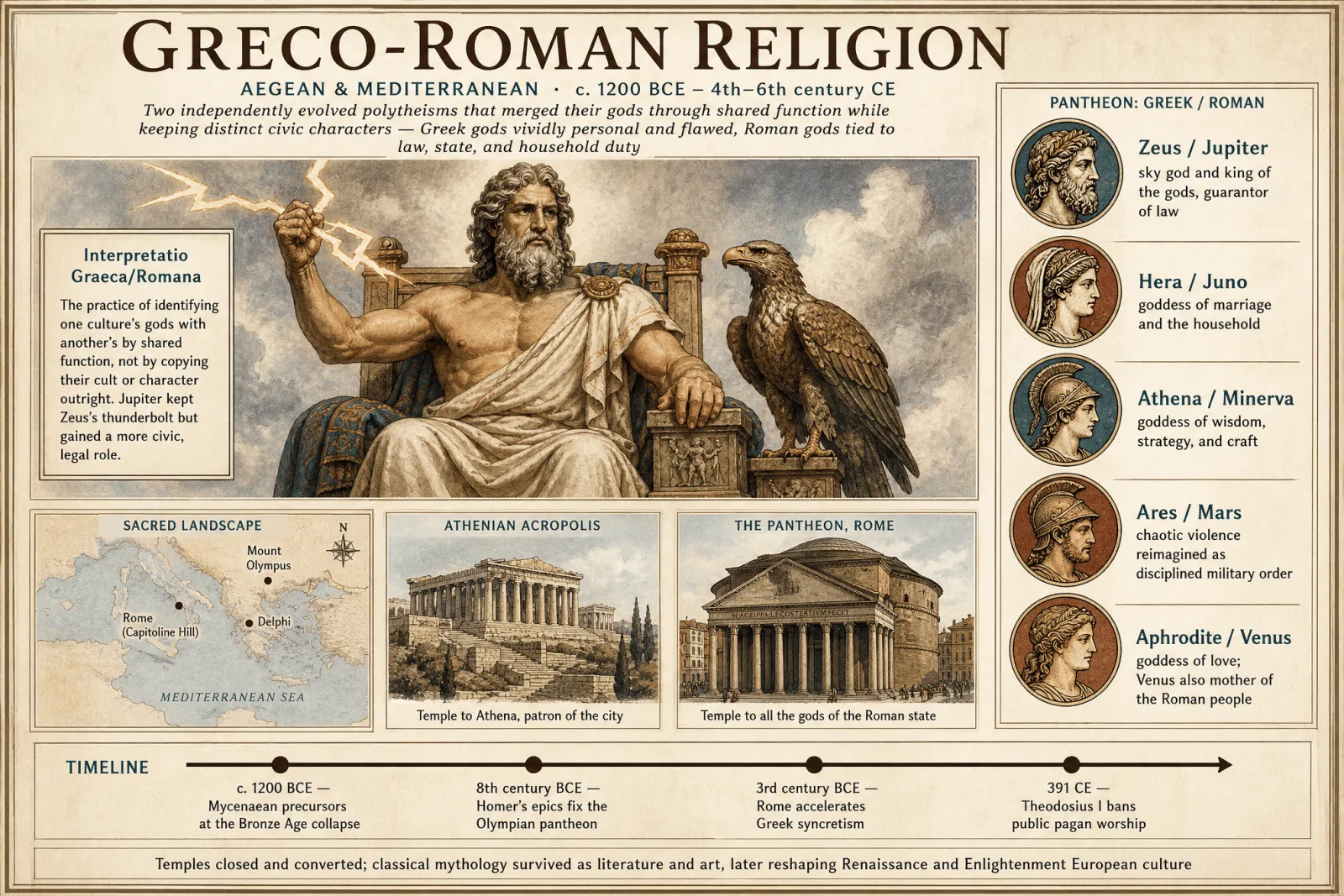
Overview
Greco-Roman Religion encompasses the polytheistic civic and religious traditions of ancient Greece and Rome, practiced from the Archaic Greek period (circa 800 BCE) through the late Roman Empire until the Christianization of the Mediterranean world (fourth–sixth centuries CE). While Greek and Roman religions shared fundamental structures—polytheistic pantheons, animal sacrifice, temple cult, divination, and the integration of religion with civic identity—they were distinct traditions that converged through Rome's conquest and assimilation of Greek culture. This article examines both traditions, attending to their specificities while recognizing their eventual synthesis into what modern scholars designate 'Greco-Roman religion.'
Greek religion was fundamentally civic and communal, organized around the polis (city-state) as the primary religious unit. Each polis had patron deities, civic festivals, and temples funded by public resources. The Olympian gods—Zeus, Hera, Athena, Apollo, Artemis, Poseidon, Aphrodite, Hermes, Ares, Hephaestus, Hestia, and Demeter—were anthropomorphic deities with distinct personalities, domains, and mythologies, worshipped through ritual acts (sacrifice, libation, prayer, procession) rather than creedal belief or scripture. Greek religion lacked centralized religious authority, professional priesthoods (most priests were part-time civic magistrates), or canonical texts; Homer and Hesiod provided mythological narratives, but these were literary, not scriptural.
Roman religion centered on the concept of pax deorum ('peace of the gods'), a contractual relationship between the Roman state and its deities maintained through precise ritual performance. Romans understood their success—military, political, agricultural—as dependent on divine favor secured through correct worship. The Capitoline Triad (Jupiter, Juno, Minerva) presided over the Roman state, with countless other gods governing specific functions (Vesta for the hearth, Mars for war, Ceres for agriculture). Roman religion was intensely conservative, ritual-focused, and legalistic, with state-appointed priesthoods (pontifices, augurs, flamines, Vestals) administering public cult. The imperial cult, beginning with Augustus, integrated emperor worship into this framework, linking political loyalty to religious obligation and extending Roman religious practice across the empire.
Archaic and Classical Greece: Polis Religion and Panhellenic Sanctuaries
Greek religion in the Archaic (circa 800–480 BCE) and Classical (480–323 BCE) periods was organized around the polis, with each city-state maintaining its own calendar of festivals, patron deities, and temple cults. Athens, for example, honored Athena Polias (Athena of the City) as its patron, celebrating the Panathenaia, an annual festival (and quadrennial Greater Panathenaia) involving sacrifices, athletic contests, musical competitions, and a grand procession delivering a newly woven peplos (robe) to Athena's statue in the Erechtheion on the Acropolis. The Parthenon, completed in 438 BCE, housed a colossal chryselephantine (gold and ivory) statue of Athena and symbolized Athenian imperial power and piety.
Alongside polis cults, panhellenic sanctuaries served as religious and political meeting places for all Greeks. Delphi, site of Apollo's oracle, was the most prestigious, with city-states, kings, and individuals consulting the Pythia (Apollo's priestess) on matters of war, colonization, law, and personal fortune. The oracle's ambiguous pronouncements were legendary, and Delphi functioned as a neutral sacred space where Greeks could gather despite inter-city conflicts. Olympia, sanctuary of Zeus, hosted the Olympic Games every four years beginning in 776 BCE, a sacred truce (ekecheiria) ensuring athletes' safe passage. These games combined athletic competition, religious sacrifice (hecatombs of cattle to Zeus), and political display.
Eleusis, near Athens, was the site of the Eleusinian Mysteries, initiation rites honoring Demeter and Persephone and promising initiates (mystai) a blessed afterlife. Unlike public polis cult, the Mysteries were secretive, experiential, and open to all Greek-speakers (regardless of city, status, or gender), provided they were not murderers and spoke Greek. The Mysteries emphasized individual religious experience—dramatic reenactment of Persephone's abduction and return—and were extraordinarily popular, persisting for nearly two millennia until closed by Christian emperors.
Alexander the Great's conquests (336–323 BCE) transformed Greek religion by expanding its geographic scope and introducing new religious forms. The Hellenistic period (323–31 BCE) saw the spread of Greek gods, temples, and cult practices across the Near East, Egypt, and Central Asia, often syncretizing with local deities (e.g., Serapis, a Greco-Egyptian god combining Osiris, Apis, and Greek deities). Greek became the lingua franca, and Greek religious culture was adopted by Hellenistic kingdoms (Ptolemaic Egypt, Seleucid Syria, Antigonid Macedonia).
Ruler cult emerged as a significant innovation: Hellenistic kings were honored as gods or divine benefactors (euergetai), receiving temples, priesthoods, and sacrifices. This was not monotheistic worship but an extension of Greek practices of honoring heroes and acknowledging the superhuman power of extraordinary individuals. Ruler cult honored the king's ability to provide protection, prosperity, and stability—qualities Greeks associated with divine favor. This practice influenced later Roman imperial cult, providing a precedent for emperor worship.
Roman religion during the Republic (509–27 BCE) was characterized by extreme conservatism, ritual precision, and the integration of religion with state institutions. The Capitoline Hill in Rome housed the temple of the Capitoline Triad (Jupiter Optimus Maximus, Juno Regina, Minerva), the central deities of the Roman state. Magistrates and generals offered sacrifices there before and after campaigns, and triumphal processions culminated at Jupiter's temple. The Roman Forum was the civic and religious heart of Rome, filled with temples (Saturn, Castor and Pollux, Vesta, Concordia) and altars where public rituals were performed.
Roman priesthoods were state offices: the College of Pontiffs (pontifices), led by the Pontifex Maximus, oversaw religious law and ritual; the augurs interpreted divine will through auspices (reading bird flight, thunder, lightning); the Vestal Virgins maintained the sacred fire of Vesta, goddess of the hearth, symbolizing Rome's eternal existence. Priests were not separate from civic life; they were magistrates, senators, and generals who held religious offices alongside political ones. Public religion was a civic duty, not a matter of personal belief.
The transition to Empire under Augustus (27 BCE–14 CE) integrated emperor worship into Roman religion without fundamentally altering its structure. Augustus carefully presented himself not as a god but as the restorer of traditional piety and the mediator of pax deorum. He rebuilt temples, revived archaic priesthoods, and linked his authority to divine favor. After his death, the Senate deified him, establishing the precedent of imperial apotheosis. Subsequent emperors were honored through the imperial cult: provincials worshipped the emperor's genius (divine spirit) or numen (divine power) alongside traditional gods, affirming loyalty to Rome and the emperor. The Pantheon in Rome, rebuilt by Hadrian (circa 126 CE), symbolized the inclusivity of Roman religion, a temple dedicated to 'all gods' with architectural grandeur unmatched in antiquity.
Greco-Roman religion persisted through the early Christian centuries, though increasingly contested. Constantine I (reigned 306–337 CE) legalized Christianity (Edict of Milan, 313 CE) and patronized Christian churches, but traditional cults continued. Theodosius I (reigned 379–395 CE) made Christianity the sole official religion of the empire, outlawing pagan sacrifice and closing temples. The Eleusinian Mysteries were forcibly closed around 392 CE; the Olympic Games ceased in 393 CE; and the last recorded traditional sacrifice to the Olympian gods occurred at the Acropolis in the early fifth century.
Justinian I closed the Academy of Athens in 529 CE, ending the last institutional center of pagan philosophy. By the sixth century, Greco-Roman polytheism had been eradicated as a public religion, though isolated pockets persisted in rural areas (the term 'pagan' derives from Latin paganus, 'country-dweller'). Christian apologists reframed Greco-Roman gods as demons or dismissed them as poetic fictions, and Christian emperors appropriated temples, converting them into churches or stripping them of materials. The religious transformation was not solely top-down; many Greeks and Romans voluntarily converted, finding in Christianity answers to questions of theodicy, salvation, and community that traditional polytheism did not address in the same manner.
The Olympian Pantheon and Divine-Human Relations
The Olympian gods, dwelling atop Mount Olympus, were immortal, powerful, and anthropomorphic but not omnipotent, omniscient, or morally perfect. They experienced emotions, desires, and conflicts, and their interactions with one another and with mortals were central to Greek mythology and cult. Zeus (Jupiter in Roman), king of the gods, wielded thunderbolts and governed the sky; Hera (Juno), his wife and sister, protected marriage and childbirth; Athena (Minerva), born from Zeus's head, was goddess of wisdom, warfare, and crafts; Apollo, god of prophecy, music, and healing, presided over Delphi; Artemis (Diana), his twin, governed hunting and wilderness; Poseidon (Neptune), brother of Zeus, ruled the seas; Aphrodite (Venus), goddess of love and sexuality, inspired passion; Hermes (Mercury), messenger god, conducted souls to the underworld and protected travelers and commerce; Ares (Mars), god of war, embodied violent conflict; Hephaestus (Vulcan), the smith god, crafted divine weapons; Hestia (Vesta), goddess of the hearth, represented domestic stability; and Demeter (Ceres), goddess of agriculture, ensured the harvest.
Greeks and Romans did not worship the gods out of love or fear of damnation but to secure their favor and avoid their wrath. The gods were not moral exemplars; they acted in their own interests, sometimes capriciously. Mortals maintained relationships with the gods through ritual exchange: sacrifices, offerings, and prayers in exchange for protection, fertility, victory, and prosperity. This was a contractual, do ut des ('I give so that you may give') relationship, transactional rather than covenantal in the biblical sense.
Hubris (arrogance, overstepping mortal bounds) invited divine punishment (nemesis). Mortals who claimed equality with the gods or violated sacred norms (guest-friendship, oaths, suppliants) risked destruction. Yet the gods' justice was not always evident; innocent mortals suffered, and the wicked sometimes prospered, leading to philosophical critiques of traditional theology by Plato, Aristotle, and the Stoics.
In Greek polis religion, worship was a civic act, not a private matter. Citizens participated in public festivals, sacrifices, and processions, affirming their membership in the polis and honoring the gods who protected it. The Panathenaia at Athens, the Karneia at Sparta, and the Thesmophoria (an all-Greek women's festival honoring Demeter) structured the civic calendar and reinforced social hierarchies (citizens, metics, slaves; men, women, children each had distinct roles). Exclusion from cult participation marked one as an outsider; participation was a privilege and obligation of citizenship.
Sacrifice was the central ritual act. Animal sacrifice (thysia)—typically sheep, goats, pigs, or cattle—involved killing the animal at an altar, burning portions (especially thighbones wrapped in fat) for the gods, and distributing the meat among participants in a communal feast. This ritual reinforced reciprocity with the gods and solidarity among mortals. Bloodless offerings (libations of wine, water, oil; grain, fruits, cakes) were also common. Sacrifices required correct procedure; errors could invalidate the ritual or anger the gods, necessitating repetition or expiation.
Oracles provided access to divine knowledge. The Pythia at Delphi, priestesses at Dodona (Zeus's oracle), and the oracle of Trophonius at Lebadeia were consulted on personal, political, and religious matters. Oracular responses were often ambiguous, requiring interpretation. Greeks understood the gods as communicating through signs (omens, dreams, prodigies) that required expert interpretation by seers (manteis) and diviners.
Roman religion centered on maintaining pax deorum, the 'peace of the gods,' through meticulous ritual performance. Romans believed that correct worship (cultus deorum) secured divine favor, while neglect or error (vitium, 'ritual fault') invited disaster. Rituals followed ancestral custom (mos maiorum); innovation was suspect. When prodigies (unnatural events: monstrous births, blood rain, speaking animals) occurred, Romans consulted the Senate, priestly colleges, and sometimes foreign oracles to determine proper expiation (procuratio). Restoring pax deorum might require repeating rituals, dedicating temples, performing ludi (games), or seeking foreign gods' aid.
Roman sacrifice differed subtly from Greek. The ritual began with a procession (pompa) to the altar, led by the magistrate or priest who would perform the sacrifice. The officiant covered his head with his toga (capite velato), emphasizing that Roman ritual focused on action, not seeing the divine. After libations and prayers (carmen, 'ritual formula'), the animal was killed, its organs examined (extispicium) by a haruspex (diviner) for signs of divine approval, and portions burned for the gods while meat was distributed. Public sacrifices were grand, communal events; the Senate and people participated, affirming Roman unity under divine protection.
The Capitoline Triad represented Roman state religion: Jupiter Optimus Maximus (Best and Greatest) as supreme god and protector of Rome, Juno Regina (Queen) as protector of the state and women, and Minerva as goddess of wisdom and crafts. Their temple on the Capitoline Hill was Rome's religious center. Magistrates sacrificed there on entering office, generals before campaigns, and triumphatores (victorious generals) in triumphal processions. The temple's destruction and rebuilding after fires were major political and religious crises, interpreted as requiring the restoration of pax deorum.
The Roman imperial cult developed gradually, blending Hellenistic ruler cult with Roman religious conservatism. Augustus avoided claiming divinity in Rome but accepted divine honors in the provinces, where locals were accustomed to ruler worship. The worship of Augustus's genius (divine spirit) and the goddess Roma personified loyalty to emperor and empire without declaring the living emperor a god. After death, the Senate could deify an emperor (consecratio), making him a divus (deified human). Temples, priests (sodales), and rituals were established for the divi (deified emperors), integrating them into public cult.
Provincial imperial cult centered on temples dedicated to Roma and the emperor, often combining imperial worship with local deities. The imperial cult was less about personal piety and more about political loyalty and social cohesion. Participating in imperial cult affirmed one's place in the empire's hierarchy; refusal could signal disloyalty or even treason. This created conflict with monotheistic religions: Jews received exemptions, but Christians, refusing to sacrifice to the emperor's genius, were periodically persecuted as threats to pax deorum and public order.
The imperial cult peaked in the second and third centuries CE, with emperors like Hadrian, Antoninus Pius, and the Severans actively promoting it. However, the crisis of the third century, barbarian invasions, and the rise of Christianity eroded confidence in the imperial cult's efficacy. By the fourth century, Christian emperors abandoned it, and pagan critics like Julian the Apostate (reigned 361–363 CE) could not revive it.
Literary and Ritual Texts
Greco-Roman religion lacked scripture in the biblical sense. No texts were divinely revealed, and religious authority did not depend on interpreting sacred books. Instead, religious knowledge was transmitted through myth, ritual practice, and civic tradition. Homer's *Iliad* and *Odyssey* and Hesiod's *Theogony* and *Works and Days* provided foundational mythological narratives about the gods, their origins, and their relationships with mortals, but these were literary texts, not liturgy. Greeks debated, adapted, and critiqued these narratives; poets, playwrights, and philosophers offered competing accounts.
Ritual texts—hymns, prayers, sacrificial formulae—existed but were practical guides for cult performance, not objects of exegesis. The Orphic Hymns (attributed to the mythical poet Orpheus), the Homeric Hymns (hymns to individual gods), and various cult regulations inscribed on stone preserved ritual knowledge. Roman religious texts included the libri pontificales (pontifical books, ritual manuals for priests), the Sibylline Books (oracular pronouncements consulted during crises), and the indigitamenta (lists of gods and their specific functions).
Philosophical theology, developed by Plato, Aristotle, the Stoics, and Neoplatonists, critiqued and reinterpreted traditional myths, proposing more abstract, morally elevated conceptions of divinity. These philosophies influenced educated elites but did not replace traditional cult. Even philosophers participated in public rituals, distinguishing between 'theology of the poets' (myth), 'theology of the philosophers' (metaphysics), and 'theology of the state' (civic cult). Mystery religions—Eleusinian, Dionysian, Orphic, later Mithraic and Isiac—offered initiates esoteric knowledge and rituals promising individual salvation, but these supplemented rather than replaced public religion.
Sacrifice, Libation, and Prayer
Sacrifice was the primary means of communication with the gods. Greeks distinguished between thysia (normative sacrifices shared between gods and humans) and holocausts (entirely burned offerings), with thysia being standard for Olympian gods and holocausts sometimes offered to chthonic (underworld) deities or heroes. The ritual sequence involved selecting an unblemished animal, leading it in procession to the altar, ritual slaughter (the animal's throat was cut, blood poured on the altar), dismemberment, burning portions for the gods (thighbones wrapped in fat, an arrangement explaining why gods received the lesser portions), and communal feasting on the meat.
Libations (spondai)—pouring wine, water, milk, or oil onto the ground or altar—accompanied prayers, oaths, and symposia. Bloodless offerings (cakes, fruits, grain, incense) were common, particularly for household cult. Votive offerings (statues, reliefs, dedicatory inscriptions, precious objects) were given to gods in thanks for favors or in hope of future aid, displayed in temples and sanctuaries. Prayer (euche) involved invoking the god by name and epithet, reminding the deity of past offerings, and requesting specific benefits. Greeks and Romans prayed standing with arms raised (or sometimes kneeling), unlike the Christian posture of kneeling with bowed head.
Religious festivals structured the civic year. At Athens, the Panathenaia (honoring Athena), Dionysia (honoring Dionysus, featuring dramatic competitions), Eleusinia (Demeter and Persephone), and Thesmophoria (women's festival for Demeter) marked the calendar. Roman festivals included the Saturnalia (honoring Saturn, a week of role-reversal and feasting in December), Lupercalia (fertility rites in February), and the ludi (games) honoring various gods. Festivals involved sacrifices, processions, athletic contests, theatrical performances, and communal feasting.
Processions (pompai) displayed civic order, with participants ranked by status (magistrates, priests, citizens, metics, women, children). The Panathenaic procession, immortalized on the Parthenon frieze, involved the entire Athenian community and culminated in presenting Athena's peplos and sacrificing hecatombs. Roman triumphal processions, celebrating military victories, processed through Rome to Jupiter's temple on the Capitoline, with the triumphator (general) dressed as Jupiter and riding in a chariot, displaying spoils, captives, and the army's power.
Mystery cults offered initiates (mystai) secret rituals, esoteric knowledge, and promises of a blessed afterlife, contrasting with the public, communal focus of civic religion. The Eleusinian Mysteries, the most prestigious, initiated tens of thousands over nearly two millennia. Initiates underwent preliminary purification, fasted, drank the kykeon (a ritual beverage), and participated in nocturnal rites in the Telesterion (initiation hall) at Eleusis. What occurred inside was never revealed (violators faced death), but initiates experienced something—a vision, a revelation—that transformed their understanding of death and the afterlife. The Mysteries emphasized experience (dromena, 'things done') and vision (deiknymena, 'things shown') over doctrine.
Dionysian mysteries celebrated the god of wine, ecstasy, and transformation, involving orgiastic rites (ritual madness, music, dance, wine consumption) that transgressed normal social boundaries. Orphism, attributed to Orpheus, emphasized purification, asceticism, and reincarnation, teaching that the soul was divine but trapped in the body, and that through proper ritual and ethical living, one could escape the cycle of reincarnation and achieve union with the divine. These cults coexisted with public religion; one could be an initiate and still participate fully in civic cult.
Greeks and Romans sought divine guidance through divination. The Delphic oracle consulted Apollo through the Pythia, whose cryptic pronouncements were interpreted by priests and required careful deliberation. Other oracles included Zeus at Dodona (interpreting the rustling of oak leaves) and Trophonius at Lebadeia (a chthonic oracle involving descent into a cave). Dream incubation (sleeping in a sanctuary to receive divine dreams) was practiced at healing sanctuaries (Asclepieia).
Romans practiced augury (interpreting bird flight, thunder, and other celestial signs) and extispicy (examining sacrificed animals' entrails, especially the liver). Augurs were state officials whose approval was required for major political and military actions; unfavorable auspices could delay or cancel assemblies, elections, and campaigns. Prodigies (unnatural events) were reported to the Senate and interpreted by priests, requiring expiatory rites to restore pax deorum. This integration of divination into political life made religion inseparable from statecraft.
Regional Variation and Greek-Roman Distinctions
While Greco-Roman religion is treated as a unified tradition due to Rome's assimilation of Greek gods and myths (interpretatio romana, identifying Greek and Roman gods: Zeus=Jupiter, Hera=Juno, etc.), significant differences persisted. Greek religion emphasized mythological narrative, philosophical theology, and the individual polis's autonomy in cult; Roman religion emphasized ritual precision, legal formalism, and the centralization of cult under state control. Greek priests were often part-time civic officials; Roman priesthoods were permanent, prestigious positions held by elite families.
Regional variation within the Greek world was substantial: Sparta's militaristic cult of Artemis Orthia, Athenian democracy's integration with Athena's cult, and the distinct pantheons of Greek colonies in Sicily, Italy, and Asia Minor. Rome's empire spread Roman cults (the Capitoline Triad, Vesta, the imperial cult) across Europe, North Africa, and the Near East, but local gods were not suppressed. Instead, Romans identified local deities with Roman equivalents (interpretatio romana), allowing continuity of indigenous cult under Roman names. This religious inclusivity facilitated imperial cohesion but also allowed diverse practices to persist.
The mystery cults—Eleusinian, Dionysian, Orphic, Mithraic (a Roman-era mystery cult for soldiers), and Isiac (worship of the Egyptian Isis, enormously popular in the Roman Empire)—represented a different mode of religiosity: personal, initiatory, and focused on salvation and afterlife, contrasting with the communal, civic focus of public cult. These coexisted without conflict; individuals participated in both.
Greco-Roman Religion as a Historical Tradition
Greco-Roman religion is a historical tradition, no longer practiced in its original form. The Christianization of the Roman Empire and the closure of temples, oracles, and schools of philosophy ended public polytheistic cult by the sixth century CE. Modern engagement is scholarly and neopagan. Hellenismos and Religio Romana are contemporary reconstructionist movements attempting to revive ancient practices, though these are modern creations without historical continuity, practiced by small communities primarily in Greece, Italy, and the United States.
Academic study of Greco-Roman religion is robust, with major centers at Cambridge, Oxford, Harvard, and universities across Europe. Key scholarly works include Walter Burkert's *Greek Religion* (Harvard University Press, 1985), Mary Beard, John North, and Simon Price's *Religions of Rome* (Cambridge, 1998), and ongoing research on ritual, iconography, epigraphy, and archaeology. Digital resources, including the Thesaurus Linguae Graecae (TLG) and corpora of Greek and Latin inscriptions, make primary sources accessible.
Popular culture's engagement with Greco-Roman religion often emphasizes mythology (gods as characters in narratives) over cult (gods as recipients of worship). Scholarly work corrects this imbalance, emphasizing that ancient Greeks and Romans did not primarily 'believe in myths' but performed rituals, and that understanding their religion requires reconstructing practices, not merely reading literature.
Sacred Geography of Greece and Rome
Athens Acropolis and Parthenon: The Acropolis ('high city') of Athens was the sacred and symbolic center of the polis, crowned by the Parthenon (completed 438 BCE), the temple of Athena Parthenos (Athena the Virgin). The Parthenon housed a colossal chryselephantine statue of Athena by Phidias and served as the treasury of the Delian League. The Erechtheion, another temple on the Acropolis, housed the ancient wooden cult statue of Athena Polias and marked the site of the contest between Athena and Poseidon for Athens's patronage. The Propylaia (monumental gateway) and the Temple of Athena Nike completed the Acropolis's sacred ensemble, making it the architectural and religious pinnacle of Classical Greece.
Delphi: Located on the slopes of Mount Parnassus in central Greece, Delphi was the site of Apollo's oracle, the Pythia, and the omphalos (navel stone) marking the center of the world. The sanctuary included the Temple of Apollo, the theater, the stadium (for the Pythian Games), and treasuries built by city-states to house offerings. Delphi's oracle was consulted on colonization, warfare, law, and personal matters, and its pronouncements influenced Greek politics for centuries. The sanctuary's wealth, derived from dedications and consultation fees, made it a major cultural and political center.
Olympia: The sanctuary of Olympia, in the Peloponnese, was dedicated to Zeus and hosted the Olympic Games every four years from 776 BCE to 393 CE. The Temple of Zeus housed Phidias's colossal statue of Zeus, one of the Seven Wonders of the Ancient World. The sanctuary included the Heraion (Temple of Hera), the stadium, the gymnasium, and treasuries. The Olympic Games were a panhellenic religious festival; athletes competed in honor of Zeus, and hecatombs (sacrifices of a hundred cattle) were offered. A sacred truce (ekecheiria) allowed safe passage for participants, temporarily suspending warfare.
Eleusis: Located near Athens, Eleusis was the site of the Eleusinian Mysteries, the most important initiation rites in the Greek world. The Telesterion (initiation hall) accommodated thousands of initiates, who witnessed secret rites promising a blessed afterlife. The sanctuary was connected to Athens by the Sacred Way, along which initiates processed during the Greater Mysteries in autumn. Eleusis's religious prestige lasted nearly two millennia, until forcibly closed by Christian emperors around 392 CE.
Rome: Capitoline Hill, Forum, and Pantheon: The Capitoline Hill was Rome's religious center, site of the Temple of Jupiter Optimus Maximus (dedicated 509 BCE, repeatedly rebuilt after fires), home to the Capitoline Triad. Magistrates sacrificed there, and triumphal processions culminated at Jupiter's temple. The Roman Forum, the civic heart of Rome, housed temples to Saturn, Castor and Pollux, Vesta (tended by the Vestal Virgins), and Concordia, along with the Regia (residence of the Pontifex Maximus) and the sacred fig tree, olive, and vine. The Pantheon (rebuilt by Hadrian circa 126 CE) was dedicated to 'all gods,' its dome symbolizing the heavens and its oculus allowing light (and rain) to enter, linking the earthly temple to the divine realm above.
Contemporary Scholarly Debates
The interpretation of the Parthenon frieze remains contested. Traditional scholarship identified it as depicting the Panathenaic procession, but Joan Connelly proposed it represents a mythical human sacrifice. Others, like Burkhard Fehr, argue it depicts Athenian democratic ideals and the interdependence of oikos (household) and polis. Recent work applies spatial analysis (Divinespace vs. Mortalspace) to understand how divine and mortal realms interact in ritual art. The debate reflects broader questions about how Greeks represented religious experience in art.
The nature of mystery cults and their relationship to 'salvation' is debated. Early Christian-influenced scholarship portrayed mysteries as proto-Christian salvation religions, with dying-and-rising gods offering individual redemption. Walter Burkert refuted this, arguing that Greek mysteries focused on ritual experience and initiated status, not doctrinal soteriology. Recent work examines the semantic range of soteria (salvation, safety, prosperity) in Greek contexts, finding it rarely meant eschatological salvation in the Christian sense. The debate concerns how modern scholars project later theological categories onto ancient practices.
The extent to which Greek and Roman religions were distinct or unified is contested. Some scholars emphasize interpretatio romana (identifying Greek and Roman gods) and cultural fusion, treating 'Greco-Roman religion' as a coherent system. Others stress differences: Greek polytheism's philosophical engagement vs. Roman ritualism's legalism, Greek polis autonomy vs. Roman imperial centralization, Greek mythological creativity vs. Roman conservative antiquarianism. The debate affects how scholars periodize, categorize, and interpret ancient Mediterranean religion.
The reasons for Christianization's success are debated. Some scholars emphasize Christianity's superior soteriology, community structure, and moral clarity. Others point to imperial patronage, economic incentives (bishops controlled resources), and social networks. Still others note internal critiques of polytheism by pagan philosophers (Neoplatonists) and the failures of pax deorum (disasters, invasions, plagues) that eroded confidence in traditional gods. The debate intersects with broader questions about religious change, coercion vs. conversion, and the agency of historical actors.
Key Terms
- Polis
- Greek city-state, the primary unit of political and religious organization.
- Pax deorum
- 'Peace of the gods,' the harmonious relationship between Rome and its deities maintained through correct ritual.
- Thysia
- Greek animal sacrifice, involving killing, burning portions for gods, and communal feasting.
- Libation (spondai)
- Ritual pouring of liquid (wine, water, oil) as an offering.
- Pompa
- Procession, a central element of Greek and Roman festivals.
- Augury
- Roman divination by interpreting bird flight and celestial signs.
- Extispicy
- Divination by examining sacrificed animals' entrails.
- Mystai
- Initiates into mystery cults, particularly the Eleusinian Mysteries.
- Imperial cult
- Worship of the Roman emperor's genius or of deified emperors (divi).
- Interpretatio romana
- Roman practice of identifying foreign gods with Roman equivalents.
- Capitoline Triad
- Jupiter, Juno, and Minerva, the central deities of Roman state religion.
- Olympian gods
- The twelve major Greek gods dwelling on Mount Olympus.
- Hubris
- Arrogant overstepping of mortal bounds, inviting divine punishment (nemesis).
- Pythia
- Apollo's priestess at Delphi, who delivered oracular pronouncements.
Further Reading
- Walter Burkert, Greek Religion (Harvard University Press, 1985)
- Julia L. Shear, Serving Athena: The Festival of the Panathenaia (Cambridge University Press, 2021)
- Michael Scott, Delphi and Olympia: The Spatial Politics of Panhellenism (Cambridge University Press, 2010)
- Ivaylo Lozanov, 'Mystery Cults' in Personal Religion in the Ancient Greek World (Cambridge University Press, 2025)
- Mary Beard, John North, and Simon Price, Religions of Rome (Cambridge University Press, 1998)
- Wiley Encyclopedia of Ancient History: 'Pax Deorum'
- Oxford DPhil Thesis: Divine Justification: Flavian Imperial Cult (2011)
- H. Renberg, 'Salvation, Soteria, and Ancient Mystery Cults' (Eleusinian Mysteries Project, 2025)
- John Scheid, The Gods, the State, and the Individual (University of Pennsylvania Press, 2016)
- Simon Price, Rituals and Power: The Roman Imperial Cult in Asia Minor (Cambridge University Press, 1984)
Practices
- Sacrifice
- Oracles
- Mystery rites (Eleusis)
- Public festivals
Core ideas
- Afterlife
- Hades for most; Elysium for heroes
- Sin
- Hubris provoking divine retribution (nemesis)
Sacred texts
Homer's epic poems, composed orally around the eighth century BCE and foundational to Greek identity. The Iliad recounts the wrath of Achilles during the Trojan War; the Odyssey follows Odysseus's long voyage home. Both portray the gods as active participants in human affairs, rewarding honor and punishing hubris.
Hesiod's poem tracing the genealogy of the Greek gods from Chaos through the reign of Zeus. It explains the succession of divine rulers and the origins of natural forces and human woes. Greeks treated it as a canonical account of how the cosmos and Olympian order came to be.
Virgil's Roman epic linking the Trojan hero Aeneas to the founding of Rome and the Julian dynasty. It blends Greek myth with Roman piety, portraying destiny (fatum) as guided by Jupiter and fate. The poem became the literary scripture of Roman civic religion and imperial ideology.