Overview
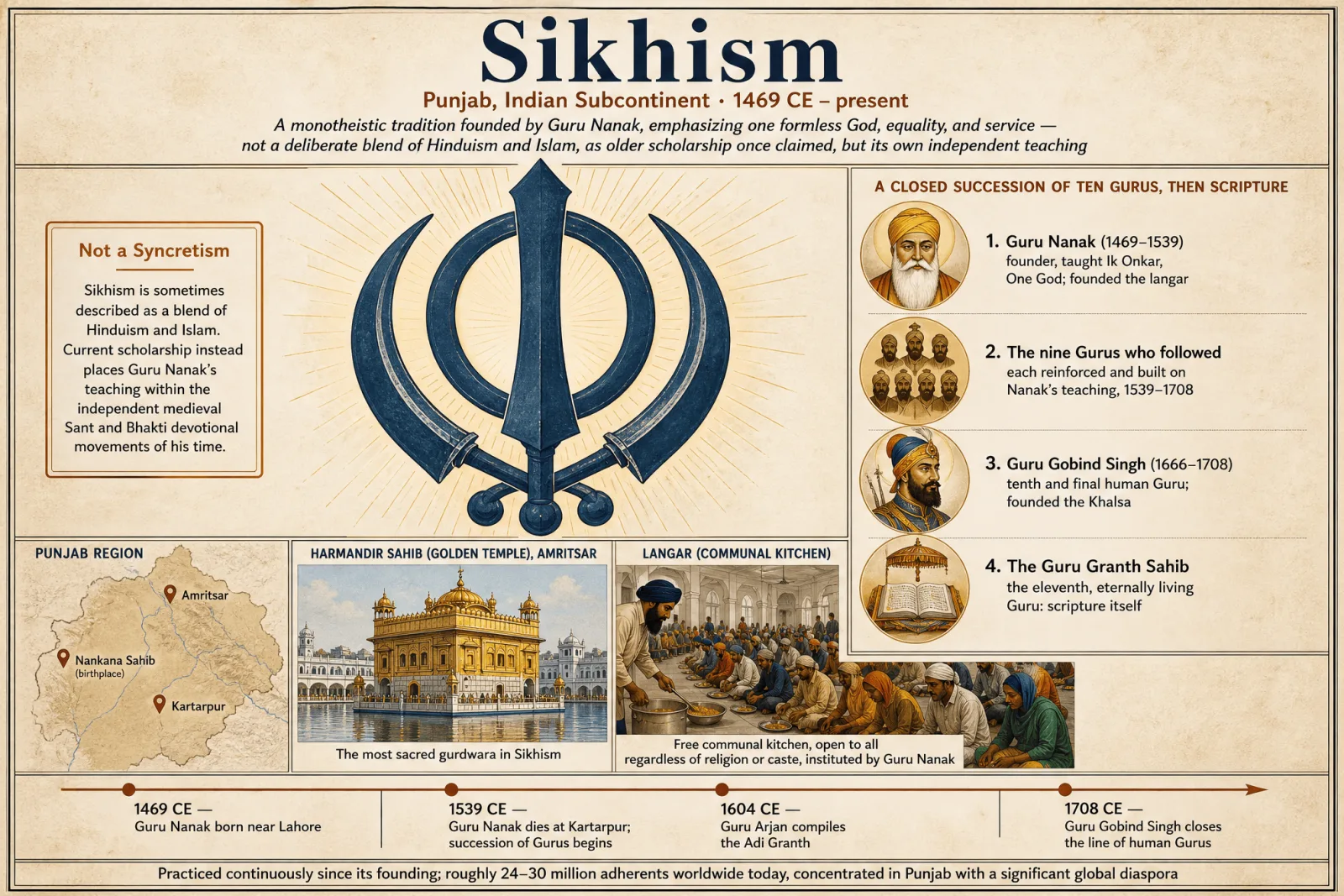
Sikhism (Sikhi) is a monotheistic tradition that emerged in the Punjab region of South Asia in the late fifteenth century. Founded by Guru Nanak (1469–1539), Sikhism centers on devotion to the one formless divine (Waheguru) and rejects ritualism, caste hierarchy, and ascetic withdrawal in favor of ethical householder life, selfless service, and spiritual discipline through meditation on the divine Name (Nam Simaran). The tradition's spiritual authority passed through a succession of nine human Gurus after Nanak, culminating in Guru Gobind Singh (1666–1708), who declared the Guru Granth Sahib—the Sikh scripture—to be the eternal Guru. Sikhs constitute approximately 25–29 million people globally as of the 2010s–2020s, with the vast majority residing in the Indian state of Punjab. The initiated Sikh order, the Khalsa, was established by Guru Gobind Singh in 1699 and is defined by the Sikh Rahit Maryada (code of conduct), the Five Ks (physical markers including uncut hair, a comb, a steel bracelet, a sword, and a particular undergarment), and a commitment to justice, courage, and spiritual egalitarianism.
Sikh philosophy, often termed gurmat (the Guru's teaching), is a dynamic, evolving assemblage that emphasizes contemplative reflection (Gurbani Vichar) and meditative practice rather than static doctrine. Sikhism arose in a context of intense religious and political contestation between Islamic and Hindu polities and articulated a distinct path that critiqued both external religiosity and social inequality. Over the course of the seventeenth and eighteenth centuries, the Sikh Panth (community) underwent a transformation from a devotional movement to a political and military force, establishing sovereign rule in Punjab under Maharaja Ranjit Singh (1799–1839) before falling under British colonial control. The colonial period saw the reformulation of Sikh identity through institutions like the Shiromani Gurdwara Parbandhak Committee (SGPC) and the codification of practices. The 1947 partition of India profoundly affected the Sikh community, dividing the Punjab and leading to large-scale displacement and violence. Post-independence India witnessed political movements for a Punjabi-speaking state, achieved in 1966, and later, during the 1980s, demands for greater autonomy and controversies over Sikh identity that culminated in violent conflict, including the 1984 assault on the Golden Temple and subsequent anti-Sikh violence.
Today, Sikhism has a significant global diaspora in the United Kingdom, Canada, the United States, and elsewhere, with diasporic communities often playing influential roles in shaping contemporary Sikh discourse and identity. Gurdwaras serve as worship halls where kirtan (devotional singing of hymns from the Guru Granth Sahib) and scripture reading continue daily, alongside the langar (communal kitchen) that feeds all visitors free vegetarian meals as an expression of equality and service. Sikhs participate actively in civic life, humanitarian relief, and interfaith cooperation, carrying forward a tradition that blends monotheistic devotion, ethical activism, and communal solidarity across generations of a global diaspora.
Historical Development
The founder of Sikhism, Guru Nanak, was born in 1469 CE in the village of Talwandi (now Nankana Sahib, Pakistan) in the Punjab region. According to Sikh tradition, Nanak experienced a revelation around 1499 in which he was taken into the divine presence and commanded to preach a new spiritual path. His teachings emphasized devotion to one formless God (Waheguru), the equality of all human beings irrespective of caste or gender, and the importance of honest labor, sharing with others, and meditation on the divine Name. Nanak undertook extensive travels across South Asia and possibly beyond, engaging with a variety of religious traditions—Hindu, Muslim, yogic, and others—and composing hymns that critiqued external ritual, caste discrimination, and religious hypocrisy.
Nanak established a community of followers (Sikhs, meaning learners or disciples) and instituted practices such as congregational worship in a dharamsala (later known as a gurdwara), singing of devotional hymns (kirtan), and the communal meal (langar), which emphasized equality by seating people of all backgrounds together. Before his death in 1539, Guru Nanak appointed a successor, Bhai Lehna, who became Guru Angad. This succession of human Gurus continued through ten leaders. Each Guru contributed to the expansion and institutionalization of the Sikh Panth. Guru Angad (1539–52) developed the Gurmukhi script to record Punjabi vernacular, making Sikh teachings more accessible. Guru Amar Das (1552–74) further developed the institution of the langar and established administrative structures (manjis) to organize the growing community. Guru Ram Das (1574–81) founded the city of Ramdaspur (later Amritsar) and began construction of a sacred pool (sarovar), the precursor to the Golden Temple complex. Guru Arjan (1581–1606) compiled the first canonical recension of Sikh scripture, the Adi Granth, in 1604, and completed the Harmandir Sahib (Golden Temple). His martyrdom in 1606 at the hands of Mughal authorities marked a turning point, as it galvanized the community and initiated a process of militarization.
The sixth Guru, Hargobind (1606–44), assumed both spiritual (piri) and temporal (miri) authority, wearing two swords to symbolize this dual sovereignty. He organized a small armed force and built the Akal Takht (Throne of the Timeless One) facing the Harmandir Sahib as a seat of temporal authority. Subsequent Gurus—Har Rai (1644–61), Har Krishan (1661–64), and Tegh Bahadur (1664–75)—navigated Mughal politics with varying strategies. Guru Tegh Bahadur was executed by the Mughal emperor Aurangzeb in 1675, an event commemorated as a supreme sacrifice for religious freedom. His son, Guru Gobind Singh (1675–1708), the tenth and final human Guru, transformed the Sikh community by establishing the Khalsa in 1699. At Anandpur Sahib, he called for five volunteers willing to sacrifice themselves, and these Panj Pyare (Five Beloved Ones) became the first initiates of a reconstituted, casteless order of saint-soldiers. Khalsa members adopted the surname Singh (lion) or Kaur (princess) and agreed to maintain the Five Ks. Guru Gobind Singh also completed the Sikh canon by adding the hymns of Guru Tegh Bahadur to the Adi Granth and, according to tradition, declared that after his death, spiritual authority would reside in the scripture (Guru Granth Sahib) and temporal authority in the community (Guru Panth).
Following Guru Gobind Singh's death in 1708, the Sikh Panth entered a period of severe persecution under late Mughal and Afghan rule. Despite this, the Khalsa emerged as a formidable military force during the eighteenth century. Banda Singh Bahadur briefly established Sikh rule in parts of Punjab (1710–15) before his capture and execution. Later, Sikh warriors organized into confederacies (misls) and gradually gained control over much of Punjab. In 1799, Maharaja Ranjit Singh consolidated these factions into the Sikh Empire, which at its height controlled Punjab, Kashmir, and parts of the North-West Frontier. His reign (1799–1839) is remembered as a golden age of Sikh political power and cultural flourishing. After Ranjit Singh's death, internal strife weakened the empire, and the British annexed Punjab following the Anglo-Sikh Wars (1845–49).
Under British colonial rule, Sikh institutions and identity underwent significant reconfiguration. The British recruited Sikhs into the colonial army and developed stereotypes of Sikhs as a 'martial race.' In the early twentieth century, reform movements such as the Singh Sabha sought to define a distinct Sikh identity, often in opposition to Hindu and Muslim influences. The Gurdwara Reform Movement of the 1920s wrested control of major gurdwaras from hereditary mahants and led to the establishment of the SGPC in 1925 to manage Sikh religious affairs. The 1947 partition of India and Pakistan divided Punjab, causing immense suffering; millions of Sikhs were displaced, and many perished in communal violence. Post-independence, the Akali Dal, a Sikh political party, campaigned for a Punjabi-speaking state, achieved in 1966 when Punjab was reorganized on linguistic grounds. The 1980s saw intense conflict over Sikh autonomy and identity, culminating in Operation Blue Star (the Indian army's assault on the Golden Temple in June 1984) and the assassination of Prime Minister Indira Gandhi by her Sikh bodyguards, followed by organized anti-Sikh pogroms. These events left deep scars on the community and continue to shape Sikh political consciousness and diaspora activism.
Core Worldview and Doctrines
Sikh theology is grounded in the belief in one supreme, formless, timeless, and ineffable reality, referred to as Waheguru (Wonderful Lord), Ik Onkar (One Universal Creator), or simply Akal Purakh (Timeless Being). God is both immanent and transcendent, present throughout creation yet beyond comprehension. The opening phrase of the Guru Granth Sahib, the Mool Mantar (Root Formula), encapsulates Sikh theology: 'Ik Onkar, Satnam, Karta Purakh, Nirbhau, Nirvair, Akal Murat, Ajuni, Saibhang, Gur Prasad' (One Universal Creator, True Name, Creative Being, Without Fear, Without Enmity, Timeless Form, Unborn, Self-Existent, Realized by the Guru's Grace). This affirmation emphasizes divine unity, truthfulness, creativity, fearlessness, non-enmity, immortality, and the necessity of grace for spiritual realization.
Sikhs reject polytheism, idol atry, and anthropomorphic conceptions of God. The divine is not incarnated but is experienced through the cosmos and through the enlightened consciousness of the Guru. Human beings, in the Sikh view, are separated from God by the veil of ego (haumai) and attachment to worldly illusions (maya). This separation results in the cycle of birth and death (samsara). Liberation (mukti or jivan-mukti, liberation while living) is achieved not through renunciation or asceticism but through disciplined devotion, ethical living, and meditation on the divine Name (Nam Simaran or Nam Japna). The path to liberation involves recognizing the divine presence in all creation, surrendering one's ego to the divine will (hukam), and cultivating virtues such as humility, compassion, honesty, courage, and selfless service (seva).
Central to Sikh spirituality is the concept of Shabad (Word) or Gurbani (Guru's utterance). The hymns in the Guru Granth Sahib are considered the embodiment of the Guru's voice and the primary means through which the divine is made manifest. Listening to, reciting, and contemplating Gurbani constitutes the core of Sikh spiritual practice. The Guru Granth Sahib itself is treated as a living Guru, installed on a throne in gurdwaras, and accorded reverence as the eternal guide for the community.
Sikh ethics emphasize the equality of all human beings. The Gurus explicitly rejected the caste system, which was deeply entrenched in South Asian society, and affirmed the dignity of every person regardless of birth, occupation, or gender. The institution of the langar—where all sit together on the floor and share a simple vegetarian meal—physically enacts this egalitarian principle. Gender equality is also affirmed in Sikh teachings, although patriarchal practices persist in many Sikh communities. Sikhism values the life of a householder engaged in honest labor (kirat karo), sharing one's earnings with those in need (vand chhako), and meditating on God's Name (nam japo)—often summarized as the three pillars of Sikh life. Sikhs are enjoined to stand against injustice and oppression, even at the cost of their lives. This principle of righteous struggle (dharam yudh) underpins the Khalsa ideal of the saint-soldier who balances spiritual discipline with readiness to defend the oppressed.
Sacred Texts and Canons
The primary scripture of Sikhism is the Guru Granth Sahib, also known as the Adi Granth. Compiled by the fifth Guru, Guru Arjan, in 1604, the Guru Granth Sahib contains nearly 1,430 pages and comprises approximately 3,000 hymns composed by six of the Sikh Gurus (Nanak, Angad, Amar Das, Ram Das, Arjan, and Tegh Bahadur) as well as by fifteen Hindu and Muslim saints (bhagats) and several bards (bhatts). The scripture is written primarily in a form of Punjabi, but also includes verses in Hindi, Braj, Persian, and other languages, all recorded in the Gurmukhi script. The text is organized by musical ragas (melodic frameworks) rather than by author or theme, reflecting the tradition of singing hymns in congregational worship.
The Guru Granth Sahib is regarded as the eternal Guru of the Sikhs, embodying the spiritual authority and wisdom of the ten human Gurus. It is treated with utmost reverence: kept on a raised platform under a canopy, wrapped in silken cloth, and ceremoniously opened and closed each day in gurdwaras. Sikhs bow before the Guru Granth Sahib and seek guidance by opening it at random (vaak laina) or listening to its recitation. The text addresses profound theological themes—divine unity, the nature of God, the human condition, ethical conduct, and the path to liberation—through poetic and devotional language. It emphasizes personal experience of the divine, ethical living, and the rejection of ritualism and caste.
In addition to the Guru Granth Sahib, Sikhs revere the Dasam Granth (Tenth Guru's Book), attributed primarily to Guru Gobind Singh. This text, compiled after his death, includes autobiographical narratives, mythological retellings, philosophical compositions, and martial poetry. Its exact composition and canonicity have been subjects of scholarly and community debate. Notable sections include the Jaap Sahib (a morning prayer), the Chaupai Sahib (a protection prayer), and the Zafarnama (Letter of Victory), a defiant epistle to the Mughal emperor Aurangzeb. Parts of the Dasam Granth are recited daily in Sikh liturgy and during Khalsa initiation (Amrit Sanchar), but the text as a whole does not hold the same liturgical centrality as the Guru Granth Sahib.
The Sikh community also values the Varan Bhai Gurdas, compositions by Bhai Gurdas (c. 1551–1636), a scribe and exegete whose writings are considered authoritative commentaries on Sikh teachings. His forty vaaran (ballads) elucidate Sikh theology, history, and ethics and are often recited in gurdwaras. The rahitnamas are codes of conduct attributed to the time of Guru Gobind Singh and later, prescribing the duties and prohibitions for members of the Khalsa. The Sikh Rahit Maryada, standardized and published by the SGPC in 1950, is the current authoritative guide for Sikh ritual, ethical, and social life. It covers daily prayers, gurdwara protocols, lifecycle rites (birth, marriage, death), and prohibitions (including tobacco, halal meat, and extramarital relations).
Practices and Observances
Sikh religious life centers on the gurdwara (literally, 'door to the Guru'), a place of worship open to people of all backgrounds. The central feature of a gurdwara is the presence of the Guru Granth Sahib, installed in the main hall (darbar hall) on a raised platform under a canopy. Services consist primarily of kirtan (devotional singing of hymns from the Guru Granth Sahib), accompanied by musical instruments such as the harmonium and tabla, and ardas (a formal communal prayer). After the service, karah prasad—a sweet pudding made of flour, sugar, and ghee—is distributed to all present as a symbol of divine grace and equality. Every gurdwara has a langar, a communal kitchen and dining hall where free vegetarian meals are served to all visitors regardless of religion, caste, or social status. Preparing and serving langar is considered an act of seva (selfless service), a core Sikh value.
Individual daily practice (nitnem) for observant Sikhs includes reciting prescribed prayers from the Guru Granth Sahib and the Dasam Granth. The morning prayers include Japji Sahib (composed by Guru Nanak), Jaap Sahib, and Tav-Prasad Savaiye. Evening prayers include Rehras Sahib, and the bedtime prayer is Kirtan Sohila. Devout Sikhs also engage in Nam Simaran or Nam Japna—meditative repetition or contemplation of the divine Name—throughout the day. Meditation is often practiced in the early morning hours (amrit vela), considered the most spiritually potent time.
Khalsa initiation, known as Amrit Sanchar or Khande di Pahul, is the ceremony through which a Sikh formally joins the Khalsa order. The ritual involves drinking amrit (sweetened water stirred with a double-edged sword, the khanda) prepared by five initiated Sikhs representing the Panj Pyare. Initiates vow to uphold the Khalsa code of conduct, including maintaining the Five Ks: kesh (uncut hair), kangha (a wooden comb), kara (a steel bracelet), kirpan (a ceremonial sword or dagger), and kachera (a specific undergarment). The Five Ks serve as visible markers of Sikh identity and commitment. Initiated Sikhs also adopt the surnames Singh (for men) or Kaur (for women), signifying their entry into a casteless spiritual brotherhood and sisterhood.
Sikh lifecycle rituals include the Naam Karan (naming ceremony), in which a baby's name is chosen by opening the Guru Granth Sahib at random and selecting a name beginning with the first letter of the first word on the page. Sikh weddings (Anand Karaj) are conducted in the presence of the Guru Granth Sahib, and the couple circumambulates the scripture four times while the Lavan (wedding hymns composed by Guru Ram Das) are sung. Death rites involve cremation, with prayers and hymns recited to console the bereaved and celebrate the soul's return to the divine. Major Sikh festivals include Vaisakhi (Baisakhi), celebrated in April, which commemorates the founding of the Khalsa in 1699 and also marks the Punjabi New Year and harvest season. Gurpurabs are anniversaries associated with the Gurus, such as the birth of Guru Nanak and the martyrdom of Guru Arjan and Guru Tegh Bahadur. Diwali holds special significance for Sikhs as it coincides with the return of Guru Hargobind from imprisonment. Hola Mohalla, initiated by Guru Gobind Singh, is a spring festival featuring martial arts displays and mock battles, celebrated at Anandpur Sahib.
Internal Diversity: Schools and Variations
While Sikhism emphasizes a unified vision centered on the Guru Granth Sahib and the Khalsa ideal, the Sikh community (Panth) is internally diverse in practice, interpretation, and identity. A fundamental distinction exists between Khalsa Sikhs (Amritdharis, those who have undergone Amrit initiation) and Sahajdhari Sikhs (slow adopters, those who follow Sikh teachings but have not taken Amrit or maintained the Khalsa markers). Historically, Sahajdhari Sikhs were recognized as part of the Panth, though their status and rights have been contested in recent decades, particularly regarding voting rights in gurdwara management. Keshdhari Sikhs maintain uncut hair and often wear a turban but have not formally taken Amrit. They form a large segment of the community and are culturally and religiously identified as Sikhs.
Caste remains a persistent social reality among Sikhs despite the Gurus' explicit rejection of caste hierarchy. The Jat Sikhs (traditionally agricultural communities) constitute the majority and have historically dominated religious and political institutions. Dalit Sikhs, particularly the Mazhabi and Ramdasia communities, continue to face social discrimination and have sometimes established separate gurdwaras. Sectarian movements have also emerged within Sikhism. The Udasis, founded by Sri Chand (son of Guru Nanak), are ascetics who historically managed many Sikh shrines but were marginalized during the Gurdwara Reform Movement. The Namdharis (also called Kukas) believe in a living line of Gurus beyond Guru Gobind Singh and are considered heterodox by mainstream Sikhs. The Nirankaris, who also claim a succession of living Gurus, have been a source of tension and controversy.
The Nihang Sikhs, or Akali Nihangs, are a militant order tracing their origins to Guru Gobind Singh's army. They maintain distinctive dress, including tall turbans and traditional weapons, and live a semi-nomadic, ascetic lifestyle while emphasizing martial traditions. Sant traditions, led by charismatic spiritual leaders (sants), have been influential in the modern period. These sants have sometimes challenged established religious and political authorities and drawn large followings, particularly in rural Punjab. The Sikh diaspora, especially in countries like Canada, the United Kingdom, and the United States, has developed distinctive characteristics shaped by the experience of migration, multiculturalism, and engagement with modernity. Converts to Sikhism, including the 3HO (Healthy, Happy, Holy Organization) community founded by Yogi Bhajan in the West, represent a small but visible minority. Often called 'Gora Sikhs' (white Sikhs), they practice a yogic, vegetarian, and disciplined lifestyle and have introduced Sikhism to non-Punjabi audiences.
Women's roles in Sikhism are theoretically equal, as the Gurus affirmed gender equality and women are permitted to perform all religious functions, including leading prayers and reading the Guru Granth Sahib. However, patriarchal social norms persist, and women have historically been underrepresented in religious leadership and gurdwara management. Feminist Sikh scholars and activists have worked to reclaim women's voices within the tradition and challenge practices such as sex-selective abortion, which disproportionately affects Punjabi Sikh communities.
Communities and Demographics
The Sikh population is overwhelmingly concentrated in the Punjab region, specifically the Indian state of Punjab, where Sikhs constitute a majority. Sikhs also reside in significant numbers in the neighboring states of Haryana, Himachal Pradesh, Rajasthan, Delhi, and Uttarakhand. Historically, Punjab was partitioned in 1947, and many important Sikh sites, including the birthplace of Guru Nanak (Nankana Sahib) and the Kartarpur Sahib gurdwara, are located in what is now Pakistan. Cross-border access to these sites has been a longstanding issue, though recent developments such as the Kartarpur Corridor (opened in 2019) have facilitated pilgrimage.
Outside India, the largest Sikh communities are found in the United Kingdom (estimated at over 500,000), Canada (over 770,000, with concentrations in British Columbia and Ontario), and the United States (estimated at 500,000–700,000, with significant populations in California, New York, and New Jersey). These diasporas originated primarily from Punjabi migration beginning in the late nineteenth and early twentieth centuries, with major waves following the 1947 partition and the turbulence of the 1980s. Sikhs have also settled in Australia, New Zealand, Malaysia, Singapore, Hong Kong, the Middle East, and parts of East Africa.
Sikh communal life revolves around the gurdwara, which serves not only as a place of worship but as a social, cultural, and political hub. Major gurdwaras, particularly the Golden Temple (Harmandir Sahib) in Amritsar and the Akal Takht adjacent to it, serve as centers of religious authority and pilgrimage. The Akal Takht, one of five Takhts (seats of temporal authority), issues hukamnamas (edicts) on matters of religious discipline, community conduct, and occasionally political issues. The other Takhts are Takht Sri Keshgarh Sahib at Anandpur Sahib (birthplace of the Khalsa), Takht Sri Patna Sahib (birthplace of Guru Gobind Singh), Takht Sri Hazur Sahib at Nanded (site of Guru Gobind Singh's death), and Takht Damdama Sahib (associated with the final compilation of the Guru Granth Sahib by Guru Gobind Singh).
The Shiromani Gurdwara Parbandhak Committee (SGPC), established in 1925, is the primary organization managing gurdwaras in Punjab, Haryana, and Himachal Pradesh. The SGPC is elected by Sikh voters and wields significant religious and political influence. Diaspora Sikh communities have established their own gurdwaras and organizations, often replicating the social and religious structures of Punjab while adapting to local contexts. Sikh advocacy organizations in the diaspora, such as the World Sikh Organization (Canada), the Sikh Coalition (United States), and various UK-based groups, have been active in issues ranging from religious freedom and discrimination to human rights and political autonomy. The Sikh tradition of seva extends beyond the community; during natural disasters, conflicts, and public health crises, Sikh organizations and individuals have provided food, medical aid, and relief services globally, often through initiatives like Khalsa Aid International. This humanitarian work is rooted in the Sikh principle of sarbat da bhala (welfare of all humanity).
Sacred Places and Pilgrimage Sites
Harmandir Sahib (Golden Temple), Amritsar, Punjab, India: The most sacred site in Sikhism, the Harmandir Sahib was established by Guru Ram Das in the late sixteenth century and completed by Guru Arjan in 1604. The gurdwara sits in the center of a sacred pool (Amrit Sarovar, from which Amritsar takes its name) and is accessible by a causeway, symbolizing the spiritual journey toward the divine. Its architecture blends Hindu, Islamic, and Sikh elements, and its four entrances signify openness to all directions and all people. The sanctum houses a copy of the Guru Granth Sahib and is adorned with gold leaf, giving the temple its popular name. The Golden Temple attracts over 100,000 visitors daily and serves as the spiritual and symbolic heart of the Sikh world. Its langar feeds tens of thousands daily, embodying the Sikh commitment to equality and service.
Akal Takht, Amritsar, Punjab, India: Directly facing the Harmandir Sahib across the pool, the Akal Takht (Throne of the Timeless One) was built by Guru Hargobind in 1606 as the seat of temporal authority, balancing the spiritual authority of the Harmandir. It is the highest seat of earthly authority in Sikhism, where the jathedar (head) issues religious edicts and addresses matters of discipline and community concern. The Akal Takht was severely damaged during the 1984 Indian military assault (Operation Blue Star) and subsequently reconstructed, becoming a symbol of Sikh resilience and controversy over state actions.
Takht Sri Keshgarh Sahib, Anandpur Sahib, Punjab, India: This is the birthplace of the Khalsa, where Guru Gobind Singh established the order in 1699. The gurdwara complex commemorates the founding event and is one of the five Takhts. Anandpur Sahib hosts the annual Hola Mohalla festival, featuring martial displays, music, and poetry, drawing hundreds of thousands of Sikhs. The site symbolizes the Khalsa ideals of courage, sacrifice, and spiritual commitment.
Takht Sri Patna Sahib, Patna, Bihar, India: Built at the birthplace of Guru Gobind Singh in Patna, this Takht is a major pilgrimage site in eastern India. It houses relics and artifacts associated with the Guru and is revered as a place where he spent his early childhood. The gurdwara's architecture is distinctive, blending Mughal and Rajput styles, and it represents the Sikh presence beyond the Punjab heartland.
Takht Sri Hazur Sahib, Nanded, Maharashtra, India: Situated on the bank of the Godavari River in Nanded, this Takht marks the site where Guru Gobind Singh passed away in 1708. It is the southernmost of the five Takhts and holds deep historical and spiritual significance as the place where the Guruship was passed to the Guru Granth Sahib. The gurdwara houses weapons and belongings of the Guru and is a focal point for Sikhs in central and southern India.
Takht Damdama Sahib, Talwandi Sabo, Punjab, India: Associated with Guru Gobind Singh's stay in the early eighteenth century, Damdama Sahib is where the Guru is said to have dictated the final version of the Guru Granth Sahib, incorporating the hymns of Guru Tegh Bahadur. It is known as the 'School of Guru Gobind Singh' and has historically been a center of Sikh learning and military training. The Takht is revered as a site of spiritual and intellectual consolidation.
Nankana Sahib, Pakistan: The birthplace of Guru Nanak, Nankana Sahib (formerly Talwandi) is one of the holiest Sikh pilgrimage sites, located in present-day Pakistan. The main gurdwara, Gurdwara Janam Asthan, was built on the site of Nanak's birth. The 1947 partition placed Nankana Sahib in Pakistan, and access for Indian Sikhs has been restricted, though periodic pilgrimage visas are issued. The site remains a powerful symbol of Sikh origins and the pain of partition.
Kartarpur Sahib, Pakistan: Located near the India-Pakistan border, Kartarpur is where Guru Nanak spent the final eighteen years of his life and established a community centered on meditation, communal worship, and shared meals. The Kartarpur Corridor, opened in 2019, allows Indian Sikhs to visit the gurdwara without a visa, marking a significant moment in Sikh-Pakistan-India relations. The site represents the founding of the Sikh Panth and Guru Nanak's vision of an egalitarian community.
Panja Sahib, Hasan Abdal, Pakistan: This gurdwara, located in the town of Hasan Abdal in the Punjab province of Pakistan, is associated with a legendary event from Guru Nanak's travels. According to tradition, Nanak placed his hand (panja) on a large boulder to stop it from rolling down a hill and harming his devotees. The boulder, bearing the impression of a hand, is enshrined in the gurdwara. Panja Sahib is a major pilgrimage site for Sikhs and a reminder of the miracle and grace associated with the Guru.
Contemporary Debates and Issues
Contemporary debates within Sikhism reflect longstanding tensions as well as new challenges posed by modernity, politics, and globalization. One persistent debate concerns Sikh identity and the boundaries of the Panth. Specifically, the status of Sahajdhari Sikhs (those who follow Sikh teachings but do not maintain the Khalsa's external markers) has been contentious. In 2003, the SGPC controversially amended its constitution to exclude non-Amritdhari (non-initiated) Sikhs from voting in gurdwara elections, sparking protests from Sahajdharis who see themselves as integral to the Panth. This debate raises fundamental questions about whether Sikhism is defined by internal belief or external practice.
The question of living authority versus scriptural authority also generates discussion. Mainstream Sikhs hold that the Guru Granth Sahib is the sole Guru after Guru Gobind Singh. However, sects like the Namdharis and Nirankaris claim a continuing line of living Gurus. Additionally, the role of charismatic sants (spiritual leaders) who command large followings and sometimes function as quasi-Gurus has been a source of debate and occasionally conflict.
The relationship between religion and politics is another fraught area. The concept of miri-piri (temporal and spiritual sovereignty) and the Khalsa's charge to defend justice have historically intertwined Sikhism with political activism. The demand for Khalistan, an independent Sikh state, gained momentum in the 1970s and 1980s, fueled by economic grievances, perceived discrimination, and communal violence. The Indian government's military assault on the Golden Temple in 1984 and the subsequent anti-Sikh violence radicalized many Sikhs. Today, Khalistan remains a politically sensitive issue, with varying degrees of support among diaspora Sikhs and more muted resonance in Punjab itself.
Gender equality is affirmed in Sikh scripture, yet patriarchal practices are widespread. Women are underrepresented in gurdwara management and religious leadership. While women are technically permitted to perform all religious roles, social norms often restrict their participation. Debates over female participation in Panj Pyare and as granthis (scripture readers) and ragis (hymn singers) continue. Caste discrimination within the Sikh community, despite the Gurus' rejection of caste, remains a major issue. Dalit Sikhs often face social exclusion, and separate gurdwaras for different caste groups exist in many areas. The canonicity and interpretation of the Dasam Granth have been subjects of scholarly and sectarian debate. Some Sikhs revere the entire text as the work of Guru Gobind Singh, while others question the authorship of certain sections. Interfaith marriage is another contentious issue, with some gurdwaras banning the Anand Karaj ceremony for interfaith couples. Finally, the relationship between Sikhism and modernity raises questions about the interpretation of scripture, the role of critical scholarship, and the adaptation of practices.
Key Terms
- Waheguru
- Wonderful Lord; a primary name for God in Sikhism, emphasizing divine majesty and ineffability.
- Ik Onkar
- One Universal Creator; the opening phrase of the Guru Granth Sahib, affirming the unity and singularity of God.
- Guru Granth Sahib
- The eternal Guru of the Sikhs; the central scripture comprising hymns by the Gurus and other saints, compiled in 1604 and granted Guruship in 1708.
- Khalsa
- The order of initiated Sikhs established by Guru Gobind Singh in 1699, characterized by discipline, the Five Ks, and commitment to justice and equality.
- Five Ks
- Kesh (uncut hair), Kangha (comb), Kara (steel bracelet), Kirpan (sword), and Kachera (undergarment); physical markers of Khalsa identity.
- Gurdwara
- A Sikh place of worship, literally 'door to the Guru,' housing the Guru Granth Sahib and serving as a community center.
- Langar
- The communal kitchen and free meal served in gurdwaras, symbolizing equality, service, and hospitality to all.
- Nam Simaran / Nam Japna
- Meditation on the divine Name; a core Sikh spiritual practice involving repetition and contemplation of God's name.
- Gurbani
- The Guru's utterance; the hymns and teachings in the Guru Granth Sahib, regarded as the embodiment of the Guru's voice.
- Hukam
- Divine will or order; the principle of surrendering to and living in accordance with God's will.
- Seva
- Selfless service; a central Sikh value involving acts of service to the community and humanity without expectation of reward.
- Sangat
- The congregation or community of Sikhs; collective worship and fellowship are central to Sikh practice.
- Miri-Piri
- Temporal and spiritual sovereignty; the dual authority symbolized by Guru Hargobind's two swords.
- Panj Pyare
- The Five Beloved Ones; the first five Sikhs initiated into the Khalsa by Guru Gobind Singh, representing courage and sacrifice.
- Amrit Sanchar
- The Khalsa initiation ceremony, involving drinking amrit (sanctified water) and vowing to uphold the Khalsa code.
- Takht
- Seat of temporal authority; there are five Takhts in Sikhism, with the Akal Takht in Amritsar being the highest.
- Sarbat da Bhala
- Welfare of all humanity; a Sikh prayer phrase expressing the ideal of universal well-being and social justice.
- Gurmukhi
- The script in which the Punjabi language is written in the Guru Granth Sahib and other Sikh texts, developed by Guru Angad.
- Dharam Yudh
- Righteous struggle or warfare; the Sikh concept of just war fought in defense of righteousness and against oppression.
- Rahit Maryada
- The Sikh code of conduct; the standardized guide for Khalsa Sikhs, covering ethics, rituals, and daily practice.
Further Reading
- Stanford Encyclopedia of Philosophy: Sikh Philosophy - Arvind-Pal S. Mandair (2026)
- Encyclopaedia Britannica: Sikhism
- The Oxford Handbook of Sikh Studies - Pashaura Singh & Louis E. Fenech, eds. (2014)
- The Sikhs of the Punjab - J.S. Grewal (1990)
- History, Literature, and Identity - J.S. Grewal (2011)
- The Making of Sikh Scripture - Gurinder Singh Mann (2001)
- The Guru Granth Sahib: Canon, Meaning and Authority - Pashaura Singh (2000)
- The Evolution of the Sikh Community - W.H. McLeod (1996)
- Sikhism - Cambridge Companion to Religion and War - Pashaura Singh (2023)
- Pew Research: Global Religious Landscape (2012)
- Pew Research: Other Religions - Sikhs (2012)
- UNESCO: Sri Harimandir Sahib (Tentative List)
Practices
- Kirtan (sacred song)
- Langar (free kitchen)
- Five Ks
- Simran (remembrance)
Core ideas
- Monotheism
- Ik Onkar — one timeless creator
- Salvation
- Union with God through Nam and seva
- Equality
- No caste, no gender hierarchy
Sacred texts
Sikhism's eternal Guru, a single volume of hymns and poetry compiled by the fifth Guru, Arjan, and finalized by the tenth Guru, Gobind Singh. It includes writings of six Sikh Gurus plus saints from Hindu and Muslim backgrounds, sung in gurdwaras worldwide. The book is treated as a living presence — enthroned, covered, and addressed directly in worship.