Overview
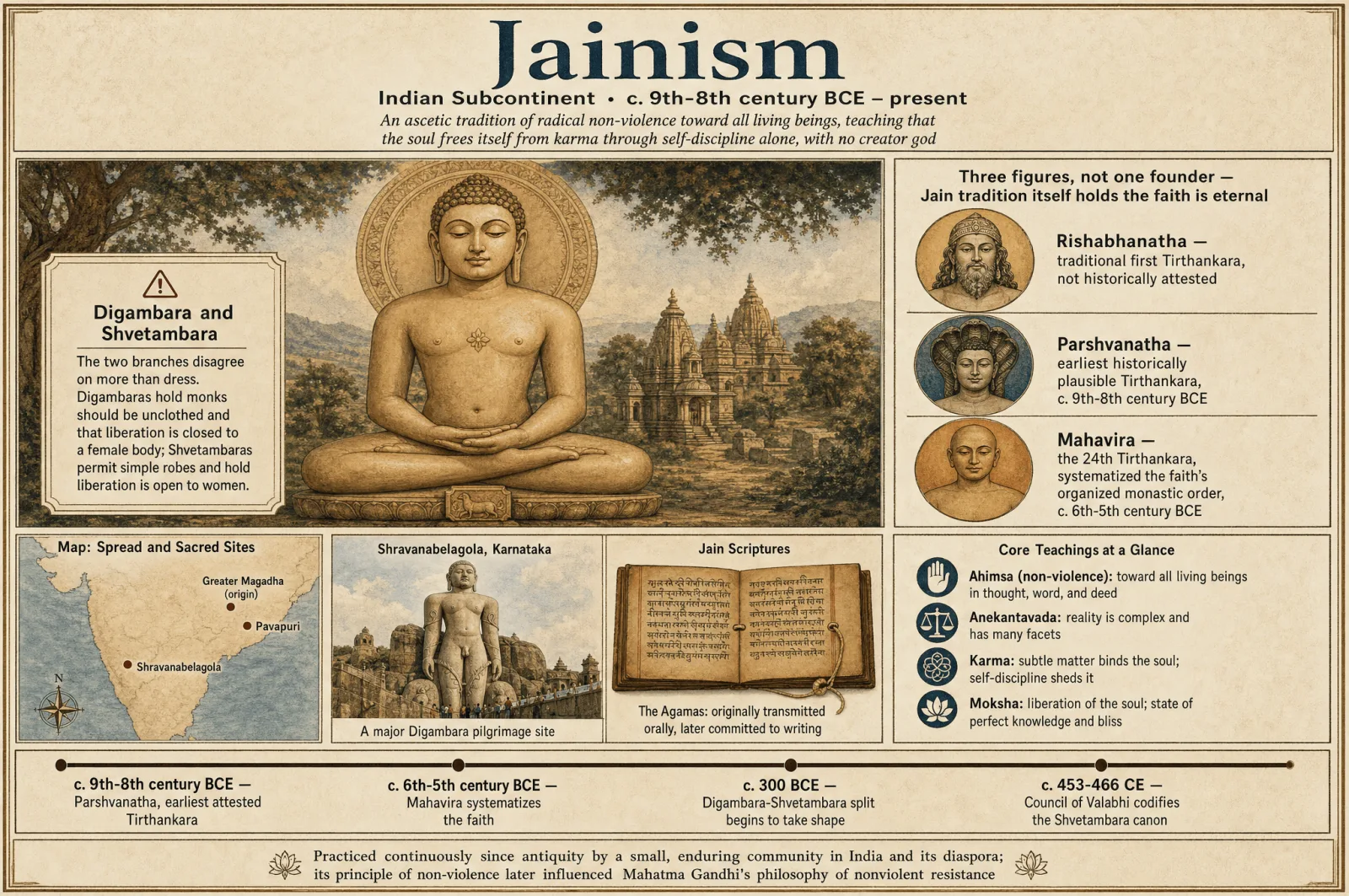
Jainism is an ancient Indian religion that emphasizes non-violence (ahimsa) toward all living beings, a rigorous path of ascetic purification, and a philosophy of epistemological and metaphysical pluralism. The tradition traces itself to twenty-four Tirthankaras ("ford-makers" who blazed the path across samsara), the most recent of whom is Mahavira (traditional dates 599–527 BCE, though scholars place him closer to 550–470 BCE), a contemporary of the Buddha in the Gangetic plain. Unlike the Vedic religion and later Hinduism, Jainism rejects the authority of the Vedas and the caste system, teaching instead that every soul (jiva) possesses infinite potential and can attain omniscience (kevala jnana) and liberation (moksha) through self-discipline, renunciation, and the destruction of karmic matter.
Jain metaphysics is dualistic and atomistic: reality consists of souls (jiva) and non-soul substances (ajiva), including matter (pudgala), space, time, and motion. Karma is understood as subtle material particles that adhere to the soul due to passions and actions, obscuring its innate qualities of infinite knowledge, perception, bliss, and energy. The goal of Jain practice is to shed karmic accumulation through the three jewels (triratna): right faith, right knowledge, and right conduct. Central to right conduct is ahimsa, which extends not only to refraining from killing but to minimizing harm in thought, word, and deed. This principle has shaped Jain ethics, diet (strict vegetarianism), occupational choices (avoiding agriculture and trades that harm living beings), and social contributions (Jains have historically been merchants, bankers, and patrons of education and art).
Jainism split into two major sects around the first centuries CE: Digambara ("sky-clad," whose monks practice nudity as a sign of total renunciation) and Shvetambara ("white-clad," whose monks wear white robes). The sects differ on scriptural canons, the status of women (Digambaras hold that women cannot attain liberation in female form; Shvetambaras affirm they can), and ritual practices, yet share core doctrines. Today there are approximately 4 to 6 million Jains, the vast majority in India (particularly Gujarat, Rajasthan, Maharashtra, Karnataka, and Madhya Pradesh), with diaspora communities in East Africa, the United Kingdom, North America, and elsewhere. Though numerically small, Jains wield significant cultural and economic influence, and their commitment to non-violence has inspired modern movements including Gandhian nonviolent resistance. Jainism remains a living tradition, adapting ancient ascetic ideals to contemporary ethical questions while preserving monastic lineages, temple rituals, and pilgrimage practices that reach back millennia.
Emerges fromHinduism ←
Historical Development
Jain tradition regards its teachings as eternal, revealed anew in each cosmic cycle by twenty-four Tirthankaras. The first Tirthankara of this cycle is Rishabhanatha (Adinatha); the twenty-third is Parshvanatha, whom scholars tentatively date to the eighth or seventh century BCE. The twenty-fourth and final Tirthankara is Mahavira ("Great Hero"), whose traditional dates (599–527 BCE) roughly coincide with the Buddha's life, though modern scholarship places both figures later (circa 550–470 BCE for Mahavira). Mahavira was born into the Kshatriya (warrior) caste in the Vajjian republic near modern Vaishali, Bihar. At age thirty, he renounced household life, spending twelve years in severe ascetic practice before attaining omniscience (kevala jnana). He then preached for thirty years, establishing a fourfold community (monks, nuns, laymen, laywomen) and codifying the principles of ahimsa, anekantavada (many-sidedness), and aparigraha (non-possession).
Early Jainism emerged alongside Buddhism as a shramana (renunciant) movement challenging Brahmanical authority, caste hierarchy, and Vedic ritual. Both rejected the ontological primacy of the Vedas and the sacrificial priesthood, emphasizing instead ethical conduct and personal realization. Jainism and Buddhism shared the Gangetic cultural milieu, but diverged in metaphysics (Jainism affirms a soul; Buddhism denies it) and ethics (Jainism's ahimsa is more absolute). By the third century BCE, Jainism had spread across northern India, receiving patronage from rulers including the Mauryan emperor Chandragupta, who according to tradition abdicated the throne, became a Jain monk, and fasted to death at Shravanabelagola in Karnataka. This early southern presence established Karnataka as a Jain heartland.
The schism between Digambara and Shvetambara sects likely crystallized in the early centuries CE, though its roots may be older. Digambara tradition attributes the split to a famine in the north that forced monks to migrate south, where they retained stricter practices (nudity, rejection of women's liberation in female form, rejection of Shvetambara scriptures). Shvetambaras, remaining in the north and west, preserved an Agamic canon codified at the Council of Valabhi (circa fifth century CE). Each sect developed its own monastic lineages (gacchas), scholastic traditions, and temple cultures. Despite sectarian differences, both affirm the core teachings of Mahavira and venerate the same Tirthankaras.
Medieval Jainism flourished under regional dynasties. The Rashtrakutas (eighth to tenth centuries) and later Hoysalas (eleventh to fourteenth centuries) patronized Jain scholars, poets, and architects in Karnataka, producing masterpieces like the monolithic Gommateshwara statue at Shravanabelagola (983 CE) and Jain literature in Kannada and Sanskrit. In Gujarat and Rajasthan, merchant communities built elaborate marble temples at Dilwara (Mount Abu, eleventh to thirteenth centuries) and Ranakpur (fifteenth century). The Solanki and Vaghela dynasties supported Jain monasticism and learning. Jain thinkers such as Haribhadra (eighth century), Hemachandra (twelfth century), and Yashovijaya (seventeenth century) engaged in philosophical debates with Hindu and Buddhist schools, contributing to Indian logic (nyaya), epistemology (pramana), and ethics.
Islamic rule (twelfth to eighteenth centuries) brought challenges: iconoclasm destroyed some Jain temples, and political instability disrupted pilgrimage routes. Yet Jain communities adapted, negotiating with Muslim rulers and continuing mercantile success. The Mughal emperor Akbar granted patronage to Jain monks and exempted Jains from animal slaughter taxes, reflecting Jain advocacy for ahimsa. British colonial rule (nineteenth to twentieth centuries) introduced Western education and legal reforms; Jains navigated colonial categories (often classified as Hindus in censuses, despite distinct identity) and participated in independence movements. Mahatma Gandhi, deeply influenced by Jain nonviolence (his mother was a devout Vaishnava with Jain leanings, and he studied with Jain monks), adapted ahimsa and satyagraha (truth-force) into political strategies. Post-independence India (1947–present) has seen Jain communities assert religious distinctiveness, campaign for vegetarianism and animal rights, and globalize through diaspora and digital platforms.
Core Worldview and Doctrines
Jain metaphysics is dualistic: the universe consists of jiva (soul, consciousness) and ajiva (non-soul, including matter, space, time, and motion). Souls are infinite in number and possess inherent qualities of infinite knowledge, perception, bliss, and energy, but these are obscured by karmic matter. Karma in Jainism is not merely moral causation but a subtle physical substance (pudgala) that adheres to the soul due to actions driven by passion (kashayas: anger, pride, delusion, greed). The soul's liberation (moksha) depends on purging all karmic particles, achieved through ascetic practice and ethical restraint. Liberated souls ascend to the summit of the universe (siddha-shila), where they exist in omniscient bliss, free from rebirth.
Jainism categorizes souls by their senses: one-sensed beings (earth, water, fire, air, plants) possess only touch; higher beings add taste, smell, sight, and mind. Humans, gods, and hell-beings are five-sensed and capable of liberation. Crucially, even plants and microbes possess souls, making absolute non-harm impossible; Jains must minimize harm through careful conduct. Jain cosmology is elaborate: the universe (loka) is shaped like a standing person, with seven hells below the middle world (where humans live), layers of heavens above, and the abode of liberated souls at the summit. Time is cyclical, divided into ascending and descending half-cycles (utsarpini and avasarpini) of millions of years; Tirthankaras appear only in specific eras.
Ahimsa (non-violence) is the cornerstone of Jain ethics, rooted in the recognition that all souls are fundamentally equal and divine. Harming others is both morally wrong and spiritually damaging, as it generates negative karma. Jains practice ahimsa through diet (strict vegetarianism, avoiding root vegetables to minimize harm to earth-bodied souls), occupation (traditionally merchants, not farmers or warriors), and behavior (filtering water, sweeping paths, limiting travel at night). Monks take five great vows (mahavratas): ahimsa, satya (truthfulness), asteya (not taking what is not given), brahmacharya (celibacy), and aparigraha (non-possession). Laypeople follow five lesser vows (anuvratas) adapted to household life, plus additional vows regulating travel, consumption, and social interaction.
Anekantavada ("many-sidedness" or "non-one-sidedness") is Jainism's distinctive epistemology, holding that reality is multifaceted and no single perspective captures the whole truth. Any proposition about an object is true only from a particular standpoint (naya). To avoid dogmatism, Jains use syadvada ("may-be-ism" or conditional predication), a seven-fold schema prefacing assertions with "in some respect" (syat): an object (1) is, (2) is not, (3) is and is not, (4) is indescribable, (5) is and is indescribable, (6) is not and is indescribable, (7) is, is not, and is indescribable. This framework promotes intellectual humility and tolerance, recognizing that diverse viewpoints may all contain partial truths.
Jain soteriology prescribes a gradual path to liberation through fourteen stages (gunasthanas) from ignorance to omniscience. Ascetics progress faster, shedding karmic matter through austerities (tapas) such as fasting, meditation, and study. The ultimate ascetic ideal is sallekhana (voluntary death by fasting), undertaken with equanimity and without passion; it is distinguished from suicide (which involves violence and generates negative karma) and regarded as the noblest end for an advanced practitioner. Liberation (moksha) is achieved when all destructive (ghatin) and non-destructive (aghatin) karmas are destroyed, and the soul, freed from the cycle of rebirth, ascends to the summit of the universe in eternal omniscient bliss. This individual focus distinguishes Jainism from theistic devotionalism; there is no creator God, no divine grace—only the soul's own effort determines its fate.
Sacred Texts and Canons
Jain scriptures, unlike the shruti (revelation) of the Vedas, are regarded as the teachings of the omniscient Tirthankaras, transmitted through the oral tradition of their disciples (ganadharas) and compiled over centuries. The Shvetambara canon (Agamas) was codified at the Council of Valabhi (circa fifth century CE) and consists of forty-five texts (though only some survive in full). Key texts include the Acharanga Sutra (rules of conduct for monks), the Sutrakritanga (doctrinal discourses), the Bhagavati Sutra (dialogues on cosmology and metaphysics), and the Kalpa Sutra (biographies of Tirthankaras and rules for monastic discipline). The Shvetambara canon is written in Ardhamagadhi Prakrit; Digambaras reject it as corrupt and incomplete, arguing that the original teachings were lost during the ancient famine.
Digambara Jains rely instead on post-canonical literature, particularly the works of Acharya Kundakunda (first to second centuries CE or fourth to fifth centuries CE, dates contested), whose Samayasara (Essence of the Self) and Pravachanasara (Essence of the Doctrine) are foundational philosophical texts emphasizing the distinction between the pure soul (nishchaya naya, transcendent perspective) and the embodied soul (vyavahara naya, conventional perspective). Other important Digambara texts include Umasvati's Tattvartha Sutra (circa second to fifth centuries CE), a systematic summary of Jain philosophy accepted by both sects, and Shatkhandagama and Kashayapahuda, extensive scholastic works on karma theory.
Both sects produced vast commentarial and philosophical literature in Sanskrit, Prakrit, and regional languages. Haribhadra Suri (eighth century), a prolific Shvetambara scholar, wrote commentaries, doxographies, and works on yoga and logic, engaging with Buddhist and Hindu philosophers. Hemachandra (1088–1172 CE), a polymath at the Solanki court in Gujarat, composed the Yogashastra (on Jain practice), a grammar, a prosody, and historical chronicles, embodying the Jain scholar-monk ideal. Yashovijaya (1624–1688 CE) synthesized Jain logic and ontology in response to Vedantic critiques. Medieval Jain authors also produced story literature (kathanakas) such as the Jain versions of the Ramayana and Mahabharata, reinterpreted through Jain ethics, and Universal Histories (Mahapuranas) narrating the lives of Tirthankaras, Chakravartins (universal emperors), and other exemplary figures.
Jain texts are preserved in manuscript libraries (bhandaras) in temples and monastic institutions, particularly in Gujarat and Rajasthan. Many manuscripts are illustrated with intricate miniatures depicting Tirthankaras, cosmological diagrams, and narrative scenes, forming an important genre of Indian art. Modern scholarship has edited and translated key Jain texts; Prakrit and Sanskrit Jain literature is studied for its linguistic, philosophical, and historical value. The Jain eLibrary and other digital projects make texts accessible globally. Unlike Vedic shruti, Jain scriptures are studied primarily by monks, nuns, and scholars; laypeople engage with the tradition through vernacular narratives, devotional hymns (stotras), and ritual manuals rather than canonical exegesis.
Practices and Observances
Jain practice centers on the three jewels (triratna): right faith (samyak darshana), right knowledge (samyak jnana), and right conduct (samyak charitra). Right faith is conviction in the teachings of the Tirthankaras and the soul's potential for liberation. Right knowledge involves understanding Jain metaphysics, cosmology, and ethics through study and reflection. Right conduct is the implementation of ahimsa and other vows in daily life. Monastics (sadhus and sadhvis) renounce possessions, home, family, and clothing (in the Digambara case) to pursue liberation through asceticism. They wander on foot (except during the four-month monsoon retreat, chaturmas), beg for food, and practice meditation, study, and penance. Lay Jains (shravaks and shravikas) support monastics, uphold lesser vows, and accumulate merit through ethical living, pilgrimage, and temple worship.
Jain temple worship (puja) involves ritual offerings to images (murtis) of Tirthankaras. Unlike Hindu puja, which seeks blessings from a deity, Jain puja venerates the Tirthankara's example of liberation; Tirthankaras are not gods who intervene in the world but enlightened teachers whose images inspire renunciation. The eight-fold puja (ashtaprakari puja) includes offerings of water, sandalwood paste, flowers, incense, lamps, rice, sweets, and fruit, accompanied by mantras and hymns. Shvetambaras may worship images adorned with jewels and clothing; Digambaras prefer plain, unadorned figures. Some Jain sects (Sthanakvasi and Terapanthi Shvetambaras) reject temple worship and images entirely, emphasizing meditation and ethical conduct over ritual.
Fasting is central to Jain asceticism and lay piety. Monks and nuns fast regularly, and laypeople observe fasts on auspicious days (particularly the fortnightly parva and the annual Paryushana festival). Fasts range from one meal a day to complete abstention from food and water (nirjala upvas) for days. Sallekhana, the practice of fasting unto death undertaken by advanced practitioners at the end of life, is regarded as the highest spiritual act, shedding karmas and demonstrating mastery over bodily attachments. It is undertaken publicly, with the community's support, and distinguished from suicide by the practitioner's equanimity and lack of passion.
Paryushana (Shvetambara) and Das Lakshana (Digambara) are the most important annual festivals, typically observed in August or September during the monsoon retreat. Paryushana lasts eight days; Das Lakshana ten. The festivals involve fasting, confession (pratikramana) of past transgressions, forgiveness rituals (asking and granting forgiveness from all beings), scriptural recitation, and meditation. The final day of Paryushana, Samvatsari, is a day of universal forgiveness (Micchami Dukkadam, "may all my transgressions be forgiven"). Mahavir Jayanti celebrates Mahavira's birth. Diwali holds special significance for Jains: it marks the attainment of nirvana by Mahavira, making it a day of reflection and lamp-lighting to symbolize the light of knowledge.
Pilgrimage (tirtha yatra) is a meritorious practice for Jains. Major pilgrimage sites (Shatrunjaya, Girnar, Shravanabelagola, Shikharji, Mount Abu) are sacred mountains or temple complexes associated with Tirthankaras' lives or monks' liberation. Pilgrims climb thousands of steps (often barefoot) to reach hilltop temples, circumambulate shrines, and perform puja. Some Jain ascetics undertake pan-Indian foot pilgrimages lasting years. Jains also practice daily meditation (dhyana), recite the Namokar Mantra (salutation to the five supreme beings: Arihants, Siddhas, Acharyas, Upadhyayas, and all monks), and read or listen to religious stories. Jain laywomen often lead household rituals and transmit traditions to children, playing a crucial role in sustaining community identity.
Internal Diversity: Schools and Sects
The fundamental division within Jainism is between Digambaras ("sky-clad") and Shvetambaras ("white-clad"), sects that diverged in the early centuries CE. Digambara monks practice complete nudity as a symbol of total renunciation and non-attachment; they reject all possessions, even clothing. Digambaras hold that women cannot attain liberation in female form and must be reborn as men; consequently, they have no female monastics (though lay women are central to the community). They reject the Shvetambara Agamic canon as corrupted and rely on later scholastic works. Their temple images are unadorned, and rituals are simpler. The Digambara tradition is strongest in Karnataka, Maharashtra, and parts of Madhya Pradesh.
Shvetambara monks and nuns wear simple white robes and carry few possessions (a staff, water pot, alms bowl, and scriptures). Shvetambaras affirm that women can attain liberation in female form; indeed, the nineteenth Tirthankara, Mallinatha, is venerated as female by Shvetambaras (Digambaras regard Mallinatha as male). Shvetambaras preserved an Agamic canon and have elaborate temple rituals. The sect is strongest in Gujarat, Rajasthan, and parts of Maharashtra. Within Shvetambara Jainism, further divisions exist: Murtipujak ("image-worshippers") Shvetambaras practice temple worship; Sthanakvasis ("hall-dwellers," emerging in the seventeenth century) reject temples and images, conducting worship in meditation halls (sthanakas); and Terapanthis ("thirteen-pointed," founded 1760 by Acharya Bhikshu) are a reform movement emphasizing strict asceticism, centralized monastic authority, and rejection of ritual laypeople.
Despite sectarian differences, both Digambaras and Shvetambaras share core doctrines: the teachings of Mahavira, the principle of ahimsa, anekantavada epistemology, and the goal of liberation through the three jewels. Inter-sect marriages are rare, and communities maintain separate temples and monastic lineages (gacchas), yet they co-exist peacefully. Scholarly and interfaith dialogues often bring Jains together across sectarian lines. In the diaspora, sectarian distinctions may blur as Jains emphasize shared identity in pluralist societies.
Modern reform movements have emerged within Jainism. The Terapanth Shvetambaras, mentioned above, are highly organized under a single Acharya and emphasize social reform, education, and global outreach. The Kanji Panth, a twentieth-century Digambara movement, emphasizes meditation and the pure soul (shuddhatma) over ritual, attracting lay followers with a simplified, inward-focused practice. Some contemporary Jain thinkers advocate for "scientific Jainism," highlighting parallels between Jain cosmology and modern physics or ecology (e.g., the doctrine of infinite particles and relativity, or ahimsa and environmentalism). Critics warn against distorting traditional teachings to conform to modern ideologies.
Diaspora Jainism in North America, the United Kingdom, and East Africa has adapted to new contexts. Jain centers in the West often serve multiple sects, promote vegetarianism and animal rights, and engage in interfaith dialogue. Organizations such as the Jain Center of Southern California, Jain Society of Toronto, and the Institute of Jainology (London) support scholarship, youth education, and global Jain identity. Digital platforms enable virtual darshan, online scriptural study, and global communication among Jains. While monastic ordinations are rarer in the diaspora, lay Jains maintain festivals, temple worship, and ethical commitments, negotiating tradition and modernity in pluralist contexts.
Communities and Demographics
Jainism is a minority religion numerically, but culturally and economically influential in India. The 2001 Indian census counted 4.2 million Jains (0.4 percent of India's population), though Jain organizations contest this as a significant undercount, arguing that many Jains were misclassified as Hindus or not counted due to their small presence in rural areas. Some Jain scholars estimate the global population at 5 to 6 million. The Pew Research Center's 2012 Global Religious Landscape report grouped Jains under "other religions" (totaling 58 million globally, including Sikhs, Bahais, Zoroastrians, and others), noting that Jainism is not measured separately in most censuses. The vast majority of Jains live in India, with fewer than 250,000 outside India according to the World Religion Database.
Within India, Jains are concentrated in western and southern states. Gujarat has the largest Jain population (nearly one million, about 1 percent of the state's population), followed by Rajasthan (650,000), Maharashtra (1.3 million), Madhya Pradesh (550,000), and Karnataka (400,000). Jains are predominantly urban and middle-to-upper class, with high literacy rates and educational attainment. Historically, Jains have been merchants, bankers, jewelers, and cloth traders, occupations compatible with ahimsa (avoiding farming, which harms soil-bodied beings, and professions involving violence). Jain business communities have wielded significant economic power, and Jain philanthropy supports education, hospitals, animal welfare (panjrapoles, shelters for old and injured animals), and cultural preservation.
Jains in India are organized into regional and caste-based communities (often called "samaj" or "sangh"), such as the Oswal, Porwal, Agarwal, and Shrimal communities, which regulate marriage, social norms, and temple administration. These communities may be further divided by sect (Digambara or Shvetambara) and sub-sect. Monastic lineages (gacchas) operate independently, each with its own Acharya (head monk) and traditions. Lay Jains support monastics through dana (alms), and the relationship between laity and monastics is central to Jain communal life. Women, though not ordained as monks in Digambara communities, play crucial roles as nuns in Shvetambara orders (outnumbering monks significantly) and as lay leaders in temples, festivals, and charitable activities.
The Jain diaspora emerged primarily through twentieth-century migration. East African Jain communities (Kenya, Uganda, Tanzania) trace roots to nineteenth-century Indian traders; many migrated to the United Kingdom in the 1960s and 1970s following African independence and Africanization policies. The UK now has one of the largest Jain populations outside India, with temples and community centers in London, Leicester, and other cities. In North America, Jains migrated as students and professionals after US immigration reforms in 1965, concentrating in major metropolitan areas (New York, New Jersey, California, Texas, Illinois, Toronto, Vancouver). Jain centers in the diaspora often combine Digambara and Shvetambara communities, emphasizing shared identity over sectarian distinctions. They promote vegetarianism, animal rights (Jains have campaigned against leather, silk, and animal testing), and interfaith understanding, presenting Jainism as a philosophy of nonviolence, ecology, and pluralism compatible with modernity.
Sacred Places and Pilgrimage Sites
Shatrunjaya (Palitana), located atop a hill in Bhavnagar district, Gujarat, is one of the holiest Jain pilgrimage sites, particularly for Shvetambaras. The hill is believed to be the place where countless monks attained liberation (moksha), making it a Siddhakshetra (field of liberation). The Palitana temple complex comprises nearly 900 marble temples built between the eleventh and twentieth centuries, clustering the hilltop in a stunning display of sacred architecture. Pilgrims climb 3,500 stone steps to reach the summit; the ascent must be completed before sunset, and no one is permitted to stay overnight (to avoid eating or defecating on the sacred hill). The main temple is dedicated to the first Tirthankara, Adinatha (Rishabhanatha). Shatrunjaya epitomizes the Jain ethic of pilgrimage as physical and spiritual ascent, requiring discipline, devotion, and detachment. The site has been compared to a sacred city, where every shrine honors Tirthankaras, liberated souls, or great ascetics.
Shravanabelagola, in Hassan district, Karnataka, is one of the most important Digambara pilgrimage sites and home to the iconic monolithic statue of Gommateshwara (Bahubali), son of the first Tirthankara Rishabhanatha. Carved from a single granite block and standing 57 feet high, the statue was consecrated in 983 CE by the Ganga dynasty minister Chavundaraya. It depicts Bahubali in meditative posture, vines growing around his legs to symbolize his unworldly immersion, embodying the ideal of renunciation and self-conquest. Every twelve years, the Mahamastakabhisheka (grand head-anointing) festival draws hundreds of thousands of pilgrims who pour offerings of milk, saffron, turmeric, and vermillion over the statue from scaffolding. Shravanabelagola is also historically significant as the site where Emperor Chandragupta Maurya, having renounced his throne, performed sallekhana (fasting unto death) in the third century BCE, establishing the Digambara presence in South India.
Mount Abu in Rajasthan is home to the Dilwara Temples, five Jain temples built between the eleventh and thirteenth centuries CE under the patronage of wealthy Shvetambara merchants. The temples are renowned for their exquisite white marble carvings, considered among the finest examples of Jain and Indian temple art. The Vimala Vasahi (1031 CE) and Luna Vasahi (1230 CE) temples are particularly celebrated; their intricately carved ceilings, pillars, and doorways depict Tirthankaras, celestial dancers, and geometric patterns with breathtaking delicacy. Every surface is carved with floral motifs, narrative scenes, and devotional inscriptions. Mount Abu is both a pilgrimage destination and a site of aesthetic and historical significance, demonstrating the integration of Jain devotion, wealth, and artistic patronage.
Ranakpur, in Pali district, Rajasthan, is famous for the Chaumukha (Four-Faced) Temple dedicated to the first Tirthankara, Adinatha. Built in 1439 CE by a Jain businessman named Dharna Shah, the temple is an architectural marvel, featuring 1,444 intricately carved marble pillars, no two alike. The temple's name derives from the central shrine's four-faced image of Adinatha, facing the cardinal directions, symbolizing the Tirthankara's universal teaching. The pillars, domes, and ceilings are adorned with carvings of dancers, musicians, gods, and geometric designs. Ranakpur exemplifies the Jain tradition of commissioning grand temples as acts of merit and devotion, showcasing both spiritual aspiration and technical mastery.
Sammed Shikharji (Parasnath Hill), in Giridih district, Jharkhand, is the most sacred Digambara and Shvetambara pilgrimage site, believed to be the place where twenty of the twenty-four Tirthankaras attained liberation. The hill is dotted with shrines marking each Tirthankara's moksha site. Pilgrims undertake a circumambulation (parikrama) of the hill, a journey of about 30 kilometers that takes a full day, visiting each shrine and offering prayers. Completing the parikrama barefoot, often in extreme weather, is an act of devotion and penance. Shikharji is a Siddhakshetra, making it supremely sacred; Jains believe visiting it grants immense spiritual merit. The site has been the subject of contemporary controversy: in 2019, the Jharkhand government initially proposed opening Shikharji to tourism, sparking Jain protests and a nationwide campaign to protect its sanctity. The government eventually designated it a pilgrimage site only, respecting Jain sentiment.
Girnar (Junagadh), in Gujarat, is a cluster of Jain temples atop a sacred mountain, reached by climbing nearly 10,000 stone steps. The site is sacred to both Digambaras and Shvetambaras and is associated with the twenty-second Tirthankara, Neminatha, who is believed to have attained liberation here. The temples, built from the twelfth century onward, include shrines to Neminatha and other Tirthankaras. The arduous climb, undertaken by thousands of pilgrims annually, is an act of physical discipline mirroring spiritual striving. Girnar is one of the Pancha Tirth (five principal pilgrimage sites) for Shvetambaras. Beyond Jain significance, Girnar is also sacred to Hindus (with temples to Shiva and goddesses), illustrating the layered religious geography of India. For Jains, Girnar epitomizes tirtha (ford) as a crossing place—not merely geographic, but metaphysical, where pilgrims ford the river of samsara through devotion and effort.
Contemporary Debates and Issues
The status of sallekhana (fasting unto death) has sparked legal and ethical debates. In 2015, the Rajasthan High Court briefly banned sallekhana, equating it with suicide (illegal under Indian law). Jain communities protested vehemently, arguing that sallekhana is a deeply religious, non-violent practice undertaken with equanimity and community support, distinct from suicide driven by despair or passion. The Supreme Court of India stayed the ban, and the Rajasthan High Court later vacated its order. The controversy revealed tensions between religious tradition and modern legal norms, as well as differing understandings of bodily autonomy, end-of-life ethics, and religious freedom. Critics outside Jainism sometimes view sallekhana as coercive or extreme; Jains defend it as the ultimate expression of ahimsa (non-violence to oneself and others) and spiritual discipline.
Animal rights and vegetarianism advocacy are central to Jain public engagement. Jain organizations campaign against leather, silk (sericulture kills silkworms), animal testing, and meat consumption, framing these as ahimsa imperatives. Some Jains have lobbied for legal bans on slaughterhouses and meat trade, occasionally sparking conflict with non-Jain communities and secular critics who view such efforts as imposing religious values on pluralist society. Jains also run panjrapoles (animal shelters) and gaushalas (cow shelters), caring for aged, injured, or abandoned animals. This commitment to animal welfare aligns Jains with global veganism and environmentalism, though Jain dietary ethics are grounded in karmic metaphysics rather than secular animal rights philosophy.
Gender and women's ordination is a divisive issue. Digambaras do not ordain women as monks (only as aryikas, a lower rank), holding that women cannot attain liberation in female form due to impurity, modesty constraints, and inability to practice nudity (deemed essential for full renunciation). Many Digambara laywomen and some scholars contest this doctrine as patriarchal and inconsistent with core Jain teachings of soul equality. Shvetambaras ordain women as sadhvis (nuns), who outnumber monks significantly; the nineteenth Tirthankara, Mallinatha, is venerated as female (though Digambaras regard Mallinatha as male). Feminist Jain scholars and activists call for reinterpreting texts to affirm women's full spiritual capacity, while conservatives defend traditional interpretations as doctrinal fidelity.
Jainism and modernity prompts questions about adapting ascetic ideals to contemporary life. Can Jains practice professions like law enforcement or surgery (which may involve harm) without violating ahimsa? How should Jains engage with technology (e.g., air conditioning, which may harm air-bodied beings; antibiotics, which kill microbes)? Some Jain thinkers advocate for "relative ahimsa," recognizing that absolute non-harm is impossible in a complex world and emphasizing intention and minimization of harm. Others worry such compromises dilute Jain principles. The tension between strict adherence to traditional vows and pragmatic adaptation defines much contemporary Jain ethical discourse, particularly in the diaspora.
Jainism's relationship with Hinduism is debated both internally and externally. Colonial and post-colonial censuses often classified Jains as Hindus, erasing distinct identity. Jains have historically participated in Hindu-majority society, sharing festivals, temples, and social structures, leading some scholars to view Jainism as a sect within Hinduism. Jain communities reject this classification, asserting independent religious identity: Jains reject the Vedas, caste (at least doctrinally), and theism, and possess distinct scriptures, monasticism, and metaphysics. Hindu nationalist groups sometimes claim Jains as Hindus, while Jain organizations campaign for recognition as a separate religion (achieved in Indian law for minority status purposes). This debate reflects broader questions of religious boundaries, identity politics, and pluralism in South Asia.
Key Terms
- Ahimsa
- Non-violence; the cardinal principle of Jain ethics, requiring avoidance of harm to all living beings in thought, word, and deed.
- Jiva
- Soul or consciousness; an infinite number of jivas exist, each possessing infinite knowledge, perception, bliss, and energy when liberated.
- Karma
- Subtle material particles that adhere to the soul due to passions and actions, obscuring its innate qualities and binding it to samsara.
- Moksha
- Liberation from samsara; achieved by shedding all karmic matter, resulting in the soul's ascent to eternal omniscient bliss.
- Tirthankara
- Ford-maker; a liberated soul who establishes the Jain path in each cosmic cycle; twenty-four Tirthankaras appear in the current cycle, the last being Mahavira.
- Anekantavada
- Many-sidedness; the Jain epistemological doctrine that reality is multifaceted and no single perspective captures absolute truth.
- Syadvada
- Conditional predication; a seven-fold schema prefacing propositions with 'in some respect' to avoid dogmatism and acknowledge partial truths.
- Aparigraha
- Non-possession or non-attachment; one of the five great vows, requiring renunciation of material and emotional attachments.
- Sallekhana
- Voluntary death by fasting, undertaken by advanced practitioners at life's end as the ultimate act of self-discipline and karmic purification.
- Digambara
- Sky-clad; one of two major Jain sects, whose monks practice nudity as total renunciation; holds women cannot attain liberation in female form.
- Shvetambara
- White-clad; one of two major Jain sects, whose monks wear white robes; affirms women can attain liberation and ordains female monastics.
- Kevala Jnana
- Omniscience; infinite knowledge attained when all obstructing karmas are destroyed, the defining characteristic of a Tirthankara and liberated soul.
Further Reading
- Stanford Encyclopedia of Philosophy: Jaina Philosophy
- Internet Encyclopedia of Philosophy: Jain Philosophy
- Encyclopaedia Britannica: Jainism
- Paul Dundas, The Jains (2nd ed., Routledge, 2002)
- Pew Research Center: Other Religions (includes Jainism demographics, 2012)
- John E. Cort, Jains in the World: Religious Values and Ideology in India (Oxford University Press, 2001)
- Padmanabh S. Jaini, The Jaina Path of Purification (University of California Press, 1979)
- Kristi L. Wiley, The A to Z of Jainism (Scarecrow Press, 2009)
- Brill's Encyclopedia of Jainism (ed. John E. Cort, Paul Dundas, Knut A. Jacobsen, Kristi L. Wiley, 2020)
- Jeffery D. Long, Jainism: An Introduction (I.B. Tauris, 2009)
- Lawrence A. Babb, Absent Lord: Ascetics and Kings in a Jain Ritual Culture (University of California Press, 1996)
- Helmuth von Glasenapp, Der Jainismus: Eine Indische Erlösungsreligion (German classic, translated excerpts available)
Practices
- Extreme ahimsa
- Fasting (sallekhana)
- Meditation
- Five vows
Core ideas
- Nonviolence
- Ahimsa toward all jiva
- Liberation
- Kevala — the soul freed from karmic matter
- Soul
- Every being has an individual jiva
Sacred texts
The canonical scriptures of Jainism, believed to preserve the teachings of Mahavira and earlier Tirthankaras as memorized by his disciples. They cover cosmology, ethics, and the path to kevala (omniscient liberation). Digambara and Svetambara Jains recognize different Agama collections, reflecting a centuries-old schism.
A systematic philosophical text by Umasvati (c. 2nd–5th century CE) accepted by both major Jain sects. It defines the seven (or nine) fundamental truths (tattvas), including soul, karma, and liberation. It is the only Jain scripture universally recognized across traditions.
A Svetambara text recounting the lives of the Tirthankaras, especially Parshvanatha and Mahavira, and prescribing monastic rules. It is read aloud during Paryushana, Jainism's most important festival of repentance and renewal. Its biographical sections inspire lay and monastic devotion alike.