Overview
Cheondogyo (천도교, Ch'ŏndogyo, 'Religion of the Heavenly Way') is an indigenous Korean monotheistic religion founded in the mid-19th century as Donghak (동학, 'Eastern Learning') by Choe Je-u (최제우, Ch'oe Che-u, 1824-1864), an impoverished Confucian scholar who proclaimed a divine revelation from Haneullim (한울님, the 'Lord of Heaven') in 1860. Choe Je-u's teachings synthesized elements of Confucianism, Buddhism, Daoism, Korean shamanism, and a response to Catholic Christianity (called Seohak, 서학, 'Western Learning'), emphasizing the radical doctrine of innaecheon (인내천, 人乃天, 'humans are heaven'), which asserts that the divine dwells within every person regardless of social status, gender, or birth. Donghak emerged during a period of profound social crisis in late Joseon Korea: peasant immiseration, epidemics, government corruption, and the encroachment of Western imperialism and Japanese power. The movement appealed to marginalized rural Koreans by offering spiritual healing, egalitarian social vision, and millenarian hope for the transformation of the world into a terrestrial paradise. Choe Je-u was executed by the Joseon government in 1864 for allegedly spreading heretical teachings and disturbing social order, but his disciples continued the movement, leading to the massive 1894 Donghak Peasant Revolution (동학농민혁명, Donghak nongmin hyeongmyeong), the largest peasant uprising in Korean history, which was brutally suppressed with Japanese and Chinese military intervention and precipitated the Sino-Japanese War.
Following the failed 1894 uprising and amid intensifying Japanese imperial control over Korea, the movement was reorganized under its third leader, Son Byong-hi (손병희, Son Pyŏng-hŭi, 1861-1922), who renamed it Cheondogyo in 1905 (officially proclaimed December 1, 1905) to distance the religion from its revolutionary associations, to modernize its institutions and doctrines, and to position it as a vehicle for Korean national identity and cultural preservation. Son Byong-hi introduced systematic reforms: he centralized religious authority, codified rituals and doctrines, established educational institutions, published newspapers and journals, and articulated Cheondogyo as a universal religion compatible with modernity, science, and international thought while remaining distinctly Korean. Cheondogyo played a leading role in the Korean nationalist movement during the Japanese colonial period (1910-1945), most notably as a principal organizer of the March First Movement (삼일운동, Samil undong) in 1919, Korea's largest nonviolent independence demonstration, in which Son Byong-hi and 15 other Cheondogyo leaders signed the Korean Declaration of Independence. The movement's headquarters, the Cheondogyo Central Temple (천도교 중앙대교당) in Seoul, completed in 1921, became a symbol of Korean cultural resilience and a site for religious and political gatherings. After Korea's liberation in 1945, Cheondogyo experienced internal divisions and sharp decline, particularly in South Korea, though it retained a significant presence in North Korea, where it was co-opted by the state and incorporated into the Korean front organizations supporting the regime.
Today, Cheondogyo claims approximately 1-3 million adherents worldwide, though precise numbers are contested and the active membership in South Korea is much smaller, likely tens of thousands. The religion maintains its Central Temple in Seoul, regional temples and shrines throughout South Korea, and sacred sites such as Yongdamjeong (용담정, Dragon Pool Pavilion) in Gyeongju, where Choe Je-u was born, received his revelation, and is buried. Cheondogyo continues to emphasize its core doctrines of innaecheon (humans are heaven), egalitarianism, social reform, and the pursuit of a terrestrial paradise, though its influence and visibility have diminished significantly since the mid-20th century. Scholars classify Cheondogyo as a Korean new religious movement that occupies a unique position in Korean history: rooted in indigenous religious syncretism, shaped by anti-feudal and anti-imperialist struggle, and profoundly intertwined with Korean nationalism, yet also claiming universal religious significance and engaging with global modernity. The movement's legacy is contested: celebrated by some as a pioneering expression of Korean spiritual and political independence, critiqued by others for its internal contradictions, its co-optation by the North Korean state, and its failure to sustain its revolutionary social vision.
Historical Development
The origins of Cheondogyo lie in the life and teachings of Choe Je-u (1824-1864), who was born into a fallen yangban (aristocratic) family in Gyeongju, southeastern Korea, during the late Joseon dynasty. Choe's father, Choe Ok, was a scholar who had been excluded from government office due to his illegitimate birth, and his mother was a concubine of humble origins. Choe Je-u himself suffered social marginalization, economic hardship, and personal crises, wandering as an itinerant merchant and struggling with illness and existential despair. In 1859, Choe returned to Yongdamjeong (Dragon Pool Pavilion), a small pavilion on Mount Gumi in Gyeongju built by his father, where he engaged in intense prayer, meditation, and study of classical texts and religious ideas. On May 25, 1860 (by the lunar calendar, April 5, 1860), Choe reported a direct mystical encounter with Haneullim (the Lord of Heaven, also called Sangje, 상제, the Supreme Emperor), in which he received a divine revelation, a sacred incantation (jumun, 주문), and a talisman (yeongbu, 영부, often described as lost or destroyed). Haneullim commanded Choe to teach humanity a new way to achieve spiritual and material salvation, to heal the sick, and to prepare for the coming transformation of the world. Choe called his teaching Donghak (Eastern Learning), explicitly contrasting it with Seohak (Western Learning, i.e., Catholicism), which he viewed as foreign and disruptive, though he was clearly influenced by Catholic concepts such as monotheism, divine-human intimacy, and the equality of souls.
Choe Je-u's central doctrine was innaecheon (人乃天, 'humans are heaven'), which proclaimed that the divine spirit dwells within every person, making all humans equal bearers of sacred dignity regardless of social class, gender, or lineage. This teaching directly challenged the rigid Neo-Confucian social hierarchy that dominated Joseon Korea, and it resonated powerfully with marginalized peasants, artisans, women, and outcasts who were denied status and opportunity by the feudal system. Choe also taught that through proper ritual practice (recitation of the sacred incantation, offerings of pure water, moral conduct, and communal worship), believers could achieve chigi (치기,治氣, 'curing energy' or spiritual healing), restoring physical health, mental well-being, and social harmony. He prophesied that the world was entering a time of great upheaval (hugcheon-gaebyeok, 後天開闢, 'opening of the later heaven'), after which a new era of peace, prosperity, and universal salvation would dawn. Choe's teachings spread rapidly in the southeastern provinces, attracting thousands of followers, which alarmed the Joseon government and local Confucian elites. In 1863, Choe was arrested on charges of spreading heretical teachings, deceiving the people, and disturbing social order. He was executed by beheading in Daegu in March 1864, becoming a martyr and cementing Donghak's identity as a persecuted faith.
Following Choe Je-u's martyrdom, leadership passed to his disciple Choe Si-hyeong (최시형, Ch'oe Si-hyŏng, 1827-1898), who became the second great leader (대신사, daeshinsa) of Donghak. Choe Si-hyeong continued to propagate Donghak teachings clandestinely, establishing a more organized network of congregations, ritual practices, and leadership structures. He emphasized the practical and communal dimensions of Donghak: mutual aid, literacy education, moral reform, and the empowerment of women and commoners. Under Choe Si-hyeong's leadership, Donghak expanded throughout southern and central Korea, drawing hundreds of thousands of adherents, particularly among poor farmers suffering from oppressive taxation, corrupt officials, and economic exploitation by landlords and foreign merchants. By the early 1890s, Donghak had become a mass movement, and tensions between Donghak followers and government authorities escalated into open conflict. In 1894, the Donghak Peasant Revolution (동학농민혁명, also called the Donghak Rebellion or Peasant War) erupted, led by military commanders such as Jeon Bong-jun (전봉준, Chŏn Pong-jun, 1855-1895) and supported by Donghak religious networks. The uprising initially achieved remarkable successes, seizing control of Jeolla Province and demanding sweeping social reforms: abolition of hereditary class distinctions, cancellation of debts, land redistribution, punishment of corrupt officials, and expulsion of foreign influence. However, the Joseon government requested military intervention from Qing China and Japan, and the rebellion was brutally crushed by combined Korean, Chinese, and Japanese forces. The suppression of the uprising precipitated the Sino-Japanese War (1894-1895), which ended in Japanese victory and marked the beginning of Japan's colonial domination of Korea. Choe Si-hyeong was captured and executed in 1898.
The third great leader of Donghak, Son Byong-hi (1861-1922), inherited a movement that was decimated, demoralized, and facing intensified government repression and Japanese imperial control. Son Byong-hi had participated in the 1894 uprising and had spent several years in exile in Japan (1901-1904), where he was exposed to modern political thought, Western religious ideas, and new models of religious organization. Recognizing that Donghak's revolutionary associations and heterodox reputation endangered its survival, and convinced that the movement needed to modernize and adapt to the rapidly changing geopolitical and cultural landscape, Son Byong-hi undertook sweeping reforms. On December 1, 1905, shortly after Japan imposed the Eulsa Treaty (을사조약, a protectorate treaty that stripped Korea of its diplomatic sovereignty), Son officially renamed Donghak as Cheondogyo (Religion of the Heavenly Way), signaling a new phase in the movement's history. The name change was both strategic and theological: 'Cheondogyo' evoked the ancient Chinese concept of the 'Way of Heaven' (天道, Cheon-do or Tian-dao), linking the movement to classical East Asian religious and philosophical traditions and distancing it from the stigma of rebellion, while also asserting a universal religious identity that could engage with global modernity.
Under Son Byong-hi's leadership, Cheondogyo underwent systematic institutional and doctrinal reform. He established the Cheondogyo Central Headquarters (천도교 중앙총부, Ch'ŏndogyo chungang ch'ongbu) in Seoul, creating a centralized administrative structure with regional and local temples (교당, gyodang), a formal clergy (교역자, gyoyeokja), and a hierarchical organization modeled in part on Christian denominations and modern political parties. He codified and standardized Cheondogyo rituals, prayers, and liturgies, making them more uniform and accessible. He founded schools, including the Boseong School (보성학교, later Boseong University, now Korea University), to educate Cheondogyo youth and to promote literacy and modern knowledge. He established newspapers and journals, such as *Mansei-bo* (만세보, 'Long Live Newspaper') and later *Cheondogyo Hoewol* (천도교회월보, 'Cheondogyo Monthly'), to disseminate Cheondogyo teachings, discuss social and political issues, and articulate Korean national identity. Son Byong-hi also reinterpreted Cheondogyo doctrines in dialogue with modern ideas: he emphasized the compatibility of Cheondogyo with science, democracy, and human rights; he articulated innaecheon as a foundation for universal human dignity and social equality; and he promoted Cheondogyo as a vehicle for Korean cultural preservation and national independence in the face of Japanese colonialism.
Cheondogyo played a central role in the Korean nationalist movement during the Japanese colonial period (1910-1945). The religion's extensive organizational network, its emphasis on Korean identity and autonomy, and its tradition of resistance to injustice made it a natural base for anti-colonial activism. On March 1, 1919, Cheondogyo leaders, in collaboration with Christian and Buddhist leaders, organized the March First Movement (삼일운동, Samil undong), Korea's largest and most significant nonviolent independence demonstration. Son Byong-hi and 15 other Cheondogyo leaders (including prominent figures such as Kwon Dong-jin, O Se-chang, and Choe Rin) signed the Korean Declaration of Independence and publicly read it at Tapgol Park in Seoul, sparking nationwide demonstrations involving millions of Koreans. The Japanese colonial authorities responded with brutal repression, killing thousands of demonstrators and arresting tens of thousands, including Son Byong-hi, who was imprisoned and died in 1922, shortly after his release. The March First Movement failed to achieve immediate independence, but it established the legitimacy of Korean nationalism, inspired subsequent resistance movements, and secured international attention for Korea's plight. The Cheondogyo Central Temple (천도교 중앙대교당), completed in 1921 in Seoul's Jongno district, became a symbol of Korean cultural resilience and a site for religious services, political gatherings, and cultural events. The building, designed by Japanese architect Nakamura Yoshihei in an eclectic style combining Western, Korean, and Japanese architectural elements, was one of the most impressive structures in colonial-era Seoul.
After Korea's liberation from Japanese rule in 1945, Cheondogyo experienced division and decline. In North Korea, Cheondogyo was initially tolerated by the communist regime and was incorporated into the Chondoist Chongu Party (천도교청우당, Ch'ŏndogyo Ch'ŏngu-dang, 'Cheondogyo Young Friends Party'), one of the satellite parties nominally independent of the ruling Workers' Party but effectively controlled by the state. Cheondogyo in North Korea claims millions of members, though these numbers are impossible to verify, and the religion has been thoroughly co-opted as a tool of state propaganda and control, with its doctrines reinterpreted to align with Juche ideology and its leadership subordinated to the regime. In South Korea, Cheondogyo suffered from internal factional conflicts, competition with Christianity and Buddhism, rapid secularization and urbanization, and the loss of its revolutionary social base (the peasantry) due to land reform and industrialization. Cheondogyo's membership declined sharply from its peak in the 1920s-1940s, and by the late 20th century, it had become a relatively minor religious community, though it retained symbolic importance as a historical carrier of Korean national identity and as a pioneer of indigenous Korean new religions. Today, Cheondogyo continues to maintain its Central Temple in Seoul, regional temples, educational institutions, and sacred sites, and it emphasizes its core teachings of innaecheon, social justice, and spiritual cultivation, though its active membership and social influence are limited.
Core Worldview and Doctrines
Cheondogyo is a monotheistic religion centered on the worship of Haneullim (한울님, the Lord of Heaven), the supreme, transcendent, and immanent God who is the source of all existence, the ground of moral order, and the object of human devotion. Haneullim is understood as personal and intimate, capable of direct communication with humans (as in Choe Je-u's revelation), yet also as the ultimate metaphysical reality underlying the cosmos. The concept of Haneullim synthesizes Korean indigenous notions of divine power (often associated with Heaven, Haneunim, 하느님, or Cheon, 천, in shamanic and folk traditions), Neo-Confucian cosmological principles (the 'Lord on High,' Sangje, 상제, or Sangje, 上帝), Daoist naturalism, and Buddhist compassion, while also engaging with Catholic monotheism (the 'Lord of Heaven,' Cheonju, 천주, used by Korean Catholics). The name 'Haneullim' itself reflects a distinctly Korean linguistic and conceptual framework, asserting the indigeneity and universality of Cheondogyo's God.
The central doctrine of Cheondogyo is innaecheon (인내천, 人乃天, 'humans are heaven'), which proclaims that the divine spirit (shin, 神, or gi, 氣, spiritual energy) dwells within every person, making all humans fundamentally sacred, equal, and capable of realizing their divine nature. This teaching has radical egalitarian implications: it abolishes hereditary class distinctions, asserts the equal dignity of women and men, challenges feudal hierarchies, and calls for the transformation of social and political structures to reflect the sacred worth of every individual. Innaecheon is both a theological claim (the immanence of the divine) and an ethical imperative (to treat every person as a manifestation of heaven). The doctrine is often summarized in the Cheondogyo formula 'Serve heaven as you serve humans; serve humans as you serve heaven' (Shi-cheon-ju (시천주, 侍天主), 'serve the Lord of Heaven,' which is the title of Choe Je-u's sacred incantation). This teaching distinguishes Cheondogyo from both Confucianism, which maintains hierarchical social distinctions, and from Christianity, which emphasizes the transcendence and otherness of God; in Cheondogyo, the divine is not distant but intimately present in every human heart.
Cheondogyo teaches that the world is entering a transformative era called hugcheon-gaebyeok (후천개벽, 後天開闢, 'opening of the later heaven'), a millenarian concept influenced by Daoist and Korean shamanic cosmologies. The 'former heaven' (seoncheon, 선천, 先天) was an age of ignorance, suffering, social injustice, and spiritual darkness, characterized by feudalism, imperialism, disease, and exploitation. The 'later heaven' (hucheon, 후천, 後天) will be an age of enlightenment, peace, prosperity, and universal salvation, in which the divine will be fully manifest, social hierarchies will be abolished, and humanity will live in harmony with the cosmos. The transition to the later heaven is not merely a future eschatological event but an ongoing process that requires human participation: moral reform, spiritual cultivation, social activism, education, and the practice of Cheondogyo rituals and ethics. Cheondogyo believers are called to become agents of this transformation, working to create a 'terrestrial paradise' (jisang-cheonguk, 지상천국, 地上天國) on earth. This millenarian vision imbued Cheondogyo with revolutionary potential, motivating its followers to challenge existing power structures and to envision radical social change.
Cheondogyo cosmology and anthropology emphasize the concept of gi (氣, qi or ki, spiritual energy or vital force), which is understood as the fundamental substance of the universe, the medium of divine immanence, and the source of life, health, and moral power. Through proper ritual practice and moral conduct, believers can cultivate and harmonize their gi, achieving chigi (치기, 治氣, 'curing energy' or 'regulating energy'), which restores physical health, mental clarity, and spiritual well-being. Choe Je-u taught that by reciting the sacred incantation (jumun, 주문, the 21-character prayer 'Ji-gi-geum-ji-won-wi-dae-gang / Si-cheon-ju-jo-hwa-jeong / Yeong-se-bul-mang-man-sa-ji', roughly translatable as 'Now at this time, by the great descent of energy, I serve the Lord of Heaven; transformed by creation, eternal and imperishable, all affairs are known'), believers could invoke divine power, dispel illness and misfortune, and attain spiritual enlightenment. This ritual practice, combined with offerings of pure water (cheongsu, 청수, representing sincerity and purity) and moral living, forms the core of Cheondogyo religious life. The emphasis on healing and practical spiritual efficacy made Cheondogyo appealing to marginalized and suffering people who lacked access to medical care and institutional power.
Sacred Texts and Canon
The primary sacred texts of Cheondogyo are the writings of the founder Choe Je-u, compiled and transmitted by his disciples. The most important canonical text is the Donggyeong Daejeon (동경대전, 東經大全, 'Great Scripture of Eastern Learning,' also called Donghak Scripture), which consists of two main works attributed to Choe Je-u: the Donggyeong (동경, 東經, 'Eastern Scripture'), written in classical Chinese, and the Yongdam Yusa (용담유사, 龍潭遺詞, 'Hymns from Dragon Pool'), written in vernacular Korean (hangul) using the traditional poetic form of gasa (가사, narrative song). The Donggyeong contains prose theological and cosmological teachings, including Choe's account of his revelation, his doctrines of Haneullim, innaecheon, and the coming transformation of the world, and instructions for ritual practice. The text is dense, allusive, and influenced by Neo-Confucian, Daoist, and Buddhist philosophical vocabularies, requiring careful interpretation. The Yongdam Yusa presents Choe's teachings in poetic, accessible form, using Korean vernacular language and folk song styles to communicate his message to non-elite audiences. The collection includes famous poems such as 'Yongdam-ga' (용담가, 'Song of Dragon Pool'), 'Ansim-ga' (안심가, 'Song of Peace of Mind'), and 'Gyohun-ga' (교훈가, 'Song of Instruction'), which narrate Choe's spiritual journey, exhort believers to moral conduct and ritual practice, and prophesy the coming era of salvation. The use of hangul and accessible poetic forms was theologically significant, asserting the value of vernacular Korean language and culture and making Cheondogyo teachings available to women, peasants, and others excluded from classical Chinese literacy.
In addition to Choe Je-u's writings, Cheondogyo reveres the teachings of the second and third leaders, Choe Si-hyeong and Son Byong-hi, though these are considered supplementary rather than equivalent to the founder's revelations. Choe Si-hyeong's writings, including his 'Instructions' (beomseol, 법설, 法說) and letters, emphasize the practical and communal dimensions of Donghak: mutual aid, family ethics, respect for women and children, and the cultivation of virtue. Son Byong-hi's extensive writings and speeches, including his 'Essentials of Human Learning' (Innyukyo yo, 인녁교요, 人力敎要) and his essays on Cheondogyo doctrine and practice, articulate Cheondogyo theology in dialogue with modern thought, emphasizing human autonomy, scientific rationality, social progress, and the compatibility of Cheondogyo with democracy and universal human rights. Son also codified the 'Cheondogyo Canon' (천도교 경전, Ch'ŏndogyo kyŏngjŏn), organizing and standardizing the texts, rituals, and doctrines of the movement.
Cheondogyo liturgy includes the recitation of the sacred incantation (jumun, 주문, or 'Shi-cheon-ju', 시천주, 'Serving the Lord of Heaven'), a 21-character prayer revealed to Choe Je-u during his mystical encounter with Haneullim. The exact wording and pronunciation of the incantation are carefully guarded and transmitted orally, and it is recited daily by believers as a means of invoking divine presence, healing, and spiritual power. Cheondogyo also uses hymns and liturgical songs that draw on Choe Je-u's Yongdam Yusa poems and on later compositions by Cheondogyo leaders and members. These hymns are sung during religious services, festivals, and communal gatherings, fostering collective identity and devotion. The liturgical use of Korean vernacular poetry and song, rather than classical Chinese liturgy, reflects Cheondogyo's emphasis on Korean cultural identity and accessibility to non-elite believers.
Practices and Observances
The central practice of Cheondogyo is the daily recitation of the sacred incantation (jumun, 주문, or Shi-cheon-ju, 시천주), the 21-character prayer revealed to Choe Je-u. Believers recite the incantation in the morning and evening, often while facing east or toward a shrine or altar, as a means of invoking divine presence, cultivating spiritual energy (gi), and maintaining a connection with Haneullim. The recitation is accompanied by the offering of pure water (cheongsu, 청수), a bowl of clean water placed on a small table or shelf in the home, symbolizing sincerity, purity, and the offering of one's heart to heaven. The water is left for a period of time and then consumed or discarded, and the practice is repeated daily. This simple, accessible ritual makes Cheondogyo practice suitable for ordinary households and does not require clergy mediation, though communal worship and guidance are also encouraged.
Cheondogyo observes regular communal worship services (yebaesik, 예배식, 'worship ceremony') at Cheondogyo temples (gyodang, 교당), typically held on Sundays (following the Christian weekly pattern adopted during Son Byong-hi's reforms) and on major Cheondogyo holy days. The worship service includes hymn singing, scripture reading (from the Donggyeong Daejeon or other texts), sermons or teachings by Cheondogyo clergy, collective recitation of the sacred incantation, prayers, and offerings. The service emphasizes communal solidarity, moral instruction, and the cultivation of Cheondogyo identity. Cheondogyo temples are often simple buildings with minimal iconography, reflecting the religion's emphasis on inward spirituality rather than elaborate ritual or visual display, though the Central Temple in Seoul is an architecturally impressive exception.
Major Cheondogyo holy days and festivals include: Cheonil (천일, 天日, 'Heavenly Day' or 'Founder's Day'), celebrated on April 5 (by the solar calendar, corresponding to the date of Choe Je-u's revelation in 1860), commemorating the founding of Donghak and the revelation of innaecheon; Martyrdom Day (순도일, 殉道日, Sundo-il), commemorating the executions of Choe Je-u (March 10, by the lunar calendar) and Choe Si-hyeong, honoring their sacrifice and commitment to the faith; and March First Day (삼일절, Samil-jeol), March 1, commemorating the March First Movement and Cheondogyo's role in the Korean independence struggle (this is also a national holiday in South Korea). These holy days are marked by special worship services, memorial ceremonies, pilgrimages to sacred sites, and communal gatherings, reinforcing collective memory and Cheondogyo identity.
Cheondogyo emphasizes ethical practice and social action as essential expressions of religious faith. The doctrine of innaecheon ('humans are heaven') is understood not only as a theological claim but as an ethical imperative to treat every person with dignity, respect, and compassion, and to work for social justice, equality, and the transformation of society. Historically, Cheondogyo has been associated with progressive social causes: peasant rights, land reform, education for all (especially women and the poor), anti-feudalism, anti-imperialism, and Korean national independence. Contemporary Cheondogyo continues to emphasize social engagement, though its capacity for activism has diminished with its declining membership. Believers are encouraged to practice the 'Three Principles' (samgyeong, 삼경, 三敬): reverence for heaven (kyeongcheon, 경천, 敬天), reverence for humans (kyeongin, 경인, 敬人), and reverence for material things (kyeongmul, 경물, 敬物), which together express a holistic ethic of respect for the divine, for all people, and for the natural world.
Internal Diversity and Sectarian Divisions
Cheondogyo has experienced significant internal diversity and sectarian divisions throughout its history, rooted in theological disagreements, leadership disputes, political pressures, and the religion's responses to colonialism, war, and national division. During the late 19th and early 20th centuries, Donghak/Cheondogyo encompassed a wide spectrum of believers, from conservative adherents who emphasized ritual purity and withdrawal from politics, to radical activists who saw Donghak as a vehicle for social revolution and anti-imperialism. The 1894 Donghak Peasant Revolution itself was not uniformly supported by all Donghak leaders; some opposed armed rebellion, fearing it would bring disaster upon the movement, while others (such as Jeon Bong-jun) believed that revolutionary action was necessary to achieve Donghak's social vision.
In the early 20th century, as Son Byong-hi undertook sweeping reforms and renamed the movement Cheondogyo, some Donghak believers rejected the changes, viewing them as betrayals of Choe Je-u's original teachings or as compromises with modernity and foreign influences. Several splinter groups emerged, including the Sangje-gyo (상제교, 'Religion of the Supreme Emperor') and later the Jeungsando (증산도, 'Jeungsan Way') movements, which developed alternative interpretations of Donghak cosmology and millenarianism, often centered on new charismatic leaders who claimed revelations from Sangje or other divine beings. These groups shared historical roots with Donghak but diverged theologically and organizationally, and they are now considered distinct religions.
The most significant division in Cheondogyo occurred after 1945, with the partition of Korea into North and South. In North Korea, Cheondogyo was initially tolerated and was organized into the Chondoist Chongu Party (천도교청우당, Ch'ŏndogyo Ch'ŏngu-dang, 'Cheondogyo Young Friends Party'), ostensibly an independent political party but effectively controlled by the communist regime. The North Korean government promoted Cheondogyo as a symbol of Korean national tradition and as a counterweight to Christianity, which was suppressed. However, Cheondogyo in North Korea was thoroughly co-opted: its doctrines were reinterpreted to align with Juche ideology and Marxist-Leninist materialism, its leadership was subordinated to the state, and its religious practices were heavily regulated and monitored. North Korean Cheondogyo claims millions of members, though these numbers are impossible to verify independently, and the religion's autonomy and authenticity are highly questionable. Some observers view North Korean Cheondogyo as largely a propaganda tool.
In South Korea, Cheondogyo retained greater autonomy and remained closer to its traditional doctrines and practices, though it suffered from internal factional conflicts, particularly over leadership succession, the interpretation of innaecheon doctrine, and the religion's relationship to politics and modernity. Various Cheondogyo organizations and temples have operated semi-independently, with loose coordination through the Cheondogyo Central Headquarters in Seoul. The religion's declining membership and social influence have reduced internal diversity, though theological debates continue among Cheondogyo scholars and clergy about how to interpret the tradition in contemporary contexts and how to revitalize the movement.
Communities and Demographics
Estimating the current membership of Cheondogyo is difficult due to inconsistent self-reporting, political propaganda, and the definition of 'adherent' (active participant vs. cultural identifier). Cheondogyo claims approximately 1-3 million adherents worldwide, with the majority in North Korea. However, these numbers are contested. In South Korea, census data and surveys suggest that active Cheondogyo membership is much smaller, likely in the tens of thousands, with a larger number of cultural or nominal adherents who identify with Cheondogyo heritage but do not participate regularly in religious activities. The religion's membership peaked in the 1920s-1940s, when it claimed millions of followers and was one of the largest organized movements in Korea, but it has declined sharply since the mid-20th century due to urbanization, secularization, competition from Christianity and Buddhism, and the loss of its revolutionary social base.
In North Korea, Cheondogyo is organized through the Chondoist Chongu Party and is officially recognized by the state as one of the permitted religious communities. The government reports that there are millions of Cheondogyo believers in North Korea, and it has constructed Cheondogyo temples and facilities, including the Chonggyo-dong Temple in Pyongyang. However, independent verification is impossible, and most experts believe that Cheondogyo's role in North Korea is primarily symbolic and political, serving as a tool for the regime to demonstrate religious tolerance and to mobilize support for state policies. Cheondogyo believers in North Korea are likely subject to the same surveillance, control, and ideological indoctrination as other citizens, and the religion's autonomy is severely constrained.
In South Korea, Cheondogyo is headquartered at the Cheondogyo Central Temple (천도교 중앙대교당) in Seoul's Jongno district, a historic building completed in 1921 and designated as Tangible Cultural Property No. 36. The Central Temple serves as the administrative center of Cheondogyo, the site of major religious services and festivals, and a symbol of Cheondogyo's historical role in Korean nationalism. The building, with its distinctive red brick and granite exterior and eclectic architectural style combining Western, Korean, and Japanese elements, is one of Seoul's architectural landmarks and is occasionally open to tourists and scholars. Cheondogyo maintains regional temples and congregations in cities and towns throughout South Korea, though many have closed or consolidated due to declining membership. The religion also operates educational institutions, including schools and publishing houses, and it sponsors cultural and social activities, though on a much smaller scale than in its heyday.
Cheondogyo has a small presence in the Korean diaspora, particularly in China (among ethnic Koreans in northeastern China, where Donghak/Cheondogyo had historical influence) and in Korean communities in North America and elsewhere. However, diaspora Cheondogyo communities are generally small, informal, and lack institutional continuity, and most Korean diaspora religious life is dominated by Christianity and Buddhism. Cheondogyo's decline in South Korea and its co-optation in North Korea have limited its capacity to sustain global diaspora networks.
Sacred Places and Pilgrimage Sites
Yongdamjeong (용담정, Dragon Pool Pavilion), Gyeongju, North Gyeongsang Province: Yongdamjeong is the most sacred site in Cheondogyo, located on Mount Gumi (구미산, Gumi-san) in Gajeong-ri, Hyeongok-myeon, Gyeongju, southeastern Korea. This is the birthplace of Choe Je-u, the site where he received his divine revelation from Haneullim on April 5, 1860 (by the lunar calendar), and the place where he composed the foundational texts of Donghak, including the Yongdam Yusa hymns. Choe Je-u's father, Choe Ok, built a small pavilion at this site for study and meditation, and Choe Je-u returned here in 1859 to engage in intense prayer and spiritual seeking. After Choe Je-u's execution in 1864, his disciples retrieved his remains and buried him near Yongdamjeong, making it a pilgrimage site and martyrdom memorial. The site was neglected and damaged during decades of persecution and political turmoil, but beginning in the 1970s, Cheondogyo undertook a major Yongdam Sacred Site Development Project (용담성역화운동, Yongdam seongyeok-hwa undong), constructing new buildings, monuments, and landscaping to create a formal religious complex. Today, Yongdamjeong includes the reconstructed pavilion (rebuilt in 1975), the Podeokmun (포덕문, Gate of Spreading Virtue), the Yongdam Jeonsa (용담전사, Yongdam Memorial Hall), the Seonghwamun (성화문, Gate of Sacred Transformation), Choe Je-u's tomb, and a statue of the founder. Cheondogyo believers make pilgrimages to Yongdamjeong for Cheonil (Founder's Day) on April 5 and for other holy days, offering prayers, reciting the sacred incantation, and commemorating the origins of their faith. The site is recognized as a Korean cultural heritage site and is visited by scholars, tourists, and religious practitioners.
Cheondogyo Central Temple (천도교 중앙대교당, Ch'ŏndogyo Chungang Daegyodang), Seoul: The Cheondogyo Central Temple in Seoul's Jongno-gu district (near the traditional Insa-dong neighborhood) is the headquarters and main worship center of Cheondogyo in South Korea. The building was constructed between 1918 and 1921, shortly after the March First Movement, and it was designed by Japanese architect Nakamura Yoshihei in an eclectic architectural style that blends Western (particularly Gothic and Romanesque) elements, traditional Korean motifs, and modern reinforced concrete construction. The exterior is clad in red brick and granite, and the building features a distinctive T-shaped floor plan, a large central worship hall with rows of seating, and decorative elements including images of the mugunghwa (무궁화, Rose of Sharon, Korea's national flower) on the ceiling. At the time of its completion, the Central Temple was one of the tallest and most impressive buildings in Seoul, alongside Myeongdong Cathedral and the Japanese Government-General Building, and it symbolized Cheondogyo's prominence in Korean society and its aspirations for national and religious renewal. The temple was a center of Korean nationalist activities during the colonial period and has hosted religious services, political meetings, educational programs, and cultural events. The building was designated as Seoul Tangible Cultural Property No. 36 in recognition of its historical and architectural significance, and it underwent major restoration in the early 21st century. Today, the Central Temple continues to serve as Cheondogyo's main administrative and worship center, though its congregation is much smaller than in its heyday.
Jeon Bong-jun Memorial Hall and Donghak Peasant Revolution Sites, Jeollabuk-do Province: The 1894 Donghak Peasant Revolution, though ultimately defeated, is a foundational event in Cheondogyo history and in modern Korean national consciousness. Several sites associated with the uprising have been designated as historical monuments and pilgrimage destinations, including the Donghak Peasant Revolution Memorial Hall (동학농민혁명기념관) in Jeongeup, Jeollabuk-do Province, which commemorates the revolution and its leaders, including Jeon Bong-jun (전봉준, 1855-1895), the military commander of the southern Donghak forces. Jeon Bong-jun is remembered as a martyr and hero both by Cheondogyo and by Korean nationalism more broadly, and his life and legacy are honored in museums, monuments, and annual commemorations. While not exclusively Cheondogyo sites (the revolution involved diverse participants and is claimed by multiple ideological traditions), these sites are important to Cheondogyo historical memory and identity.
Choe Je-u and Choe Si-hyeong Execution Sites and Memorials, Daegu and elsewhere: The martyrdom of Choe Je-u in Daegu in 1864 and of Choe Si-hyeong in 1898 are commemorated at their execution sites and burial places, which have been marked with monuments and memorials by Cheondogyo. Choe Je-u's execution site in Daegu (대구, now in North Gyeongsang Province) has been identified and memorialized, though the exact location and original burial site were uncertain for many years. Choe Si-hyeong's martyrdom is similarly commemorated. These sites are destinations for Cheondogyo pilgrimages, especially on Martyrdom Day (Sundo-il), when believers honor the founders' sacrifices.
Namsanjeong and Former Guksadang Sites, Seoul (contested heritage): Historically, some Donghak/Cheondogyo practices and leaders were associated with sacred mountains and shrines in the Seoul area, including Namsan and Inwangsan, which were centers of Korean shamanic and folk religious activity. However, the relationship between Cheondogyo and these sites is complex and contested. Cheondogyo explicitly distinguished itself from Korean shamanism (musok), though it drew on some shamanic cosmological concepts and ritual elements, and some early Donghak leaders and practitioners had shamanic backgrounds or syncretized Donghak with shamanic practices. Today, Cheondogyo does not claim these sites as exclusively its own, and they are primarily associated with shamanism and Korean folk religion rather than with Cheondogyo per se.
Cheondogyo Sites in North Korea (Pyongyang and elsewhere): The North Korean government has constructed Cheondogyo temples and facilities, including the Chonggyo-dong Temple (청교동 교당) in Pyongyang, as part of its efforts to demonstrate religious tolerance and to co-opt Cheondogyo for political purposes. These sites are used for state-sanctioned religious activities and for propaganda displays to foreign visitors. However, their religious authenticity and autonomy are highly questionable, and they are not accessible to independent Cheondogyo practitioners or scholars.
Contemporary Debates and Contested Issues
The classification and interpretation of Cheondogyo as 'religion' vs. 'political movement' vs. 'cultural nationalism' is deeply contested. Throughout its history, Cheondogyo has been simultaneously a religious community with theological doctrines, rituals, and spiritual practices, and a political and social movement advocating for radical social change, national independence, and modernization. Scholars and practitioners have debated whether Cheondogyo should be understood primarily as a religious tradition (comparable to Buddhism or Christianity) or as a nationalist and revolutionary movement that used religious language and organization to mobilize political resistance. This ambiguity was strategic: religious identity provided Cheondogyo with legitimacy, protection (at times), and a transcendent moral authority that secular political movements lacked, while its political activism addressed concrete social injustices and national crises. The renaming from Donghak to Cheondogyo in 1905 and Son Byong-hi's institutional reforms can be seen as efforts to emphasize Cheondogyo's religious identity and universal spiritual message, distancing it from the stigma of rebellion and positioning it as a modern religion compatible with global thought. However, critics argue that this process also sanitized Cheondogyo's revolutionary edge and compromised its radical social vision. Today, Cheondogyo is generally classified as a 'new religious movement' or 'indigenous Korean religion,' though its historical and ideological complexity resists simple categorization.
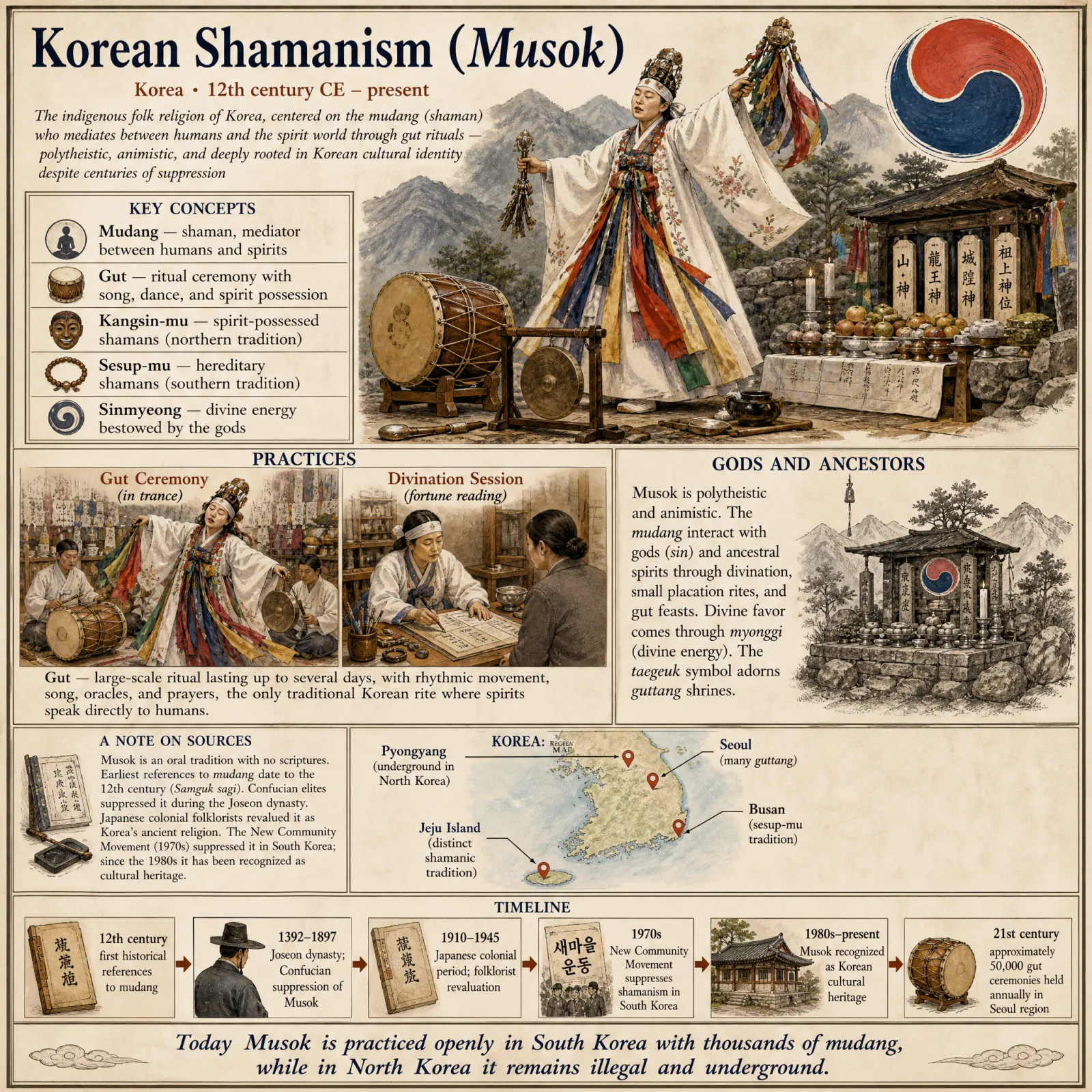
The relationship between Cheondogyo and Korean shamanism (musok) is contested and requires careful historical and theological analysis. Choe Je-u and early Donghak leaders explicitly distinguished Donghak from shamanism, which was stigmatized by Confucian elites and by modernizing reformers as superstitious and backward. Choe Je-u proclaimed a direct revelation from Haneullim (a monotheistic supreme God) and taught a systematic theology and ethics, which he contrasted with shamanic spirit possession, divination, and healing rituals. Cheondogyo has consistently emphasized its status as a 'higher' or 'pure' religion based on revealed truth, moral reform, and universal principles, rather than as folk practice or shamanic cult. However, scholars have noted significant continuities and influences between Donghak/Cheondogyo and Korean shamanism: both traditions emphasize divine immanence, spiritual healing (chigi), the use of Korean vernacular language and accessible rituals, and the empowerment of marginalized people (especially women). Some early Donghak leaders and practitioners had shamanic backgrounds, and some Donghak rituals (such as the use of talismans, incantations, and offerings of water) resemble shamanic practices. The doctrine of innaecheon ('humans are heaven') can be interpreted as radicalizing and universalizing shamanic notions of divine presence in humans and nature. The relationship is thus complex: Cheondogyo is not simply a continuation of shamanism, nor is it entirely separate; rather, it represents a creative reinterpretation and systematization of Korean indigenous religious concepts in dialogue with Confucianism, Daoism, Buddhism, and Catholicism, claiming a distinct religious identity while drawing on shared cultural and spiritual resources.
The historicity and interpretation of Choe Je-u's revelation and the authenticity of the sacred incantation (jumun) and talisman (yeongbu) are contested among scholars and practitioners. Choe Je-u's account of his mystical encounter with Haneullim in 1860 is the founding event of Donghak/Cheondogyo, and the sacred incantation and talisman are central to its ritual practice and theological identity. However, the exact details of the revelation, the wording and meaning of the incantation, and the form and fate of the talisman (which is said to have been lost, destroyed, or hidden) are debated. Some scholars interpret Choe's revelation as a psychological or sociological phenomenon shaped by his personal crises, his exposure to Catholic ideas, and the social turmoil of his time, while others (particularly Cheondogyo believers) view it as a genuine divine communication. The sacred incantation has been transmitted orally and is jealously guarded by Cheondogyo clergy, leading to debates about its correct pronunciation, translation, and theological meaning. Scholars have proposed various interpretations of the incantation's cryptic phrases, drawing on Chinese, Korean, Daoist, and Confucian linguistic and philosophical resources. The lost talisman (yeongbu) has been the subject of scholarly speculation and sectarian disputes, with various groups claiming to possess or reconstruct it. These debates reflect broader questions about the nature of religious authority, the role of textual and oral tradition, and the interpretation of foundational religious experiences.
The legacy and co-optation of Cheondogyo in North Korea is a highly contested and politically sensitive issue. North Korean Cheondogyo, organized through the Chondoist Chongu Party, claims millions of members and presents itself as a continuation of the authentic Donghak/Cheondogyo tradition, emphasizing its revolutionary heritage, its role in the anti-Japanese independence struggle, and its compatibility with socialist ideology. The North Korean government promotes Cheondogyo as a symbol of Korean national identity and as evidence of the regime's tolerance of religion. However, scholars and defectors have documented extensive state control, surveillance, and manipulation of Cheondogyo in North Korea: its doctrines have been reinterpreted to align with Juche ideology and Marxist-Leninist materialism (e.g., innaecheon is reinterpreted as 'the people are heaven,' legitimizing the dictatorship), its leadership is appointed by or subordinated to the Workers' Party, and its religious practices are heavily regulated and used for propaganda purposes. South Korean Cheondogyo and international scholars generally view North Korean Cheondogyo as a co-opted and inauthentic version of the tradition, though the situation is difficult to assess due to lack of access and reliable information. The division of Cheondogyo between North and South reflects the broader tragedy of Korea's national division and the manipulation of religion for political ends.
Key Terms
- Cheondogyo (천도교)
- Religion of the Heavenly Way; the name adopted in 1905 for the reformed and institutionalized Donghak movement, emphasizing universal spiritual principles and modern organization.
- Donghak (동학)
- Eastern Learning; the original name of the movement founded by Choe Je-u in 1860, contrasting Korean indigenous teachings with Seohak (Western Learning, i.e., Catholicism).
- Haneullim (한울님)
- The Lord of Heaven; the supreme, monotheistic God in Cheondogyo, understood as both transcendent and immanent, the source of existence and moral order.
- Innaecheon (인내천, 人乃天)
- Humans are heaven; the central doctrine of Cheondogyo, proclaiming that the divine dwells within every person, making all humans sacred, equal, and capable of realizing their divine nature.
- Choe Je-u (최제우, 1824-1864)
- Founder of Donghak; an impoverished Confucian scholar who received a divine revelation from Haneullim in 1860 and taught the doctrine of innaecheon. Executed as a heretic in 1864.
- Choe Si-hyeong (최시형, 1827-1898)
- Second great leader of Donghak; succeeded Choe Je-u and organized the movement, leading it through decades of persecution. Executed in 1898 after the Donghak Peasant Revolution.
- Son Byong-hi (손병희, 1861-1922)
- Third great leader; renamed Donghak as Cheondogyo in 1905 and modernized its institutions. Led Cheondogyo's participation in the 1919 March First Movement and signed the Korean Declaration of Independence.
- Jumun (주문)
- Sacred incantation; the 21-character prayer revealed to Choe Je-u, recited daily by believers to invoke divine presence and spiritual power. Also called Shi-cheon-ju ('Serving the Lord of Heaven').
- Cheongsu (청수)
- Pure water; a bowl of clean water offered daily by believers as a symbol of sincerity and purity, representing the offering of one's heart to Haneullim.
- Chigi (치기, 治氣)
- Curing energy or regulating energy; the spiritual healing and well-being achieved through proper ritual practice, moral conduct, and cultivation of gi (vital force).
- Hugcheon-gaebyeok (후천개벽, 後天開闢)
- Opening of the later heaven; a millenarian vision of the coming transformation of the world from an age of suffering to an era of peace, prosperity, and universal salvation.
- Donggyeong Daejeon (동경대전)
- Great Scripture of Eastern Learning; the primary canonical text of Cheondogyo, comprising Choe Je-u's prose teachings (Donggyeong) and vernacular hymns (Yongdam Yusa).
- Yongdam Yusa (용담유사)
- Hymns from Dragon Pool; Choe Je-u's poetic teachings written in Korean vernacular (hangul), including famous songs such as Yongdam-ga and Ansim-ga.
- 1894 Donghak Peasant Revolution
- The largest peasant uprising in Korean history, led by Donghak believers and military commanders, demanding social reforms and expulsion of foreign influence. Brutally suppressed, precipitating the Sino-Japanese War.
- March First Movement (삼일운동, 1919)
- Korea's largest nonviolent independence demonstration against Japanese colonial rule, organized by Cheondogyo, Christian, and Buddhist leaders. Son Byong-hi and 15 Cheondogyo leaders signed the Declaration of Independence.
- Yongdamjeong (용담정)
- Dragon Pool Pavilion; the sacred site in Gyeongju where Choe Je-u was born, received his revelation, and is buried. The most important pilgrimage site in Cheondogyo.
- Cheondogyo Central Temple
- The headquarters and main worship center of Cheondogyo in Seoul, built 1918-1921 in eclectic Western-Korean architectural style. A symbol of Cheondogyo's historical role in Korean nationalism.
- Jeon Bong-jun (전봉준, 1855-1895)
- Military commander of the southern Donghak forces in the 1894 Peasant Revolution; a martyr and hero in Cheondogyo and Korean nationalist memory.
- Chondoist Chongu Party (천도교청우당)
- The North Korean political party nominally representing Cheondogyo, effectively controlled by the communist regime and used as a propaganda tool.
- Jisang-cheonguk (지상천국)
- Terrestrial paradise or paradise on earth; the Cheondogyo vision of transforming the world into a realm of peace, justice, and divine presence through human moral and social action.
Further Reading
- George L. Kallander, Salvation through Dissent: Tonghak Heterodoxy and Early Modern Korea (University of Hawaii Press, 2013)
- Carl F. Young, Eastern Learning and the Heavenly Way: The Tonghak and Chondogyo Movements and the Twilight of Korean Independence (University of Hawaii Press, 2014)
- Benjamin B. Weems, Reform, Rebellion, and the Heavenly Way (University of Arizona Press, 1964)
- Carl F. Young, 'Embracing Modernity: Organizational and Ritual Reform in Ch'ondogyo, 1905-1910,' Asian Studies Review 29:1 (2005)
- Susan Shin, 'The Tonghak Movement: From Enlightenment to Revolution,' Korean Studies Forum (1979)
- Encyclopaedia Britannica: Donghak
- Encyclopaedia Britannica: Cheondogyo
- HeritageWiki: Yongdamjeong Pavilion
- Cultural Heritage Administration (Korea): Seoul Tangible Cultural Property No. 36 - Cheondogyo Central Temple
- Paul L. Beirne & Carl Young, 'Tonghak/Ch'ondogyo' in Handbook of East Asian New Religious Movements (Brill, 2018)
Practices
- Incantation (sicheonnyeong)
- Daily prayer
- Equality rituals
Core ideas
- Monotheism
- Haneullim — God within all humans
- Salvation
- Bringing heaven to earth
Sacred texts
The 'Classic of the Eastern Scripture,' the primary scripture of Cheondogyo compiled by Choe Je-u's followers. It records divine revelations received through incantation and presents the doctrine of Haneullim, the Lord of Heaven dwelling within all people. The text calls for moral reform, equality, and the realization of paradise on earth.
A collection of teachings, hymns, and narratives associated with Choe Je-u and early Cheondogyo leaders. It preserves the movement's origin story and its fusion of Confucian ethics, Buddhist practice, and monotheistic faith. The work remains central to Cheondogyo worship and Korean nationalist identity.