Samaritanism
The smallest living branch of ancient Israelite religion.
Overview
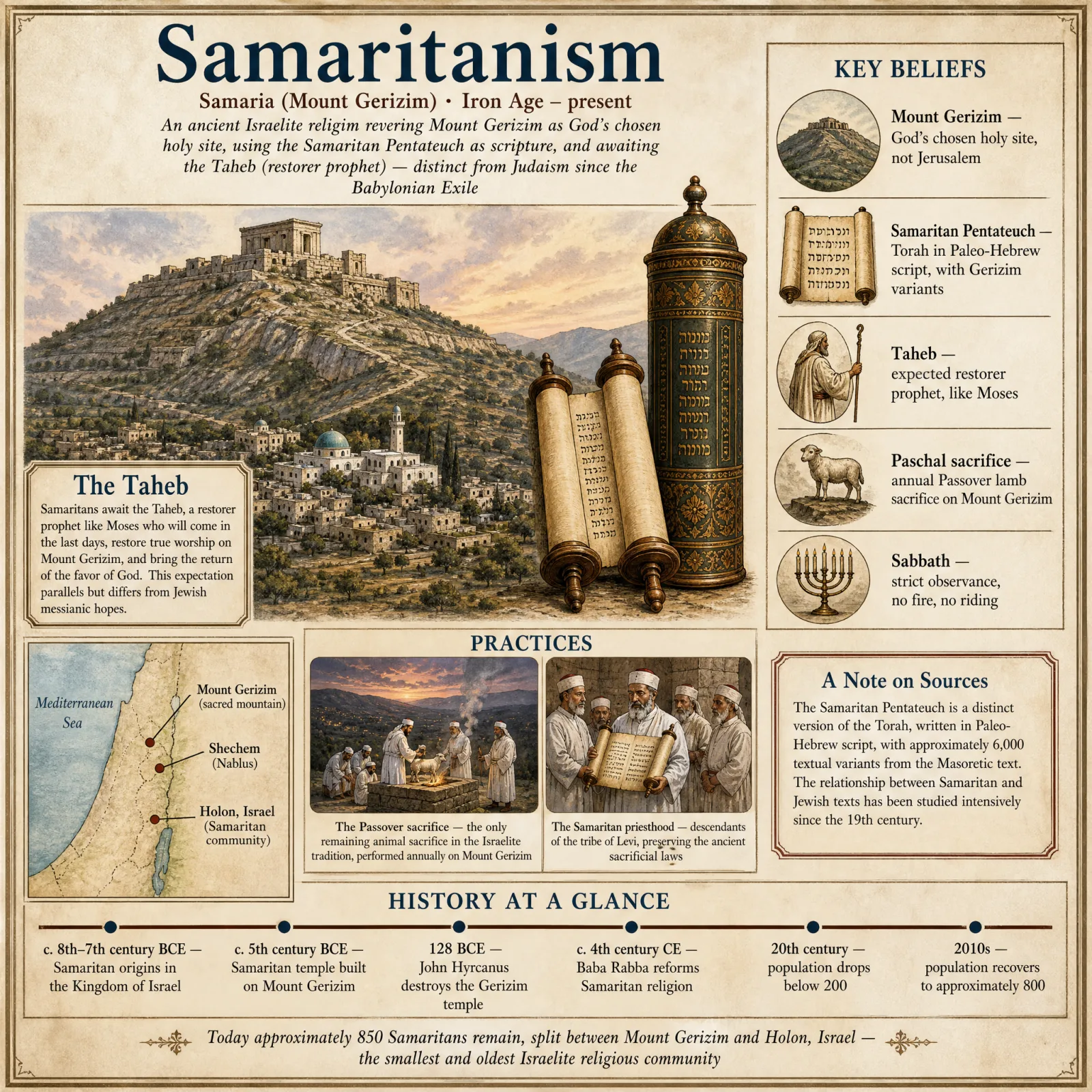
Samaritanism is an ancient Israelite religion practiced by the Samaritans, a small ethnoreligious community that regards itself as the true preservers of the original Israelite faith, unbroken since the time of Moses. The Samaritans claim descent from the northern tribes of Ephraim and Manasseh (the two tribes of Joseph) and the priestly line of Levi, and they assert that their traditions represent the authentic continuation of pre-exilic Israelite religion, unchanged by Babylonian and post-exilic innovations that shaped Rabbinic Judaism. Central to their identity is the conviction that Mount Gerizim near the ancient city of Shechem (modern Nablus in the West Bank) is the true location chosen by God for worship—not Jerusalem. This theological and geographic claim stands as the defining boundary between Samaritans and Jews, whose parallel yet distinct religious traditions have coexisted for over two millennia.
The Samaritan canon consists solely of the Pentateuch—the five books of Moses (Torah)—in a distinctive recension known as the Samaritan Pentateuch, which differs from the Masoretic (Jewish) text in approximately six thousand instances, mostly minor orthographic and grammatical variations, though a few variants reflect the centrality of Mount Gerizim. The Samaritans reject the Prophets and Writings of the Hebrew Bible, and they maintain their own liturgical tradition in Samaritan Hebrew and Samaritan Aramaic, preserved in a unique cursive script derived from the Old Hebrew alphabet. Religious life revolves around the hereditary Samaritan priesthood, descended from Aaron through his grandson Phinehas, who conduct sacrifices, lead prayers, and preserve the sacred texts. Observance of the Torah's commandments is strict: Sabbath regulations are rigorously enforced, dietary laws (kashrut) are observed, and the biblical festivals—especially Passover, which includes the sacrifice of lambs on Mount Gerizim—are celebrated according to ancient rites.
Today, the Samaritan community numbers approximately 900 individuals, making them one of the smallest surviving ethnoreligious groups in the world. The community is divided between two locations: roughly half live in Kiryat Luza, a village on the slopes of Mount Gerizim in the West Bank, and the other half reside in the Neve Pinchas neighborhood of Holon, a city near Tel Aviv in Israel. Samaritans hold dual Israeli and Palestinian citizenship, a unique status reflecting their geographic and political positioning. Despite their small numbers, the community has experienced modest population growth in recent decades, recovering from a historic low of fewer than 150 individuals in the early 20th century. However, they face challenges including genetic bottlenecks due to endogamy, the need to balance tradition with modernity, and the complexities of living in a region marked by political conflict. Scholarly interest in Samaritanism has intensified since the mid-20th century, driven by archaeological discoveries at Mount Gerizim, the publication of ancient Samaritan manuscripts, and recognition of the community's importance for understanding the diversity of ancient Israelite and early Jewish traditions.
Emerges fromJudaism ←
Historical Origins and Development
The origins of the Samaritans and the timing of their separation from the Judahites (Jews) have been subjects of intense scholarly debate. The Samaritan tradition itself asserts continuous Israelite presence in the land since the conquest under Joshua, with the priesthood descending unbroken from Aaron and the sanctuary at Shechem and Mount Gerizim predating Solomon's Temple in Jerusalem. According to Samaritan chronicles, the schism occurred during the high priesthood of Eli (late 12th or early 11th century BCE), when Eli illicitly established a rival sanctuary at Shiloh, abandoning the divinely ordained site at Gerizim. This narrative positions the Samaritans as the faithful remnant and the Judahites as the schismatics. In contrast, the Hebrew Bible's account in 2 Kings 17 describes the Samaritans as descendants of foreign colonists brought by the Assyrians after the destruction of the northern kingdom of Israel in 722 BCE, who adopted a syncretistic form of Israelite worship mixed with pagan practices. This polemical text has shaped Jewish and Christian perceptions of Samaritans for centuries, portraying them as outsiders with illegitimate claims to Israelite heritage.
Modern scholarship has largely rejected both the Samaritan and biblical polemical accounts in favor of a more nuanced historical reconstruction. Most scholars now agree that the Samaritans are indeed descendants of Israelites, specifically the remnant population of the northern kingdom that survived the Assyrian conquest and deportations. Archaeological and epigraphic evidence—including the Samaria papyri (late 4th century BCE), hundreds of Mount Gerizim inscriptions (3rd–2nd centuries BCE), and extensive excavations at Mount Gerizim conducted by Yitzhak Magen—supports the presence of a thriving Israelite community in Samaria throughout the Persian and Hellenistic periods. Linguistic and textual analyses of the Samaritan Pentateuch reveal that it shares a common textual tradition with proto-Masoretic and Qumran manuscripts, indicating that Samaritans and Judahites both preserved ancient Israelite scriptures. The precise timing of the "schism" remains contested. Scholars such as Gary Knoppers (*Jews and Samaritans*, Oxford, 2013) argue that the divide was gradual, emerging over centuries rather than in a single decisive break, and that significant cooperation and overlap persisted between Judahites and Samaritans well into the Second Temple period.
A pivotal moment in Samaritan history was the construction of the Samaritan Temple on Mount Gerizim, likely in the mid-5th or early 4th century BCE. Magnar Kartveit (*The Origin of the Samaritans*, Brill, 2009) argues that this temple's establishment marks the definitive crystallization of a distinct Samaritan identity. The temple functioned as the community's central sanctuary until its destruction by the Hasmonean king John Hyrcanus I in 128 BCE, an act of violence that deepened the rift between Jews and Samaritans. Despite the temple's destruction, Mount Gerizim remained the Samaritans' sacred site, and worship continued on the mountain's summit. Under Roman rule, the Samaritans endured periodic persecution, including the suppression of major revolts in the 6th century CE under Byzantine rule, which resulted in catastrophic population losses. The rise of Islam brought a degree of toleration, though Samaritans, like Jews and Christians, held dhimmi status and faced periodic discrimination. By the medieval period, the community had dwindled to fewer than a few thousand individuals, and by the early 20th century, their population had fallen to a historic low. The 20th and 21st centuries have seen modest recovery, though the community remains precariously small.
Theology and Core Beliefs
Samaritan theology is strictly monotheistic, centered on the worship of the one God, YHWH (the Tetragrammaton), who is eternal, incorporeal, and unique. The Samaritans adhere to a creed encapsulated in the five fundamental principles: (1) belief in One God; (2) belief in Moses as the sole prophet (no other prophets are recognized after Moses); (3) belief in the Torah (Pentateuch) as the complete and exclusive revelation; (4) belief in Mount Gerizim as the chosen place of God; and (5) belief in the Day of Judgment and Recompense (Yom HaDin). This formulation, while codified in medieval texts, reflects the ancient theological commitments that distinguish Samaritanism. The rejection of prophets beyond Moses means that the writings of the Hebrew prophets (Nevi'im) and the Writings (Ketuvim) hold no canonical authority for Samaritans. Instead, the Pentateuch alone is divinely inspired and sufficient for faith and practice.
The centrality of Mount Gerizim is non-negotiable. The Samaritan Pentateuch includes an additional commandment in Deuteronomy 27:4, specifying that the altar is to be built on Mount Gerizim, not Mount Ebal (as in the Masoretic text). This variant is not merely textual but foundational: Mount Gerizim is identified as "the navel of the earth," the first land to emerge from the primordial waters, the place where Adam was created, where Abraham bound Isaac, and where the divine Presence (Shekhinah) dwells. The Samaritans call it Har Berakha (the Mount of Blessing), and they believe that when the Taheb—the Samaritan messianic figure, a prophet like Moses—comes, he will restore true worship on the mountain. The Taheb, meaning "the Restorer" or "the One Who Returns," will reinstate the proper sacrificial cult, gather the scattered Samaritans, reveal hidden sacred vessels, and inaugurate an era of divine favor. Unlike the Jewish Messiah, the Taheb is not a Davidic king but a prophet-teacher in the Mosaic tradition.
Samaritan anthropology and eschatology are simpler than their Rabbinic Jewish counterparts. The soul is understood as a divine breath given to humanity, and the afterlife involves reward or punishment based on adherence to the commandments. The righteous will enjoy eternal bliss in the presence of God, while the wicked face annihilation or prolonged suffering. There is no developed doctrine of bodily resurrection akin to Pharisaic-Rabbinic Judaism; instead, emphasis is placed on the immortality of the soul and divine justice at the final judgment. Samaritan ethics stress strict observance of the Pentateuchal commandments, communal solidarity, and the preservation of priestly purity. Sabbath observance is particularly rigorous—no fire, no cooking, minimal movement—and festivals are timed according to the Samaritan calendar, which sometimes diverges from the Jewish calendar due to differences in intercalation methods.
Sacred Literature
The Samaritan Pentateuch is the sole canonical scripture of Samaritanism, comprising the five books of Moses: Genesis, Exodus, Leviticus, Numbers, and Deuteronomy. The text is written in the Samaritan script, a descendant of the paleo-Hebrew alphabet used in ancient Israel before the Babylonian exile, which the Samaritans preserved while Jews adopted the Aramaic (square) script. The Samaritan Pentateuch differs from the Masoretic Text in approximately 6,000 places, though most variants are orthographic (spelling differences, fuller or defective spellings) or grammatical. A small number of substantive variants have theological significance: the most famous is the insertion of a command to build an altar on Mount Gerizim in Deuteronomy 27:4. Textual scholars have long debated the relationship between the Samaritan Pentateuch and other ancient Hebrew text traditions. The discovery of Qumran (Dead Sea Scrolls) manuscripts revealed that some biblical texts from the Second Temple period share readings with the Samaritan Pentateuch, suggesting that it represents a legitimate ancient textual tradition rather than a sectarian corruption. Recent critical editions and translations, such as those by Abraham Tal and Moshe Florentin, have made the Samaritan Pentateuch more accessible to scholars and general readers.
Beyond the Pentateuch, Samaritan literature includes liturgical and historical texts. The Samaritan Liturgy (Defter) is a collection of hymns, prayers, and ritual instructions used in worship, composed in Samaritan Hebrew and Aramaic. These liturgical texts reflect the community's theological emphases and preserve ancient poetic forms and vocabulary. The Samaritan Targum, an Aramaic translation of the Pentateuch, was produced for communal use when Aramaic became the vernacular; it reflects both linguistic adaptations and interpretive traditions. The Samaritan Arabic translation (known as the Samaritan-Arabic Pentateuch), composed in the medieval period, served a similar function when Arabic became the dominant language. Historical chronicles, such as the Tolidah (Chronicle) and the Asatir (Secrets of Moses), recount Samaritan sacred history from creation through the Muslim period, blending biblical narrative, communal memory, and apologetic polemic. These texts are less scripturally authoritative than the Pentateuch but are essential for understanding Samaritan self-perception and historiography.
The Abisha Scroll is one of the most famous and contested Samaritan manuscripts. Housed in the Samaritan synagogue in Nablus (now relocated to Kiryat Luza), this Torah scroll is traditionally claimed to have been written by Abisha, the great-grandson of Aaron, in the 13th year of the Israelite settlement in Canaan—thus making it over 3,000 years old. Modern paleographic and codicological analysis, however, dates the oldest portions of the scroll to the 11th or 12th century CE, with later additions and repairs. Nevertheless, the Abisha Scroll holds immense religious and symbolic importance for the Samaritan community as a tangible link to their ancient heritage. The scroll is displayed during Passover and other high holy days, and pilgrims and visitors regard it with reverence. Alan Crown and other scholars have produced extensive studies of the scroll's textual history, decoration, and role in Samaritan ritual life.
Rituals and Observances
The Sabbath (Shabbat) is observed with extreme strictness. From Friday evening until Saturday evening, Samaritans refrain from all work, including lighting fires, cooking, traveling beyond minimal distances, and handling money. Observance is even more stringent than in Orthodox Judaism: no hot food is consumed on the Sabbath (meals are prepared in advance and eaten cold), and communal prayer services are held in the synagogue. Sabbath prayers include recitations from the Pentateuch, liturgical hymns, and priestly blessings. The synagogue in Kiryat Luza and the one in Holon serve as the communal centers for worship, and attendance is nearly universal within the community. Men and women sit separately, and the service is conducted in Samaritan Hebrew by the priests.
The Passover (Pesach) sacrifice is the most distinctive and dramatic Samaritan ritual. Unlike Jews, who have not performed animal sacrifice since the destruction of the Second Temple in 70 CE, Samaritans continue the ancient practice annually on the 14th of Nisan, on the summit of Mount Gerizim. On the eve of Passover, the entire Samaritan community—from Kiryat Luza and many from Holon—gathers on the mountain. At sunset, the High Priest signals the moment, and dozens of lambs are simultaneously slaughtered by designated community members, in accordance with Exodus 12. The lambs are roasted whole in large pits, and the meat is consumed in a communal meal lasting through the night. The ritual is accompanied by prayers, hymns, and readings from the Pentateuch. Women and children participate, though men perform the slaughter. The Passover sacrifice is not only a religious obligation but also a powerful assertion of Samaritan identity and continuity with ancient Israelite practice. It attracts media attention, scholars, and tourists, and the community regards it as proof of their unbroken tradition.
Other festivals include Shavuot (Feast of Weeks), Sukkot (Feast of Tabernacles), Yom Kippur (Day of Atonement), and Rosh Hashanah (New Year). Each of these is observed with pilgrimages to Mount Gerizim (when possible), communal prayers, and festive meals. Yom Kippur is a solemn day of fasting and repentance, marked by extended prayers and priestly intercession. The Day of Standing on Gerizim, associated with Shavuot, commemorates Moses receiving the Torah and includes a night-long vigil on the mountain. Life-cycle rituals follow Pentateuchal prescriptions: male infants are circumcised on the eighth day, marriages are conducted by the priesthood and require endogamy (marriage within the community), and funerals adhere to purity laws (the body is buried promptly, and mourners observe purification rites). Purity laws (tahara) are meticulously maintained: menstruating women are secluded, contact with corpses requires ritual washing, and dietary laws forbid pork, shellfish, and improperly slaughtered meat. The priesthood, divided into families, rotates responsibilities for leading prayers, copying manuscripts, and conducting sacrifices. The High Priest (Kohen Gadol) holds supreme religious authority and represents the community in external affairs.
Internal Traditions and Contemporary Variations
Samaritanism has historically exhibited minimal sectarian diversity compared to Judaism or Christianity, largely due to its small, tightly-knit community and the absence of a diaspora tradition (until the 20th century). However, internal variations have emerged, particularly between the Kiryat Luza (Mount Gerizim) and Holon communities. The Kiryat Luza community, living in close proximity to the sacred mountain, maintains a more traditional lifestyle, with greater insularity and adherence to strict purity laws. The Holon community, situated in a secular Israeli urban environment, has adapted more to modernity: they participate in Israeli civic life, pursue higher education, and engage with the broader Israeli society. Young Samaritans in Holon often speak Hebrew as their primary language and are more integrated into Israeli culture, though they maintain religious observance and travel to Mount Gerizim for festivals.
Historically, theological debates within Samaritanism were rare, though the medieval period saw the emergence of the Dosithean sect, followers of Dositheus (1st century CE), who reportedly claimed messianic or prophetic status and advocated stricter ascetic practices. The Dositheans are mentioned in patristic writings and rabbinic texts, but they disappeared by the medieval period, and little is known about their specific beliefs. In the modern era, no formal sects exist, though individual Samaritans may differ on the degree of permissible accommodation to modernity. Debates over whether to allow limited intermarriage with non-Samaritans (especially Jewish women who convert to Samaritanism) have emerged due to the community's gender imbalance (more males than females, a result of genetic factors). Some Samaritans have married Jewish or Christian women who undergo conversion and are taught Samaritan law, language, and customs. These marriages, while controversial, are seen by some as necessary for demographic survival.
Priestly families (the descendants of Aaron) hold significant authority, and the office of High Priest is hereditary. In recent decades, disputes over High Priestly succession have occasionally surfaced, reflecting broader tensions about leadership and the balance between tradition and adaptation. The community's small size means that nearly everyone is related, and family dynamics can influence communal decisions. Despite these internal variations, the Samaritan community remains remarkably cohesive, united by shared rituals, common texts, and the centrality of Mount Gerizim. The establishment of the A.B.—Institute of Samaritan Studies in Holon, led by the scholar and community member Benyamim Tsedaka, has played a key role in promoting Samaritan culture, publishing Samaritan texts, and facilitating academic engagement. The Institute publishes the bilingual newspaper *A.B. The Samaritan News*, which covers communal affairs, religious teachings, and scholarly research.
Contemporary Demographics and Global Presence
As of 2024, the Samaritan community numbers approximately 900 individuals, making them one of the world's smallest surviving ethnoreligious groups. The population is divided between two primary locations: Kiryat Luza, a village on the slopes of Mount Gerizim in the West Bank, and the Neve Pinchas neighborhood in Holon, Israel, near Tel Aviv. Roughly half of the community resides in each location. The Kiryat Luza community lives in modern homes but remains closely tied to traditional practices, and its proximity to Mount Gerizim allows for easy access to the sacred site for festivals and prayers. The Holon community, established in the mid-20th century to provide Samaritans with opportunities in Israel's urban economy, has integrated more fully into Israeli society while maintaining religious observance. Samaritans in both locations hold dual Israeli and Palestinian citizenship, a unique status that reflects their geographic positioning and their recognition by both Israeli and Palestinian authorities.
Historically, the Samaritan population has fluctuated dramatically. In antiquity, estimates suggest there were hundreds of thousands of Samaritans in the Land of Israel and diaspora communities (including Egypt and Rome). Waves of persecution—especially under Byzantine rule in the 5th and 6th centuries CE—decimated the population. By the medieval period, Jewish traveler Benjamin of Tudela (12th century) reported only about 1,900 Samaritans remaining. The community continued to decline through the Ottoman period, reaching a nadir of approximately 140 individuals in 1917. The 20th century saw modest recovery, driven by improved living conditions, modern medicine (reducing infant mortality and increasing life expectancy), and community efforts to encourage larger families. The gender imbalance (more males than females) has posed challenges, leading to occasional marriages with non-Samaritan women who convert. Despite these challenges, the community's population has grown steadily, and demographic projections suggest cautious optimism for continued survival.
Outside of Israel and the West Bank, there is no significant Samaritan diaspora. A few Samaritan families reside in other Israeli cities such as Binyamina, Matan, and Ashdod, but these are exceptions. The community's deep attachment to Mount Gerizim and the centrality of pilgrimage in Samaritan religious life have historically discouraged permanent emigration. Scholarly and cultural interest in the Samaritans has grown significantly since the mid-20th century, and the community has become more visible through academic conferences, media coverage (especially of the Passover sacrifice), and tourism. International organizations such as the Société d'Études Samaritaines (Society for Samaritan Studies), founded in 1985, facilitate scholarly exchange and publish research on Samaritan history, texts, and culture. The Samaritans themselves have embraced modern technology: they maintain websites, use social media, and participate in interfaith dialogue, while striving to preserve their ancient traditions.
Sacred Geography
Mount Gerizim (Arabic: Jabal al-Tur; Hebrew: Har Gerizim) is the geographic and spiritual center of Samaritanism. Located near the city of Nablus (ancient Shechem) in the northern West Bank, the mountain rises approximately 881 meters (2,890 feet) above sea level. For Samaritans, Gerizim is the holiest place on earth, the chosen site where God's Presence dwells and where Abraham nearly sacrificed Isaac (a claim contested by Jewish tradition, which identifies Mount Moriah in Jerusalem as the site). The Samaritan tradition holds that when Moses commanded the Israelites to build an altar upon entering the Promised Land (Deuteronomy 27), the location specified was Mount Gerizim, not Mount Ebal. Archaeological excavations conducted by Yitzhak Magen and his team from 1982 to 2006 uncovered extensive remains of the Samaritan temple complex on the summit, including a massive sacred precinct, fortification walls, and hundreds of dedicatory inscriptions in Greek and Aramaic. These findings confirm that Mount Gerizim was a major pilgrimage site during the Hellenistic and early Roman periods, with a large city (Luzah) adjacent to the temple.
The Samaritan Temple on Mount Gerizim was built in the mid-5th or early 4th century BCE and functioned as the central sanctuary of the Samaritan community. It was modeled on the Jerusalem Temple, with priests, sacrifices, and festivals conducted according to Pentateuchal law. The temple stood for over two centuries until its destruction in 128 BCE by the Hasmonean king John Hyrcanus I, an act of violence that solidified the breach between Jews and Samaritans. Despite the temple's destruction, the mountain itself retained its sanctity, and Samaritans continued to worship on the summit. Today, no above-ground structures from the ancient temple remain, but the site is marked, and Samaritans ascend the mountain for festivals. During Passover, Sukkot, and Shavuot, the entire community gathers on a designated area near the summit, where prayers are offered and, in the case of Passover, the sacrificial ritual is performed. The mountain also hosts a small prayer house and facilities for the community during pilgrimage festivals.
Kiryat Luza is the modern Samaritan village located on the slopes of Mount Gerizim. Established in the 1980s and 1990s, Kiryat Luza was built to provide permanent housing for Samaritans who had previously lived in Nablus but relocated due to violence during the First Intifada (1987–1990). The village consists of modern apartment buildings and houses, and it includes a Samaritan synagogue where daily and Sabbath prayers are held. The synagogue houses the community's sacred scrolls, including copies of the Pentateuch, and serves as the ritual center for the Mount Gerizim community. The village is situated within a contested area: it is adjacent to the Israeli settlement of Har Brakha, and the Israeli military maintains a presence in the region. Samaritans in Kiryat Luza hold both Palestinian and Israeli citizenship, allowing them to navigate the complex political landscape. The village has become the primary residence for Samaritans who wish to live in close proximity to their sacred mountain.
Nablus (ancient Shechem) holds historical significance for Samaritans. Shechem was the first capital of the northern kingdom of Israel and is mentioned frequently in the Pentateuch as a site of covenant renewal (Joshua 24) and as the location of Jacob's Well. The city of Nablus, founded by the Romans as Flavia Neapolis in 72 CE, grew adjacent to the ruins of ancient Shechem. For centuries, Nablus was home to the Samaritan community, and a Samaritan synagogue in the old city served as the communal center. However, during the First Intifada, most Samaritans relocated to Kiryat Luza for safety, and the Nablus synagogue was largely abandoned (though it remains a historic site). The tomb traditionally identified as Joseph's Tomb (Qabr Yusuf), located on the outskirts of Nablus, is revered by Samaritans, Jews, and Muslims, though its identification is debated. Samaritans regard the site as connected to their Israelite heritage.
Holon is an Israeli city located south of Tel Aviv, home to approximately half of the global Samaritan population. The Neve Pinchas neighborhood in Holon was developed in the 1950s and 1960s to provide housing for Samaritans seeking economic opportunities in Israel. The community in Holon has a Samaritan synagogue and communal facilities, and it serves as a center for Samaritan cultural and educational activities. The A.B.—Institute of Samaritan Studies, founded by Benyamim Tsedaka, is located in Holon and houses a library, archives, and a museum dedicated to Samaritan history and culture. The Institute publishes the bilingual newspaper *A.B. The Samaritan News* and facilitates academic research. Holon Samaritans maintain close ties with the Kiryat Luza community, traveling regularly to Mount Gerizim for festivals, especially Passover, when the entire community reunites on the sacred mountain.
Jacob's Well (Bir Yaʿqub) is a site of shared significance for Samaritans, Jews, and Christians. Located near Nablus, the well is traditionally identified as the place where the patriarch Jacob dug a well (Genesis 33:18-19) and where Jesus spoke with a Samaritan woman (John 4:1-26). The well is now enclosed within a Greek Orthodox monastery, but Samaritans regard it as part of their sacred heritage. While not a central pilgrimage site, the well's association with Jacob and its mention in the New Testament story (which depicts a relatively positive encounter between Jesus and a Samaritan) gives it symbolic importance. The story in John 4, in which Jesus crosses ethnic and religious boundaries to speak with a Samaritan woman, has been interpreted as an acknowledgment of the Samaritans' Israelite identity, though Christian tradition has often used the passage to emphasize supersessionism (the idea that Christianity supersedes Judaism and Samaritanism).
Scholarly and Theological Controversies
The origins of the Samaritans and the timing of the Jewish-Samaritan schism remain among the most contested questions in biblical and ancient Near Eastern studies. For centuries, the dominant view—shaped by 2 Kings 17 and Josephus—held that Samaritans were foreign colonists or a syncretistic hybrid population with dubious claims to Israelite heritage. This view was challenged in the 20th century by scholars such as James Montgomery (*The Samaritans, the Earliest Jewish Sect*, 1907; reprinted Wipf and Stock, 2006), who argued that Samaritans were genuine Israelites. More recently, archaeological and textual discoveries have shifted the consensus toward recognizing the Samaritans as authentic descendants of the northern Israelite tribes. Gary Knoppers' *Jews and Samaritans* (Oxford, 2013) presents a nuanced argument that the divide between Jews and Samaritans was gradual, emerging over centuries, and that significant cooperation and shared religious practices persisted into the Hellenistic period. Magnar Kartveit (*The Origin of the Samaritans*, Brill, 2009) identifies the construction of the Mount Gerizim temple (5th–4th century BCE) as the key moment of differentiation, when Samaritan identity crystallized around a distinct cultic center.
A related debate concerns the textual relationship between the Samaritan Pentateuch and the Masoretic Text. Early Christian and Jewish polemics dismissed the Samaritan Pentateuch as a sectarian corruption. However, modern textual criticism, especially after the discovery of the Dead Sea Scrolls, has shown that the Samaritan Pentateuch represents a legitimate ancient textual tradition. Some Qumran manuscripts share readings with the Samaritan Pentateuch, suggesting a common pre-Masoretic textual heritage. Scholars such as Emanuel Tov and Abraham Tal have argued that the Samaritan Pentateuch preserves authentic variants and should be treated as a witness to the textual plurality of the Second Temple period. The substantive theological variants—especially those elevating Mount Gerizim—are fewer than once thought, and most are explicable as scribal harmonizations or clarifications rather than deliberate sectarian alterations. Nevertheless, the degree to which the Samaritan Pentateuch reflects "original" readings versus sectarian editing remains debated.
The destruction of the Samaritan temple by John Hyrcanus in 128 BCE is interpreted differently by Jewish and Samaritan traditions and by modern scholars. Jewish sources, particularly Josephus, present the destruction as justified retaliation against Samaritan hostility and as part of the Hasmonean campaign to consolidate Jewish control over the Land of Israel. Samaritan chronicles portray it as an act of religious persecution and desecration, a catastrophic event that nevertheless did not diminish the sanctity of Mount Gerizim. Reinhard Pummer (*The Samaritans: A Profile*, Eerdmans, 2016; *Early Christian Authors on Samaritans and Samaritanism*, Mohr Siebeck, 2002) has examined the event's impact on Jewish-Samaritan relations, arguing that it marked a turning point from competition to outright hostility. However, he also notes that even after 128 BCE, some level of interaction and shared cultic practices may have persisted, complicating simplistic narratives of total rupture.
Finally, the demographic future of the Samaritan community raises ethical and scholarly questions. With a population of fewer than 1,000, the community faces genetic bottlenecks due to endogamy, and some scholars and community members worry about long-term viability. The community's acceptance of limited exogamous marriages (with converts) has been both a pragmatic adaptation and a source of internal debate about identity boundaries. Scholars such as Steven Fine (*The Samaritans: A Biblical People*, Brill, 2022) and Alan Crown (multiple works via Mandelbaum Publishing, University of Sydney) have documented the community's resilience and adaptability, noting that reports of the Samaritans' imminent extinction have been premature for over a century. The community's embrace of modern medicine, technology, and strategic integration into Israeli society suggests that, barring catastrophic political upheaval, the Samaritans will continue to survive as a living tradition, preserving one of the most ancient and unbroken forms of Israelite religion.
Key Terms
- Shamerim
- The Samaritans' self-designation, meaning "Keepers" or "Observants" (of the Torah), emphasizing their role as preservers of authentic Israelite tradition.
- Mount Gerizim (Har Gerizim)
- The sacred mountain near Nablus (ancient Shechem), believed by Samaritans to be the place chosen by God for worship and the site of the Samaritan temple (destroyed 128 BCE).
- Samaritan Pentateuch
- The Samaritan version of the Torah, written in Samaritan script and differing from the Masoretic Text in approximately 6,000 instances, mostly minor, with a few theologically significant variants emphasizing Mount Gerizim.
- Taheb
- The Samaritan messianic figure, meaning "the Restorer" or "the One Who Returns." The Taheb is envisioned as a prophet like Moses who will restore true worship on Mount Gerizim and inaugurate an era of divine favor.
- Kiryat Luza
- The modern Samaritan village on the slopes of Mount Gerizim, established in the 1980s–1990s as the primary residence for Samaritans in the West Bank.
- Holon
- An Israeli city near Tel Aviv, home to approximately half of the global Samaritan population in the Neve Pinchas neighborhood.
- Passover Sacrifice (Qorban Pesach)
- The annual ritual slaughter and consumption of lambs on Mount Gerizim on the eve of Passover, one of the most distinctive Samaritan practices, maintaining the biblical command that Jews ceased after the destruction of the Second Temple.
- High Priest (Kohen Gadol)
- The supreme religious leader of the Samaritan community, a hereditary office held by a descendant of Aaron through Phinehas, responsible for leading prayers, conducting sacrifices, and representing the community.
- Abisha Scroll
- A famous Samaritan Torah scroll traditionally attributed to Abisha, great-grandson of Aaron, though modern scholarship dates it to the medieval period. It is revered as the community's most sacred manuscript.
- Samaritan Script
- A cursive alphabet derived from the Old Hebrew (paleo-Hebrew) script, used by Samaritans to write the Pentateuch and liturgical texts, distinct from the square Aramaic script adopted by Jews.
- Defter
- The Samaritan liturgy, a collection of hymns, prayers, and ritual instructions in Samaritan Hebrew and Aramaic, used in communal worship.
- Five Pillars
- The fundamental principles of Samaritan faith: belief in One God, belief in Moses as the sole prophet, belief in the Torah, belief in Mount Gerizim as the chosen place, and belief in the Day of Judgment.
- Dositheans
- A now-extinct Samaritan sect, followers of Dositheus (1st century CE), mentioned in early Christian and rabbinic writings, who reportedly advocated stricter asceticism and possibly messianic claims.
- Société d'Études Samaritaines
- The international scholarly society for Samaritan studies, founded in 1985, which organizes conferences and publishes research on Samaritan history, texts, and culture.
- A.B.—Institute of Samaritan Studies
- A research and cultural center in Holon, Israel, founded by Benyamim Tsedaka, which houses archives, publishes *A.B. The Samaritan News*, and promotes Samaritan scholarship and heritage.
- Shekhinah
- The divine Presence, believed by Samaritans to dwell on Mount Gerizim, the chosen place of God.
- Tahara
- Ritual purity laws, strictly observed by Samaritans, governing contact with corpses, menstruation, dietary laws, and Sabbath observance.
- John Hyrcanus I
- The Hasmonean king who destroyed the Samaritan temple on Mount Gerizim in 128 BCE, a pivotal event that deepened the Jewish-Samaritan divide.
Further Reading
- Pummer, Reinhard. *The Samaritans: A Profile*. Wm. B. Eerdmans Publishing, 2016.
- Pummer, Reinhard. *Early Christian Authors on Samaritans and Samaritanism: Texts, Translations and Commentary*. Mohr Siebeck, 2002.
- Knoppers, Gary N. *Jews and Samaritans: The Origins and History of Their Early Relations*. Oxford University Press, 2013.
- Kartveit, Magnar. *The Origin of the Samaritans*. Brill, 2009.
- Montgomery, James A. *The Samaritans, the Earliest Jewish Sect: Their History, Theology and Literature*. 1907; reprinted Wipf and Stock, 2006.
- Crown, Alan D., et al. *A Companion to Samaritan Studies*. Mohr Siebeck, 1993.
- Crown, Alan D., and Lucy Davey (eds.). *New Samaritan Studies III & IV*. Mandelbaum Publishing, University of Sydney, 2000.
- Fine, Steven. *The Samaritans: A Biblical People*. Brill and Yeshiva University Press, 2022.
- Florentin, Moshe, and Abraham Tal. *The Samaritan Pentateuch: An English Translation*. Open Book Publishers, 2024.
- Kartveit, Magnar. "Theories of the Origin of the Samaritans—Then and Now." *Religions* 10, no. 12 (2019): 661.
Practices
- Passover sacrifice on Mount Gerizim
- Sabbath observance
- Priestly (Cohen) lineage
Core ideas
- Monotheism
- One God, worshipped at Mount Gerizim
- Scripture
- Torah alone, in its Samaritan textual form
Sacred texts
The Samaritan community's version of the Torah, written in the ancient Hebrew (Paleo-Hebrew) script and differing from the Jewish Masoretic text in thousands of details — most significantly in naming Mount Gerizim, not Jerusalem, as God's chosen sanctuary. It is the sole scriptural canon of Samaritanism, without the later Prophets or Writings accepted in Judaism.