Overview
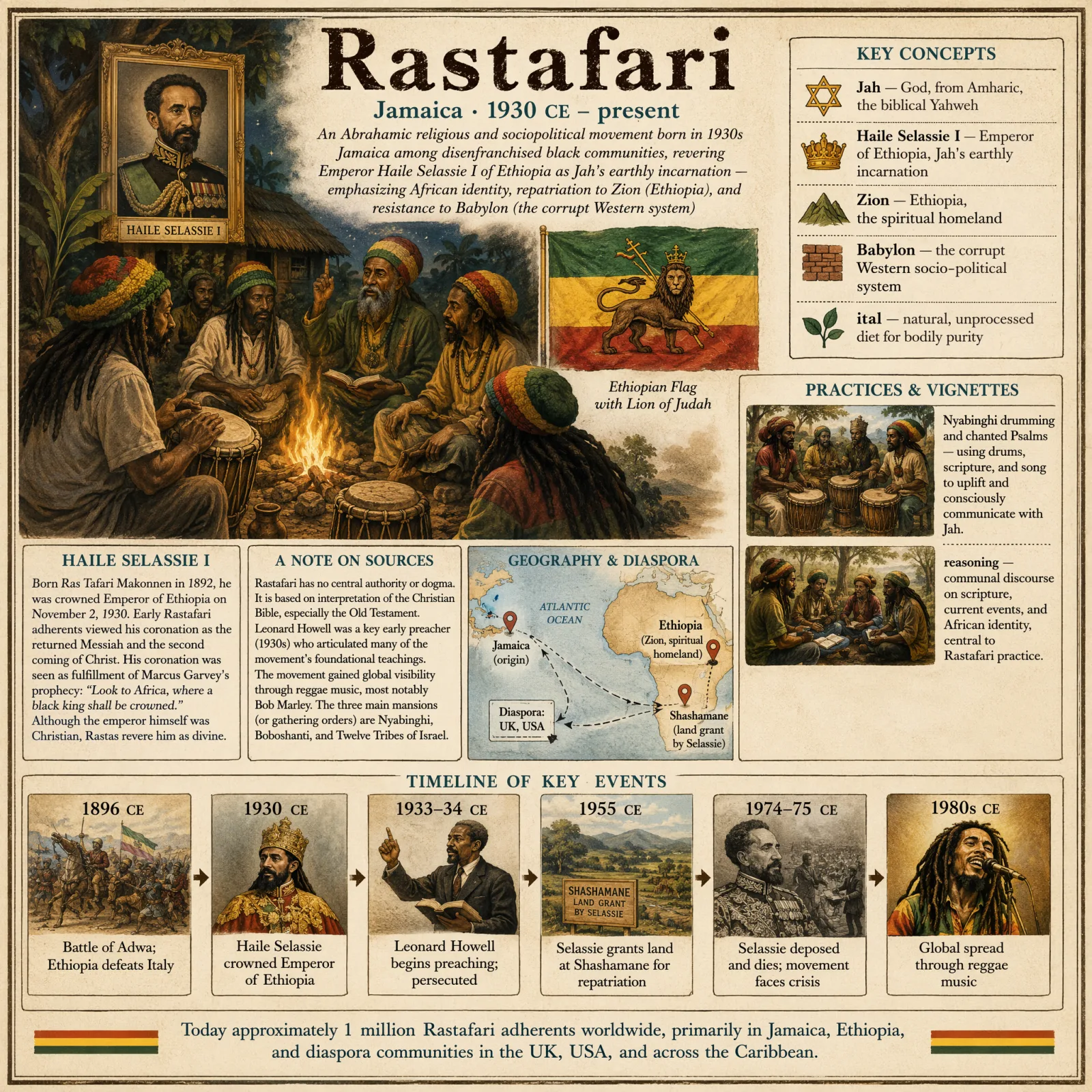
Rastafari is an Afro-Caribbean religious and cultural movement that emerged in 1930s Jamaica, rooted in black consciousness, Pan-Africanism, biblical interpretation, and resistance to colonial oppression. The movement centers on the divinity of Emperor Haile Selassie I of Ethiopia (1892–1975, reigned 1930–1974), whom Rastafari believe to be the returned Messiah, the fulfillment of biblical prophecy, and the living embodiment of Jah (God). Rastafari rejects 'Babylon'—a comprehensive symbol for Western colonial society, white supremacy, political-economic exploitation, and spiritual corruption—and proclaims Africa, specifically Ethiopia, as Zion, the promised land and ancestral homeland to which the African diaspora must return, either physically through repatriation or spiritually through consciousness and identity. The movement developed among Jamaica's dispossessed urban poor and rural peasantry in the context of economic devastation, racial oppression, and the unfulfilled promises of post-emancipation (1838) and post-independence (1962) Jamaica.
Rastafari is not a centralized church with unified doctrine but a decentralized movement organized into 'houses' (small informal groups around individual leaders) and 'mansions' (larger quasi-denominational branches with distinct emphases). The three major mansions are: Nyahbinghi (or Nyabinghi, the oldest, emphasizing African repatriation, ritual drumming ceremonies, and militant resistance to Babylon); Bobo Ashanti (or Bobo Shanti, founded by Prince Emmanuel Charles Edwards, emphasizing strict adherence to Old Testament law, dreadlocks, turbans, and hierarchical priestly structure); and Twelve Tribes of Israel (founded by Vernon Carrington/'Prophet Gad,' more inclusive, allowing members to attend Christian churches, emphasizing monthly Bible reading cycles). Despite differences, Rastafari share core principles: the divinity of Haile Selassie; Africa/Ethiopia as spiritual homeland; repatriation as ultimate goal; rejection of Babylon; veneration of cannabis (ganja) as sacred herb for meditation and spiritual insight; livity (righteous living according to natural, Ital principles); and dreadlocks as covenant symbol and rejection of Babylonian aesthetic norms.
Historically, Rastafari faced severe repression: Jamaican authorities criminalized the movement in the 1930s–1960s, conducting police raids, arresting leaders, forcibly shaving dreadlocks, and portraying Rastafari as dangerous subversives. The 1963 Coral Gardens incident—a violent confrontation between Rastafari and police that resulted in deaths and mass arrests—epitomized state persecution. However, from the late 1960s onward, Rastafari gained cultural legitimacy through reggae music, especially Bob Marley's global success, which introduced Rastafari symbols, language ('dread talk'), and philosophy to international audiences. Reggae became the sonic vehicle for Rastafari's anti-Babylon message, spreading the movement far beyond Jamaica to the Caribbean, Africa, Europe, North America, and globally. Contemporary Rastafari is practiced by an estimated 700,000–1 million adherents worldwide, concentrated in Jamaica but with significant communities in other Caribbean islands, the United States, United Kingdom, Canada, and Africa (especially Ethiopia).
Rastafari occupies a complex religious-political space: it is simultaneously a religion (with theology, ritual, spiritual practices), a social movement (advocating black liberation, Pan-Africanism, anti-imperialism), and a cultural phenomenon (music, art, language, aesthetics). Scholars debate whether Rastafari is a new religious movement, a millenarian movement, a cultural resistance movement, or all three. Rastafari challenges conventional categorization, blending Afrocentric biblical interpretation, Ethiopian Orthodox Christianity influences, Garveyite Pan-Africanism, Jamaican folk religion, and countercultural critique of modernity. The movement has been both celebrated as prophetic voice for the oppressed and criticized for patriarchy, homophobia, and rigid gender norms. In 21st-century Jamaica and the diaspora, Rastafari continues to evolve, grappling with generational change, commercialization (Rastafari aesthetics marketed as lifestyle brand), tensions between orthodoxy and innovation, and the legacy of Haile Selassie's death (1975), which some Rastafari still reject as Babylon propaganda.
Historical Development
Rastafari's immediate origins lie in 1930s Jamaica, but its roots extend deeper into Afro-Jamaican resistance traditions: maroonage (runaway enslaved communities maintaining African traditions and fighting colonial forces), slave rebellions (including the 1831–32 Baptist War led by Samuel Sharpe), and Afro-Christian revivalism (movements like Myalism and Revivalism blending Christianity with African spiritual practices). The 1838 emancipation of enslaved Jamaicans did not bring freedom but transformed slavery into exploitative wage labor, landlessness, and racial hierarchy dominated by a white planter class and mixed-race middle class. By the early 20th century, Jamaica's black majority faced grinding poverty, unemployment, limited education, and systemic racism, creating conditions ripe for radical religious-political movements.
The intellectual and organizational foundation for Rastafari was laid by Marcus Mosiah Garvey (1887–1940), Jamaican-born Pan-Africanist leader who founded the Universal Negro Improvement Association (UNIA) in 1914. Garvey preached black pride, economic self-sufficiency, the dignity of African heritage, and the necessity of repatriation to Africa to escape white oppression. His slogan 'Africa for the Africans, those at home and those abroad' galvanized millions of black people globally. Garvey's most famous alleged prophecy—'Look to Africa, when a black king shall be crowned, for the day of deliverance is near'—is remembered as predicting Haile Selassie's coronation, though scholars debate whether Garvey actually said this (the phrase appears in later sources, not Garvey's own writings). Nonetheless, when Ras (Prince) Tafari Makonnen was crowned Emperor Haile Selassie I of Ethiopia on November 2, 1930, taking titles 'King of Kings, Lord of Lords, Conquering Lion of the Tribe of Judah, Elect of God,' impoverished Jamaican Garveyites saw biblical prophecy fulfilled.
The first Rastafari preachers emerged in West Kingston's slums in the early 1930s: Leonard Percival Howell (1898–1981), Joseph Nathaniel Hibbert, Archibald Dunkley, and Robert Hinds independently began proclaiming Haile Selassie's divinity, drawing on Garveyism, biblical prophecy (especially Revelation 5:5, 19:16; Psalm 68:31), and Ethiopian exceptionalism (Ethiopia as the only African nation never colonized, site of ancient Christian civilization, and biblical Cush/Abyssinia). Howell is most often credited as 'first Rasta' for his systematic theology and organizational efforts. In 1933, Howell was arrested and jailed for sedition after selling photographs of Haile Selassie as 'passports to Ethiopia,' telling followers to pledge allegiance to the Ethiopian emperor rather than British King George V. This established the pattern: Rastafari as anti-colonial political threat, met with state repression.
In 1940, Howell founded Pinnacle, a self-sufficient communal settlement on approximately 500 acres in the hills of St. Catherine parish, near Sligoville (the first free village established by emancipated slaves in 1834). Pinnacle housed 500–1,600 residents at its peak, functioning as an agro-industrial commune with farming, craft workshops, bakery, health facilities, and internal economy. Howell led the Ethiopian Salvation Society, teaching Rastafari theology, advocating black economic independence, and cultivating cannabis (which Pinnacle residents used sacramentally and sold commercially). Pinnacle embodied Rastafari livity—righteous living outside Babylon's corrupt system—and became the movement's organizational and ideological center. However, Jamaican authorities viewed Pinnacle as seditious and criminal, conducting raids in 1941, 1948, 1954, and finally destroying the community in 1954, arresting Howell, and dispersing residents. Many Pinnacle Rastafari relocated to West Kingston's Back-o-Wall ghetto, spreading the movement into urban centers.
The 1950s–1960s were years of persecution and growth. Rastafari were stigmatized as ganja-smoking criminals, vagrants, and madmen. Police routinely arrested Rastafari, forcibly shaved dreadlocks (a humiliating violation of the Nazarite vow Rastafari observe based on Numbers 6:5), and harassed communities. The 1960 University of the West Indies report on Rastafari, led by scholars including M.G. Smith, Roy Augier, and Rex Nettleford, was sympathetic, recommending dialogue and acknowledging Rastafari grievances, but government action was minimal. The April 1963 Coral Gardens incident—a violent confrontation in Montego Bay between Rastafari and police over land and harassment, resulting in deaths on both sides—sparked mass arrests, detention without trial, and intensified repression. Hundreds of Rastafari were jailed; some were committed to mental asylums under the pretext of insanity. Coral Gardens traumatized the Rastafari community, cementing their view of the Jamaican state as Babylon.
A turning point came in April 1966 when Emperor Haile Selassie visited Jamaica, greeted by tens of thousands of Rastafari and supporters at the airport. The visit, orchestrated by Jamaican government and Rastafari elders, was ecstatic: Rastafari viewed it as divine visitation, proof of Selassie's concern for his diaspora children. Selassie reportedly advised Rastafari to 'liberate Jamaica before seeking to liberate Ethiopia'—interpreted as endorsement of social justice work in Jamaica rather than immediate physical repatriation. The visit boosted Rastafari legitimacy; the Jamaican government began cautiously tolerating the movement. Around this time, the three major mansions crystallized: Nyahbinghi consolidated around elders like Mortimo Planno and Sam Brown, emphasizing African consciousness and ritual drumming; Twelve Tribes of Israel was founded in 1968 by Vernon Carrington, offering more structured, inclusive organization; and Bobo Ashanti emerged in the 1950s–1960s under Prince Emmanuel, emphasizing priestly hierarchy and strict livity.
The 1970s brought Rastafari's global breakthrough through reggae music. Bob Marley and the Wailers, Peter Tosh, Burning Spear, Culture, and other reggae artists—many of them Rastafari or sympathetic—used music as vehicle for Rastafari philosophy, reaching international audiences. Marley's albums *Catch a Fire* (1973), *Natty Dread* (1974), *Rastaman Vibration* (1976), *Exodus* (1977), and *Survival* (1979) introduced millions globally to Rastafari concepts: Babylon, Zion, repatriation, Jah, livity, and resistance. Reggae's popularity transformed Rastafari from marginalized Jamaican sect to global cultural-religious force. Rastafari symbols—dreadlocks, red-gold-green colors, cannabis, lion of Judah—became internationally recognizable. Marley's 1981 death (at age 36) elevated him to martyr status, and he remains Rastafari's most famous ambassador.
The 1974 Ethiopian revolution, which deposed Haile Selassie, and his 1975 death in custody, created theological crisis. Some Rastafari rejected news of his death as Babylon lies, insisting Selassie is immortal and living (a position some still hold); others acknowledged his physical death but maintained his spiritual divinity and eternal reign; still others reinterpreted Selassie as prophet or symbol rather than literal God incarnate. The crisis did not destroy Rastafari but spurred theological diversification and introspection. Simultaneously, Rastafari spread globally: Caribbean migrants brought the movement to UK (Brixton, Notting Hill), USA (New York, Miami, Washington D.C.), and Canada (Toronto); African enthusiasm for Rastafari grew, with communities forming in Ghana, South Africa, and elsewhere; and repatriation to Ethiopia continued, with Rastafari settling in Shashamane, a town where Haile Selassie had granted 500 acres of land to the Ethiopian World Federation in 1948 for black diaspora repatriation. By the 1980s–1990s, Rastafari was an international movement, though Jamaica remained its spiritual center.
Contemporary Rastafari navigates tensions: commercialization (Rastafari aesthetics commodified in fashion, tourism, and 'Rasta lifestyle' branding) versus spiritual authenticity; orthodoxy (maintaining strict livity, dietary laws, gender norms) versus innovation (feminist Rastafari critiquing patriarchy, LGBTQ+ inclusion debates); repatriation ideal versus diaspora realities (most Rastafari remain in Jamaica or diaspora, not Ethiopia); and generational change (younger Rastafari negotiate between elders' teachings and modern contexts). Nonetheless, Rastafari persists as vibrant movement, adapting while maintaining core principles.
Worldview and Theology
Rastafari theology is Afrocentric, biblical, experiential, and non-creedal—there is no official scripture or hierarchy defining orthodoxy, though shared convictions exist. Central is the divinity of Haile Selassie I, understood not as incarnation of a separate deity but as Jah (God, Jehovah) manifest in flesh, the returned Christ, the fulfillment of Revelation 5:5 ('the Lion of the tribe of Judah, the Root of David, has triumphed') and Revelation 19:16 ('King of Kings and Lord of Lords'). This claim rests on several pillars: Selassie's lineage (claimed descent from King Solomon and Queen of Sheba, making him heir to the Davidic covenant); his titles (King of Kings, Lord of Lords, Conquering Lion of Judah—biblical titles for the Messiah); his coronation (November 2, 1930, seen as prophesied by Garvey and scripture); and Ethiopia's unique status (never colonized, ancient Christian nation, biblical Cush). Rastafari do not worship Selassie as external god but see him as divine emperor, Jah in human form, living embodiment of God's presence on earth.
Rastafari reinterpret the Bible through Afrocentric hermeneutics, arguing that Babylon (white Christianity, colonial powers, Western Bible translators) distorted scripture to justify slavery and oppression. Rastafari 'overstand' (they reject the word 'understand,' seeing 'under' as submission to Babylon) the Bible as African document: ancient Israelites were black; Eden was in Africa; Egypt/Ethiopia/Cush are central, not peripheral; Moses' wife was Ethiopian (Numbers 12:1); and the Messiah promised return through Africa (Psalm 68:31, 'Princes shall come out of Egypt; Ethiopia shall soon stretch out her hands unto God'). This 'Ethiopianism'—theological centering of Ethiopia/Africa—predated Rastafari (found in 19th-century African-American and Caribbean Christianity) but Rastafari radicalized it, making Selassie the fulfillment.
Babylon is Rastafari's comprehensive symbol for oppression: Western colonial society, white supremacy, capitalism, political corruption, police brutality, materialistic consumer culture, false Christianity (especially the Catholic and Anglican churches that blessed slavery), and any system that enslaves, exploits, or spiritually corrupts. Babylon is not merely geographic (though Western nations, especially Britain and America, epitomize it) but metaphysical—a spiritual condition of alienation from Jah, from African identity, and from righteousness. The phrase 'chanting down Babylon' means ritually, culturally, and politically delegitimating and resisting Babylon through Rastafari consciousness, music, and livity. Rastafari see themselves in Babylonian captivity (the Atlantic slave trade and ongoing oppression paralleling the biblical Babylonian exile of Israelites), awaiting liberation.
Zion (also called Ethiopia, Africa, or Mount Zion) is Babylon's opposite: the promised land, ancestral homeland, site of God's throne, and place of spiritual and physical liberation. Ethiopia holds special symbolic weight as never-colonized, biblically mentioned, and seat of Haile Selassie. Repatriation—physical return to Africa/Ethiopia—is eschatological hope and practical goal. Some Rastafari have repatriated to Shashamane, Ethiopia, though the reality is complex (land tenure disputes, Ethiopian government ambivalence, cultural adjustment). Most Rastafari remain in diaspora but cultivate spiritual repatriation: embracing African identity, rejecting Babylon, and living as though already in Zion through righteous consciousness.
Livity is Rastafari's term for righteous, natural living aligned with Jah's law and African principles. It encompasses: dietary purity (Ital food—vegetarian or vegan, no salt, no processed foods, no alcohol, emphasizing raw, organic, 'vital' foods, from the word 'vital' pronounced 'I-tal'); sacramental use of cannabis (ganja, herb, holy weed, understood as 'wisdom weed' given by Jah for meditation, healing, and spiritual insight, based on Genesis 1:29, Psalm 104:14, Revelation 22:2); dreadlocks (covenant symbol of Nazarite vow per Numbers 6:5, rejection of Babylon's aesthetic norms, and expression of natural, 'dread' [awesome, fearsome to Babylon] identity); and moral-spiritual discipline (honesty, humility, non-violence toward righteous, resistance to Babylon, communal solidarity). Livity is not legalistic rulebook but embodied philosophy of living in harmony with creation and Jah.
I and I is distinctive Rastafari linguistic-theological concept, replacing 'I' and 'you' with 'I and I' to signify unity, equality, and shared divinity. 'I and I' rejects hierarchical subject-object dualism (inherent in 'you and me'), instead affirming that Jah resides in each person, so 'I' speaking to 'you' is 'I and I'—we are one in Jah. This reflects Rastafari's radical egalitarianism (at least in theory, though practice is more complex, especially regarding gender) and mystical understanding of divine indwelling. Similarly, Rastafari speak in 'dread talk' or 'Iyaric,' a creolized Jamaican patois infused with African-derived words, biblical language, and neologisms that 'upfull' (positive, elevating) rather than 'downpress' (Rastafari term for 'oppress,' avoiding negative prefixes). For example: 'overstand' instead of 'understand'; 'livicate' instead of 'dedicate' (avoiding 'dead'); 'Iration' instead of 'creation' (inserting 'I' to emphasize divine presence).
Rastafari eschatology is this-worldly and realized rather than otherworldly. There is no focus on heaven after death; the goal is liberation and repatriation now, in this life, through consciousness transformation and social-political change. Some Rastafari hold that Haile Selassie will orchestrate final repatriation; others see repatriation as ongoing process. Death is not emphasized; some Rastafari believe the righteous don't die but 'pass over' or that true Rastafari achieve immortality through consciousness. The millennium is already here or imminent—signaled by Selassie's coronation—and Rastafari are living in the 'last days' when Babylon falls and Zion rises.
Sacred Texts and Oral Traditions
Rastafari has no canonical scripture beyond the Bible, which is read selectively and interpreted through Afrocentric lens. The King James Bible is most commonly used, though Rastafari critique it as Babylon-corrupted, arguing that white translators changed names (Jesus should be 'Yesus' or 'Iyesus'; God is 'Jah,' shortened from Jehovah; Israelites were Africans), suppressed African passages, and inserted pro-slavery, pro-white content. Some Rastafari prefer the Ethiopian Bible or Amharic scriptures to access less-corrupted versions, though few speak Amharic. Key biblical books for Rastafari include: Psalms (especially 68, 87, 137—Ethiopianist and exilic themes); Revelation (5:5, 19:16—Messiah as Lion of Judah, King of Kings); Genesis (African origin of humanity); Exodus (liberation from oppression); Daniel (prophetic visions); and Leviticus/Numbers (dietary laws, Nazarite vow). New Testament is read cautiously—Rastafari honor Jesus ('Yesus Kristos') as prophet or manifestation of Jah, but Haile Selassie is the fulfillment, the returned Christ.
Early Rastafari texts include manifestos, pamphlets, and tracts produced by first-generation leaders, often handwritten or mimeographed, circulated within communities. The most famous is 'The Promised Key' by Leonard Howell (c. 1935), a theological-political manifesto outlining Haile Selassie's divinity, Garveyism, biblical prophecy, and anti-colonial resistance. Howell's work synthesized existing ideas (Garveyism, Ethiopianism, biblical interpretation) into coherent Rastafari theology. Copies were rare, passed hand-to-hand, making 'The Promised Key' semi-legendary until scholars recovered and published it in the late 20th century (notably in *Chanting Down Babylon: The Rastafari Reader*, 1998). Other early texts include writings by Joseph Hibbert, Robert Hinds, and Archibald Dunkley, though many have been lost or survive only in fragments.
Rastafari oral tradition is central: elders ('ancients,' 'dawtas,' 'bredren') transmit theology, history, and livity through 'reasoning'—communal discussions, often facilitated by passing a chalice of ganja, during which Rastafari 'reason' (debate, teach, meditate) on scripture, politics, Selassie, and Babylon. Reasoning is Rastafari's primary pedagogical and ritual practice, replacing formal church services with participatory dialogue. These sessions produce vast oral corpus: interpretations of scripture, stories of Haile Selassie, accounts of Pinnacle and Coral Gardens, testimonies of police brutality and repatriation dreams, and philosophical reflections on livity. Elders like Mortimo Planno, Sam Brown, and Ras Boanerges have been revered as oral theologians, though their teachings are not written systematically.
Reggae music functions as Rastafari textual tradition. Bob Marley's lyrics, Peter Tosh's anthems ('Legalize It,' 'Equal Rights'), Burning Spear's historical narratives ('Marcus Garvey,' 'Slavery Days'), and countless other reggae songs articulate Rastafari theology, history, and resistance in accessible, memorable, globally disseminated form. For many Rastafari and sympathizers, reggae is primary theological source—Marley's 'Redemption Song' teaches self-liberation ('emancipate yourselves from mental slavery'); 'Exodus' teaches repatriation; 'One Love' teaches unity; 'Get Up, Stand Up' teaches resistance. Reggae democratized Rastafari knowledge, spreading it beyond Jamaica and enabling global Rastafari identity formation. Scholars note reggae's 'aural scripture' role, comparable to how gospel hymns function in some Christian communities.
Since the 1970s, Rastafari have produced written texts: theological treatises, autobiographies, histories, and cultural studies, often by Rastafari scholars or sympathetic academics. Key works include: Barry Chevannes' *Rastafari: Roots and Ideology* (1994), combining ethnography and history; Horace Campbell's *Rasta and Resistance* (1987), analyzing Rastafari as political movement; Ennis Edmonds' *Rastafari: From Outcasts to Culture Bearers* (2003), tracing social integration; and the anthology *Chanting Down Babylon: The Rastafari Reader* (1998), collecting scholarly and Rastafari voices. These academic texts now circulate within Rastafari communities alongside oral traditions, creating hybrid textual culture. Younger Rastafari access information through YouTube lectures, blogs, and social media, blending traditional reasoning with digital resources, though elders worry about loss of oral intimacy and Babylon-corrupted online content.
Ritual Practices and Livity
Rastafari practice is decentralized, varying by mansion, house, and individual interpretation, but shared practices exist. Reasoning sessions are core ritual: small groups of Rastafari (typically male, though women participate in some contexts) gather to 'reason'—discuss scripture, politics, current events, and spiritual matters—while smoking cannabis from a chalice (water pipe). The chalice is passed clockwise, each participant inhaling deeply ('drawing wisdom'), holding breath, then exhaling while often invoking 'Jah Rastafari' or reciting scriptures. Ganja is sacrament, not recreation; Rastafari cite Genesis 1:29 ('every herb bearing seed... to you it shall be for meat'), Psalm 104:14 ('He causeth the grass to grow for the cattle, and herb for the service of man'), and Revelation 22:2 ('the leaves of the tree were for the healing of the nations'). Cannabis facilitates meditation, spiritual insight (dubbed 'the wisdom weed'), and communal bonding. Rastafari reject alcohol and tobacco as Babylon poisons.
Nyahbinghi ceremonies (also spelled Nyabinghi, Niyabinghi) are Rastafari's most important communal rituals, held by Nyahbinghi mansion and attended by Rastafari across mansions. Nyahbinghi are multi-day drumming and chanting gatherings, often marking significant dates: Haile Selassie's birthday (July 23), coronation anniversary (November 2), Ethiopian Christmas (January 7), Marcus Garvey's birthday (August 17), and Haile Selassie's visit to Jamaica (April 21). Ceremonies occur at designated Nyahbinghi grounds—open-air spaces in rural Jamaica or diaspora. Three drums—bass, funde, and repeater (keteh)—play hypnotic polyrhythmic patterns for hours or days, accompanying chanting of Psalms, hymns, and Rastafari anthems. Participants dance, chant, smoke ganja, and enter meditative/ecstatic states. Nyahbinghi drums are sacred, played only by initiated brethren, and the rhythms are understood as calling down Jah's presence and 'chanting down Babylon.' The term 'Nyahbinghi' derives from a Ugandan anti-colonial movement and means 'death to black and white oppressors.'
Ital food (livity diet) is crucial practice. Rastafari avoid 'dead food'—meat (especially pork, an abomination), alcohol, processed foods, salt (seen as contaminating), preservatives, and anything artificial. Ital diet emphasizes fresh fruits, vegetables, grains, legumes, and juices, often raw or minimally cooked, organic, and 'natural' (from 'vital,' pronounced 'I-tal' with characteristic Rastafari I-emphasis). Some Rastafari are strictly vegan; others consume fish (interpreted as 'fishes' in Bible, distinct from 'flesh' of mammals). Ital livity extends to medicine: Rastafari prefer herbal remedies, bush medicine (Jamaican folk herbalism), and natural healing over Babylon pharmaceuticals. This reflects broader livity principle: living in harmony with creation, rejecting artificial, chemical, and exploitative Babylon systems.
Dreadlocks are visible covenant sign, though not all Rastafari wear them, and wearing dreads doesn't automatically make one Rastafari. Dreads signify: Nazarite vow (Numbers 6:5, 'no razor shall come upon his head'); rejection of Babylon vanity and grooming norms; connection to African ancestors (some interpret dreads as emulating Ethiopian warriors or African lion's mane); and 'dread' identity (fearsome to Babylon, awesome to Jah). Historically, dreadlocks marked Rastafari for police targeting and social stigma; forced shaving was common punishment. Today, dreads are more socially accepted but remain potent symbol. Women who wear dreads are sometimes called 'dreadlocked sisters' or 'Empress,' though women's roles in Rastafari are complex and contested.
Groundations are reasoning sessions combined with Ital cooking and eating, creating communal sacred meals. Rastafari gather, prepare Ital food collectively (often outdoors over wood fire), reason, chant, smoke, eat, and fellowship. Groundations build community solidarity, transmit livity to younger generations, and enact Rastafari's communal-economic vision (sharing resources, collective labor, rejecting Babylon individualism). Some houses maintain communal gardens or farms practicing Ital agriculture, echoing Pinnacle's self-sufficient model.
Prayer and meditation are daily practices, though not formalized like Christian liturgy. Rastafari pray spontaneously, often beginning with 'Jah Rastafari' or 'His Imperial Majesty,' citing Psalms, and requesting guidance, protection, or liberation. Meditation occurs through reasoning, ganja smoking, listening to reggae, or solitary contemplation. Some Rastafari practice fasting, abstaining from food for spiritual purification or during mourning. Ethiopian Orthodox Christianity influences some practices—incense burning, Orthodox crosses, iconography of Haile Selassie—though Rastafari are not Ethiopian Orthodox Christians and don't attend Orthodox services regularly.
Repatriation efforts, while not ritual per se, are central practice. Rastafari have petitioned Jamaican and Ethiopian governments for repatriation assistance, organized fundraising for travel, and established settlement in Shashamane, Ethiopia. Repatriation is both eschatological hope (ultimate goal of returning to Zion) and practical project (some Rastafari have emigrated to Ethiopia, Ghana, and other African nations). However, repatriation faces obstacles: cost (most Rastafari are economically marginalized), Ethiopian government reluctance to grant land titles or citizenship, and cultural adjustment challenges (Ethiopians often view Rastafari as foreign, eccentric, or heretical for deifying Selassie). Most Rastafari remain in diaspora, living spiritual repatriation through African consciousness, rejecting Babylon mentally, and preparing for eventual physical return.
Mansions, Houses, and Internal Diversity
Rastafari's three major mansions—Nyahbinghi, Bobo Ashanti, and Twelve Tribes of Israel—differ significantly in organization, theology, and practice, though they share core commitments to Haile Selassie's divinity and African redemption. Nyahbinghi (or Nyabinghi) is the oldest, most decentralized, and most militant mansion, emerging in the 1940s–1950s around Pinnacle veterans and emphasizing African repatriation, ritual drumming, and resistance to Babylon. Nyahbinghi Rastafari are often called 'orthodox' or 'fundamentalist,' maintaining strict livity, dreadlocks, Ital diet, and patriarchal gender norms. They view Haile Selassie as Jah incarnate, consider repatriation mandatory, and practice communal reasoning and Nyahbinghi ceremonies as primary rituals. Nyahbinghi has no central hierarchy—elders guide houses through moral authority and spiritual reputation—and women's roles are limited, reflecting conservative biblical interpretation and Jamaican patriarchy.
Bobo Ashanti (also Bobo Shanti, or simply Bobo) was founded by Prince Emmanuel Charles Edwards (1915–1994) in the 1950s in Bull Bay, east of Kingston. Bobo Ashanti is the most hierarchical and scripturally strict mansion, emphasizing Old Testament law, priestly structure, and apocalyptic urgency. Bobo theology centers on a 'holy trinity': Haile Selassie as Jah/God, Marcus Garvey as prophet, and Prince Emmanuel as high priest. Bobo Rastafari wear distinctive turbans (wrapping dreadlocks, often with red, gold, green), long robes, and maintain strict gender segregation (women wear long dresses, cover heads, and are excluded from certain rituals and spaces). Bobo emphasize selling brooms and other crafts as means of economic independence from Babylon employment, practice strict dietary laws (some avoid eating with non-Bobo), observe Sabbath rigorously, and conduct communal reasoning and prayer at Bull Bay headquarters and diaspora Bobo houses. Bobo are often the most visible Rastafari (due to turbans and robes) and are renowned for discipline and commitment, though outsiders sometimes perceive them as rigid or cult-like.
Twelve Tribes of Israel, founded in 1968 by Vernon Carrington (Prophet Gad) (1924–2005), is the most inclusive, organized, and internationally spread mansion. Twelve Tribes divides humanity into twelve tribes corresponding to zodiac birth months, each tribe associated with a biblical patriarch (e.g., January = Reuben, February = Simeon, etc.). Members identify by birth-tribe and pay membership dues, and the organization provides structure, communal support, and regular gatherings. Theologically, Twelve Tribes affirms Haile Selassie's divinity but is less rigid than Nyahbinghi or Bobo: members may attend Christian churches, maintain professional careers, abstain from dreadlocks if necessary for employment, and interpret livity less strictly. Twelve Tribes emphasizes monthly Bible reading cycles (members read assigned chapters collectively) and hosts Nyahbinghi-style gatherings. Bob Marley was a prominent Twelve Tribes member, and the mansion has attracted middle-class, educated, and diaspora Rastafari more than other mansions. Critics accuse Twelve Tribes of being 'Rastafari lite,' compromising livity for Babylon integration, though Twelve Tribes defend their approach as pragmatic adaptation without abandoning core principles.
Beyond the mansions, countless independent houses exist—small groups around charismatic leaders or families, often in rural Jamaica or urban neighborhoods. These houses maintain Rastafari identity without mansion affiliation, practicing reasoning, livity, and ganja use according to local elders' teachings. Gender norms vary: patriarchal houses exclude women from reasoning and leadership; other houses allow women greater participation, though structural gender inequality persists across Rastafari. A small but growing feminist Rastafari movement critiques patriarchy, reinterprets biblical gender texts, and demands women's equality in reasoning, leadership, and theology. Feminist Rastafari face resistance from male elders citing biblical headship doctrines and Jamaican machismo culture, but change is gradual, especially among younger, diaspora, and educated Rastafari.
Rastafari has spread globally, creating diverse regional expressions. Caribbean Rastafari (beyond Jamaica) exists in Trinidad, Barbados, St. Lucia, Grenada, and other islands, adapting Jamaican Rastafari to local contexts. UK Rastafari, concentrated in London (Brixton, Notting Hill), Birmingham, and Manchester, emerged with 1950s–1970s Windrush-generation Jamaican migrants, playing key role in UK reggae and sound-system culture. British Rastafari navigate racism, police harassment (especially during 1970s–1980s), and diaspora identity, often more politically engaged with Black British activism than Jamaican Rastafari. North American Rastafari (USA, Canada) is diverse: Caribbean immigrants maintain Jamaican traditions; African-Americans and white converts adopt Rastafari as spiritual path; and tensions arise over cultural appropriation (non-Jamaicans wearing dreads and red-gold-green but lacking Rastafari consciousness or commitment).
African Rastafari exists in Ghana, South Africa, Kenya, and elsewhere, with Africans embracing Rastafari as return to indigenous spirituality, rejection of colonial Christianity, and Pan-African solidarity. African Rastafari face unique challenges: Ethiopians often view Rastafari as heretical for deifying Haile Selassie (Ethiopian Orthodox Christianity considers this blasphemy); other Africans perceive Rastafari as foreign Jamaican import; and repatriated Jamaican Rastafari in Africa sometimes clash culturally with local populations. Nonetheless, Rastafari's Pan-African message resonates, and African reggae artists (Alpha Blondy, Lucky Dube) have spread the movement.
Commercial 'lifestyle Rastafari' or 'Rasta fashion' exists: people who adopt dreadlocks, wear red-gold-green, listen to reggae, and claim Rastafari identity without theological commitment, livity, or community participation. Authentic Rastafari critique this as appropriation, commodification, and 'Wolf in sheep clothing' (fake Rastas exploiting movement's cultural capital). Discerning authentic from 'fashion Rasta' is contested—some Rastafari emphasize outward signs (dreads, Ital diet, ganja use), others emphasize consciousness and livity, still others say only Jah knows one's heart. This reflects broader tension between Rastafari's decentralized, non-creedal character and desire for boundary maintenance against dilution.
Contemporary Practice and Demographics
Estimating Rastafari population is difficult due to decentralization, no membership rolls, and reluctance to identify to census-takers (some Rastafari distrust government enumeration as Babylon control). Scholars estimate 700,000–1 million Rastafari worldwide, with approximately 5–10% of Jamaica's 2.8 million population identifying as Rastafari to some degree (approximately 150,000–300,000). Rastafari is concentrated in urban West Kingston (Trenchtown, Jones Town, Denham Town) and rural Jamaica, though present across the island. Beyond Jamaica, significant populations exist in other Caribbean nations (tens of thousands collectively), UK (estimated 20,000–50,000), USA (estimated 50,000–100,000, concentrated in New York, Miami, Washington D.C., Los Angeles), Canada (Toronto, Montreal), and smaller communities in Africa, Europe, and globally.
Socioeconomically, Rastafari historically comprised Jamaica's poorest—urban lumpenproletariat and rural peasantry marginalized by colonial and post-colonial economy. Rastafari livity (rejecting Babylon employment, preferring subsistence, craft, and informal economy) reinforced economic marginalization, though Rastafari frame this as spiritual purity, not failure. However, reggae's success created some economic mobility: musicians, artists, and entrepreneurs built wealth while maintaining Rastafari identity. Today, Rastafari spans class spectrum, from impoverished ghetto residents to middle-class professionals to wealthy musicians and business owners, though most remain working-class. Twelve Tribes mansion attracts more middle-class members than Nyahbinghi or Bobo.
Racially, Rastafari is predominantly but not exclusively black. Rastafari's Afrocentric theology and black liberation emphasis makes it primarily black movement, and most Rastafari are of African descent. However, since the 1970s, non-black people (whites, Asians, Latinos) have adopted Rastafari, attracted by reggae, spiritual seeking, or countercultural rebellion. Their reception is mixed: some Rastafari welcome them as evidence of Jah's universal love and Rastafari's truth transcending race; others view non-black Rastafari as appropriators incapable of truly understanding black suffering and African identity. White Rastafari (especially common in diaspora) often face suspicion—are they sincere seekers or 'dreadsploiters'? Some non-black Rastafari have earned acceptance through long-term commitment, livity, and community participation; others remain marginal.
Gender dynamics are contentious. Rastafari is strongly patriarchal: reasoning sessions, Nyahbinghi ceremonies, and leadership are male-dominated; women are often excluded from drumming, chalice-passing, and theological debates; and biblical texts on male headship (Ephesians 5:22-24, 1 Corinthians 11:3) are invoked to justify women's subordinate roles. Women are honored as 'Queens,' 'Empresses,' and mothers, but this valorization often confines them to domestic, reproductive, supportive roles. Menstruating women are considered ritually impure and may be excluded from ceremonies. Some Rastafari practice polygyny (multiple wives), citing Old Testament precedent and African tradition, though this is controversial and not universal. Feminist Rastafari—women and allies challenging patriarchy—cite biblical women (Deborah, Esther), Queen Omega (Haile Selassie's wife, Empress Menen Asfaw), and women's crucial roles in sustaining Rastafari through persecution. Change is slow, resisted by male elders, though younger Rastafari and diaspora communities show more gender egalitarianism.
LGBTQ+ inclusion is highly contested. Rastafari theology, based on conservative biblical interpretation, condemns homosexuality as 'Sodom and Gomorrah,' Babylon abomination, unnatural, and contrary to Jah's creation order. Homophobic rhetoric is common in reggae lyrics and Rastafari discourse, and LGBTQ+ individuals face exclusion, verbal abuse, or violence from some Rastafari. However, a minority of Rastafari, especially diaspora and younger members, argue for inclusion, citing Jah's love, rejecting judgmentalism, and critiquing homophobia as Babylon prejudice. LGBTQ+ Rastafari exist, navigating hostility or finding affirming houses, though they remain marginal and controversial. This reflects broader Jamaican societal homophobia, not unique to Rastafari, but Rastafari's biblical conservatism exacerbates it.
Contemporary Rastafari faces challenges: commercialization (Rastafari symbols commodified, divorced from spirituality), criminalization (ganja remains illegal in many contexts, though Jamaica decriminalized small amounts in 2015), generational change (youth attracted to Rastafari aesthetics but less committed to livity), and theological crisis (Haile Selassie's death, Ethiopian government ambivalence toward Rastafari). Nonetheless, Rastafari persists, adapting through reggae's continued global influence, digital media enabling transnational community, and ongoing relevance of anti-Babylon critique (Rastafari's analysis of oppression, racism, and exploitation resonates amid global inequality, police violence, and climate crisis). Rastafari's decentralization and non-dogmatic character allow flexibility, enabling diverse expressions while maintaining core identity.
Sacred Sites and Significant Locations
Pinnacle, the historic communal settlement founded by Leonard Howell in 1940 near Sligoville, St. Catherine parish, Jamaica, is the most significant site in Rastafari history. Pinnacle (the name meant 'high place,' reflecting both physical elevation in the hills and spiritual aspiration) housed 500–1,600 Rastafari at its peak, functioning as self-sufficient agro-industrial commune with farming (yams, vegetables, cannabis), craft workshops, bakery, and internal economy based on bartering and Ethiopian dollars (currency Howell issued). Pinnacle was organizational and ideological center of early Rastafari, where Howell taught theology, residents practiced livity, and communal living embodied rejection of Babylon. Jamaican authorities destroyed Pinnacle in 1954 raids, arresting Howell, dispersing residents, and razing structures. Today, Pinnacle site is largely overgrown and undeveloped, though it remains pilgrimage site for Rastafari and heritage site recognized by scholars. Some Rastafari elders who lived at Pinnacle as children maintain oral histories, transmitted through documentaries and books.
Bull Bay, east of Kingston, is headquarters of the Bobo Ashanti mansion, established by Prince Emmanuel Charles Edwards in the 1950s. The Bull Bay community, often called 'Bobo Hill' or simply 'the Camp,' is a walled compound where Bobo Rastafari live communally, maintain strict livity, conduct daily prayers and reasoning, and practice economic self-sufficiency through broom-making, craft sales, and agriculture. Bull Bay is Bobo Ashanti's spiritual center, where Prince Emmanuel lived and taught until his death in 1994, and where current leadership resides. The community is insular, welcoming outsiders cautiously, though Bobo Rastafari from diaspora visit for pilgrimage, rituals, and reconnection with headquarters. Bull Bay represents continuity of Pinnacle's communal vision, adapted by Bobo's hierarchical, priestly structure.
Nyahbinghi grounds exist across Jamaica and diaspora, open-air spaces designated for Nyahbinghi ceremonies. These grounds are often rural, located in hills or countryside, providing space for multi-day drumming, chanting, and camping. Significant Nyahbinghi grounds include sites in St. Thomas, Portland, St. Ann, and other Jamaican parishes, though precise locations are often not publicized to prevent Babylon interference. Nyahbinghi grounds are sacred spaces, consecrated through ritual use, where Rastafari gather on holy days (Haile Selassie's birthday, coronation anniversary, etc.) to 'chant down Babylon,' reason, smoke, and affirm community solidarity. Diaspora Nyahbinghi grounds exist in UK, USA, and Canada, established by Rastafari migrants creating ritual infrastructure abroad.
Shashamane, a town approximately 250 kilometers south of Addis Ababa, Ethiopia, is Rastafari's primary repatriation destination, where Haile Selassie granted 500 acres of land to the Ethiopian World Federation (EWF) in 1948 (some sources say 1955) for black diaspora settlers. The first Rastafari arrived in 1963, and the community grew in the 1960s–1970s, especially after Selassie's 1966 Jamaica visit and Bob Marley's 1978 pilgrimage to Shashamane. At its peak, several thousand Rastafari lived in Shashamane; today, the community numbers approximately 300–500 (estimates vary), facing land tenure disputes (the 1974 Derg revolution nationalized land, including the EWF grant), economic hardship, and Ethiopian government reluctance to grant citizenship or formal land titles. Shashamane Rastafari call themselves 'repatriates,' emphasizing return to Africa as fulfillment of biblical prophecy and Rastafari's eschatological goal. The community maintains Ital livity, runs schools teaching Rastafari and Ethiopian culture, and operates small businesses (craft shops, lodges for Rastafari tourists). Shashamane is pilgrimage site for Rastafari globally, who visit to 'touch African soil,' meet elders, and explore repatriation possibilities, though many are disillusioned by harsh realities—Shashamane is majority Ethiopian, not Rastafari; Ethiopians often view Rastafari as foreign and heretical; and promised land is legally insecure. Nonetheless, Shashamane endures as Rastafari's living connection to Africa/Zion.
Ethiopia broadly is sacred geography for Rastafari, especially Addis Ababa (capital, site of Haile Selassie's palace and tomb) and Axum (ancient Christian site, claimed location of Ark of the Covenant). Rastafari revere Ethiopia as biblical Zion, never-colonized African nation, and seat of Jah's earthly representative (Selassie). However, Ethiopian Orthodox Christianity—the majority religion—considers Rastafari deification of Selassie heretical, and Ethiopians often do not embrace Rastafari as spiritual kin. This creates painful dissonance for repatriated Rastafari, who expected warm welcome as returning exiles but encounter cultural distance, religious condemnation, and bureaucratic obstacles. Still, Ethiopia remains ultimate pilgrimage goal, and Rastafari continue visiting, studying Amharic, and seeking spiritual connection.
Trenchtown, West Kingston ghetto, is culturally significant as 'ghetto where reggae was born' and where many Rastafari lived, including Bob Marley in the 1960s. Trenchtown embodies Rastafari's roots among Jamaica's dispossessed urban poor, and its streets, sound systems, and recording studios incubated reggae as Rastafari's musical vehicle. While not a 'sacred site' like Pinnacle or Shashamane, Trenchtown represents Rastafari's social-political context and cultural creativity emerging from oppression. Today, Trenchtown is impoverished and violence-affected, though cultural tourism (Bob Marley Museum, Trenchtown Culture Yard) attempts heritage preservation.
Jamaica itself is sacred as 'Babylonian captivity' site where Rastafari emerged, proving that even in oppression, Jah's truth survives. Rastafari honor Jamaica's resistance traditions—maroon wars, slave rebellions, Garveyism—as precursors to Rastafari consciousness. However, Jamaica is also Babylon—a colonial, corrupt, violent society Rastafari must escape through repatriation or transform through consciousness. This ambivalence (Jamaica as both sacred homeland and Babylon prison) pervades Rastafari thought.
Contested Questions and Contemporary Challenges
Haile Selassie's Divinity After His Death: The 1974 Ethiopian revolution deposed Selassie, who died in custody in 1975 (officially from natural causes, though many suspect he was killed). This created theological crisis: how can Jah die? Responses vary. Some Rastafari deny Selassie's death as Babylon propaganda, insisting he lives (either physically in hiding or spiritually as immortal deity). Others acknowledge physical death but maintain his divinity—he died as man but reigns eternally as God, or his death parallels Christ's crucifixion, a temporary mortal event not negating divinity. Still others reinterpret Selassie as inspired prophet, symbol, or Christ-returned, not literal God incarnate, allowing for his mortality while preserving his spiritual significance. This diversity persists; no consensus exists, reflecting Rastafari's non-creedal character. The debate has not destroyed Rastafari but spurred theological maturation and pluralism.
Repatriation: Physical or Spiritual?: Is repatriation literal return to Africa/Ethiopia, or metaphorical consciousness transformation? Early Rastafari emphasized physical repatriation—Jamaican government should sponsor mass return to Ethiopia, fulfilling biblical prophecy. However, most Rastafari have not repatriated; Shashamane struggles; and Ethiopian government is unsupportive. This has led some Rastafari to reinterpret repatriation spiritually: 'mental slavery' escape, African identity reclamation, and livity are repatriation. Others insist physical return remains imperative, and spiritual repatriation alone is insufficient. This tension reflects practical constraints (poverty, immigration barriers) versus ideological commitment, and diaspora Rastafari (born in Jamaica, UK, USA) must reconcile identity as Africans-in-exile with lived reality far from Africa.
Gender Equality: Rastafari patriarchy, justified by selective biblical interpretation and Jamaican gender norms, is contested by feminist Rastafari. Critics note women's exclusion from reasoning, leadership, drumming; menstrual taboos; and polygyny as oppressive, contradicting Rastafari's anti-Babylon egalitarian rhetoric. Why should Rastafari challenge Babylon's racial hierarchy but reinforce Babylon's gender hierarchy? Feminist Rastafari argue that livity should include gender justice, cite biblical women leaders, and demand full participation. Male elders resist, invoking 'biblical order' and 'African tradition,' though feminist scholars note African gender systems were more flexible pre-colonially, and rigid patriarchy is itself Babylon imposition. Change is slow, generational, and uneven—diaspora and younger Rastafari are more receptive, orthodox Nyahbinghi and Bobo resist.
Cannabis Legalization and Commercialization: Rastafari sacramental ganja use has been criminalized globally, resulting in arrests, imprisonment, and persecution. Rastafari have fought for religious freedom protections, with some success—Jamaica decriminalized small amounts in 2015 and granted Rastafari exemptions for sacramental use; some U.S. states with legal cannabis recognize Rastafari religious exemptions. However, legalization brings new threats: commercial cannabis industry (often dominated by white-owned corporations) appropriates Rastafari imagery (dreadlocks, red-gold-green, 'Rasta' branding) while excluding Rastafari from economic benefits. Rastafari communities, many still impoverished and lacking capital, cannot compete with corporate cannabis. This is cultural and economic exploitation—Rastafari imprisoned for ganja for decades, now Babylon profits from it. Some Rastafari enter cannabis industry, others reject commercialization as Babylon corruption of sacred herb.
Commercialization and Cultural Appropriation: Rastafari symbols—dreadlocks, red-gold-green, reggae, 'One Love' slogans—are commodified in global fashion, music, and tourism industries. Non-Rastafari, especially non-black people, wear dreads and red-gold-green as style, not spiritual commitment, profiting from 'Rasta chic' while ignoring or misrepresenting Rastafari theology and struggles. Authentic Rastafari critique this as theft, spiritual trivialization, and Babylon commodification. Yet boundaries are blurry: reggae's global spread depends on non-Jamaican audiences; Rastafari tourism (Bob Marley Museum, ganja tours) generates income; and some Rastafari welcome global engagement as spreading Jah's truth. Debates rage over who can claim Rastafari identity, how to balance cultural sharing versus appropriation, and whether commercialization inevitably corrupts Rastafari's anti-Babylon message.
Homophobia: Rastafari's condemnation of homosexuality, based on Leviticus 18:22 and Romans 1:26-27, is increasingly contested internally and criticized externally. Homophobic reggae lyrics (Buju Banton's 'Boom Bye Bye,' for example) sparked international controversy and boycotts in the 1990s–2000s. LGBTQ+ activists and allies critique Rastafari as hateful, contradicting its liberationist rhetoric; some Rastafari respond that homosexuality is Babylon abomination, others that judgment belongs to Jah, and still others (minority, but growing) advocate full LGBTQ+ inclusion, reinterpreting scripture and rejecting homophobia as Babylon prejudice. This mirrors broader Jamaican societal debate and generational shifts—younger, diaspora, and educated Rastafari are more LGBTQ+-affirming than elders.
Ethiopian Ambivalence and African Relations: Rastafari revere Ethiopia, but Ethiopians largely do not reciprocate. Ethiopian Orthodox Christianity views Haile Selassie's deification as blasphemy; Ethiopian government has not honored the Shashamane land grant; and Ethiopians sometimes mock or ostracize Rastafari. This is painful for Rastafari, who see themselves as Africa's spiritual vanguard. Similarly, other Africans often perceive Rastafari as foreign Jamaican oddity, not authentic African spirituality. This raises identity questions: are Rastafari African or Caribbean? Is Rastafari African spirituality or creolized hybrid? How should Rastafari relate to Africa when Africa doesn't claim them? No easy answers exist, and Rastafari navigate these tensions through faith, persistence, and redefining Africa as spiritual concept, not merely geographic-political entity.
Key Terms
- Rastafari (Rastafarianism, Rasta)
- Afro-Caribbean religious-cultural movement centered on Haile Selassie's divinity, African redemption, and rejection of Babylon; emerged in 1930s Jamaica.
- Jah
- Rastafari name for God, derived from shortened form of Jehovah (Yahweh); used in Psalm 68:4.
- Haile Selassie I
- Emperor of Ethiopia (1930–1974), born Ras Tafari Makonnen (1892–1975); Rastafari believe him to be Jah incarnate, returned Christ, King of Kings, Lord of Lords.
- Babylon
- Comprehensive Rastafari symbol for Western colonial society, white supremacy, capitalism, political-economic oppression, false Christianity, materialistic culture—any system enslaving or corrupting humanity.
- Zion (Ethiopia, Africa)
- Promised land, ancestral homeland, spiritual liberation site; Babylon's opposite; goal of repatriation.
- Repatriation
- Physical and/or spiritual return to Africa/Ethiopia; Rastafari eschatological hope and practical goal.
- Marcus Garvey
- Jamaican Pan-Africanist leader (1887–1940), founder of UNIA; intellectual precursor to Rastafari, whose alleged prophecy about African king prefigured Selassie's coronation.
- Livity
- Righteous, natural living aligned with Jah's law; encompasses Ital diet, ganja use, dreadlocks, moral-spiritual discipline, and communal solidarity.
- Ital (I-tal)
- Natural, pure, organic food and lifestyle; Rastafari dietary practice emphasizing raw or minimally cooked vegetables, fruits, grains, no meat, no salt, no processed foods; from 'vital' pronounced with I-emphasis.
- Ganja (herb, cannabis, holy weed)
- Sacred plant used sacramentally for meditation, wisdom, spiritual insight; based on Genesis 1:29, Psalm 104:14, Revelation 22:2.
- Dreadlocks (dreads)
- Unshorn, matted hair worn as Nazarite covenant (Numbers 6:5), rejection of Babylon grooming, and symbol of 'dread' (awesome, fearsome) identity.
- I and I
- Distinctive Rastafari pronoun replacing 'I and you' or 'we,' signifying unity, equality, and shared divinity in Jah.
- Reasoning
- Communal discussion, debate, and meditation session, often facilitated by passing chalice (ganja pipe); primary Rastafari ritual and pedagogical practice.
- Chalice
- Water pipe (bong) for smoking cannabis sacramentally during reasoning.
- Nyahbinghi (Nyabinghi, Niyabinghi)
- Oldest Rastafari mansion, emphasizing African repatriation and militant resistance; also ceremonial drumming gatherings with chanting, dancing, and ganja smoking.
- Bobo Ashanti (Bobo Shanti, Bobo)
- Hierarchical Rastafari mansion founded by Prince Emmanuel Charles Edwards, emphasizing Old Testament law, turbans, robes, strict livity, and priestly structure; headquartered at Bull Bay, Jamaica.
- Twelve Tribes of Israel
- Inclusive Rastafari mansion founded by Vernon Carrington (Prophet Gad) in 1968, organizing members into twelve birth-month tribes, allowing members to attend Christian churches, and practicing less strict livity.
- House
- Small informal Rastafari group around a leader or family; unit below mansion level.
- Mansion
- Large, quasi-denominational Rastafari branch (Nyahbinghi, Bobo Ashanti, Twelve Tribes).
- Pinnacle
- Historic communal settlement founded by Leonard Howell in 1940 near Sligoville, Jamaica; organizational center of early Rastafari, destroyed by authorities in 1954.
- Leonard Percival Howell
- Jamaican preacher (1898–1981), widely considered 'first Rasta' for systematizing theology and founding Pinnacle.
- Shashamane
- Town in Ethiopia where Haile Selassie granted land to Ethiopian World Federation (1948/1955) for black diaspora repatriation; primary Rastafari settlement in Africa.
- Coral Gardens
- 1963 violent confrontation in Montego Bay, Jamaica, between Rastafari and police; resulted in mass arrests, detention, and intensified state repression of Rastafari.
- Reggae
- Jamaican music genre that became sonic vehicle for Rastafari philosophy, spreading movement globally; Bob Marley most famous reggae-Rastafari ambassador.
- Bob Marley
- Jamaican reggae musician (1945–1981), Twelve Tribes member; most famous Rastafari globally, whose music introduced millions to Rastafari consciousness.
- Overstand
- Rastafari term replacing 'understand,' emphasizing rising above (over-) rather than submitting under (under-) Babylon; reflects dread talk/Iyaric linguistic innovation.
- Dread talk (Iyaric)
- Rastafari creolized language, blending Jamaican patois, African-derived words, biblical language, and neologisms emphasizing 'I' (divinity) and positive meanings.
- Groundation
- Reasoning session combined with Ital cooking and communal eating; sacred meal fellowship.
- Empress/Queen
- Honorific for Rastafari woman, though often confined to domestic/supportive roles due to patriarchy.
- Bredren/Sistren
- Brother/sister; fellow Rastafari.
- Selah
- Biblical term (Psalm refrain) used by Rastafari to affirm truth or pause for meditation; roughly equivalent to 'Amen.'
- Red, gold (yellow), green
- Rastafari sacred colors, from Ethiopian flag; symbolize blood of martyrs (red), wealth of Africa/promised land (gold), vegetation/land of Africa (green).
Further Reading
- Barry Chevannes, Rastafari: Roots and Ideology (Syracuse University Press, 1994)
- Ennis B. Edmonds, Rastafari: From Outcasts to Culture Bearers (Oxford University Press, 2003)
- Ennis B. Edmonds, Rastafari: A Very Short Introduction (Oxford University Press, 2012)
- Horace Campbell, Rasta and Resistance: From Marcus Garvey to Walter Rodney (Africa World Press, 1987; Hansib Publications)
- Nathaniel Samuel Murrell, William David Spencer, and Adrian Anthony McFarlane (eds.), Chanting Down Babylon: The Rastafari Reader (Temple University Press, 1998)
- Clinton Hutton et al. (eds.), Leonard Percival Howell & the Genesis of Rastafari (University of the West Indies Press, 2018)
- James Robertson, 'The Suppression of Leonard Howell in Late Colonial Jamaica, 1932-1954', New West Indian Guide (2013)
- Shelene Gomes, Rastafari Repatriates in Shashamane, Ethiopia (PhD thesis, University of St. Andrews, 2009)
- BBC News, 'The Rastafarians' flawed African "promised land"' (2014)
- Jamaica Gleaner, 'Pinnacle – Jamaican nationalist and African conscious incubator' (2022)
Practices
- Reasoning (communal discussion)
- Nyabinghi drumming & chanting
- Ital diet
- Ganja as sacrament
Core ideas
- Deity
- Haile Selassie I as divine, Jah manifest
- Liberation
- Repatriation from 'Babylon' to Zion (Africa)
Sacred texts
Rastafari does not produce a separate scripture but reinterprets the Christian Bible — particularly the Book of Revelation and Psalms — through an Afrocentric lens identifying Ethiopia as Zion and Haile Selassie as a messianic figure. The Kebra Nagast, an Ethiopian text on Solomon and Sheba, is also widely revered.