Ifá (Yoruba Divination)
The wisdom oracle of the Yoruba and beyond.
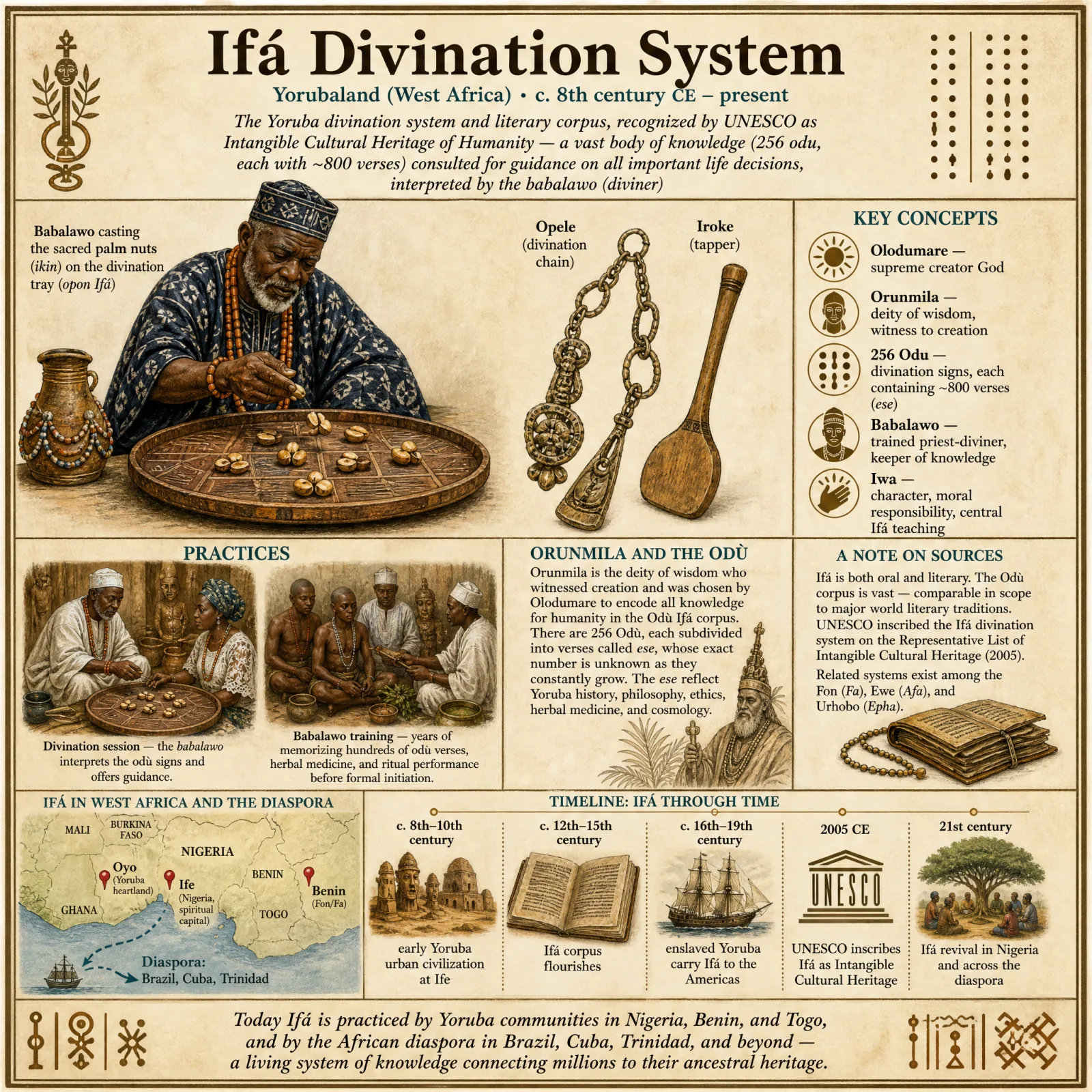
Overview
Ifá is a comprehensive system of divination rooted in the Yoruba cultural tradition of southwestern Nigeria, built upon an oral literary corpus of extraordinary scope and sophistication. Often called the Odu Ifá, this body of knowledge comprises 256 primary figures (Odù), each subdivided into hundreds of verses (ese), together forming what UNESCO has recognized as a Masterpiece of the Oral and Intangible Heritage of Humanity (proclaimed 2005, inscribed 2008). The system centers on the interpretation of geometric patterns produced by casting sacred palm nuts or divination chains, patterns which correspond to specific textual passages recited by a trained diviner known as a babaláwo (literally 'father of secrets').
While Ifá divination is intimately connected to Yoruba orisha religion, it operates as a distinct tradition with its own protocols, training, and epistemology. Ọ̀rúnmìlà—also called Ifá—is the deity associated with this knowledge, understood as the witness of human destiny before birth and the repository of all wisdom concerning individual life paths. Ifá is not primarily a religion in the sense of congregational worship, but rather a knowledge system and hermeneutic practice: a way of accessing divine counsel through a formal, literary, and mathematical process. The babaláwo functions not as a medium or spirit-possessed oracle, but as a skilled interpreter of a fixed textual tradition, selecting and chanting appropriate verses based on the divination configuration.
The Ifá corpus is oral literature of staggering scope. Conservative estimates suggest at least 4,096 major ese (256 Odù × 16 core verses), though the actual total is far higher—some authorities count between 40,000 and 100,000 verses, and the corpus remains open, with new ese continuously composed and transmitted. A fully trained babaláwo commits thousands of these verses to memory over years of intensive apprenticeship, creating a living archive that rivals the scale of any written scripture. This oral literary achievement has attracted scholarly attention from anthropology, linguistics, philosophy, and religious studies, and Ifá is now practiced not only in Nigeria but across West Africa (Benin, Togo, Ghana), the African diaspora (Cuba, Brazil, Haiti, Trinidad, the United States), and beyond.
Historically, Ifá divination likely emerged in the Yoruba region by the first millennium CE, though oral traditions trace its origin to the legendary sage Ọ̀rúnmìlà, said to have lived many centuries earlier. The system's spread followed Yoruba political and cultural expansion—particularly during the Oyo Empire's height (16th–18th centuries)—and later, through the transatlantic slave trade and subsequent diasporic adaptations. In the 21st century, Ifá continues to thrive as both a traditional practice embedded in African communities and a global spiritual resource, sustained by UNESCO safeguarding initiatives, academic scholarship, and transnational networks of practitioners.
Historical Development
The historical origins of Ifá divination are difficult to reconstruct with precision, as the tradition predates written records in the Yoruba region. According to internal tradition, Ifá knowledge was revealed by Ọ̀rúnmìlà, a semi-divine sage associated with Ilé-Ifẹ̀, the spiritual and cosmological center of Yoruba culture. Oral narratives describe Ọ̀rúnmìlà as a witness to destiny: present at Olódùmarè's court when each human being chose their oriẹ (destiny) before birth, he alone retained the memory of these choices and could reveal them through divination. Whether Ọ̀rúnmìlà was a historical figure or a symbolic personification of the system's wisdom is contested, but his name and role structure the entire divination discourse.
Archaeological and historical evidence places the development of Ifá in the broader context of Yoruba state formation, likely between the 9th and 13th centuries CE. The system's textual references to historical kingdoms, warfare, trade networks, and political institutions suggest it crystallized during the era of early Yoruba city-states (Ifẹ̀, Ọ̀yọ́, Ìjẹ̀bú, Èkìtì) and became formalized as a mechanism for political and spiritual decision-making. Ifá served kings, chiefs, and commoners alike, consulted for matters ranging from succession disputes to agricultural calendars to individual illness. The Alaafin of Oyo and the Ooni of Ife maintained official court diviners, embedding Ifá within the structures of governance.
The Oyo Empire's expansion (16th–18th centuries) carried Ifá divination westward into present-day Benin and Togo, where it blended with Fon and Ewe religious practices to produce the Fa system, closely related but distinct in ritual and terminology. During the same period, Ifá traveled with Yoruba merchants and military campaigns into neighboring regions. The transatlantic slave trade (16th–19th centuries) forcibly relocated millions of Yoruba speakers to the Americas, where Ifá became foundational to diasporic religions: Lucumí (Santería) in Cuba, Candomblé in Brazil, Vodou in Haiti, and Orisha traditions in Trinidad and the United States. In these contexts, Ifá was often practiced clandestinely, syncretized with Catholic symbolism, and adapted to new social conditions, yet retained its core structure of 256 Odù and its hermeneutic logic.
Colonial rule in Nigeria (late 19th–mid 20th century) brought pressure on traditional religious institutions. British and missionary authorities often dismissed Ifá as 'superstition,' and Western education systems marginalized indigenous knowledge transmission. Despite this, Ifá persisted, especially in rural areas and through lineage-based training. Post-independence Nigeria (1960–) saw a cultural resurgence: scholars like Wándé Abímbọ́lá and Kọ́lá Abímbọ́lá, both trained babaláwo and academics, began documenting the literary and philosophical dimensions of Ifá, presenting it not as folklore but as a sophisticated intellectual tradition. The UNESCO proclamation (2005/2008) marked international recognition of Ifá's value, prompting safeguarding initiatives including the establishment of the Ifá Heritage Institute in Ọ̀yọ́ (2008), a two-year college teaching the Ifá corpus in Yoruba language.
In the 21st century, Ifá divination exists in multiple registers: as an indigenous West African practice centered on Yoruba communities; as a globalized spiritual technology accessible via diaspora networks and digital media; and as an object of academic study in fields from philosophy to performance studies. Debates continue over authenticity, authority, and the transmission of secret knowledge—particularly as Ifá appears online, in published translations, and among non-African practitioners. The tradition's resilience lies in its dual nature: rigidly structured (the 256 Odù are fixed) yet infinitely interpretable (each ese can be applied to new circumstances), allowing Ifá to remain both ancient and contemporary.
Worldview and Philosophy
Ifá operates within a Yoruba cosmological framework but articulates its own epistemological and ethical logic. The system presupposes a layered universe: Olódùmarè (the supreme divinity, distant and non-anthropomorphic) at the apex; the orisha (deities with specific domains—Ògún for iron and war, Ọ̀ṣun for rivers and fertility, Ṣàngó for thunder, etc.) as intermediary forces; ancestors (egungun) as protective lineage spirits; and human beings navigating destiny (orí and àyànmọ́) in the physical realm (ayé). Ifá situates Ọ̀rúnmìlà within this hierarchy as the deity of wisdom and the keeper of destinies, uniquely positioned between divine knowledge and human need.
Central to Ifá philosophy is the concept of àyànmọ́ or ìpín—the notion that each person chose a destiny before birth, including life span, character tendencies, challenges, and potential accomplishments, but that this destiny is neither wholly deterministic nor wholly arbitrary. The individual's head (orí) carries this destiny, yet human beings possess àṣẹ (spiritual agency, authoritative power) to modify outcomes through action, sacrifice (ẹbọ), and proper conduct (ìwà). Ifá divination functions as the mechanism for recovering knowledge of one's pre-chosen path, revealing obstacles and recommending interventions—ritual offerings, behavioral changes, or alliances with specific orisha—that align individual will with cosmic order.
Ifá epistemology privileges sensory verification and empirical testing. Yoruba concepts of knowledge distinguish between ìmọ̀ (direct, firsthand knowledge based on perception) and ìgbàgbó (secondhand belief, information obtained from others). Ifá texts, as transmitted knowledge, technically fall under ìgbàgbó, yet their authority is secured by communal consensus, ancestral validation, and pragmatic outcomes. Philosopher Barry Hallen notes that Ifá operates as an interpretive hermeneutic rather than a mechanical oracle: the babaláwo must select from multiple ese associated with each Odù, applying judgment, contextual insight, and ethical reasoning to identify the verse that 'speaks' to the client's situation. This is philosophy enacted through divination—logic, analogy, metaphor, and narrative deployed to diagnose moral and spiritual conditions.
The 256 Odù are structured through a binary mathematical system. Divination produces a sequence of eight positions, each marked as either single or double (corresponding to one or two palm nuts remaining in the diviner's hand, or the concave/convex faces of the divination chain). This yields 256 possible figures (2⁸ = 256), each named and ranked. The sixteen primary Odù (the Mejì or 'doubled' figures: Èjì Ogbè, Ọ̀yẹ̀kú Méjì, Ìwòrì Méjì, etc.) are considered senior; the 240 combined figures (Amọ̀lù) are junior. Each Odù has its own temperament, historical associations, orisha affiliations, and ethical themes. For instance, Èjì Ogbè (the first Odù) is associated with light, beginnings, and male lineage, often linked to Ọbàtálá; Ọ̀yẹ̀kú Méjì evokes death, endings, and mystery, associated with Ìkú (death personified).
Ifá texts embed Yoruba ethics, particularly the centrality of ìwà (character, moral comportment). Good character—honesty, patience, respect, generosity—is repeatedly emphasized in ese as the foundation of a successful life. The corpus critiques greed, arrogance, haste, and deceit through cautionary tales in which protagonists suffer for moral failings. Sacrifice (ẹbọ) is the primary mode of restoring balance: offerings to orisha, ancestors, or Ẹṣù (the trickster deity who mediates between human and divine) are prescribed not as supplication but as reciprocal exchange, maintaining cosmological circulation of àṣẹ. Ifá also addresses social justice, gender relations, kingship, and ecological balance, making the corpus a philosophical encyclopedia as much as a divination manual.
Contemporary philosophers, notably Kọ́lá Abímbọ́lá, argue that Ifá constitutes a complete philosophical system comparable to classical Western traditions, articulating metaphysics, ethics, logic, and epistemology through oral narrative. This challenges earlier anthropological models that treated divination as 'primitive magic' rather than rational inquiry. Ifá divination, in this view, is a technology of knowledge production: a formal method for diagnosing uncertainty, a communal archive of historical and moral precedent, and a dialogic performance in which meaning is co-created by diviner, text, and client.
Sacred Texts and Oral Literature
The Ifá literary corpus—known collectively as Odu Ifá—is not a fixed text but an expansive, living archive transmitted orally and performatively. It consists of 256 major chapters (Odù), each subdivided into ese (verses), recited poetically by babaláwo during divination. The exact number of ese is unknown and debated: conservative estimates suggest 800–1,000 ese per Odù (yielding ~200,000 verses total), though no single babaláwo memorizes all of them. Each diviner masters a core repertoire—typically several thousand verses—and adds to this knowledge throughout their career through continued study with senior colleagues and consultation of recorded materials.
Each ese is a self-contained narrative unit, usually 50–200 lines long when fully recited, though shortened versions exist for quick consultation. The typical structure includes: (1) an opening formula identifying the Odù and invoking Ọ̀rúnmìlà; (2) a story (ìtàn) about a protagonist—human, animal, or deity—who faced a dilemma and consulted Ifá; (3) the divination outcome and prescribed sacrifice; (4) the results of following or ignoring the advice; (5) a closing proverb or moral summary. These narratives encode Yoruba history, mythology, medicinal knowledge, astronomical observations, agricultural calendars, and social norms. Many ese reference historical events (wars between Oyo and Dahomey, migrations, famines), providing oral-historical data that scholars have correlated with external sources.
The ese are chanted in a specialized poetic register called 'Ifá language' (èdè Ifá), characterized by archaic vocabulary, metaphor, proverbs (òwe), praise epithets (oríkì), and tonal musicality. Mastery requires linguistic skill beyond conversational Yoruba. The performance of ese is itself significant: babaláwo modulate tone, rhythm, and volume to emphasize key passages, and may intersperse Yoruba with ritual formulae in other languages (some ese contain lexical borrowings from Fon, Hausa, or Arabic, reflecting historical interactions). The chant is not merely informational transmission but aesthetic and rhetorical persuasion, shaping the client's understanding of their situation through narrative analogy.
Beyond the ese, Ifá tradition includes secondary genres: oríkì Ifá (praise poems for Ọ̀rúnmìlà), orín Ifá (ritual songs), àdúrà (prayers), and ọfọ̀ (incantations for specific rituals). Training texts for apprentices often begin with memorization of the sixteen Mejì Odù and their associated oríkì, then progressively add ese. Traditionally, transmission was entirely oral, from master to apprentice in intensive one-on-one sessions over 7–21 years. However, since the mid-20th century, written aids have appeared: notebooks kept by babaláwo, published collections by scholars (Wándé Abímbọ́lá's Ifá Divination Poetry, 1977; William Bascom's Ifa Divination, 1969), and digital archives. This shift raises debates about secrecy, commercialization, and the integrity of oral transmission.
The Ifá corpus also circulates in diaspora contexts, where it has been adapted and sometimes creolized. Cuban Lucumí preserves a large body of Odù and ese, though in 19th-century Yoruba dialect mixed with Spanish terminology. Brazilian Candomblé Ketu maintains a more fragmentary corpus but retains core Odù structures. These variations—sometimes called 'Regla de Ocha-Ifá' or 'Ifá de la Diaspora'—are contested: some Nigerian practitioners view them as legitimate branches, others as incomplete or altered. The question of textual authority is ongoing, especially as diaspora babaláwo increasingly reconnect with Nigerian counterparts and seek 'authentic' training.
UNESCO's 2005 proclamation of Ifá as Intangible Cultural Heritage recognized the corpus as endangered: aging babaláwo, declining apprenticeships, Christian and Islamic missionary pressure, and youth disinterest threatened transmission. The safeguarding project funded the Ifá Heritage Institute in Ọ̀yọ́ (opened 2008), a two-year residential program where students learn the corpus in Yoruba language, plus associated rituals, herbal medicine, and philosophical exegesis. Digital projects have also emerged: audio recordings, YouTube channels, and apps that facilitate memorization, though these remain controversial within traditionalist circles who argue that Ifá knowledge requires initiation and embodied practice, not mere textual access.
Divination Practice and Ritual
Ifá divination is a formal ritual process governed by precise protocols. The session (known as dídá Ifá, 'casting Ifá') occurs in a sacred space—typically the babaláwo's shrine room or a designated outdoor location—and involves four key participants: the babaláwo (diviner), the client (or clients), the divination instruments, and the spiritual presences invoked (Ọ̀rúnmìlà, Ẹṣù, and relevant orisha or ancestors). The client approaches the babaláwo with a question or dilemma: health issues, marital decisions, career choices, disputes, or general requests for guidance ('What does Ifá say about my life?'). The babaláwo does not need to know the specifics in advance; the divination will reveal the issue.
The primary divination instrument is ikin Ifá: sixteen sacred palm nuts from the Ọpẹ Ifá tree (Elaeis guineensis), each with four eyelets (a rare mutation). These nuts are consecrated, housed in a carved wooden bowl (agere Ifá), and treated with ritual reverence—fed offerings, never touched by uninitiated hands, and stored with medicines. To divine, the babaláwo holds the sixteen ikin in his left hand, then scoops them with his right hand in a rapid motion. If exactly one nut remains in the left hand, he marks two vertical lines in wood dust (ìyẹ̀rọ̀sùn, termite-eaten powder) spread on a divination tray (opón Ifá). If two nuts remain, he marks one line. The process repeats eight times, generating a column of eight marks read from right to left and top to bottom, producing one of the 256 Odù.
An alternative, faster method uses the ọpẹlẹ (divination chain): a chain with eight half-shells of the ọpẹ fruit or metal discs, four on each side, each with a concave and convex face. The babaláwo casts the chain, and the pattern of concave/convex faces corresponds to one of the 256 Odù. The ọpẹlẹ is used for quick consultations, while ikin divination is reserved for initiation, annual ceremonies, or complex matters requiring greater spiritual authority. Both methods produce the same Odù figures, but ikin is considered more direct communication with Ọ̀rúnmìlà.
Once the Odù is determined, the babaláwo recites ese associated with it. Because each Odù has hundreds of ese, the diviner must select the appropriate one(s) based on context, intuition, and secondary questioning. The ese are chanted in poetic Yoruba, often accompanied by tapping an ivory or wooden staff (ìròkè Ifá) on the edge of the opón Ifá to 'call' Ọ̀rúnmìlà's attention. The client listens as the narrative unfolds, identifying resonances with their own situation. The babaláwo then explains the ese's meaning, diagnoses the spiritual cause of the problem, and prescribes ẹbọ (sacrifice/offering) to address it. Ẹbọ may include animal offerings (chickens, goats, pigeons), vegetable offerings (kola nuts, palm oil, yams, honey), monetary payments, or behavioral prescriptions (fasting, celibacy, reconciliation with an offended party).
The role of Ẹṣù is central. Ẹṣù is the trickster orisha who controls the crossroads between human and divine realms; without his cooperation, sacrifices do not reach their intended recipients and divination may be blocked. Before every Ifá session, the babaláwo feeds Ẹṣù first—usually with palm oil, rum, and prayers—to ensure smooth communication. Ẹṣù's face is carved prominently on divination trays, and his shrines occupy the threshold of Ifá temples. Misunderstanding of Ẹṣù by European colonial observers led to misidentification with the Christian Devil, a conflation explicitly rejected by Yoruba theology: Ẹṣù is morally neutral, enforcing cosmic justice but not inherently malevolent.
Becoming a babaláwo requires initiation (ìtẹ̀fá or itẹ̀lọdù), a multi-day ceremony involving ritual seclusion, head-shaving, receiving ikin Ifá, and revelation of one's 'birth Odù' (the Odù that governs one's own destiny). Initiation costs significant resources—animals, cloth, cowries, fees to senior diviners—and confers lifelong responsibilities: daily prayers to Ọ̀rúnmìlà, abstention from specific foods (taboos vary by Odù), and communal obligations. Women's participation in Ifá has historically been restricted in Nigeria (only men could become babaláwo in most lineages), though women can be initiated into orisha priesthoods and in some diaspora contexts (Cuba, Brazil) women do become Ifá initiates (ìyánífá), a practice that remains controversial.
Ifá divination extends beyond individual consultation to communal and calendar rituals. Annual Ifá festivals occur in Yoruba towns, featuring processions, collective divinations for the community's coming year, and renewal of the babaláwo's spiritual authority. The Odù Ifá Agbáyé—a global divination for the entire world—is performed each June in Ilé-Ifẹ̀, with results announced publicly, addressing issues from climate to politics to health. In diaspora contexts, Ifá has adapted: Cuban Ifá divination (called 'registro') follows similar logic but may use Spanish-language ese or different sacrificial protocols; Brazilian babaláwo often work within Candomblé houses alongside other priesthoods. Digital divination—automated Odù generation via apps—exists but is widely rejected as spiritually invalid, lacking the necessary invocation of Ọ̀rúnmìlà and face-to-face hermeneutic dialogue.
Internal Diversity and Diasporic Expressions
While Ifá operates as a recognizable system across contexts, significant internal diversity exists based on geography, lineage, and historical trajectory. Within Nigeria, regional styles vary: Ọ̀yọ́ babaláwo emphasize oral performance and lengthy ese recitation; Ìjẹ̀bú diviners favor more concise verses and elaborate visual symbolism on opón Ifá; Ègbádò and Ègba lineages have distinct ritual calendars and taboos. These differences do not represent sectarian divisions but rather organic variation within a shared framework. Lineage (ilẹ̀ Ifá) is crucial: apprentices train under a specific master babaláwo, inheriting that lineage's interpretive traditions, ese corpus, and ritual protocols. Cross-lineage recognition exists, but authority claims can be contested, especially when political or economic stakes are involved (e.g., who may crown a king, who speaks for Ifá in public discourse).
In Benin and Togo, Ifá is known as Fa or Afa, practiced primarily among Fon and Ewe speakers. Fa retains the 256-sign structure and uses similar instruments (fádékwín, equivalent to ikin; fa tray, equivalent to opón Ifá) but integrates Fon cosmology, vodún spirits, and linguistic adaptations. Ritual procedures differ: Fa diviners (bokonɔ) often perform daily divinations for clients, emphasizing 'coolness' (achieving balance) over dramatic interventions, and incorporate elements of Islamic geomancy (absorbed via trans-Saharan trade). Benin's Vodún religion has also been recognized by UNESCO (as 'Oral Heritage of Gelede'), and Fa functions as its primary divinatory system. Scholarly debate continues on whether Fa originated independently or derived from Yoruba Ifá during Oyo Empire expansion; most evidence points to shared roots with subsequent divergence.
The African diaspora has produced distinct Ifá branches, shaped by slavery's ruptures and subsequent cultural innovations. In Cuba, Ifá (often called 'La Regla de Ifá' or integrated into 'Regla de Ocha-Ifá'—the combined Santería/Ifá system) was preserved by Lucumí (Yoruba-descended) enslaved persons and freedmen in the 19th century. Cuban Ifá uses the same 256 Odù structure, names them in 19th-century Yoruba dialect (Eyiogbe, Oyeku, Iwori, etc.), and maintains a corpus of ese, though these have been supplemented with Cuban historical references and Spanish-language chants. Cuban babaláwo (also called olorishas when referring to general orisha priests) underwent a cultural renaissance post-1959 Cuban Revolution, as African heritage was officially promoted, and since the 1980s have reconnected with Nigerian practitioners, leading to debates over 'African orthodoxy' versus 'creolized legitimacy.'
Brazilian Candomblé Ketu houses include Ifá divination, though it is less central than in Cuba; instead, dilogun (cowrie shell divination) is more commonly used for routine consultations. However, some Candomblé lineages have babaláwo trained in Nigerian or Cuban systems, and Brazilian Ifá has grown since the late 20th century through transatlantic exchanges. Haitian Vodou incorporates elements of Fa divination (via Fon influence) but blends it with other systems, and dedicated Ifá practice is rarer. In Trinidad and Tobago, the Orisha tradition includes Ifá divination within its ritual complex, often under the leadership of Yoruba cultural societies.
North American Ifá has emerged since the 1960s, initially through Cuban exiles and later through Nigerian diaspora communities and spiritual seekers. Ifá temples exist in Miami, New York, Los Angeles, and other cities, serving both African-descended practitioners and converts of various backgrounds. This has sparked controversies: Is Ifá an ethnic-specific tradition or a universal philosophy? Can non-Yoruba people be legitimately initiated? Some Nigerian babaláwo welcome global participation as fulfilling Ifá's expansionist mandate; others view it as cultural appropriation. The commercialization of Ifá—online initiations, commodified rituals, 'spiritual tourism' to Nigeria—has intensified these debates.
Gender and Ifá authority also vary by context. In Nigeria, most lineages historically excluded women from becoming babaláwo (though women could and did become priestesses of orisha like Ọ̀ṣun, Ọya, or Yemọja, and some held significant religious authority as ìyálóde or ìyálàṣẹ). Since the late 20th century, a few Nigerian women have been initiated as ìyánífá (female Ifá priests), but this remains controversial. In contrast, Cuban and diaspora Ifá have more frequently initiated women, though debates continue. Kola Abimbola and other scholars argue that Ifá philosophy itself does not exclude women; the exclusion was a historical-social pattern, not a theological necessity. This debate exemplifies how Ifá's 'tradition' is both stable (the 256 Odù remain fixed) and negotiable (ritual practice adapts to social change).
Global Communities and Contemporary Practice
The primary geographic center of Ifá remains the Yoruba region of southwestern Nigeria, particularly the states of Ọ̀yọ́, Ọ̀ṣun, Ògùn, Ọ̀ndó, and Èkìtì. Within these areas, Ifá is practiced both as a living indigenous tradition and as a consciously revived cultural heritage. Babaláwo serve urban and rural communities, consulted by individuals across religious boundaries—Muslims and Christians often consult Ifá for serious decisions while maintaining their monotheistic public identities. This pluralism is typical in Yoruba society, where multiple religious affiliations coexist pragmatically.
Ilé-Ifẹ̀ holds unique spiritual authority as the mythic origin point of both Yoruba culture and Ifá itself. The city hosts the annual Odún Ifá festival, attended by babaláwo from across Nigeria and the diaspora, and the Ooni (king of Ifẹ̀) serves as a patron of Ifá tradition. The Ifa Heritage Institute in Ọ̀yọ́ town, established under UNESCO's safeguarding project (2008), operates as an Ifá seminary, offering two-year residential programs teaching the Odu corpus, herbal medicine, ritual procedures, and Yoruba philosophy in Yoruba language. Graduates receive certification as babaláwo and return to their communities to practice and teach.
Beyond Nigeria, Ifá communities exist in Benin and Togo (where Fa divination is integrated into Vodún religious practice), Ghana (among Yoruba diaspora and converts), and other West African countries. In Benin, the city of Ouidah functions as a Vodún pilgrimage site, with Fa shrines and annual festivals. The transnational character of Ifá is evident in the movement of babaláwo between Nigeria, Benin, and diaspora centers for training, collaboration, and ritual events.
The Caribbean and Latin America host large Ifá communities, especially in Cuba (Havana, Matanzas, Santiago de Cuba), where Ifá is embedded within the broader Santería/Regla de Ocha tradition. Cuban Ifá houses (ilé Ifá) operate semi-publicly, offering divination services, initiation ceremonies, and annual tambores (drumming festivals) that celebrate orisha and Ọ̀rúnmìlà. Cuban babaláwo have, since the 1990s, re-established ties with Nigerian counterparts, traveling to Ilé-Ifẹ̀ for 'spiritual pilgrimage' and inviting Nigerian elders to Cuba for ceremonies, creating a transatlantic Ifá network. In Brazil, Ifá is less central than in Cuba but has grown through Candomblé lineages incorporating babaláwo trained in Nigerian or Cuban traditions.
In the United States, Ifá communities have expanded since the 1970s, concentrated in cities with large African diaspora populations (New York, Miami, Los Angeles, Atlanta, Houston, Chicago). Temples (ilé Ifá) offer divination, initiation, classes, and festivals. Some operate as nonprofit cultural organizations, emphasizing Yoruba heritage education, African identity formation, and spiritual wellness. Ifá has also attracted non-Black converts, leading to ongoing discussions about cultural ownership and access. Organizations like the World Congress of Orisa Tradition and Culture (founded 1981, with Wándé Abímbọ́lá as long-time president) facilitate international coordination, holding biennial conferences that rotate between Nigeria, the Americas, and Europe.
Digital technologies have transformed Ifá practice and community formation in the 21st century. Babaláwo maintain YouTube channels, Facebook groups, and websites offering teachings, though full divination consultations typically occur in person or via video call (WhatsApp, Zoom) rather than automated processes. Online sales of ritual materials (ikin, opón Ifá, beaded necklaces) have commercialized aspects of Ifá, raising ethical questions about commodification. Virtual Ifá 'universities' offer courses in Yoruba language, Odù study, and ritual procedures, though these are often viewed as supplementary to in-person apprenticeship, not replacements. The COVID-19 pandemic accelerated digital adoption, with some initiation rituals conducted remotely, though this remains controversial.
Demographically, Ifá practitioners (both babaláwo and clients) span social classes, from rural farmers to urban professionals, and religious backgrounds (Christians, Muslims, and traditionalists all consult Ifá). Gender dynamics are shifting: while the babaláwo priesthood has been male-dominated, women increasingly participate as ìyánífá (in diaspora and reform-minded Nigerian lineages), orisha priestesses, ritual assistants, and clients. Youth engagement is a concern: the intensive memorization and traditional protocols of Ifá training compete with formal education and economic opportunities, leading UNESCO and Nigerian cultural ministries to fund preservation initiatives aimed at attracting younger apprentices.
Sacred Sites and Centers of Practice
Ilé-Ifẹ̀ (Osun State, Nigeria) is the paramount sacred center of Ifá. According to Yoruba cosmology, Ilé-Ifẹ̀ is the place where Olódùmarè sent the orisha Ọbàtálá and Odùduwà to create the earth, making it the navel of the world (ìbùdó ilẹ̀). It is also the mythic home of Ọ̀rúnmìlà, where he taught the Ifá system to his disciples. The city contains numerous sacred groves, shrines, and the Ooni's palace, which functions as both a political and spiritual nucleus. The annual Odún Ifá festival in Ilé-Ifẹ̀ attracts thousands of babaláwo, culminating in the Odù Ifá Agbáyé (global divination for the coming year). Archaeological evidence confirms Ilé-Ifẹ̀'s antiquity, with artistic traditions (terracotta and bronze sculptures) dating to the 12th–15th centuries, reinforcing its role as a cultural and religious epicenter.
Oke Itase (Ilé-Ifẹ̀) is the hill where, according to oral tradition, Ọ̀rúnmìlà taught Ifá to his sixteen disciples (the Olodu Méjì, named after the sixteen primary Odù). The site is marked by the Ifa Temple (Ifa Agbaye), a structure that serves as a pilgrimage destination for babaláwo worldwide. While the physical building is modest—constructed of mud and wood, with small windows and a corrugated iron roof—its spiritual significance is immense. The temple's interior houses consecrated ikin Ifá and ritual objects, and ceremonies conducted here are considered particularly efficacious. The site has suffered from neglect (a 2009 survey documented structural decay and lack of maintenance funding), prompting calls for restoration as part of Ifá's UNESCO Intangible Cultural Heritage status.
Ọ̀yọ́ (Oyo State, Nigeria) was the capital of the Oyo Empire (14th–19th centuries), which spread Ifá practice across West Africa. The city remains an important Ifá center, home to the Ifá Heritage Institute, established in 2008 under UNESCO's safeguarding project. The Institute operates as a residential seminary where students undergo two-year intensive training in the Odu corpus, Yoruba language, herbal medicine, and ritual practice. Located at Oke Agboniregun, it embodies efforts to formalize Ifá education and attract younger generations. Ọ̀yọ́ also hosts annual Ifá festivals and maintains strong lineages of babaláwo associated with the Alaafin of Oyo's court.
Odùduwà Grove (Ilé-Ifẹ̀) is an ancient sacred grove where ritual feasting, sacrifices, and royal coronation ceremonies occur. Archaeological research (Ogundiran & Ige, 2015) shows the grove's continuous use from at least the 14th century to the present, with material evidence of colonial-era adaptations. Though primarily associated with Odùduwà veneration, the grove also hosts Ifá ceremonies, as Ifá divination guides decisions about kingship, land use, and communal welfare. The grove exemplifies how Ifá operates within broader Yoruba religious landscapes, intersecting with orisha cults and ancestral veneration.
Osun-Osogbo Sacred Grove (Osogbo, Osun State, Nigeria), a UNESCO World Heritage Site (2005), is dedicated to the river goddess Ọ̀ṣun but also contains Ifá shrines. Babaláwo conduct divinations within the grove, especially during the annual Osun-Osogbo festival, when pilgrims seek guidance. The integration of Ifá and orisha worship here illustrates their complementarity: Ifá determines which orisha to propitiate, and orisha priests execute the prescriptions.
Ouidah (Benin) is the historical center of the Fon kingdom's slave trade and, today, a major Vodún pilgrimage site. Fa divination is practiced at temples and shrines throughout the city, particularly at the Temple of Pythons and the Gate of No Return memorial. Ouidah hosts an annual Vodún festival (January 10, National Vodún Day) featuring Fa divinations, processions, and sacrifices. Bokonɔ (Fa diviners) from across Benin and Togo gather here, making it the Benin equivalent of Ilé-Ifẹ̀'s role in Nigeria.
Matanzas and Havana (Cuba) are twin centers of Cuban Ifá/Santería. Matanzas, known as the 'Athens of Cuba,' preserves 19th-century Lucumí traditions with strong lineages of babaláwo and orisha priests. Havana hosts numerous ilé Ifá (Ifá houses) offering divination, initiation, and ritual services. Since the 1990s, Cuban babaláwo have organized transatlantic exchanges, inviting Nigerian elders to Cuba and sending Cuban practitioners to Nigeria for training, creating a globalized Ifá network. Sacred sites in Cuba include Ifá shrines (often within private homes, due to historical repression), the Regla neighborhood (across Havana Bay, dedicated to Yemọja but also home to many Ifá houses), and the Morro Castle area.
Salvador (Bahia, Brazil) is the heart of Candomblé Ketu and includes Ifá shrines within its terreiros (temples). Though dilogun (cowrie shell divination) is more common for routine consultations, babaláwo trained in Ifá conduct major divinations. Sites include the Ilê Axé Opô Afonjá terreiro, a historic Candomblé house with strong Yoruba connections, and the Afro-Brazilian Museum, which documents Yoruba diasporic religion. Salvador's annual Lavagem do Bonfim festival incorporates Candomblé/Yoruba rituals, though it is nominally Catholic.
Miami, New York, and Los Angeles (United States) host significant Ifá communities. Miami's Little Havana and Hialeah neighborhoods contain Cuban-descended Ifá houses; New York's Harlem and the Bronx host both Caribbean and African-lineage temples; Los Angeles has temples serving West African diaspora and spiritual seeker communities. These urban centers function as nodes in a transnational Ifá network, facilitating pilgrimages, festivals, and exchanges. Virtual sacred spaces—YouTube channels, Zoom shrines—have also emerged, though their legitimacy is debated.
Debates and Contested Questions
Authenticity and Authority: Who has the right to define 'authentic' Ifá, and who may transmit it? This question fractures along geographic, racial, and gender lines. Nigerian babaláwo lineages often claim primacy as guardians of the 'original' tradition, sometimes dismissing diaspora versions (Cuban, Brazilian) as incomplete or corrupted by slavery's disruptions. Conversely, diaspora practitioners argue that their traditions, while adapted, are legitimate evolutions shaped by unique historical conditions and should not be subordinated to Nigerian authority. Since the 1990s, Nigerian-diaspora reconnection has intensified these debates, with some Cuban babaláwo traveling to Nigeria for 're-initiation' under Nigerian elders, prompting disputes over whether diaspora initiations 'count.' The issue is complicated by commercialization: some Nigerian babaláwo offer rapid 'tourist initiations' for high fees, which other practitioners denounce as spiritually invalid.
Gender and Ifá Priesthood: Historically, most Nigerian Ifá lineages restricted babaláwo status to men, though women could become powerful priestesses of orisha like Ọ̀ṣun, Ọya, or Yemọja. This exclusion rests on narratives in the Ifá corpus about Odù (personified as Ọ̀rúnmìlà's wife) being denied full divination authority due to past transgressions—stories that feminist scholars and reformist practitioners challenge as androcentric interpretations, not theological absolutes. Since the late 20th century, some Nigerian lineages and many diaspora communities (especially Cuban) have initiated women as ìyánífá. Prominent Nigerian ìyánífá, such as Chief (Mrs.) Fátùnbí, have defended women's inclusion, citing alternative ese that affirm women's capacity for Ifá knowledge. Opponents argue that breaking traditional gender taboos invites spiritual danger and disrespects ancestral protocols. This debate is ongoing and reflects broader tensions between cultural preservation and social justice.
Secrecy and Public Disclosure: Ifá knowledge has traditionally been esoteric, transmitted orally within initiatory lineages and protected by oaths. Yet since the mid-20th century, scholarly publications (Bascom, Abimbola), museum exhibitions, and digital media have made Ifá texts and rituals widely accessible. Some babaláwo welcome this transparency as necessary for safeguarding the tradition and countering racist depictions of African religions as 'primitive.' Others view it as dangerous commodification that strips Ifá of sacred power and allows uninitiated persons to misuse the knowledge. The publication of ese in English translation is particularly contentious: does translation betray the ritual potency embedded in Yoruba language, or does it enable global appreciation? This tension parallels debates in other esoteric traditions (Kabbalah, Tibetan Buddhism, Native American spirituality) over publicness versus privacy.
Modernization and Technology: Can Ifá adapt to modernity without losing its essence? The proliferation of 'Ifá apps' that generate Odù via algorithms, online divination services, and virtual initiations has sparked fierce debate. Traditionalists argue that authentic divination requires physical presence, consecrated instruments (ikin, ọpẹlẹ), and invocation of Ọ̀rúnmìlà through ritual procedures impossible to replicate digitally. Modernizers counter that technology is a tool, not a replacement: apps can aid memorization, online consultations extend access for diaspora practitioners, and digital archives preserve endangered ese. The COVID-19 pandemic forced many communities to experiment with remote rituals, accelerating these debates. The question is whether Ifá's 'tradition' is defined by specific material practices (physical palm nuts, face-to-face chanting) or by the underlying hermeneutic logic (256 Odù, ese interpretation, ethical reasoning).
Ifá and Monotheism: Yoruba Christians and Muslims often consult Ifá, creating syncretistic accommodations that purist theologians (both Yoruba traditionalist and monotheist) find problematic. Some babaláwo argue that Olódùmarè (the supreme divinity) is compatible with the Christian God or Islamic Allah, framing Ifá as a culturally specific path to the same transcendent truth. Others insist Ifá is irreducibly polytheistic, centered on orisha veneration, and cannot be reconciled with monotheism. Christian and Muslim leaders have historically condemned Ifá as 'pagan idolatry,' though grassroots practice is more flexible. This debate intersects with African identity politics: is Ifá an ethnic heritage or a religious system? Can one be culturally Yoruba (and thus honor Ifá) without religiously affirming orisha existence?
UNESCO Recognition and Institutionalization: The 2005/2008 UNESCO proclamation brought international prestige but also bureaucratization. The Ifá Heritage Institute and other formal programs institutionalize Ifá training, shifting it from apprenticeship to schooling. Critics worry this creates a 'standardized' Ifá disconnected from living lineages, prioritizing textual knowledge over embodied practice, and introducing Western educational models (grading, certificates) incompatible with Ifá's oral-ritual character. Supporters argue that formal institutions are necessary for survival in a globalized, state-centric world, and that without them, Ifá would remain marginal and underfunded. This reflects broader tensions in heritage preservation: can a tradition be safeguarded without fundamentally altering it?
Philosophical Status: Is Ifá a religion, a philosophy, or something else? Western academic categories struggle to classify it. Anthropologists often treat Ifá as 'divination' (a sub-category of 'magic' or 'religion'), while philosophers like Kọ́lá Abímbọ́lá and Barry Hallen argue it is a complete philosophical system deserving comparison with Plato or Confucius. This debate has political stakes: categorizing Ifá as 'philosophy' grants it intellectual legitimacy in academic and UNESCO contexts, countering colonial-era dismissals of African thought as 'pre-philosophical.' However, some practitioners reject the 'philosophy' label as reductive, insisting Ifá is a living spiritual practice, not an abstract idea-system. The question is whether Ifá can be both—simultaneously a communal ritual technology and a theoretical framework for ethics and epistemology.
Key Terms
- Odù
- The 256 primary figures or 'signs' generated through divination, each corresponding to a corpus of ese (verses). The sixteen senior Odù (Mejì) are considered foundational; the 240 junior Odù (Amọ̀lù) are combinations of the Mejì. Each Odù has its own name (e.g., Èjì Ogbè, Ọ̀yẹ̀kú Méjì), personality, associated orisha, taboos, and philosophical themes.
- Ese
- The verses, poems, or narratives associated with each Odù. Each ese tells a story (ìtàn) featuring a protagonist, a dilemma, a divination consultation, prescribed sacrifice, and outcome. Ese are the textual units babaláwo recite during divination, applying them analogically to clients' situations.
- Ọ̀rúnmìlà (Ifá)
- The deity of wisdom, divination, and destiny, also called Ifá. Ọ̀rúnmìlà is understood as the witness of destiny—present when each human chose their oriẹ (destiny) before birth—and the one who remembers and reveals these choices through divination. He is depicted as a patient, wise teacher rather than a commanding ruler.
- Babaláwo
- 'Father of secrets,' the title for an initiated Ifá priest. Babaláwo undergo years of training, memorizing thousands of ese, learning ritual procedures, and mastering hermeneutic skills. They are the human agents through whom Ọ̀rúnmìlà speaks during divination.
- Ikin Ifá
- The sixteen sacred palm nuts used for divination. These nuts come from the Ọpẹ Ifá tree (oil palm) and are distinguished by having four eyelets (rather than the usual three). They are consecrated, treated as sacred objects, and housed in an agere Ifá (carved bowl).
- Ọpẹlẹ
- The divination chain, an alternative instrument to ikin. It consists of eight half-shells (or metal discs) attached to a chain. The babaláwo casts the ọpẹlẹ, and the pattern of concave and convex faces reveals one of the 256 Odù. Ọpẹlẹ is faster than ikin divination but considered slightly less authoritative.
- Opón Ifá
- The divination tray, a round or rectangular wooden board with a raised border often carved with images (especially Ẹṣù's face). The babaláwo spreads ìyẹ̀rọ̀sùn (wood dust) on the tray's smooth inner surface and marks the results of each cast of ikin, recording the Odù.
- Ìyẹ̀rọ̀sùn
- The fine wood powder (produced by termites eating iroko or other hardwood) spread on the opón Ifá. The babaláwo marks lines in this powder during divination, creating the visual record of the Odù.
- Ìròkè Ifá
- A tapper, usually made of ivory or wood, used by the babaláwo to strike the edge of the opón Ifá during divination. The tapping calls Ọ̀rúnmìlà's attention and punctuates the recitation of ese.
- Ẹbọ
- Sacrifice or offering prescribed by Ifá to address a problem. Ẹbọ may include animal sacrifices (chickens, goats, pigeons), plant offerings (kola nuts, yams, palm oil), cloth, cowrie shells, or behavioral changes. The logic is reciprocal exchange: the client gives something of value to rebalance spiritual accounts and align their path with destiny.
- Ẹṣù
- The trickster orisha who mediates between human and divine realms. Ẹṣù controls crossroads, communication, and the delivery of sacrifices. Without feeding Ẹṣù, divination is blocked and ẹbọ do not reach their intended recipients. Ẹṣù is morally neutral—enforcing cosmic justice but not evil—though colonial misinterpretations conflated him with the Christian Devil.
- Àṣẹ
- Spiritual power, life force, or authoritative agency. Àṣẹ flows through all beings and can be accumulated, lost, or redirected through ritual action. Ifá divination aims to restore or enhance àṣẹ, aligning individual will with cosmic order.
- Orí
- The 'head' or personal destiny. In Yoruba cosmology, each person's orí carries the memory of their pre-birth choices and determines their life trajectory. Ifá divination addresses orí, revealing its intentions and recommending actions to fulfill one's destiny.
- Àyànmọ́ / Ìpín
- Destiny or fate, the life plan chosen before birth. Àyànmọ́ is neither wholly fixed nor wholly open—human agency and sacrifice can modify outcomes within the framework of destiny. Ifá functions to reveal àyànmọ́ and guide actions that fulfill it.
- Ìwà
- Character or moral comportment. Ìwà is central to Yoruba ethics and recurs throughout the Ifá corpus as the foundation of a good life. Traits like honesty, patience, generosity, and humility are praised; greed, arrogance, and deceit are condemned.
- Ìtàn
- A story, narrative, or historical account. Each ese contains an ìtàn about a protagonist's encounter with Ifá, serving as an analogical precedent for the client's situation.
- Olódùmarè
- The supreme divinity in Yoruba cosmology, distant and non-anthropomorphic. Olódùmarè is the creator but does not intervene directly in human affairs; instead, orisha and Ifá mediate between Olódùmarè and humanity.
- Ìtẹ̀fá / Itẹ̀lọdù
- The initiation ceremony that makes someone a babaláwo. It involves ritual seclusion, head-shaving, receiving consecrated ikin Ifá, revelation of one's birth Odù, and oaths of secrecy and responsibility.
Further Reading
- UNESCO: Ifa Divination System
- Wándé Abímbọ́lá, Ifá Divination Poetry (NOK Publishers, 1977)
- William Bascom, Ifa Divination: Communication between Gods and Men in West Africa (Indiana University Press, 1969)
- Kọ́lá Abímbọ́lá, Yoruba Culture: A Philosophical Account (Iroko Academic Publishers, 2006)
- Jacob K. Olupona & Rowland O. Abiodun (eds.), Ifá Divination, Knowledge, Power, and Performance (Indiana University Press, 2016)
- Barry Hallen, 'Yoruba Epistemology', Routledge Encyclopedia of Philosophy (1998)
- Akinwumi Ogundiran & Bọ́láńlé Ige, 'Colonial Modernity, Rituals and Feasting in Odùduwà Grove, Ilé-Ifẹ̀', Journal of African Archaeology (2015)
- Timothy R. Landry, 'Fá Divination, Well-being, and Coolness in Bénin, West Africa', Journal of Religion in Africa (2023)
- Toyin Falola & Akintunde Akinyemi, 'Ifa Divination Trays from Isale-Oyo', Cahiers d'Études africaines (2003)
- Oriire: 'Orunmila: Divination, Knowledge and the Ethics of Knowing in Yoruba Religious Epistemology'
Practices
- Divination
- Ebo (offerings)
- Ancestor consultation
Core ideas
- Deity
- Olodumare; Orunmila as wisdom-keeper
- Destiny
- Each soul chooses its fate (ayanmo)
Sacred texts
The heart of Ifá divination: 256 odu, each comprising hundreds of verses of myth, proverb, and ritual prescription attributed to the orisha Orunmila. Babalawos memorize vast portions over decades and cast odu through palm nuts or a divining chain to answer life's questions. This corpus is among the largest bodies of oral wisdom literature in the world.