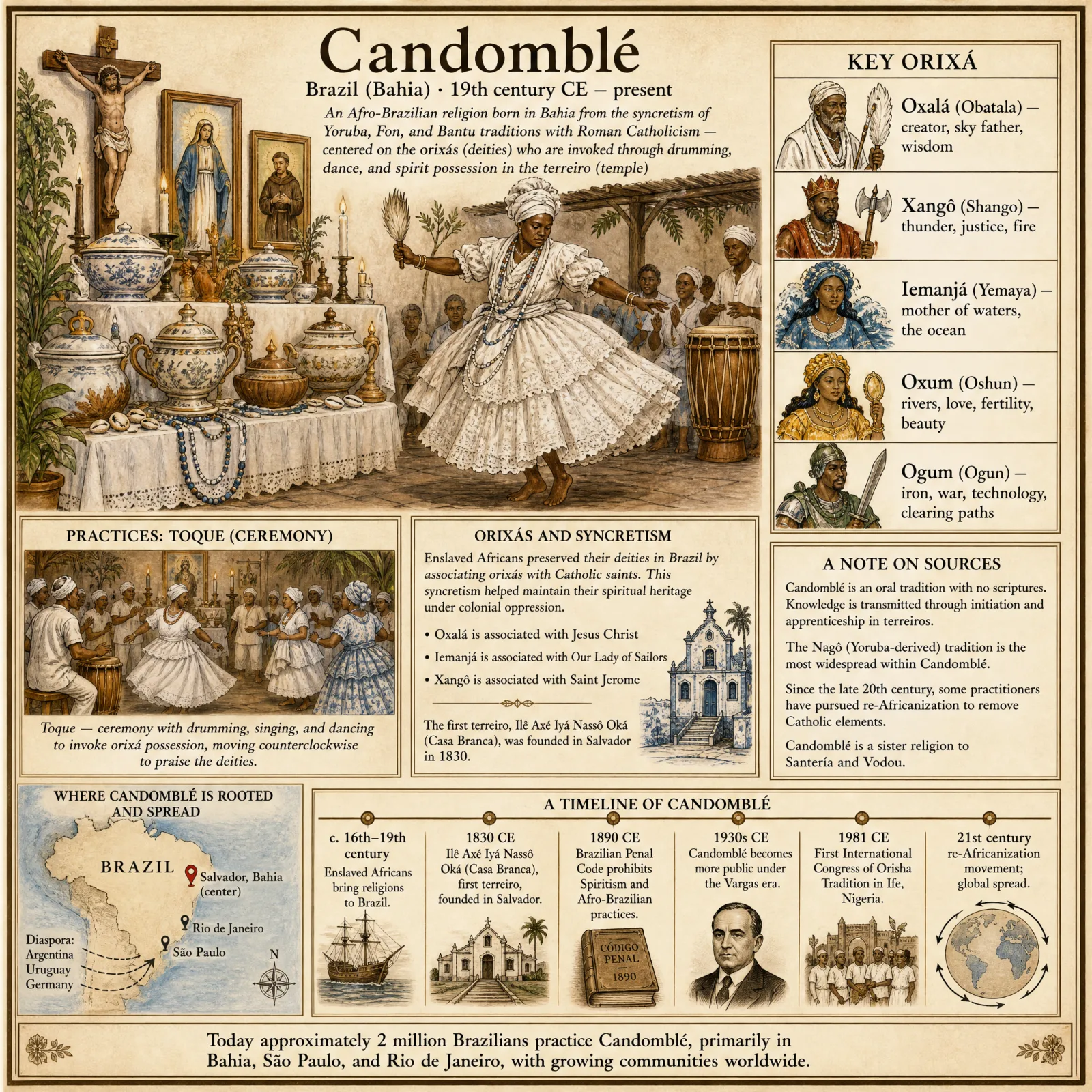
Overview
Candomblé is an Afro-Brazilian religion that crystallized in nineteenth-century Bahia, emerging from the forced encounter of enslaved West and Central Africans—primarily Yoruba, Fon, and Bantu peoples—with Brazilian slave society, Portuguese Catholicism, and indigenous influences. Unlike a singular, unified tradition, Candomblé comprises multiple nações (nations), ritual lineages identified with African ethnic origins: Ketu (Yoruba/Nagô), Jeje (Fon/Ewe from Dahomey), Angola and Congo (Bantu), and smaller groupings. Each nação preserves distinct liturgical languages, drum rhythms, deity pantheons (orixás in Ketu, voduns in Jeje, inkices in Angola), and ritual protocols, though they share common structural elements—spirit possession, animal sacrifice, initiation hierarchies, and the cultivation of axé (vital spiritual force).
At the heart of Candomblé practice is the terreiro (also called ilê, roça, or casa de santo)—a sacred compound, typically a residential property in urban or peri-urban Bahia, containing shrines, ritual rooms, sacred trees, and communal spaces. Each terreiro is led by a mãe-de-santo (mother-of-saint, also iyalorixá in Ketu terminology) or pai-de-santo (father-of-saint, babalorixá), initiated priests who oversee rituals, train godchildren (filhos and filhas-de-santo), and maintain relationships with the deities. Terreiros function as autonomous religious units without centralized hierarchy or scripture; knowledge is transmitted through initiation, apprenticeship, and embodied practice. Authority derives from seniority, initiatory lineage, demonstrated spiritual power, and community recognition.
Candomblé developed in conditions of extreme oppression—slavery, colonial racism, Catholic hegemony, and post-abolition marginalization. Enslaved Africans created Candomblé as what historian Rachel Harding calls 'alternative spaces of Blackness,' zones of relative autonomy where they cultivated African-derived identities, healed bodies and spirits, and resisted cultural erasure. Throughout the colonial, imperial (1822–1889), and early republican periods (1889–1930s), Candomblé was persecuted by police, criminalized as 'witchcraft' (feitiçaria), and subjected to raids, arrests, and destruction of ritual objects. Only in the mid-20th century did Brazilian state attitudes shift toward tolerance and, eventually, official recognition as part of national cultural heritage.
Today, Candomblé is practiced primarily in Bahia (especially Salvador and the Recôncavo region), with significant communities in Rio de Janeiro, São Paulo, and other Brazilian states. Since the 1980s, it has also spread internationally to Portugal, Argentina, Uruguay, and other countries through Brazilian migration and global spiritual networks. Contemporary Candomblé exists in tension between preservation of African heritage and Brazilian creolization, between local autonomy and transnational 're-Africanization' movements seeking to align with Nigerian Yoruba practices, and between religious secrecy and public visibility as UNESCO-recognized cultural patrimony. The religion attracts both Afro-descendants maintaining ancestral connections and white/mixed-race Brazilians drawn to its earth-centered spirituality, ritual aesthetics, and communal belonging.
Historical Development
Candomblé's roots lie in the transatlantic slave trade, which forcibly transported approximately 4–5 million Africans to Brazil between the 16th and 19th centuries, making Brazil the largest recipient of enslaved Africans in the Americas. Unlike the Caribbean and North America, where African populations were ethnically fragmented, Brazil received concentrated waves of specific groups at different periods: Bantu-speaking peoples from West-Central Africa (Congo, Angola) dominated the 16th–17th centuries; Fon-Ewe speakers from the Bight of Benin (Dahomey, present-day Benin and Togo) increased in the 18th century; and Yoruba speakers from southwestern Nigeria (especially following the collapse of the Oyo Empire) arrived in large numbers in the early 19th century. This sequential and regional concentration allowed enslaved Africans to reconstitute ethnic-religious communities despite diaspora's ruptures.
The term 'Candomblé' itself is of uncertain etymology, possibly derived from Bantu languages (kandombe, a drum or dance) or a creolized designation for African collective ritual. Early colonial and imperial documents refer to calundus (healing rituals), batuques (drumming gatherings), and casas de feitiço (witchcraft houses)—terms used pejoratively by authorities but pointing to the persistence of African religious practices despite prohibition. These practices blended healing, divination, spirit communication, and collective worship, often disguised within Catholic brotherhoods (irmandades) that enslaved and freed Blacks formed for mutual aid and burial rites. Behind the façade of Catholic saints' festivals, Africans honored their own deities.
The consolidation of Candomblé as a distinct religious institution occurred in 19th-century Salvador, Bahia's capital and Brazil's major slave port until 1850. Police archives from the 1850s–1880s, analyzed by historian Rachel Harding, document raids on Candomblé houses (then called candomblés or casas de culto) where multiple deities were worshiped in a single location by communities mixing African-born (africanos) and Brazilian-born (crioulos) practitioners. These mid-19th-century terreiros, unlike earlier individual healing practices, featured organized priesthoods, initiation protocols, communal rituals, and the cultivation of axé—understood as divine spiritual power accumulated through offerings, sacrifices, and correct ritual performance. Harding argues that Candomblé emerged as an 'Afro-Brazilian orientation to ultimate meaning,' responding to slavery's disaggregation with community-building, healing, and spiritual empowerment.
Three legendary terreiros founded in the early-to-mid 19th century became the matrices of Bahian Candomblé: the Ilê Axé Iyá Nassô Oká (Casa Branca do Engenho Velho), traditionally dated to the 1830s and associated with Yoruba women from Ketu (present-day Benin); the Terreiro do Gantois (Ilê Iyá Omin Axé Iyamassé), founded mid-19th century by initiates from Casa Branca; and the Zôogodô Bogum Malê Seja Hundê (Casa de Jeje Mahi), the primary Jeje terreiro in Cachoeira, Bahia. From these houses descended numerous other terreiros through initiatory lineages. Casa Branca, especially, is venerated as the 'mother house' (casa matriz) of Ketu Candomblé, and its priestesses—Iyá Nassô, Marcelina da Silva (Iyá Obá Sanyá), Ursulina de Figueiredo (Iyá Sussu)—are remembered as foundational leaders.
Abolition of slavery in Brazil (1888) did not end persecution. Throughout the late 19th and early 20th centuries, Candomblé faced legal repression under laws against 'illegal practice of medicine,' 'charlatanism,' and 'disturbing the peace.' Police raided terreiros, arrested priests, confiscated ritual objects (especially drums and sacred stones), and forced practitioners to pay fines or bribes. Sensationalist press coverage depicted Candomblé as 'black magic,' associating it with criminality and backwardness. This repression was racialized—part of broader efforts to 'whiten' Brazil and marginalize Afro-Brazilians in the post-abolition order. Nonetheless, Candomblé persisted through clandestinity, strategic alliances with sympathetic whites, and relocation to urban peripheries.
A crucial shift occurred in the 1930s–1940s with the Brazilian modernist movement and cultural nationalism under Getúlio Vargas's Estado Novo regime. Intellectuals like anthropologist Arthur Ramos, writer Jorge Amado, and painter Carybé celebrated Afro-Brazilian culture as authentic national heritage. Anthropologist Roger Bastide, a French scholar who lived in Brazil 1938–1954, conducted pioneering fieldwork in Salvador, publishing *Le Candomblé de Bahia* (1958) and *The African Religions of Brazil* (1960). Bastide's work, while romanticizing Candomblé and privileging Ketu-Nagô traditions as 'pure African survivals,' helped legitimize the religion academically and publicly. By the 1960s–1970s, Candomblé had gained semi-official tolerance and became a symbol of Bahian regional identity and Brazilian multiculturalism.
The late 20th century brought new dynamics: re-Africanization movements emerged, seeking to 'purify' Candomblé by eliminating Catholic syncretism, reclaiming Yoruba language, and establishing connections with Nigerian Yoruba religion. Figures like Mãe Stella de Oxóssi (Ilê Axé Opô Afonjá) and intellectuals like sociologist Juana Elbein dos Santos promoted African cultural pride and challenged earlier anthropological paradigms. Simultaneously, transnational networks formed linking Brazilian Candomblé practitioners with Cuban Santería, Haitian Vodou, and West African Yoruba and Vodun communities through conferences (such as the International Congress of Orisha Tradition and Culture), travel, and religious exchange. Scholars like J. Lorand Matory and Stefania Capone have documented how these 'Black Atlantic' circulations reshape Candomblé, creating both revitalization and new controversies over authority and authenticity.
In 1986, the Ilê Axé Iyá Nassô Oká (Casa Branca) became the first terreiro designated as national patrimony by IPHAN (Brazil's heritage agency), recognizing Afro-Brazilian religion as cultural heritage. Other terreiros have since received heritage status. In 2003, a federal law (Law 10.639) mandated teaching African and Afro-Brazilian history and culture in schools, indirectly benefiting Candomblé's visibility. However, Candomblé continues to face challenges: evangelical Christian hostility (neo-Pentecostal churches often demonize Candomblé as 'devil worship'), gentrification threatening urban terreiros, and internal debates over commercialization, gender roles, and the boundaries between tradition and innovation.
Worldview and Philosophy
Candomblé's cosmology centers on axé (ashé), a Yoruba-derived concept understood as vital spiritual force, divine energy, and the power to make things happen. Axé flows from Olodumare (Olorun, Olofin)—the supreme creator deity, distant and impersonal—through the deities (orixás in Ketu, voduns in Jeje, inkices in Angola, collectively referred to as 'saints' or santos) to humans, plants, animals, minerals, and natural forces. Axé is not static but circulates and accumulates through ritual action: sacrifice feeds axé to deities, offerings channel it, initiations transmit it, and correct behavior (including moral conduct, respect for elders, and ritual purity) preserves it. A person's well-being, health, prosperity, and spiritual development depend on maintaining balanced axé.
The deities are not abstract principles but personified forces governing natural domains and human experiences. In Ketu-Nagô Candomblé, major orixás include: Exu (guardian of crossroads, communication, and cosmic order, often misidentified with the Christian devil); Ogum (iron, war, technology, labor); Oxóssi (hunting, forests, sustenance); Obaluaiyê/Omolu (disease, healing, earth); Xangô (thunder, fire, justice, kingship); Oxum (rivers, love, fertility, wealth, beauty); Iemanjá (ocean, motherhood, nurturing); Iansã/Oyá (wind, storms, cemeteries, transformation); Oxumarê (rainbow, continuity, cycles); Nanã (primordial earth, death, ancestral wisdom); Oxalá (creation, purity, peace, wisdom, eldest deity). Each orixá possesses distinct colors, foods, songs, drum rhythms, dance movements, sacred plants, and moral attributes. Practitioners do not worship all orixás equally; through divination at initiation, each person learns which orixá 'owns their head' (dono da cabeça), establishing a lifelong tutelary relationship.
Jeje Candomblé venerates voduns—deities from Fon-Ewe cosmology including Loko (trees, medicine), Sogbô (thunder), Hevioso (lightning), Aziri (wealth, rivers), Dan (serpent, continuity), and Sakpatá (earth, smallpox/healing). Angola-Congo Candomblé honors inkices (nkisi) such as Nkosi (war), Kaitembu (forests), Nzazi (thunder), Kisimbi (water), and Kavungo (disease/healing). While deity names differ across nações, practitioners recognize structural equivalences—Xangô (Ketu) corresponds to Sogbô (Jeje) and Nzazi (Angola); Iemanjá (Ketu) to Aziri-Tobosi (Jeje) and Kisimbi (Angola). These correspondences facilitate inter-nação communication and ritual borrowing, though each nação maintains distinct liturgical integrity.
Candomblé posits a complex relationship between destiny, free will, and spirit possession. Before birth, each soul negotiates its destiny (enredo, caminho) with Olodumare, choosing life circumstances, challenges, and the orixá who will accompany them. Upon incarnation, this pre-birth choice is forgotten but can be revealed through divination (jogo de búzios, cowrie shell casting). Destiny is not deterministic—humans possess agency to improve or worsen their path through ritual intervention (ebós, offerings), moral conduct, and alignment with their orixá. Spirit possession (transe, santo feito) is the central ritual mechanism: when an orixá 'mounts' (monta) a devotee during drumming ceremonies, the possessed individual loses ordinary consciousness and embodies the deity, who dances, gestures, speaks, and interacts with the community. Possession demonstrates the deity's presence and favor, provides oracular guidance, and renews axé.
Moral philosophy in Candomblé is relational and situational rather than based on universal commandments. Ethical behavior emphasizes respect for elders (especially ritual elders), honoring one's word, reciprocity, humility before the deities, and maintaining ritual purity. Each orixá has specific taboos (quizilas or ewós)—foods, colors, actions forbidden to their initiates—that vary individually based on divination. What is prohibited for one person may be required for another. Candomblé does not dichotomize 'good' and 'evil' in Christian terms; orixás can be beneficent or destructive depending on circumstances, and rituals exist for both protection and harm (feitiços or trabalhos). This moral flexibility reflects pragmatic, context-sensitive ethics rooted in African cosmologies, though it has attracted Christian criticism.
Death in Candomblé is a transition, not an ending. The deceased become eguns (ancestors), joining the ranks of spirits who continue to influence the living. Elaborate funerary rites (axexê) ensure the spirit's peaceful separation from the body and community, preventing it from 'walking' (causing disturbances). Ancestors are honored at shrines and consulted for guidance, though ancestor veneration is more central in Angola-Congo traditions than in Ketu. Initiates believe their orixá accompanies them through life and, at death, returns to the divine realm (orun or aiê in Ketu terminology) while the egun remains as ancestral presence. Reincarnation (reencarnação) is acknowledged—souls may return to the same family lineage—though the focus is on this life and cultivating axé here and now.
Sacred Texts and Oral Literature
Candomblé has no written scripture. Sacred knowledge is transmitted orally through itans (myths and sacred narratives), cantigas (songs), rezas (prayers), and embodied ritual performance. This orality reflects both African roots—where religious knowledge circulated through apprenticeship, memorization, and initiatory revelation—and historical necessity, as literacy was denied to enslaved Africans and written records risked exposure under persecution. The absence of scripture has allowed Candomblé remarkable flexibility and regional variation, but also creates challenges for standardization, authority claims, and inter-generational transmission in contexts of social change.
The primary textual corpus consists of itans—mythological narratives about the orixás, voduns, or inkices. These stories, told in Portuguese mixed with African liturgical languages (Yoruba, Fon, Kikongo), explain each deity's characteristics, domain, relationships, and ritual preferences. A typical itan might recount how Oxum became the owner of rivers by helping the male orixás when they excluded her from decision-making; how Exu became the messenger deity through his cleverness; or how Xangô's pride led to his conflict with Iansã. Itans function simultaneously as entertainment, moral instruction, and hermeneutic keys for interpreting life situations revealed through divination. During consultations, the priest may tell relevant itans to help the client understand the orixá's message.
Cantigas (songs) form another oral-textual category, central to ritual performance. Each orixá has a repertoire of songs sung during public ceremonies (festas públicas or toques), typically in African languages (Yoruba for Ketu, Fon for Jeje, Kikongo/Kimbundu for Angola) that most practitioners do not speak fluently but memorize phonetically. These songs invoke the orixá, recount their deeds, praise their attributes, and facilitate possession trance. For instance, a cantiga to Iemanjá might address her as 'Iemanjá Ogunte, mother of the sea,' while one to Xangô might praise his kingship and thunder. The atabaques (drums)—rum, rumpi, and lé in Ketu; other configurations in Jeje and Angola—accompany the cantigas in complex polyrhythmic patterns specific to each orixá. Drummers (alabês in Ketu, runtós in Jeje) and lead singers (puxadores de canto) memorize extensive repertoires, with knowledge considered proprietary to each terreiro and nação.
Divination knowledge—especially the meanings of the sixteen primary cowrie shell patterns (búzios or cauris) and their associated itans—is closely guarded. In Ketu Candomblé, the jogo de búzios uses sixteen cowries cast on a mat, read according to how many fall open-side-up, generating patterns called odus (0 to 16, though some systems use different counts). Each odu has associated orixás, itans, and prescriptions. For example, odu 8 (Ejiobé or Obé) is associated with Oxum and might indicate matters of love, wealth, or water; odu 9 (Ossá) relates to Iansã and transformation. The diviner interprets the odu in context, tells relevant itans, and prescribes ebós (offerings) to address imbalances. Unlike Cuban Santería, where many Candomblé practitioners learned dilogun divination, or Nigerian Ifá with its 256 odu system, Brazilian Candomblé traditionally used a simpler 16-pattern system. However, since the 1980s, some terreiros have adopted Ifá divination from Nigerian and Cuban sources, sparking debates about tradition and innovation.
Initiation knowledge—the rituals, songs, and procedures for making santo (initiation), feitura (creating an initiate), and giving obrigações (periodic ritual renewals)—is the most secret textual tradition. This knowledge circulates through master-apprentice transmission: an iyalorixá or babalorixá trains godchildren progressively, revealing secrets stage by stage based on initiatory seniority. Written cadernos (notebooks) exist, kept privately by priests as memory aids, but tradition emphasizes oral transmission and physical demonstration. Initiation (feitura de santo) involves seclusion (recolhimento) for 7–21 days, during which the novice undergoes head-shaving, ritual baths, sacrifices, and hundreds of ritual steps culminating in public presentation. This knowledge is lineage-specific; each terreiro claims authentic transmission from its founding mother or father-of-saint.
Since the mid-20th century, anthropologists have documented Candomblé, publishing aspects of theology, ritual, and social organization. Roger Bastide, Pierre Verger, Juana Elbein dos Santos, and others have created substantial written archives, sparking debates within the community: some practitioners welcome scholarly documentation as preservation and legitimation; others view it as profanation of secrets meant only for initiates. The internet has accelerated this tension—YouTube videos of ceremonies, online forums, digital libraries—disrupting traditional gatekeeping but also making Candomblé accessible to diaspora practitioners, researchers, and spiritual seekers globally. Younger initiates navigate between respect for secrecy and pragmatic need for resources, especially as Candomblé spreads beyond Bahia to contexts where traditional oral transmission networks are weaker.
Practices and Rituals
Candomblé practice centers on the terreiro, a sacred compound that is simultaneously a temple, community center, and initiatory space. Terreiros vary in size and elaboration—from modest urban houses with a single ritual room to expansive rural estates with multiple shrines, sacred groves (matos), and residential structures. Each terreiro is led by a mãe or pai-de-santo, supported by a hierarchy of initiates based on years since initiation (tempo de santo): iaôs (novice initiates, first 7 years), ebomis (senior initiates after completing the 7-year obrigação), and ogãs/ekedes (non-possessing ritual functionaries—ogãs are men who play drums or perform administrative roles; ekedes are women who care for possessed devotees). This gerontocratic structure mirrors West African age-grade systems, adapted to Brazilian contexts.
Divination (consulta or jogo de búzios) is the most frequent ritual interaction, through which practitioners diagnose spiritual problems, identify responsible orixás, and receive prescriptions for restoration. The mãe or pai-de-santo casts sixteen cowrie shells on a mat or divining board, interprets the resulting pattern (odu), tells relevant itans, and prescribes ebós—offerings ranging from simple (lighting candles, herbal baths, feeding one's orixá with honey, fruit, or flowers) to complex (animal sacrifice, elaborate ceremonies requiring multiple days and community participation). Clients pay for divination, though fees vary by region, terreiro, and relationship—godchildren may receive free or discounted consultations. Divination is not fortune-telling but diagnostic spiritual medicine, identifying imbalances in axé and recommending interventions.
Animal sacrifice (matança or sacrifício) is central and controversial. Candomblé views sacrifice as feeding the orixás, releasing axé from the animal into the spiritual realm, and creating reciprocal exchange between humans and deities. The animals—chickens, roosters, guinea fowl, goats, sheep, doves—are consecrated through prayers, ritually killed with prayers invoking the orixá, and their blood offered to sacred stones (otás or pedras de santo) housed in shrines. The meat is cooked and shared communally, with portions for the orixá (placed on altars or buried), the priests, and participants. Sacrifice is understood as more humane and spiritually meaningful than industrial slaughter. However, it faces legal challenges (Brazilian animal welfare laws are ambiguous), evangelical Christian condemnation, and misunderstanding by outsiders who associate it with 'black magic.' Candomblé communities defend sacrifice as constitutionally protected religious freedom.
Initiation (feitura de santo, making the saint) transforms an abian (candidate) into an iaô (initiated devotee of an orixá). The process, lasting 7–21 days depending on nação and terreiro, involves: seclusion (recolhimento) in a ritual room (roncó); head-shaving (raspagem da cabeça); ritual baths with sacred herbs (amacis); painting the body with sacred designs (pinturas); animal sacrifices to 'feed' the orixá and prepare the initiate's ori (head/spirit); possession by the orixá under controlled circumstances; and public presentation (saída de iaô) where the newly initiated dances in elaborate ritual garments. The initiate's head is 'made' (feito)—the orixá is 'seated' (assentado) there, establishing permanent spiritual connection. Post-initiation, the iaô must observe strict taboos for one year (resguardo or preceito): wearing white, avoiding certain foods, not shaking hands, not looking in mirrors, maintaining sexual abstinence. This liminal period marks ritual rebirth.
Public ceremonies (festas públicas, toques, or xirês) are communal celebrations honoring the orixás. These multi-hour events feature: opening prayers and offerings to Exu (who must be propitiated first to ensure communication); successive cantigas and dances for each orixá in hierarchical order (typically Exu, Ogum, Oxóssi, Obaluaiyê, Ossaim, Xangô, Oxum, Iemanjá, Iansã, Oxumarê, Oxalá); drumming by alabês on atabaques; possession trance, where orixás 'mount' their devotees who then dance, bless participants, and receive offerings; and communal feasting. Festas occur on orixá feast days (aligned with Catholic saints' days in syncretized contexts—Iemanjá on December 8/Our Lady of the Immaculate Conception, Oxalá on December 25/Christ, Iansã on December 4/Saint Barbara) or to mark terreiro anniversaries, initiations, and obrigações. These events reinforce community identity, display the terreiro's spiritual power, attract clients, and renew axé.
Private rituals (rituais de fundamento) are closed to non-initiates and constitute Candomblé's esoteric core: preparing assentamentos (shrines containing each orixá's sacred stones, herbs, tools, and offerings); conducting ebós; performing obrigações (periodic ritual renewals at 1, 3, 7, 14, and 21 years post-initiation); and managing the terreiro's fundamentos (spiritual foundations, including the axé plantado—ritually 'planted' spiritual force at the terreiro's founding). These practices involve complex choreographies of prayers, songs, gestures, and offerings known only to senior initiates. Knowledge circulates vertically through initiatory lineages, with each generation learning from the previous under oaths of secrecy.
Daily maintenance of axé includes feeding the orixás' shrines with water, palm oil (azeite de dendê), honey, and other offerings; lighting candles; reciting prayers; and maintaining ritual purity (avoiding pollution from menstruation, death, or spiritual contamination). Many initiated Candomblé practitioners also maintain home altars with their orixá's colors, symbols, and small assentamentos, conducting private devotions. Integration with Catholic practice varies: some practitioners attend Mass and Candomblé ceremonies without conflict, viewing Catholic and African elements as complementary; others reject Catholicism entirely, seeing syncretism as colonial imposition to be discarded in favor of African authenticity.
Internal Diversity: Nações and Regional Variations
Candomblé's most fundamental division is among nações (nations)—ritual lineages identified with African ethnic origins. The three major nações are Ketu (or Nagô), Jeje, and Angola (or Congo-Angola), each preserving distinct liturgical languages, deity pantheons, drum patterns, and ritual protocols. Ketu-Nagô Candomblé derives from Yoruba culture (southwestern Nigeria); it is the most numerically dominant (approximately 60–65% of Bahian terreiros self-identify as Ketu) and academically documented, partly due to anthropological privileging and the prestige of founding houses like Casa Branca, Gantois, and Ilê Axé Opô Afonjá. Ketu terminology, liturgy, and theology have become somewhat hegemonic, often standing in for 'Candomblé' generally in popular and scholarly discourse.
Jeje Candomblé derives from Fon-Ewe peoples of Dahomey (present-day Benin and Togo), enslaved in large numbers during the 18th century. Jeje terreiros, less numerous (approximately 3–5% of Bahian houses), worship voduns rather than orixás, use Fon-derived liturgical language (Jeje), and employ distinct drum rhythms (rum, rumpi, lé in different configurations). The Zôogodô Bogum Malê Seja Hundê in Cachoeira, Bahia, is the most renowned Jeje terreiro, considered the matrix of Jeje tradition. Anthropologist Luis Nicolau Parés has documented how Jeje Candomblé developed parallel to but distinct from Ketu, challenging earlier assumptions that Candomblé was uniformly Yoruba-derived. Jeje practice emphasizes healing, uses different divination methods, and maintains stricter secrecy than Ketu.
Angola and Congo Candomblé derives from Bantu-speaking peoples of West-Central Africa (Angola, Congo), the earliest African populations enslaved in Brazil. Angola-Congo terreiros (approximately 25–30% of Bahian houses) venerate inkices, use Bantu-derived liturgical languages (Kikongo, Kimbundu), and integrate more indigenous Brazilian (caboclo) spirits and Catholic elements than Ketu. Angola Candomblé has historically been stigmatized as 'syncretic' or 'impure' by Ketu-Nagô orthodoxy, a hierarchy critiqued by scholars like Stefania Capone who demonstrate that all nações are creolized and that the Ketu-as-pure narrative is itself a 20th-century construction. Angola terreiros, especially in Rio de Janeiro, have increasingly asserted their legitimacy and distinct identity.
Beyond these major nações, smaller groupings exist: Ijexá (another Yoruba subgroup), Caboclo (emphasizing indigenous Brazilian spirits), and hybrid forms blending nação elements. The boundaries between nações are porous—practitioners may be initiated in one nação but incorporate rituals from another, and terreiros may shift nação identity across generations based on prestige, leadership changes, or transnational influences. Some terreiros practice 'Candomblé de Caboclo,' incorporating spirits of indigenous Brazilians and deceased Afro-Brazilian heroes alongside African deities, a practice historically denigrated by Ketu purists but defended as authentically Brazilian by its practitioners.
Geographic variation is significant. Salvador (Bahia), Candomblé's historic heartland, concentrates the oldest, most prestigious terreiros and the highest density of initiates. Here, Candomblé is woven into urban fabric—terreiros in neighborhoods like Engenho Velho, Liberdade, Federação; public celebrations like the Festa de Iemanjá (February 2) drawing hundreds of thousands to the beach; and Candomblé aesthetics permeating Bahian cuisine, music, and visual culture. Cachoeira and the Recôncavo (Bahia's interior sugar-plantation region) host rural terreiros with more land, sacred groves, and connections to 19th-century histories. Rio de Janeiro developed its own Candomblé variant, influenced by Angola-Congo nações, urban demographics, and integration with Umbanda (a 20th-century Brazilian Spiritist-African hybrid religion). São Paulo, Brazil's largest city, has growing Candomblé communities among Bahian migrants and converts, though practice is constrained by urban density, noise ordinances, and evangelical opposition.
Since the 1980s, transnational dynamics have reshaped Candomblé. 'Re-Africanization' movements emerged, seeking to 'purify' practice by eliminating Catholic syncretism, learning Yoruba language, and establishing ties with Nigerian Yoruba religion. Some Bahian priests travel to Nigeria for initiation or consultation, and Nigerian babaláwo have visited Brazil to perform rituals. This generates tension: some practitioners embrace re-Africanization as cultural recovery; others view it as elitist imposition of foreign norms onto Brazilian tradition. Simultaneously, Cuban Santería priests have brought Ifá divination and other innovations to Brazil, creating hybrid Candomblé-Santería practices. Scholars like J. Lorand Matory and Stefania Capone document these 'Black Atlantic' circulations, arguing that Candomblé has always been transnational and that 'tradition' is continuously negotiated, not fixed.
Global Communities and Contemporary Practice
Candomblé remains centered in Brazil, with Bahia as its spiritual and demographic heartland. Estimates of practitioners are difficult, as Candomblé does not proselytize, many practitioners also identify as Catholic or other religions, and census data on Afro-Brazilian religions are limited. The 2010 Brazilian census reported approximately 167,000 people self-identifying as Candomblé practitioners, but scholars suggest this vastly undercounts actual participation, which may range from 2–5 million when including non-initiated clients, occasional participants, and those who practice privately. Bahia concentrates the highest density, with thousands of terreiros in Salvador alone, followed by significant communities in Rio de Janeiro, São Paulo, Recife, Porto Alegre, and other urban centers.
Socially, Candomblé draws practitioners from diverse backgrounds. Historically, it was primarily an Afro-Brazilian religion—descendants of enslaved Africans maintaining ancestral connections. This remains the core constituency, and Candomblé functions as a site of Black Brazilian identity formation, cultural resistance, and spiritual empowerment. However, since the mid-20th century, Candomblé has attracted white and mixed-race (pardo) Brazilians, drawn by its ritual aesthetics, earth-centered spirituality, healing efficacy, and communal belonging. Some elite whites, including artists, intellectuals, and politicians, have been initiated, bringing Candomblé prestige but also sparking debates about appropriation, racial authenticity, and whether Candomblé's 'Blackness' is essential or contingent.
Gender dynamics in Candomblé are complex. Unlike many religions, Candomblé has historically been matriarchal in leadership—most terreiros are led by mães-de-santo (iyalorixás), and legendary founding figures are predominantly women (Iyá Nassô, Marcelina da Silva, Menininha do Gantois, Mãe Aninha, Mãe Stella). Scholars attribute this to multiple factors: enslaved and freed Black women's relative autonomy in Bahian society compared to plantation contexts; the centrality of motherhood and female spiritual power (iyá, mother, as ritual authority); and the association of Candomblé with domestic/private space during periods of persecution. However, male priests (pais-de-santo, babalorixás) also lead terreiros, and gender is ritually complex—possession by opposite-gender orixás queers gender performance, and LGBTQ+ practitioners have historically found Candomblé more accepting than Brazilian Catholicism, though homophobia exists within some terreiros.
Candomblé has spread internationally since the 1980s, primarily through Brazilian migration. Portugal (especially Lisbon and Porto) hosts growing Candomblé communities among Brazilian immigrants, with several terreiros established and public ceremonies held. Argentina and Uruguay have smaller communities, often linked to Brazilian trade, tourism, and cultural exchange. United States and Europe (Germany, France, Italy) have isolated terreiros founded by Brazilian emigrants or converts, though these face challenges: linguistic barriers (Portuguese/African languages), difficulty sourcing ritual materials (specific herbs, animals for sacrifice), legal restrictions on sacrifice, and geographic distance from Brazilian mother-houses for initiatory transmission. These diaspora terreiros often adapt practice—using substitute herbs, smaller or symbolic sacrifices, translating liturgy into local languages—while maintaining claims to authenticity through periodic travel to Bahia for initiations and consultations.
Digital communities have transformed Candomblé practice and transmission. YouTube channels, Instagram accounts, and WhatsApp groups allow initiates to share knowledge, organize transnationally, and teach younger generations. Online divination services exist, though many priests consider them spiritually inferior to face-to-face consultations. The COVID-19 pandemic (2020–2021) forced many terreiros to suspend public ceremonies, accelerating digital experimentation—livestreamed festas, virtual obrigações, online classes in Yoruba language and Candomblé theology. Elders worry about loss of secrecy, commodification (Candomblé aesthetics and symbols marketed as 'ethnic chic'), and superficial engagement by spiritual tourists. Younger practitioners argue that digital tools enable survival, accessibility, and global community-building.
Contemporary Candomblé demographics are shifting. Urbanization, economic pressure, and evangelical Christian expansion (neo-Pentecostal churches actively proselytize against Candomblé, sometimes violently attacking terreiros or practitioners) threaten the religion's social base. Youth disengagement is a concern—initiatory training is long, expensive, and demanding, competing with secular education, employment, and modern lifestyles. However, countervailing trends include: university courses on Afro-Brazilian religions (Law 10.639/2003 mandates African history in schools, indirectly benefiting Candomblé); cultural tourism promoting Candomblé as Bahian heritage; and transnational networks linking Candomblé with global Black Atlantic spirituality. The religion's decentralization, adaptability, and lack of dogma have historically enabled resilience; whether these same qualities suffice in 21st-century contexts remains an open question.
Sacred Sites and Terreiros
Salvador (Bahia) is Candomblé's geographic and spiritual center, the city where the religion crystallized in the 19th century and where the oldest, most prestigious terreiros are located. Salvador's Afro-Brazilian population (approximately 80% of the city's 2.9 million residents identify as Black or mixed-race) and colonial history as Brazil's first capital and major slave port created conditions for Candomblé's emergence. Specific neighborhoods concentrate terreiros: Engenho Velho, where Casa Branca is located; Liberdade, a historically Black working-class neighborhood with dozens of terreiros; Federação, home to Ilê Axé Opô Afonjá; and Boca do Rio, near the ocean where Iemanjá ceremonies occur. Salvador's public life integrates Candomblé—the Festa de Iemanjá (February 2) draws hundreds of thousands to beaches to offer flowers and gifts to the ocean goddess; the Lavagem do Bonfim (January) blends Catholic pilgrimage with Candomblé devotion to Oxalá.
Ilê Axé Iyá Nassô Oká (Casa Branca do Engenho Velho), located in Salvador's Engenho Velho neighborhood, is the most historically significant Candomblé terreiro. Traditionally dated to the 1830s, it was founded by Yoruba women—Iyá Nassô, Iyá Adetá, Iyá Akalá—from Ketu (present-day Benin), along with the priest Bamboxé Obitikô. Casa Branca is considered the 'mother house' (casa matriz) of Ketu Candomblé, from which Gantois and Ilê Axé Opô Afonjá descended through initiatory secession. In 1986, Casa Branca became the first terreiro designated as national patrimony by IPHAN, a landmark recognition of Afro-Brazilian religion as cultural heritage. The terreiro occupies approximately 6,800 square meters, containing shrines (casas de santo), sacred trees (especially a massive gameleira branca), ritual rooms, and the cemetery where past priestesses are buried. It remains a pilgrimage site for Candomblé practitioners from Brazil and abroad, and its iyalorixás wield significant religious authority.
Terreiro do Gantois (Ilê Iyá Omin Axé Iyamassé), founded mid-19th century by Maria Júlia Figueiredo (Iyá Omôniquê), a daughter-of-saint from Casa Branca, is renowned for its lineage of powerful priestesses. Menininha do Gantois (Maria Escolástica da Conceição Nazaré, 1894–1986), who led Gantois from 1922 until her death, became a national celebrity—initiated politicians, artists, and intellectuals, hosted anthropologists, and advocated publicly for Afro-Brazilian religious rights. Her funeral drew thousands, and she is remembered as one of Candomblé's most influential leaders. Gantois, located in Salvador's Federação neighborhood, continues as a major Ketu terreiro, attracting initiates and visitors globally.
Ilê Axé Opô Afonjá, founded 1910 by Eugênia Ana dos Santos (Mãe Aninha), another Casa Branca initiate, is distinguished by its intellectual engagement and Afrocentric orientation. Under the leadership of Mãe Stella de Oxóssi (Maria Stella de Azevedo Santos, 1925–2018, iyalorixá from 1976–2018), Opô Afonjá became a center of re-Africanization—promoting Yoruba language, cultural pride, and challenging Catholic syncretism. The terreiro hosted scholars like Pierre Verger and Juana Elbein dos Santos, and Mãe Stella authored books articulating Candomblé theology. Opô Afonjá is located in Salvador's São Gonçalo do Retiro neighborhood, featuring extensive grounds with shrines, a museum, and the Sociedade Cruz Santa do Axé Opô Afonjá, a mutual-aid organization.
Cachoeira (Recôncavo region, Bahia), a colonial-era sugar town 120 km inland from Salvador, is the historic center of Jeje Candomblé. The Zôogodô Bogum Malê Seja Hundê, the primary Jeje terreiro, was founded in the 19th century by Ludovina Pessoa (Gaiaku Luiza), a freed African woman of Mahi-Fon origin. The terreiro preserves Jeje liturgy, vodun pantheon, and Fon-derived language, and is considered the mother house of Jeje tradition. Cachoeira's rural setting allows sacred groves, ritual seclusion, and practices difficult in urban contexts. The town hosts the Festa da Boa Morte (August), a unique Afro-Catholic celebration led by the Sisterhood of the Good Death, elderly Black women many of whom are Candomblé initiates, blending Catholic processions with Candomblé devotion to Iemanjá/Our Lady of Glory.
Rio de Janeiro, Brazil's second-largest city, developed its own Candomblé variant, influenced by Angola-Congo traditions, Bahian migration (especially post-1888 abolition), and urban demographics. Terreiros concentrate in historically Black neighborhoods—Madureira, Oswaldo Cruz, Nilópolis—and integrate with Umbanda, a 20th-century Brazilian Spiritist-African hybrid religion. Rio's Candomblé is less Ketu-dominated than Bahia's, with Angola nação more prominent. The city hosts major public ceremonies, especially New Year's Eve offerings to Iemanjá at Copacabana Beach, where millions of Brazilians (Candomblé practitioners and non-practitioners alike) throw flowers into the ocean and wear white for good luck.
Praia do Rio Vermelho (Salvador) is the site of the annual Festa de Iemanjá (February 2), Candomblé's most public and attended ceremony. Hundreds of thousands of people—initiates, Catholics, spiritual seekers, tourists—gather at the beach to offer flowers, perfume, mirrors, combs, and other gifts to Iemanjá, placed in small boats and sent into the ocean. Priestesses from multiple terreiros attend, conducting prayers and divinations. The festa blends Candomblé devotion with Brazilian popular culture, demonstrating the religion's integration into national identity despite historical marginalization.
Dique do Tororó (Salvador), an artificial lake surrounded by orixá statues erected in 1998, is a controversial site. The eight towering statues—Exu, Ogum, Oxóssi, Xangô, Oxum, Iansã, Iemanjá, Oxalá—were commissioned by the city government as tourist attractions and symbols of Bahian identity. Some Candomblé leaders celebrated the public recognition; others criticized the statues as folkloric commodification, lacking spiritual consecration and reducing orixás to tourist spectacles. The site nonetheless attracts devotees who leave offerings and pray, and has become an unofficial pilgrimage site for visitors seeking connection with Candomblé.
Debates and Contested Questions
Syncretism vs. African Purity: The central contemporary debate concerns Catholic elements in Candomblé. Historically, enslaved Africans syncretized orixás with Catholic saints (Iemanjá/Our Lady of the Immaculate Conception, Xangô/Saint Jerome, Oxalá/Jesus Christ) as protective camouflage and because Catholic-African correspondences facilitated worship under persecution. 'Purists' and re-Africanization advocates argue that syncretism was colonial imposition, now obsolete, and that Candomblé should eliminate Catholic vestiges—using only orixá names, rejecting saint imagery, reclaiming Yoruba language and Nigerian connections. 'Syncretists' counter that Catholic-African fusion is authentically Brazilian, reflects centuries of creative adaptation, and that 'pure' African religion never existed in Brazil—Candomblé is inherently creolized. This debate intensified with Nigerian-Brazilian exchanges since the 1980s, as some Bahian priests sought legitimation from Nigerian Yoruba authorities, sparking questions: Who determines orthodoxy? Is Candomblé African, Brazilian, or Afro-Atlantic?
Authenticity and Authority: With no centralized hierarchy, Candomblé authority is contested. Who is a legitimate priest? What makes a terreiro 'authentic'? Claims to authenticity rest on: initiatory lineage (tracing one's godparent back to founding houses like Casa Branca); seniority (years of initiation); demonstrated spiritual power (successful divinations, healing, possessions); community recognition; and, increasingly, academic/media validation. However, these criteria conflict—a priest with long lineage may lack charisma; a powerful spiritual leader may have uncertain initiation; a terreiro recognized by UNESCO may be considered commercialized by traditionalists. Anthropologists like Stefania Capone argue that 'tradition' is not inherited but constructed through strategic claims, and that Candomblé has always been heterogeneous and in flux, making static orthodoxy an impossibility.
Race and Cultural Ownership: Is Candomblé an ethnically specific Afro-Brazilian religion or a universal spiritual path? Historically, Candomblé was created by and for enslaved and freed Africans and their descendants, functioning as resistance, identity formation, and cultural survival. Most practitioners today are Afro-Brazilian, and Candomblé remains central to Black Brazilian identity. However, since the mid-20th century, white Brazilians have been initiated in growing numbers, including elite intellectuals, artists, and politicians. Some Afro-Brazilian practitioners resent this as appropriation—whites benefit from Candomblé's cultural prestige without experiencing anti-Black racism that historically oppressed the religion. Others welcome inter-racial practice as fulfilling Candomblé's universalist potential and securing social/political support. The debate reflects broader Brazilian tensions around racial democracy mythology, anti-Black racism, and who profits from Afro-Brazilian cultural production.
Gender, Sexuality, and Power: Candomblé's matriarchal leadership is celebrated as empowering women, yet gender dynamics are complex. Most terreiros are led by mães-de-santo, but male priests also wield authority, and some terreiros are patriarchal. Possession by opposite-gender orixás (men possessed by female orixás like Oxum, women by male orixás like Ogum) queers gender performance, creating ritual spaces where gender fluidity is normative. LGBTQ+ practitioners, especially gay men and transgender women, have historically found Candomblé more accepting than Brazilian Catholicism, though homophobia and transphobia exist within some communities. Feminist scholars critique certain ritual practices (e.g., menstrual taboos, restrictions on women during pregnancy) as patriarchal, while others argue these are African-derived cosmologies, not patriarchy. Gender and sexuality in Candomblé remain sites of negotiation between African heritage, Brazilian social norms, and contemporary LGBTQ+ identities.
Commercialization and Heritage Politics: Candomblé's UNESCO recognition and Brazilian cultural heritage status bring prestige but also risks. Terreiros receive (limited) state funding for preservation, Candomblé aesthetics are marketed in tourism (Bahian cuisine, music, dance), and Candomblé symbols circulate as commodities (orixá statues, sacred jewelry, ritual clothing sold commercially). Some practitioners welcome visibility and economic opportunity; others lament commodification—sacred practices reduced to folklore, terreiros becoming tourist attractions, and priests becoming spiritual entrepreneurs. Heritage designation also involves state regulation: IPHAN (Brazil's heritage agency) imposes preservation standards, limits modifications, and mediates disputes, raising questions about who controls sacred spaces—religious communities or government bureaucrats?
Evangelical Christian Hostility: Brazil's evangelical Christian expansion (neo-Pentecostal churches like the Universal Church of the Kingdom of God) poses the most immediate threat to Candomblé. Evangelical leaders often demonize Candomblé as 'devil worship,' encouraging converts to destroy Candomblé objects, abandon initiations, and view Afro-Brazilian religions as satanic. Verbal and physical attacks on terreiros, practitioners, and public ceremonies have increased since the 1990s. Some evangelical politicians advocate legal restrictions on Candomblé (e.g., banning animal sacrifice, regulating drumming as noise pollution). Candomblé communities respond through interfaith dialogue, legal advocacy (asserting constitutional religious freedom), and public education. The conflict reflects deeper struggles over Brazilian identity, secularism, and the legacy of colonialism and slavery.
Tradition vs. Innovation: How much can Candomblé change while remaining 'Candomblé'? Innovations—adopting Ifá divination from Nigeria/Cuba, translating liturgy into Portuguese, allowing non-initiated attendance at previously secret rituals, using social media for religious education—spark debate. Conservatives argue that innovation betrays ancestors, violates oaths of secrecy, and dilutes axé. Progressives counter that Candomblé has always adapted (it emerged through slavery's transformations) and that rigid tradition stifles growth, alienates youth, and prevents Candomblé from thriving in changed contexts. Elders worry that young initiates prioritize convenience over discipline, while youth critique elders as authoritarian gatekeepers. This tension between preservation and adaptation is existential—too much conservatism risks irrelevance; too much innovation risks incoherence.
Key Terms
- Candomblé
- Afro-Brazilian religion centered on worship of orixás (or voduns/inkices), spirit possession, and cultivation of axé; emerged in 19th-century Bahia from West/Central African traditions.
- Axé (ashé)
- Vital spiritual force, divine energy, power to make things happen; flows from Olodumare through deities to humans; accumulated through ritual.
- Orixá (orixa)
- Deity in Ketu-Nagô Candomblé; spiritual force governing natural domains and human experiences (e.g., Iemanjá/ocean, Xangô/thunder).
- Vodun
- Deity in Jeje Candomblé; equivalent to orixá but from Fon-Ewe cosmology.
- Inkice (nkisi)
- Deity in Angola-Congo Candomblé; equivalent to orixá but from Bantu cosmology.
- Olodumare (Olorun, Olofin)
- Supreme creator deity, distant and impersonal; source of all axé.
- Terreiro (ilê, roça, casa de santo)
- Sacred compound where Candomblé is practiced; includes shrines, ritual rooms, communal spaces.
- Mãe-de-santo (iyalorixá)
- Mother-of-saint, female initiated priest who leads a terreiro.
- Pai-de-santo (babalorixá)
- Father-of-saint, male initiated priest who leads a terreiro.
- Filho/Filha-de-santo
- Son/daughter-of-saint; initiated devotee of an orixá, godchild of a mãe or pai-de-santo.
- Nação (nation)
- Ritual lineage identified with African ethnic origin (Ketu/Yoruba, Jeje/Fon, Angola/Bantu); distinct liturgical languages, deities, drum rhythms.
- Ketu (Nagô)
- Yoruba-derived nação; most numerically dominant and academically documented; worships orixás, uses Yoruba liturgical language.
- Jeje
- Fon-Ewe-derived nação; worships voduns, uses Fon-derived language; associated with Dahomey.
- Angola (Congo)
- Bantu-derived nação; worships inkices, uses Kikongo/Kimbundu language; associated with West-Central Africa.
- Feitura de santo (making the saint)
- Initiation ceremony transforming an abian into an iaô; involves seclusion, head-shaving, sacrifices, possession.
- Iaô (iyawó)
- Newly initiated priest/priestess in first 7 years post-initiation; must observe strict taboos.
- Ebomi
- Senior initiate after completing 7-year obrigação; eligible to initiate others.
- Abian
- Candidate for initiation; non-initiated participant in terreiro activities.
- Jogo de búzios
- Cowrie shell divination; sixteen shells cast to generate patterns (odus) interpreted by priest.
- Odu
- Divination sign or pattern; associated with specific orixás, itans, and prescriptions.
- Itan
- Mythological narrative about orixás; functions as sacred literature, moral instruction, divination key.
- Ebó
- Offering or sacrifice prescribed by divination to restore axé, feed orixás, resolve problems.
- Matança (sacrifício)
- Animal sacrifice; feeding orixás by offering blood to their sacred stones (otás).
- Otá (pedra de santo)
- Sacred stone representing and embodying an orixá; housed in shrines, fed with offerings.
- Transe (possessão, santo feito)
- Spirit possession; state where orixá 'mounts' devotee who loses ordinary consciousness and embodies the deity.
- Atabaque
- Ritual drum; set of three (rum, rumpi, lé) used in Ketu ceremonies to invoke orixás.
- Cantiga
- Sacred song in African liturgical language; sung to invoke and praise orixás during ceremonies.
- Festa pública (toque, xirê)
- Public ceremony honoring orixás; features drumming, singing, dancing, possession, feasting.
- Exu (Eshu)
- Orixá of crossroads, communication, and cosmic order; must be propitiated first in all rituals; often misidentified with Christian devil.
- Iemanjá (Yemoja)
- Orixá of the ocean, motherhood, and nurturing; one of the most popular deities in Brazilian Candomblé.
- Xangô (Shango)
- Orixá of thunder, fire, justice, and kingship; associated with Saint Jerome in Catholic syncretism.
- Oxum (Oshun)
- Orixá of rivers, love, fertility, beauty, and wealth; associated with Our Lady of Charity.
- Oxalá (Obatala)
- Orixá of creation, purity, peace, and wisdom; eldest deity; associated with Jesus Christ in Catholic syncretism.
- Ogum (Ogun)
- Orixá of iron, war, technology, and labor; patron of blacksmiths, warriors, and workers.
- Iansã (Oyá)
- Orixá of wind, storms, cemeteries, and transformation; governs female power and change; associated with Saint Barbara.
- Axexê
- Funerary ritual for deceased initiates; ensures spirit's peaceful transition and prevents disturbances.
Further Reading
- Roger Bastide, The African Religions of Brazil (Johns Hopkins University Press, 1978/2007)
- Rachel E. Harding, A Refuge in Thunder: Candomblé and Alternative Spaces of Blackness (Indiana University Press, 2000)
- J. Lorand Matory, Black Atlantic Religion: Tradition, Transnationalism, and Matriarchy in the Afro-Brazilian Candomblé (Princeton University Press, 2005)
- Stefania Capone, Searching for Africa in Brazil: Power and Tradition in Candomblé (Duke University Press, 2010)
- Jim Wafer, The Taste of Blood: Spirit Possession in Brazilian Candomblé (University of Pennsylvania Press, 1991)
- Luis Nicolau Parés, The Formation of Candomblé: Vodun History and Ritual in Brazil (University of North Carolina Press, 2013)
- Luis Nicolau Parés, 'The birth of the Yoruba hegemony in post-abolition candomblé', Journal de la Société des Américanistes (2005)
- Ilê Axé Iyá Nassô Oká: Casa Branca Temple (IPHAN/VIBRANT, 2013)
- Stefania Capone, 'The Orisha religion in a transnational perspective', Social Compass (2022)
- IPHAN, 'IPHAN e a expansão da concepção de patrimônio cultural e reconhecimento da memória étnica', Revista de Antropologia da UFSCar (2013)
Practices
- Drumming & trance possession
- Orixá initiation
- Animal & food offerings
- Terreiro festivals
Core ideas
- Deity
- Olorun above; orixás as forces of nature and personality
- Afterlife
- Return to ancestral and orixá realms
Sacred texts
Candomblé transmits its theology orally through itan (myths of the orixás) and divination systems related to Ifá, taught within terreiro lineages under a mãe or pai de santo (priestess or priest). There is no single written scripture; authority rests in initiation and oral memory passed from generation to generation.