Overview
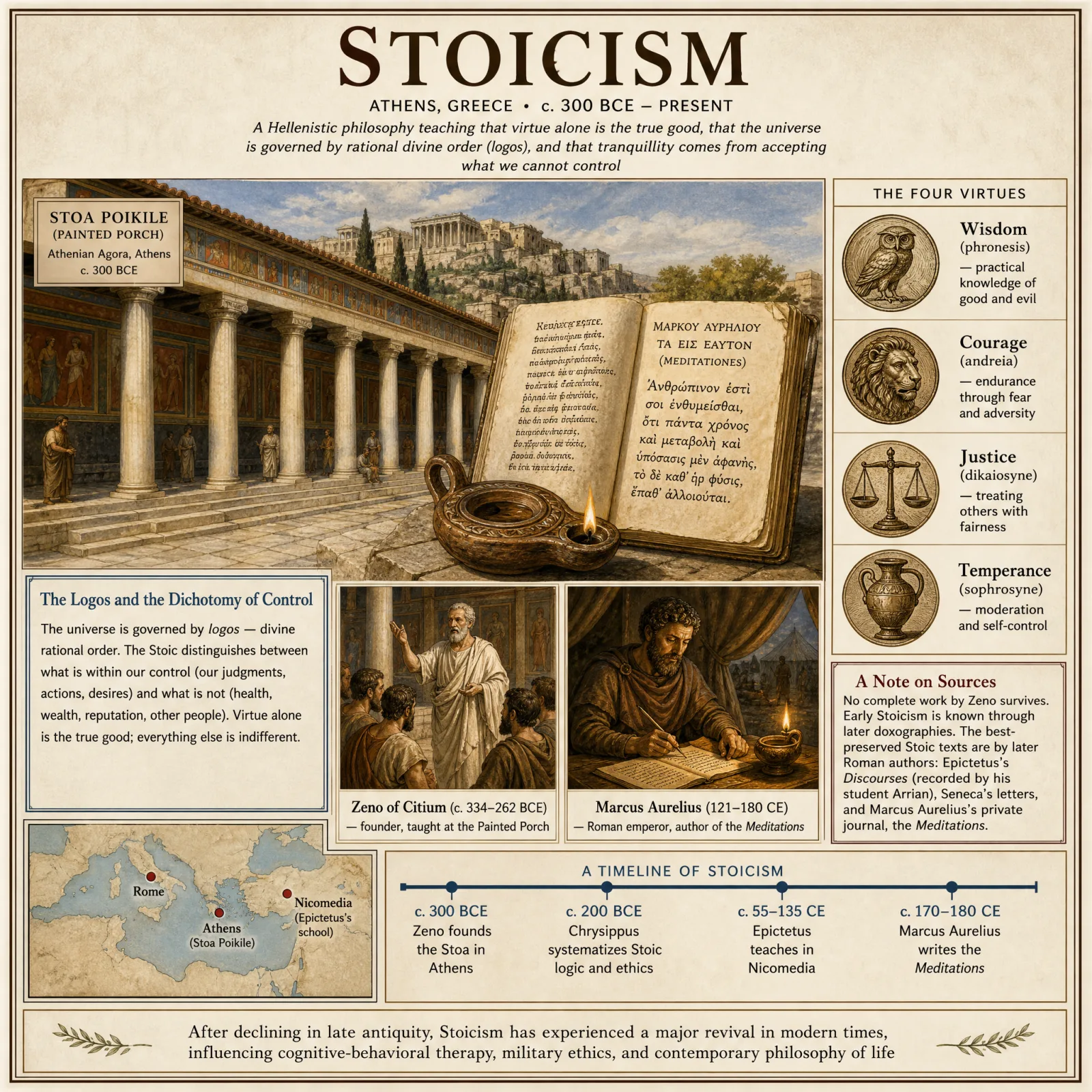
Stoicism is a Hellenistic and Roman philosophical school founded in Athens around 300 BCE by Zeno of Citium, who taught in the Stoa Poikile (Painted Stoa) on the north side of the Agora. It is listed in this dataset as a lived tradition rather than as a church: a complete way of life joining logic, physics, and ethics, practiced in classrooms, households, palaces, and army camps. The early Stoa (Zeno, Cleanthes, Chrysippus) built the system; the middle Stoa (Panaetius, Posidonius) carried it to Rome; the imperial Stoics whose books survive—Seneca, Musonius Rufus, Epictetus, Marcus Aurelius—wrote as people trying to live the doctrines under Nero, Domitian, and the Antonine wars.
The ethical core is that virtue (wisdom, justice, courage, temperance) is the only genuine good, and that happiness (eudaimonia) consists in a life according to nature and reason. Externals—wealth, office, health, even the emperor's favor—are "indifferents" that may be preferred or dispreferred but do not make or unmake the good person. The cosmos is a living, rational whole permeated by logos; human reason is a fragment of that fire. Passion, in the technical sense, is a false judgment. The distinctive Stoic spiritual exercises—morning preparation, evening review, premeditation of hardship, attention to what is "up to us"—are not generic self-help. They are the school's technology for aligning impulse with the order of the world.
Stoicism is not a dump of "ancient philosophy" and not interchangeable with Platonism or Epicureanism. Epicureans located the good in trained pleasure and denied providence; Stoics affirmed a providential cosmos and located the good only in virtue. The Athenian school as an institution faded in late antiquity, but the Roman books never stopped circulating. They shaped Roman law and elite ethics, entered Christian moral vocabulary, returned in Renaissance and early modern Europe, and in the late twentieth century fed both academic Hellenistic philosophy and a popular revival. This article follows the lived school from the Painted Stoa to Nicopolis and the Danube, not a floating list of wise sayings.
From the Painted Stoa to the Imperial Household
Zeno of Citium (modern Larnaca, Cyprus) arrived in Athens, studied with the Cynic Crates and with Megarian and Academic teachers, and around 300 BCE began lecturing in the Stoa Poikile, a public colonnade famous for Polygnotus's paintings of the battle of Marathon. The school took its name from the building, not from a private garden. Zeno's Republic, now lost, imagined a cosmopolitan community of sages. Cleanthes of Assos succeeded him; his Hymn to Zeus is almost the only continuous early Stoic poem we have. Chrysippus of Soli (third century BCE), the third scholarch, wrote hundreds of books, systematized logic and fate, and became the school's Aristotle: later opponents attacked "the Stoics" by attacking him. Almost none of that early corpus survives intact; it is recovered from fragments in Plutarch, Galen, Sextus Empiricus, and the doxographers.
Middle Stoicism, based especially on Rhodes, adapted the school for Roman elites. Panaetius of Rhodes (second century BCE) softened some early paradoxes and influenced Scipio's circle; Cicero's On Duties reworks Panaetius for Roman readers. Posidonius of Apamea taught at Rhodes, mixed Stoic physics with history and ethnography, and taught Romans including Pompey. By the first century BCE, Stoicism was the default moral language of the Roman senatorial class even when individuals were not orthodox schoolmen.
Under the Empire the school had no single Athenian chair of the old kind, but it had public teachers and court lives. Seneca the Younger (c. 1–65 CE), from Corduba, was tutor and later minister to Nero, wrote the Moral Letters to Lucilius and essays on anger, providence, and the happy life, and was ordered to suicide in 65. Musonius Rufus taught in Rome that philosophy was training, including for women, and was exiled. Epictetus, born a slave, studied under Musonius, was expelled from Rome with other philosophers by Domitian in 93 CE, and opened a school at Nicopolis in Epirus. His student Arrian took notes that became the Discourses and the Enchiridion. Marcus Aurelius (emperor 161–180), campaigning on the northern frontier, wrote the Greek notebooks later called Meditations, a private spiritual exercise, not a treatise for publication.
The institutional school withered as Christian bishops and Neoplatonic chairs took over the educational landscape of late antiquity. Justinian's closing of the Athenian Academy in 529 is a conventional end-date for ancient philosophical schools, though Stoicism had long since ceased to be a rival institution. What remained were books, legal and ethical commonplaces, and the possibility of reading Seneca and Epictetus as a rule of life—which monks, humanists, and modern therapists have all done in different keys.
Logos, Virtue, and What Is Up to Us
Stoic physics holds that only bodies exist in the full sense, that the world is a finite living animal, and that a craftlike fire—pneuma, logos, Zeus—structures every thing from stones to sages. Fate is the chain of causes; providence is that chain described as intelligent. This is not a clockmaker deism and not a personal creator who stands outside nature. To live according to nature is to consent to that order without adding false value to what it does not place in our power.
Ethics depends on a psychology of impression (phantasia), assent, and impulse. A passion (pathos) is an excessive impulse born of a mistaken assent: treating an indifferent as a genuine evil or good. The four canonical passions (appetite, fear, distress, pleasure) are diseases of judgment. The sage's apatheia is not numbness; it is freedom from those diseases, compatible with good feelings (eupatheiai) such as joy, caution, and rational wish. Epictetus's famous dichotomy—some things are up to us (prohairesis, our faculty of choice), some are not (body, property, reputation, office)—is the practical form of this metaphysics. Marcus repeats it in camp: you can always examine the impression, strip it, and return to the common good.
Virtue is one, though named four ways, and is sufficient for happiness. Preferred indifferents (health, means, a living child) may be selected according to nature's prompts—the theory of oikeiosis, appropriation, which begins in self-preservation and widens to family, city, and the cosmopolis of rational beings. Stoic cosmopolitanism is not tourism; it is the claim that every human shares logos and so falls within justice. Seneca's letters apply this to slavery, anger, and wealth without abolishing Roman hierarchy; the tension between cosmopolitan theory and imperial practice is part of the tradition's history, not an accident to skip.
Theology is immanent. Cleanthes' Zeus is the world-reason. Divination and a deterministic fate were orthodox in the early school; later readers sometimes downplayed them. Death is a natural change of the elements, not a portal to a judged afterlife of the Christian type, though some Stoics allowed a temporary survival of the soul until the next cosmic conflagration (ekpyrosis). The point of the physics, for the Roman writers, is ethical: if the world is one living whole, complaining at your role is a failure of piety as well as of logic.
Books of a Lived School
No complete work by Zeno or Chrysippus survives. The early school is a reconstructed mosaic. Cleanthes' Hymn to Zeus, quoted by later authors, addresses the world's law as a god to be followed. For the lived Roman tradition the three central books are Seneca's Letters, Epictetus as recorded by Arrian, and Marcus's Meditations. They are not scripture in a canonical sense; they are the exercises and letters of teachers. Cicero's philosophical dialogues (On Ends, On Duties, Tusculans) are a Roman translation of the system for Latin readers who might never sit in a Stoic classroom.
The Enchiridion (Handbook) of Epictetus is a short manual extracted from the Discourses: distinguish what is yours from what is not, do not demand that events happen as you wish, remember that insult is a judgment. It was copied in Byzantine monasteries, translated by missionaries, and remains the most portable Stoic text. The Discourses themselves are classroom scenes—Epictetus rebuking a student who wants a letter of recommendation, analyzing the fear of Caesar, insisting that philosophy is not ornaments of speech. They are the best evidence that Stoicism was a school of life, not a reading list.
Marcus Aurelius's Meditations, written in Greek on campaign, address the author's own soul: do not waste the remainder of life, look at the cause, remember that you are a citizen of the world-city. They were not titled or published by him. Seneca's Letters to Lucilius mix consolation, diet, the examination of days, and literary friendship; his essays On Anger and On the Shortness of Life show a minister writing ethics under a bad emperor. Modern readers who meet only online "Stoic quotes" miss this texture of letters, notes, and oral teaching.
Spiritual Exercises of the School
Pierre Hadot's work on ancient philosophy as a way of life is especially apt for the Stoics. Practice is not an extra. Musonius insisted on training (askesis): simple food, endurance of heat and cold, the habit of saying no. Epictetus assigned students to watch their impressions the way an athlete watches a hold. Seneca describes the evening review: when the light is removed, I examine my day, hide nothing, pass over nothing. Marcus writes to himself at dawn: I will meet the busybody, the ungrateful, the arrogant; they are this way because they do not know good from evil.
Premeditation of adversity (premeditatio malorum)—rehearsing exile, illness, death—was a named exercise, not a mood. Negative visualization in modern popular Stoicism descends from it, sometimes stripped of the physics. Attention (prosoche) is the continuous return to the present impression. The view from above, in Marcus, shrinks the court and the frontier to a patch of earth. None of this requires a temple. It does require a teacher, a notebook, and the willingness to be shown that your distress is a judgment.
There was no Stoic priesthood and no initiatory grade system. The "school" was a public colonnade, then a private lecture room, then a household and a camp. Offerings to the gods of the city were compatible with Stoic theology because the gods are names of the one logos; empty superstition was not. Consolation literature—Seneca to Marcia, to Polybius—shows the ethics applied to Roman grief. Modern cognitive therapy has acknowledged a debt to Epictetus's claim that people are disturbed not by things but by their judgments about things; that is a reception history, not proof that CBT is the Stoa.
Early, Middle, and Roman Stoas
Early Stoicism is technically the most ambitious: Chrysippean logic, a strict paradox that only the sage is free, rich, and a king, and a physics of fate that later Platonists found crude. Middle Stoicism made the ethics exportable to statesmen. Roman imperial Stoicism, the only phase with complete surviving works, is ethically intense and theoretically selective: Seneca is more literary and sometimes more Platonizing; Epictetus is the teacher of prohairesis; Marcus is the emperor doing the exercises without a living Chrysippus at his elbow.
Not every Roman moralist was a Stoic. Cicero remained an Academic skeptic who used Stoic ethics. Seneca's wealth and political compromises were already mocked in antiquity (the charge of hypocrisy is as old as the school). Epictetus's classroom was for young men aiming at office as well as for those aiming at the sage. Marcus's wars and the Antonine plague sit beside his cosmopolitan notebook. A responsible account keeps these tensions; a quote-collection dissolves them.
Later "Stoicisms"—Justus Lipsius's Neostoicism, Victorian duty, twenty-first-century apps—are receptions. They may be serious. They are not the Painted Stoa. This article's tradition id is the ancient school as a lived Hellenistic-Roman path.
Who Lived as a Stoic
In Athens the community was a scholarch, students, and a public porch. In Rome it was senators, imperial freedmen, a former slave with a lame leg, and an emperor writing in a tent. Women are visible in Musonius's arguments that daughters should study philosophy and in the figure of Porcia in the Republican tradition; they are less visible as named teachers. The school never counted members the way a church counts baptisms. Its demographic "followers" in this dataset are a modern estimate of people who identify with Stoic practice, not a census of 200 CE.
Today Stoic Week, local meetups, and online forums treat the Roman books as a toolkit. Academic specialists (A.A. Long, Brad Inwood, Margaret Graver, and others) reconstruct the early fragments that the popular revival often skips. Both layers exist. The living tradition, such as it is, is a community of readers and exercitants, not a sacramental body. That is faithful to the ancient school, which offered a way of life without a mystery cult's grades or a bishop's see.
Places of Teaching and Practice
The Stoa Poikile (Painted Stoa) on the north side of the Athenian Agora is the school's name-place. Zeno taught in a public colonnade decorated with the Battle of Marathon, which meant philosophy happened in civic space, not in a closed garden like Epicurus's. The American School of Classical Studies at Athens has excavated the Agora; the stoa's foundations and the topography of the square are known even though the paintings are gone. Students still walk the same ground when they visit the site.
Citium on Cyprus, Zeno's birthplace, and Assos and Soli, homes of Cleanthes and Chrysippus, mark the eastern Mediterranean origins of a school that became Athenian by choice. Rhodes, with Panaetius and Posidonius, was the middle Stoa's island campus, a stop for Roman nobles on the educational tour. These are biographies in landscape: the school moved with teachers.
Rome is where the lived ethics met power: Seneca's house and the Palatine, Musonius's lectures, the expulsion of philosophers under Vespasian and Domitian. Nicopolis in Epirus, the city Augustus founded after Actium, is where Epictetus taught after 93 CE; the Discourses are Nicopolitan classroom. Carnuntum on the Danube, and the other frontier headquarters of the Marcomannic Wars, are where Marcus Aurelius likely wrote much of the Meditations—philosophy as a practice in camp, not a retirement hobby. The tradition's sacred geography is colonnades, lecture rooms, and army winter quarters, which is exactly what a lived philosophy without temples should look like.
Scholarly Debates
How much of early Stoic physics did the Roman writers still hold? Some scholars see Seneca and Marcus as almost purely ethical, dropping ekpyrosis and the corporeal soul; others find the physics still load-bearing whenever they talk of nature, fate, and the whole. The fragments of Chrysippus are hard enough that two reconstructions of Stoic logic can disagree. Hadot's "spiritual exercises" thesis is widely used and sometimes accused of reading Ignatius back into Epictetus; even critics admit the Roman texts are practical.
The hypocrisy problem—Seneca the millionaire, Marcus the emperor at war—is ancient. It does not empty the doctrines, but it forbids presenting Stoicism as a spotless moral brand. Determinism versus moral responsibility (the "lazy argument," Chrysippus's cylinder) remains a live philosophical issue. Popular Stoicism's focus on individual resilience can sideline the school's cosmopolitan justice and its physics; academic Stoicism can sideline the fact that Epictetus thought a student should leave the classroom different. This article treats the school as both a technical philosophy and a training of the self, because that is how its teachers described it.
Key Terms
- Logos
- The rational, fiery principle that structures the cosmos; human reason is a portion of it.
- Virtue (arete)
- The only genuine good; wisdom, justice, courage, and temperance as one knowledge of how to live.
- Indifferents (adiaphora)
- Everything other than virtue and vice, including health and wealth; some are preferred, none are the good.
- Prohairesis
- Epictetus's term for the faculty of moral choice, the only thing truly "up to us."
- Apatheia
- Freedom from passions understood as false judgments; not the absence of all feeling.
- Oikeiosis
- Appropriation or affinity; the developmental widening of concern from self to cosmopolis.
- Phantasia
- An impression; the starting point of judgment, to be tested before assent.
- Stoa Poikile
- The Painted Stoa in the Athenian Agora where Zeno taught and from which the school is named.
- Enchiridion
- Arrian's short handbook of Epictetus's teaching, the most circulated Stoic manual.
- Premeditatio malorum
- Rehearsal of possible hardships so that they do not ambush the judgment.
- Cosmopolis
- The world-city of rational beings; the Stoic frame for justice beyond one's own polis.
- Sage (sophos)
- The ideal wise person who never errs in assent; a standard more than a census of graduates.
Further Reading
- Stanford Encyclopedia of Philosophy: Stoicism
- Stanford Encyclopedia of Philosophy: Epictetus
- Stanford Encyclopedia of Philosophy: Marcus Aurelius
- Stanford Encyclopedia of Philosophy: Seneca
- Internet Encyclopedia of Philosophy: Stoicism
- Encyclopaedia Britannica: Stoicism
- The Cambridge Companion to the Stoics (ed. Brad Inwood, Cambridge University Press, 2003)
- American School of Classical Studies at Athens: Excavations in the Athenian Agora
- Athenian Agora excavations public resource (ASCSA)
- Perseus Digital Library: Epictetus, Discourses
- A.A. Long, Epictetus: A Stoic and Socratic Guide to Life (Oxford University Press, 2002)
- Internet Encyclopedia of Philosophy: Epictetus
Practices
- Morning meditation
- Negative visualization
- Journaling
- Self-examination
Core ideas
- Sin
- Error of judgment, not evil essence
- Liberation
- Apatheia — freedom from destructive passions
- Deity
- Logos — divine reason pervading all
Sacred texts
Private philosophical notes written by the Roman emperor Marcus Aurelius during military campaigns in the second century CE. He reflects on virtue, duty, mortality, and aligning the mind with nature's rational order. Never intended for publication, it became one of the most widely read works of Stoic practice.
A concise handbook compiled by Epictetus's student Arrian from the philosopher's classroom teachings. It distills Stoic ethics into practical rules: distinguish what is in your control from what is not, and guard your judgments. The Enchiridion served as a daily manual for Stoic living for centuries.
Moral letters from the Roman statesman Seneca to his friend Lucilius, covering grief, anger, wealth, friendship, and death. Written in elegant prose, they apply Stoic principles to the dilemmas of everyday life. Seneca's letters bridge philosophy and literature, making Stoicism accessible beyond the lecture hall.