Overview
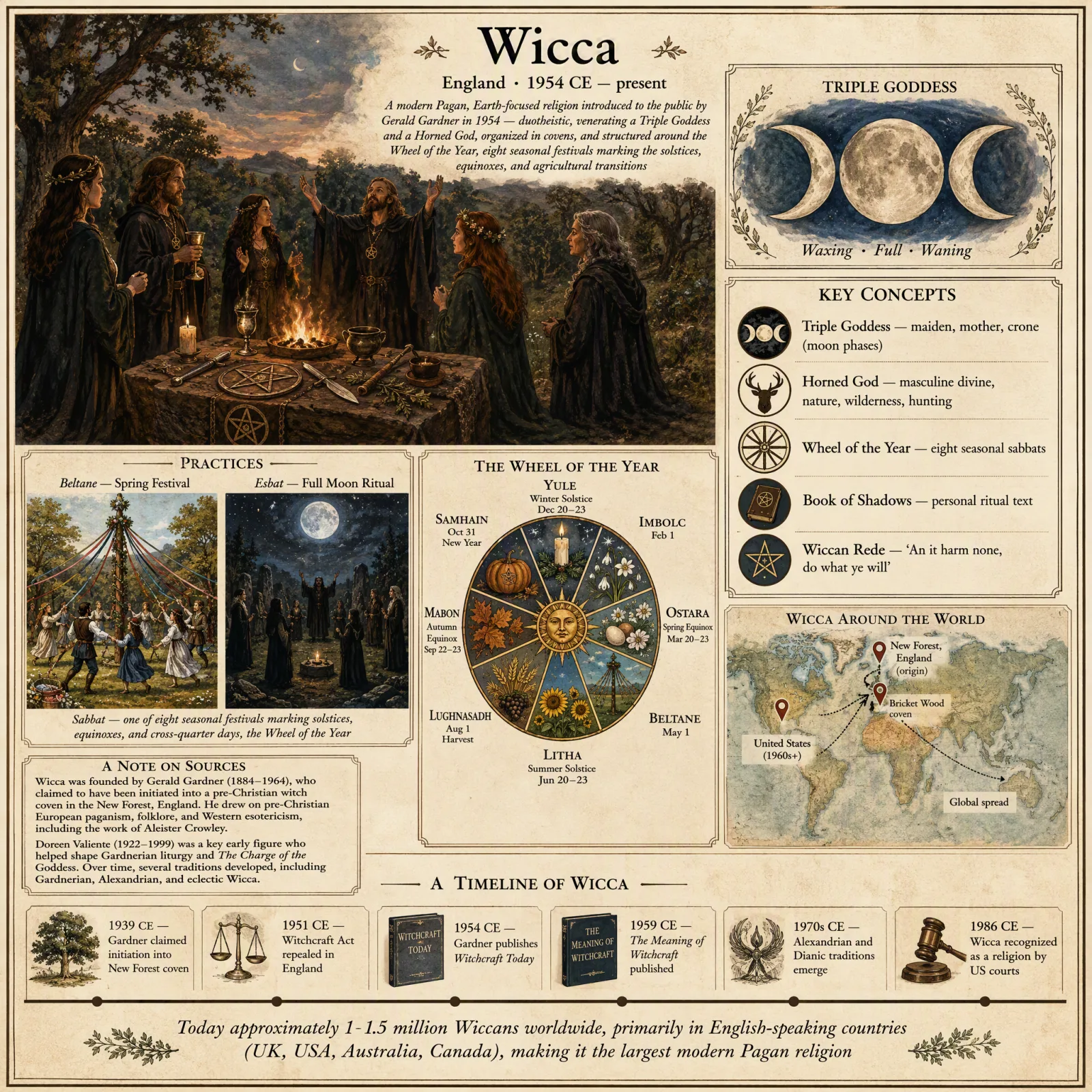
Wicca is a modern Pagan religion that took public shape in mid-twentieth-century Britain, above all through Gerald Brosseau Gardner (1884–1964) and the circles that formed around him after the Second World War. It is not ancient British witchcraft surviving in secret, and it is not Druidry. Ronald Hutton's The Triumph of the Moon, the standard scholarly history, shows that Gardner synthesized folklore, ceremonial magic, Freemasonry, literary paganism, Margaret Murray's now-discredited witch-cult thesis, and his own ritual imagination into a new initiatory craft. From Britain it spread to North America, where feminism, environmentalism, and the 1960s counterculture produced Goddess-centered and eclectic forms that now outnumber British Traditional covens.
Public Wiccan theology typically honors a Goddess and a God whose relationship tracks the seasons, keeps a Wheel of the Year of eight sabbats, and treats magic as ethical, willed action inside a sacred cosmos. The Wiccan Rede—often summarized as harm none, do what you will—and the Charge of the Goddess, a liturgical poem associated with Doreen Valiente, are among the few widely published ethical and theological texts. British Traditional Wicca (Gardnerian, Alexandrian, and related lines) is initiatory and oathbound: this article describes only what is public—that degrees and covens exist, that a Book of Shadows is copied from teacher to student, that outer-court and published material is not the same as inner-court liturgy. It does not reproduce oathbound ritual.
Wicca is a living new religious movement with legal recognition in several countries, a large solitary and eclectic population, and an academic literature in history, folklore, and religious studies. It must be kept distinct from the separate modern Druid orders treated under this site's druidic id, from generic "witchcraft" in early modern trial records, and from fantasy media. Hutton, Ethan Doyle White, Sabina Magliocco, and others treat it as a genuine religion whose origin story is modern even when its symbols are old.
Gardner and the Making of a New Religion
Gerald Gardner, a retired colonial civil servant with interests in folklore, naturism, and ceremonial magic, claimed to have been initiated in 1939 into a coven in the New Forest. That claim cannot be verified in the way a baptismal register can; Hutton and later historians treat a New Forest group of some kind as possible but the "unbroken witch-cult" as a myth. What is documentable is that after the war Gardner assembled a coven at Bricket Wood, Hertfordshire, on the grounds of a naturist club, wrote Witchcraft Today (1954) with a foreword by Margaret Murray, and The Meaning of Witchcraft (1959) as public statements after the 1951 repeal of the Witchcraft Act. Doreen Valiente, initiated in 1953, rewrote much of the early liturgy in better English and became the craft's principal public poet.
Alex Sanders (1926–1988) and Maxine Sanders popularized a closely related Alexandrian line in the 1960s, more ceremonial in flavor and more willing to appear in the press. In the United States, Raymond Buckland carried Gardnerian practice across the Atlantic; later, writers such as Starhawk (The Spiral Dance, 1979) and the Reclaiming tradition shifted many seekers toward feminist, political, and non-initiatory or loosely initiatory witchcraft. Scott Cunningham and others taught solitary practice from paperbacks. By the 1990s "Wicca" in popular speech often meant any eclectic Pagan witchcraft, while British Traditional initiates reserved the word for lineaged covens. Both uses now coexist, which is a historical fact about the movement, not a verdict on authenticity.
Scholarship has been decisive. Murray's Witch-Cult in Western Europe (1921) gave Gardner a story of a surviving fertility religion; historians of the witch trials dismantled that story. Hutton (1999, revised 2019) replaced it with a cultural history of modern pagan witchcraft's ingredients. Cambridge Elements' Gerald Gardner and the Creation of Wicca and the Feraro–Doyle White volume marking Triumph of the Moon's twentieth anniversary continue that work. Wiccans themselves disagree: some accept the modern origin and still find the gods real; some hold inner-court claims that historians cannot test and that this article will not try to publish.
Goddess, God, and a Moral Cosmos
The most common public theology is duotheistic: a Great Goddess (often lunar, earthly, triple as maiden-mother-crone in later popular Wicca) and a Horned God (often solar, dying and returning with the year). Neither is the God of Christian orthodoxy, and neither requires the practitioner to deny other deities; many Wiccans are polytheist or henotheist in practice, calling particular named gods in particular rites. Nature is not a backdrop; it is the body of the divine. Magic is typically defined, in published sources, as the art of changing consciousness or circumstances in accordance with will, inside an ethic of responsibility.
Reincarnation, a rest between lives sometimes called the Summerland, and a law of return (popularly "threefold") appear in many introductory books. These are not dogmas policed by a church. The Rede is counsel, not canon law; traditions disagree on whether it forbids all coercive magic, only harm, or is a later popular slogan. What Wicca is not, in its mainstream published form, is Satanism: it does not worship the Christian Devil, a point Gardner already labored to make in the 1950s and that scholars of new religions repeat.
British Traditional cosmology is taught in stages; only the existence of a degree system is public here. Eclectic and feminist Wicca often place the Goddess first, sometimes exclusively, and read the Wheel of the Year as ecological and political as well as mythic. Those are family resemblances, not a single creed. Distinctness from Druidry matters: modern Druids (OBOD and others) reconstruct a different Romantic and Celtic-inspired path, even when some people belong to both scenes. Distinctness from ancient Celtic religion is the same point Hutton makes in Blood and Mistletoe: modern Paganisms are new.
Published Texts, Not Oathbound Books
Wicca has no closed scripture analogous to a Bible. The Book of Shadows is a ritual and instructional notebook, traditionally copied by hand in initiatory lines. Gardner's and Valiente's published books, and later introductory manuals, are the public layer. This article does not quote or reconstruct inner-court Books of Shadows. What can be cited are works Gardner and others put in shops: Witchcraft Today, The Meaning of Witchcraft, Valiente's Witchcraft for Tomorrow and her published poems, including versions of the Charge of the Goddess that have circulated in print and on websites with the authors' knowledge.
The Charge of the Goddess, in the form most Wiccans know, is Valiente's prose-poem in the voice of the Goddess, drawing on older literary sources (including Crowley and Leland's Aradia) that Hutton and others have traced. It is liturgy, not a prehistoric tablet. The Rede appears in several wordings; the rhyming couplet popular in the United States is later than Gardner's first covens. Academic introductions—Doyle White's Wicca: History, Belief, and Community in Modern Pagan Witchcraft, Magliocco's ethnography of American Paganism—are the right guides to belief and practice at the public level.
Fiction and television (The Witch, The Craft, Practical Magic, and later streaming series) have shaped conversion more than any inner book. That media history is part of the religion's spread and of its misunderstandings. Responsible description keeps the published Charge and Rede, names the unpublished remainder, and stops.
Public Practice: Year, Moon, and Circle
The Wheel of the Year, in the form now standard, has eight sabbats: the solstices and equinoxes plus the cross-quarter days often called Samhain, Imbolc, Beltane, and Lughnasadh (with many spelling variants). Bricket Wood's mid-century decision to keep the solar festivals as well as the four "Greater Sabbats" is part of how that wheel became common. Esbats are working meetings often timed to the moon. Public-level ritual, as described in countless published primers, includes consecrating a space ("casting a circle"), invoking deity, working, sharing food and drink, and opening the space. Those outlines are not the same as lineaged initiation scripts.
Coven practice in British Traditional Wicca is small-group, initiatory, and usually capped in size. Solitary and eclectic practice, now demographically larger in many surveys, uses books, online classes, and self-dedication. Magic (spellcraft) in published Wicca is typically herbal, candle, spoken, and symbolic—not a license to harm. Sexual theology in some traditions includes a ritual drama of Goddess and God; only the fact that such rites exist in some covens is noted here, not their choreography.
Pilgrimage is informal: Glastonbury's landscape, public Pagan gatherings, and museums of witchcraft are destinations, not a hajj. Legal chaplaincy, prison ministry, and interfaith councils have become part of practice in the United States and the United Kingdom. None of this requires, or here receives, a dump of oathbound material.
Lines, Eclectics, and Neighbors
Gardnerian and Alexandrian Wicca, with their offshoots, form British Traditional Wicca: lineaged, oathbound, typically dual-sex priesthood in older forms (later groups have adapted gender rules). Seax-Wica, Feri, Reclaiming, Dianic (Goddess-only, itself internally diverse and sometimes contested on trans inclusion), and a host of family and local traditions illustrate how fast the movement branched. "Wiccan" and "witch" and "Pagan" overlap but are not synonyms; many witches are not Wiccan, and many Pagans are Druids, Heathens, or reconstructionists instead.
North American Wicca is not a copy of Bricket Wood. Magliocco's fieldwork shows folklore, festival, and identity politics shaping American covens and circles. Online Wicca since the 1990s has produced solitary practitioners whose only "coven" is a forum. Traditional initiates sometimes deny these seekers the name Wicca; historians describe the naming fight rather than joining it.
Modern Druidry is the important neighbor not to collapse. Druid orders have their own origins in eighteenth-century antiquarianism and twentieth-century groups such as OBOD; they may share seasonal festivals and Glastonbury with Wiccans without being the same religion. This site's druidic article covers that path. Heathenry/Asatru is another neighbor. Wicca's horned god is not the same as a reconstruction of a named Celtic or Norse deity, even when a coven borrows a name for a rite.
Communities and Demographics
Numbers are soft. Pew's U.S. Religious Landscape studies place Wiccans inside a small "other faiths" or "something else" band that also includes Unitarians and New Agers; they are visible enough to be named, not large enough for a precise national headcount. The United Kingdom's census has allowed write-in Pagan and Wiccan identities. Solitaries likely outnumber coven members. Legal cases in the United States (including prison and military chaplaincy) have treated Wicca as a religion for First Amendment purposes.
Institutions include covens, training circles, Pagan Pride days, the Pagan Federation (UK), Covenant of the Goddess (U.S.), and academic networks in Pagan studies. Interfaith work and environmental activism are common public faces. Internal conflicts over lineage, gender, race, and commercialism are as real as in other new religions. The community today is global, anglophone-heavy, and still young as religions go: less than a century of public life.
Places of Origin and Public Memory
Highcliffe and the New Forest in Hampshire are the landscape of Gardner's war years and of his claim to have met a pre-existing coven. The forest is a real place; the coven as an ancient survival is not established. Historians treat the New Forest as origin-story geography, not as a second Avebury.
Bricket Wood, Hertfordshire, is the documentable cradle of Gardnerian coven practice: Gardner established a group at the Fiveacres naturist club from the mid-1940s, with a reconstructed timber-framed witches' cottage as working space. Doreen Valiente's years as high priestess there are part of the public history of the craft. The site is private club land, not a tourist temple; it is named because the scholarship names it.
Castletown on the Isle of Man, at the Witches' Mill, housed the Folklore Centre of Superstition and Witchcraft that Cecil Williamson opened in 1951 with Gardner as "resident witch," then Gardner's own Museum of Magic and Witchcraft after the two men parted. The mill is the public, legal-era face of Wicca just after the Witchcraft Act's repeal. Williamson's later Museum of Witchcraft and Magic in Boscastle, Cornwall (opened 1960, still operating), holds the largest public collection of British folk-magic and Wiccan objects; its published history is the right source for visitors.
Glastonbury in Somerset is a major contemporary Pagan and Wiccan pilgrimage town—tor, goddess shops, mixed Christian and Pagan myth—but it is not where Gardner founded the religion. Stonehenge belongs in the modern Druid story more than in Wicca's, though Pagan festivals draw mixed crowds. Wiccan sacred geography is therefore recent, British, and modest: a forest claim, a Hertfordshire covenstead, a Manx mill, a Cornish museum, and a Somerset town of seekers.
Origins, Oaths, and Authenticity
The origin debate is settled among historians and still live among some practitioners: Wicca is a modern religion. Hutton's thesis has been refined, not reversed, by later work on Gardner's biography, Valiente's role, and American transformation. Claims of family traditional witchcraft older than Gardner are, as Hutton noted, not the historian's business unless evidence is offered for scrutiny. This article follows the evidence.
Oathbound material is a boundary, not a tease. Initiates are entitled to privacy; writers are entitled to refuse to speculate about passwords, names of inner tools, or initiation dramas beyond the public fact that initiation and degrees exist. Popular books that print alleged inner texts are not used here as sources. The ethical line is the same one scholars of contemporary esotericism generally keep.
Authenticity fights (lineage vs. eclectic, British Traditional vs. "Wicca" as a generic label, trans inclusion in Dianic and other spaces, commercial "Instagram witchcraft") are internal politics of a living religion. Academic description records them. Distinctness from Druidry, from Satanism, and from early modern witch-trial victims remains the external boundary: Wicca is not the continuation of the people hanged at Salem or in Essex, and saying so is history, not insult.
Key Terms
- Wicca
- A modern Pagan witchcraft religion publicly shaped by Gerald Gardner in mid-twentieth-century Britain; usage now ranges from lineaged covens to eclectic solitaries.
- British Traditional Wicca
- Initiatory, oathbound lines descending from Gardnerian and Alexandrian practice, as distinct from generic popular Wicca.
- Book of Shadows
- A coven or personal ritual book, traditionally copied in initiatory lines; unpublished inner texts are not reproduced here.
- Charge of the Goddess
- A published liturgical address in the Goddess's voice, chiefly associated with Doreen Valiente.
- Wiccan Rede
- A public ethical maxim, often summarized as harm none and do as you will; wording and authority vary by group.
- Sabbats
- The eight seasonal festivals of the Wheel of the Year in common Wiccan practice.
- Esbat
- A coven or personal working, often at the full or dark moon, as distinct from the seasonal sabbats.
- Coven
- A small working group; in Traditional Wicca, typically initiatory and limited in size.
- Wheel of the Year
- The annual cycle of solstices, equinoxes, and cross-quarter days used as Wicca's ritual calendar.
- New Forest coven
- The group into which Gardner said he was initiated in 1939; historically possible as a circle, not proven as an ancient cult.
- Eclectic Wicca
- Self-assembled practice from published sources, often solitary, now a large part of the movement.
- Oathbound
- Material reserved to initiates by vow; named as a limit of public description, not as content to dump.
Further Reading
- Ronald Hutton, The Triumph of the Moon: A History of Modern Pagan Witchcraft (2nd ed., Oxford University Press, 2019)
- Cambridge Elements: Gerald Gardner and the Creation of Wicca
- Shai Feraro and Ethan Doyle White, eds., Magic and Witchery in the Modern West (Palgrave Macmillan, 2019)
- Sabina Magliocco, Witching Culture: Folklore and Neo-Paganism in America (University of Pennsylvania Press, 2004)
- Encyclopaedia Britannica: Wicca
- Encyclopaedia Britannica: Gerald Gardner
- Oxford Research Encyclopedia of Religion: Contemporary Paganism
- Pew Research Center: America's Changing Religious Landscape, Chapter 1 (2015)
- Pew Research Center: Religious Landscape Study, religious identity (2025)
- Harvard Pluralism Project: Wicca
- BBC Religion: Wicca
- Museum of Witchcraft and Magic, Boscastle: History
Practices
- Coven or solitary ritual
- Sabbats (8/year)
- Magic (spellcraft)
- Esbat (moon rites)
Core ideas
- Deity
- Goddess and God; immanent in nature
- Sin
- Threefold return of harm done
- Afterlife
- Summerland between rebirths
Sacred texts
A personal or coven journal of rituals, spells, invocations, and seasonal rites, traditionally copied by hand from teacher to student. Gerald Gardner's version, published in the 1950s, helped standardize modern Wiccan practice. Each practitioner or coven maintains their own, making it a living rather than fixed scripture.
A prose poem attributed to Doreen Valiente, spoken in the voice of the Goddess to her worshippers. It declares 'harm none, do what ye will' and invites devotees to seek the divine within nature. Recited at many Wiccan rituals, it is the tradition's best-known declaration of ethics and theology.