Navajo (Diné) Spirituality
Hózhó — beauty, balance, and the Blessingway.
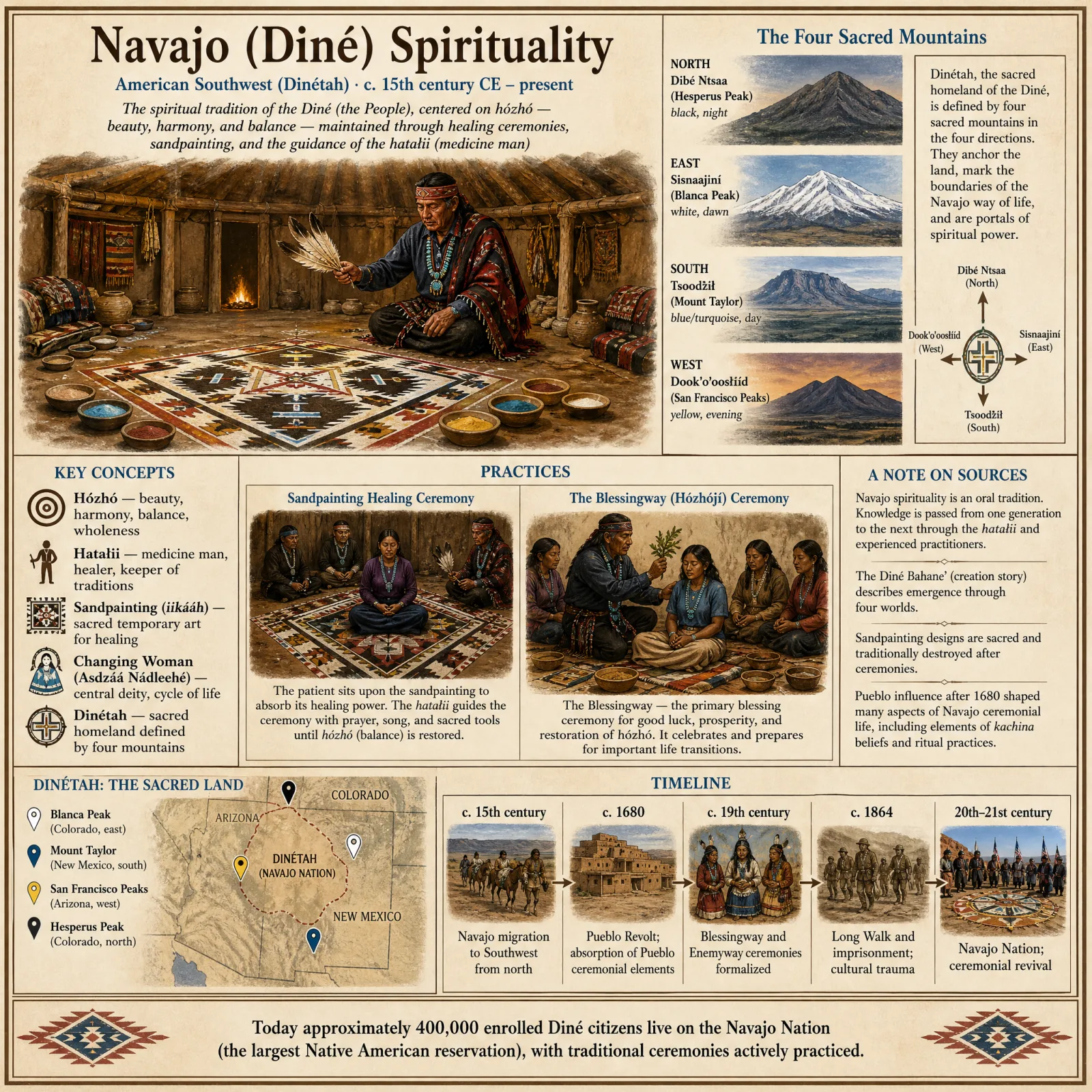
Overview
Navajo (Diné) spirituality is the living religious tradition of the Diné people—'the People,' as they call themselves—whose ancestral homeland, Dinétah, lies between the four sacred mountains in what is now the southwestern United States (primarily northeastern Arizona, northwestern New Mexico, southeastern Utah, and southwestern Colorado). The Navajo Nation is the largest federally recognized Native American tribe in the United States, with over 300,000 enrolled members, most living on or near the 27,000-square-mile reservation. Diné spirituality is not a 'religion' in the Western sense of a bounded belief system separate from daily life; rather, it permeates all aspects of Diné existence—language, kinship, agriculture, art, healing, ethics, and relationship with the land. The tradition is grounded in the Diné Bahaneʼ (Navajo creation narrative), which recounts the People's emergence through successive underworlds into the present Glittering World, and in an intricate ceremonial system designed to maintain or restore hózhó—harmony, balance, beauty, and right relationship with all beings.
Central to Diné spirituality is the concept of hózhó (often translated as 'beauty,' 'harmony,' 'balance,' or 'order'), which represents the ideal state of the universe and the goal of human life. Hózhó encompasses aesthetic beauty, moral goodness, health, prosperity, happiness, and proper relationality—it is simultaneously physical, spiritual, moral, and social well-being. Its opposite, hóchxǫ́ (disharmony, disorder, evil, ugliness), arises when things are out of balance, displaced, or improperly related. Diné ceremonialism is fundamentally about restoring hózhó when it has been disrupted by illness, misfortune, or transgression. The central ceremonial complex is Blessingway (Hózhǫ́ǫ́jí), which establishes and maintains hózhó, and is considered the 'main stalk' from which all other ceremonies branch. Other major ceremonial systems—including Enemyway, Nightway, Mountainway, and many others—address specific forms of disharmony caused by contact with dangerous forces (lightning, snakes, bears, enemy ghosts, witchcraft) and work to restore balance through elaborate multi-day rituals involving prayers, songs, sandpaintings, and the invocation of Holy People.
The Holy People (Diyin Dineʼé) are powerful, immortal beings who inhabit the sacred landscape and participate in Diné ceremonial life when properly invoked. They are not 'gods' in the monotheistic sense but rather personifications of natural forces, landscape features, and cosmic principles—simultaneously transcendent and immanent, dangerous and beneficent, depending on how they are approached. Major Holy People include Changing Woman (Asdzą́ą́ Nádleehé, the most beloved deity, associated with growth, renewal, seasons, and the earth's generative power), the Sun Bearer (Jóhonaaʼéí), Monster Slayer and Born for Water (the Hero Twins who made the world safe for humans), Spider Woman, First Man and First Woman, and the holy beings associated with each of the four sacred mountains. The Holy People taught the Diné the ceremonies and gave them the sacred knowledge necessary for survival and hózhó. Diné ceremonialism requires specialized practitioners—hatałii (chanters, singers, ceremonial practitioners), often translated as 'medicine men' or 'medicine women'—who undergo years of apprenticeship to learn the intricate songs, prayers, sandpaintings, and ritual procedures of specific ceremonial complexes.
Diné spirituality is inseparable from place. The four sacred mountains—Sisnaajiní (Blanca Peak, Colorado) in the east, Tsoodził (Mount Taylor, New Mexico) in the south, Dookʼoʼoosłííd (San Francisco Peaks, Arizona) in the west, and Dibé Nitsaa (Hesperus Mountain, Colorado) in the north—are not merely symbolic; they are living, holy beings with inner forms (spiritual essences) who provide protection, resources, and identity to the Diné. First Man and First Woman placed these mountains at the time of creation, fastening them to the earth with lightning, sunbeam, rainbow, and stone knives, and adorning them with sacred stones (white shell, turquoise, abalone, jet/obsidian) and the plants and animals that sustain Diné life. The mountains embody the boundaries of Dinétah, the sacred homeland, and their presence orients Diné cosmology, ethics, and daily practice. Beyond the four sacred mountains, numerous other peaks, springs, rock formations, and landscape features are recognized as sacred—homes of Holy People, sites of mythic events, sources of medicinal plants and ceremonial materials, and places where prayers are offered.
Historical Development
The Diné are Athabaskan-speaking people whose ancestors migrated southward from the Subarctic regions of present-day Alaska and Canada, likely arriving in the Southwest between the 14th and 16th centuries CE (though oral traditions and some archaeological evidence suggest earlier presence). Athabaskan linguistic and cultural evidence links the Diné to other Athabaskan groups (Apache tribes, Alaskan Dene), but centuries in the Southwest transformed Diné culture through interaction with Puebloan peoples, adoption of agriculture (especially maize, beans, squash), weaving, and integration with the distinctive Southwest landscape. The Diné Bahaneʼ (creation narrative) does not emphasize migration from the north but rather emergence through successive underworlds—Black World, Blue World, Yellow World—into the present Glittering World (also called the Fifth World or White World), where the Holy People shaped the land, created the four sacred mountains, and established the conditions for Diné existence.
By the time of Spanish contact in the late 16th century, the Diné were well-established in the region, practicing a mixed economy of agriculture, hunting, gathering, and raiding. Spanish colonization (1598 onward) brought horses, sheep, goats, and cattle, which the Diné adopted enthusiastically, transforming their economy and material culture. Sheepherding became central to Diné life—economically, socially, and spiritually—and weaving, learned from Puebloan peoples, became a highly developed art form using Diné-raised wool. The Spanish period also brought violence: Spanish slave raids captured Diné, especially women and children, and Diné raiders targeted Spanish and Puebloan settlements for livestock, goods, and captives. Despite conflict, significant cultural exchange occurred, including the adoption of silversmithing and certain Catholic iconography (though not Catholicism itself, which the Diné largely resisted). Diné oral tradition also incorporates encounters with Spanish colonizers into ceremonial narratives, particularly Enemyway, which addresses harm caused by contact with non-Diné enemies and their ghosts.
Mexican independence (1821) and subsequent U.S. conquest of the region (1846–1848) intensified pressures on Diné land and autonomy. The U.S. Army, led by Colonel Kit Carson, waged a brutal campaign (1863–1864) of scorched-earth warfare, destroying Diné crops, orchards, livestock, and homes, and killing those who resisted. Approximately 8,000–9,000 Diné were forcibly removed from Dinétah and marched over 300 miles to Bosque Redondo (Hwéeldi), a desolate internment camp in eastern New Mexico, in what is known as the Long Walk (1864–1868). Conditions at Bosque Redondo were catastrophic: inadequate food, contaminated water, disease, crop failures, and raids by other tribes. Over 2,000 Diné died during the internment. The trauma of Hwéeldi is seared into Diné collective memory and oral tradition, and it profoundly shaped subsequent Diné resistance to assimilation and determination to remain on ancestral land. In 1868, the Diné signed a treaty with the U.S. government allowing them to return to a portion of their homeland, establishing the Navajo Reservation—a rare instance of a Native nation returning to ancestral territory after removal.
The late 19th and early 20th centuries brought renewed threats: U.S. government policies aimed at assimilating Native peoples through forced attendance at boarding schools (where Diné children were punished for speaking Diné bizaad, practicing ceremonies, or maintaining Diné identity), suppression of traditional religion, allotment schemes to privatize communal lands, and livestock reduction programs that devastated the Diné economy in the 1930s–1940s. Federal agents confiscated and slaughtered tens of thousands of sheep and goats, ostensibly to prevent overgrazing, but the policy ignored Diné land management practices and caused widespread poverty and hunger. Christian missionaries (primarily Presbyterian, Catholic, and later Pentecostal) established missions and schools on the reservation, though conversion rates remained modest; many Diné selectively adopted Christian elements while maintaining traditional ceremonial practice, or rejected Christianity entirely. Despite these assaults, Diné ceremonialism persisted—often in secrecy or semi-secrecy to avoid persecution—sustained by families and ceremonial practitioners who transmitted sacred knowledge orally.
World War II marked a turning point: Diné Code Talkers, who used the Diné language to create an unbreakable military code in the Pacific theater, became national heroes, raising Diné pride and visibility. Post-war, the Navajo Nation developed tribal governance structures, asserted greater sovereignty, and invested in education, healthcare, and economic development, though poverty, unemployment, and health disparities remained (and remain) severe. The 1960s–1970s saw a cultural revitalization movement: younger Diné, educated in Western institutions, returned to learn ceremonies, study Diné language and philosophy, and advocate for cultural preservation. Scholars like Gary Witherspoon, Trudy Griffin-Pierce (both of whom worked closely with Diné teachers), and Diné intellectuals themselves began documenting Diné philosophy and ceremonialism in ways accessible to outsiders while respecting restrictions on sacred knowledge. Diné language revitalization efforts intensified, including bilingual education programs, though English dominance and generational language loss remain challenges.
Contemporary Diné spirituality exists in a complex landscape: many Diné practice traditional ceremonialism, consulting hatałii for healing and life-cycle rituals; others are Christian (often Pentecostal or Catholic) or blend Christianity with traditional practices; still others are secular but maintain cultural identity through language, kinship, and land connection. Environmental and sovereignty struggles continue—uranium mining on Diné land (legacy of Cold War extraction) has caused severe health and environmental damage; coal mining and power plants have similarly harmed land, water, and health; and sacred sites, including the San Francisco Peaks (Dookʼoʼoosłííd), face threats from development, tourism, and recreational use (e.g., use of reclaimed wastewater for ski resort snowmaking, which Diné and other tribes vigorously opposed). Diné spiritual leaders and activists frame these struggles in terms of hózhó—maintaining sacred relationship with land, resisting desecration, and asserting Indigenous sovereignty and stewardship.
Worldview and Philosophy
Diné philosophy is holistic, relational, and dynamic, organized around the principle of hózhó—harmony, balance, beauty, and right relationship. Hózhó is simultaneously aesthetic (beauty), ethical (goodness, righteousness), physical (health, order), social (peaceful relations), and spiritual (alignment with Holy People and sacred patterns). It is the goal and measure of life: to 'walk in beauty' (hózhǫ́ǫ́jí), to maintain hózhó, and to restore it when disrupted. Hózhó is not a static state but an ongoing process requiring vigilant attention to proper conduct, ritual maintenance, and respectful relationships with all beings—human, animal, plant, landscape, and Holy People. The opposite, hóchxǫ́ (disharmony, chaos, evil), arises from imbalance, improper action, transgression of taboos, or malevolent intervention (witchcraft). Illness, misfortune, conflict, and disorder are manifestations of hóchxǫ́, and Diné ceremonialism is fundamentally therapeutic—aimed at diagnosing the source of disharmony and ritually restoring hózhó.
Diné cosmology describes the universe as emergent and layered. The Diné Bahaneʼ recounts the People's progression through successive underworlds—usually enumerated as four (Black, Blue, Yellow, Glittering/White), though some versions include more—each world characterized by distinct beings, events, and moral lessons. In each lower world, beings (insect people, bird people, various pre-human forms) lived but were forced to ascend due to floods caused by transgressions (often sexual misconduct, witchcraft, or violating reciprocity). The present Glittering World (Fifth World) was made habitable through the actions of First Man and First Woman, who created the four sacred mountains, established the sun and moon's paths, and organized the cosmos according to cardinal directions, colors, sacred stones, and gendered complementarity (Father Sky and Mother Earth held in dynamic balance). The Hero Twins—Monster Slayer (Naayééʼ Neezghání) and Born for Water (Tóbájíshchíní)—then slayed the monsters that threatened humanity, making the world safe for the Diné, though some monsters (Old Age, Poverty, Hunger, Death) were allowed to remain to motivate humans toward virtue and effort.
Diné ontology recognizes multiple categories of being, each with distinct properties and proper relationships. Diyin Dineʼé (Holy People) are powerful, immortal, and ambivalent—they can help or harm depending on how they are approached, whether protocols are followed, and whether offerings are made. They are not 'gods' ruling from transcendent heaven but immanent in the landscape, present in mountains, winds, waters, celestial bodies, and phenomena like lightning and rain. Changing Woman (Asdzą́ą́ Nádleehé) is the most beloved Holy Person, embodying the earth's generative power, seasonal renewal, growth, and nurture. She created the four original Diné clans from her own body (rubbing skin from her breast, back, and underarms), establishing the matrilineal clan system central to Diné kinship and social organization. Spider Woman (Naʼashjéʼíí Asdzáá) taught Diné women to weave and is associated with wisdom and protection. The Sun Bearer (Jóhonaaʼéí) is a powerful, sometimes dangerous male figure, father of the Hero Twins, who carries the sun across the sky daily.
Central to Diné philosophy is the concept of nilchʼi (wind, breath, air-in-motion), which animates all life. James McNeley's ethnographic study *Holy Wind in Navajo Philosophy* documents how nilchʼi is understood as the life force entering each being at birth (often described as 'wind within one'), sustaining life, enabling thought, speech, and movement, and departing at death. Nilchʼi connects all beings in a web of shared animacy—humans, animals, plants, even mountains have inner winds that give them life and consciousness. This understanding grounds Diné ethics of respect and reciprocity: because all beings share nilchʼi, all deserve respectful treatment, and harming others (humans, animals, plants) without proper cause or ritual sanction disrupts hózhó. Similarly, the concept of inner and outer forms (discussed by Witherspoon, Farella, and others) distinguishes between the visible, physical body/surface (outer form) and the spiritual essence, consciousness, or animating principle (inner form). Holy People, mountains, and other powerful beings have inner forms that must be addressed in ceremony.
Diné ethics emphasize k'é (kinship, solidarity, love, compassion) and k'éí (clanship, the system of matrilineal kinship that structures Diné social life). All Diné belong to clans 'born to' (mother's clan) and 'born for' (father's clan), and are expected to treat clan relatives as family, offering hospitality, mutual aid, and solidarity. This kinship ethic extends metaphorically to all relationships—humans must live in k'é with the land, animals, Holy People, and one another. Violating k'é—through selfishness, stinginess, gossip, jealousy, incest, witchcraft, or harm to kin—causes hóchxǫ́ and requires ritual correction. Diné morality is not based on abstract commandments but on consequences: certain actions (violating taboos, breaking reciprocity, angering Holy People) cause illness, misfortune, or communal disharmony, and must be addressed through ceremony. There is no concept of sin requiring divine forgiveness, but rather imbalance requiring restoration through ritual, compensation, and renewed commitment to hózhó.
Diné philosophy also emphasizes saʼah naagháí bikʼeh hózhǫ́ǫ́ (often abbreviated SNBH), a complex phrase central to Blessingway and Diné life goals. Translations vary—'long life and happiness,' 'the ideal of life,' 'one's life journey in harmony,' 'the path to old age in beauty'—but the phrase encapsulates the goal of living a full, harmonious, productive, and beautiful life, aging gracefully, and dying peacefully after contributing to community continuity. SNBH is invoked in prayers and songs, and is understood as the ultimate expression of hózhó—a life lived in right relationship with all beings, fulfilling one's potential, and participating in the renewal of the world.
Sacred Narratives and Oral Tradition
Diné spirituality is fundamentally oral. There is no written scripture; sacred knowledge is transmitted through oral narratives, ceremonial songs, and prayers passed from practitioner to apprentice, elder to youth, across generations. The Diné Bahaneʼ (Navajo creation narrative, sometimes called 'Navajo origin story' or 'emergence narrative') is the foundational narrative corpus, recounting the People's emergence through underworlds, the creation of the present world, the exploits of the Hero Twins, and the establishment of ceremonial knowledge. The Diné Bahaneʼ exists in multiple versions—there is no single canonical text—because different ceremonial practitioners, families, and regions preserve distinct traditions, though core themes and episodes are shared. Early anthropologists (Washington Matthews, Aileen O'Bryan) recorded versions in the late 19th and early 20th centuries, but these are necessarily incomplete and reflect the perspectives and knowledge of specific consultants, not 'the' definitive narrative.
The Diné Bahaneʼ is not merely myth but foundational philosophy and ceremonial charter. It explains the origins of the four sacred mountains, the establishment of the clans, the creation of Blessingway (taught by Changing Woman), and the rationale for ceremonial procedures (why sandpaintings depict specific Holy People, why certain songs are sung in specific sequences, why particular offerings are required). Ceremonial practitioners learn extensive portions of the Diné Bahaneʼ relevant to their ceremonial specializations—for example, a Nightway practitioner must know the Nightway origin story, which explains how the ceremony was obtained from the Holy People and why it has the power to cure certain illnesses. Elders emphasize that the narratives are not entertainment but sacred knowledge requiring respectful transmission and contextually appropriate telling (some stories are told only in winter, when snakes are hibernating and cannot overhear).
Ceremonial songs (hataał) are the heart of Diné ritual. Each major ceremonial complex comprises hundreds of songs, learned verbatim through years of apprenticeship. Songs invoke Holy People, narrate mythic events, request blessings, compel the presence of sacred beings, and ritually transform the ceremonial space and participants. Songs are considered sacred—owned by the Holy People, given to humans under specific conditions, and effective only when performed correctly with proper intent and context. Gladys Reichard, Charlotte Frisbie, and other ethnographers have documented song structures, melodies, and symbolic content, but most ceremonial songs remain restricted knowledge, transmitted only within practitioner lineages. Songs are not merely verbal; they are performative speech acts that bring Holy People into presence, manipulate cosmic forces, and enact healing.
Prayers (sodizin) are similarly central, spoken in highly formalized, poetic language invoking the Holy People, sacred geography, and desired outcomes. Prayers often follow ritual formulae: invoking the four sacred mountains and their associated colors, stones, and Holy People; requesting protection, healing, prosperity, or rain; and concluding with affirmations of hózhó. Prayers are not petitions to a distant deity but respectful invitations and offerings to beings who are present and capable of response. Many prayers include pollen offerings (corn pollen, tádídíín, is sacred and used extensively in ritual) and are spoken at dawn facing east, the direction of renewal and Changing Woman's home. Sam Gill's *Sacred Words* analyzes the linguistic structure and theological implications of Diné prayer, noting how prayers enact relationships, constitute social and cosmic order, and performatively create the conditions they describe.
Important early ethnographic texts document Diné ceremonialism and narratives, though with significant limitations. Father Berard Haile, a Franciscan missionary who lived among the Diné from 1900 to 1954, produced extensive manuscripts on ceremonialism, language, and philosophy, working closely with Diné consultants. While his work is foundational, it reflects Catholic theological biases and often imposes Western categories onto Diné concepts. Gladys Reichard's *Navaho Religion: A Study of Symbolism* (1950) remains a comprehensive reference on Diné ceremonialism, symbolism (color, number, direction), and ritual structure, though some interpretations are dated. More recent scholarship by Gary Witherspoon (*Language and Art in the Navajo Universe*, 1977), John Farella (*The Main Stalk: A Synthesis of Navajo Philosophy*, 1984), James McNeley (*Holy Wind in Navajo Philosophy*, 1981), and Trudy Griffin-Pierce (*Earth Is My Mother, Sky Is My Father*, 1992) prioritizes Diné voices, philosophical sophistication, and internal categories over earlier anthropological frameworks.
Much Diné sacred knowledge is deliberately restricted. Certain songs, prayers, sandpainting designs, ceremonial procedures, and narratives are not shared publicly—they are owned by specific ceremonial practitioners or families, considered too powerful or dangerous for casual telling, or restricted to protect against misuse (including by witches, who invert sacred knowledge for harmful purposes). Outsiders (anthropologists, tourists, even Diné who are not initiated into specific ceremonial knowledge) are told partial or generalized versions, or redirected away from restricted topics. This is not secrecy for secrecy's sake but responsible stewardship of potent knowledge that requires proper context, training, and intent to handle safely. Diné elders have repeatedly expressed frustration with anthropologists who published restricted knowledge without permission, violating trust and endangering ceremonial efficacy.
Ceremonial Practices
Diné ceremonialism is elaborate, highly specialized, and central to maintaining and restoring hózhó. Ceremonies range from brief household rituals (morning prayers, corn pollen blessings) to multi-day ceremonial complexes (chantways) requiring specialized practitioners, extensive preparations, sandpaintings, songs, prayers, and community participation. The foundational ceremonial complex is Blessingway (Hózhǫ́ǫ́jí), which establishes and maintains hózhó. Blessingway is performed for positive purposes: blessing a new hogan (traditional octagonal dwelling), consecrating a marriage, blessing a pregnant woman, initiating young people into adulthood, or ensuring good fortune. It is considered the 'main stalk' (náhookǫs biyiil, a metaphor from the corn plant's central stalk from which all other stalks branch) from which all other ceremonies derive. Blessingway songs recount Changing Woman's emergence and teachings, invoke the sacred mountains and Holy People, and ritually align participants with the cosmic order established at creation.
Chantways (hataałii, though this term also means 'chanter/singer') are complex multi-day healing ceremonials addressing specific forms of disharmony caused by contact with dangerous forces or transgression of taboos. There are dozens of chantways, each with its own origin story, associated illnesses, ritual procedures, and sandpainting designs. Major chantways include Nightway (Tłʼéʼéjí), a nine-day winter ceremonial addressing illnesses caused by improper contact with Yéʼii (powerful Holy People masked dancers impersonate during the ceremony), characterized by elaborate masked dances and public performances on the final night; Mountainway, addressing harm caused by bears or improper hunting; Beautyway, restoring beauty and harmony after snakebite or disrespect to snakes; Enemyway (Anaʼí Ndááʼ), addressing illness caused by contact with enemy ghosts (including non-Diné enemies, such as Spanish, Mexican, or U.S. soldiers), involving three days of ritual warfare symbolism, dancing, and community gathering; and many others. Each chantway is a highly technical procedure requiring years of apprenticeship to learn and perform correctly.
Central to many chantways are sandpaintings (iikááh, 'place where the gods come and go')—intricate, large-scale images created on the hogan floor using colored sands, crushed stones, charcoal, cornmeal, and pollen. Sandpaintings depict Holy People, sacred mountains, rainbow guardians, and cosmic symbols in precise, symmetrical designs. They are not 'art' in the Western sense but sacred, living entities that become active when completed and sung over. During the ceremony, the patient sits on the sandpainting, and the chanter transfers divine power from the depicted Holy People into the patient's body through ritual gestures, prayers, and songs, absorbing illness into the sandpainting. After the ceremony, the sandpainting is destroyed (ritually dismantled and the sands disposed of properly, often to the north), as it has absorbed the illness and must not remain. Each chantway has its own repertoire of sandpainting designs—over 500 distinct designs have been documented across all chantways—and these designs are restricted knowledge, taught only to initiated practitioners.
Divination (haneʼ, 'telling') is practiced to diagnose the cause of illness or misfortune and prescribe the appropriate ceremony. Diviners (hand tremblers, crystal gazers, listeners) are specialists who enter trance states or use ritual techniques to determine whether illness is caused by witchcraft, ghost contact, breaking taboos, lightning strike, bear encounter, or other specific causes. The diviner then recommends a particular chantway or other corrective action. Diagnosis is essential because performing the wrong ceremony is ineffective or even harmful—each ceremony addresses specific etiologies, and Diné recognize hundreds of distinct illness causes requiring tailored ritual responses.
Life-cycle ceremonies mark transitions. The Kinaalda (Kinaaldá), the girl's puberty ceremony, is performed when a girl experiences her first menstruation. She is ritually identified with Changing Woman, undergoing four days of physical exertion (running toward the east at dawn, being molded and massaged to embody ideal female form), food restrictions, and Blessingway songs, culminating in baking a large corn cake (alkaan) in an earth oven. The Kinaalda transforms the girl into a woman, blesses her with fertility and long life, and reaffirms Diné continuity. Charlotte Frisbie's *Kinaaldá: A Study of the Navaho Girl's Puberty Ceremony* is the most comprehensive ethnographic study. Boys traditionally underwent less formalized initiations, though Nightway and other ceremonials served as male initiation contexts. Naming ceremonies, first laugh ceremonies (celebrating a baby's first laugh, hosted by the person who elicited it), and Blessingway-based wedding ceremonies mark other life transitions.
Daily practices include morning prayers offered at dawn, often accompanied by corn pollen offerings; respectful treatment of sacred landscape features (not disturbing springs, ruins, or animal homes without cause); adherence to taboos (avoiding bears, snakes, lightning-struck trees, and other dangerous entities unless ritually protected; not telling winter stories in summer; not pointing at rainbows); and maintaining hózhó through right conduct, generosity, respect for elders, and fulfilling kin obligations. The hogan itself is sacred—built with door facing east to greet the dawn, structured as microcosm of the universe (floor as Mother Earth, roof as Father Sky, center as cosmic axis), and consecrated through Blessingway. Ceremonies are held in hogans, and proper hogan construction, use, and avoidance of death contamination (hogans where someone died are traditionally abandoned) are important ritual concerns.
It is crucial to note that much ceremonial knowledge is restricted and should not be publicly described in detail. Diné elders and practitioners emphasize that ceremonies are powerful, potentially dangerous if misused, and require proper training, authorization, and intent. Sandpainting designs, specific songs, prayers, herbal formulas, and ritual procedures are intellectual and spiritual property, not public domain. Non-Diné observers are generally welcome at public portions of ceremonies (such as the final night of Nightway), but many ritual actions occur privately, and photography, recording, or detailed note-taking are often prohibited. This article provides only a high-level overview consistent with published scholarship and respects the boundaries Diné teachers have established.
Contemporary Diversity and Change
Contemporary Diné spirituality is diverse, shaped by history, geography, family tradition, education, and individual choice. Many Diné—especially elders and those living in rural, more traditional areas—actively practice traditional ceremonialism, consulting hatałii for healing, participating in Kinaalda and Nightway ceremonies, offering daily prayers, and maintaining close relationships with the land and sacred sites. Ceremonial practitioners continue to train apprentices (often family members), though the number of active hatałii has declined due to the immense time, expense, and commitment required to learn even a single chantway. Some ceremonies, such as Nightway and Enemyway, remain widely practiced and draw large community gatherings, while others, such as certain rare chantways, are practiced by only a handful of remaining specialists or have been lost entirely as the last knowledgeable practitioners have passed away without trained successors.
Many Diné identify as Christian, particularly Pentecostal, Catholic, or members of the Native American Church (Peyote Religion, which is not traditional Diné but was adopted in the 20th century and has become widespread, with its own ceremonial practices blending Christian and pan-Indigenous elements). Some Christian Diné reject traditional ceremonialism as 'pagan' or 'superstitious,' influenced by missionary teachings, while others practice both Christianity and traditional ceremonies without perceived conflict, viewing them as complementary paths or addressing different needs (Christian church on Sunday, traditional ceremony when ill). Still other Diné are secular or non-religious but maintain strong cultural identity through Diné language, kinship, clan obligations, and connection to Dinétah. This diversity sometimes creates tensions—debates over whether Christian Diné can participate in traditional ceremonies, whether traditional practitioners should charge fees for ceremonies (historically, they received gifts and reciprocal support but not cash payments), and how to balance cultural preservation with religious pluralism.
Language loss is a critical concern. While Diné bizaad remains one of the most widely spoken Indigenous languages in North America (spoken by approximately 170,000 people), younger generations increasingly grow up speaking primarily English, especially in urban areas or when educated in off-reservation English-dominant schools. Language revitalization efforts include bilingual education programs, Diné language immersion schools, elder language mentorship initiatives, and documentation projects recording fluent speakers before they pass. Ceremonial knowledge is encoded in Diné language—songs, prayers, and narratives lose meaning, power, and subtlety in translation—so language loss directly threatens ceremonial continuity. Some hatałii refuse to teach ceremonies to non-fluent Diné, arguing that one cannot properly learn or perform ceremonies without deep linguistic and cultural competence.
Gender roles in Diné ceremonialism are complex and contested. Traditionally, most hatałii are male, and certain ceremonies (especially those involving powerful or dangerous knowledge, such as sandpainting) were male-dominated, though women have always participated as essential supporters, singers, and consultants, and some women have been recognized ceremonial practitioners. The Kinaalda is a specifically female ceremony, and weaving is a sacred female art taught by Spider Woman. Changing Woman, the most beloved Holy Person, is female, and Diné kinship is matrilineal (clan membership passes through mothers), giving women significant social authority. However, like many societies, historical Diné gender norms included some hierarchies, and debates continue among contemporary Diné about whether gender restrictions in ceremonialism reflect essential spiritual truths or are culturally contingent and open to change. Some younger Diné, influenced by feminism and LGBTQ+ activism, challenge gender exclusions and advocate for greater inclusivity, while traditionalists argue that changing ceremonial gender roles violates sacred patterns established by the Holy People.
Urbanization and diaspora have created new challenges and adaptations. Roughly half of enrolled Navajo Nation citizens live off-reservation, in cities such as Albuquerque, Phoenix, Flagstaff, Los Angeles, and Denver. Urban Diné often face difficulties accessing traditional ceremonies (no local hatałii, no hogan, distance from Dinétah and sacred sites), maintaining language and cultural practices amid dominant American culture, and transmitting identity to children born and raised far from the reservation. Some urban communities have formed Diné cultural organizations, language groups, and support networks to maintain connections, and some hatałii travel to urban areas to perform ceremonies. Others return to the reservation periodically for ceremonies and family gatherings. The reservation itself has become increasingly influenced by American consumer culture, mass media, and economic pressures, though traditional practices remain more visible and accessible there than in urban diaspora.
Environmental and sovereignty struggles are framed in spiritual terms. The ongoing impacts of uranium mining (conducted on Diné land from the 1940s to 1980s without adequate regulation, leaving over 500 abandoned mines and widespread contamination of water, soil, and communities), coal mining and power plants, and threats to sacred sites are understood by many Diné as violations of hózhó and the sacred covenant between the Diné and the land. Activists invoke traditional teachings about k'é (kinship with the land), the sacredness of water, and the responsibilities of stewardship to oppose extraction, demand cleanup, and advocate for renewable energy and sustainable development. The struggle over the San Francisco Peaks (Dookʼoʼoosłííd), where a ski resort's use of reclaimed wastewater for snowmaking was opposed by Diné and other tribes as desecration of a sacred mountain, exemplifies how contemporary political and environmental struggles are inseparable from spiritual commitments.
Demographics and Contemporary Practice
The Navajo Nation has over 300,000 enrolled citizens, making it the largest federally recognized tribe in the United States. The reservation spans approximately 27,000 square miles (about the size of West Virginia) across northeastern Arizona, northwestern New Mexico, and southeastern Utah, with additional parcels in southwestern Colorado. The Nation's capital is Window Rock, Arizona. Roughly half of enrolled members live on or near the reservation, while the remainder live off-reservation, primarily in urban areas of the Southwest. The reservation population density is low (approximately 10 people per square mile), with most residents living in widely dispersed family homesteads or small communities rather than concentrated towns. Major population centers include Shiprock (New Mexico), Tuba City (Arizona), Chinle (Arizona), and Kayenta (Arizona), though even these are small by U.S. urban standards.
Socioeconomically, the Navajo Nation faces significant challenges. Poverty rates on the reservation are high (approximately 38%, more than double the U.S. national rate), unemployment is chronic (often over 40%), and infrastructure is inadequate—many homes lack electricity, running water, or paved road access. Health disparities are severe: rates of diabetes, alcoholism, and other chronic conditions are elevated, and access to healthcare is limited due to distance, underfunding of Indian Health Service facilities, and provider shortages. Educational attainment has improved in recent generations, but many Diné students attend underfunded schools on or near the reservation or must travel long distances to access education, and graduation rates lag behind national averages. Despite these challenges, the Diné have maintained strong community solidarity, kinship networks, and cultural resilience.
Traditional Diné social organization is based on matrilineal clans (there are over 60 recognized clans, though some are now extinct). Every Diné is 'born to' (shí) their mother's clan and 'born for' (báshíshchíín) their father's clan, and often also identifies with maternal grandfather's and paternal grandfather's clans. Clan exogamy is strictly observed—one cannot marry someone from the same 'born to' or 'born for' clan, as this would be incest—and clan membership structures social obligations, hospitality, and mutual aid. Clans link Diné across space and time, creating networks of relatedness that extend beyond immediate family and provide social cohesion. Clan identity remains central even among urban and assimilated Diné, and introductions typically include clan affiliations ('I am Red Running Into Water clan, born for Bitter Water clan').
Ceremonial practice varies by region, family tradition, and access to practitioners. Some Diné families maintain active relationships with hatałii and regularly hold ceremonies; others have not participated in traditional ceremonies for generations (often due to Christianization, urbanization, or poverty—ceremonies are expensive, requiring payment or substantial gifts to the hatałii, feeding all attendees, and taking time off work). The number of active hatałii has declined significantly—estimates suggest only a few hundred remain (compared to likely thousands historically), and many are elderly. Efforts to train younger hatałii face obstacles: apprenticeship requires years of full-time commitment, memorization of vast song and prayer cycles, and often substantial payments to teachers, all difficult in a cash-poor economy where young people need wage employment. Some ceremonial knowledge has been lost—certain chantways are no longer practiced because the last knowledgeable practitioners died without successors.
The Native American Church (Peyote Religion) is widely practiced on the Navajo Nation, though it is not traditional Diné religion but rather a pan-Indigenous movement that spread to the Diné in the early-to-mid 20th century. Adherents participate in all-night prayer meetings in tipis, consuming peyote sacramentally, singing peyote songs accompanied by water drum and rattle, and praying to God/Great Spirit. The Native American Church blends Christian elements (references to Jesus, the Bible, crosses) with Indigenous practices and peyote visionary experience. It has become an important spiritual path for many Diné, especially those who find traditional chantways inaccessible (due to cost, lack of local hatałii, or personal preference) or Christianity unsatisfying. Some traditional practitioners view the Native American Church as foreign intrusion; others see it as a legitimate contemporary spiritual path; still others practice both.
Cultural tourism and commodification present ongoing tensions. Diné weaving, jewelry (silver and turquoise), and sandpainting-inspired art are internationally recognized and economically important, providing income for many families. However, commercialization also raises concerns: sandpainting designs, which are sacred and ceremonially potent, are reproduced on commercial textiles, paintings, and souvenirs without proper context or authorization; non-Diné manufacturers produce 'Navajo-style' crafts, undercutting authentic Diné artisans; and tourists visit sacred sites (such as Canyon de Chelly or Monument Valley) without understanding or respecting their spiritual significance. Some Diné welcome tourism as economic opportunity and cultural exchange, while others oppose it as commodification and desecration. The Navajo Nation has enacted some protections (e.g., tribal laws against photographing ceremonies without permission), though enforcement is difficult.
Sacred Geography
The Diné landscape is sacred—every mountain, spring, rock formation, plant, and animal is understood as alive, ensouled, and potentially significant in ceremonial or mythic narratives. The foundational sacred geography consists of the four sacred mountains that define the boundaries of Dinétah and provide protection, resources, and identity to the Diné. Sisnaajiní (Blanca Peak, elevation 14,345 feet, located in the Sangre de Cristo Range in south-central Colorado) is the sacred mountain of the east, associated with the color white, white shell (yoołgai), dawn, and the beginning of life. First Man and First Woman fastened Sisnaajiní to the earth with a bolt of lightning and adorned it with white shell, white lightning, white corn, and dark clouds that bring male rain. They placed Rock Crystal Boy and Rock Crystal Girl as the mountain's inner forms (spiritual guardians). Sisnaajiní represents birth, renewal, and the dawn—the direction from which blessings come and toward which morning prayers are offered.
Tsoodził (Mount Taylor, elevation 11,301 feet, near Grants, New Mexico) is the sacred mountain of the south, associated with the color blue, turquoise (dootłʼizh), midday, growth, and maturation. It was fastened with a stone knife and adorned with turquoise, skyblue stone, dark mist that brings female rain, and all varieties of birds and animals. Turquoise Boy and Turquoise Girl were placed as inner forms. Tsoodził represents the fullness of life, growth, and the generative power of the midday sun. Dookʼoʼoosłííd (San Francisco Peaks, the highest point being Humphreys Peak at 12,633 feet, near Flagstaff, Arizona) is the sacred mountain of the west, associated with the color yellow, abalone shell (dichin), sunset, harvest, and maturity. It was fastened with a sunbeam and adorned with abalone, black clouds, yellow corn, and diverse animals and plants. White Corn Boy and Yellow Corn Girl were placed as inner forms. Dookʼoʼoosłííd is home to numerous kachina-like Holy People and is particularly sacred, revered not only by the Diné but also by Hopi, Zuni, Havasupai, and other tribes. The Peaks have been threatened by development, including a ski resort's use of reclaimed wastewater for snowmaking, which Diné and other tribes opposed through legal challenges and protests, arguing that spraying treated sewage on a sacred mountain constitutes desecration.
Dibé Nitsaa (Hesperus Peak, also called Lavender Peak, elevation 13,232 feet, in the La Plata Mountains near Durango, Colorado) is the sacred mountain of the north, associated with the color black, obsidian or jet (báshzhini), night, old age, and wisdom. It was fastened with a rainbow and adorned with jet, dark mist, all kinds of plants and animals, and the darkness of night. Pollen Boy and Grasshopper Girl were placed as inner forms. Dibé Nitsaa ('Big Mountain Sheep') represents completion, the culmination of life, rest, and the wisdom of elders. Together, the four sacred mountains form a symbolic hogan that contains and protects Dinétah. They are understood not as inert landforms but as living, conscious Holy People with inner forms, capable of hearing prayers, providing blessings, and being offended or harmed by disrespectful treatment.
Beyond the four cardinal mountains, numerous other peaks, mesas, and formations are sacred. Huerfano Mountain (Dzilth-Na-O-Dith-Hle, 'Mountain Around Which Moving Was Done,' also called El Huerfano) and Gobernador Knob (Chʼóolʼį́ʼí), both in northern New Mexico, are associated with the Diné emergence and early history. Shiprock (Tsé Bitʼaʼí, 'Rock With Wings'), the dramatic volcanic plug rising 1,583 feet above the high-desert plain in northwestern New Mexico, is a sacred landmark figuring in multiple narratives, including stories of the Hero Twins and sacred bird beings. Shiprock is closed to climbing—Diné traditional law and tribal regulation prohibit recreational climbing, which is viewed as desecration. Canyon de Chelly (Tséyi'), a vast canyon system in northeastern Arizona with sheer red-rock walls, ancient Ancestral Puebloan ruins, and abundant water and vegetation, has been continuously inhabited by Diné for centuries and is dotted with hogans, corrals, and farms. The canyon is sacred—home to Spider Woman (Spider Rock, a towering sandstone spire, is identified as her home) and site of numerous mythic events.
Springs, rivers, and water sources are sacred—life-giving, home to water beings, and sources of rain-bringing clouds. The confluence of the San Juan and Colorado Rivers, various springs where medicinal plants grow, and seasonal waterholes used by livestock and wildlife are all recognized as sacred and requiring respectful treatment. Plants are also sacred: corn (naadą́ą́) is the primary sacred plant, central to subsistence, ceremony (corn pollen offerings, cornmeal in sandpaintings, corn cake in Kinaalda), and philosophy (the corn plant as metaphor for human growth and hózhó). Mountain tobacco, blue corn, and numerous medicinal herbs gathered from specific locations for ceremonial use are understood as gifts from the Holy People, requiring prayers and offerings when harvested.
The sacredness of these places is not abstract but lived. Diné families visit the sacred mountains to gather plants, hunt (with proper ritual sanction), pray, and renew spiritual connections. Threats to sacred sites—uranium and coal mining, development, recreational overuse, desecration—are resisted through activism, litigation, and appeals to religious freedom and treaty rights. The Diné assert that their religious practices require access to sacred sites and protection of those sites from harm, invoking U.S. legal protections for Indigenous sacred places (though these protections are often inadequate and inconsistently enforced). For the Diné, the land is not property or resource but kin, teacher, and source of identity—to lose the land or allow its desecration is to lose not only material resources but spiritual grounding and the possibility of maintaining hózhó.
Contemporary Challenges and Debates
Cultural Preservation vs. Change: Diné communities debate how to balance cultural preservation with adaptation to contemporary realities. Should ceremonies be recorded (audio, video, written) to prevent loss if practitioners die without successors, or does recording violate the oral, sacred, and restricted nature of ceremonial knowledge? Should ceremonies be modified to fit contemporary constraints (shortened to accommodate work schedules, held in urban settings without traditional hogans or access to sacred geography), or must they be performed exactly as taught to retain efficacy? Should hatałii accept payment for ceremonies, or does monetization corrupt sacred practice? These debates reflect broader tensions between maintaining tradition and responding to socioeconomic pressures, generational change, and modernity.
Language Revitalization: Efforts to revitalize Diné bizaad face obstacles—limited funding, competing demands on young people's time, English dominance in schools and media, and debates over methods (immersion vs. bilingual education, standardized orthography vs. respecting dialectal variation, teaching 'heritage' language classes focused on speaking vs. full literacy). Some elders worry that teaching ceremonial language in secular school contexts strips it of sacred power and context; others argue that any language transmission is better than loss. Younger Diné navigate between English fluency (necessary for economic opportunity) and Diné language competence (necessary for ceremonial participation and cultural identity), sometimes feeling inadequate in both.
Sacred Site Protection: Legal battles over sacred site protection have had mixed outcomes. The San Francisco Peaks snowmaking controversy (U.S. Forest Service approved use of reclaimed wastewater for ski resort, opposed by tribes on religious freedom grounds) ultimately proceeded despite tribal opposition, after federal courts ruled that economic and recreational interests outweighed tribal religious claims. Uranium mine contamination, coal extraction, and development pressures continue to threaten Diné sacred geography, and legal frameworks (American Indian Religious Freedom Act, National Historic Preservation Act) provide limited protection. Diné activists argue that U.S. law insufficiently protects Indigenous sacred sites compared to, for example, Christian churches or Jewish cemeteries, and that this double standard reflects ongoing colonialism.
Intellectual Property and Cultural Appropriation: Diné cultural symbols—sandpainting designs, ceremonial songs, weaving patterns, jewelry styles, even the term 'Navajo' itself—are widely appropriated without permission or compensation. Non-Diné artists produce 'Navajo-inspired' art, fashion companies use Diné designs without authorization (the 'Urban Outfitters Navajo' controversy), and New Age spiritual seekers misrepresent and commercialize Diné teachings. The Navajo Nation has attempted to protect cultural intellectual property through trademark law (trademarking 'Navajo' for certain uses), but enforcement is difficult and legal frameworks inadequately address Indigenous cultural property rights. Debates rage over who has authority to represent Diné culture—can non-Diné anthropologists write about Diné ceremonialism? Can Diné individuals sell restricted knowledge or sacred objects? What constitutes respectful cultural exchange vs. exploitative appropriation?
Christianity, Traditional Practice, and Religious Pluralism: The presence of multiple religious traditions within Diné communities—traditional ceremonialism, various Christian denominations, Native American Church, and secular identities—creates both richness and tension. Some Christian Diné view traditional practices as incompatible with Christianity (citing biblical prohibitions on idolatry or 'pagan' practices), while traditionalists resent Christian missionary history and ongoing proselytization. Others see no conflict, practicing both or viewing them as addressing different needs. Families may fracture along religious lines, with parents who are traditional ceremonial practitioners and children who are Pentecostal Christians, or vice versa. These tensions intersect with generational, educational, and geographic divides.
Environmental Justice and Economic Development: The Navajo Nation faces difficult trade-offs between economic development (jobs, revenue) and environmental/cultural protection. Historically, the Nation's economy depended on extraction (uranium, coal, oil, gas), which provided employment and revenue but caused devastating health and environmental harm. As coal markets decline and renewable energy grows, the Nation is transitioning, but debates continue: Should the Nation pursue large-scale solar or wind projects, which provide revenue but may impact sacred sites or traditional land use? How should compensation for past harms (uranium contamination, water depletion) be negotiated and used? Diné environmentalists frame these as spiritual and sovereignty issues—maintaining k'é with the land, protecting sacred waters and sites, and ensuring that development serves Diné self-determination rather than external corporate interests.
Authenticity and Identity Politics: Who counts as 'authentically' Diné, and who has authority to speak for Diné culture? Enrollment in the Navajo Nation requires documented blood quantum (at least one-quarter Navajo ancestry), but cultural and spiritual identity is not reducible to blood. Diné who grew up off-reservation, speak only English, and have limited ceremonial knowledge may still claim Diné identity, but face accusations of being 'not really Navajo' from those who live on-reservation and maintain traditional practices. Conversely, non-enrolled individuals with Diné ancestry, or non-Diné adopted or married into Diné families, may participate deeply in Diné cultural life but lack formal recognition. These debates reflect historical trauma (federal blood quantum policies were tools of assimilation and erasure), ongoing identity politics, and questions about the relationship between culture, biology, law, and lived experience.
Key Terms
- Diné
- 'The People'; the Navajo people's name for themselves in Diné bizaad (Navajo language).
- Dinétah
- 'Among the People'; the traditional homeland of the Diné, bounded by the four sacred mountains.
- Hózhó (hózhǫ́)
- Harmony, balance, beauty, order, health, well-being, right relationship; the central value and goal of Diné life and ceremonialism.
- Hóchxǫ́
- Disharmony, disorder, ugliness, evil; the opposite of hózhó.
- Saʼah naagháí bikʼeh hózhǫ́ǫ́ (SNBH)
- 'Long life and happiness'; 'the ideal of life'; a phrase encapsulating the goal of living a full, harmonious life in beauty.
- K'é
- Kinship, solidarity, love, compassion; the ethical principle of treating others as kin.
- K'éí
- Clanship; the matrilineal clan system that structures Diné social organization.
- Diyin Dineʼé
- Holy People; powerful, immortal beings who inhabit the sacred landscape and participate in ceremonial life.
- Changing Woman (Asdzą́ą́ Nádleehé)
- The most beloved Holy Person, associated with growth, renewal, seasons, earth's generative power, and the origin of the Diné clans.
- Hero Twins
- Monster Slayer (Naayééʼ Neezghání) and Born for Water (Tóbájíshchíní); sons of Changing Woman and the Sun Bearer, who slayed monsters and made the world safe for the Diné.
- Nilchʼi
- Wind, breath, air-in-motion; the animating life force that enters beings at birth, sustains thought and speech, and departs at death.
- Diné Bahaneʼ
- Navajo creation narrative; the story of the Diné's emergence through underworlds into the present Glittering World.
- Hatałii (hatałii)
- Singer, chanter, ceremonial practitioner; often translated as 'medicine man' or 'medicine woman.'
- Blessingway (Hózhǫ́ǫ́jí)
- The foundational ceremonial complex that establishes and maintains hózhó; considered the 'main stalk' from which other ceremonies branch.
- Chantway (hataał)
- Multi-day healing ceremonial addressing specific forms of disharmony; includes Nightway, Mountainway, Beautyway, Enemyway, etc.
- Iikááh
- Sandpainting; intricate designs created on the hogan floor using colored sands, depicting Holy People and cosmic symbols.
- Kinaalda (Kinaaldá)
- Girl's puberty ceremony, identifying the initiate with Changing Woman and marking her transition to womanhood.
- Hogan (hooghan)
- Traditional octagonal dwelling with door facing east; structured as microcosm of the universe and site of ceremonies.
- Sisnaajiní
- Blanca Peak, Colorado; sacred mountain of the east, associated with white shell, dawn, and birth.
- Tsoodził
- Mount Taylor, New Mexico; sacred mountain of the south, associated with turquoise, midday, and growth.
- Dookʼoʼoosłííd
- San Francisco Peaks, Arizona; sacred mountain of the west, associated with abalone, sunset, and maturity.
- Dibé Nitsaa
- Hesperus Mountain, Colorado; sacred mountain of the north, associated with obsidian, night, and wisdom.
- Tádídíín
- Corn pollen; sacred substance used extensively in prayers, offerings, and ceremonial blessings.
- Hwéeldi
- Bosque Redondo; the site of Diné internment (1864–1868) following the Long Walk; a traumatic event in Diné collective memory.
- Yéʼii (Yeiʼii)
- Powerful Holy People impersonated by masked dancers in Nightway and other ceremonies.
Further Reading
- Gary Witherspoon, Language and Art in the Navajo Universe (University of Michigan Press, 1977)
- Trudy Griffin-Pierce, Earth Is My Mother, Sky Is My Father: Space, Time, and Astronomy in Navajo Sandpainting (University of New Mexico Press, 1992)
- John R. Farella, The Main Stalk: A Synthesis of Navajo Philosophy (University of Arizona Press, 1984)
- James Kale McNeley, Holy Wind in Navajo Philosophy (University of Arizona Press, 1981)
- Charlotte J. Frisbie, Kinaaldá: A Study of the Navaho Girl's Puberty Ceremony (University of Utah Press, 1967, revised ed. 1993)
- Gladys A. Reichard, Navaho Religion: A Study of Symbolism (Princeton University Press/Bollingen Series, 1950, 2nd ed. 1974)
- Sam D. Gill, Sacred Words: A Study of Navajo Religion and Prayer (Greenwood Press, 1981)
- Charlotte J. Frisbie, 'Navajo Medicine Bundles or Jish: Acquisition, Transmission, and Disposition in the Past and Present', American Indian Quarterly (1987)
- Adriana C. Rissetto, Between Four Sacred Mountains: The Dine' and the Land in Contemporary America (Master's thesis, University of Virginia, 1997)
- Natural History Museum of Utah, Four Sacred Mountains collection
Practices
- Sandpainting healing
- Sweat lodge
- Blessingway ceremony
Core ideas
- Sin
- Disharmony (hóchxó) requiring restoration
- Deity
- Holy People (Diyin Diné'é)
Sacred texts
Diné healing and blessing ceremonies rely on precisely memorized songs and sandpainting designs that must be executed without error. Each ceremony — such as the Blessingway or Enemy Way — has its own narrative cycle tied to the Holy People who taught these rites. Knowledge is held by medicine men and women and passed through apprenticeship, not published texts.