Overview
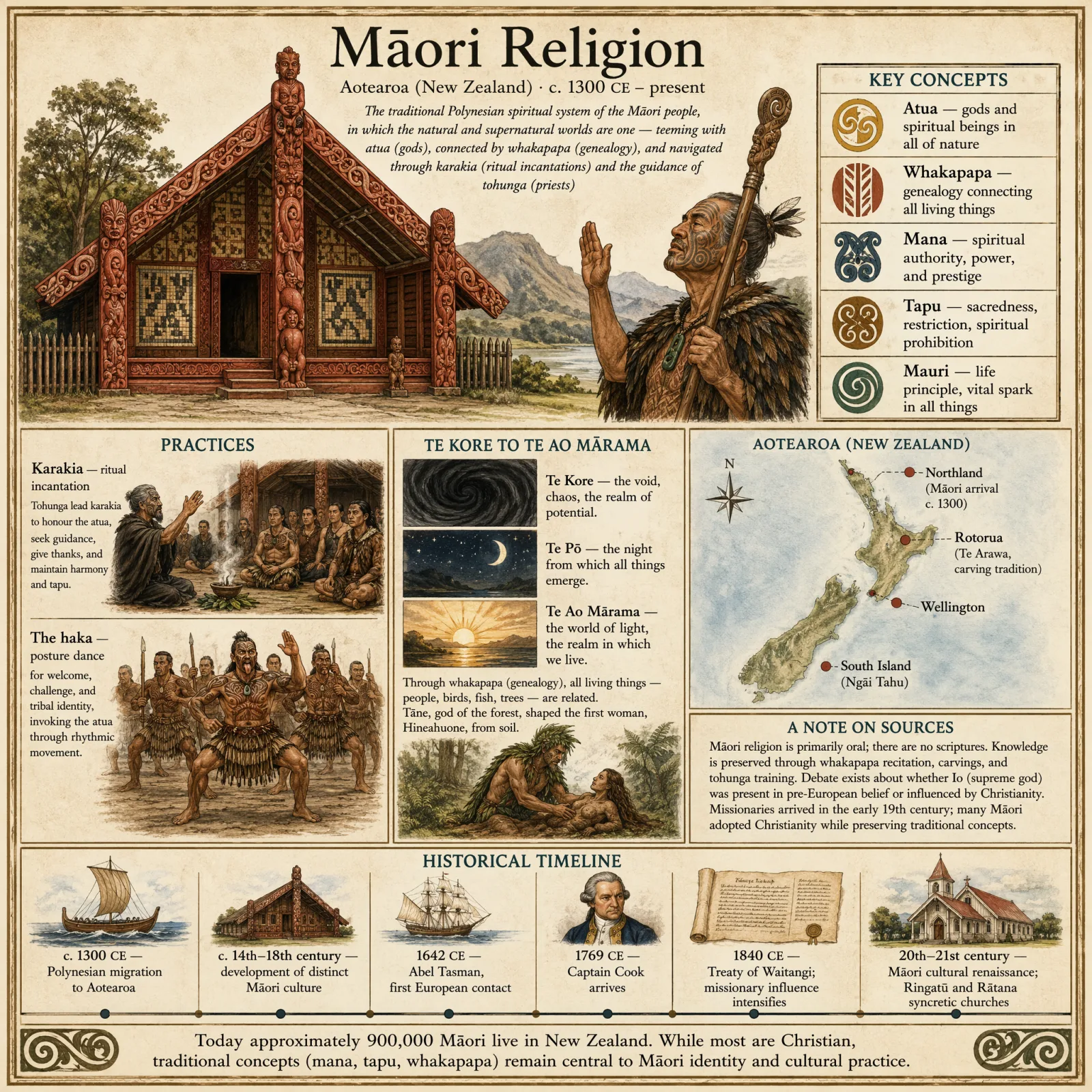
Māori Religion, or aspects of Māoritanga (Māori culture and worldview), encompasses the living spiritual and philosophical traditions of the Māori people of Aotearoa (New Zealand). Rooted in Polynesian origins and shaped by centuries of life in Aotearoa, Māori religion centers on the interconnectedness of all existence through whakapapa (genealogy), the dynamic interplay of tapu (sacred restriction) and noa (commonality), and the cultivation of mana (spiritual authority and power). Atua (gods and ancestral spirits) are not distant deities but living presences embedded in the natural world, while the land itself—mountains, rivers, forests, and seas—is understood as kin, descended from Ranginui (the Sky Father) and Papatūānuku (the Earth Mother).
Unlike religions that separate the sacred from the secular, Māori religion permeates every aspect of life: kinship structures, leadership, resource management, ritual protocols, and artistic expression. The marae (communal gathering place) functions as the institutional heart of Māori religious and social life, where ceremonial protocols (tikanga) govern greetings, speeches (whaikōrero), mourning rites (tangihanga), and communal decision-making. While Christianity profoundly transformed Māori society from the 1820s onward, Māori religious concepts did not disappear; instead, they adapted, blended, and persisted, giving rise to distinctive movements such as Ringatū and Rātana that fuse biblical narratives with Māori cosmology and political aspirations.
Today, Māori religion is a living tradition, practiced in varying forms across urban and rural communities. Some Māori maintain traditional cosmological frameworks, while others integrate Christian or secular worldviews. The revitalization of te reo Māori (the Māori language), the reclamation of ancestral lands, and the resurgence of tikanga in legal and environmental contexts all reflect the enduring vitality of Māori religious thought. This article examines the historical development, core concepts, sacred geography, and contemporary expressions of Māori religion as a distinct Indigenous tradition within Oceania.
Polynesian Origins and Early Settlement
Māori trace their origins to Eastern Polynesia, with ancestral voyages beginning around the 13th and 14th centuries CE. The great ocean-going waka (canoes) carried not only people but also their cosmological knowledge, agricultural practices, and sacred narratives. The cosmology brought from Hawaiki (the ancestral homeland) included stories of creation, the separation of Ranginui and Papatūānuku, and the deeds of atua such as Tāne (god of forests), Tangaroa (god of the sea), and Tāwhirimātea (god of weather).
Upon settling in Aotearoa, Māori adapted their Polynesian traditions to the new environment. The temperate climate, different flora and fauna, and volcanic landscapes required new understandings of tapu and resource management. Oral traditions evolved to incorporate local landmarks as ancestral figures: mountains became tupuna (ancestors), rivers became the tears of Rangi, and forests became the domain of Tāne. The tohunga (ritual experts and priests) were the keepers of this knowledge, responsible for karakia (incantations), genealogical recitation, and the mediation between human and divine realms.
Early Māori society was organized around hapū (subtribes) and iwi (tribes), each with distinct whakapapa linking them to specific waka, atua, and geographical regions. The marae emerged as the central institution for ritual life, a space where the living and the dead converged, where ancestors were honored, and where communal identity was affirmed through ceremonial performance.
The arrival of European missionaries in the early 19th century initiated a profound transformation of Māori religious life. Initially, Māori engaged with Christianity on their own terms, interpreting biblical narratives through existing cosmological frameworks. The concept of a single supreme creator resonated with some traditions of Io Matua Kore (a supreme being known in some tribal traditions), while the biblical stories of covenant, exile, and prophetic leadership found parallels in Māori oral traditions.
By the 1830s, Christianity spread rapidly among Māori, facilitated by Māori evangelists and the adoption of literacy. However, this was not a simple replacement of one religion with another. Māori Christians often retained concepts of tapu, mana, and whakapapa, integrating them into Christian practice. Church services incorporated Māori oratory styles, and wharenui (meeting houses) sometimes functioned as both sacred spaces and sites of Christian worship.
The New Zealand Wars (1845–1872) and subsequent land confiscations created a crisis of faith and identity. Many Māori leaders questioned whether Christianity had failed them, given that Christian colonizers had violated the principles of justice and reciprocity embodied in Te Tiriti o Waitangi (the Treaty of Waitangi, signed in 1840). This crisis gave rise to prophetic movements that blended Māori and Christian traditions, asserting tino rangatiratanga (self-determination) and challenging both colonial authority and mainstream Christianity.
Te Kooti Arikirangi Te Tūruki, wrongly imprisoned and exiled to the Chatham Islands (Wharekauri) in 1866, founded the Ringatū faith after experiencing divine visions. Upon his escape and return to the mainland, Te Kooti and his followers raised their hands in gratitude to God, giving the movement its name: Ringatū (the upraised hand). Ringatū integrated biblical themes—especially the exodus narrative and the Passover—with Māori cosmology and a lunar calendar. Te Kooti established sacred days (the twelfths of each month) commemorating key events in the movement's history, and Saturday (like the Jewish Sabbath) became the day of worship.
Ringatū remains a living faith, with regional branches maintaining distinct tikanga while sharing core liturgical practices. The movement emphasized Māori autonomy, literacy in both te reo Māori and biblical texts, and a critique of colonial injustice. Te Kooti's teachings combined prophecy, healing, and political resistance, making Ringatū both a religious and a political force.
In the 20th century, Tahupōtiki Wiremu Rātana emerged as a faith healer and prophet, founding the Rātana movement in 1918. Rātana's visions called for Māori unity and the fulfillment of Te Tiriti o Waitangi. He famously held the Bible in one hand and the Treaty in the other, asserting that spiritual and political liberation were inseparable. The Rātana Church incorporated Christian theology, angels (ngā anahera), and the Holy Spirit (te Wairua Tapu), while Rātana himself was considered te Māngai (the mouthpiece) of God.
The Rātana movement gained widespread support among Māori, and from the 1930s onward, Rātana politicians allied with the Labour Party, securing Māori seats in Parliament and advancing social justice for Māori communities. Rātana remains a significant religious and political institution, with its headquarters at Rātana Pā near Whanganui serving as a pilgrimage site and center of communal life.
The late 20th century saw a resurgence of Māori cultural and religious identity, often termed the Māori Renaissance. This period was marked by protests such as the 1975 Land March led by Dame Whina Cooper, the establishment of the Waitangi Tribunal to address historical grievances, and the revitalization of te reo Māori through language nests (kōhanga reo) and immersion schools (kura kaupapa Māori).
Māori religious concepts reentered public life through legal and environmental contexts. The 2017 recognition of the Whanganui River (Te Awa Tupua) as a legal person with rights reflected Māori cosmological principles: the river is not a resource to be owned but an ancestor with intrinsic mana. Similar recognitions have been granted to Te Urewera (formerly a national park) and Mount Taranaki. These legal frameworks draw directly on Māori understandings of kaitiakitanga (guardianship) and the relational nature of existence.
Marae across Aotearoa have been revitalized as centers of cultural transmission, where tikanga is taught, tangihanga are conducted, and political hui (gatherings) address contemporary issues. Younger generations are reclaiming Māori spiritual practices, not as museum artifacts but as living systems of knowledge relevant to environmental justice, decolonization, and Indigenous sovereignty.
Whakapapa: The Cosmic Genealogy
At the heart of Māori religion is whakapapa, the genealogical framework that links all beings—human and nonhuman—to a common origin. Whakapapa is not merely a family tree; it is a cosmological map that situates individuals within a vast network of relationships extending back to the primordial realms of Te Kore (the void), Te Pō (the darkness), and Te Ao Mārama (the world of light).
According to Māori cosmogony, Ranginui (the Sky Father) and Papatūānuku (the Earth Mother) were originally locked in a tight embrace, their children cramped in darkness between them. The children—Tāne, Tangaroa, Tāwhirimātea, Tūmatauenga, Rongo, and Haumia—debated how to bring light into the world. Tāne eventually succeeded in separating his parents by pushing Rangi upward with his feet, creating the space between earth and sky where life could flourish. Rangi's tears became rain and rivers, while Papa's mist rose to meet him in an eternal expression of longing.
Humans are the descendants of Tūmatauenga (the god of war and humanity), but they are also kin to the forests (children of Tāne), the seas (children of Tangaroa), and the winds (children of Tāwhirimātea). This kinship imposes responsibilities: to respect the mauri (life force) of all beings, to observe tapu when harvesting resources, and to maintain reciprocal relationships with the natural world. Whakapapa is recited in formal settings to establish identity, legitimacy, and connection to place. To know one's whakapapa is to know one's place in the cosmos.
Tapu is a foundational concept in Māori religion, often translated as 'sacred' or 'forbidden,' but encompassing a complex system of restrictions that protect mana and maintain the integrity of persons, places, and objects. Tapu is not inherently negative; it marks boundaries between the sacred and the profane, ensuring that powerful forces are approached with respect and caution. A person of high rank carries tapu, as do places of burial, wharenui, and sites associated with atua. Violating tapu can bring misfortune, illness, or death, as it disrupts the cosmic order.
Noa is the complementary principle to tapu, signifying commonality, neutrality, and the removal of restriction. Rituals of noa are performed to lift tapu after sacred activities: food is blessed to remove tapu before eating, water is used to cleanse oneself after visiting a cemetery (urupā), and karakia are recited to restore a place to common use. The interplay of tapu and noa regulates social relations, resource management, and ritual life.
Mana is spiritual authority, power, and prestige, derived from whakapapa, personal achievement, and the favor of atua. A rangatira (chief) holds mana through descent and demonstrated leadership, while a tohunga gains mana through mastery of sacred knowledge. Mana is not static; it can be enhanced through successful endeavors or diminished through failure or disrespect. The violation of tapu can damage a person's mana, while acts of generosity, courage, and wisdom increase it. Mana is closely linked to mauri, the life principle that animates all beings. The mauri of a forest, a river, or a person must be protected, for without it, life ceases.
Atua in Māori religion are not transcendent, omnipotent deities but dynamic presences embedded in the natural world. The primary atua—such as Tāne, Tangaroa, Tāwhirimātea, and Tūmatauenga—govern different realms and embody different aspects of existence. Tāne is the god of forests and birds, the provider of timber and food; Tangaroa rules the ocean and its creatures; Tāwhirimātea commands the winds and weather; Tūmatauenga is the ancestor of humankind and the patron of war.
In addition to these major atua, there are lesser atua, tribal atua, and deified ancestors who continue to influence the living. A particular iwi or hapū may have a guardian atua who protects their lands and waters. Mountains, rivers, and forests are often understood as atua themselves, or as the physical manifestations of atua. For example, Aoraki (Mount Cook) is an ancestor of Ngāi Tahu, turned to stone when his waka ran aground. Tongariro is revered by Ngāti Tūwharetoa as a tupuna and a living presence.
The relationship between Māori and atua is reciprocal. Atua provide sustenance, protection, and guidance, but they also demand respect, correct behavior, and offerings. Karakia are recited to invoke the assistance of atua before fishing, planting, or building. To harvest from Tāne's domain without acknowledging him is to invite misfortune. This reciprocal ethic extends to the land itself, which is not property to be owned but a relative to be cared for.
Sacred Knowledge and Oral Tradition
Māori religious knowledge has been transmitted primarily through oral tradition, recited and performed by tohunga and kaumātua (elders). Whakapapa, karakia, waiata (songs), and kōrero pūrākau (traditional narratives) are learned through repetition, observation, and initiation. The accuracy and continuity of this knowledge depend on the memory and skill of the tohunga, who guard esoteric teachings (whare wānanga knowledge) accessible only to those properly trained and initiated.
Karakia are ritual incantations that invoke atua, protect individuals from spiritual harm, and sanctify activities. Some karakia are general and widely known, while others are closely guarded by specific iwi or tohunga. The power of karakia lies not only in the words themselves but in the mana of the speaker, the context of recitation, and the observance of correct protocol. Karakia are used in contexts ranging from birth and naming ceremonies to warfare, agriculture, and death rites.
With the arrival of literacy, some tohunga began recording traditional knowledge in manuscripts. The most famous example is the material collected by Pākehā (European) ethnographers such as Elsdon Best and S. Percy Smith, though these records must be approached critically, as they often reflect colonial biases and misunderstandings. Best's writings, while extensive, imposed European hierarchical structures onto Māori concepts of atua and misrepresented aspects of tapu and mana. More reliable sources include the writings of Māori scholars such as Apirana Ngata, Te Rangikaheke, and contemporary authorities like Hirini Moko Mead and Te Ahukaramū Charles Royal.
Today, whare wānanga (Māori universities) and tribal education programs are revitalizing traditional knowledge systems, ensuring that karakia, whakapapa, and tikanga are transmitted to younger generations in culturally appropriate ways. The Bible, particularly in Māori translation, has also become a significant text for Māori Christians, integrated into liturgical practices that reflect Māori oratory and ritual styles.
The Marae and Hui Protocols
The marae is the sacred heart of Māori communal life, a physical and spiritual space where the living and the dead, the human and the divine, converge. At its center stands the wharenui (meeting house), often carved and painted to represent a tupuna. The ridgepole (tāhuhu) is the ancestor's spine, the rafters (heke) are the ribs, and the porch (roro) is the head. To enter a wharenui is to enter the body of an ancestor, and thus the space is deeply tapu.
A hui (gathering) on a marae follows strict tikanga. Visitors are welcomed through the pōwhiri, a ceremonial process that includes the karanga (call of welcome by women), whaikōrero (formal speeches by men), and the hongi (pressing of noses to share the breath of life). The speeches invoke ancestors, acknowledge the dead, and establish the purpose of the gathering. The marae ātea (courtyard in front of the wharenui) is the domain of Tūmatauenga and thus a space of contest and debate, while the interior of the wharenui is the domain of Rongo, the god of peace, where harmony prevails.
Tangihanga (funeral rites) are conducted on the marae, with the tūpāpaku (deceased) lying in state in the wharenui for several days. Mourners gather to weep, sing waiata tangi (laments), recount the deeds of the deceased, and affirm whakapapa. The tangihanga is an expression of aroha (love and compassion), but it is also a political and social act, reinforcing kinship ties and communal solidarity. After burial, a tohunga or minister performs the takahi whare, walking through the deceased's home to remove the tapu of death.
Birth is marked by the cutting of the umbilical cord and the placenta (whenua), which is often buried on ancestral land, linking the child to place and whakapapa. The tohi (naming ceremony) involves karakia to bestow mana on the child and connect them to ancestral lines. Coming-of-age rituals, particularly for young men, once included training in warfare, oratory, and esoteric knowledge, though these practices have been transformed by colonization and urbanization.
Marriage (mārena) traditionally involved negotiations between families, with the exchange of gifts and speeches affirming the union's political and genealogical significance. In contemporary Māori society, Christian marriage ceremonies are common, but many couples also incorporate Māori customs, such as karakia, hongi, and speeches on the marae.
Death rituals (tangihanga) are the most elaborately preserved aspect of Māori religious practice. The journey of the wairua (spirit) after death is understood in some traditions as a return to Hawaiki via Te Rerenga Wairua (Cape Reinga), where the spirit descends into the underworld. The tangihanga process allows the living to farewell the dead properly, ensuring the wairua's peaceful transition and maintaining balance between the living and the ancestral realm.
Māori environmental practices are grounded in the concept of kaitiakitanga (guardianship), which emphasizes reciprocal care for the land, waters, and ecosystems. Kaitiaki (guardians) are responsible for protecting the mauri of natural places, ensuring that harvesting is sustainable and that tapu is observed. Traditional resource management included rāhui (temporary restrictions on harvesting), seasonal closures, and karakia before fishing, hunting, or entering forests.
Contemporary environmental movements led by Māori have revitalized these practices, challenging extractive industries and asserting Indigenous rights over land and water. The recognition of rivers, mountains, and forests as legal persons reflects a Māori worldview in which the natural world is kin, deserving of protection and respect. Māori environmental activism is thus both a spiritual and a political endeavor, rooted in the principle that the health of the land and the health of the people are inseparable.
Regional and Denominational Diversity
Māori religious practices vary significantly across iwi and regions, reflecting the diversity of whakapapa, historical experiences, and environmental contexts. Northern iwi such as Ngāpuhi have distinct tikanga and karakia traditions, shaped by early contact with Europeans and the legacy of the Musket Wars. Central North Island iwi such as Ngāti Tūwharetoa and Tūhoe maintain strong connections to volcanic landscapes and the forests of Te Urewera. South Island iwi such as Ngāi Tahu have whakapapa linking them to Aoraki and the Southern Alps, with traditions shaped by the colder climate and different resources.
Denominational diversity also marks contemporary Māori religion. Some Māori are committed members of mainstream Christian denominations—Anglican, Catholic, Methodist—while integrating Māori tikanga into worship. Ringatū and Rātana represent distinctly Māori Christian movements, each with its own liturgy, sacred calendar, and political commitments. Some Māori practice a non-Christian spirituality, drawing on pre-colonial cosmology and rejecting Christian influences as colonial impositions.
Urban marae in cities like Auckland, Wellington, and Christchurch serve pan-tribal communities, bringing together Māori from different iwi who share urban space. These marae adapt traditional tikanga to urban contexts, balancing inclusivity with the need to maintain cultural specificity. The diversity of Māori religious life reflects the resilience and adaptability of Māori culture in the face of colonization, modernization, and globalization.
Māori Communities Today
Today, Māori make up approximately 17% of New Zealand's population, with communities distributed across both rural and urban areas. Rural marae remain the spiritual and social anchors of iwi identity, while urban marae serve as gathering places for Māori who have migrated to cities. The revitalization of te reo Māori and tikanga has created a generation of young Māori who are fluent in the language and knowledgeable about cultural protocols, even if they live far from their ancestral lands.
Māori religious life is also shaped by diaspora communities in Australia, the United Kingdom, and elsewhere. These communities maintain connections to home marae, participate in tangihanga remotely, and establish urban marae abroad to preserve cultural continuity.
The Māori population is young and growing, with increasing political and economic influence. Māori leaders in education, law, environmental activism, and the arts are drawing on Māori religious and philosophical traditions to address contemporary challenges, from climate change to Indigenous rights. The resurgence of Māori religion is not a retreat into the past but a dynamic engagement with the present and future, asserting that Māori ways of knowing and being are vital to a just and sustainable world.
Sacred Geography of Aotearoa
Te Rerenga Wairua (Cape Reinga): Located at the northernmost tip of the North Island, Te Rerenga Wairua is the most spiritually significant site in Māori cosmology. It is here that the wairua (spirits) of the dead depart Aotearoa to return to Hawaiki, the ancestral homeland. The spirits descend via the root of an ancient pōhutukawa tree into the ocean, then travel to Te Manawatāwhi (Three Kings Islands) for a final farewell. The site is deeply tapu, and visitors are asked to observe tikanga, including refraining from eating at the cape. Te Rerenga Wairua embodies the Māori understanding of death as a journey, not an end, and the enduring connection between the living, the dead, and the ancestral homeland.
Tongariro: The volcanic peaks of Tongariro, Ngauruhoe, and Ruapehu in the central North Island are sacred mountains (maunga) of Ngāti Tūwharetoa. Tongariro is a tupuna (ancestor) and embodies the mauri of the iwi. The mountains were gifted to the Crown in 1887 by Te Heuheu Tūkino IV to protect them from European settlement, leading to the establishment of Tongariro National Park, New Zealand's first. The park's recognition as a UNESCO World Heritage Site for its cultural landscape affirms the Māori understanding of mountains as living ancestors, not mere geological formations.
Aoraki (Mount Cook): The highest peak in New Zealand, Aoraki is the most sacred ancestor of Ngāi Tahu. According to Ngāi Tahu tradition, Aoraki and his brothers were the sons of Rakinui (the Sky Father). Their waka (canoe) ran aground on a reef, and when they climbed onto the high side, they were turned to stone, forming the Southern Alps. Aoraki's head is the summit of Mount Cook. The meltwaters that flow from Aoraki are sacred, used in ceremonial blessings. Ngāi Tahu assert that it is inappropriate to climb the mountain, as it is the head of an ancestor, though this view has not prevented mountaineering.
Waitangi: The site in the Bay of Islands where Te Tiriti o Waitangi was signed on 6 February 1840 between representatives of the British Crown and Māori rangatira. The Treaty Grounds are a place of historical and spiritual significance, marking the beginning of formal relations between Māori and the Crown, and the source of ongoing debates about sovereignty, land rights, and justice. Waitangi Day commemorations held here are sites of political protest and cultural affirmation, where Māori assert tino rangatiratanga and challenge breaches of the Treaty.
Marae across Aotearoa: Every iwi and many hapū maintain marae, each with its own wharenui named for a tupuna. These marae are not tourist attractions but living institutions central to Māori life. Examples include Tūrangawaewae Marae in Ngāruawāhia (the seat of the Kiingitanga, the Māori King movement), Te Herenga Waka Marae at Victoria University of Wellington (the first university marae with a carved wharenui), and Rātana Pā near Whanganui (the headquarters of the Rātana movement). Marae are sites of tangihanga, hui, educational programs, and the transmission of tikanga.
Contemporary Issues and Debates
One major debate concerns the relationship between Māori religion and Christianity. Some Māori argue that Christianity was a tool of colonization, used to justify land theft and cultural suppression, and advocate for a return to pre-colonial spirituality. Others see Christianity as having been indigenized and integrated into Māori identity, pointing to movements like Ringatū and Rātana as authentically Māori expressions of faith. This tension reflects broader questions about authenticity, decolonization, and the possibilities for religious hybridity.
The legal recognition of natural features as persons (e.g., the Whanganui River, Te Urewera) has sparked debate about the applicability of Māori religious principles in secular legal systems. Critics argue that such recognitions are symbolic gestures without teeth, while supporters see them as precedents for reimagining environmental law and Indigenous sovereignty. These debates raise fundamental questions about whose worldview governs in a postcolonial state.
The transmission of sacred knowledge (mātauranga Māori) is another contested issue. Some kaumātua insist that certain knowledge is tapu and should not be shared publicly or with outsiders, while others argue that wider dissemination is necessary for cultural survival in a modern, urbanized context. Debates over intellectual property, the ethics of recording karakia, and the role of universities in teaching mātauranga Māori reflect ongoing tensions between tradition and adaptation.
Finally, the question of who can speak for Māori religion—and who can practice it—remains contentious. Should non-Māori be allowed to participate in marae protocols, learn karakia, or write about Māori spirituality? Some Māori welcome engagement as a form of cultural sharing and reconciliation, while others see it as appropriation. These debates are part of broader struggles over cultural authority, representation, and the politics of recognition in Aotearoa.
Key Terms
- Atua
- Gods, deities, or ancestral spirits; dynamic presences embedded in the natural world and whakapapa.
- Haka
- A ceremonial dance or chant, often performed to express identity, challenge opponents, or honor the dead.
- Hapū
- Subtribe, a kinship group descended from a common ancestor.
- Hongi
- The traditional Māori greeting in which two people press their noses and foreheads together, sharing the breath of life.
- Hui
- A gathering or meeting, often held on a marae for ceremonial, political, or social purposes.
- Iwi
- Tribe, the largest kinship group in Māori society, composed of multiple hapū.
- Kaitiakitanga
- Guardianship or stewardship, particularly of the environment and natural resources.
- Karakia
- Incantations or prayers, often used to invoke atua, remove tapu, or sanctify activities.
- Kaumātua
- Elders, respected members of the community who hold knowledge and authority.
- Mana
- Spiritual authority, power, and prestige, derived from whakapapa and personal achievement.
- Marae
- A communal gathering place, consisting of a wharenui (meeting house) and surrounding area, central to Māori social and religious life.
- Mauri
- The life principle or essence that animates all beings and places.
- Noa
- The state of being common or free from tapu; rituals of noa remove restrictions.
- Pōwhiri
- The formal process of welcoming visitors onto a marae, involving karanga, whaikōrero, and hongi.
- Rangatira
- Chief or leader, a person of high rank and mana.
- Tangihanga
- Funeral rites, an elaborate process of mourning conducted on the marae.
- Tapu
- Sacred restriction or prohibition, marking boundaries between the sacred and the profane.
- Tikanga
- Customary practices, protocols, and values that govern Māori life.
- Tohunga
- Ritual expert, priest, or specialist in esoteric knowledge.
- Tūpāpaku
- The deceased, the corpse lying in state during a tangihanga.
- Wairua
- Spirit or soul, the immaterial essence of a person that continues after death.
- Whakapapa
- Genealogy; the cosmological framework linking all beings to a common origin.
- Whaikōrero
- Formal oratory or speechmaking, a key component of marae protocols.
- Wharenui
- Meeting house, the central structure of a marae, often representing a tupuna.
- Whenua
- Land, but also placenta; both signify deep connection to place and ancestry.
Further Reading
- Hirini Moko Mead, Tikanga Māori: Living by Māori Values (Huia Publishers, 2003)
- Ranginui Walker, Ka Whawhai Tonu Matou: Struggle Without End (Penguin Books, 2004)
- Te Ahukaramū Charles Royal, 'Te Ao Mārama – the natural world,' Te Ara Encyclopedia of New Zealand (2009)
- Anne Salmond, Hui: A Study of Māori Ceremonial Gatherings (Reed Publishing, 1975)
- Anne Salmond, Tears of Rangi: Experiments Across Worlds (Auckland University Press, 2017)
- Claudia Orange, The Treaty of Waitangi (Bridget Williams Books, 2011)
- Michael Belgrave, 'Beyond the Treaty of Waitangi,' Journal of New Zealand Studies (2014)
- Department of Conservation, 'Cape Reinga/Te Rerenga Wairua heritage'
- Ngāi Tahu Claims Settlement Act 1998, Schedule 14: Statutory acknowledgement for Aoraki/Mount Cook
- Department of Conservation, 'Nomination of Tongariro National Park for inclusion in the World Heritage cultural list' (1990)
Practices
- Karakia (incantations)
- Marae gatherings
- Tā moko
- Ancestor veneration
Core ideas
- Deity
- Io supreme; gods of nature
- Soul
- Wairua continues among ancestors
Sacred texts
Māori sacred knowledge is carried in whakapapa (genealogical chants linking all beings to Ranginui and Papatūānuku) and karakia (incantations for every occasion from birth to harvest). These are recited on the marae and taught within iwi (tribal) communities. Written collections exist, but oral performance on ancestral land remains the authoritative form.