Inuit Religion
Sedna of the sea, shamans, and animal souls.
Overview
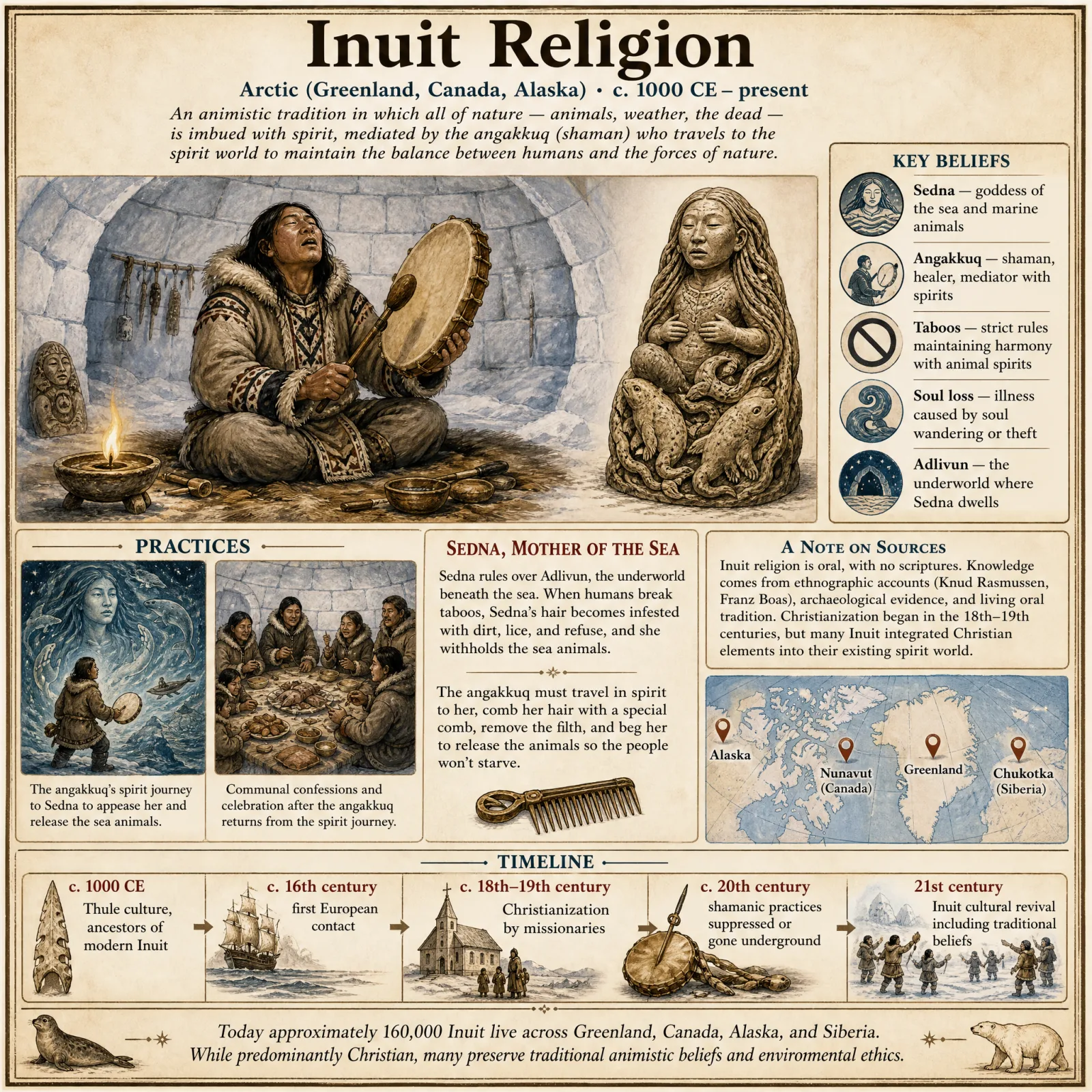
Inuit religion is the traditional spiritual system of the Inuit peoples, whose homeland spans the Arctic regions of Alaska (Iñupiat), Canada (Inuit of Nunavut, Nunavik, Nunatsiavut, and Inuvialuit), and Greenland (Kalaallit). Numbering approximately 180,000 people across these circumpolar regions, the Inuit have maintained cultural and spiritual traditions adapted to one of Earth's most challenging environments for at least three millennia. Inuit religion is fundamentally relational—centered on reciprocal relationships with animal persons, landscape beings, weather forces, and the pervasive spiritual essence called sila (cosmic breath, weather, intelligence, consciousness). The tradition is not organized around temples, sacred texts, or centralized institutions, but rather emerges from daily hunting practices, seasonal rhythms, oral narratives (unikkaaqtuq), community rituals, and the specialized knowledge of angakkuit (shamans, singular: angakkuq), who mediate between human and non-human worlds.
Central to Inuit cosmology is the understanding that animals, humans, and other beings possess anirniq (breath-soul, life force; also called inua or 'person-essence')—a shared animacy that makes all beings persons capable of thought, intentionality, and relationship. Seals, caribou, whales, polar bears, and other hunted animals are not mere resources but sentient persons who must be respected, thanked, and treated properly if they are to continue offering themselves to hunters. Hunting is therefore a moral and spiritual act requiring observance of maligait (customs, taboos, rules of conduct) to maintain right relationship with animal persons and ensure their willingness to return. Violations of taboos—failing to offer water to a seal's soul, mixing sea and land animal products, menstruating women touching hunting equipment—can offend animal spirits, cause illness, disrupt weather, or drive away game. The Sea Woman (known by many names: Takannaaluk, Nuliajuk, Sedna, Arnakuagsak, depending on region), a powerful female being who controls marine mammals, is a central figure—shamans journey to her underwater realm to comb her hair and petition for the release of seals when hunting fails or taboos have been broken.
Inuit religion has undergone profound transformations since sustained contact with Europeans, beginning with whalers and explorers in the 18th–19th centuries and intensifying with missionaries (primarily Anglican, Catholic, and Moravian) in the late 19th–early 20th centuries. By the mid-20th century, most Inuit had nominally converted to Christianity, and shamanic practices were suppressed, driven underground, or ceased. However, as anthropologists Frédéric Laugrand and Jarich Oosten have documented through extensive oral testimony from elders in Nunavut, the transition to Christianity was not a simple replacement but a complex negotiation—many Inuit integrated Christian beliefs with traditional cosmology, understanding Jesus as a powerful helping spirit, God as akin to Sila, and church rituals as analogous to shamanic ceremonies. Contemporary Inuit spiritual life is diverse: many practice Christianity (often with Pentecostal or evangelical influences), some have revitalized traditional practices, and most navigate between multiple frameworks while maintaining core values of respect for animals, elders, and land.
Inuit Qaujimajatuqangit (IQ)—'Inuit traditional knowledge' or more accurately 'Inuit ways of knowing and doing'—is a contemporary term encompassing traditional ecological knowledge, ethical principles, social practices, and spiritual understandings. IQ has been officially adopted by the Government of Nunavut (established 1999) as a guiding framework for policy, education, and resource management, representing an Indigenous governance approach that honors elder knowledge and traditional values. The Interviewing Inuit Elders series, published by Nunavut Arctic College and edited by Laugrand and Oosten, documents oral testimonies from elders across Nunavut on cosmology, shamanism, hunting, childrearing, law, and health, preserving knowledge threatened by the passing of the last generation who lived fully nomadic, pre-settlement lives. These publications, along with ongoing community-based transmission through land camps, language programs, and cultural centers, sustain Inuit spiritual and cultural continuity amid rapid social change, climate crisis, and ongoing colonial pressures.
Historical Development
The ancestors of the Inuit, the Thule people, migrated eastward from Alaska across the Canadian Arctic and into Greenland beginning around 1000–1200 CE, bringing with them advanced marine mammal hunting technology (especially bowhead whale hunting), dog sleds, and umiak (large skin boats). They displaced or absorbed the earlier Dorset culture people, whose spiritual practices may have influenced Thule-Inuit traditions, though evidence is limited. By the time of European contact, Inuit societies were distributed across the vast Arctic, organized into regional groups with distinct dialects, seasonal migration patterns, and cultural variations, but sharing core cosmological beliefs, hunting practices, and social organization based on extended family camps and seasonal gatherings.
Early European contact came through Norse expeditions to Greenland (beginning c. 985 CE) and later Martin Frobisher's expeditions (1576–1578), but sustained interaction began with commercial whaling in the 18th–19th centuries. Whalers introduced trade goods (metal tools, firearms, alcohol, tobacco), European diseases (causing devastating epidemics), and disrupted traditional subsistence patterns by depleting whale and caribou populations. Christian missionaries arrived in the mid-to-late 19th century: Moravian missions in Labrador (1770s), Anglican missions in the Central and Eastern Arctic (1820s onward), and Catholic missions in the Western Arctic and Greenland. Missionaries viewed Inuit shamanism as demonic, forbade traditional practices (drum dancing, shamanic ceremonies, polygyny, spouse exchange, infanticide), and worked to convert Inuit to Christianity. Many Inuit adopted Christianity, though motivations were complex—some genuinely embraced the new faith, others saw political or economic advantages, and many integrated Christian elements into existing spiritual frameworks rather than abandoning traditional beliefs.
The Danish polar explorer Knud Rasmussen (1879–1933), himself part Greenlandic Inuk, conducted the monumental Fifth Thule Expedition (1921–1924), traveling over 20,000 miles by dog sled from Greenland across the Canadian Arctic to Alaska. Rasmussen, fluent in Inuktitut, recorded extensive oral histories, myths, songs, and shamanic knowledge from Iglulik, Caribou, Netsilik, and Copper Inuit elders, publishing multi-volume reports (*Intellectual Culture of the Iglulik Eskimos*, 1929; *Observations on the Intellectual Culture of the Caribou Eskimos*, 1930, etc.) that remain foundational ethnographic sources. His work, conducted during the transition period when many elders still remembered pre-contact shamanic practices, preserved knowledge that would soon be suppressed or lost. However, Rasmussen's accounts must be read carefully—they reflect the perspectives and knowledge of specific consultants, his own interpretive frameworks, and the power dynamics of outsider ethnography.
The mid-20th century brought forced sedentarization, residential schools, and Canadian/Greenlandic/U.S. government policies aimed at assimilating Inuit. Families were relocated from seasonal camps to permanent settlements, children were removed to residential schools (especially in Canada, 1950s–1990s) where they were punished for speaking Inuktitut and practicing traditional culture, and subsistence hunting was restricted or discouraged in favor of wage labor. These policies caused profound trauma—family separation, cultural loss, language erosion, and epidemics of social ills (suicide, substance abuse, domestic violence) that persist today. Shamanic practices largely ceased in this period, driven underground by missionary and government pressure, though some elders continued to practice secretly or maintained shamanic knowledge without active practice.
Since the 1970s–1980s, Inuit have pursued political self-determination and cultural revitalization. The Inuit Circumpolar Council (ICC, founded 1977) represents Inuit interests internationally, advocating for Indigenous rights, environmental protection, and cultural preservation. Canada's Nunavut Territory (established 1999), carved from the Northwest Territories, is the first Canadian territory with an Inuit majority and Inuit self-government, with Inuktitut and Inuinnaqtun as official languages. Greenland achieved home rule (1979) and self-government (2009), gaining increasing autonomy from Denmark. Alaska Natives, including Iñupiat, secured land claims through the Alaska Native Claims Settlement Act (1971), though their sovereignty remains contested. Cultural revitalization efforts include Inuktitut language revitalization, land-based education programs, revival of traditional hunting practices, documentation of elder knowledge (including the Interviewing Inuit Elders series and IQ projects), and contemporary Inuit art (sculpture, printmaking, throat singing, drum dancing) that engages traditional spiritual themes.
Contemporary Inuit spiritual life reflects this history: Christianity is widespread (especially Anglicanism in the Canadian Eastern Arctic, Catholicism in parts of Quebec and Greenland, Pentecostalism increasingly popular), but many Inuit describe their faith as syncretic, blending Christian theology with traditional respect for animals, land, and elder wisdom. Some communities have revitalized drum dancing, throat singing (katajjaq), and storytelling as cultural-spiritual practices. Shamanic practices are not widely practiced publicly—the last generation of practicing angakkuit largely passed away by the late 20th century—though some individuals claim shamanic abilities, and elders continue to share knowledge about shamanism in educational contexts. The relationship with Christianity is complex: some Inuit fully embrace Christianity and view traditional shamanism as dangerous or outdated; others critique Christianity as a tool of colonization and seek to reclaim traditional spirituality; many navigate between both, finding value in Christian community and ethics while honoring traditional relationships with land and animals.
Cosmology and Philosophy
Inuit cosmology understands the universe as layered and inhabited by multiple classes of beings. The human world (nuna, 'land') is surrounded and interpenetrated by other realms: the sea depths (where the Sea Woman dwells and marine mammals originate), the sky (home of celestial beings, including the sun and moon, understood as a brother-sister pair involved in a mythic incestuous pursuit), and various spirit realms accessible through dreams, shamanic journeys, and death. The cosmos is not static but dynamic—beings transform between forms (human to animal, animal to spirit, living to dead), and boundaries between categories are permeable. Human persons and animal persons are not ontologically distinct but share anirniq (breath-soul) and can shapeshift, reincarnate, and communicate.
Sila is a central and complex concept, encompassing weather, breath, consciousness, intelligence, and cosmic order. Sila is simultaneously the air, wind, and atmosphere; the breath that animates all living beings; and the cosmic intelligence or consciousness that pervades reality. It is both immanent (the breath in one's lungs, the wind on one's face) and transcendent (the vast intelligence governing weather and seasons). Angakkuit derive power from sila, and proper conduct maintains harmony with sila, while taboo violations disturb sila, causing storms, illness, or bad hunting. Some scholars have noted parallels between sila and Christian concepts of Holy Spirit or God, facilitating Inuit integration of Christianity—God/Jesus as supreme manifestations of sila's intelligence and power.
Anirniq (plural: anirniit) or inua (plural: inuat) are terms for the breath-soul or person-essence possessed by all beings. Every human, animal, plant, and even some objects and landscape features have anirniq/inua—an inner personhood, consciousness, and agency. Seals have anirniq; they see, think, choose whether to offer themselves to hunters, and expect respectful treatment. After death, a seal's anirniq can be reborn into another seal (if treated properly) or may be offended and refuse to return (if disrespected). Humans also possess anirniq, which survives death, may linger as a ghost (tuurngaq), or be reincarnated into a newborn child. Naming practices reflect reincarnation beliefs—newborns are named after recently deceased relatives, and the child is believed to carry aspects of the deceased's anirniq, personality, and skills. This creates complex kinship relations where, for example, a young boy named after his grandfather may be addressed using grandfather terms and treated with the respect due an elder.
The Sea Woman is the most prominent non-human person in Inuit cosmology, though her name, origin story, and attributes vary by region. In Igloolik and surrounding areas, she is Takannaaluk ('the one down there'); among Kivalliq Inuit, Nuliajuk ('dear little wife'); in parts of Greenland, Arnakuagsak or Sassuma Arnaa ('Mother of the Deep'). The most widely known narrative describes her as a young woman whose father, during a storm or famine, threw her overboard from a boat to save himself; as she clung to the gunwale, he cut off her fingers, which became seals, walruses, and whales. She sank to the sea floor, where she rules over marine mammals, controlling their availability to hunters. When humans violate taboos, the Sea Woman's hair becomes tangled and dirty (representing the pollution of human transgressions), and she withholds animals. Shamans must journey to her underwater realm, comb her hair, and confess community violations to persuade her to release animals again.
Tuurngait (singular: tuurngaq) are a broad category of non-human beings or spirits, including helping spirits allied with shamans, ghosts of the dead, monstrous beings, and ambiguous entities. Tuurngait are powerful, unpredictable, and often dangerous—they may help or harm depending on circumstances and how they are approached. Shamans cultivate relationships with tuurngait as helping spirits (who assist in healing, locating game, traveling to other realms), but encountering tuurngait without proper protection or knowledge is dangerous. Some tuurngait are associated with specific places (rocks, cliffs, lakes), others with weather phenomena (wind, aurora borealis), and still others with transformation and liminality.
Inuit ethics emphasize respect (qanuqtuurniq, 'being resourceful and respectful'), sharing (avvaq), and maintaining right relationship with all beings—human and non-human. Hunting is governed by elaborate protocols: offering fresh water to a seal's mouth to quench its thirst (releasing its anirniq to return to the sea and be reborn); butchering properly; sharing meat widely (especially with elders and those unable to hunt); not boasting or claiming superior skill (which offends animal persons and causes them to avoid the arrogant hunter); and observing taboos separating sea and land animal products (e.g., not sewing caribou clothing while seal hunting is ongoing, as mixing violates categorical boundaries). These practices are not superstitious fear but ethical obligations to persons—seals are kin, deserving respect and reciprocity. Failure to observe these obligations breaks relationship, causes animals to withdraw, and brings misfortune.
There is no concept of omnipotent creator deity in traditional Inuit cosmology—the world and its beings have always existed, undergoing transformations but not created ex nihilo. Origin stories explain how current conditions arose (why seals have the shape they do, why sun and moon move as they do, how death entered the world), but these are narratives of transformation, not creation from nothing. The integration of Christianity introduced creator theology, which some Inuit adopted fully, while others interpreted God as analogous to sila or as the most powerful tuurngaq.
Oral Traditions and Contemporary Documentation
Inuit religion is fundamentally oral—there are no ancient written scriptures or sacred books. Religious knowledge is transmitted through unikkaaqtuaq (stories, oral narratives), songs, drum dancing performances, elder teachings, and experiential learning on the land. Unikkaaqtuaq encompass mythic narratives (explaining cosmic origins, the deeds of transformative beings, the Sea Woman's origin), legendary accounts (historical events, memorable hunts, encounters with non-human beings), and personal testimonies (shamanic experiences, dreams, encounters with tuurngait). These narratives are not fixed texts but living traditions—tellers adapt stories to context, audience, and purpose, and multiple versions coexist without any being 'correct' or 'canonical.'
Key narrative cycles include: the Sun and Moon story (in many versions, siblings who become the sun and moon after a brother's sexual pursuit of his sister—a cosmic incest narrative explaining celestial motion); the Kiviuq cycle (a great traveler-hero who journeys across the Arctic, encountering dangerous women, transformative beings, and strange lands); the Lumak story (a blind boy mistreated by his mother, who regains sight and takes revenge, often involving bowhead whales); and numerous animal transformation stories (humans becoming animals, animals becoming human, shamans shapeshifting). The Sea Woman narrative is foundational, though its details vary—her origin (thrown overboard, drowned, abandoned), her appearance (sometimes depicted with a fish or seal lower body, like a mermaid; other times as an old woman), and her temperament (sometimes benevolent, sometimes wrathful) differ by region and teller.
Songs (pisiq) are spiritually potent—personal songs (owned by individuals, expressing identity and power), hunting songs (calling animals, ensuring success), healing songs (used by shamans in curing), and communal songs (performed during drum dances and festivals). Songs are often received in dreams or visions, and their power lies not just in lyrics but in melody, rhythm, and performance context. Drum dancing (qilaut), performed with a large frame drum beaten with a stick, accompanies songs and is itself a spiritual practice—connecting participants to ancestors, expressing community solidarity, and invoking non-human powers. Christian missionaries suppressed drum dancing as 'pagan' and 'demonic,' but it has been revitalized in recent decades as cultural-spiritual expression.
With literacy came written documentation, initially by outsiders. Knud Rasmussen's Fifth Thule Expedition reports (1929–1932) are the most comprehensive early ethnographic sources, recording myths, songs, shamanic accounts, and personal narratives from Iglulik, Caribou, Netsilik, and Copper Inuit elders. Rasmussen's consultants—including the renowned shaman Aua (Awa), who shared extensive knowledge with Rasmussen—provided insider perspectives, though mediated through Rasmussen's interpretive framework and the power dynamics of colonial ethnography. Other early sources include Franz Boas's work with Cumberland Sound Inuit (1880s), Diamond Jenness's ethnographies (1920s), and later anthropologists' accounts. These texts are valuable but must be approached critically—they reflect specific regional traditions, the perspectives of particular consultants (often male shamans or hunters, less often women or non-specialists), and the biases of outsider researchers.
Contemporary documentation by Inuit themselves has become central. The Interviewing Inuit Elders series (Nunavut Arctic College, 1996–present), edited by Frédéric Laugrand and Jarich Oosten, comprises multiple volumes based on oral testimony workshops where elders shared knowledge with Inuit students on topics including cosmology and shamanism (Volume 4), traditional health, childrearing, and law. Published in English and Inuktitut, these volumes preserve knowledge from the last generation of elders who grew up in nomadic camps and had direct or near-direct contact with practicing shamans. Similarly, Inuit Qaujimajatuqangit (IQ) projects by the Government of Nunavut and cultural organizations document elder knowledge for educational and policy purposes, framing traditional knowledge as living, relevant wisdom rather than archaic lore.
Contemporary Inuit authors have also written novels, memoirs, and cultural studies incorporating traditional spiritual themes. Mitiarjuk Nappaaluk's *Sanaaq* (originally written in Inuktitut syllabics in the 1950s, published 1984), the first Inuktitut novel, depicts mid-20th-century Inuit life navigating tradition and change, including references to shamanism and Christianity. Inuit filmmakers, artists, and musicians engage traditional narratives and spiritual themes—the film *Atanarjuat: The Fast Runner* (2001), directed by Zacharias Kunuk and produced by Inuit filmmakers, is based on an Igloolik legend involving shamanism, revenge, and transformation, and was created with elder consultation to ensure cultural accuracy. Such contemporary works demonstrate that Inuit oral traditions are not frozen in the past but actively reinterpreted and retold in new media.
Ritual Practices and Daily Observances
Inuit religious practice is embedded in daily subsistence activities rather than segregated into temple rituals or Sabbath observances. Hunting, in particular, is the primary religious act—requiring spiritual preparation, observance of taboos, proper treatment of animal bodies, and post-hunt rituals. Before a hunt, hunters may sing personal songs, speak to animal persons (requesting their cooperation), check weather and ice conditions (interpreted as sila's mood), and ensure no taboo violations have occurred in the camp (e.g., menstruating women have avoided contact with hunting gear, sea and land animal products have been kept separate). During the hunt, hunters approach animals respectfully, avoiding boasting or excessive violence, and thank animals who offer themselves. After a successful seal hunt, fresh water is offered to the seal's mouth (quenching the seal's thirst and releasing its anirniq to return to the sea); meat is butchered properly and shared widely, especially with elders and non-hunters; and the seal's bladder or other parts may be returned to the sea (ensuring reincarnation).
Taboos (maligait) structure much of Inuit ritual life. Major categories include: separation of sea and land animals (seal products and caribou products must not be mixed—e.g., eating seal meat off a plate that recently held caribou, sewing caribou clothing during seal hunting season); menstrual taboos (menstruating women are powerful but must avoid hunters, hunting equipment, and certain spaces, as their power can interfere with animals' willingness to approach); birth taboos (women giving birth are isolated in special huts or spaces, and must observe restrictions afterward); death taboos (the recently deceased's belongings may be destroyed or given away, names avoided temporarily, and mourners observe restrictions). Violating taboos causes piquhiq (pollution, contamination), which offends animal persons, angers the Sea Woman, disturbs sila, and causes misfortune—illness, bad hunting, storms, accidents. Addressing piquhiq requires public confession (often facilitated by a shaman), restitution, and sometimes ritual purification.
Angakkuit (shamans, singular: angakkuq) are religious specialists who mediate between human and non-human worlds. Angakkuit are not priests or hereditary leaders but individuals called through visionary experiences, often involving illness, near-death, or encounters with tuurngait. They undergo initiation (acquiring helping spirits, learning to journey in trance, mastering songs and techniques) and develop qaumaniq (enlightenment, spiritual sight, the ability to see spirits, diagnose illness, and perceive hidden causes). Angakkuit perform several key functions: healing (diagnosing illness as caused by soul loss, spirit intrusion, or taboo violation, and curing through trance, soul retrieval, extraction, or negotiation with spirits); divination (locating game, finding lost persons, predicting weather); sorcery (both protective and offensive—some shamans used power to harm rivals or enemies); and community rituals (leading collective ceremonies, confessing taboos, journeying to the Sea Woman to release animals).
The most dramatic shamanic ritual is the journey to the Sea Woman. When hunting fails persistently, the community gathers, and the angakkuq enters trance (often during a darkened performance involving drumming, singing, and dramatic struggle with spirits). The shaman's soul travels down to the Sea Woman's underwater house, navigating dangers (her fierce dog, turbulent waters, narrow passages), and finds her with tangled, dirty hair (representing accumulated human transgressions). The shaman must comb her hair clean, confess community taboos, and petition her to release seals again. This ritual is simultaneously diagnostic (revealing hidden violations) and restorative (cleansing pollution, restoring relationship with the Sea Woman). Shamanic performances also included demonstrations of power—angakkuit would perform feats like being bound and escaping (showing mastery over physical constraints), swallowing and regurgitating objects, or causing stones to move, proving their spiritual power and connection to tuurngait.
Festivals and communal gatherings marked seasonal transitions and social needs. The autumn feast or Sedna feast (names vary by region) involved communal sharing of meat, confessing taboo violations publicly, and sometimes shamanic journeys to the Sea Woman. Winter festivals included drum dance competitions, throat singing duels (katajjaq, a women's practice involving rhythmic vocalizations), song contests (where rivals mocked each other in song rather than physical violence, providing conflict resolution), and communal eating and gift-giving. These gatherings reinforced social bonds, redistributed resources, and reaffirmed relationships with non-human powers. Christian missionaries often banned these festivals as occasions for 'paganism' and 'immorality,' though some communities have revived them as cultural events (drum dances now occur at community celebrations, though often stripped of explicitly shamanic content).
Death and the dead were treated with caution. The deceased's anirniq could become a dangerous ghost (tuurngaq) if improperly handled—bodies were wrapped and placed outside settlements (traditional Inuit practiced exposure or shallow stone-covered burial, not deep graves, due to permafrost), belongings destroyed or given away (to prevent the dead's anirniq from lingering), and names avoided temporarily. Mourning taboos required restrictions on behavior, work, and food. However, the dead also reincarnated—a deceased person's name and anirniq would be given to a newborn, bringing the ancestor back into the community. This created continuity across generations and meant death was not final separation but transformation and return. Christian burial practices (deep graves, church funerals, hymns) were introduced by missionaries but coexist with ongoing beliefs in anirniq, naming, and the presence of ancestors.
Contemporary practice varies widely. Most Inuit attend Christian churches (Anglican, Catholic, Pentecostal), where services are often conducted in Inuktitut and blend hymn-singing, Bible readings, and communal prayer with Inuit cultural values (sharing, respect for elders, connection to land). Some communities have revitalized drum dancing, throat singing, and storytelling as cultural-spiritual practices, though often framed as 'cultural heritage' rather than 'religion' to avoid conflict with Christian identity. Shamanic practices are largely not practiced publicly—elders share knowledge about angakkuit in educational contexts (workshops, books, films) but emphasize that true shamanic power is rare and dangerous, requiring proper training and calling. A few individuals claim shamanic abilities, though this is controversial and not widely recognized.
Regional and Contemporary Diversity
Inuit peoples are not monolithic—significant regional, linguistic, and cultural diversity exists across the Arctic. Greenlandic Inuit (Kalaallit, approximately 50,000 people) have been influenced by centuries of Danish colonization, Lutheran (later also Pentecostal) Christianity, and more recent self-government. Greenlandic spiritual traditions share core Inuit cosmological beliefs (animals as persons, taboos, shamanism) but also reflect Greenland-specific narratives and practices. Canadian Inuit (approximately 65,000, concentrated in Nunavut, Nunavik [northern Quebec], Nunatsiavut [Labrador], and Inuvialuit region [western Arctic]) exhibit regional variation—Igloolik, Pond Inlet, and Baffin Island communities (Qikiqtaaluk region) have strong Anglican and traditional knowledge continuity; Kivalliq and Kitikmeot regions have Catholic and Anglican influences; Inuvialuit (western Arctic) have distinct histories with whaling and fur trade. Alaska Iñupiat (approximately 35,000) experienced different colonial histories (Russian fur trade, U.S. statehood, oil development) and are culturally distinct from Canadian and Greenlandic Inuit, though sharing linguistic and cosmological affinities.
Language is central to spiritual and cultural identity, and dialects vary significantly—Greenlandic (Kalaallisut) is distinct from Canadian Inuktitut, which itself comprises Eastern (Qikiqtaaluk, Aivilik, Kivalliq), Western (Inuinnaqtun, Siglitun), and Labrador (Inuttitut/Inuttut) dialects. Spiritual concepts do not always translate directly—sila, anirniq, inua, and other terms carry nuances that differ regionally and are lost in English translation. Language revitalization is critical for spiritual continuity, as elder teachings, songs, and narratives are most fully expressed in Inuktitut. However, language loss is severe among younger generations, especially in settlements with high English/Danish dominance, threatening transmission of traditional knowledge.
Gender in Inuit religion is complex. Historically, shamanism was practiced by both men and women—some of the most powerful shamans recorded by Rasmussen were women, and female shamans (especially those who became 'third gender' or 'transformed' individuals) held significant spiritual power. However, hunting, the central religious-economic activity, was primarily male, and women's religious roles were often framed around childbirth, sewing, food preparation, and maintaining domestic taboos. Anthropologist Bernard Saladin d'Anglure has documented Inuit concepts of gender fluidity and 'third gender'—individuals whose biological sex and social gender did not align were sometimes understood as having special spiritual power, embodying both male and female anirniq, or being reincarnations of opposite-gender ancestors. Contemporary Inuit gender relations are changing: women hold political leadership (Nunavut and Greenland have had female premiers), challenge patriarchal norms, and reclaim women's spiritual roles, including throat singing (historically women's practice), storytelling, and elder teaching.
Christianity has profoundly shaped contemporary Inuit spirituality. By the mid-20th century, most Inuit were baptized Christians, and church attendance, Bible study, and Christian hymn-singing became central to community life. However, as Laugrand and Oosten argue, the transition was not a simple replacement—Inuit interpreted Christianity through existing cosmological frameworks, understanding Jesus as a powerful helping spirit, God as analogous to sila, and resurrection as similar to reincarnation. Some Inuit elders today describe Christianity and traditional shamanism as incompatible—Christianity brought salvation, and shamanic practices are dangerous remnants of a dark past. Others see continuity—both Christianity and traditional Inuit religion emphasize respect, sharing, and right relationship, and both involve rituals to maintain cosmic order. Still others critique Christianity as a colonial tool that suppressed Inuit culture and advocate for reclaiming traditional spirituality.
Pentecostal and evangelical Christianity has grown rapidly in recent decades, especially in Greenland and some Canadian communities. Pentecostalism offers ecstatic worship (speaking in tongues, healing, prophetic visions) that some Inuit find resonant with shamanic trance experiences, and Pentecostal churches often incorporate Inuktitut worship, indigenous leadership, and moral frameworks addressing contemporary social problems (substance abuse, domestic violence, suicide). However, Pentecostalism is also theologically conservative—condemning traditional shamanism as demonic, rejecting cultural practices as 'pagan,' and sometimes creating conflict between Christian converts and tradition-keepers. This has caused family and community divisions, with younger Pentecostals sometimes refusing to participate in drum dances or traditional ceremonies viewed by elders as cultural, not religious.
Contemporary cultural revitalization includes land-based education programs (taking youth on the land to learn hunting, camping, and traditional skills from elders), Inuktitut language immersion, cultural festivals (Nunavut Arts Festival, Alianait Festival, Greenlandic National Day), and artistic production (Inuit sculpture, printmaking, throat singing performances, films) that engage traditional spiritual themes. These efforts are framed as 'cultural' rather than 'religious' to avoid conflict with Christian identity, though elders emphasize that culture and spirituality are inseparable—hunting is spiritual, language carries cosmology, and stories teach ethical relationships with land and animals. Climate change poses existential threats—melting sea ice disrupts hunting, wildlife patterns shift, and traditional ecological knowledge becomes less reliable, raising spiritual and practical crises about maintaining relationships with land and animals in a rapidly transforming Arctic.
Contemporary Practice and Demographics
The Inuit population is approximately 180,000–200,000 globally: roughly 50,000 in Greenland, 65,000 in Canada (primarily Nunavut, Nunavik, Nunatsiavut, Inuvialuit), 35,000–40,000 Alaska Iñupiat, and smaller populations in Chukotka (Russia) and among Yup'ik peoples (who are culturally and linguistically related but distinct from Inuit). Most Inuit live in small, remote communities accessible only by air or sea (no road access), though some live in regional hubs (Iqaluit, Nuuk, Barrow/Utqiaġvik) or have migrated to southern cities (Ottawa, Montreal, Anchorage, Copenhagen). Traditional nomadic life has ended—virtually all Inuit now live in permanent settlements, though many still hunt, fish, and maintain cabins or camps for seasonal subsistence activities. Socioeconomic challenges are severe: poverty rates are high, housing is inadequate and overcrowded, food insecurity is common (store-bought food is prohibitively expensive in remote communities), and suicide rates, especially among youth, are among the highest globally, reflecting ongoing colonial trauma, cultural loss, and lack of economic opportunity.
Nunavut (established 1999) is Canada's largest and newest territory, with approximately 39,000 residents (85% Inuit), 25 communities, and capital at Iqaluit. Nunavut represents Inuit self-government—the territorial government prioritizes Inuktitut language, Inuit employment, and Inuit Qaujimajatuqangit (IQ) as guiding principles for policy. IQ emphasizes elder knowledge, consensus decision-making, respect for land and animals, and traditional values, attempting to integrate Indigenous governance with modern administration. However, challenges persist: most government workers are non-Inuit southerners (due to education and credentialing barriers), English dominates workplaces, and economic dependence on federal funding limits sovereignty. Spiritual life in Nunavut is diverse—most residents attend Anglican or Catholic churches, some have joined Pentecostal congregations, and cultural activities (drum dancing, throat singing, storytelling) occur in schools, festivals, and community centers, though often framed as cultural heritage rather than active religious practice.
Greenland achieved home rule (1979) and self-government (2009), gaining autonomy over most domestic affairs (though Denmark retains control over foreign policy and defense). Greenland's population is approximately 56,000 (88% Greenlandic Inuit), with capital at Nuuk. The Church of Greenland (Lutheran) is the established church, and most Greenlanders are nominally Christian, though Pentecostalism has grown significantly. Greenlandic language and culture are officially supported, but Danish language and cultural influence remain strong, especially in urban areas and among elites. Traditional shamanic practices are largely historical knowledge—elders share stories about angakkuit, but active shamanism is rare. Contemporary cultural expression includes Greenlandic music (blending traditional drum songs with rock, hip-hop, and electronic genres), art, and literature engaging themes of identity, colonization, and relationship with the Arctic landscape.
Alaska Iñupiat communities (North Slope, Northwest Arctic, Bering Strait regions) have distinct histories and challenges. The Alaska Native Claims Settlement Act (1971) established regional and village corporations, giving Alaska Natives land and monetary compensation but structuring Indigenous governance through corporate rather than tribal models, which some critics argue undermines traditional governance and facilitates resource extraction. Iñupiat communities face threats from oil and gas development (especially on the North Slope), climate change (coastal erosion, loss of sea ice, wildlife changes), and ongoing struggles for subsistence hunting rights against federal and state regulations. Spiritually, many Iñupiat are Christian (Presbyterian, Catholic, increasingly Pentecostal), but whaling communities maintain strong cultural-spiritual traditions around bowhead whale hunts (Nalukataq whaling festivals in spring), which are community-defining events involving ritual preparation, communal labor, and feast celebrations blending Christian prayers with traditional respect for whales as sentient, gift-giving persons.
Language vitality varies: Greenlandic is relatively strong (official language, used in government and education), while Inuktitut in Canada and Iñupiaq in Alaska are endangered, especially among younger generations who increasingly speak English/Danish as first language. Language loss directly threatens spiritual transmission—elder teachings, songs, and narratives lose depth in translation, and subtle cosmological concepts encoded in Inuktitut cannot be fully conveyed in English. Language revitalization efforts include immersion schools, elder mentorship programs, digital resources (apps, online dictionaries), and media in Inuktitut (radio, TV, film), but face challenges of limited funding, teacher shortages, and dominance of English in employment and higher education.
Contemporary Inuit navigate multiple identity frameworks—Christian faith, traditional cultural values, modern Canadian/Greenlandic/Alaskan citizenship, global Indigenous solidarity, and transnational Inuit identity (through the Inuit Circumpolar Council). Most would not describe themselves as practicing 'Inuit traditional religion' as a distinct, organized faith, but many maintain traditional values (respect for elders, sharing, connection to land, ethical hunting) and participate in cultural practices (drum dancing, throat singing, storytelling, land camps) that have spiritual dimensions. The question of whether these practices are 'religious' or 'cultural' is itself contested—elders often emphasize that Inuit cosmology is inseparable from daily life, so hunting, sewing, storytelling, and land-based living *are* spiritual practices, not secular culture. Christianity is also Inuit for many—it has been practiced for generations, is expressed in Inuktitut, and shapes Inuit moral frameworks and community life, even as some Inuit critique its colonial origins and seek to decolonize their spirituality.
Sacred Geography and Significant Locations
For the Inuit, the entire Arctic landscape is sacred—every ice formation, rock, hill, lake, and animal is potentially ensouled, and many places are associated with spirit beings, mythic events, or practical-spiritual significance. There are no temples or shrines, but the land itself is holy, requiring respectful treatment and offering. However, certain locations hold particular spiritual importance, either as sites of mythic events, homes of powerful beings, or places where shamans experienced visions and initiations.
Igloolik (Iglulik, Nunavut), a community on Igloolik Island in northern Foxe Basin, is ethnographically and spiritually significant. It was a major site for Knud Rasmussen's Fifth Thule Expedition—Rasmussen spent extended time with Igloolik Inuit, recording extensive oral histories, myths, and shamanic knowledge from elders including the renowned shaman Ava. Igloolik remains a center of cultural preservation—elder knowledge is strong, Inuktitut is widely spoken, and cultural organizations (Igloolik Oral History Project, Isuma Productions film company) document and share traditional knowledge. The landscape around Igloolik, including Turton Bay and surrounding islands, is layered with place-names and stories—specific rocks where spirits dwell, caches where ancestors stored food, sites of legendary events. Igloolik is also home to ongoing cultural practices—Inuit filmmakers based there have produced internationally acclaimed films (including *Atanarjuat*) grounded in local oral traditions and created with elder consultation.
Iqaluit (formerly Frobisher Bay, capital of Nunavut) is a regional hub and site of contemporary cultural-spiritual activity. While Iqaluit is a relatively modern settlement (established as U.S./Canadian military base in 1940s–1950s, became territorial capital in 1999), it is home to Nunavut Arctic College, which has produced the Interviewing Inuit Elders series and other IQ documentation projects, making it a center for recording and transmitting traditional knowledge. The city hosts cultural festivals, art galleries (Nunatta Sunakkutaangit Museum), and serves as a gathering place for Inuit from across Nunavut. The surrounding landscape—islands, fjords, tundra—remains spiritually significant, with residents maintaining land camps, hunting, and fishing in traditional territories.
Siorapaluk (Greenland), one of the world's northernmost permanent settlements (located in northwest Greenland, Qaanaaq area), is home to a small community of Inughuit (Polar Inuit), the northernmost Inuit group. Siorapaluk and surrounding Thule region (Avanersuaq, the area from which the Thule archaeological culture takes its name) are culturally and historically significant—early ethnographies by Rasmussen and others documented Inughuit culture, and the region's extreme Arctic environment shaped distinctive adaptations and spiritual practices related to winter darkness, sea ice hunting, and relationships with polar bears, walrus, and narwhal. The area remains important for traditional hunting, though has been impacted by U.S. Thule Air Base (established 1951, displacing Inughuit from prime hunting lands) and climate change.
Sea ice and open water are spiritually significant—the boundary between land and sea is a liminal zone where the Sea Woman's realm and human world meet. Breaking through thin ice, falling into water, or being caught in storms are moments of spiritual danger and potential encounter with non-human powers. Hunters speak to the ice, assess its moods (ice is alive, has anirniq), and offer thanks for safe passage. Polynyas (areas of open water surrounded by ice) are critical hunting locations—marine mammals surface there to breathe—and are understood as gifts from the Sea Woman, places where her generosity is manifest. Conversely, dangerous ice conditions (unstable ice, moving pack ice, crevasses) are sometimes interpreted as signs of sila's displeasure or the Sea Woman's anger.
Mountains, cliffs, and rock formations are often associated with spirits or mythic events. Specific rocks may be identified as petrified beings—humans or animals transformed to stone during mythic times, whose spirits still inhabit the location. Inuksuk (inukshuk, plural: inuksuit)—human-made stone cairns, sometimes in human-like form—mark trails, fishing spots, caribou drives, or memorial sites, and are both practical navigation aids and spiritual markers connecting present travelers to ancestors who placed them. Some inuksuit are simply functional; others are memorials or offerings to spirits of place.
Shamanic initiation sites varied by individual—a specific lake, cave, cliff, or ice feature where an angakkuq-to-be experienced vision, near-death, or encounter with tuurngait. These were personal sacred sites, not communal pilgrimage destinations, and their locations were often kept secret or only revealed to apprentices. The landscape was thus personalized and spiritually charged based on individual experiences, rather than having universally recognized pilgrimage sites.
Contemporary Inuit continue to experience the land as spiritually alive—hunters speak of sensing when animals will appear, feeling the presence of ancestors in certain places, or interpreting landscape features and weather as communication from sila. However, climate change is transforming Arctic geography—melting permafrost, disappearing sea ice, shifting wildlife patterns, coastal erosion—disrupting traditional relationships with place and raising spiritual-practical questions about how to maintain traditional knowledge and respect in a rapidly changing environment.
Contemporary Challenges and Debates
Christianity vs. Traditional Spirituality: Inuit communities debate the relationship between Christianity and traditional Inuit religion. Some view Christianity as incompatible with shamanism and traditional practices, arguing that conversion brought salvation and that reverting to 'old ways' is spiritually dangerous or Satanic. Others see Christianity as colonial imposition that suppressed Inuit culture and advocate for reclaiming traditional spirituality. Still others (including many elders and scholars like Laugrand and Oosten) argue that Inuit creatively integrated Christianity and traditional cosmology, and that setting up a dichotomy between 'Christian' and 'traditional' misrepresents Inuit agency and the dynamic, syncretic nature of Inuit spiritual life. This debate has practical implications—should drum dances, throat singing, or storytelling about spirits be taught in schools (some Christians oppose), and how should elders share knowledge about shamanism without implying endorsement or encouraging youth to attempt dangerous practices?
Cultural Appropriation and Knowledge Control: Inuit traditional knowledge, art, and spiritual symbols are frequently appropriated by non-Inuit—New Age 'shamans' claiming Inuit spiritual authority without training or connection, artists using Inuit motifs without permission, tourists purchasing 'Inuit art' mass-produced elsewhere. Inuit communities assert that traditional knowledge is not public domain but owned by communities, families, or individuals, and should be shared respectfully with consent. However, enforcing these boundaries is difficult, and debates arise over who has authority to share or restrict knowledge—elders, political leaders, cultural organizations, or individuals? Some knowledge (especially shamanic techniques, personal songs, dangerous spirits) is deliberately restricted, while other knowledge (origin stories, hunting ethics) is meant to be shared widely. Determining these boundaries and how to apply them in digital, globalized contexts is ongoing work.
Language Loss and Knowledge Transmission: With Inuktitut/Kalaallisut/Iñupiaq fluency declining among younger generations, how can traditional spiritual knowledge be transmitted? Translations into English/Danish inevitably lose nuance—concepts like sila, anirniq, and inua cannot be fully conveyed in European languages. Some argue that without language, true spiritual continuity is impossible; others contend that core values (respect for animals, sharing, connection to land) can be transmitted in any language. Language revitalization is prioritized politically and culturally, but faces resource constraints and competition from English-dominated employment, education, and media.
Climate Change and Traditional Knowledge: Rapid Arctic warming is transforming the environment—sea ice thinning and disappearing, permafrost melting, wildlife patterns changing, new species arriving. Traditional ecological knowledge, accumulated over millennia, is becoming less reliable—ice that used to be safe is now dangerous, animals appear in unexpected places or times, weather is less predictable. This raises spiritual questions: Is sila's order itself changing? Are animal persons behaving differently because of human disrespect (globally, through climate change)? How do Inuit maintain traditional relationships with land and animals when the physical and ecological realities are transforming? Some elders and hunters are documenting climate impacts and adapting traditional knowledge, while others experience the changes as disorienting spiritual crisis.
Shamanism: Revival or Danger?: Some Inuit advocate for reviving shamanic practices as part of cultural decolonization, while others warn that shamanism is dangerous, requires proper training and calling, and should not be casually attempted. Elders who share shamanic knowledge in educational contexts (books, workshops, films) emphasize that they are teaching *about* shamanism, not training shamans, and that true angakkuit are rare and must be called through genuine spiritual experiences, not chosen. The romanticization of shamanism by outsiders (and some Inuit) as exotic or powerful without understanding its dangers, responsibilities, and cultural context is critiqued. Additionally, some Christian Inuit view shamanism as demonic, creating community tensions when shamanic themes appear in cultural productions or education.
Sovereignty and Self-Determination: Inuit political movements prioritize self-determination—control over land, resources, governance, and cultural practices. However, Inuit territories remain under Canadian, Greenlandic/Danish, and U.S. sovereignty, and self-government is limited. Resource extraction (oil, gas, mining) threatens land and waters, and decision-making power often rests with external corporations and governments rather than Inuit communities. Environmental regulations sometimes conflict with subsistence hunting (e.g., restrictions on polar bear, beluga, or bowhead whale hunting), framing Inuit as threats to wildlife rather than recognizing millennia of sustainable harvesting and spiritual-ecological relationships. Inuit assert that their spiritual and cultural survival depends on maintaining relationships with animals and land, which requires political sovereignty and control over territories.
Mental Health and Suicide Crisis: Inuit communities face epidemic rates of suicide, especially among youth. Root causes include colonial trauma (residential schools, forced relocation, cultural suppression), poverty, substance abuse, overcrowding, and disconnection from land and traditional ways of living. Addressing this crisis requires both Western mental health services and culturally grounded healing—reconnecting youth to elders, land, language, and traditional knowledge. Some argue that revitalizing Inuit spirituality (whether Christian, traditional, or both) can provide meaning, identity, and resilience, while others emphasize that spiritual approaches alone are insufficient without addressing structural poverty, housing, and access to services.
Key Terms
- Inuit
- 'The people'; collective term for Indigenous peoples of the Arctic (Alaska, Canada, Greenland).
- Sila
- Weather, breath, air, consciousness, cosmic intelligence; the pervasive force animating life and governing cosmos.
- Anirniq (anirniit, plural)
- Breath-soul, life force possessed by all beings; survives death and may reincarnate.
- Inua (inuat, plural)
- Person-essence, inner personhood; similar to anirniq, emphasizing the sentience and agency of beings.
- Angakkuq (angakkuit, plural)
- Shaman; religious specialist who mediates between human and non-human worlds, heals, divines, and journeys in trance.
- Tuurngaq (tuurngait, plural)
- Spirit, non-human being; includes helping spirits, ghosts, monsters, and ambiguous entities.
- Sea Woman
- Powerful female being controlling marine mammals; known by many names (Takannaaluk, Nuliajuk, Sedna, Arnakuagsak) depending on region.
- Maligait
- Customs, taboos, rules of conduct; observing maligait maintains right relationship with animals and spirits.
- Piquhiq
- Pollution, contamination caused by taboo violations; offends animals and spirits, requires confession and purification.
- Unikkaaqtuaq (unikkaaqtuat, plural)
- Stories, oral narratives; include myths, legends, and personal accounts.
- Pisiq (pisit, plural)
- Songs; spiritually potent, often received in dreams or visions.
- Qilaut
- Frame drum used in drum dancing; spiritual instrument connecting to ancestors and spirits.
- Katajjaq
- Throat singing; women's rhythmic vocal practice with playful and spiritual dimensions.
- Qaumaniq
- Enlightenment, spiritual sight; shamanic ability to see spirits and hidden causes.
- Inuit Qaujimajatuqangit (IQ)
- 'Inuit traditional knowledge' or 'Inuit ways of knowing'; contemporary term for traditional knowledge, values, and practices.
- Nuna
- Land, earth; the human world.
- Inuksuk (inuksuit, plural)
- Stone cairn, often in human-like form; marks trails, fishing spots, and memorials.
- Igloolik (Iglulik)
- Community in Nunavut, Canada; ethnographically important site for Rasmussen's research and ongoing cultural preservation.
- Iqaluit
- Capital of Nunavut; contemporary center for cultural documentation and Inuit governance.
- Nunavut
- Canadian territory with Inuit majority and self-government (established 1999).
- Kalaallit
- Greenlandic Inuit.
- Iñupiat
- Alaska Inuit.
- Fifth Thule Expedition
- Knud Rasmussen's ethnographic expedition (1921–1924) documenting Inuit cultures across Arctic Canada and Alaska.
Further Reading
- Knud Rasmussen, Intellectual Culture of the Iglulik Eskimos, Report of the Fifth Thule Expedition (1929)
- Bernard Saladin d'Anglure, Inuit Stories of Being and Rebirth: Gender, Shamanism, and the Third Sex (University of Manitoba Press, 2018)
- Frédéric Laugrand and Jarich Oosten, Inuit Shamanism and Christianity: Transitions and Transformations (McGill-Queen's University Press, 2010)
- Frédéric Laugrand and Jarich Oosten, Hunters, Predators and Prey: Inuit Perceptions of Animals (Berghahn Books, 2015)
- Frédéric Laugrand and Jarich Oosten (eds.), Cosmology and Shamanism: Interviewing Inuit Elders, Volume 4 (Nunavut Arctic College, 2002)
- Frédéric Laugrand and Jarich Oosten (eds.), Introduction: Interviewing Inuit Elders, Volume 1 (Nunavut Arctic College, 2001)
- Frédéric Laugrand and Jarich Oosten, The Sea Woman: Sedna in Inuit Shamanism and Art in the Eastern Arctic (University of Alaska Press, 2008)
- Frédéric Laugrand and Jarich Oosten, 'Representing the Sea Woman', Religion and the Arts 13 (2009)
- Knud Rasmussen, Observations on the Intellectual Culture of the Caribou Eskimos, Report of the Fifth Thule Expedition (1930)
- Frédéric Laugrand, 'Ontology on Ice: The Inuit of the central Canadian Arctic and their animals', La lettre du Collège de France (2016)
Practices
- Shamanic journeys
- Taboo observance
- Ancestor respect
Core ideas
- Soul
- Animals and humans share souls (inua)
- Sin
- Breaking taboos angers Sedna
Sacred texts
Inuit spiritual knowledge was transmitted through stories, songs, and taboos passed down by elders and shamans across the Arctic. Tales of Sedna, the sea goddess, and the angakkuq's journeys to the spirit world explained hunting fortunes and cosmic balance. No written canon existed; the land, animals, and oral narratives together formed the sacred record.